

The safest way to choose a wholesale jewelry supplier is to verify five things before you place a bulk order: the legal business and payment recipient, the exact SKU specification, a sample that matches that specification, the landed cost, and written terms for defects and shipping. A large catalog or a low quote cannot substitute for those checks.
Use the same brief and questions with every supplier. That turns an attractive listing into a buying decision you can explain, compare, and repeat.
Table of Contents
- Why the Right Wholesale Jewelry Supplier Changes Everything
- Ready-Stock Wholesalers vs OEM and ODM Manufacturers
- Materials That Hold Up When Customers Actually Wear Them
- A Step-by-Step Supplier Vetting Workflow
- What to Look for When Samples Arrive
- Pricing, Markup, and Inventory Risk That Most Buyers Miss
- Logistics, Lead Times, and Documentation That Protects You
Why the right supplier changes your inventory risk
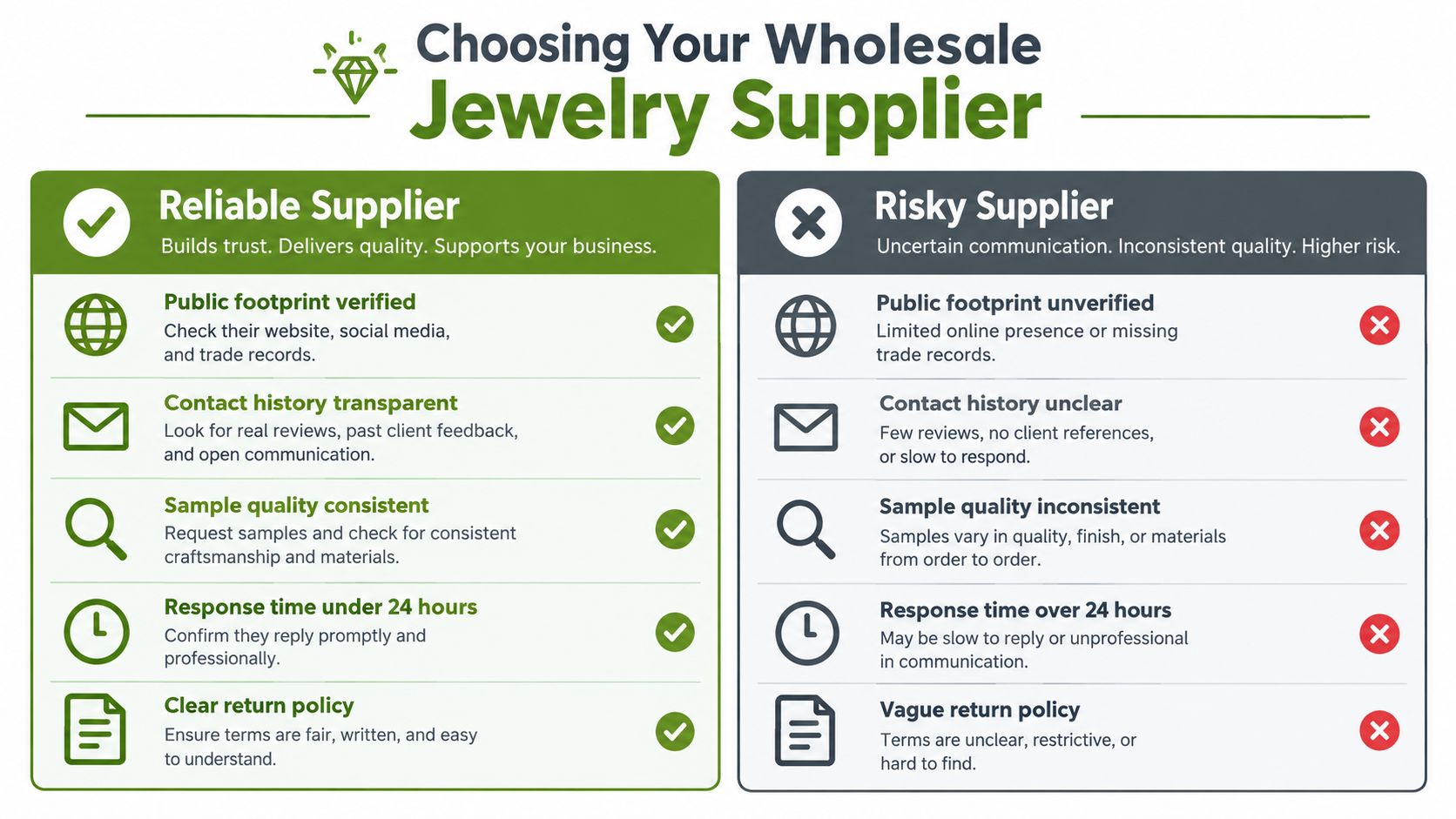
Supplier problems rarely begin with a dramatic failure. They start with small ambiguities: “stainless steel” without a grade, “gold plated” without a base metal, a quote that excludes freight, or a sample that is approved without recorded dimensions. Those gaps become harder to resolve after payment.
A dependable supplier makes the buying decision easier to audit. The company name on the quotation matches the payment recipient. Product claims are written at SKU level. The sample can be traced to an approved specification. MOQ, lead time, shipping basis, and defect remedies are clear enough that both sides know what happens next.
| Check before ordering | Evidence to keep | Stop or clarify when |
|---|---|---|
| Business identity | Company details, quotation, invoice, and payment instructions | The beneficiary or company name changes without a documented explanation |
| Product specification | SKU, base metal, finish, dimensions, components, packaging, and claim support | The answer stays at category level or changes between messages |
| Sample | Approval record, photos, measurements, and revision notes | The supplier cannot confirm that bulk production will follow the approved version |
| Commercial terms | Quantity, unit price, tooling, sample cost, payment stages, and defect remedy | Important costs or remedies remain verbal |
| Shipment | Incoterm, named place, shipping method, documents, and estimated handoff date | Two quotes use different delivery responsibilities but are presented as comparable |
Set your buying brief before you browse
Write the brief before requesting catalogs. It should name the customer, intended retail range, product categories, material preferences, expected wear situation, packaging needs, target launch window, and the most you can afford to hold in unproven inventory.
Give each style a role: core replenishment, seasonal test, coordinated set, or custom hero product. This prevents a broad catalog from turning into a scattered first order. It also helps you decide whether ready stock is enough or whether OEM/ODM development solves a real product problem.
Track at least these fields in one comparison sheet:
- Customer and price position: who will buy the piece and what retail range fits the store.
- Exact SKU: category, dimensions, weight, base material, finish, components, color, and packaging.
- Assortment role: core style, small test, seasonal item, or custom development.
- Order structure: quantity per style, color and size, sample cost, tooling, and reorder minimum.
- Timing: sample, approval, production, dispatch, transit, customs, and receiving inspection.
One third-party ecommerce article cites a 1.19% jewelry conversion figure. Treat that as the source's directional context, not as a forecast or a benchmark for your store; channel mix, price point, traffic quality, returns, and product presentation can change the result substantially. Corso's guidance on jewelry returns and ecommerce conversion is useful mainly as a reminder to budget for returns and test demand before increasing inventory.
Ready stock vs OEM and ODM manufacturing
Choose the sourcing model from the decision you need to make, not from which label sounds more professional.
| Model | What you are buying | Main approval point | Best fit |
|---|---|---|---|
| Ready stock | An existing style and its listed specification | Confirm the actual SKU, availability, and dispatch terms | Testing a category, launching quickly, or replenishing proven styles |
| OEM | Production to the buyer's design or technical brief | Approve the drawing, sample, specification, and production tolerance | A brand with a defined design and a reason to own the specification |
| ODM | A supplier-developed design adapted within agreed limits | Record exactly what changed from the original model | A buyer who needs differentiation without developing every detail from zero |
MOQ and lead time are not category-wide facts. Ask for the minimum for the exact style, material, color, size range, logo treatment, and packaging version. A change that looks minor on a mood board may require a separate production run or tooling step.
For HonHo custom development, the currently published planning figures are 50 pieces per style and color, 25–30 days for brass and 925 silver samples, 25–35 days for stainless steel samples, and 35–45 days for bulk production after sample and specification approval. These are custom-development parameters, not specifications for every ready-stock SKU. Confirm the quotation and current schedule for the project you are ordering. For the process in more detail, see custom stainless steel jewelry manufacturing.
Match material claims to evidence
A polished photo tells you very little about the underlying material. Ask for a written, SKU-level description and keep it with your purchase record.
| Material or finish | What to confirm | What not to assume |
|---|---|---|
| Stainless steel | Grade if claimed, construction, finish, components, and any coating | That every steel item is 316L or has the same wear performance |
| Brass | Base metal, finish process, color target, and care limits | That “gold plated” means solid gold or identifies the plating method |
| 925 sterling silver | Alloy declaration, marks, responsible party, components, and supporting records | That a 925 stamp alone proves the full product description |
| Stones, pearls, and enamel | Natural, laboratory-grown, imitation, glass, shell, or other composition | That a design name identifies the material |
Claims such as “hypoallergenic,” “nickel-free,” “waterproof,” or “tarnish-free” need evidence and a defined scope. A supplier statement, laboratory result, or spot reading may answer one question without proving every claim about a finished item. A sample that passes inspection also does not guarantee that every unit in a bulk run will match it.
The U.S. FTC Jewelry Guides focus on truthful representations of metallic content, quality, treatment, origin, durability, and other product characteristics. The consumer-facing explanation of common precious-metal marks is available in The FTC's guide to buying platinum, gold, and silver jewelry. Buyers selling in the United States should also review the FTC Jewelry Guides and obtain market-specific advice where needed; a supplier document is an input to compliance, not a blanket approval.
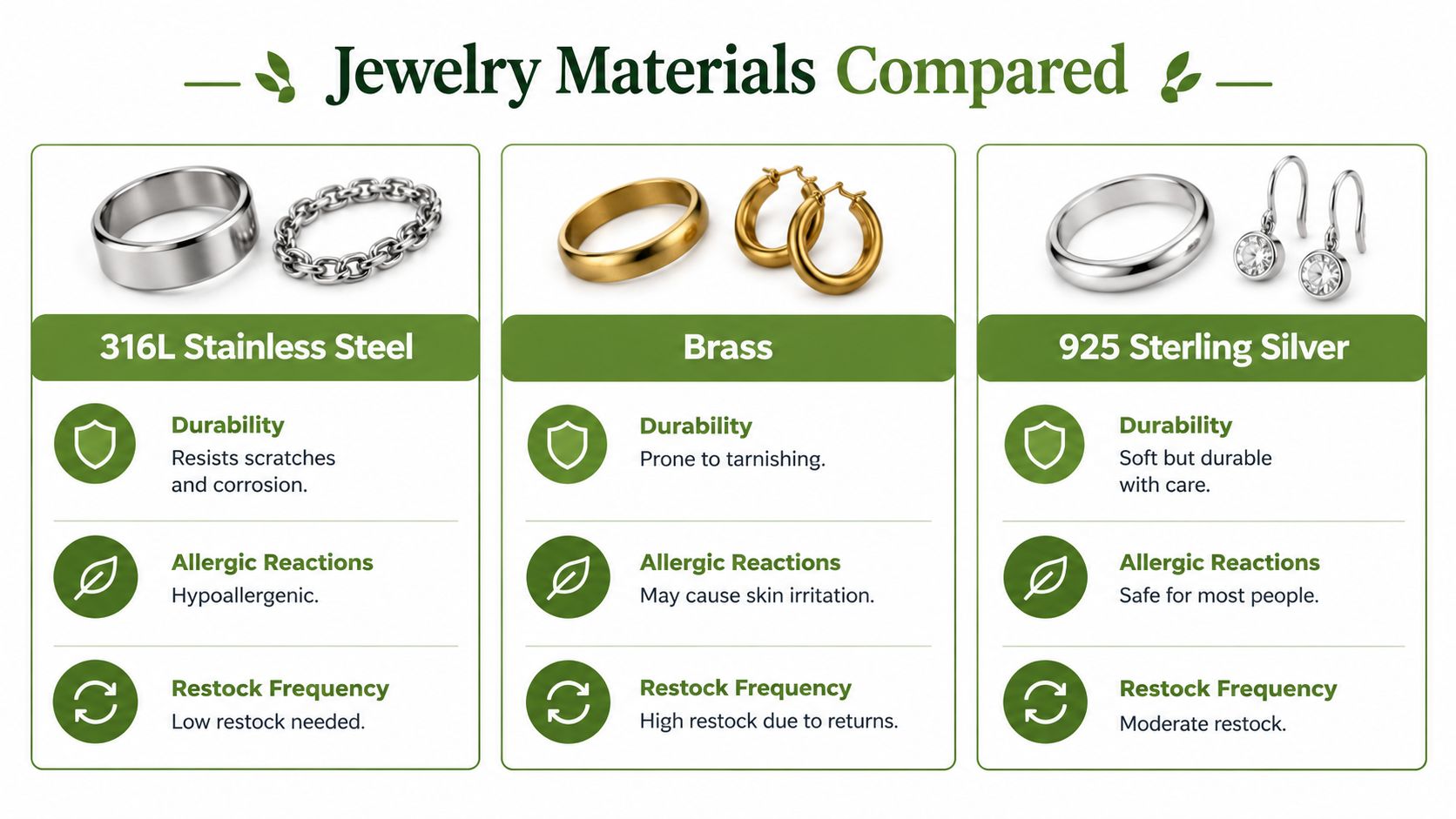
For plated jewelry, separate the base metal from the decorative finish and any performance claim. Ask what process is used, what can be measured, and whether the quoted specification applies to this order. HonHo's overview of gold PVD coating explains why PVD, electroplating, layer structure, and finished-product performance should not be treated as interchangeable.
A supplier-vetting workflow you can score
Use a short sequence and record the result. It is more reliable than collecting impressions across chat threads.
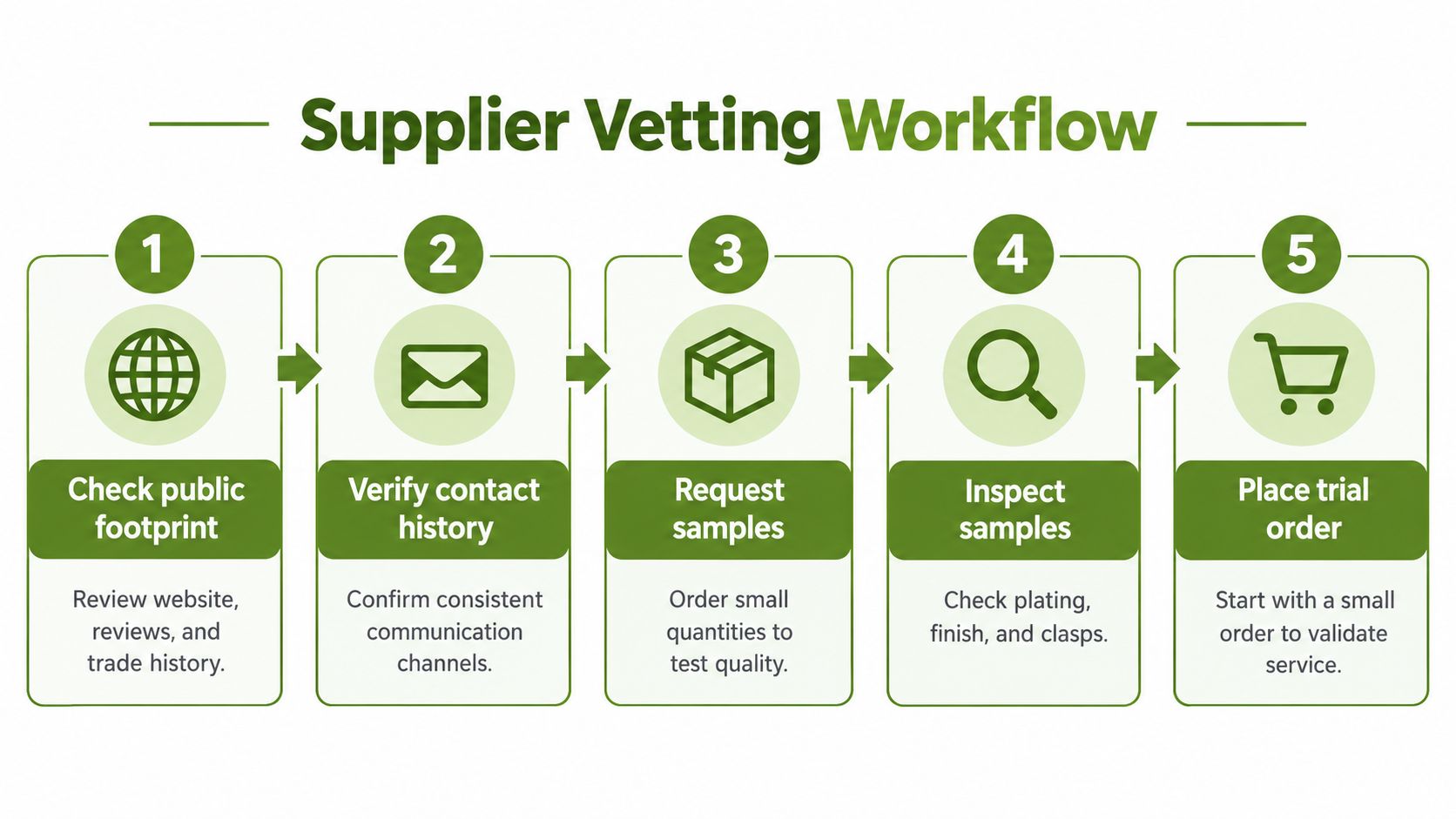
- Verify identity and payment details. Match the business name across the website, quotation, invoice, and beneficiary information. Pause if the recipient changes, payment instructions arrive from a new channel, or staff pressure you to pay before the discrepancy is explained.
- Send one normalized RFQ. Give every supplier the same SKU specification, quantity by variant, packaging request, destination, and requested shipping basis. Ask them to separate unit price, sample cost, tooling, packaging, freight, and other charges.
- Test the answers. Ask about MOQ, sample revisions, bulk tolerances, defect reporting windows, replacement or credit terms, and the documents supplied. Generic reassurance is not an answer to a specific question.
- Review claim support. Match each material, finish, or safety claim you plan to publish to a document for the relevant SKU and market. Record what the evidence does and does not establish.
- Approve a sample, then place a controlled trial order. Keep the approved sample or a signed specification as the reference. Limit the first order to a quantity you can inspect, sell, and learn from without relying on an optimistic forecast.
Score finalists only after defining non-negotiable failures. A clear scale is enough: pass when evidence meets the requirement, clarify when a document or term is incomplete, and stop when identity, payment, or product information conflicts and remains unresolved. Do not let a strong catalog compensate for a stop condition.
| Decision area | Pass evidence | Common clarification |
|---|---|---|
| Identity and payment | Names and instructions align across documents | Different trading and legal names are documented |
| Specification | SKU-level material, finish, dimensions, components, and packaging | A component or tolerance still needs confirmation |
| Sample control | Approved version and changes are recorded | The bulk reference has not been named |
| Commercial terms | Costs, MOQ, timing, payment stages, and remedies are written | A fee or defect window is missing |
| Delivery | Named Incoterm, place, method, documents, and responsibility split | The shipping quote uses a different basis |
Responsible sourcing deserves the same discipline. The OECD guidance provides a risk-based framework for mineral supply chains; it does not turn a single certificate into proof that every risk has been resolved. Use the OECD minerals due-diligence guidance to structure questions about supply-chain policy, risk identification, mitigation, reporting, and follow-up.
Inspect the sample against the written brief
A sample is not a beauty check. It is evidence of whether the supplier can translate a specification into a sellable piece.
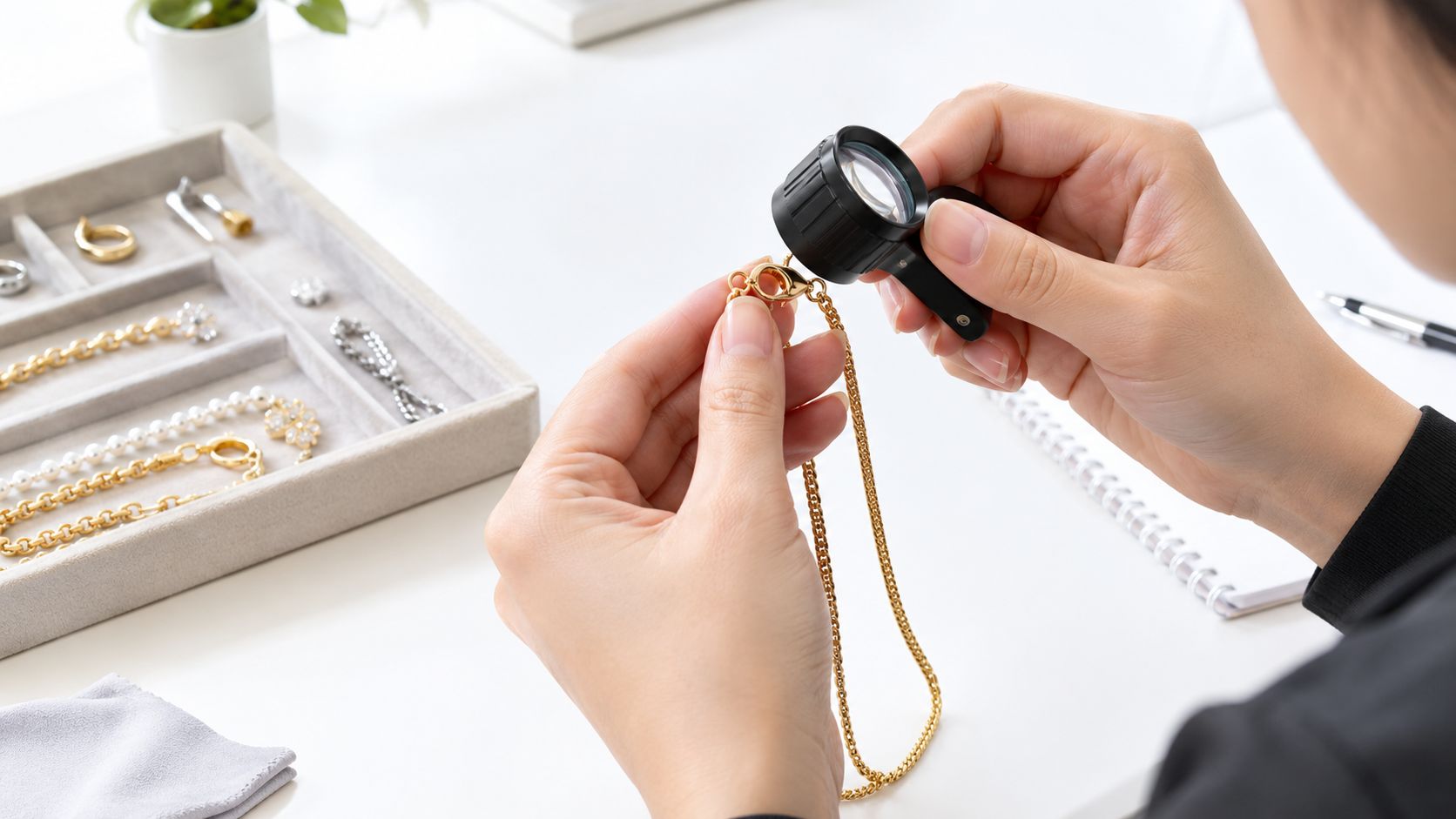
Use the same record for every style:
- Identity: SKU, revision, color, size, and date received.
- Dimensions and weight: measured values beside the agreed specification and tolerance.
- Finish: color consistency, coverage on edges and recesses, visible scratches, pits, or residue.
- Construction: joints, solder points, stone security, chain movement, clasp operation, posts, and backs.
- Wear contact: sharp edges, snag points, balance, fit, and parts that rub against skin or fabric.
- Packaging and labeling: SKU accuracy, protection in transit, marks, and inserts.
- Evidence: photos, measurements, documents, questions, supplier answers, and the final decision.
If you use XRF or another material check, state what was measured and where. A spot reading is not automatically a full composition report, a coating-thickness measurement, or a durability test. Likewise, a visual sample approval cannot establish a service life. Define the test, its acceptance limit, and its limitation before using the result in a buying decision.
Mark the outcome approve, revise, or reject. If you approve, identify the sample or signed specification that bulk production must follow. If you revise, list each change and require a new confirmation. HonHo's jewelry sample approval checklist provides a reusable record for this step.
Compare landed cost, not headline unit price
Two quotes are comparable only when they cover the same product and delivery responsibilities. Normalize the base material, finish, dimensions, components, quantity, packaging, tooling, sample cost, payment fees, and shipping basis first.
| Calculation | Include | Why it matters |
|---|---|---|
| Landed cost per sellable unit | Product, packaging, inbound freight, duties or taxes where applicable, and inspection loss | Shows the inventory cost that actually reaches your shelf |
| Variable selling cost | Payment and marketplace fees, outbound packaging, shipping support, returns, and discounts | Prevents gross margin from being mistaken for contribution |
| Cash exposure | Deposits, balance payment, lead time, variant count, and reorder minimum | Shows how long cash is committed before sales data exists |
Keystone pricing simply doubles cost. A $10 cost and $20 selling price produce $10 of gross profit and a 50% gross margin before variable selling and operating expenses. A secondary article discusses jewelry-store margin benchmarks, but such figures depend on accounting treatment, store type, product mix, and period. Use The jewelry-pricing discussion from AJ Luxe as background, not as a target for your business.
Variant multiplication is the quiet risk. One design across three finishes and five ring sizes is fifteen inventory positions, even if the supplier describes it as one style. Model the cash and expected sell-through by variant. For a category-specific example, see HonHo's wholesale guide to sterling silver rings.
Order rule: Set the retail price from landed cost and selling expenses, then test whether the remaining contribution still works after a realistic discount, return, or defect allowance.
Build the full launch timeline
A production estimate is not a delivery date. Your calendar may also need design confirmation, sample revision, approval, bulk production, pre-shipment inspection, handoff to the carrier, transit, customs clearance, receiving inspection, photography, and product-page preparation.
HonHo currently states that ready-stock orders usually ship within three business days after payment confirmation. For custom work, the published planning ranges are 25–30 days for brass and 925 silver samples, 25–35 days for stainless steel samples, and 35–45 days for bulk production after sample and specification approval. Confirm stock, project scope, the start point for each range, and destination transit before publishing a launch date.
Agree on shipment terms before payment
Put the Incoterm and named place on the quotation or purchase order. Incoterms allocate specified delivery tasks, costs, and risks between buyer and seller; they do not replace the product specification, payment terms, title transfer, or defect agreement. The ICC Incoterms overview explains the scope of the rules.
Before release, confirm who books transport, pays each charge, arranges export and import formalities, carries insurance where applicable, and supplies the commercial invoice, packing list, origin or material documents, and tracking or transport record. Name the person responsible for resolving a document mismatch.
Keep the purchase order, approved specification, sample record, invoice, packing list, shipping documents, material declarations, test records, and receiving inspection together. Compare the goods with those records before distributing stock.
Questions to settle before the first order
What if the supplier will not provide every requested document?
Decide whether the missing evidence affects a claim, a legal requirement, or a commercial preference. Narrow the product claim or stop the order when the evidence is essential. Do not turn an unanswered question into an assumption.
Does one good sample prove the supplier is reliable?
No. It proves only what that sample and the recorded process establish. Use a controlled first order, define bulk acceptance checks, and compare the shipment with the approved reference before increasing quantities.
When should you choose ready stock instead of custom production?
Choose ready stock when speed, small-scale assortment testing, and an existing specification matter most. Choose custom development when a documented design, finish, dimension, logo, or packaging requirement creates enough value to justify sampling, approval, MOQ, and production coordination.
For a practical assortment review, HonHo's stainless steel wholesale collection can help you compare ready-stock options before deciding whether custom development is necessary.
Send an RFQ that can be answered clearly
Include the product category, reference or drawing, target material and finish, dimensions, components, quantity by style and color, packaging, logo requirements, destination, requested shipping basis, claim or testing requirements, target timing, and the questions that must be answered before sampling.
Browse HonHo Wholesale Jewelry for ready-stock stainless steel, brass, and 925 silver jewelry. For OEM, ODM, or private-label work, send the specification and target quantity so the team can confirm feasibility, MOQ, sampling, pricing, and timing for the actual project.


