

For a first wholesale sterling silver ring order, confirm four things before choosing styles: the 925 material claim, any plating or coating, the size and weight specification, and the finished-sample checks you will use for approval. Then price from landed cost and start with formats that fit your customer rather than relying on a universal “best-selling” mix.
Sterling silver can give retailers a clear precious-metal story without moving into solid-gold price territory. The trade-offs are real: silver can tarnish, plated finishes can wear differently from unplated sterling, fixed sizes create inventory complexity, and a 925 stamp does not prove every part or every compliance requirement. A useful buy therefore starts with a written specification and a representative sample, not the product photo alone.
Use this guide to choose a material and finish, compare ring formats, build a landed-cost model, and write a sample approval record. You can review the current offer on HonHo Jewelry Wholesale's 925 sterling silver rings page, then ask for the exact SKU or custom-order specification before committing to quantity.
Table of Contents
- Introduction to Wholesale Sterling Silver Rings for Resale
- What 925 Sterling Silver Means for Wholesale Rings
- Solid Sterling Silver Versus Plated and Mixed Metal Finishes
- Pricing and Markup Strategies for Sterling Silver Rings
- Inventory Planning With Stackable Adjustable and Minimalist Rings
- How to Source and Verify Wholesale Sterling Silver Rings
- Conclusion and Next Steps for Your Ring Assortment
Introduction to Wholesale Sterling Silver Rings for Resale
A retailer is not simply deciding whether silver is attractive. The practical decision is whether a ring's construction, size plan, finish, and economics are appropriate for the intended sales channel. A design that works as an adjustable boutique add-on may be a poor choice for a fixed-size marketplace listing, while a giftable stone-set ring may need more packaging and inspection than a plain band.
Why this category makes sense for resale
Sterling silver is familiar to many shoppers and gives product pages a specific material proposition. It can support everyday bands, stackable styles, open adjustable rings, and more detailed gift designs without changing the base-material story. That consistency can make merchandising and reordering simpler.
It is not automatically the right material for every price point or use case. Unplated sterling can tarnish and may need polishing; a rhodium or gold finish changes the wear and care discussion; stones and settings add inspection points; and ring sizes can fragment inventory. Those are manageable issues when they are written into the specification and product copy.
Buying principle: Choose the ring whose material, finish, size plan, and care expectations you can describe accurately in one product page—and reproduce in the next order.
What this guide helps you decide
| Decision | Confirm before approval | Why it matters |
|---|---|---|
| Material | 925 sterling silver body, component exceptions, solder, and any mixed-metal parts | The stamp and the full construction are not the same thing. |
| Finish | Unplated, rhodium-finished, gold-finished, oxidized, or another coating; target color and thickness if applicable | Finish affects appearance, care copy, inspection, and repeat-order consistency. |
| Fit | Fixed sizes or adjustable range, inner diameter/circumference, band width, profile, and sample weight | Fit drives variant count, comfort, and return risk. |
| Quality checks | Surface, dimensions, setting security, markings, and any destination-market test documents | A repeatable approval record is more useful than “looks good.” |
| Economics | Unit quote, packaging, freight, duties/taxes where applicable, payment costs, return allowance, and promotion plan | The supplier price is only one part of landed cost. |
If the answers are incomplete, use a sample to close the gaps before setting a retail price or committing to a size run. For a current category reference, return to HonHo Jewelry Wholesale's 925 sterling silver rings page.
What 925 Sterling Silver Means for Wholesale Rings
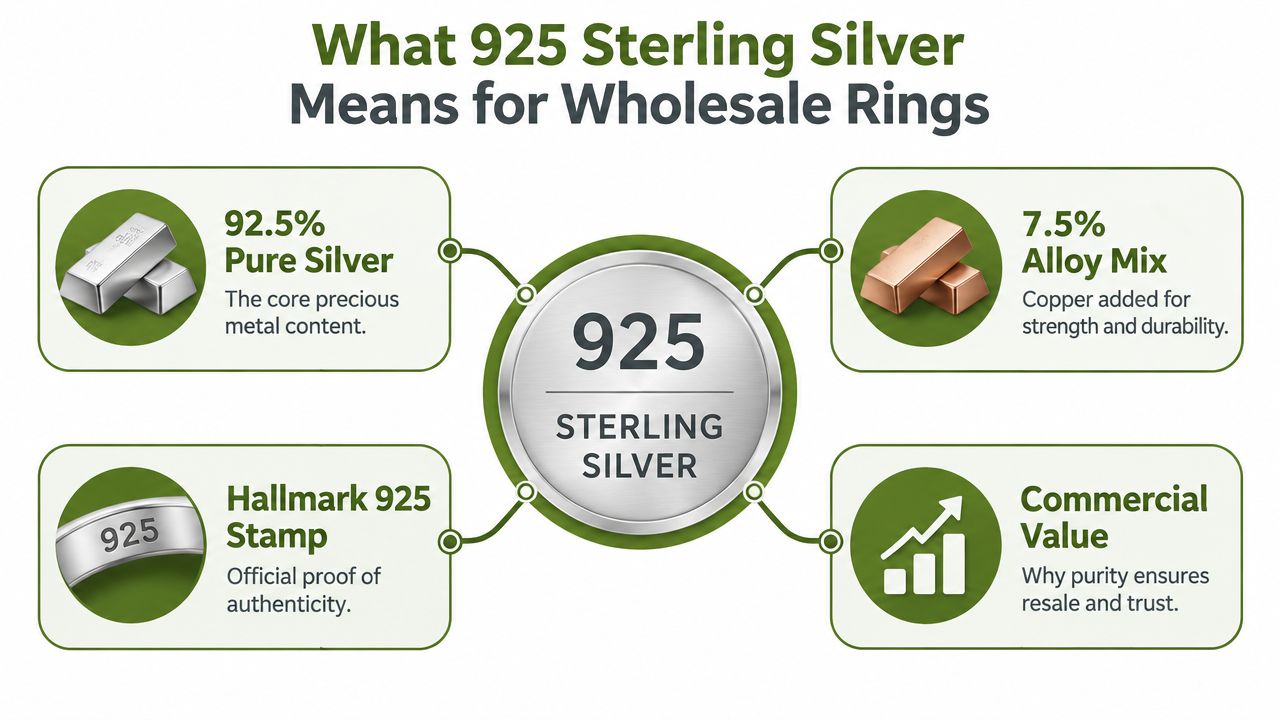
A 925 claim refers to silver fineness: 925 parts per thousand, or 92.5% silver, in the alloy. The balance consists of other alloying metals, but the exact recipe should not be assumed from the stamp alone. “925 sterling silver” describes the body material; it does not, by itself, describe a plating layer, stone setting, solder composition, coating, or every decorative component.
Why the alloy matters in production
Pure silver is relatively soft, so sterling alloys are used to improve the practicality of a ring while retaining a high silver content. Geometry still matters: a very thin open band behaves differently from a wide solid band, and repeated adjustment can fatigue a design even when the material claim is correct.
Sterling silver can tarnish through chemical reactions at the surface. Packaging, storage conditions, contact with chemicals, skin chemistry, and the chosen finish can all influence appearance. A care instruction can reduce misunderstandings, but it is not a substitute for checking how the representative finished sample responds to handling and storage.
Why the hallmark has commercial value
A hallmark or 925 stamp is useful for identification and customer communication, but buyers should treat it as one item in the evidence set rather than the entire verification process. Britannica's metallurgy overview provides background on sterling silver and its established fineness convention.
For procurement, match the material description on the quote, sample approval, packaging label, and product page. If a component differs from the sterling body, record that exception instead of letting “925” stand in for the whole construction. This also makes repeat-order conversations more precise.
For a broader comparison of commonly used jewelry materials, review HonHo Jewelry Wholesale's materials guide before finalizing the specification.
Solid Sterling Silver Versus Plated and Mixed Metal Finishes
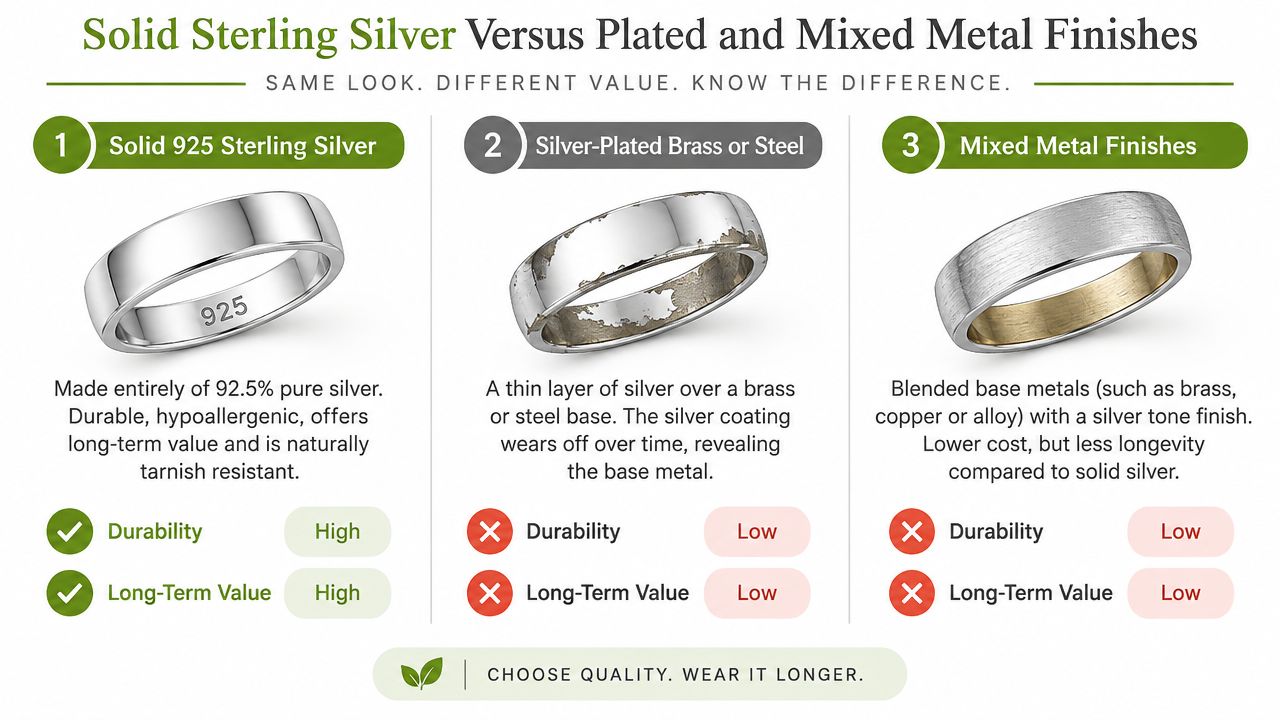
Material and finish answer different questions. A ring may have a sterling silver body and also carry rhodium, gold-color, or another surface finish. A silver-plated base-metal ring is not the same construction as a sterling silver ring, even if both look silver-colored in a photograph.
How the three formats behave
| Format | What the buyer should specify | Useful when | Limitation to disclose |
|---|---|---|---|
| Unplated 925 sterling silver | Fineness claim, dimensions, weight, surface finish, marking, and care | A clear sterling-silver proposition and a finish that can be repolished | Tarnish and small surface marks can occur; care expectations matter. |
| 925 sterling silver with a surface finish | Body material plus finish type, target color, thickness or process when relevant, and approved color sample | Rhodium-, gold-, black-, or other finish-led assortments | Surface wear depends on the full construction and use; “925” does not describe the coating. |
| Silver-plated base metal | Base metal, plating specification, underlayers, finished-item tests, and accurate labeling | A different cost or fashion position where the construction is clearly disclosed | The silver-colored layer can wear and should not be marketed as solid sterling silver. |
Oxidized and mixed-finish designs can add useful variety, but keep them as clearly labeled finish stories. External trend material such as ELF925's trend forecast can inspire a color or styling hypothesis; it does not prove demand for a specific HonHo SKU or a specific retailer's audience.
Sample decision: Approve a finish against a physical master sample or agreed color reference, then keep that reference for the reorder. A finish name alone is rarely precise enough.
Compliance and skin-contact questions
A 925 stamp is not a nickel-release result. Destination-market rules may apply to a finished ring intended for direct and prolonged skin contact, and solder, underlayers, plating, settings, and decorative parts can affect the finished article. The existing discussion in Formblends' nickel and sterling silver guide is useful background, but procurement evidence should come from the requirements and test scope agreed for the market where the ring will be sold.
Ask which finished SKU was tested, the method or standard used, the laboratory, the date, and whether the tested construction matches the order. A report for a different plating system, component, or production route should not be treated as evidence for the current ring. An XRF reading can help screen elemental composition or, with suitable calibration, some coating systems; it does not by itself demonstrate nickel release, forecast years of wear, or prove every unit in a batch.
For finish terminology and specification questions, use HonHo Jewelry Wholesale's plating guide as a starting point, then confirm the individual SKU or custom-order details in writing.
Pricing and Markup Strategies for Sterling Silver Rings
A useful retail price starts with landed unit economics and the position of the design. Supplier price, packaging, inbound freight, duties or taxes where applicable, payment fees, marketplace fees, promotion allowances, and expected returns can all change the margin. That is why a universal markup multiple is a weak substitute for a channel-specific model.
Why common markup bands are only a starting point
Honho Jewelry's pricing guide and Erawan Atelier's pricing article describe common industry pricing approaches. Keep them as reference points, not as proof that a particular multiple will cover your costs or match what your customer will pay.
| Cost or decision | Record per sellable unit | Question to answer |
|---|---|---|
| Product and customization | Quoted unit price plus molds, engraving, or finishing allocated across the order | What changes when quantity, size mix, or finish changes? |
| Packaging and inbound logistics | Box or pouch, labeling, freight, insurance, duties, and handling | What is the true landed cost at the receiving location? |
| Sales channel | Payment, platform, fulfillment, and commission costs | Does the same SKU need a different price by channel? |
| Commercial allowance | Planned discount, return allowance, service, and unsold-risk provision | Does the normal selling price still meet the target margin? |
How to use the numbers without overcomplicating buying
Build the model for one ring and one channel first. Compare the normal selling price, a realistic promoted price, and the break-even point. Then test whether the customer-facing differences—material, finish, design complexity, packaging, or giftability—support the price gap between styles.
Pricing rule: Do not approve a ring because the quote fits a familiar markup. Approve it when the landed-cost model, likely selling price, and reorder terms work together.
HonHo's public HonHo Jewelry Wholesale's MOQ and pricing page explains that custom production starts from 50 pieces per style and color and that quotes depend on the specification. Treat that as a custom-development capability, not as a promise that every ready-stock SKU, finish, or size has the same terms; confirm the current quote for the actual order.
Inventory Planning With Stackable Adjustable and Minimalist Rings
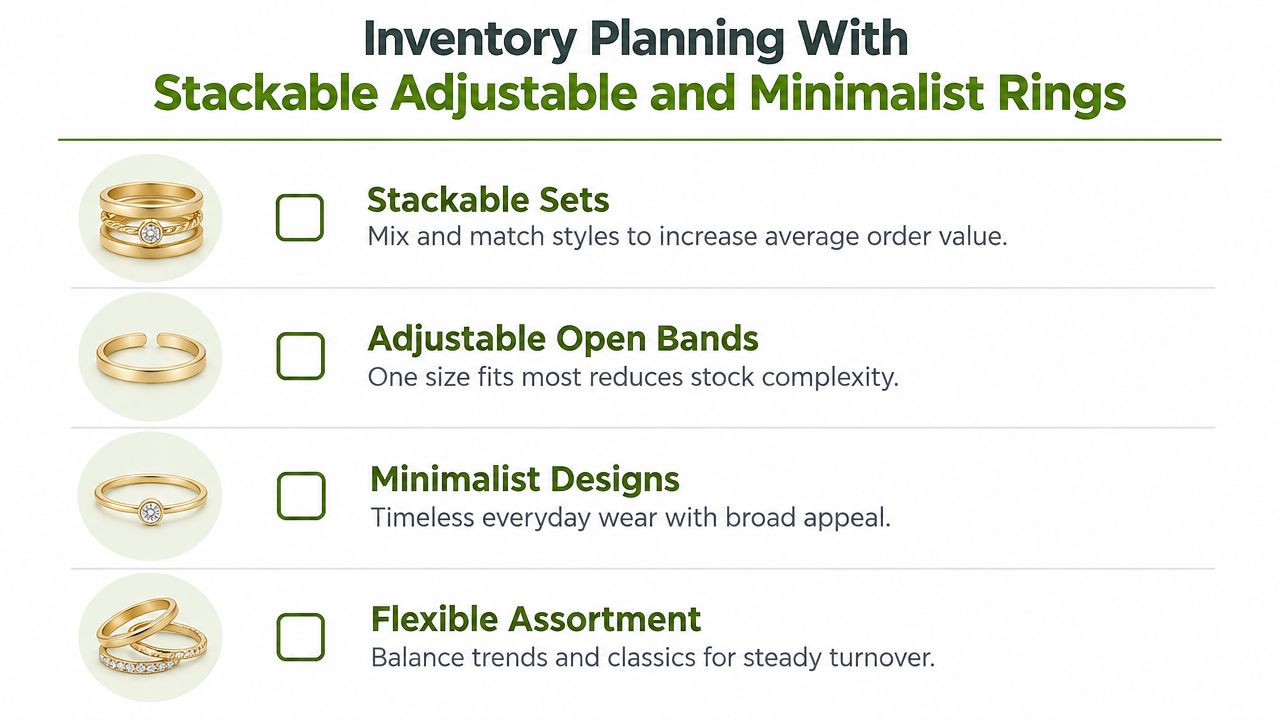
Stackable, adjustable, and minimalist rings can reduce some merchandising friction, but none is automatically low risk. Stackable styles need compatibility and repeatable dimensions, adjustable bands still need a stated fit range, and minimalist designs can reveal surface or symmetry defects that a more detailed design might hide.
Why flexible ring formats can lower size risk
An adjustable opening can cover a defined range and reduce the number of variants, but the supplier should state that range and the sample should be checked at both ends. Avoid promising “one size fits all.” Repeated bending can affect shape and finish, so decide whether the product is intended for a one-time fitting adjustment or frequent reshaping.
Stackable rings create cross-sell possibilities when profiles and sizes work together. Minimal bands can act as stable assortment anchors, while a smaller number of design-led rings can test new motifs or finishes. The mix should come from the retailer's own customer, sell-through, return, and reorder data—not from a universal percentage.
Market pages such as NextMSC's sterling silver jewelry market page may be useful for directional context, but a category forecast does not validate a specific design, retail price, or opening order.
How to build the assortment
- Define the role of each SKU. Mark it as a core band, stacking companion, adjustable entry style, gift design, or controlled trend test.
- Limit the variables in the first test. A broad combination of sizes, finishes, and stones can make the result difficult to interpret.
- Set reorder evidence before launch. Track sell-through by size and finish, returns by reason, and customer questions.
- Keep the sample and specification. Use them as the approval reference for replenishment rather than relying on a listing image.
For fixed-size rings, record sales and returns by size rather than looking only at total category performance. For adjustable rings, record whether customers needed help fitting them and whether reshaping affected the finish. That evidence is more actionable than a generic “best seller” claim.
How to Source and Verify Wholesale Sterling Silver Rings
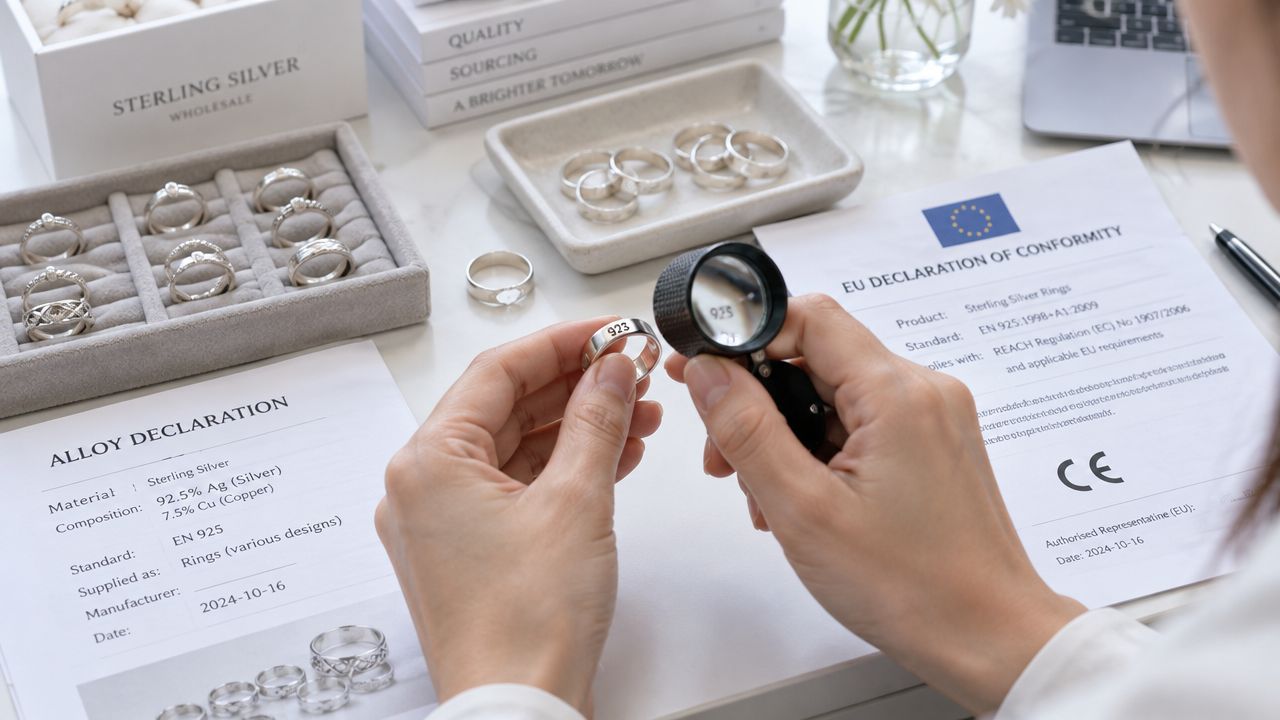
Before requesting a sample, turn the listing into a purchase specification. Name the body material, finish, dimensions, size system, weight tolerance if important, stone or decorative components, marking, packaging, and the documents required for the destination market.
What to ask for before you buy
- Construction: Is the ring body 925 sterling silver? Which parts, solder points, settings, or decorative components differ?
- Finish: Is it unplated, plated, coated, or oxidized? If plated, what process, color reference, underlayer, and measurable specification apply?
- Fit: Which sizing system is used? What are the inner dimensions, band width and thickness, adjustable range if relevant, and sample weight?
- Visual acceptance: Which surface marks are unacceptable? How will color, polish, symmetry, engraving, and stone alignment be compared?
- Mechanical checks: Are edges smooth? Does the ring sit comfortably? Are stones and settings secure under the agreed inspection method?
- Evidence: Which finished-item reports or declarations apply to this exact construction and destination market?
- Packaging: How will pieces be separated and protected against scratching and tarnish during storage and transit?
Measure the received sample instead of accepting nominal dimensions automatically. Record ring size, inner diameter or circumference, band dimensions, weight, markings, finish appearance, stone security, and packaging. XRF or coating-thickness readings can support specific questions when performed with appropriate equipment and calibration, but record the method and limitation; do not convert a screening result into a blanket durability or compliance claim.
Planning around supplier operations
The current HonHo sterling-silver ring collection describes custom production from 50 pieces per style and color, 925 silver samples in 25–30 days, and bulk production in 35–45 days. These are public planning ranges for the custom route, not specifications for every ready-stock SKU or a guarantee for an unquoted project. Confirm material, finish, size mix, packaging, price, sample charge, production timing, and freight in the current quotation.
Use HonHo's sample approval checklist to structure the approval. Photograph the sample under consistent lighting, keep the approved measurements and notes, and identify who approves any deviation. If a design is later developed with engraving, packaging, or a new finish, treat that custom capability as a new specification rather than assuming the original sample covers it.
Questions buyers should settle before the purchase order
Is 925 sterling silver the same as silver-plated?
No. A 925 claim describes the fineness of a sterling silver alloy. “Silver-plated” describes a silver-colored surface layer over another base material. A sterling ring can also carry an additional finish, so ask for both the body material and the surface construction.
Does a 925 stamp prove the ring is nickel-safe?
No. The stamp does not establish nickel release or prove compliance for every destination market. Confirm the finished construction, the applicable requirement, and the scope of any test document.
Do adjustable rings eliminate size returns?
No. They can reduce variant complexity, but only within a stated fit range. Check comfort, the intended adjustment method, gap position, shape recovery, and finish at both ends of the approved range.
What should be locked before a reorder?
Keep the approved sample or master reference, written construction, finish and color reference, dimensions, size mix, markings, packaging, acceptance checks, and any applicable test-document scope. Reconfirm changes before production.
Conclusion and Next Steps for Your Ring Assortment
A disciplined first order is more useful than a large speculative assortment. Separate 925 fineness from finish, state the size strategy, model landed cost, approve a representative sample, and define the evidence needed for the destination market. Then use actual sell-through, size-level returns, and reorder behavior to decide which styles deserve depth.
When you request a quote, send the intended sales market, body material, finish, sizes or adjustable range, target quantity by style and color, packaging, sample checks, and delivery destination. That gives the supplier enough information to distinguish a standard item from custom development and reduces ambiguity before payment.
HonHo Wholesale Jewelry supplies sterling silver and other wholesale jewelry options for boutiques, online stores, and resellers. Visit HonHo Wholesale Jewelry and include your ring specification, target quantity, market, and delivery destination in the B2B inquiry so the team can quote the relevant route.


