

Buying wholesale stainless steel jewelry is not a choice between the lowest quote and the most polished product photo. The useful decision is whether a supplier can tie each SKU to a clear alloy, component list, finish, sample, acceptance standard, and destination-market document.
For a resale test, shortlist a narrow assortment, approve physical samples, and price from landed cost. For private-label work, freeze the specification before bulk production. This guide shows what to request, what common test results can and cannot prove, and how to keep a reorder consistent.
Table of Contents
- Why Stainless Steel Is the Smart Choice for Resale
- Understanding 316L Stainless Steel Grade
- Comparing Materials for Your Collection
- Vetting Your Wholesale Supplier
- Pricing, Markup, and Inventory Strategy
- Navigating Compliance and Safety Standards
- Final Steps From Sample to Shipment
Why Stainless Steel Is the Smart Choice for Resale
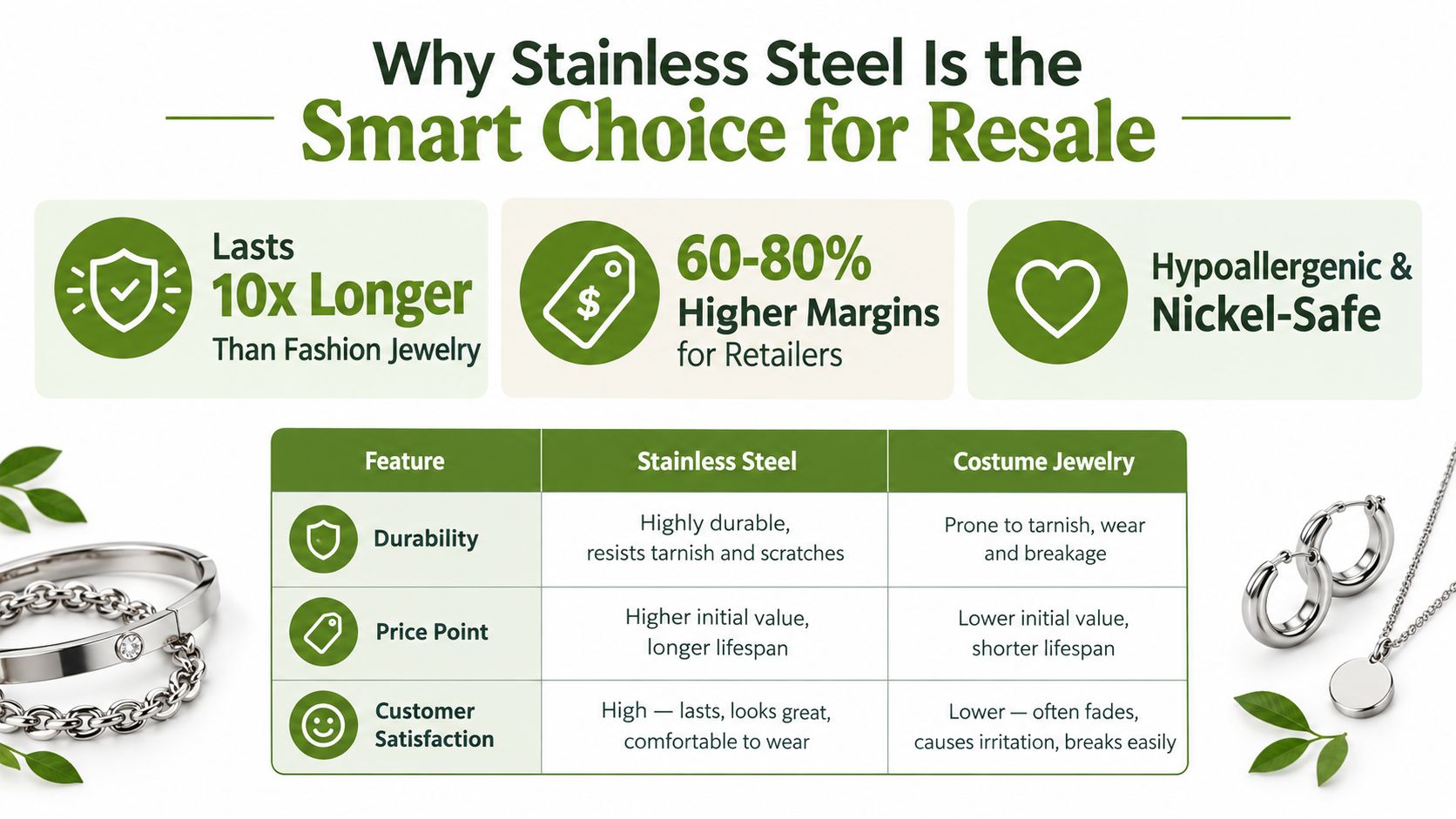
Stainless steel can support an everyday jewelry range because it combines useful strength, corrosion resistance in many ordinary environments, and a relatively low-maintenance customer proposition. Those advantages still depend on the grade, construction, surface finish, care conditions, and quality control of the finished piece.
| Decision | Confirm before ordering | Why it matters |
|---|---|---|
| Material | Grade for the body and for posts, clasps, backs, jump rings, and charms | One grade claim may not describe every component. |
| Finish | Polish, plating or PVD process where applicable, color reference, and wear zones | The base alloy does not prove coating thickness, adhesion, or color consistency. |
| Sample | Dimensions, weight, function, comfort, surface condition, and packaging | A photograph cannot confirm tolerances or moving parts. |
| Evidence | Report scope, test method, sample or batch identity, laboratory, and date | A generic certificate may not apply to the SKU you receive. |
| Commercial plan | Ready stock or custom, MOQ, confirmed timing, freight basis, and defect remedy | These terms determine cash exposure and reorder reliability. |
Stainless steel has a long manufacturing history; Sheffield's archive on Harry Brearley and stainless steel records the material's Sheffield origins. That context explains the alloy family's development, but it is not evidence for a modern jewelry SKU. A buyer still needs product-specific documentation and inspection.
The material is suitable for rings, hoops, chains, pendants, cuffs, and bracelets when the construction matches the use case. Describe it precisely: “stainless steel” or “316L stainless steel” is a material statement, not a promise that a finished item is waterproof, rust-proof, or suitable for every wearer.
Why the supply base matters
Interfax's report on 2024 stainless-steel production describes the scale and concentration of upstream stainless-steel production. Those industrial totals help explain why Asian manufacturing clusters offer deep component and finishing supply, but they do not forecast demand for a jewelry design or prove the quality of a supplier.
For a first order, use a few repeatable shapes to test material descriptions, comfort, finish consistency, customer care questions, and replenishment. The wholesale jewelry guide for boutiques helps place that test in a broader assortment plan instead of treating every trending style as an automatic buy.
Understanding 316L Stainless Steel Grade
“Stainless steel,” “surgical steel,” and “marine grade” are not interchangeable specifications. If 316L is part of the retail claim, ask the supplier to identify the exact grade for the main body and every skin-contact component, then relate the evidence to the product or production lot.
The existing Stainlessinox technical data for 316L and related grades lists chemistry for 316L and related grades. Independent design guidance from worldstainless explains the purchasing distinction: Type 316 contains 2–3% molybdenum and generally has better resistance than Type 304 in chloride environments that can cause pitting. Actual performance still depends on environment, fabrication, surface condition, cleaning, and time.
That distinction can matter at clasp recesses, hinge gaps, engraving channels, chain joints, and other places where moisture or residue can remain. It does not mean every 316L component is identical, nor does it turn a base-metal grade into proof of a plated finish.
What the low-carbon formulation changes
The “L” denotes a lower-carbon version of 316. The difference is most relevant where a component is welded or otherwise heated because lower carbon reduces the risk of sensitization around heat-affected areas. For cast, machined, welded, and assembled jewelry, the supplier should therefore state both the grade and the manufacturing route.
316L is corrosion-resistant, not corrosion-proof. Chlorides, trapped residue, aggressive cleaners, high temperatures, rough finishing, contamination, or crevices can still create problems. Treat “never tarnishes,” “rust-proof,” and “safe for everyone” as unsupported unless the wording is narrowed to evidence you can verify.
For colored pieces, approve the base alloy and the finish separately. Record the color target, process, surface preparation, coverage, and high-contact zones such as ring interiors, clasp faces, chain edges, and bracelet corners.
Before approving a collection, request:
- Exact designation: the grade used for the body and for each functional or skin-contact component.
- Traceability: a material declaration, mill certificate, or other batch evidence where available, with a clear link to the supplied item.
- Construction detail: whether posts, backs, clasps, jump rings, chains, soldered areas, and charms differ from the main body.
- Surface specification: polish, plating, PVD where applicable, enamel, resin, or other treatment, plus the approved color reference.
- Finished-piece checks: dimensions, burrs, hinges, clasps, edges, stone security, coating coverage, and visible wear zones.
Use the 316L stainless steel jewelry collection to shortlist styles, then confirm SKU-level details. HonHo's ability to develop a custom specification does not mean every ready-stock item uses the same grade, coating stack, or test route.
Comparing Materials for Your Collection
A coherent catalog can mix stainless steel, brass, and 925 sterling silver. Choose by customer expectation, design geometry, finish, care message, and documentation—not by a generic “better material” ranking.
| Material route | Useful when | Confirm on the sample and quote | Important limit |
|---|---|---|---|
| 316L stainless steel | You want an everyday range with clear grade positioning and good resistance in many ordinary conditions. | All components, fabrication route, finish, wear points, and destination-market evidence. | The grade alone does not prove nickel release, coating life, or finished-piece performance. |
| 304 stainless steel | The design and expected environment do not require the added chloride-pitting resistance associated with 316. | Component grade, use environment, finish, and customer care. | Do not relabel it as 316L; keep material descriptions SKU-specific. |
| Brass | You need fashion-led shapes, detailed castings, or a different base for a plated collection. | Alloy, plating stack, color, coating checks, and care wording. | Base metal and surface finish must be described separately. |
| 925 sterling silver | Material identity is central to the customer's search, gifting, or price position. | Fineness evidence, component construction, finish, and tarnish-care information. | Sterling silver is not maintenance-free and should not be described as stainless steel. |
Match the material to the customer
316L stainless steel is a practical candidate for hoops, chains, signet rings, stackable bands, and simple pendants when repeatability and everyday positioning matter. Brass can carry larger or more experimental silhouettes. Sterling silver can serve shoppers who actively search for the material and accept its care profile.
The jewelry materials and plating guide helps separate substrate, plating, and product wording. That separation is important: a gold color can come from different processes, while a material name does not tell you coating thickness, adhesion, or expected wear.
Vetting Your Wholesale Supplier
A supplier's product page is only the starting point. The purchasing test is whether the supplier can answer one organized brief with consistent terminology, evidence tied to the item, and a clear remedy when the shipment differs from the approved sample.

Start with a written supplier brief
Send product codes, target market, order model, quantities, material, dimensions, finish, stones, logo, packaging, destination, testing needs, and target timing in one request. Ask the supplier to return a line-by-line specification rather than answering only with a price.
| RFQ field | What a usable answer contains |
|---|---|
| Material and components | Exact grade or alloy for the body, posts, backs, clasps, chain, findings, and decorative parts. |
| Finish | Process, layer sequence where relevant, color reference, coverage, and approved appearance. |
| Sample and QC | Sample type, approval points, in-process checks, final inspection, and defect classification. |
| Evidence | Document or report name, tested article, method, laboratory, date, and destination-market relevance. |
| Commercial terms | Ready-stock availability or custom MOQ, price basis, payment stages, timing, freight terms, and defect remedy. |
Do not treat a generic certificate as proof for every product. The document should identify the material, coating or construction, tested sample, method, and market for the SKU under consideration.
For HonHo custom projects, the current baseline is 50 pieces per style and color. Stainless-steel samples are usually planned at 25–35 days, and bulk production at 35–45 days after sample approval and final order confirmation. These are planning references, not unconditional delivery guarantees; tooling, revisions, testing, material availability, complexity, holidays, and shipping conditions can change a project schedule. Ready-stock availability and quantity are confirmed separately.
For private-label work, separate design approval from production approval. Confirm the logo position, dimensions, engraving treatment, packaging artwork, plating color, and sample acceptance process in writing. The custom stainless steel jewelry manufacturer resource is useful when a ready-stock test is ready to become a controlled custom line.
The embedded video provides manufacturing context, but use the written specification and SKU-specific evidence as the approval record:
Test the sample as a product, not a photograph
Handle the sample as a customer would. Check whether links catch on fabric, ring interiors have sharp edges, clasps open unintentionally, hinges align, stones move, posts bend, and plated areas show uneven color. Measure dimensions and weight instead of approving by appearance alone.
| Check | What it can tell you | What it cannot prove by itself |
|---|---|---|
| Visual and functional inspection | Color, polish, assembly, comfort, dimensions, clasp action, and obvious defects. | Alloy chemistry, nickel release, or long-term wear. |
| XRF measurement | Depending on the instrument, calibration, geometry, substrate, and layer model, it can support alloy screening or metallic coating-thickness measurement. See ISO 3497 and Fischer's jewelry measurement overview. | A universal wear-life claim or proof for every point on a complex piece. |
| Salt-spray testing | Comparative corrosion behavior under a defined artificial atmosphere when the method, duration, sample preparation, and evaluation criteria are stated. | Years of customer wear. ISO 9227:2022 defines test procedures but does not set one exposure period or a universal interpretation. |
| Wear or handling trial | Early evidence of rubbing, snagging, comfort, clasp issues, or color change under the chosen routine. | A guarantee for every customer, environment, chemical exposure, or production batch. |
Approve the sample together with its written specification. Keep photographs and measurements of high-risk areas so the incoming shipment can be compared with the same reference.
Pricing, Markup, and Inventory Strategy
A low unit price is not a low-risk order. Build the decision from landed cost, sample and testing expense, expected defect handling, reorder terms, and the amount of cash tied up in variations.
Build the retail price from the complete cost
- Landed product cost: item price, packaging, freight, duties where applicable, payment costs, and inspection.
- Channel cost: platform fees, marketplace commissions, advertising, fulfillment, returns, and customer support.
- Assortment role: evergreen replenishment, seasonal story, traffic item, gift option, or experimental design.
- Service allowance: room for occasional defects, replacements, and care questions rather than assuming every sale is frictionless.
- Reorder control: a clear specification, acceptable quantity, and repeatable lead-time plan.
U.S. Census Bureau's fourth-quarter 2025 e-commerce report provides channel-level context for U.S. online retail. It does not measure demand for stainless steel jewelry, so do not use it as a category sales forecast.
Use small tests to protect cash
Test a tightly edited assortment before expanding color, size, or custom packaging. Review sell-through, return reasons, sizing questions, finish complaints, content performance, and replenishment speed by SKU—not only total revenue.
The wholesale MOQ and pricing information distinguishes ready-stock ordering from custom development. Use the custom baseline only when it fits the project; a ready-stock test depends on the actual assortment and available quantity, not the custom MOQ.
Navigating Compliance and Safety Standards
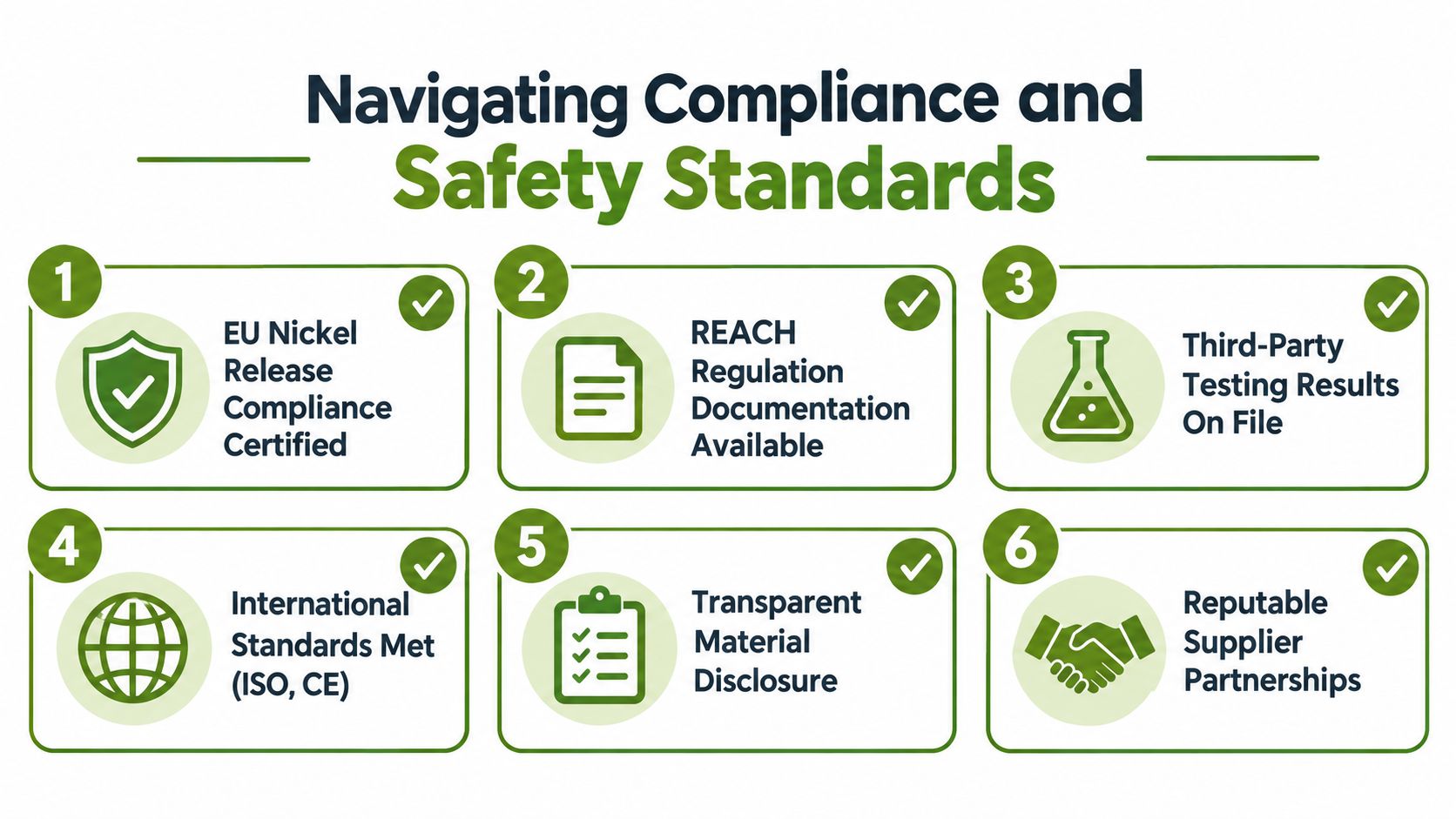
“316L,” “surgical steel,” “hypoallergenic,” and “nickel-free” are different claims. Alloy identity does not replace a finished-article compliance review, especially when a piece combines posts, backs, soldered areas, coatings, stones, or findings.
For the EU and EEA, ECHA's current Annex XVII Entry 27 conditions set a nickel-release limit below 0.2 µg/cm²/week for post assemblies inserted into piercings and 0.5 µg/cm²/week for parts intended for direct and prolonged skin contact. A non-nickel coating must keep release within the applicable limit for at least two years of normal use. Confirm the current legal scope and accepted method for the destination market rather than copying this paragraph into a product claim.
Alloy identity is only one part of the review
Request a compliance pack tied to the actual SKU:
- Product identity: exact style code, component construction, finish, and sample or batch reference.
- Test scope: report date, laboratory, method, tested article, contact areas, and destination-market relevance.
- Coating condition: confirmation that the tested sample represents the plated or colored finish customers will receive.
- Supplier declaration: material and chemical disclosures that distinguish documented facts from marketing language.
- Responsibility record: the manufacturer, importer, and retailer roles for the sales market.
A flat sample coupon does not necessarily represent a clasp gap, ring interior, engraving recess, earring post, or worn coating. Match the test specimen and contact areas to the finished product, and keep the result with the purchase record.
Avoid unsupported wording such as “completely nickel-free,” “guaranteed safe for everyone,” or “rust-proof.” If the evidence does not support a claim, narrow the product description and care instructions before launch.
Final Steps From Sample to Shipment
A smooth order starts before the invoice. Put the specification, sample approval, test scope, commercial terms, packing instructions, and acceptance criteria in one controlled record.
Use this ordering sequence
- Choose the test assortment. Separate evergreen pieces from experiments and record the material and finish for every SKU.
- Request and inspect samples. Check construction, comfort, dimensions, color, function, packaging, and wear zones.
- Freeze the specification. Approve grade, component list, dimensions, finish, logo, labels, packaging, test route, and defect criteria.
- Confirm commercial terms. Record the order model, quantity, price basis, payment schedule, production reference, shipping basis, and remedy for nonconforming goods.
- Review import requirements. Confirm product descriptions, tariff classification, importer details, documents, and destination-market obligations with the relevant broker or adviser.
- Approve the packing plan. Make sure cartons and inner packs identify SKUs and quantities and protect polished or plated surfaces from rubbing and moisture.
- Inspect the arrival. Compare the shipment with the approved sample and written criteria before distributing stock; photograph and segregate discrepancies.
Keep the final sample, specification, reports, purchase order, packing list, and incoming inspection together. That file makes reorders more consistent and gives customer-service teams a factual basis for material, finish, care, and compliance answers.
Browse HonHo Wholesale Jewelry to shortlist ready-stock styles, then use the product details and current availability to choose samples. For a custom quotation, send the SKU or design, material, finish, quantity, packaging, destination, and testing needs through HonHo's contact page.


