

Custom stainless steel jewelry manufacturing is worth considering when a proven ready-stock style needs brand-specific proportions, finish, logo, packaging, or exclusivity. The first sourcing decision is not which factory offers the lowest unit price. It is whether your project is private label, OEM, or ODM—and whether the quotation defines the material, sample standard, ownership, testing, and reorder controls clearly enough to reproduce the product.
Public market forecasts use different product scopes and assumptions, so they should not be treated as demand proof for a collection. The linked forecast is one example, not a sales prediction for your brand. (Market estimates for stainless steel jewelry) Use your own sell-through, return reasons, customer requests, and target price to decide which styles have earned custom development.
Table of Contents
- When Off-the-Shelf Jewelry Stops Being Enough
- What Custom Stainless Steel Jewelry Manufacturing Actually Covers
- Choosing the Right Stainless Steel Grade
- The Custom Manufacturing Workflow Step by Step
- MOQ, Sampling, and Lead Times for Custom Programs
- Ready-Stock Wholesale vs Custom Manufacturing
- Pre-Order Checklist for Working with a Manufacturer
- Key Takeaways for Wholesale Buyers
When Off-the-Shelf Jewelry Stops Being Enough
Ready stock is the sensible starting point for testing hoops, rings, chains, and bracelets without paying for molds or waiting for development. The limitation appears when the same supplier catalog turns up across marketplaces, a proven bestseller needs a better proportion or clasp, or customers begin asking for a design they can associate with your brand.
Practical rule: Move toward custom production when a shape, price band, and customer use case are already proven—not while you are still guessing which category will sell.
Custom manufacturing can add design differentiation, controlled branding, specified finishes, and a repeatable production reference. It also adds development fees, approval work, minimum quantities, and inventory risk. A custom mold will not rescue a weak concept, and branded packaging will not correct poor fit or finish.
Review your existing assortment before requesting a quote. Identify repeat sellers, recurring customer questions, return reasons, and gaps your current supplier cannot solve. Then choose the smallest useful intervention: a logo and packaging change, a modification to an existing design, or an original collection. HonHo's custom jewelry service is one route for comparing those options, but apply the same commercial test to every supplier.
What Custom Stainless Steel Jewelry Manufacturing Actually Covers
“Custom” can describe three different production arrangements. The label matters less than the design source, who owns the files and tooling, which decisions the buyer must approve, and what the factory is promising to reproduce.
Private label
Private label usually starts with an existing supplier design. The factory may add engraving, a branded tag, jewelry card, pouch, or box. This route limits development risk, but it rarely makes the underlying design exclusive. Ask whether the product remains available to other buyers, whether the logo changes the item itself, and who owns packaging artwork.
OEM
OEM starts from a buyer-controlled design or specification. Drawings, reference products, dimensions, logo files, or CAD files are translated into a manufacturable piece. The brief must define more than appearance: thickness, clasp construction, stone dimensions, tolerances, edge treatment, finish, and packaging all affect the result. Require the factory to record engineering changes before tooling approval.
ODM
ODM starts from a commercial and design brief rather than a finished technical file. The manufacturer contributes design development and production engineering. It can suit a brand with a clear customer, price position, and visual direction but no internal product-development team. Exclusivity, CAD ownership, mold ownership, revision limits, and the consequences of stopping reorders should be agreed before development begins.
| Decision | Private label | OEM | ODM |
|---|---|---|---|
| Design source | Existing supplier design | Buyer-supplied design or technical brief | Factory-developed proposal based on the buyer's brief |
| Useful when | You need faster brand testing | A concept is proven and specifications are clear | The commercial direction is clear but design support is needed |
| Main approval risk | Assuming exclusivity | Leaving technical details undefined | Unclear ownership and uncontrolled revisions |
| Ask in writing | Logo, packaging, availability to others | CAD, tooling, tolerances, finish, sample standard | Concept rights, CAD and mold ownership, included revisions |
Before contacting a factory, identify the route that matches your stage. The OEM and ODM jewelry program should be evaluated by ownership, approvals, and execution—not by the service label alone.
Choosing the Right Stainless Steel Grade
The grade decision affects corrosion behavior and how you write the purchase specification, but it does not prove a finished item's skin-contact compliance, plating quality, or service life. Stainless steel relies on a chromium-rich passive surface film. The original supplier overview remains useful background (Stainless steel grade guidance for jewelry), while World Stainless guidance on corrosion explains why chloride exposure and local geometry still matter.
304 and 316L are not interchangeable. Type 316 includes molybdenum, which improves resistance to chloride-related pitting compared with 304; the linked marketplace guide is a secondary overview (304 and 316L buyer guidance). That difference can support a material choice, but it does not justify calling every 316L piece “waterproof,” “nickel-free,” or suitable for every wearer.
| Buyer question | 304 stainless steel | 316L stainless steel |
|---|---|---|
| What does the grade help decide? | General corrosion-resistance requirement and cost target | Higher resistance to chloride-related pitting where the design and exposure justify it |
| What does it not prove? | Finished-item nickel release, plating adhesion, or wear life | Finished-item nickel release, plating adhesion, or wear life |
| What should be written in the PO? | Exact grade, finish route, dimensions, test requirements | Exact grade, finish route, dimensions, test requirements |
| What evidence is useful? | Material verification tied to the order plus finished-item testing where required | Material verification tied to the order plus finished-item testing where required |
Nickel content and nickel release are different questions. The original explainer provides context (Nickel composition and release explanation), but a grade name is not a compliance result. Under EU REACH Annex XVII entry 27, the release limit is below 0.2 µg/cm²/week for posts inserted into pierced parts of the body and 0.5 µg/cm²/week for parts intended for direct and prolonged skin contact. Check the current EUR-Lex consolidated REACH text for the exact legal scope and obtain market-specific compliance advice.
Testing should match the finished article and relevant surface. The linked lab article is a supplier explanation (REACH nickel-release limits and EN 1811 testing); ECHA lists EN 1811:2023, EN 12472:2020, and EN 16128:2015 under entry 27. Do not transfer a report from a different style, alloy, or finish without confirming its coverage.
If your brand makes a skin-safe, hypoallergenic, waterproof, or premium-finish claim, write the claim requirement into the brief and ask what finished-item evidence supports it. Do not infer it from a supplier product card. For a category example where grade, dimensions, finish, and wear points all affect purchasing, review wholesale stainless steel rings.
The Custom Manufacturing Workflow Step by Step
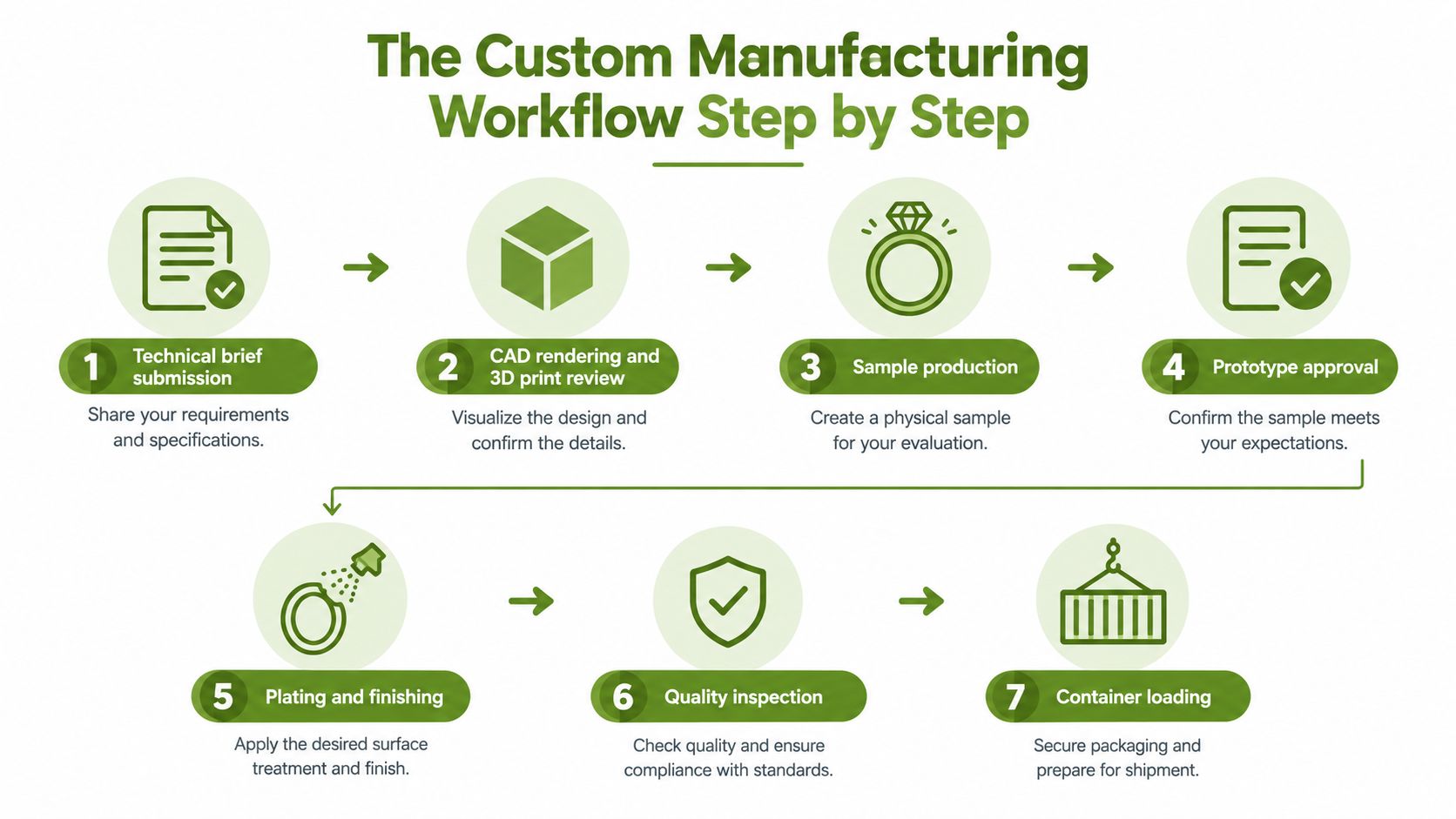
A product photo is not a production specification. Send one controlled brief covering dimensions, target grade, construction, finish, logo placement, stones or enamel, packaging, order quantity by style and color, sales markets, and required documents. Ask the manufacturer to return assumptions and open questions with the quotation.
Seven decisions that keep production moving
- Freeze the brief: Put reference images, dimensions, grade, finish, logo, packaging, quantities, target market, and required evidence in one document.
- Review CAD and engineering changes: Check thickness, connections, clasp clearance, stone seats, comfort edges, and any changes the factory recommends before tooling.
- Confirm tooling and file ownership: Record who owns the CAD, mold, and production-ready files, and whether they can be transferred or reused.
- Make the sample representative: Confirm whether the sample uses the intended grade, construction, polishing, plating, assembly, and packaging route.
- Approve a controlled version: Consolidate revisions in one log and approve a dated specification, physical sample, and finish reference.
- Define bulk inspection: Agree dimensions, cosmetic limits, function checks, finish comparison, packaging, sampling plan, and required reports before production.
- Lock packing and shipping data: Approve artwork, labels, carton marks, commercial documents, and delivery terms before final packing.
Other manufacturers publish shorter planning ranges (OEM and ODM stainless steel production timing), but those figures are not HonHo commitments and may exclude revisions, test lead time, packaging, or freight. For HonHo custom stainless steel projects, the current planning baseline is a 50-piece MOQ per style and color, about 25–35 days for sampling, and about 35–45 days for bulk production after approval. Design complexity, tooling, stone setting, finish, testing, packaging, and approved revisions can change the final quotation and schedule.
Ask for a milestone schedule rather than one delivery number. Each stage should name the required buyer approval and the date when a late decision would move the shipment.
The embedded webinar is retained as a general workflow reference; it is third-party content and is not evidence of HonHo's process or a specific order:
MOQ, Sampling, and Lead Times for Custom Programs
Compare the full development program, not only unit price. A useful quotation separates sample charge, tooling, included revisions, test cost, packaging, bulk quantity, production time, inspection, freight, and the conditions for reorders.
| Planning item | HonHo stainless steel baseline | What can change it |
|---|---|---|
| Custom MOQ | 50 pieces per style and color | Construction, components, finish, packaging, and order mix |
| Sample lead time | About 25–35 days | CAD revisions, tooling, stones, finish development, testing |
| Bulk lead time | About 35–45 days after approval | Quantity, process steps, inspection, packaging, holiday capacity |
| Final commercial terms | Confirmed in the project quotation | Design scope, development work, and agreed delivery terms |
Published supplier examples can help you form questions, but they should not be imported into another factory's plan. One private-label page lists different engraving, packaging, OEM, and ODM ranges (Private-label program examples). Treat those figures as that supplier's example only.
Before paying for a sample, confirm:
- Sample and tooling charges: What does each charge cover, and can the mold be reused?
- Revision rules: How many CAD and physical-sample revisions are included?
- Ownership: Who controls the design files, mold, and approved production specification?
- Credit policy: Is any development fee credited to the bulk order?
- Reorder basis: Which sample, color reference, dimensions, and reports will control the next run?
For small retailers balancing cash flow with stock depth, compare low MOQ jewelry manufacturing options with ready-stock buying. Full development is justified when design control creates a commercial advantage that offsets the added lead time and inventory exposure.
Ready-Stock Wholesale vs Custom Manufacturing
Ready-stock wholesale and custom manufacturing solve different problems. Ready stock tests categories and replenishes quickly. Custom production creates controlled differences that another seller cannot reproduce by opening the same catalog.
| Factor | Ready-stock wholesale | Custom manufacturing |
|---|---|---|
| Best use | Category tests, assortment building, faster replenishment | Proven hero products, signature details, private label |
| Design control | Limited to available styles and approved modifications | Defined construction, finish, branding, and packaging |
| Upfront work | Selection and merchandising | Brief, CAD, sample, approvals, inspection plan |
| Inventory risk | Usually easier to spread across styles | Higher because the goods are made to your specification |
| Repeatability risk | Supplier may discontinue the item | Buyer must control specification, reference sample, and tooling terms |
A new seller can use ready stock to learn whether customers prefer small hoops, statement rings, layered necklaces, charm bracelets, or another category. A growing brand can pilot one or two proven hero pieces before funding a collection. A broader OEM or ODM roadmap makes more sense when reorder data, visual identity, and internal approval capacity are dependable.
The useful question is not “Can this factory make custom jewelry?” It is “Which product has enough evidence to justify custom development, and what must be controlled so the reorder matches?”
Pre-Order Checklist for Working with a Manufacturer
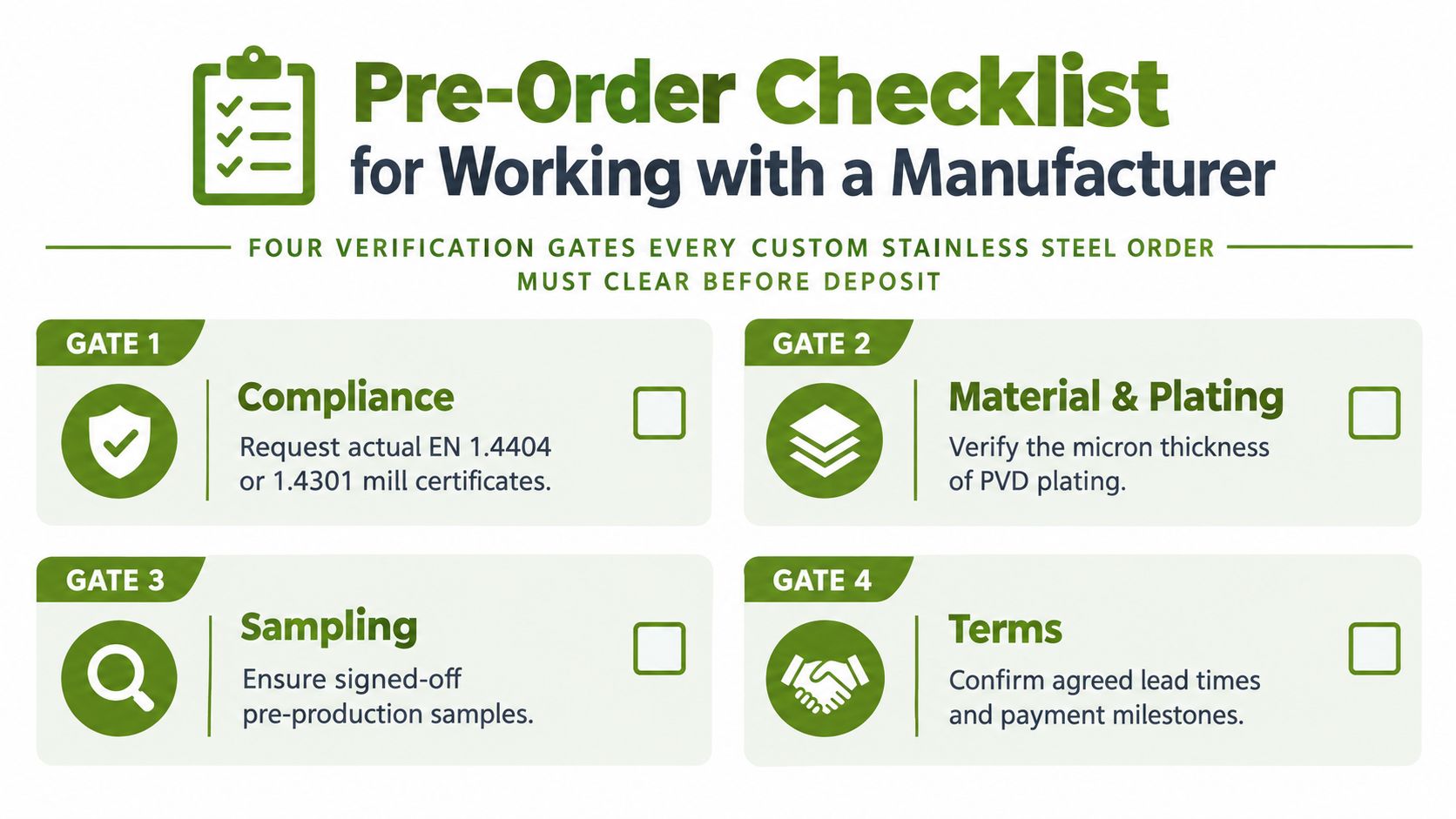
Before paying a deposit, clear four verification gates. Supplier confidence is not a substitute for a written specification, representative sample, defined test scope, and commercial remedy.
Gate one, compliance
Request evidence that matches the finished style, material, finish, and market. The linked supplier article explains why a 316L label alone is insufficient (Why a 316L label doesn't prove compliance). For EU nickel restrictions, confirm the applicable CEN test method and report scope. For other markets, identify the product category and legal requirements before deciding which documents to request.
Gate two, material and plating
Write the base metal and finish route into the quotation and purchase order. “Gold color” is not a complete specification. Record whether the finish uses PVD or electroplating, the approved color reference, surface preparation, protected contact points, and the agreed verification method.
If salt-spray testing is requested, define the method, specimen, exposure time, evaluation area, and acceptance criteria. ISO 9227:2022 describes NSS, AASS, and CASS procedures but does not set a universal exposure period or interpretation for a jewelry product. A test result can reveal coating discontinuities; it should not be converted into a guaranteed number of months or years of wear.
Gate three, sampling
Approve a physical pre-production sample before bulk manufacturing. Check weight and dimensions, edge comfort, joints, clasp action, engraving, stone security, polish, color, packaging fit, and any critical visual boundary. Record the measuring method and tolerance rather than approving with “looks good.”
Keep the approved sample and a dated photo-and-measurement record. Confirm whether it used the planned bulk process; hand finishing can make a prototype look different from a production run. Use this jewelry sample approval checklist to capture the decision.
Gate four, commercial terms
Put the deposit, balance, revision limits, sample credits, inspection rights, defect definition, remedy, packaging contents, delivery term, and responsibility for delay into writing. The article's earlier 30/70 example was only a third-party convention; it is not a universal term or a HonHo commitment. (Private-label MOQ and sample planning)
| Send with the RFQ | Ask the supplier to return |
|---|---|
| Reference and intended customer use | Feasibility notes and production assumptions |
| Dimensions, construction, grade, finish, stones | Unit quote, tooling, tolerances, finish route |
| Logo, packaging, quantity by style and color | MOQ, sample charge, included revisions, bulk price |
| Target market and required evidence | Available reports, proposed test scope, inspection plan |
| Target launch date and delivery location | Milestones, approval deadlines, production and delivery terms |
Key Takeaways for Wholesale Buyers
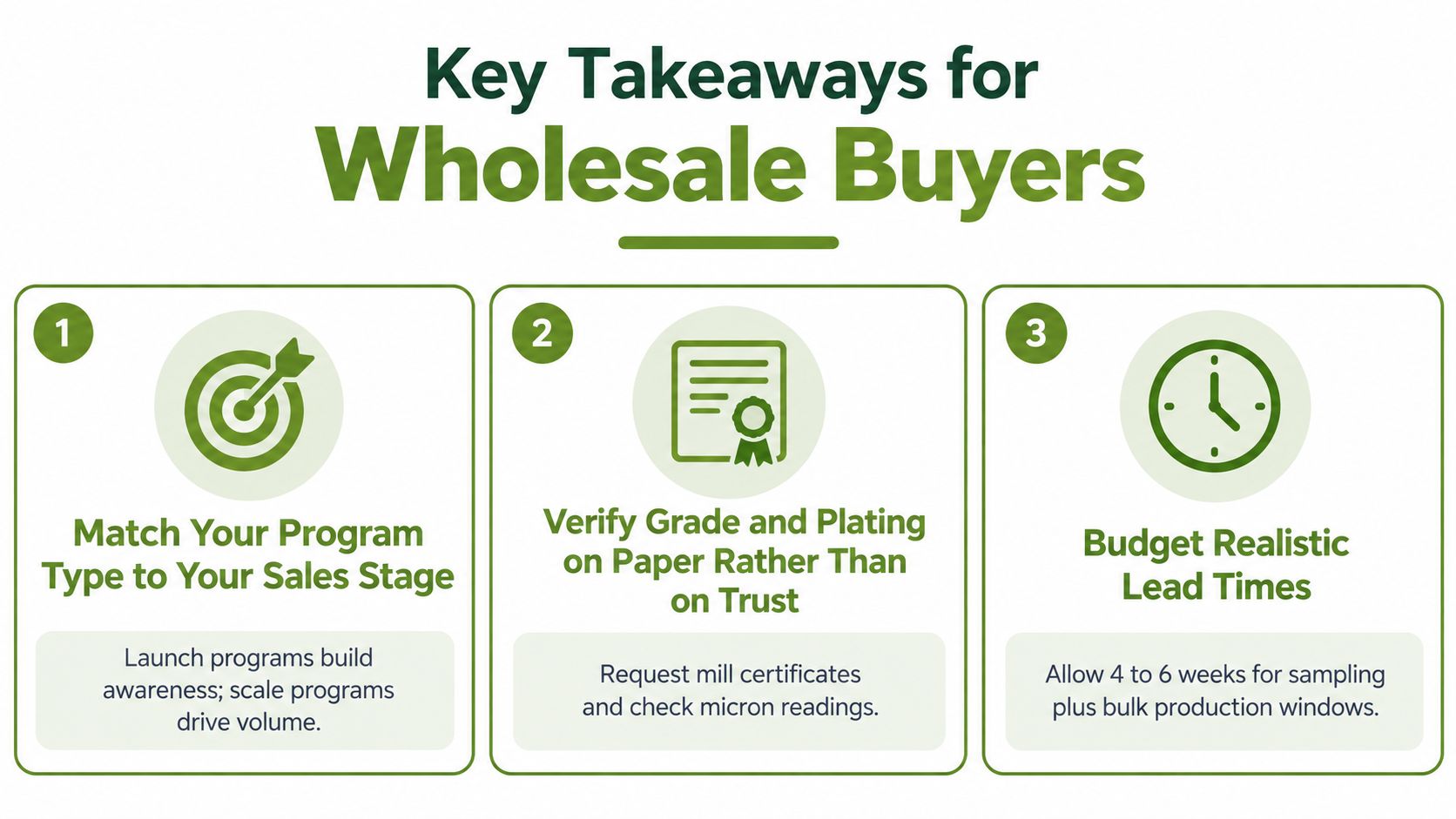
Choose the smallest custom program that solves a proven business problem. Private label improves presentation; OEM executes a defined product; ODM adds design-development support. In every route, control the material, sample, finish reference, ownership, test scope, and reorder specification.
Do not transfer another supplier's MOQ or schedule to your project. The original Custom manufacturing timing guidance remains a comparison source only. For HonHo stainless steel customization, plan from the current baseline of 50 pieces per style and color, 25–35 days for sampling, and 35–45 days for bulk after approval; the written quotation controls the actual project.
To request a practical factory review, send the product reference, target dimensions, stainless steel grade, finish, logo, quantity per style and color, sales market, packaging, and target date to HonHo Wholesale Jewelry. HonHo can then confirm the feasible development route, final MOQ, sample plan, quotation, and production schedule for that design.


