

For a wholesale buyer, “round stud size” is not one number. The visible face diameter matters, but so do the post thickness, usable post length, back type, materials and finished-assembly test evidence. Approve those fields together; a front photo alone cannot tell you whether a pair will fit your assortment or your target market.
Commercial market reports such as DataHorizzon Research and, later in this guide, another market estimate can help frame category demand. Their methods and category boundaries differ, so they are not a sound basis for choosing order depth. Your own sample approval, sell-through and return data should set the reorder.
Table of Contents
- Round Stud Earrings and Why Stock Them
- Round Stud Diameters Worth Stocking
- Metals and Finishes for Everyday Resale
- Posts and Nickel Checks Before Resale
- Backings That Keep Pairs Selling
- Packs Packaging and Assortment Mixes
- Pricing Markup and Inventory Depth
- Confirm Specs Then Browse Earrings
Round Stud Earrings and Why Stock Them
A round stud is a circular front attached to a post and secured by a back. The front may be flat, domed, set with stones or formed as a polished ball. For purchasing, treat the front, post and back as one assembly even when the supplier uses different materials for each part.
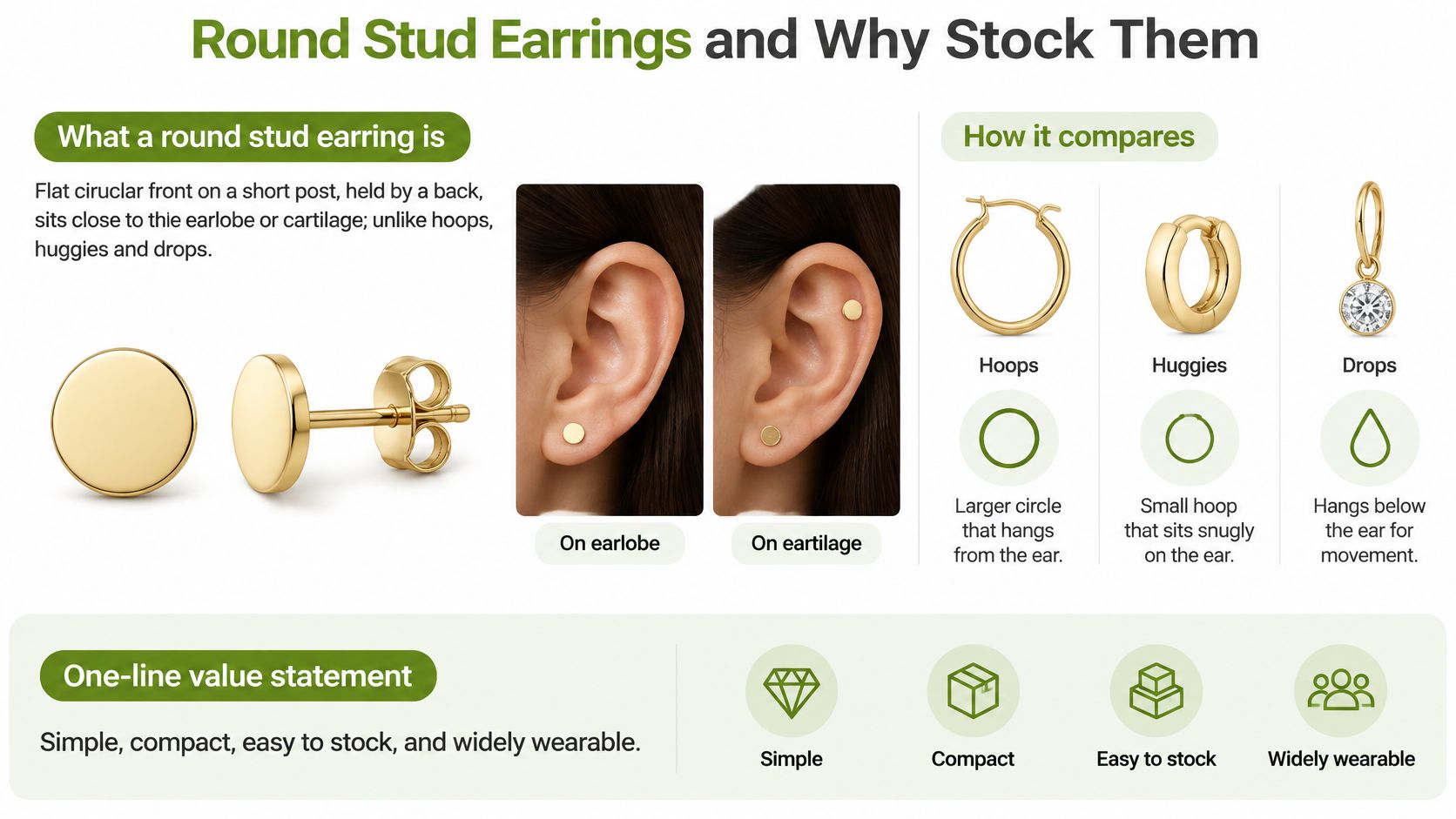
The Dataintelo global earring market report is another commercial forecast, not a specification. It may help show why studs receive attention, but it cannot tell you which diameter, finish or closure will sell in your store. Start with a small, traceable assortment and deepen only the variants that earn repeat orders.
Why the Shape Works for Resale
The circular face is easy to compare at a glance, and the same outline can cover understated dots, polished discs and brighter stone-set fronts. That makes round studs useful for testing size and material preferences without changing the basic silhouette.
Use the guide to wholesale earrings in bulk for broader assortment planning. For this category, keep the buying decision narrower: define the visible diameter, front profile, complete material breakdown, post geometry, back, finish, packaging unit and target-market evidence.
Round Stud Diameters Worth Stocking
Measure the widest visible part of the front in millimetres. Do not copy a supplier’s “small,” “classic” or “bold” label into your product data unless you also record the actual measurement. Those names are merchandising language, not controlled size standards.
| Sample field | What to record | Why it changes the buying decision |
|---|---|---|
| Front diameter | Widest visible face, in mm | Controls scale in photography, packaging and on-ear presentation |
| Front profile | Flat, domed, ball, stone-set or raised | Two fronts with the same diameter can project and weigh differently |
| Post thickness | Measured diameter or verified gauge | Must suit the intended closure and placement |
| Usable post length | From the back of the front to the closure’s working position | Overall post length can overstate the space available on the ear |
| Pair weight | Complete pair with supplied backs | Helps compare samples without turning weight into a comfort guarantee |
Reading Each Size on a Sample
A 2–3 mm front reads as a small dot; a 4–6 mm front is more visible; larger fronts become the visual focus. These are useful sample groupings, not demand forecasts. Profile, edge thickness, setting and polish can make two pieces with the same measured diameter look different.
Photograph every approved sample with a millimetre ruler and at one consistent camera distance. Keep an uncropped pair image as well as an on-ear or scale reference. Macro photography is useful for workmanship, but it should not be the only size cue on a listing.
If your team uses the systematic review in PMC for background on ear-related outcomes, verify the exact passage and scope before turning it into product advice. A medical paper does not establish the fit, weight or safety of a specific HonHo SKU or production batch.
Post Length Is Part of Size
“Post length” is ambiguous unless the measuring points are stated. Record both the overall post length and the usable length after the supplied back is fitted. Ear anatomy and intended placement vary, so do not present one length as universal or relabel a lobe stud for cartilage use solely because the front is small.
- Measure: front diameter, front projection, post thickness, overall post length, usable post length and pair weight.
- Inspect: straightness, tip finish, burrs, solder or weld area, and whether the back grips consistently.
- Document: the materials of the front, post and back separately when they differ.
- Approve: one physical reference sample per SKU, finish and closure combination.
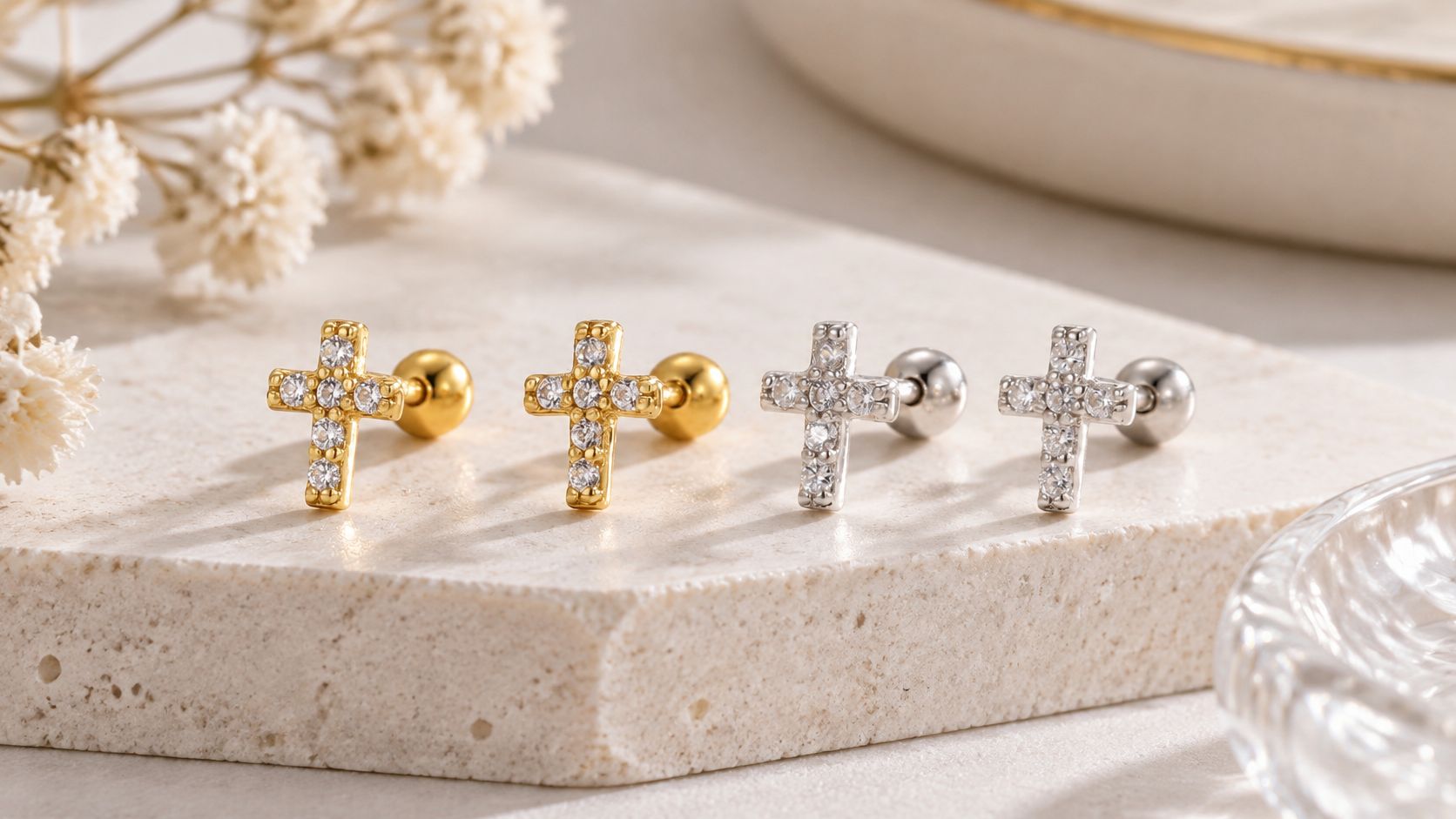
The 925 Sterling Silver Pavé Cross Ball-Back Stud Earrings are a useful example of why the face description is not enough: the front design, base metal, finish and ball-back closure all belong in the approval record. Verify the live product specification before quoting it, because a category capability is not a promise for every ready-stock unit.
Metals and Finishes for Everyday Resale
Material claims should follow documents, not color. A silver-colored face may be steel, plated brass or sterling silver, and the post or back may use another alloy. Ask for a component-level declaration, then make sure the product title and care copy describe the assembly you actually buy.
| Buying question | Evidence to request | Listing limit |
|---|---|---|
| What is the base metal? | Material declaration for front, post and back | Do not infer alloy from appearance or category name |
| What creates the color? | Finish or coating specification for the SKU | Do not call a finish PVD because the color looks similar |
| What care does it need? | Supplier care guidance tied to the material and finish | Avoid “tarnish-free,” “waterproof” or lifetime language without evidence |
| What market claim is intended? | Applicable finished-item test report and batch traceability | Raw-material paperwork does not prove the complete assembly |
316L Stainless Steel for Volume
Use “316L stainless steel” only when the relevant components are documented as 316L. If the front, post and back differ, name the difference in the SKU record and customer-facing specification. Stainless steel may suit an everyday price tier, but alloy identity does not by itself prove nickel-release compliance or performance of the finished pair.
Brass for Detail and Trend Price
Brass can support detailed forms and plated finishes, but the coating system and wear points still need sample review. Inspect edges, raised areas, the post joint and the surfaces that contact the back. If the SKU is described with a coating process, verify it first; the HonHo guide to gold PVD coating explains the terminology, but it does not make every gold-colored item a PVD product.
925 Sterling Silver for Gift and Premium Everyday
For sterling silver, confirm that the 925 claim applies to the stated component or assembly and identify any plating separately. Care copy should allow for normal surface change and avoid promising a maintenance-free finish. Gold-plated sterling silver is neither solid gold nor an unnamed “gold” material; the base and finish should both appear in the specification.
Posts and Nickel Checks Before Resale
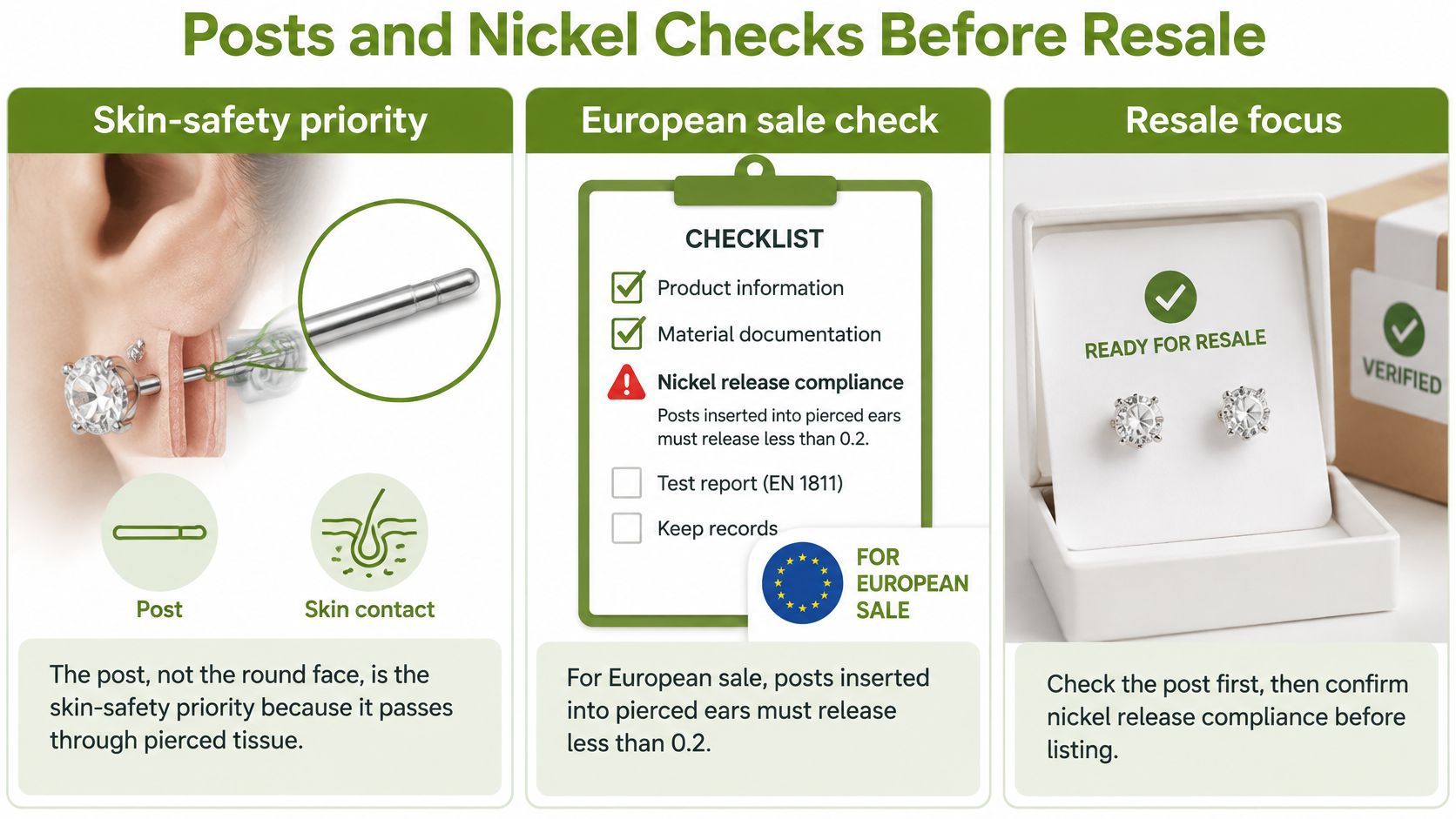
For products intended for the EU, the controlling question is nickel release from the finished item. The Nickel Institute policy page is an industry explainer; the official ECHA restriction states a release limit below 0.2 µg/cm²/week for post assemblies inserted into pierced ears and 0.5 µg/cm²/week for articles intended for direct and prolonged skin contact. The cited harmonized method should match the current market requirement when the test is commissioned.
What a Low Figure Does and Doesn't Prove
An alloy designation, a supplier declaration or a low figure reported for raw metal does not prove the assembled earring. Plating, solder, welds, pigments and the supplied back can change the contact surface. Ask for evidence that identifies the tested article, method, result, laboratory, date and production or sample reference.
“Hypoallergenic” is not a substitute for a material breakdown and market-appropriate test evidence.
Paperwork to Request
- Component-level material declarations for the front, post and back.
- A report for the finished assembly, not just a raw alloy coupon.
- The test method and edition used, with the applicable release limit.
- Photos or identifiers that link the tested sample to the ordered SKU.
- Batch or production references that let you trace later deliveries.
The embedded video is retained as general background. It is not batch evidence and should not be described as a factory inspection or HonHo test unless its identity, contents and relevance have been independently confirmed.
A dimethylglyoxime spot test may be used as a screen in some workflows. The dermatology review linked through Taylor and Francis is background reading, not a replacement for the applicable laboratory method or legal assessment. Do not turn a home or shop screen into a compliance claim.
The guide to hypoallergenic helix earrings applies the same paperwork-first principle to another piercing format. Keep the market, placement and exact product construction clear; evidence for one design should not be reused as proof for a different assembly.
Backings That Keep Pairs Selling
The back is part of the SKU. It must match the post geometry, material claim, finish and intended use. A familiar closure can still fail approval if it is loose, sharp, mismatched or inconsistent across a sample set.
| Back type | Mechanism | Sample checks | Claim boundary |
|---|---|---|---|
| Friction or butterfly clutch | Grip on a straight post | Retention, alignment, removal force and edge finish | Do not promise universal fit or loss prevention |
| Screw back | Threaded post and matching back | Thread engagement, cross-threading, tip finish and repeat use | More secure does not mean suitable for every wearer |
| Silicone clutch | Friction sleeve | Grip consistency, discoloration and supplied material information | A soft feel is not a medical or allergy claim |
| Locking clutch | Mechanical lock or release | Positive engagement, release action and compatibility | Test the exact post-and-back pair |
| Flat back | Threaded or push-fit low-profile back | Gauge, usable length, threading or pin compatibility | Do not infer cartilage suitability from the front size alone |
Match the Back to the Price Tier
Choose the closure because it fits the product specification and customer proposition, not because a table labels it “premium.” A gift pair may justify a more complex back, while an entry pair may benefit from a simple closure and a clearly labeled spare. Compare complete landed cost and service implications before standardizing the choice.
Sample Checks That Catch Returns
On each approved sample, fit and remove the back repeatedly, check for post damage, compare retention across multiple units and inspect every contact edge. Record the supplied back in the SKU photograph. If spare backs are offered, confirm that their material, finish and compatibility match the original.
Packs Packaging and Assortment Mixes
Separate variants by diameter, material, finish and back. Similar-looking fronts can require different care copy and different evidence. The pack label should make the unit clear—pair or single—and should not imply that packaging shown in a photograph is included unless it is part of the quoted configuration.
The Three Pack Structure
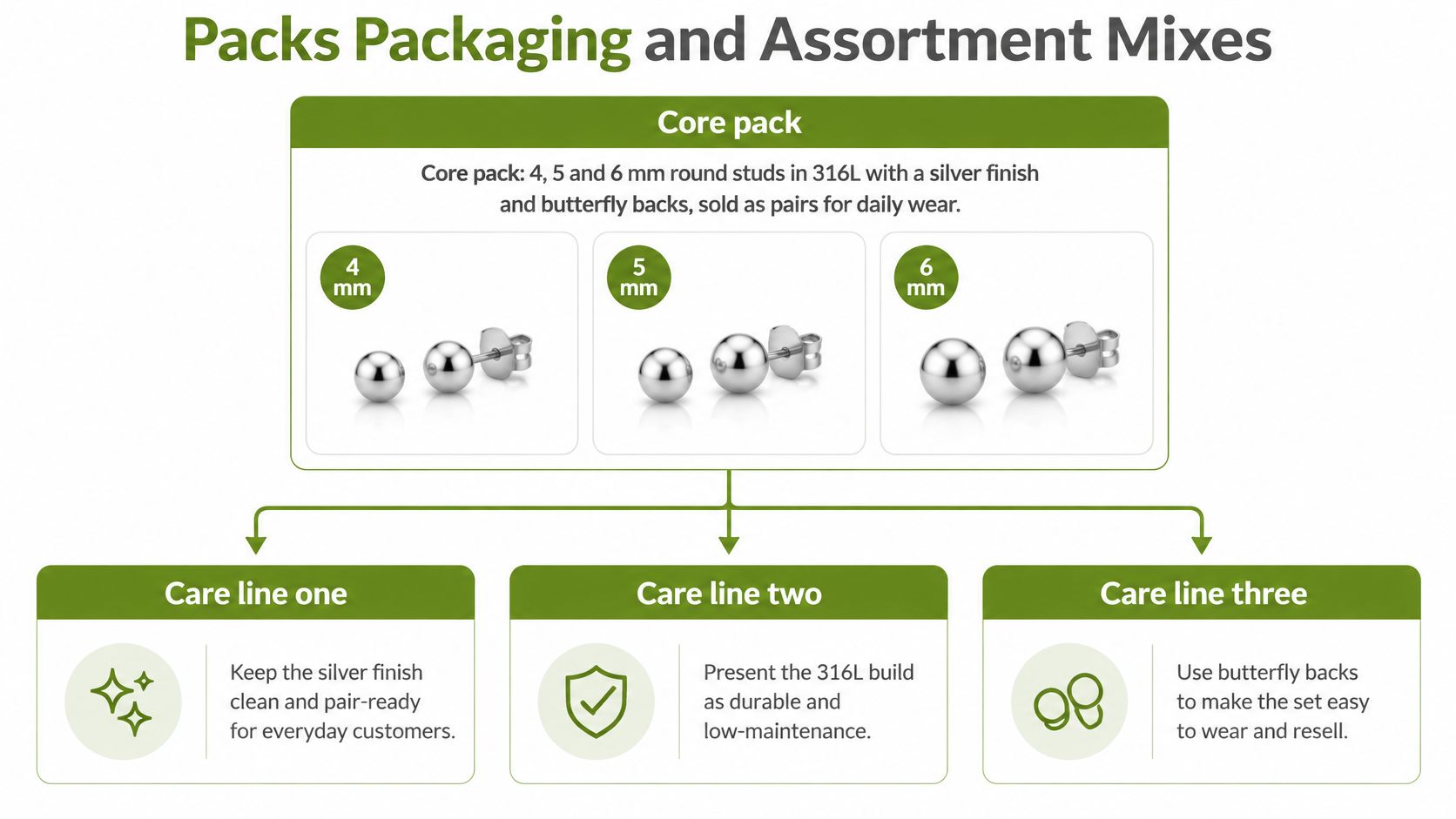
A practical test order can use three groups without assuming demand in advance:
- Core test: a limited set of measured diameters in one documented material and closure.
- Gift test: a separately labeled material or finish, with packaging and closure cost visible.
- Trend test: a shallow run of color, stone-set or larger fronts, tracked separately from basics.
These are test cells, not fixed order percentages. Reorder only after you can see sell-through, returns and customer questions by exact variant.
Packaging That Prevents Mix Ups
Keep each approved pair with its matching backs and label diameter, base metal, finish, closure and unit quantity. Use the guide to wholesale jewelry pouches when comparing cards, pouches and gift formats. Confirm the quoted packaging, logo treatment, minimum order and lead time for the specific order; a blog article is not a live production promise.
Pricing Markup and Inventory Depth
Price from landed cost rather than multiplying the factory unit price by a fixed number. Build the sheet from actual quotes and destination-specific costs:
| Input | Include |
|---|---|
| Product cost | Exact SKU, finish, back and order quantity |
| Packaging cost | Card, pouch, box, labels and assembly |
| Freight allocation | Shipment cost allocated by a consistent method |
| Import and transaction costs | Applicable duties, taxes, brokerage, payment and platform fees |
| Quality cost | Inspection, testing, replacements and expected service allowance |
Landed unit cost = product + packaging + freight allocation + import/transaction costs + quality allowance. Use your own selling price and landed cost to calculate gross margin; do not copy a worked dollar example from another store or market.
Build a Price Ladder
Let documented material, finish, closure, packaging and service level explain the price difference. The guide to wholesale jewelry for boutiques is useful when aligning those choices with a store format. Keep the comparison honest: a higher price is not proof of better fit, lower nickel release or longer wear.
Let the Margin Sheet Set Depth
Track each diameter, finish and closure as a separate SKU. A blended “studs” total can hide a sold-out core variant beside slow-moving stock. Start shallow, define the reorder point, and increase depth only where actual sales and acceptable return rates support it.
Confirm Specs Then Browse Earrings
Before sending an RFQ or approving a sample, specify:
- front diameter and profile;
- front, post and back materials;
- post thickness, overall length and usable length;
- back type and compatibility;
- finish or coating name, color and sample reference;
- pair weight and packaging unit;
- target market and required test evidence;
- quantity by variant, packaging needs and destination.
Keep one approved reference sample and a dated specification. When a reorder arrives, compare it with that record before product photography or listing updates. This protects the useful part of the original buying logic—measure, document, sample and verify—without turning general factory capability into a promise about every SKU.
Once the specification is ready, visit HonHo Wholesale Jewelry to shortlist relevant pairs, then confirm current availability, minimum order, customization scope, sampling and production timing for the exact styles under consideration.
Official reference added during this review: ECHA REACH Annex XVII, entry 27 (nickel). The current EN 1811 edition referenced for compliance should be checked when testing is ordered.


