

For chunky chain necklace wholesale, do not buy on link size alone. Approve the finished sample by material, construction, weight, clasp, finish and landed cost. A practical first order is usually two familiar chain shapes in one confirmed material, plus one limited design test.
The necklace must look substantial at a retail price your customer will accept, yet remain comfortable and consistent enough to reorder. Weigh the sample, record its link and clasp measurements, and compare those results with the approved quotation before bulk production.
Table of Contents
- What a Wholesale Chunky Chain Order Is For
- Materials and Finishes Compared for Resale
- Styles to Reorder and Styles to Test
- Weight Geometry and Wear Before You Order
- Labels Buyers Must Get Right
- Pricing Markup and Inventory Planning
- Ordering Your First Chunky Chain Lot
What a Wholesale Chunky Chain Order Is For
A chunky chain earns shelf space through the look it creates and the price it can support. Curb, rope, paperclip, figaro and oversized-link designs all make links visible from across a counter. Customers may wear them alone or use them as the base of a short stack. “Chunky” describes the visual effect, though, not the metal, construction or value.
A large-link necklace can look premium in a photograph yet feel uncomfortable for everyday wear. Its weight may also increase shipping and packaging costs, pushing the retail price beyond what customers will accept. Judge each sample by its weight-to-impact ratio: how much visual presence it delivers for its finished weight and landed cost. A heavier chain is not automatically a stronger seller.
Before ordering, confirm the base metal, finished weight, clasp, finish description and order quantity. Stainless steel, brass and 925 sterling silver can all create bold designs, but each supports different price positions, care instructions and product descriptions. Pick the chain whose weight and price a customer will accept, then check whether the landed cost leaves room for that retail price.
Keep reorderable links at the center of the assortment, and use a small number of trend-led styles to test demand. For example, compare two samples by their visual impact, weight and landed cost. If a heavier sample requires a higher retail price but looks only marginally bolder, the lighter one may be easier to wear and sell. Inspect and weigh a sample before committing to the order, and keep the test small enough that an unproven style does not crowd out repeatable stock.
Materials and Finishes Compared for Resale
A chunky chain's visual impact depends on its links and finish, while its resale label depends on what the piece is made of. Check both before setting a retail price: two gold-color chains may have different base metals and different care needs.
| Material or finish | What it is | Resale role | Care reality | Do not call it |
|---|---|---|---|---|
| 316L stainless steel | Steel grade, only when confirmed for that style | Everyday chunky chains at an accessible price | Corrosion behavior depends on the confirmed grade, finish, use and care | Sterling, silver or vermeil |
| Brass | Brass base, often with a plated finish | Fashion gold look with visual weight | Can darken if plating wears; name the finish | Copper or solid gold |
| 925 sterling silver | At least 92.5 percent pure silver | Higher-ticket and gift racks | Can tarnish; polishing and storage matter | Stainless steel or plated brass |
| Gold plated on steel or brass | A finish over a stated base metal | Gold-color fashion chains | Wear depends on use; don't invent thickness | Vermeil or karat gold |
| Silver-color finish on non-silver | Color finish, not precious-metal content | Cool-tone fashion chains | Care depends on the finish | Sterling silver or 925 |
Match the material to the price position
316L stainless steel can suit everyday chunky chains, but list that grade only when it is confirmed for the specific style. A similar appearance is not proof of the same steel. Check a sample for its weight and finish, then make sure the care information reflects its actual construction.
Brass can give a fashion chain a substantial gold-color look. Name brass as the base and state the finish, such as gold plated. If the plating wears, the surface may darken, so keep the product description and care instructions clear.
925 sterling silver contains at least 92.5 percent pure silver. The Federal Trade Commission's guidance on buying silver jewelry explains that “silver,” “sterling” and “sterling silver” describe products meeting that standard. A 925 mark indicates 925 parts per thousand are pure silver. A silver-color coating on brass or steel is a finish, not sterling silver.
Gold plated is a finish applied over a named base metal such as steel or brass. State the base metal plainly, and use “vermeil” only when the piece meets the relevant construction and labeling requirements. The guide to gold PVD coating explains coating terminology, but confirm the actual finish for each style rather than assuming all gold-color coatings are the same.
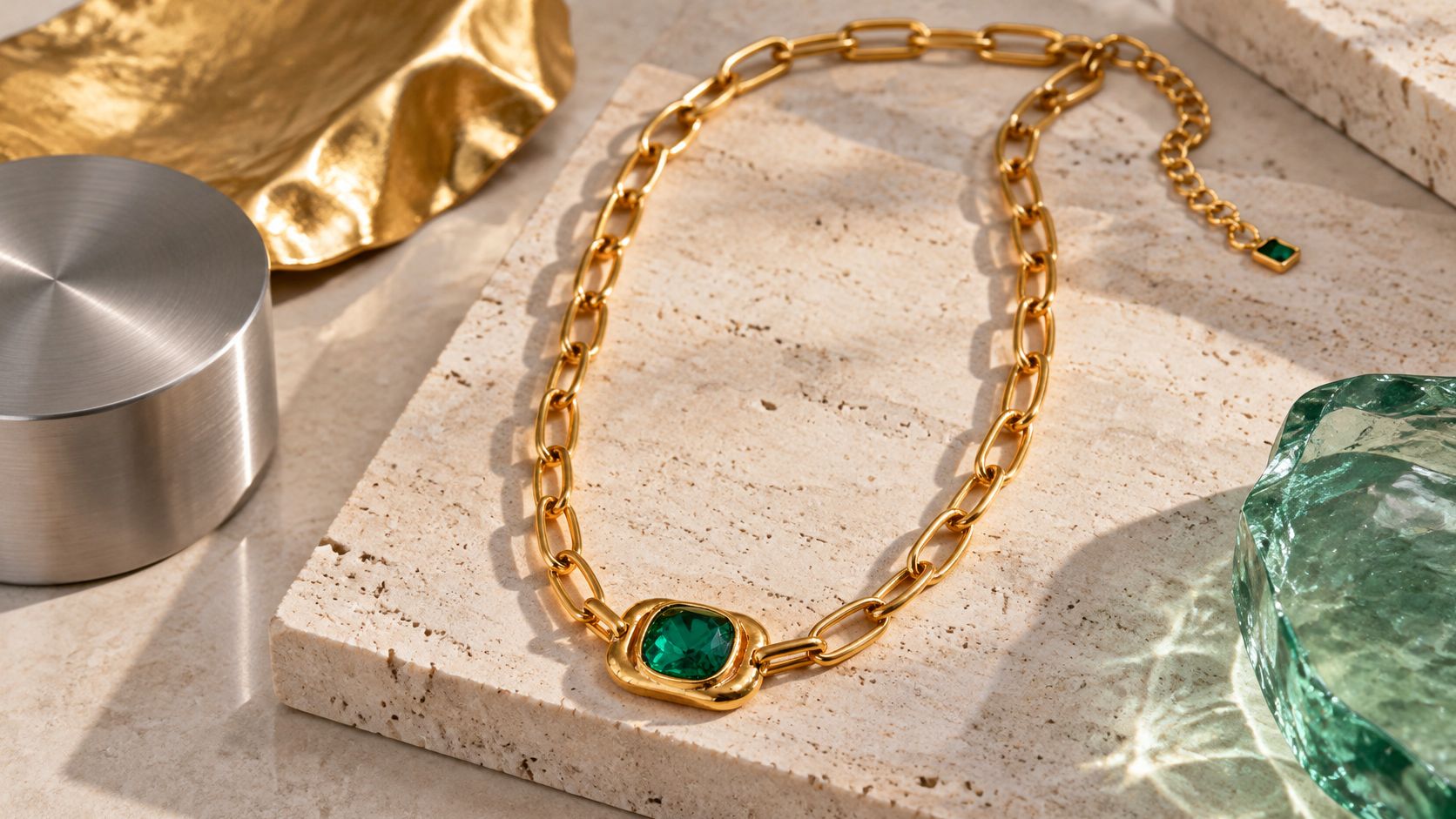
For example, the Gold Plated Stainless Steel Green Glass Link Necklace shows how an elongated-link chain can be combined with a green glass center accent, a stated stainless steel base, a gold-plated finish and an extender. Use the live product page for current price and availability. The listing does not establish finished weight, so request or weigh a sample before comparing feel, freight and retail position.
Keep material and finish information specific on every listing. A clear description helps staff explain what the customer is buying, while accurate care guidance sets expectations for wear. For wholesale planning, compare each style's sample, finish and stated base metal before deciding how much of it belongs in a core assortment or a small test order.
Styles to Reorder and Styles to Test
Separate dependable shapes from experiments. Curb, rope, paperclip and figaro chains are familiar enough to compare across lengths and finishes; oversized hollow links, mixed metals and sculptural designs need smaller opening quantities until your own sales and return data justify depth.
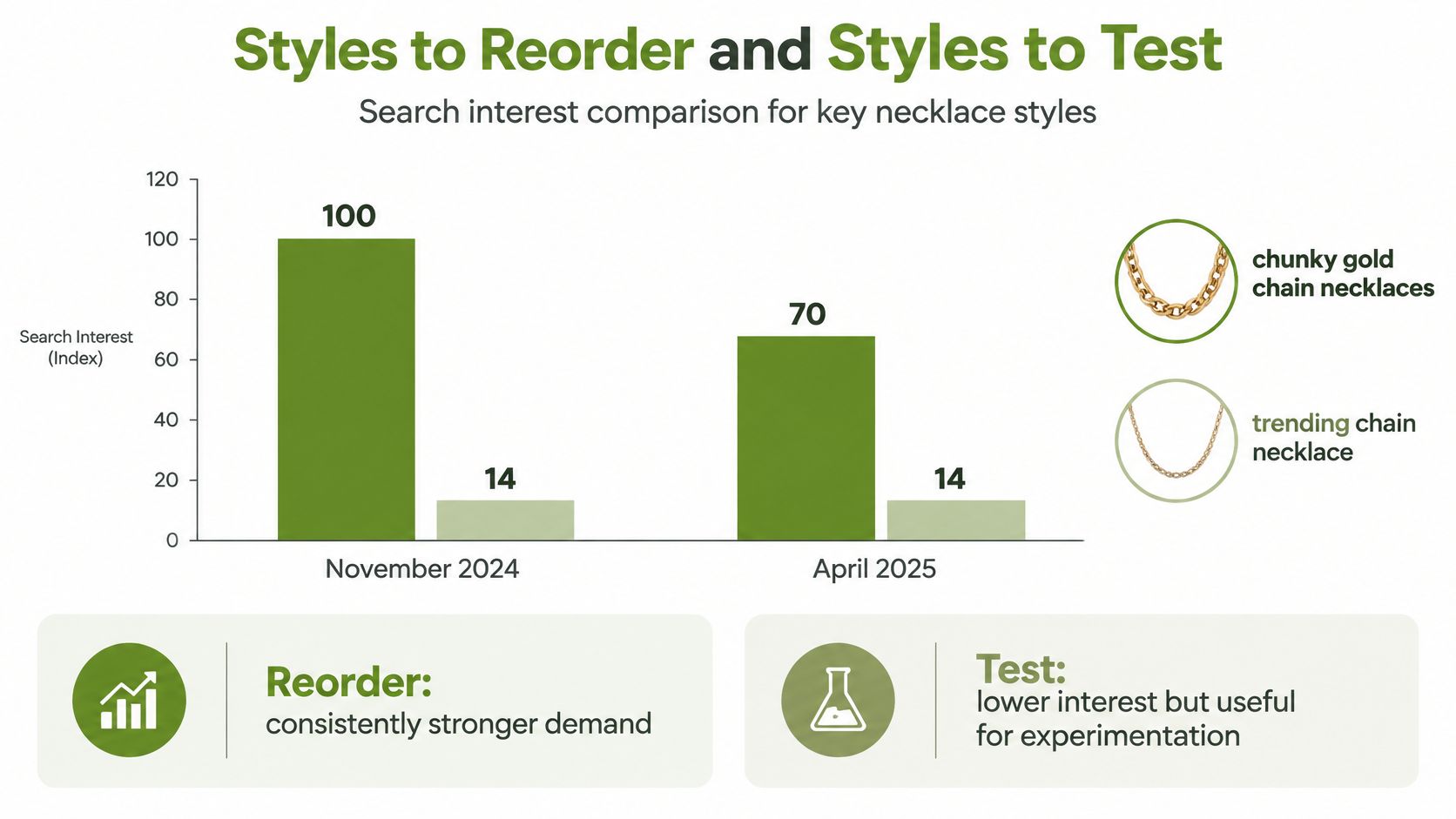
Search interest can suggest wording or a style worth testing, but it cannot set an order quantity. One third-party snapshot, Accio's analysis of chain-necklace trends, reported higher historical interest for “chunky gold chain necklaces” than for the broader phrase “trending chain necklace.” Treat that as a directional content signal, not proof of current demand or future sales.
| Style | Stock role | Why | First-order approach |
|---|---|---|---|
| Curb | Reorder | Familiar bold link customers already recognize | Two lengths in one metal and finish |
| Rope | Reorder | Twisted texture with a classic chain look | Core size plus one longer option |
| Paperclip | Reorder | Elongated links layer easily | Keep one finish replenished |
| Figaro or pendant-compatible chain | Reorder | Works alone or with a pendant | Pair a curb chain with a simple pendant you already stock |
| Oversized hollow links | Test | High visual impact, with more dent and comfort risk | Few units after checking a weighed sample |
| Mixed-metal or two-tone layers | Test | Strong in photos, with narrower repeat demand | One coordinated set, not a full size run |
| Pearl, charm-heavy or sculptural chains | Test | Trend-led and harder to replenish identically | Limited quantity tied to a season |
Curb, rope, paperclip and figaro shapes give shoppers recognizable options to wear alone or combine with jewelry they already own. A simple display can show how a familiar curb chain looks with a pendant already in your range, giving customers a concrete styling idea without requiring a new chain shape for every outfit.
Use a limited test order for oversized links, mixed-metal layers, pearl or charm-heavy designs, and sculptural shapes. Track sell-through, returns, average order value and repeat purchases by style. A social clip or search spike can point to a design worth sampling, but only your store's results can justify a reorder.
Pendant-compatible chains can extend an existing assortment without forcing a new chain shape for every look. Confirm the pendant bail fits over the clasp and end tabs, then check whether the chain carries the pendant without twisting or pulling the clasp off-center.
Search interest helps identify what shoppers are looking for, while a physical sample shows what a product delivers. An oversized hollow link may look bolder in a photo than a solid curb chain and weigh less. Compare the sample's visual impact with its weight and the landed cost you can support against the retail price the chain can hold. A square chain buying guide can help you assess that format alongside the other links in your assortment.
Weight Geometry and Wear Before You Order
Ask for a finished specification listing nominal length, external link size, wire or strip thickness, clasp type, total weight and construction. Add clear photographs of the end links, jump rings and clasp. Those records make quotations easier to compare and help catch a visually similar substitution that changes comfort, durability or cost.
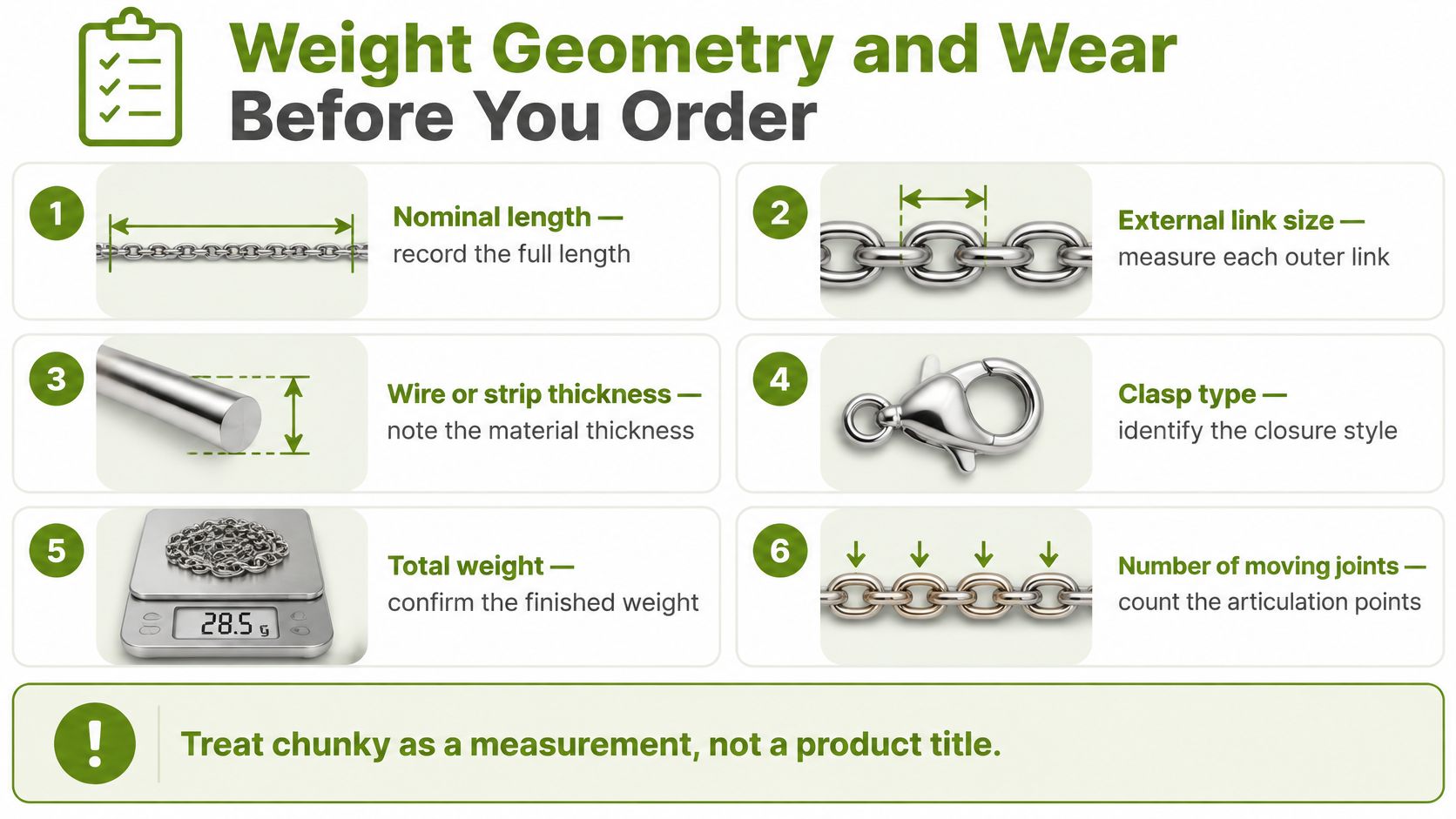
Link size does not reveal weight or strength by itself. A large hollow link can weigh less than a smaller solid link, while an unsoldered joint can be a weaker point regardless of overall width. Hollow construction may reduce weight and freight, but it can be more vulnerable to dents. Compare samples side by side and record the construction instead of inferring it from appearance.
Inspect a finished sample in sequence
- Weigh it. Compare the finished sample with the quoted weight using a suitable scale.
- Measure the length. Record the full length, including any extender, against the approved specification.
- Cycle the clasp. Open and close it repeatedly. Check that it moves freely, seats securely and is proportionate to the finished necklace.
- Screen for snags. Pass the clasp, end tabs and extender over a fine knit and a tied bundle of thread. Record any catching. This is a comparative sample check, not a standardized test.
- Flex representative links. Check their movement, then inspect connection points under magnification for openings, sharp edges or damage.
- Photograph the finish. Take clear, consistent photos for comparison with later production batches.
Compare two necklaces that look equally bold on a bust. If one weighs less and costs less to ship while still looking substantial and feeling comfortable, it may deliver more impact for its weight. The wholesale stainless steel chains guide can help you set out chain specifications for comparison.
If corrosion screening is relevant to the program, ask which finished SKU, preparation method and acceptance criteria an ASTM B117 or ISO 9227 report covers. A salt-spray result compares specified finishes under stated laboratory conditions; it does not translate directly into years of consumer wear.
For EU sales, check the finished necklace's nickel-release performance, not just its alloy name. ECHA notes that nickel is restricted in necklaces and other articles intended for long-term skin contact. The Annex XVII limit is 0.5 µg/cm²/week for relevant parts in direct and prolonged contact; confirm the current legal text and the applicable test route for your market. Ask which finished SKU and surface treatment the report covers, particularly at the clasp and areas where links rub. The ECHA overview of skin-sensitising chemicals provides regulatory context, but it is not a substitute for product-specific compliance documentation.
Labels Buyers Must Get Right
A chain's visual weight and its material label answer different questions. Chunky, layered and statement describe appearance; 316L stainless steel, brass and 925 sterling silver identify a material, while gold plated describes a finish. Keep those categories clear, like separating a garment's cut from its fabric. Style terms help customers picture the look, but they do not establish what the chain is made from or how it is finished.
Gold-colored chains qualify as vermeil only when the sterling-silver base and plating meet the FTC requirements. Under the FTC Jewelry Guides, the base must be sterling silver, and the gold or gold-alloy plating must have at least 10-karat fineness, reasonable durability and a thickness equivalent to at least 2.5 microns of fine gold across significant surfaces. The minimum is substantially thicker than the 0.175-micron minimum associated with gold electroplate, as described in the FTC Jewelry Guides. A brass or stainless-steel base does not meet the sterling-base requirement. Use “vermeil” only when the construction is documented for that finished style, and make no karat or thickness claim based on appearance alone.
The Federal Trade Commission's Jewelry Guides require accurate representations of details such as metallic content, size, weight, treatment, durability, serviceability and origin. A product photo cannot establish a clasp's quality or a necklace's wear life.
Check the listing before it goes live
Keep material wording consistent across the product page, invoice, hang tag and care card. On marketplace and Shopify listings, spell out whether a silver-colored finish is sterling silver or a finish, so customers can distinguish appearance from composition. Use 316L only when the supplier confirms the grade for that style, and PVD only when the supplier identifies that finish.
For mixed orders, match each product specification to its corresponding sample. If a claim matters to the listing, request documentation for the exact finished SKU rather than carrying wording over from a similar necklace. That keeps the label tied to the item customers will receive.
Three-line listing check
- Base metal: Name the confirmed construction.
- Finish word: State the documented finish without inventing thickness.
- Dimensions: Record measurements taken from the sample.
Pricing Markup and Inventory Planning
Build the retail price from landed cost, which includes the unit price, freight, packaging, a returns allowance and any payment or platform fees you absorb. Weighing a sample helps make the freight estimate more realistic. The markup formula is retail price ÷ landed cost.
For example, a hypothetical steel curb chain costing US$8 landed and priced at US$28 has a 3.5x markup. That is illustrative arithmetic, not a product price or a claim about net profit. Selling costs and returns affect the margin you keep.
The same landed cost can support different retail positions. If both a steel chain and a 925 sterling silver chain cost US$8 landed, pricing each at US$28 gives both the same markup, but material, customer expectations and competitive context may support different retail prices. Set the price your customer will accept, then work backward to the maximum landed cost that still covers selling costs and returns.
Give core chains and test styles different budgets
Build a barbell assortment: keep reorderable links as the core, and reserve a smaller, defined share of your open-to-buy budget for trend tests. A core chain might use one evergreen link, two lengths and one finish, with depth in the length customers buy. The trend side can test an oversized or sculptural link without tying too much cash to a style that may sell slowly.
Set the reorder point from your own weekly sales, supplier lead time and safety stock; there is no universal four-week rule. For test styles, compare sell-through and returns before committing again. If a design stalls, reduce the next quantity or exit it instead of treating visibility as demand. The wholesale jewelry buying guide for boutiques offers further assortment guidance.
Ordering Your First Chunky Chain Lot
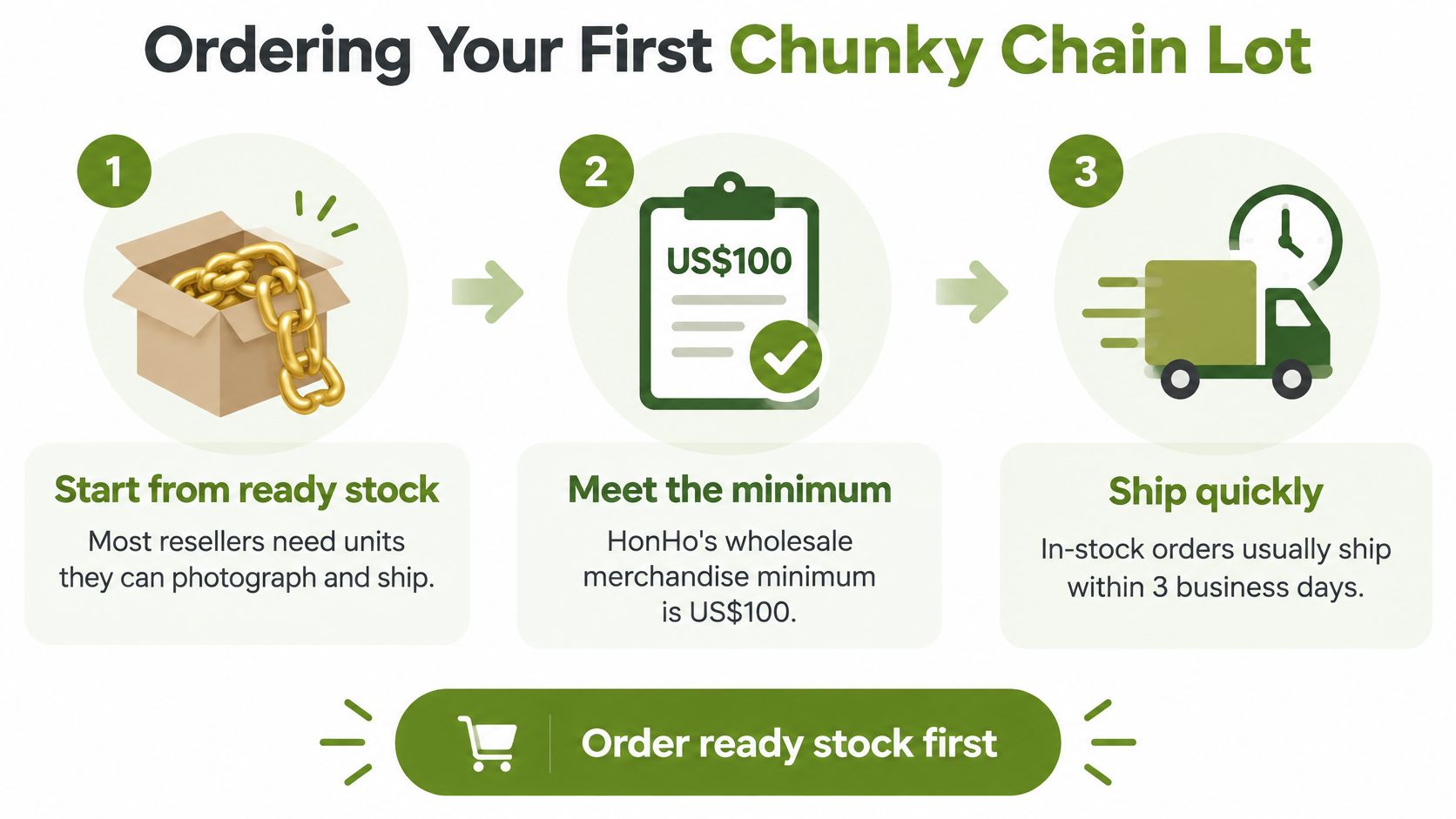
Start with ready stock if your immediate need is merchandise you can photograph and ship. HonHo's wholesale merchandise minimum is US$100; in-stock orders usually ship within 3 business days from Dongguan, and checkout is in USD. A mixed order of chains and other jewelry categories can help you reach the minimum without making one chain style carry the whole purchase.
Custom manufacturing makes more sense when a particular specification, logo or branded package is central to the plan. HonHo's current planning baseline is 50 pieces per style and color. Samples generally take 25–30 days for brass and 925 sterling silver or 25–35 days for stainless steel; bulk production generally takes 35–45 days after sample and specification approval. Special components, revisions, testing, packaging and material availability can change the quotation and schedule, so plan from the approved sample rather than the campaign date.
Choose packaging to fit the selling channel. A protective pack may suit a store that needs to price and ship individual items, while logo cards, engraving or branded packaging make more sense for a private-label line after the necklace specification is approved. If you're comparing samples, follow a written jewelry sample approval checklist.
Place the first order
- Pick the assortment. Choose one evergreen curb, rope or paperclip chain in one confirmed material, plus one test style in the smallest sensible quantity.
- Check the sample. Match its length and weight to the specification, then cycle the clasp and inspect the link joints.
- Write accurate product details. Use material and finish terms that match the construction. Don't claim vermeil unless the sterling base and required plating are documented.
- Add packaging last. Confirm the listing language before you invest in branded cards or packaging.
Reorder a core chain only when sell-through, returns and the supplier lead time support the next quantity. If the test style stalls, reduce the commitment or remove it. Compare ready-stock necklace options by confirmed material and finish; for custom work, send the target length, link dimensions, finished weight, clasp, finish, quantity per color and packaging requirements.
Browse HonHo Wholesale Jewelry for ready-stock wholesale necklaces and other jewelry categories in stainless steel, brass and 925 sterling silver. For a custom quotation, contact HonHo with the specification and intended order quantity.


