

Gold PVD coating is a vacuum-deposited jewelry finish used to create a durable gold appearance on metals such as stainless steel. But “18K PVD,” “0.5 μm PVD,” and “gold PVD” do not automatically describe the same coating construction. A buyer should confirm the base metal, support layer, actual gold layer, coverage, sample standard, and test method before comparing quotations.
For wholesale jewelry, the most important distinction is simple: PVD thickness is not necessarily gold thickness. Two suppliers can quote the same gold color while using different layer structures, preparation methods, and measurement points. This guide explains what to ask, how to compare PVD with electroplating, and how HonHo specifies custom gold PVD projects.
Gold PVD Jewelry at a Glance
| Buyer question | Short answer |
|---|---|
| What is PVD? | Physical Vapor Deposition: a vacuum process that deposits a thin coating onto a prepared surface. |
| Does gold PVD always contain real gold? | No. A gold appearance can come from different coating systems. Ask the supplier to identify the actual surface layer. |
| What does 18K PVD mean? | It can refer to a verified gold-alloy composition or simply a target 18K-style color. The wording should be clarified in the specification. |
| Is PVD jewelry waterproof? | PVD alone does not prove that a finished item is waterproof. Construction, coating coverage, stones, adhesives, testing, and care conditions all matter. |
| Which base metal is common? | 304 and 316L stainless steel are common choices. Brass and 925 sterling silver can also be reviewed for suitable PVD projects. |
| How does HonHo specify stainless steel PVD? | For custom development, our usual reference route separates a 0.5 μm TiN support layer from a gold layer generally specified at 0.03–0.10 μm. |
| Does thicker always mean better? | No. Thickness must be considered together with surface preparation, adhesion, coverage, assembly, and the wear pattern of the jewelry. |
Table of Contents
- What Is Gold PVD Coating?
- What Does 18K Gold PVD Mean?
- PVD Thickness vs. Gold Thickness
- Gold PVD vs. Electroplating, Gold Filled and Vermeil
- Gold PVD Durability and Wear
- Choosing the Base Metal
- Factory Details That Change the Finish
- How HonHo Specifies Gold PVD
- Wholesale Buyer Checklist
- Testing and Quality Verification
- Gold PVD FAQ
What Is Gold PVD Coating?
PVD stands for Physical Vapor Deposition. Jewelry components are cleaned and prepared, placed in a vacuum chamber, and exposed to coating material that is vaporized or sputtered and deposited onto the surface. Reactive PVD can also form hard compounds such as titanium nitride (TiN). The selected process, materials, preparation, and layer structure determine the finished coating.
The term “gold PVD” describes a process and appearance, but it does not by itself confirm how much gold is present. TiN can create a gold-like appearance, while other systems use TiN or another support layer beneath an actual gold or gold-alloy surface layer. For technical background on PVD coatings, see this peer-reviewed review of PVD coating technology.
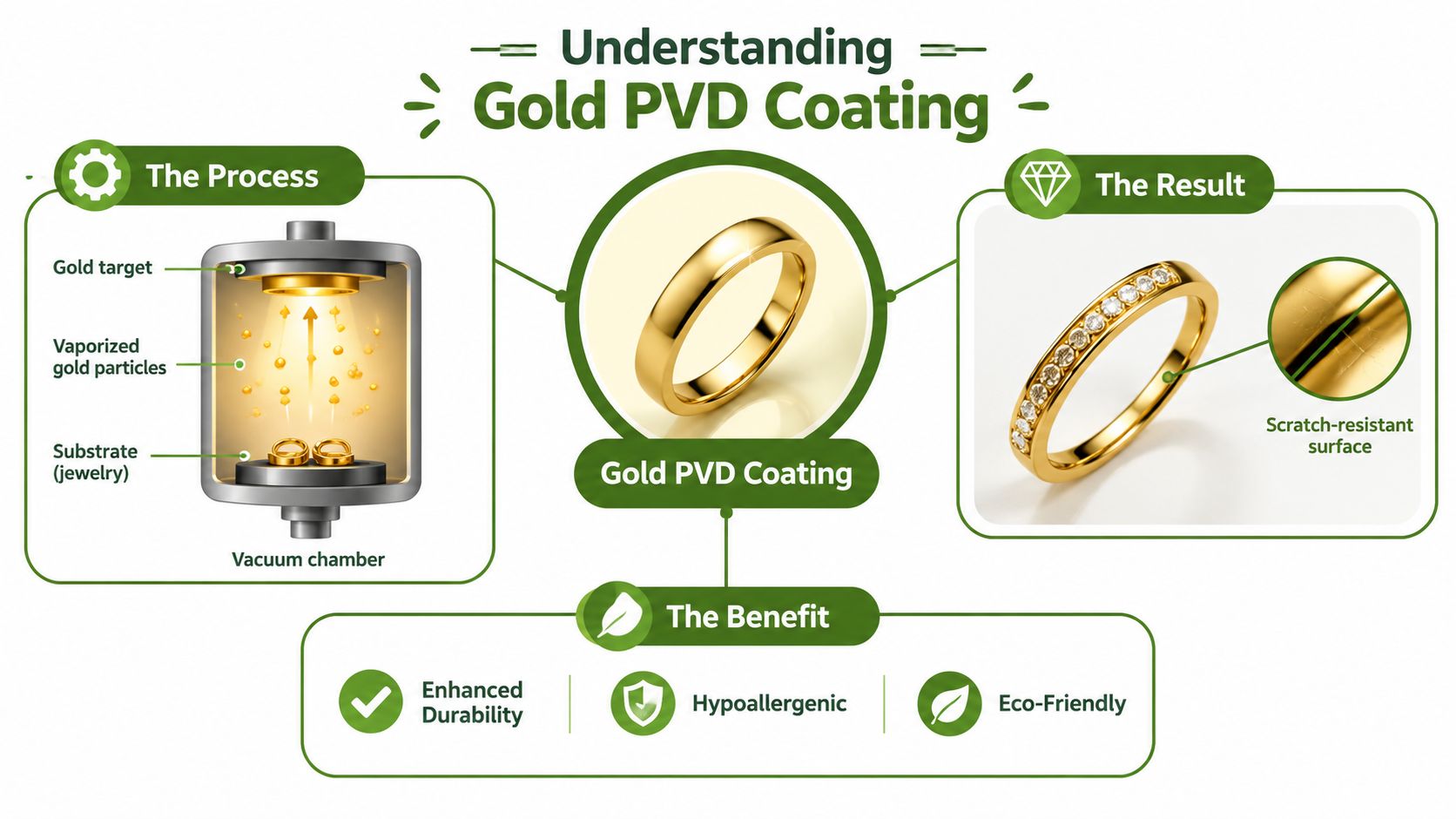
Buyer rule: ask the supplier to name the support layer and the gold layer separately. “0.5 μm PVD” is incomplete unless you know what the 0.5 μm measures.
For HonHo’s available coating routes, see our Plating & Finish Guide. Ready-stock specifications and custom-development options should always be confirmed separately.
What Does 18K Gold PVD Mean?
“18K gold PVD” needs a specification behind it. In the jewelry supply chain, the wording can be used in different ways. It may describe the verified composition of an 18K gold-alloy surface layer, or it may be used as a color reference for an 18K-style yellow gold appearance.
Before approving a quotation, ask these questions:
- Is real gold used in the surface layer?
- If yes, what gold alloy or purity is specified?
- What is the thickness of that gold layer?
- Is there a TiN or other support layer underneath it?
- What physical sample defines the approved gold color?
- Where and how will coating thickness be measured?
This avoids a common sourcing problem: two quotations can both say “18K PVD” while describing different coating systems. For resale, product wording should reflect the construction you can actually document rather than relying only on a color name.
PVD Thickness Is Not the Same as Gold Thickness
This is the most important technical point for comparing jewelry PVD quotations. A supplier may quote the thickness of the complete deposited film, the TiN support layer, the outer gold layer, or a reading that combines multiple layers. Those numbers should not be compared as if they were the same specification.
| Layer | HonHo custom stainless steel reference | Purpose |
|---|---|---|
| Optional protection | Reviewed by product and requirement | Additional surface protection where suitable. |
| Gold layer | Generally 0.03–0.10 μm | Defines the specified gold surface layer and final approved color. |
| TiN support layer | Default 0.5 μm | Provides a hard support layer beneath the gold finish. |
| Base metal | Commonly 304 or 316L stainless steel | Provides the structural substrate for the jewelry. |
Example: if a quotation says “0.5 μm PVD,” do not assume that means 0.5 μm of gold. At HonHo, our usual custom stainless steel specification treats the 0.5 μm TiN support layer and the 0.03–0.10 μm gold layer as separate items.
This distinction also matters when reviewing XRF or other thickness reports. The report should state what layer was measured, the measurement location, and whether the result is an individual reading, average, target, or minimum requirement.
Gold PVD vs. Electroplating, Gold Filled and Vermeil
PVD should not be treated as a universal “better than” label. The right finish depends on the base metal, design, intended price point, gold-content requirement, wear exposure, and the specification that the factory can consistently reproduce.
| Finish | What a buyer should confirm | Typical sourcing use |
|---|---|---|
| Gold PVD | Base metal, support layers, gold content, each relevant thickness, coverage, and finished-sample testing. | Commonly evaluated for stainless steel collections and frequent-wear fashion jewelry. |
| Gold electroplating | Gold thickness, underlayers, protective treatment, and base metal. | Flexible for brass and 925 silver, with thickness adjusted to the project. |
| Gold filled | Mechanically bonded gold construction and compliance with the terminology rules of the target market. | Used when the required bonded-gold construction is documented. |
| Vermeil | Sterling silver base plus the gold purity and thickness required for the intended market. | A specific silver-based product description, not a synonym for all gold-plated silver. |
HonHo also provides electroplating for brass and 925 sterling silver. Gold thickness can be customized according to the project, so the product page or quotation should distinguish the actual specification of a stocked item from higher-specification custom options.
Gold PVD Durability and Wear
There is no single lifespan that applies to every gold PVD jewelry item. Durability depends on the complete system: base metal, polishing and cleaning, layer structure, coating adhesion, geometry, assembly, friction, perspiration, cosmetics, chemicals, and how the customer wears the piece.
Why product category matters
Rings and bracelets usually experience more repeated contact and abrasion than earrings or pendants. Clasp recesses, chain overlaps, inner ring surfaces, hinge areas, and edges can also wear differently from broad decorative faces. A good specification therefore defines both the coating and the areas that need reliable coverage.
Is gold PVD waterproof?
PVD can be a strong route for water-resistant fashion jewelry, especially on suitable stainless steel designs, but the word “PVD” alone does not prove that an assembled item is waterproof. Stones, adhesives, soldered areas, moving parts, and coating coverage must also be considered.
For qualifying custom stainless steel PVD projects, HonHo can use 24–48 hour salt-spray testing as a production-quality reference where appropriate. Salt-spray hours should not be converted directly into “years of wear,” because laboratory corrosion exposure and real-life wearing conditions are different. See the discussion of ISO 9227 salt-spray testing below.
For customer-facing maintenance advice, use our Jewelry Care Guide. Avoid abrasive cleaning and unnecessary exposure to chlorine, harsh chemicals, perfume, and other substances that can affect jewelry surfaces or decorative components.
Choosing the Right Base Metal for PVD Coating
The base metal is part of the coating system, not a detail to ignore. The same gold color can behave differently on different substrates and constructions.
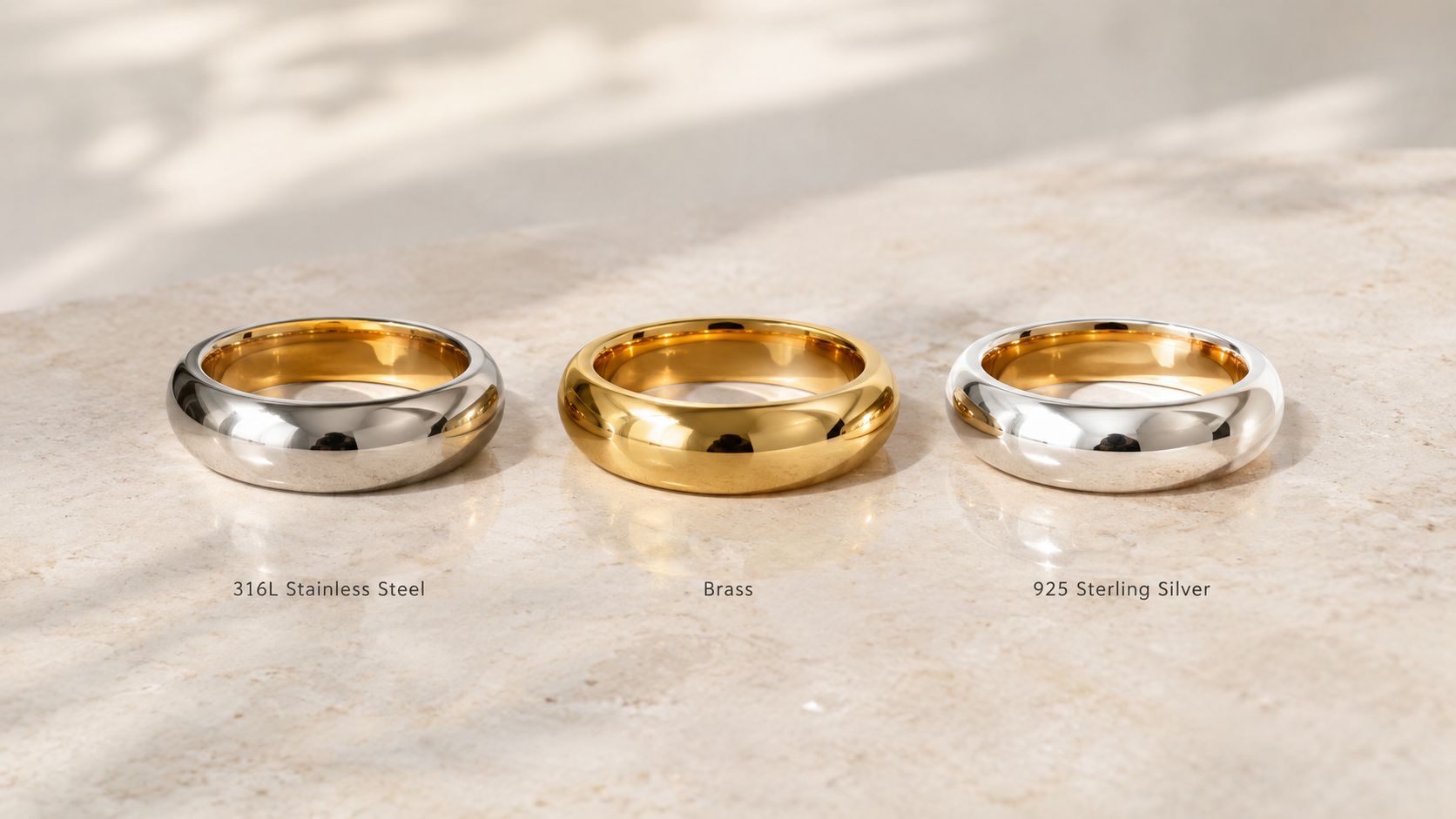
304 and 316L stainless steel
Stainless steel is a practical starting point for many PVD jewelry programs because it provides a stable structural substrate and works well for fashion jewelry that needs consistent finishing. Confirm the actual grade—such as 304 or 316L—rather than assuming alloy grade from appearance alone.
Brass and 925 sterling silver
Brass and sterling silver can also be reviewed for suitable PVD projects, but surface preparation, soldering, assembly sequence, stones, adhesives, and process temperature require closer review. At HonHo, selected brass and 925 silver designs can be evaluated for PVD; suitability should be confirmed on the actual design before production.
For base-metal selection and terminology, see our Jewelry Materials Guide.
Three Factory Details That Can Change a PVD Finish
1. Surface preparation comes before coating
PVD does not hide poor polishing. Scratches, polishing waves, pits, contamination, or inconsistent brushed texture can remain visible after coating. Approve the metal surface and texture before approving the final gold color. Cleaning and preparation should remove polishing residue and contamination that could interfere with adhesion.
2. Fixtures can create hidden or shielded areas
PVD parts must be held on racks or fixtures, and contact points or neighboring parts can shield portions of the surface. Rotating fixtures can improve exposure, but they do not automatically prove full coverage inside recesses or overlaps. A published rotating-fixture design for PVD illustrates why part orientation and exposure matter.
For jewelry, mark the important inspection areas on the sample: inner ring surfaces, clasp recesses, link overlaps, edges, and acceptable hanging/contact points. Do not approve only the front-facing decorative surface.
3. Assembly sequence affects coating suitability
Soldered joints, glued stones, pearls, hinges, springs, and other heat- or process-sensitive components can change how a design should be coated. The factory should decide whether components are coated before or after final assembly and how the approved appearance will be checked afterward.
This is also why a coating specification should be linked to a particular design rather than copied blindly across an entire collection.
How HonHo Specifies Gold PVD Coating
HonHo develops and manufactures fashion jewelry in stainless steel, brass, and 925 sterling silver, with in-house PVD and electroplating capabilities. For our usual custom stainless steel gold-PVD route, we separate the support layer from the gold layer so buyers can compare quotations clearly.
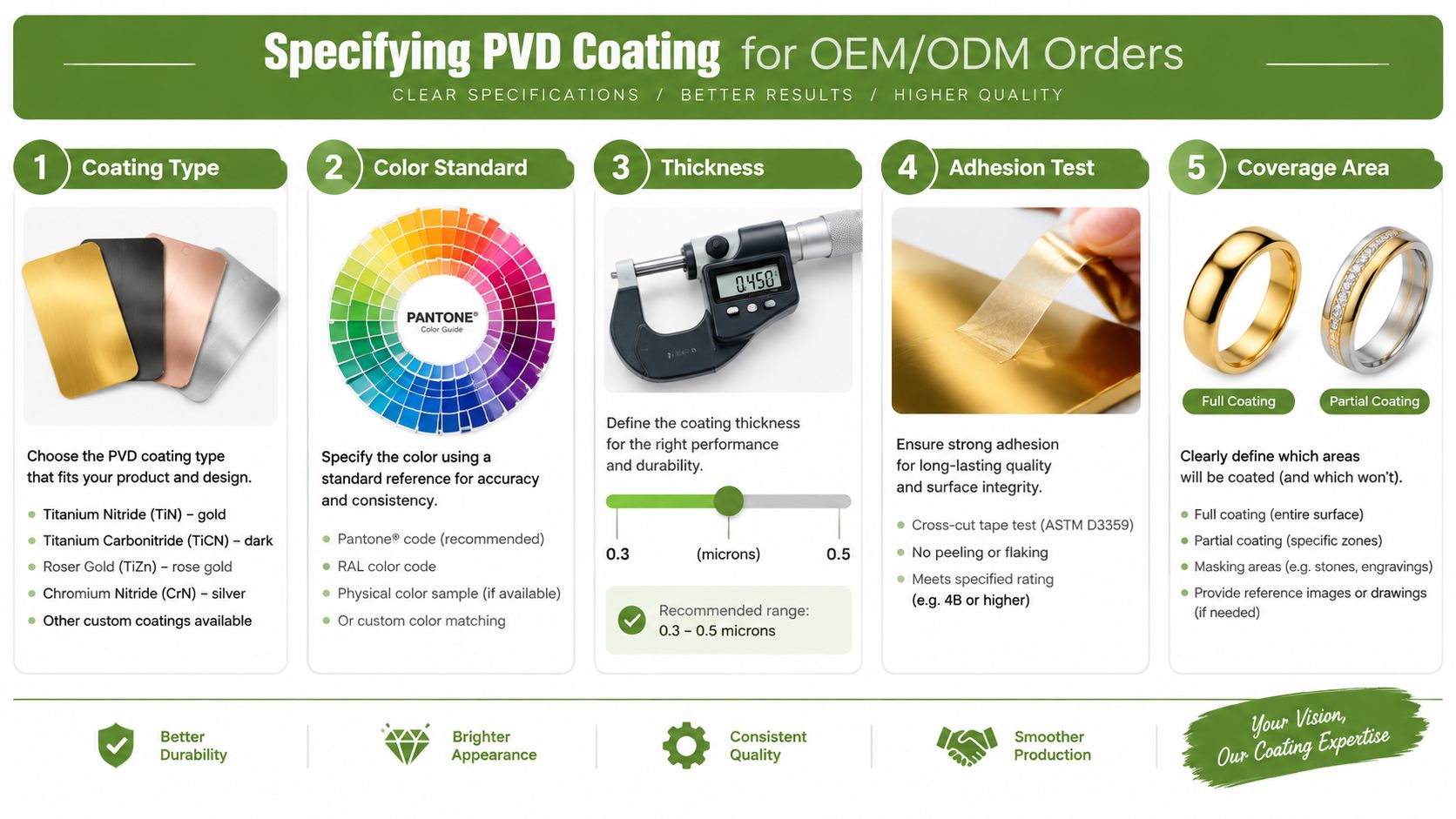
| Specification item | HonHo custom-development reference |
|---|---|
| Base metal | 304 / 316L stainless steel depending on the product specification. |
| TiN support layer | Default 0.5 μm, specified separately from the gold layer. |
| Gold layer | Generally 0.03–0.10 μm; higher requirements can be reviewed for suitable projects. |
| Color approval | Physical color sample or agreed reference, not screen color alone. |
| Protection | AF or gold-protection options can be reviewed for suitable products. |
| QC reference | Measurement method, locations, test conditions, and acceptance criteria agreed for the sample; 24–48 h salt-spray testing can be specified where appropriate. |
These are custom-development capabilities, not a claim that every ready-stock SKU carries the same coating structure. For ready-stock products, use the listing specification and request confirmation of any unlisted alloy, gold content, or thickness before relying on it in your own product copy.
For custom projects, HonHo’s current MOQ is 50 pieces per style. Typical sampling is 25–35 days for stainless steel and 25–30 days for brass or 925 silver. Bulk production is generally 35–45 days after sample approval and final order confirmation.
Wholesale Buyer Checklist: What to Put in the Tech Pack
Ask every supplier to complete the same fields. That makes price comparisons much more useful.
| Quotation wording | What is still missing | What to record |
|---|---|---|
| “18K gold PVD” | Whether 18K describes verified gold-alloy composition or only a color target. | Surface-layer material plus an approved physical color reference. |
| “0.5 μm PVD” | Which layer the number measures. | Support layer, gold layer, target/tolerance, and measurement points. |
| “Same gold finish” | Surface texture, underlayers, protection, and approved master sample. | Polished/brushed areas, layer construction, and sample revision. |
| “Full coverage” | Fixture contact points, recesses, overlaps, and post-assembly areas. | Marked photos or drawing showing required coverage and accepted exceptions. |
| “Passed testing” | Sample identity, method, duration, conditions, and pass/fail criteria. | Report tied to the same design and coating specification. |
Also record the base alloy, soldered areas, stones, adhesives, quantity, packaging, delivery terms, and any assembly performed after coating. Keep an identified physical sample for repeat orders instead of relying only on digital photographs.
Our Jewelry Sample Approval Checklist can be used to document the approved revision before bulk production.
Testing and Quality Verification
A useful test report identifies the sample, layer system, measurement or exposure method, test conditions, and result. A report for a different alloy or coating does not prove that your order has the same performance.
Thickness measurement
For suitable metallic coatings, X-ray methods covered by ISO 3497 can be considered with appropriate calibration and a correct model of the layer structure. Ask what was measured and where. Helmut Fischer’s XRF guidance also explains that measurement capability depends on the layer system and instrument configuration.
For a narrow ring edge or clasp, request the measurement location. A reading on a broad flat face does not by itself prove equivalent coverage inside a recess or at a fixture contact point.
Salt-spray testing
ISO 9227 provides methods for salt-spray corrosion testing, but it does not create a universal jewelry pass duration and it is not a direct predictor of customer wear life. Use salt-spray testing to compare a defined coating system under agreed conditions—not to claim that a fixed number of laboratory hours equals a fixed number of years.
Adhesion, wear, and finished-product checks
Where needed, add adhesion or wear checks suited to the coating thickness, shape, and intended use. A flat test panel can help monitor a process, but the actual clasp, ring, chain, or assembled jewelry item should also be inspected because geometry and assembly create different risks.
Gold PVD Coating: Frequently Asked Questions
Does gold PVD coating contain real gold?
It can, but the gold color alone is not proof. Ask the supplier to identify the surface-layer material and whether an actual gold or gold-alloy layer is used.
What does 18K gold PVD mean?
It should be clarified in the specification. “18K” may describe the verified composition of a gold-alloy layer, or it may be used only as a target color description. Ask for the surface material, gold-layer thickness, and approved physical color sample.
How thick should gold PVD jewelry be?
There is no single number that is correct for every item. First identify whether the quoted thickness refers to the gold layer, TiN/support layer, or total film. Then match the specification to the design, wear exposure, and required testing.
Is gold PVD jewelry waterproof?
PVD alone does not prove waterproof performance. Base metal, coverage, stones, adhesives, construction, testing, and care all matter. Use product-specific evidence before making a waterproof claim.
Is PVD better than normal gold plating?
Not automatically. PVD and electroplating are different coating routes. A well-specified electroplated brass or silver item can be more appropriate for one collection, while PVD stainless steel may be better suited to another. Compare complete specifications rather than process names.
Why can two 18K PVD samples look different?
Surface texture, layer composition, polishing, shape, lighting, and the approved color target all influence appearance. Approve the actual pieces together under agreed lighting and retain a physical master sample for repeat orders.
Need a PVD Specification for Your Jewelry Collection?
If you are comparing factories or developing a private-label collection, send HonHo the information below:
- Design drawing, CAD, or product reference
- Preferred base metal
- Target gold color or physical color sample
- Order quantity
- Target market
- Expected wear conditions and durability requirement
- Any stones, pearls, adhesives, hinges, springs, or soldered components
We can review the design and recommend a practical coating route, layer specification, sample-approval plan, and relevant QC checks before bulk production. For more detail, visit our Custom Jewelry page or review the Plating & Finish Guide.
For ready-stock jewelry, confirm the specification of the exact SKU before using custom-development coating data in your own product listing.


