

Source wholesale bracelets and charms by fixing the sales channel, material, carrier-and-charm fit, compliance documents, landed-cost target, and delivery date before comparing unit prices. This exposes expensive differences that a quote alone will not show: an unverified material claim, an unreliable clasp, a charm loop that does not clear the carrier, or a test report that covers a different article.
The main choice is ready stock for a smaller market test versus custom production for controlled specifications and branding. The sections below turn that choice into a quote brief, sample check, and reorder plan.
Table of Contents
- How to Source Wholesale Bracelets and Charms Step by Step
- Stainless Steel, Brass, 925 Silver and Plated Finishes Compared
- Style Mixes That Sell Well for Resale
- Building a Charm Range That Reorders Well
- Compliance, Minimums and Lead Times to Check Before You Order
- Pricing, Markup and What Your Real Cost Includes
- Frequently Asked Questions About Sourcing Wholesale Bracelets and Charms
How to Source Wholesale Bracelets and Charms Step by Step
Start by choosing between ready-stock pieces for a faster market test and custom pieces developed to your specification. The route affects minimums, samples, packaging, production time, and reorder planning. Do not mix the two when comparing quotes.
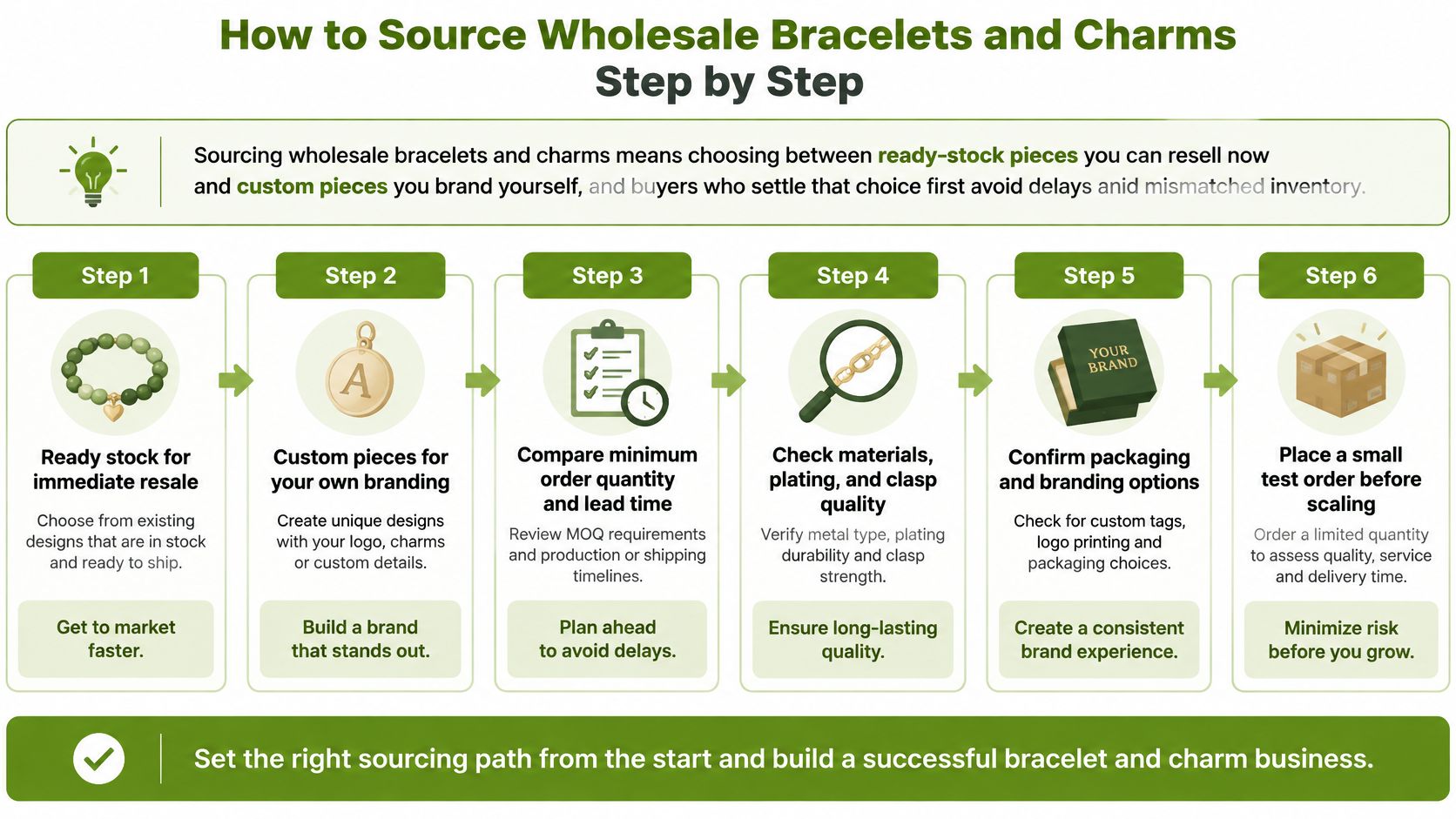
- Define your channel and customer. A boutique floor, Shopify store, marketplace shop, and reseller network need different price points, packaging, and product data.
- Choose your material tier. Decide between 316L stainless steel, brass, 925 sterling silver, or a plated finish before you fall for a design.
- Build from an evergreen core. Start with bracelets you'll stock all year, then add a smaller trend layer you can exit without pain.
- Check minimums and sampling against your launch date. A low minimum that arrives late doesn't help a seasonal launch.
- Set a price target from landed cost. Work back from your intended retail price and markup, not forward from a supplier's unit price.
- Confirm destination documents. List the test reports, declarations, and labeling each market requires before you order.
- Specify compatibility and approve a sample. Record the carrier dimensions, charm loop or jump-ring dimensions, wire diameter, orientation, clearance, closure, and finish. Then use a jewelry sample approval checklist to sign off the exact sample.
These decisions are connected. A compliance gap can rule out a material, while the required connector or plating system can change the price. Resolve those conflicts in the brief, before they become inventory.
Quote rule: Send every supplier the same one-page brief covering channel, material, target dimensions, carrier-and-charm interface, finish, packaging, documents, budget, and dates. A quote is comparable only when the specification is comparable.
Stainless Steel, Brass, 925 Silver and Plated Finishes Compared
Think of a bracelet as frame and paint. The base metal is the structure. The finish is the layer on top that sets the look and affects how long that look lasts. Buyers get into trouble when they price and label the paint as if it were the frame.
Materials and Finishes for Resale Bracelets and Charms
| Material or finish | What it is | Best retail positioning | Wear and care | Labeling caution |
|---|---|---|---|---|
| 316L stainless steel | Corrosion-resistant stainless alloy, confirmed 316L grade | Everyday fashion and gift lines at accessible price points | Holds its base well; plated versions can wear through over time | Don't call it nickel-free without test results |
| Brass | Copper-zinc base metal, often finished in gold plated or silver tones | Mid-range fashion and charm pieces | Can discolor when the finish wears; include care notes | Name the base metal and the finish separately |
| 925 sterling silver | Metal containing at least 92.5% pure silver | Higher-value and classic jewelry positioning | Tarnishes with sulfur; polishing restores the shine | Use sterling only when the metal meets the 925 standard |
| Gold plated | Gold layer applied over a base metal such as stainless steel or brass | Gift and fashion positioning with a gold look | Surface can wear where clasps and skin rub | Describe the base metal and state that the finish is plated; give plating thickness only if confirmed |
| Silver plated | Silver layer applied over a base metal | Budget fashion positioning | Finish life depends on plating specification, contact points, care, and use | Use silver plated, never sterling |
316L stainless steel can suit everyday and gift lines when the supplier confirms the grade for the specific article. Treat plated versions as a base metal plus a separate finish specification: the surface color and wear pattern depend on the coating, contact points, care, and use. If you're considering coated options, review how gold PVD coating differs before you write care claims.
Brass supports detailed forms and fashion price points, and it is commonly finished in gold plated or silver tones. When plating wears at edges, clasps, or other high-contact areas, the base can become visible. Put realistic care instructions in the product record and customer-facing listing.
The Labeling Line You Can't Blur
Sterling is a metal claim. Plated is a coating claim. The Federal Trade Commission guidance on buying platinum, gold and silver jewelry states that "silver," "sterling," and "sterling silver" describe products containing at least 92.5% pure silver, and that "925" means 925 parts per thousand are pure silver. It also notes that silver-plated items have a layer of silver applied over a base metal.
That distinction drives pricing and returns. A 925 sterling silver charm and a silver plated brass charm shouldn't carry the same material-based retail value, title, or description. Request material specifications from your supplier and keep them aligned across packaging, invoices, and marketplace listings. Marketplaces scrutinize precious-metal claims, and a short product title can imply solid metal even when you didn't intend it.
State plating thickness only when the supplier confirms it in writing. Otherwise, name the base metal and finish accurately and leave the thickness out. An omitted specification is better than an invented one.
Style Mixes That Sell Well for Resale
Build the assortment by product function, not by selecting unrelated styles one at a time. Each family below serves a different fit, layering, gifting, or personalization need.
- Chain and link bracelets: Your everyday base. They layer easily, photograph clearly, and give charm carriers a natural home.
- Open and adjustable cuffs: A flexible fit route, but still record the inside diameter, opening, and intended wrist range instead of assuming one size fits everyone.
- Beaded bracelets: Giftable and easy to layer, covered in more depth in this guide to beaded bracelets at wholesale.
- Charm bracelets: Your personalization engine, where the first sale can lead to add-on charms later.
- Bangles and stackable sets: A flexible trend layer, since customers can wear one piece or build a set over time.
Across those families, you'll see recurring motif groups: heart, floral and leaf, star and moon, butterfly and bow, geometric, shell and ocean, snake and animal, minimalist, and vintage. Motifs help customers shop by meaning or outfit, while the family decides how the piece fits and wears.
Separate the Evergreen Core From the Trend Layer
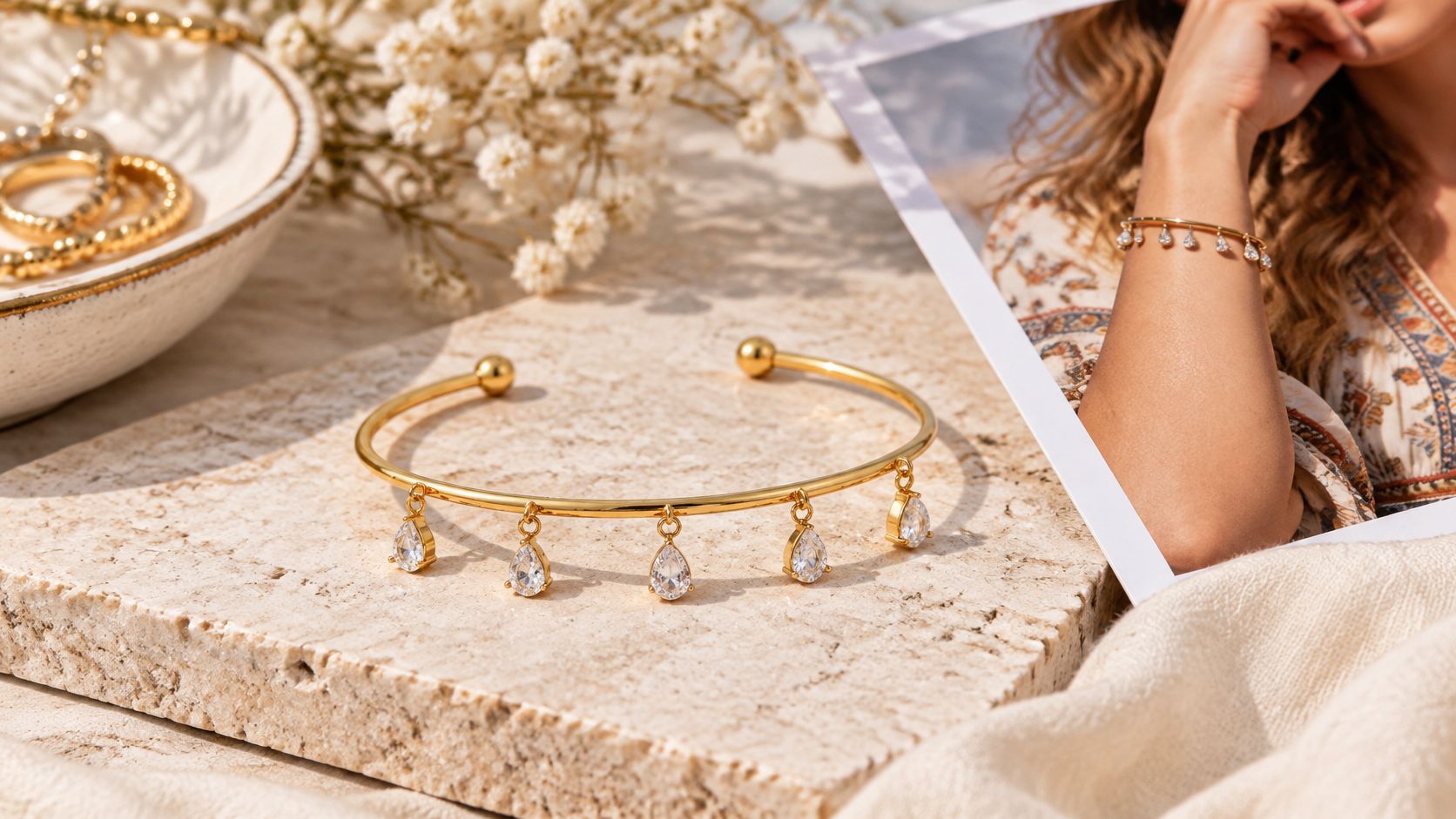
Evergreen styles include plain chain links, minimal motifs, and open cuffs that are not tied to one short seasonal theme. A Gold Plated Stainless Steel Clear Stone Drop Open Cuff Bracelet, for example, combines an open cuff with small clear stone accents. Before listing it for a target customer, confirm the specific piece's base-metal record, inside diameter, opening, and intended wrist range; an open construction does not prove universal fit.
Trend styles can include seasonal motifs, bold colorways, or a silhouette that is currently receiving unusual attention. Buy them more cautiously because a late reorder may arrive after the demand window. A gold-tone oval-link bracelet with pearl accents can sit between the core and trend layers, but the final material and pearl description must follow the product specification rather than the visual impression.
Keep the trend share smaller than the evergreen core, and size it by the sell-through your shop records, not by search buzz.
Building a Charm Range That Reorders Well
A charm range has three layers, built from the bottom up: carriers, charms, then price tiers. Set the carrier specifications first so each charm fits the bracelet it is meant to complement.
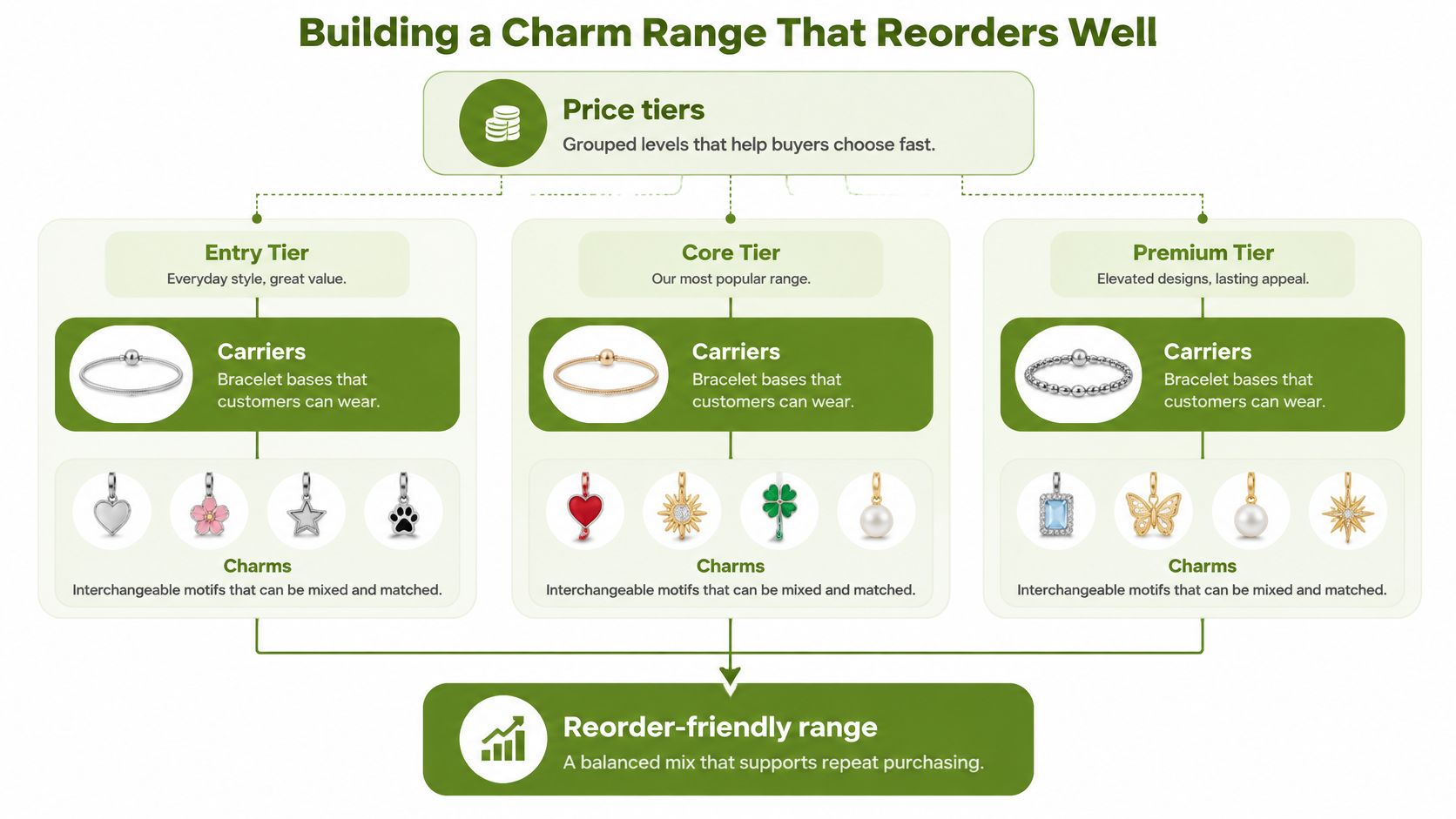
- Carriers first. These bracelet bases are worn daily, so clasp strength, length, and comfort matter more than novelty.
- Charms second. These interchangeable motifs give customers options to add, swap, and gift over time.
- Price tiers across both. Group carriers and charms into clear levels, making it easy to choose an entry option or trade up without confusion.
The Emergen Research beaded jewelry market report offers one commercial estimate for the category, but its market figures do not establish demand for a particular store, motif, or price point. Use your own search, sales, return, and reorder data to size the range.
Start Compact, Then Let Reorders Tell You What to Expand
As a planning example—not a universal opening buy—a shop might compare three carriers, twelve charms, and two price points. The useful part is the ratio: a compact carrier base with enough compatible motifs to test attachment and reorder behavior. Italian-style bracelet charms at wholesale illustrate why the interface must be explicit: a customer expects a new charm to fit the carrier already owned.
Use sales data to decide what earns a reorder. Track attachment rate, or how often a carrier sale includes an extra charm, alongside average charms per order, which shows whether personalization is raising basket size. Record the repeat purchase interval to see how soon buyers return, and monitor return rate for problems with fit, finish, or compatibility. Finally, calculate margin after packaging and marketplace fees. A low unit cost can still leave too little room once those costs are included.
Do not assume charms or clasps will reorder before bases. Measure that pattern from your own orders. Whether the range expands or stalls depends on consistency in the clasp, loop or jump ring, wire diameter, opening, orientation, weight, and finish. Lock those specifications before adding more motifs.
| Sample check | Record | Approval question |
|---|---|---|
| Carrier interface | Link or opening dimensions, wire diameter, clasp type | Can the specified connector pass through and move without binding? |
| Charm interface | Loop or jump-ring inner and outer dimensions, orientation, closure | Does the charm hang in the intended direction and remain secure? |
| Movement and contact | Clearance, sharp edges, rub points, adjacent-charm contact | Does normal movement damage the finish or interfere with the closure? |
| Repeatability | Approved sample photos, measurements, component codes, finish reference | Can the same combination be checked against the next batch? |
Compliance, Minimums and Lead Times to Check Before You Order
Set the destination-market compliance brief before production. Material, plating, component selection, test scope, traceability, and labeling are harder to correct after the batch is finished. A laboratory report is useful only when it can be tied to the article and components you are buying.
The NAJ Code of Practice on product safety is a useful industry summary of EU and Northern Ireland requirements covering nickel, lead, cadmium, certain phthalates, traceability, product identification, and the EU-based Responsible Person. Confirm the requirements that apply to the destination and sales route with current official material; the summary is not a substitute for the legislation. For U.S. resale, titles, packaging, and advertising should also stay aligned with the material specification, especially for gold, silver, and sterling claims.
For skin-contact pieces, the Perles & Co 316L stainless steel bangle listing states a product-level compliance claim, but a supplier listing is not the regulatory source or proof for another article. The European Chemicals Agency's nickel-restriction factsheet gives release limits of 0.5 micrograms per square centimeter per week for articles intended for direct and prolonged skin contact and 0.2 micrograms per square centimeter per week for post assemblies used during epithelialisation after piercing. A non-nickel coating must keep the article at or below the 0.5 limit for at least two years of normal use. 316L can contain nickel in the alloy, so alloy identity and nickel release are different questions.
Ask for evidence on the finished article and the relevant components, not a raw-alloy certificate presented as a finished-jewelry result.
Write the Specification, Don't Rely on Labels
Ask for the laboratory report, method, test date, tested article or component identifiers, plating specification, batch reference, and declaration of conformity relevant to the destination market. Do not carry hypoallergenic or tarnish-resistant claims into the listing unless the evidence and defined scope support them.
Example purchase-spec line: Confirmed 316L stainless-steel article for direct and prolonged skin contact; nickel-release evidence for the finished plated or unplated article and the relevant chains, clasps, jump rings, charm bases, and connectors; report and method identified. Adapt the limit, method, and component scope to the destination and intended use.
For coated articles, confirm whether the applicable durability and release assessment accounts for coating wear; do not turn an initial reading into a lifetime claim. Stainless steel, brass, and sterling silver may need different test and labeling workflows inside one assortment. Check the report's exact component scope: a tested bangle body does not automatically cover its clasp, jump ring, or charm connector.
Minimum Orders and Lead Times by Order Route
| Order route | Sample lead time | Fulfillment or production time | Notes |
|---|---|---|---|
| Ready-stock wholesale order | Not applicable | Usually dispatches within 3 business days after payment, subject to quantity and destination | Check the product page for the available quantity and any price tiers; useful for testing before custom |
| Custom brass or 925 sterling silver | 25 to 30 days | 35 to 45 days after sample approval | 50 pieces per style and color; confirm which plating, engraving, and packaging options apply to the design |
| Custom 316L stainless steel | 25 to 35 days | 35 to 45 days after sample approval | 50 pieces per style and color; confirm plating, engraving, and component specifications for each style |
These are the current standard routes described in HonHo's wholesale ordering guide; a specific quote should still confirm capacity, approvals, quantity, production, and transit for the order. Product-level ready-stock quantities are different from the custom minimum. Production and transit are also separate from sample time. Read the overview of jewelry manufacturing in China when comparing factory routes and the scheduling work each adds.
Run This Pre-Order Checklist
- Check the minimum and price tier on each ready-stock product page; for custom work, confirm the minimum per style and color and whether colors can combine.
- Name the approved sample, approver, due date, spec revision, plating or finish reference, engraving placement, component measurements, and packaging.
- Confirm which laboratory report covers which finished article and components, for which destination and intended use.
- Build the launch calendar backward through sampling, approval, production, transit, listing, and a practical buffer.
- Request the remedy for defects or specification errors in writing before production.
HonHo Wholesale Jewelry lists business hours of Monday to Saturday, 9:00 to 18:00 HKT and dispatch from Dongguan, China. Include your time zone and required delivery date in the inquiry so the quote can separate production from transit.
Pricing, Markup and What Your Real Cost Includes
Your wholesale unit price is only the first cost layer. The retail price has to carry packaging, freight, fees, and the orders that come back. If you set price from unit cost alone, your margin exists on paper and disappears in the bank account.
Cost Layers That Change Your Margin
| Cost layer | What it includes | How it affects margin |
|---|---|---|
| Wholesale unit cost | Price per piece from the supplier | Sets the floor for any markup calculation |
| Packaging and inserts | Bags, boxes, cards, and branded packaging if used | Adds a cost per order that's easy to forget |
| Shipping and duties | Freight from supplier to buyer, plus import charges where they apply | Set by destination, weight, and shipment method; calculate it for your market before pricing |
| Marketplace and payment fees | Platform commissions and payment processing | Reduces margin on every sale; calculate it for each sales channel you use |
| Returns and breakage | Refunds, replacements, and damaged stock | Lowers effective margin, especially on fragile or low-value items |
Markup here means retail price divided by wholesale unit cost. A 2x figure is only a hypothetical reference: it says nothing about profit until packaging, freight, duties, channel fees, promotions, returns, and tax treatment are included.
Material and finish affect positioning, but neither guarantees a price point. Documented 925 sterling silver, a confirmed base metal, a controlled finish, component quality, packaging, and product data all shape what a buyer can credibly offer. Compare contribution margin by SKU instead of applying one multiplier to every material.
A Hypothetical Worked Example
As a deliberately simplified example, a US$10 wholesale unit cost at 2x produces a US$20 list price. That is not a margin forecast. Deduct packaging, allocated freight and duties, payment or marketplace fees, discounts, and an evidence-based returns allowance. Reprice when actual channel costs differ from the planning sheet.
Buy deeper on evergreen styles with proven sell-through. Buy shallow on trend pieces you may not reorder. Use a ready-stock order to test a style before committing to a custom minimum, and treat that minimum as a cost floor, not as evidence the style will sell.
Frequently Asked Questions About Sourcing Wholesale Bracelets and Charms
Can I Sell Under My Own Label
Yes. HonHo's current standard custom minimum is 50 pieces per style and color, with plating, logo engraving, and branded-packaging options available for suitable projects. Confirm the options, added costs, approvals, and documents for the specific design before production.
Can I Call 316L Stainless Steel Nickel-Free
Only if test results for the finished article support that claim. Otherwise, identify the alloy and state the tested nickel-release figure. The alloy name alone does not establish how the finished piece performs against skin-safety requirements.
Is Sterling Silver Worth Stocking for a Mid-Range Shop
It can fit a mid-range assortment when the 925 sterling silver content is documented and the planned retail price leaves room for your costs. Compare the supplier quote with your intended shelf price before choosing the range. Label silver-plated pieces separately so customers can distinguish them from sterling silver.
What If I Need to Return a Custom Run
Agree on the remedy before production starts. Ask the supplier to put the process for defects, incorrect specifications, and damaged goods in writing, including what evidence they need and whether the remedy is replacement, repair, or credit. Custom work may not be handled like ready stock, so settle those terms before approving the order.
How Should I Reorder After Changing Suppliers
Compare the new sample with your approved piece for dimensions, finish, closure, charm fit, and packaging. Send the new supplier the existing product specification and confirm any differences before placing the run. A similar-looking bracelet may not be an exact match, so keep product descriptions and photos aligned with the version you receive.
Browse ready-stock bracelets, charms, and mixed-material assortments at HonHo Wholesale Jewelry to compare available stainless steel, brass, and 925 sterling silver styles. For a comparable custom quote, send the material, target quantity, carrier-and-charm measurements, finish, market, packaging, target price, and required delivery date. Confirm the final product specification and order terms before committing.


