

For retailers sourcing beaded bracelets wholesale, the safest buying decision is to approve the complete construction—not just the bead color. Before committing, record the bead material and diameter, finished inner circumference, stringing system, metal-component specification, and the sample tests you will use. Those details determine fit, handling durability, labeling, landed cost, and whether a supplier can reproduce the same style on reorder.
A bracelet can photograph well and still fail at the bead holes, knot, crimp, clasp, or stretch recovery. The useful question is therefore not “Which beads look best?” but “Which construction matches the intended customer, wear pattern, price position, and repeat-order plan?”
Table of Contents
- Introduction to Beaded Bracelets Wholesale for Resale
- Understanding Beaded Bracelets Wholesale Basics
- Bead Types and Materials That Drive Durability and Style
- Stringing Methods and Construction Quality to Check Before You Buy
- Customization and Private Label Options for Your Store
- Inventory Planning Pricing and Assortment Strategies With Examples
- Conclusion and Next Steps for Sourcing Beaded Bracelets Wholesale
Introduction to Beaded Bracelets Wholesale for Resale
Wholesale buying turns a bracelet into a repeatable retail specification. A buyer has to decide which styles deserve shelf space, how they should fit, what material claims can be supported, and what evidence must match the approved sample. That is more useful than choosing from photographs alone.
Marketplace category pages can help with merchandising ideas, but they do not prove how a particular bracelet is made. For example, Faire's beaded and woven bracelet buying guide shows the breadth of the category; use it for assortment context, then return to the supplier's product-level construction and documentation.
A practical brief starts with six fields:
- Customer and use: everyday stack, gift item, occasion piece, wellness story, or seasonal color.
- Fit: finished inner circumference or agreed wrist range, plus whether the measurement is taken relaxed or under tension.
- Beads: material, diameter, shape, hole size and acceptable natural variation.
- Stringing: elastic, cord, wire or links, including knot, crimp, clasp and end treatment.
- Metal components: base metal, finish, skin-contact location and evidence required for the destination market.
- Approval: a named sample, color reference, packaging format and agreed inspection record.
HonHo's wholesale jewelry buying guide explains how to choose between ready stock, private label, OEM and ODM. For beaded bracelets, that choice should come before detailed pricing because custom beads, stones, cords, charms and packaging can each change the feasible minimum and schedule.
Understanding Beaded Bracelets Wholesale Basics
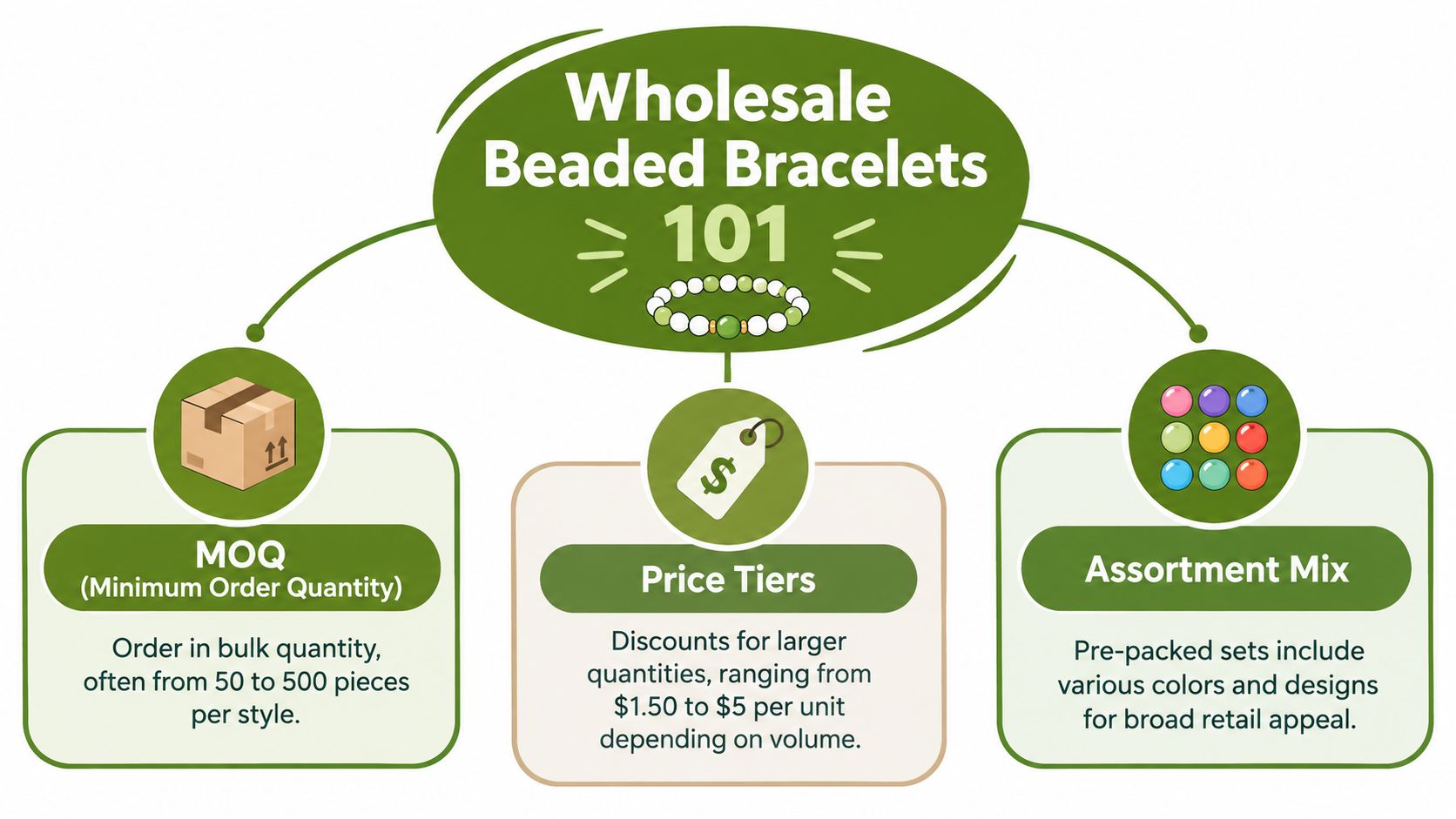
Separate the ordering route from the product specification. Ready stock is useful for testing an assortment quickly. Stock-based private label adds brand presentation to available products. Custom development is appropriate when bead dimensions, color combinations, components, logo treatment or construction must be controlled.
| Ordering route | Best for | Confirm before ordering |
|---|---|---|
| Ready stock | Fast tests and mixed assortments | Actual variant, quantity, stock, product-level minimum and dispatch terms |
| Stock-based private label | Existing styles with branded presentation | Logo method, card or pouch, artwork approval and packaging minimum |
| Custom production | Controlled bead, fit, construction or exclusive details | Specification, sample, per-style/color minimum, component sourcing and project schedule |
Wholesale directories can be useful for finding suppliers, but a directory listing is not a current quotation. Keep the original Wholesale Central jewelry listings as a discovery resource, then compare the selected supplier's live terms and written quote.
How to read a wholesale listing
A useful listing should let you identify what is being sold rather than infer it from styling. Check:
- Unit of sale: one bracelet, a pair, a coordinated set, or an assorted pack.
- Material wording: natural stone, reconstructed stone, dyed material, glass, acrylic, wood, shell, pearl or imitation material should not be treated as interchangeable.
- Dimensions: bead diameter and finished bracelet fit are different measurements; ask for both.
- Construction: elastic, cord, beading wire, chain or links, including the closure and finishing points.
- Finish: identify the base metal and surface finish of spacers, charms and clasps instead of accepting “gold tone” as a complete specification.
- Status: ready stock, made to order or custom development.
- Reorder reference: color, lot, sample or specification used to judge the next production run.
This retained video embed is an additional visual reference. Its presence does not establish the specifications or quality of any HonHo product, and playback must be checked separately from the article text.
When a listing omits a field that affects fit or failure risk, treat it as a question for the supplier rather than filling the gap with an industry average.
Bead Types and Materials That Drive Durability and Style
Bead material affects weight, surface variation, breakage risk, labeling and perceived value, but there is no universal durability ranking. A well-finished glass bead on an appropriate wire can be a better retail product than a poorly drilled stone bead on under-specified elastic.
Commercial market summaries such as Market Intelo's beaded jewelry market overview may describe category demand, but they are not evidence for an individual bracelet's material, service life or sales potential.
| Material family | Buyer checks | Useful retail position | Important limitation |
|---|---|---|---|
| Natural stone | Species or trade name, treatment disclosure, color range, inclusions, drilling and lot consistency | Material-led and giftable assortments | Natural variation must be approved rather than promised away |
| Glass or crystal | Edge finish, coating, chips, hole quality, color consistency and weight | Polished color stories and occasion stacks | “Crystal” can be a design term; request the actual material description |
| Acrylic or resin | Mold seams, scratches, color transfer, hole finish and heat sensitivity | Lightweight, novelty and seasonal designs | Do not describe it as stone, glass, amber or pearl without support |
| Wood or plant-derived beads | Moisture response, coating, splinters, color transfer and odor | Casual and tactile collections | Surface behavior varies with species and treatment |
| Metal beads and charms | Base metal, finish, plating route, contact points, edges and attachment | Branded details and higher visual contrast | Factory capability does not establish the specification of a selected SKU |
Match material to the promise
Product copy, packaging and price should match the approved material record. A natural stone name should be backed by the supplied specification and any agreed treatment disclosure. “Gold plated” describes a surface, not the bead or component underneath it. “925” applies to qualifying silver components, not automatically to an entire mixed-material bracelet.
The original JewelTrendPro's sterling silver hallmark guide remains available as background. For US descriptions, the controlling reference is the current FTC Jewelry Guides provision for silver products. Apply it to the actual marked or described component and target market; do not infer composition from color or a supplier photograph.
For a clearer comparison of stainless steel, confirmed 316L, brass and 925 sterling silver, use HonHo's jewelry materials guide. The selected quote or SKU record remains the source for the actual grade, finish and component mix.
Stringing Methods and Construction Quality to Check Before You Buy
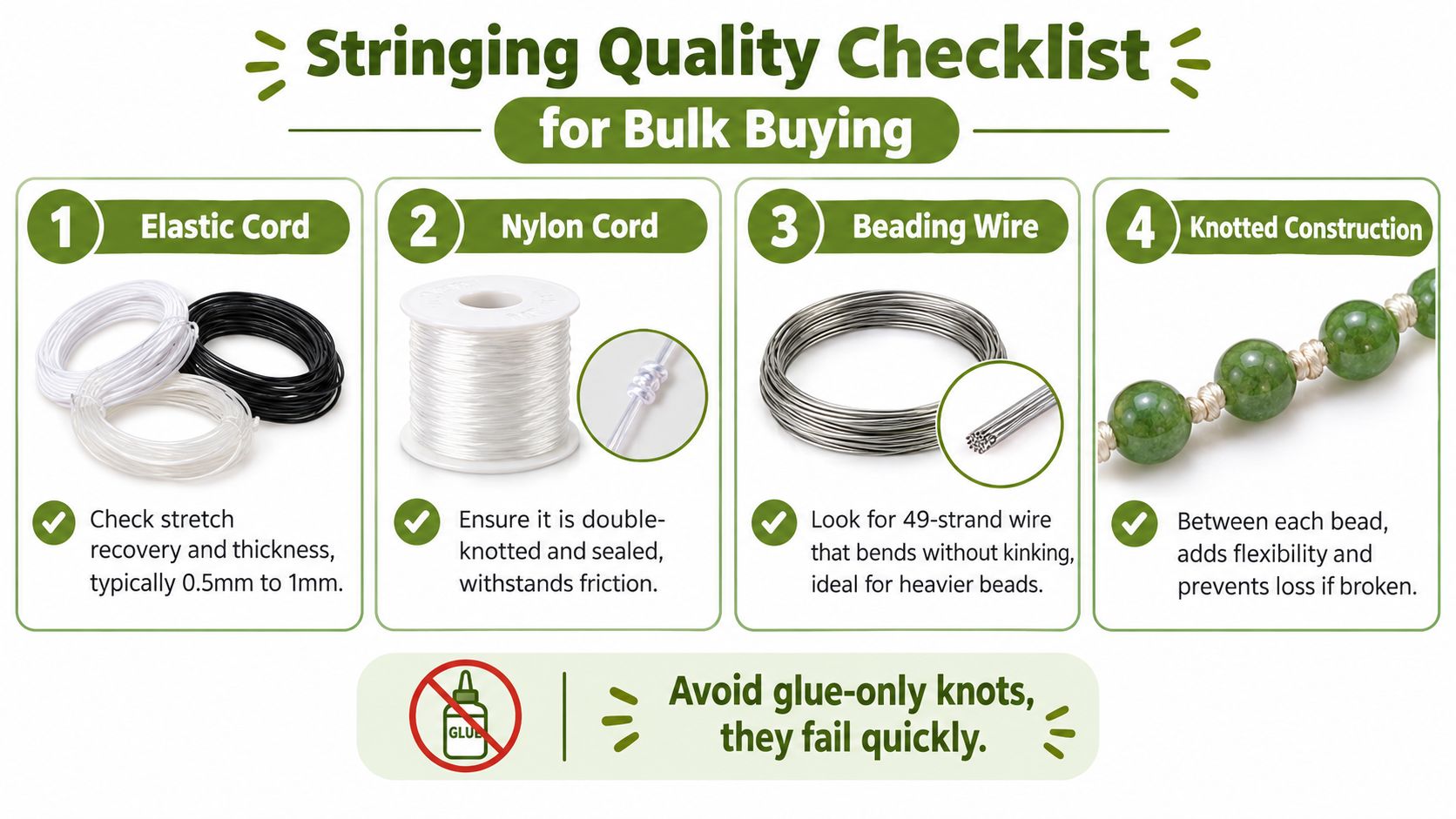
The stringing system should be selected around bead mass, hole finish, expected flexing, closure and customer fit. Elastic offers easy on-and-off use but must recover after repeated extension. Cord can suit knotted or adjustable designs if the knot and ends are controlled. Beading wire can support heavier beads when the wire, crimps, guards and clasp are specified together. Links and chain shift the main checks to soldering, jump rings, plating and closure function.
Maker-oriented guidance such as Handmadelytics' bead bracelet construction guidance can suggest questions, but it does not prove that one failure mode dominates every construction. Record what the sample does under the agreed check instead.
What to inspect in a sample
| Check | Method | Record | What it does not prove |
|---|---|---|---|
| Fit | Measure the relaxed finished inner circumference and try the agreed wrist range | Measurement method, tolerance and fit notes | One size does not fit every customer |
| Stretch recovery | Extend to the agreed limit for a defined number of cycles, rest, then remeasure | Before/after circumference and visible cord condition | A short bench check does not predict a universal wear life |
| Bead holes | Inspect edges and rotate beads while the stringing is lightly tensioned | Chips, burrs, sharp edges, hole consistency and cord marks | A visual pass does not replace a relevant performance test |
| Knots, crimps and closures | Inspect placement, security, exposed ends and movement under use | Approved construction photos and any movement or slippage | One passing sample does not prove every production unit |
| Finish and color | Compare under consistent light with the approved sample or color reference | Acceptable lot variation, coating condition and component alignment | Color matching does not establish material or plating thickness |
Agree the protocol with the supplier before treating a reading as pass or fail. A pull test without fixture, loading rate, direction, sample conditioning and acceptance criterion is only a number. It must not be converted into a claim about years of wear.
Customer care should also follow the actual materials. HonHo's jewelry care guide is a starting point, but stone treatments, wood finishes, elastic and plated components may need product-specific instructions.
The original Commercive's beaded bracelet sourcing guidance offers general sourcing context. Do not apply another supplier's MOQ range to HonHo or to a particular bracelet. HonHo's current custom-planning reference starts from 50 pieces per style and color; special beads, stones, packaging or sourced components can require a different minimum, and the written quotation controls.
Customization and Private Label Options for Your Store
Customization should solve a clear retail problem: a missing wrist size, a signature color combination, a branded charm, a more secure construction, or packaging that makes the assortment easier to present and replenish.
Trend summaries such as Accio's bracelet trend coverage can generate ideas, but they should not be used as a sales forecast. Translate any idea into a testable buyer decision: which customer, price position, size range and reorder signal would justify the style?
Choose the right customization lever
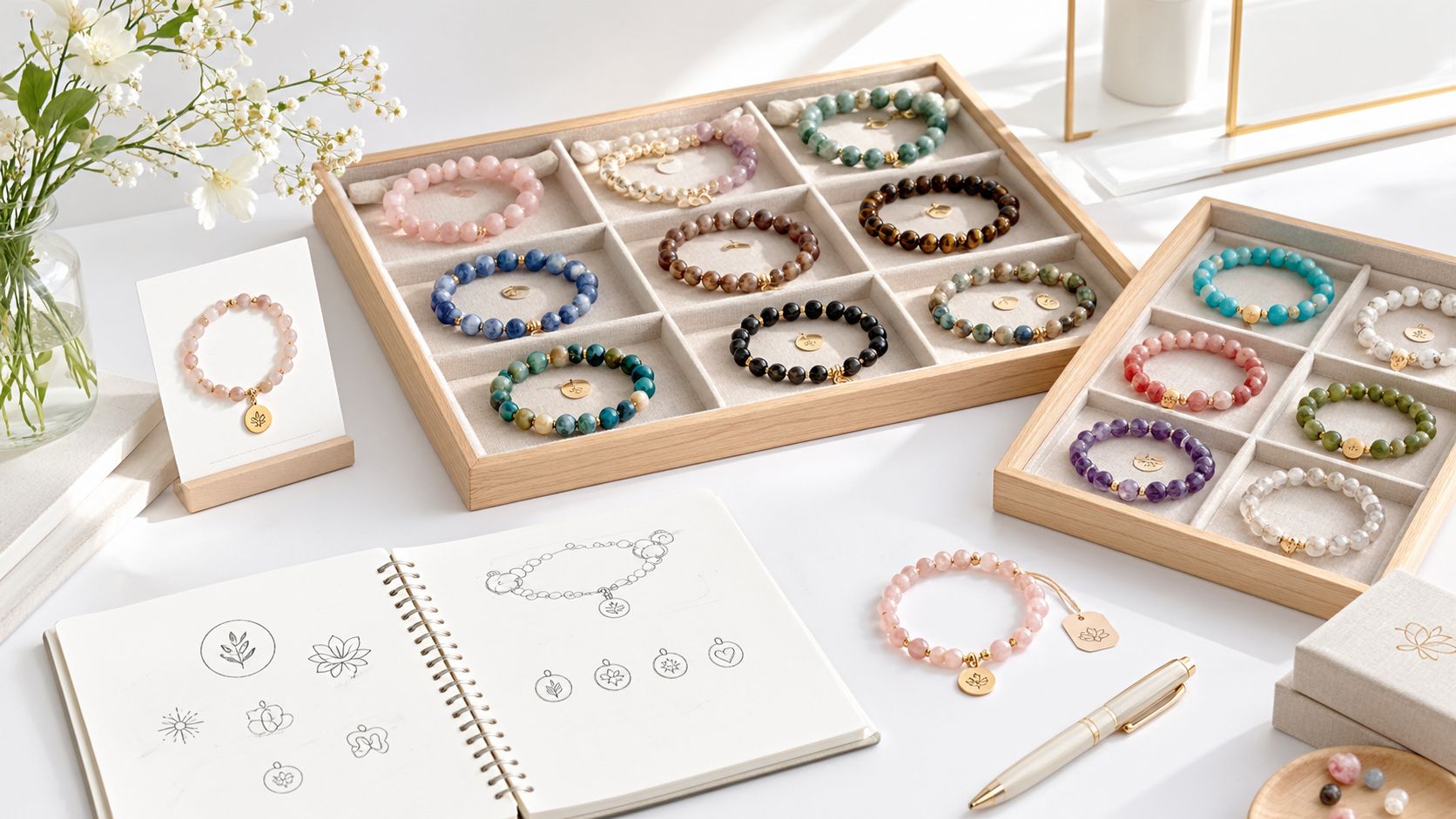
- Colorway: provide physical references or defined color targets and state acceptable lot variation.
- Bead specification: record material, treatment, shape, diameter, hole size and layout rather than only attaching a mood board.
- Fit and construction: define circumference, extender or closure, stringing material, knots, crimps, spacers and tolerances.
- Brand detail: specify logo file, placement, scale, legibility, base material and finish of any tag or charm.
- Packaging: confirm card or pouch dimensions, barcode location, warnings, care text, country-of-origin treatment and packing quantity.
HonHo's private-label jewelry service supports stock-based and custom routes. Current planning references are 50 pieces per style and color for custom production; brass and 925 sterling-silver samples are generally planned at 25–30 days, stainless-steel samples at 25–35 days, and bulk production at 35–45 days after sample approval. A beaded design may rely on separately sourced beads, cord or packaging, so its quotation can set a different minimum or schedule. These factory references are not a promise for every ready-stock SKU.
Send a single approval brief that identifies the customer, material claims, dimensions, color references, construction, logo, packaging, inspection points and target market. The approved sample and signed specification should travel together into production.
Inventory Planning Pricing and Assortment Strategies With Examples
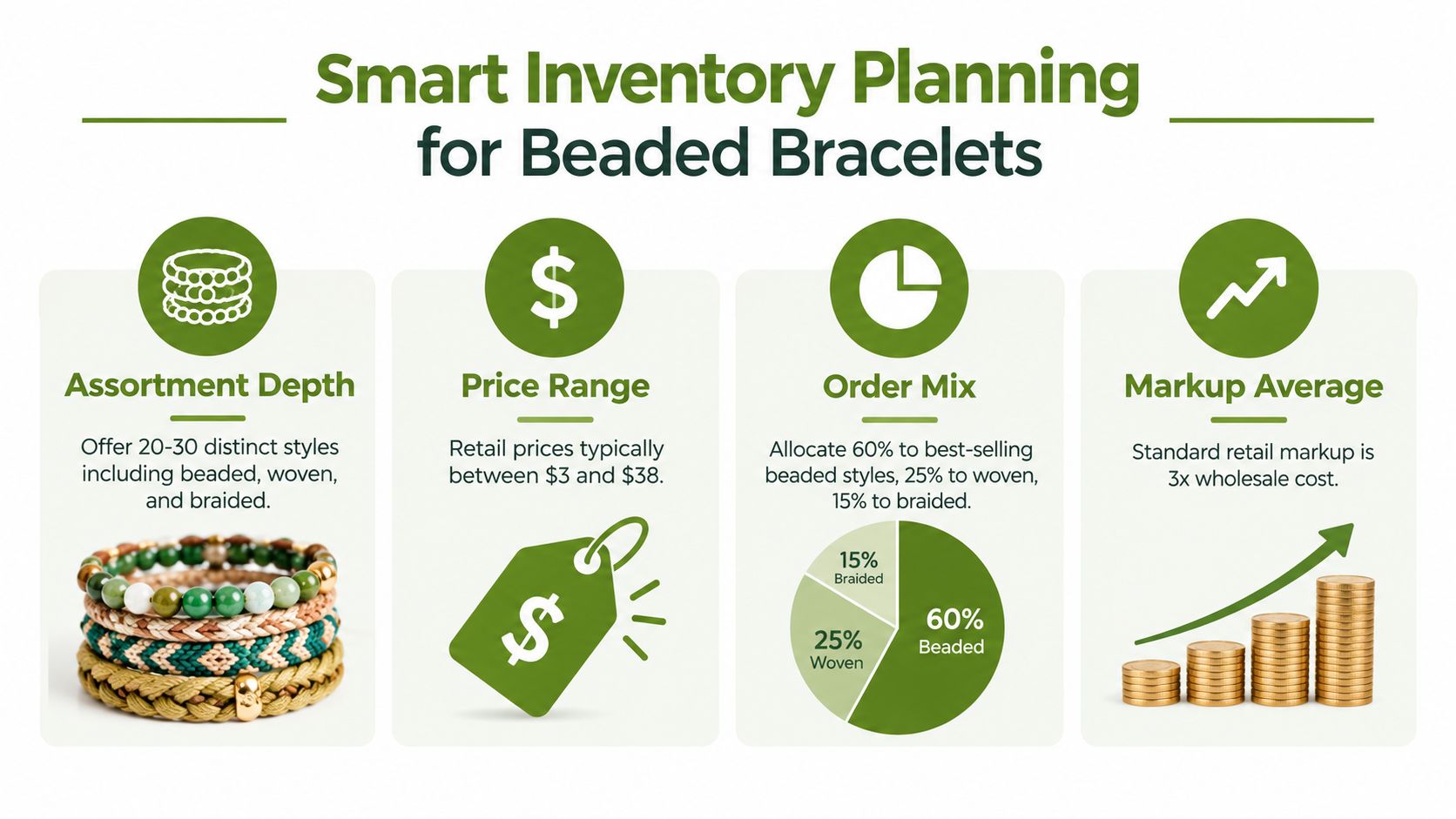
Build the order around roles rather than filling it with unrelated colors. Breadth is the number of different styles; depth is the number of units held in each style. A new store may prefer more visual breadth with shallow tests, while a proven gift-shop program may place more depth behind a smaller number of repeatable designs.
Price from landed cost, not a fixed markup rule. Record product cost, inbound freight, duty or tax treatment, inspection, packaging, payment and marketplace fees, expected markdowns and the cost of defects or replacements. Then compare the remaining contribution with the space, photography and selling effort the style requires.
Use assortment roles
- Core: repeatable materials and neutral colors with stable component availability.
- Color story: a small seasonal or apparel-linked group with an exit plan if demand is weak.
- Stack builder: slim, compatible sizes and finishes that make sense together.
- Gift item: stronger material explanation, packaging and a clear fit statement.
- Brand signature: a controlled charm, bead sequence or color mix worth protecting with an approved sample.
Before finalizing a custom order, read HonHo's MOQ and wholesale pricing information. The current 50-piece reference applies per style and color, different designs do not automatically combine, and the final quotation controls component, packaging and testing requirements.
Keep a reorder record for each approved style: supplier SKU or project code, bead and component specification, approved sample date, production lot, landed cost, defect notes, sell-through by color and size, discounting, customer feedback and replenishment lead time. A reorder should reproduce the approved construction, not just the catalog photograph.
Conclusion and Next Steps for Sourcing Beaded Bracelets Wholesale
A reliable beaded-bracelet order connects five decisions: material, fit, stringing construction, approval evidence and landed cost. Start with the customer and use case, then document bead diameter and hole finish, finished circumference, cord or wire, metal components, closure, color tolerance and packaging. Compare the pilot with the approved sample before scaling.
Broad market reports do not tell a buyer which style will sell. The retained Custom Market Insights fashion jewelry market report may describe the larger category, but its forecasts should not be converted into demand or sales claims for an individual bracelet. Your own test order, returns, discounting and repeat-purchase data are more useful for replenishment.
For a practical B2B quote, send HonHo the bracelet reference, quantity per style and color, bead material and dimensions, finished fit, stringing method, metal components and finish, logo or charm artwork, packaging, destination market, inspection requirements and target launch date. Browse HonHo Wholesale Jewelry for available categories, or request a product-specific review before treating any factory capability as the specification of a selected item.


