

For a wholesale buyer, jewelry manufacturing in China is not mainly a search for the lowest unit price. It is a decision about whether a supplier can control the processes your design depends on, document the material and finish, reproduce an approved sample, and release a shipment against agreed checks. Compare quotations only after the product brief, order quantity, Incoterm, packaging, testing, and payment stages are on the same basis. The weakest points are usually the handoffs between casting, stone setting, plating, inspection, packing, freight, and customs.
Table of Contents
- Why China Became the Center of Jewelry Production
- How a Chinese Jewelry Order Moves From Design to Shipment
- Stainless Steel, Brass, Silver and Gold Plated Compared for Resale
- What Drives the Unit Cost of Chinese Jewelry
- Compliance Evidence Every Buyer Should Request
- How to Vet a Chinese Jewelry Factory Before Ordering
- Confirm Your Sample and Order Plan Before Committing
Why China Became the Center of Jewelry Production
Yes, China is one of the most developed jewelry manufacturing ecosystems in the world, and production sits in regional clusters rather than spreading evenly across the country. Guangdong matters most for export oriented buyers because casting, plating, setting, findings, and packing suppliers operate near each other. One order can move between specialist shops a short drive apart without leaving the region.

That concentration has deep roots. The GIA history of China's gem and jewelry industry, published in 2014, reported that manufacturing had become particularly concentrated in Guangdong. It cited more than 2,000 jewelry companies in Shenzhen and an estimated US$8 billion in annual output, representing more than 70% of China's jewelry production at that time. Treat those figures as historical context, not current capacity data. The purchasing advantage is the depth of nearby specialist labor; the risk is assuming that every supplier controls every step.
Read Demand and Export Figures Separately
Current numbers point in different directions, and that split is normal. According to the China Gold Association figures reported by the State Council Information Office, China consumed 270.04 metric tons of gold jewelry during the first nine months of 2025, down 32.5% year over year. Meanwhile, the China Gold Association production report puts domestic raw material gold output at 381.339 metric tons in 2025, up 1.09% year over year.
Exports tell a different story again. The World Bank WITS record based on UN Comtrade shows China exported $715.43 million worth of silver jewelry and jewelry parts in 2024, totaling 449,391 kilograms. Domestic gold demand can fall while silver jewelry exports stay substantial, because they're different markets with different buyers.
Practical rule: Don't use a headline demand figure to judge whether a factory can fill your export order. Match the figure to the material and market you're actually buying for.
For pricing, the takeaway is simpler. Precious-metal input costs can move while a quotation is open, so ask which metal price, date, currency, and validity period the supplier used. HonHo's production base in Dongguan, Guangdong sits inside this cluster logic. That location can shorten access to specialist processes, but it does not replace a written responsibility map for the order.
How a Chinese Jewelry Order Moves From Design to Shipment
A jewelry order is a chain of handoffs between design, production, finishing, inspection and freight. The table is the working reference: confirm which stage is included in the quote, and keep freight separate from production time.
| Stage | What happens | Typical timing |
|---|---|---|
| Design and specification | Sketch or CAD file, dimensions, materials and finish sheet | Confirmed with the brief before sampling; CAD timing is project-specific |
| Sample making | Pattern, casting or stamping, first physical sample | Brass and 925 sterling silver 25 to 30 days; stainless steel 25 to 35 days |
| Sample approval | Buyer testing, feedback and revisions | Set by your response time and revision rounds |
| Bulk production | Casting, stamping, setting and finishing | Generally 35 to 45 days after sample, specification and final order confirmation |
| Plating and finishing | Electroplating, polishing and inspection | Fixed in the written quote for the agreed finish stack |
| Ready-stock dispatch | Picking and packing from in-stock inventory | Usually within 3 business days after payment confirmation, subject to stock and quantity |
| Freight to buyer | Transit by chosen carrier and route | Confirmed separately for the carrier and route you choose |
These are planning ranges, not a promise for every design. HonHo's wholesale ordering guide gives the current custom baseline; the approved quotation controls the actual minimum, scope, schedule, packaging, and shipping route.
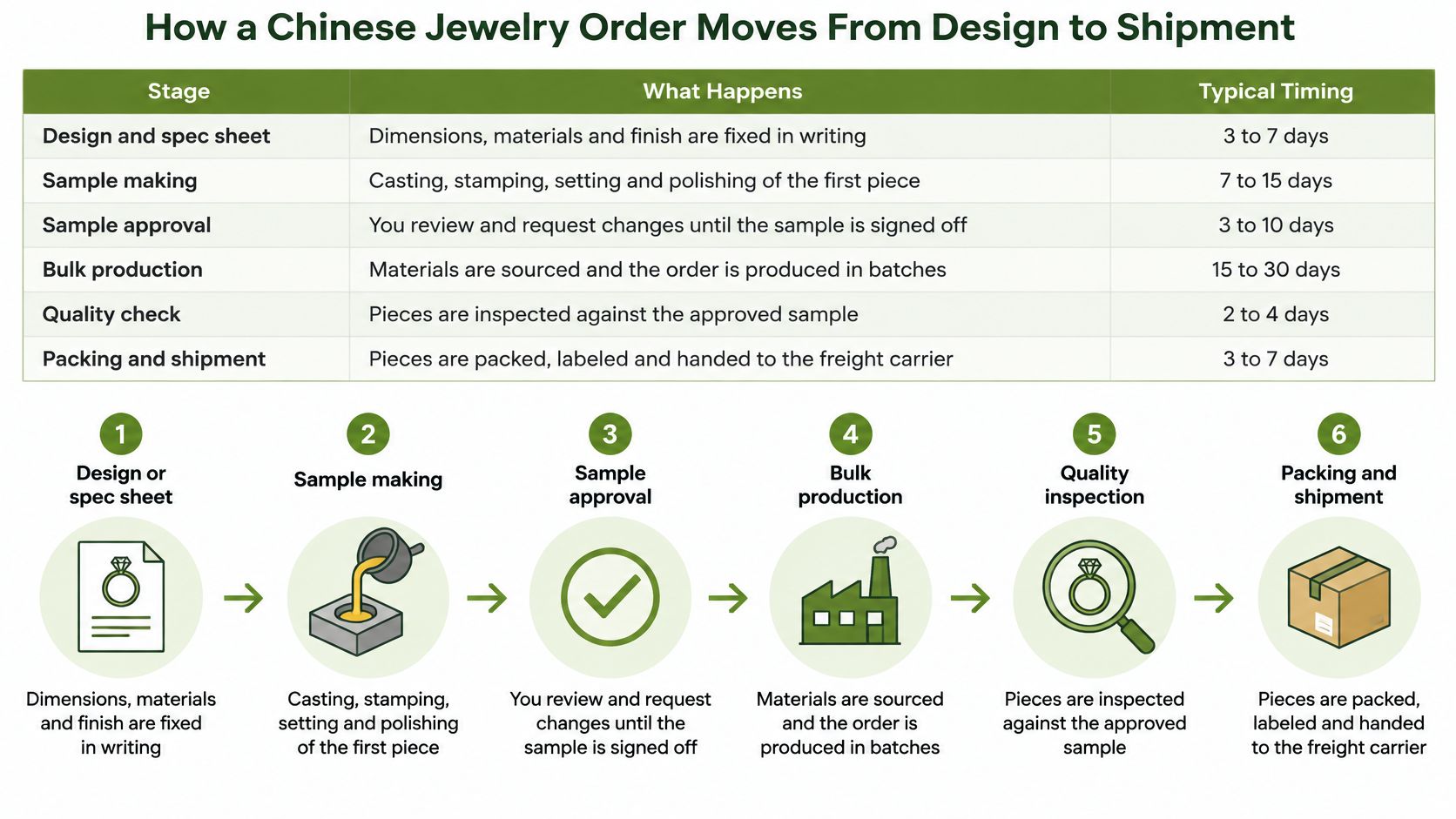
The main risk sits at the handoffs, where an approved detail can be lost or changed. Before production, put dimensions, materials, stone details and finish in the written specification. During sample review, check weight, fit, finish and clasp function, then send all revision requests together. The approved sample should remain the reference for bulk setting and finishing. At dispatch, confirm that the packed and labeled goods match that reference before the carrier takes over.
Where the Relay Usually Drops
Sample approval works like a relay handover: the next stage depends on a clear sign-off. A revision after approval can send work back through part of the chain, sometimes requiring a new mold or plating run. A small change to a pendant bail, for example, can take longer than the original sample because it affects work already completed.
Three delays account for much of the slippage. Design changes after approval send the work back to pattern making. Plating that fails adhesion or edge checks must be stripped or remade. Packaging revisions can hold finished goods that are otherwise ready to ship. These are separate specialist handoffs, so clarify who owns each correction and whether the quoted timing includes rework.
Ready stock skips sampling and production, which is why it moves faster. In-stock orders ship from Dongguan, China, while freight time sits outside the production window. Confirm transit separately for your route rather than treating it as part of the supplier's production lead time.
Stainless Steel, Brass, Silver and Gold Plated Compared for Resale
| Material and finish | Durability and tarnish behavior | Best retail position | Relative cost |
|---|---|---|---|
| Stainless steel, with grade confirmed per SKU | Resists rust and tarnish in normal wear; polished surfaces still show scratches | Everyday core lines; skin-contact claims need finished-product evidence | Low to mid |
| Brass with silver, gold plated, two-tone or enamel finish | Brass base shows once plating wears; finish life depends on coating | Trend and fashion lines that turn over quickly | Low |
| 925 sterling silver | Tarnishes in sulfur rich air; polishing reverses the tarnish | Classic, gift and higher perceived value pieces | Mid to high |
| Gold plated over brass or stainless steel | Wear depends on coating thickness and location; rings, clasps and posts wear first | Gold look at an accessible price point | Low to mid, set by base and thickness |
Stainless Steel as the Evergreen Core
HonHo lists 304 and 316L stainless steel as available options, not as interchangeable grades for every ready-stock SKU. Confirm the grade and finish for the exact product or custom quotation. Stainless steel can suit daily-wear hoops, chains, and band rings, but alloy grade alone does not prove nickel-release compliance or support a universal “hypoallergenic” claim. A high polish also shows scratches more readily than a brushed or matte surface on broad, flat areas.
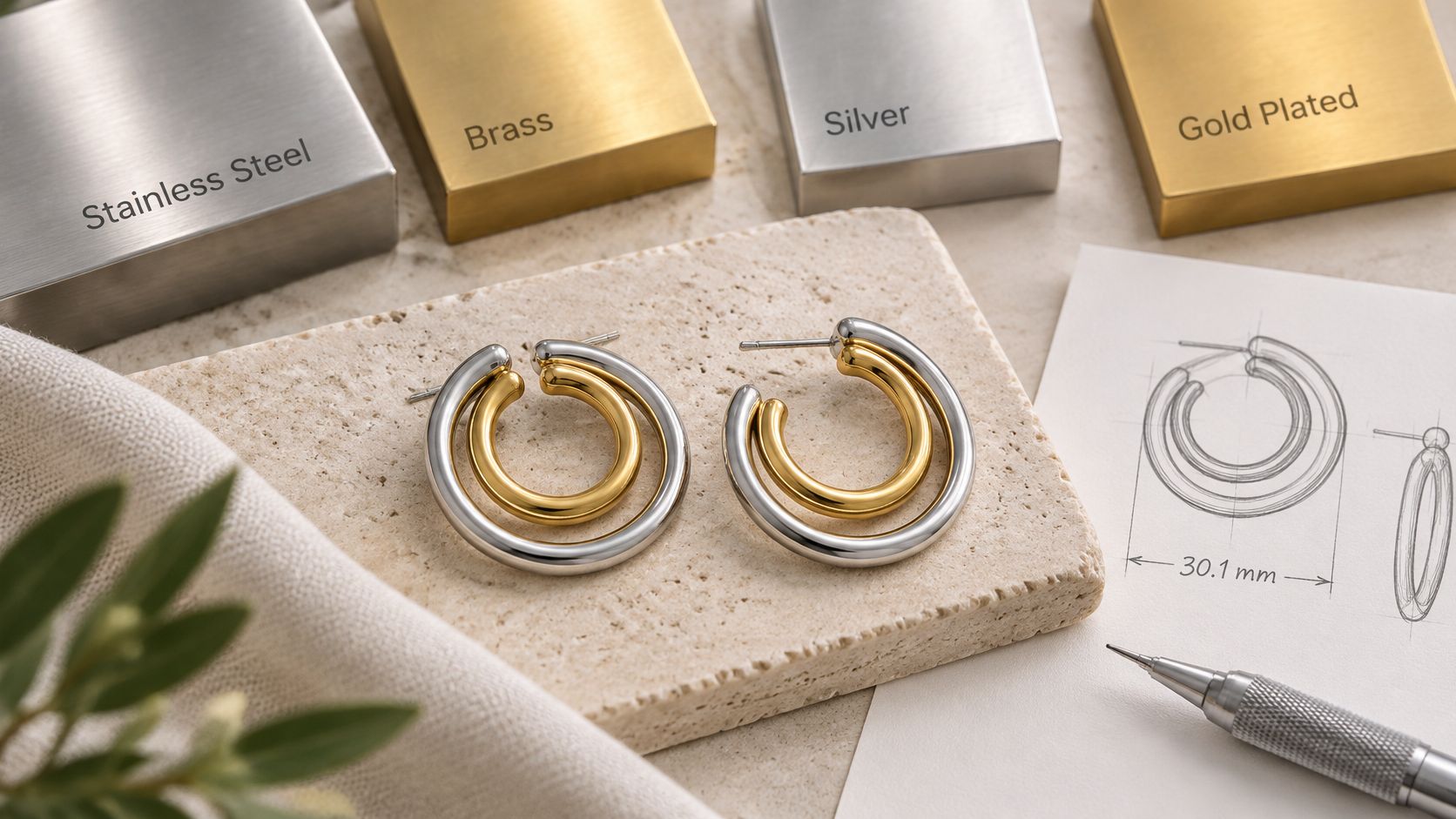
The Two-Tone Double Hoop Stainless Steel Earrings show the format well, with a polished finish, post attachment, and an approximate size of 30.1 × 30.1 mm. A smaller gold colored hoop nests inside a broader silver colored curve, so one SKU serves mixed metal styling. That's efficient inventory for a small boutique.
Brass for Trend Testing
Brass supports silver, gold plated, two-tone, and enamel finishes and can reproduce fine detail at a lower material cost than sterling silver. It is useful when a buyer wants to test a design-led assortment without building the whole range in a precious metal. Once the coating wears through at exposed edges, the brass base can show, so the listing and care guidance should describe the actual construction rather than imply solid gold or lifetime finish performance.
Silver and the Gold Plated Question
925 sterling silver is 92.5% silver. It tarnishes in sulfur rich air, and polishing reverses that tarnish, which your care card should say plainly. It suits classic and gift lines where customers expect a precious metal and accept light maintenance.
Gold plated pieces live or die by coating thickness and wear location. Rings, clasps, and earring posts wear first because they rub. The Gold Plated Stainless Steel Sculpted Flower Open Band Ring illustrates the common construction, a gold look carried on a stainless base rather than solid gold.
Terminology matters here, and the listing should be exact. The FTC consumer guidance on platinum, gold and silver jewelry explains that "gold filled," "gold overlay," and "rolled gold plate" describe jewelry with a mechanically applied layer of at least 10-karat gold over a base metal, marked with the karat quality and term such as "14K gold overlay" or "12K RGP." An electroplated finish is a different category, so name the actual construction. Our guide to wholesale gold plated jewelry works through that labeling in more detail.
A practical assortment can use verified stainless steel for repeatable everyday lines, brass for design-led tests, and 925 sterling silver where precious-metal positioning supports the retail price. The specification and evidence still have to follow each SKU.
What Drives the Unit Cost of Chinese Jewelry
A Chinese jewelry quote covers work across specialist shops, from material preparation and finishing to packing and shipment. The unit price changes with the product and the steps it needs. Costs can also surface later if tooling, freight, duty, or packaging was left out of the quote.
| Cost driver | How it moves unit cost | What to request |
|---|---|---|
| Base metal | Stainless steel, brass and sterling silver have different raw material costs; silver moves with its market | Material spec for each SKU |
| Plating or finish | Thicker coatings and extra layers add process time and cost | Finish stack with nominal thickness |
| Stones, zirconia, pearls and enamel | Each adds material and setting or application labor | Stone and enamel specification |
| Design complexity and tooling | Intricate or new molds add tooling cost | Tooling fee quoted separately |
| Order quantity | Higher quantity per style can lower per-piece cost; HonHo's current custom planning baseline is 50 pieces per style and color | MOQ and price breaks in writing |
| Packaging and branding | Logo engraving, custom plating and branded packaging add steps | Itemized packaging quote |
| Duty and freight | Depend on HTS classification, destination and carrier | Landed cost estimate with HTS code per SKU |
Landed cost sets your margin, so build it per piece before comparing unit prices. Add the unit price, each piece's share of freight and insurance, duty, brokerage, and other import charges. Ask the supplier to explain any blank line before treating it as excluded.
Duty depends on classification. The U.S. International Trade Commission HTS database covers Chapter 71 of the Harmonized Tariff Schedule, including imitation jewelry, precious metals, metal clad articles, and related goods, with separate China tariff information. Classify each product instead of applying one assumed rate to the whole order. Ask a customs broker or seek a binding ruling for complex cases.
A Like for Like Comparison
Suppose two suppliers quote the same hoop earring, one in stainless steel and one in brass. Compare both quotes using the same cost lines: unit price, freight and insurance per piece, ordinary duty at that SKU's HTS rate on customs value, brokerage and other import charges, and landed cost per piece. Record the HTS code beside each SKU. This keeps the comparison consistent while showing how material and production choices affect the final cost.
Order depth also affects the budget. HonHo currently publishes a US$100 minimum for ready-stock wholesale orders and a custom-development baseline of 50 pieces per style and color. Special stones, components, techniques, or packaging can require a different minimum, so the quotation controls. At the baseline, ten custom styles in one color would mean 500 pieces. Fewer styles at greater depth can reduce per-piece cost but commit more of the budget to each design. For silver styles, what drives a 925 silver ring price explains how metal weight feeds into the calculation.
For gold-look and plated items, quote validity matters because gold-based pricing moves with the metal market. Ask how long the quote holds, and align your retail pricing with when you expect to pay.
Before committing, make three checks. Get a line-item cost breakdown. Confirm tooling is charged separately, rather than folded into the unit price. Verify whether plating and packaging are included. These details help expose costs that can otherwise appear between the factory quote and shipment.
Compliance Evidence Every Buyer Should Request
| Product claim | Evidence to request | Why it matters |
|---|---|---|
| Solid 925 sterling silver | Batch assay report and fineness marking location | Distinguishes solid silver from plated base metal |
| Gold plated | Written construction specification naming the base metal, plating type, and nominal thickness | Keeps the claim distinct from solid gold |
| 316L stainless steel | Material declaration for the batch | Documents the grade behind the claim |
| Brass | Material declaration identifying brass as the base metal | Prevents a misleading material description |
| Nickel and lead limits | Test report from a recognized lab | Supports checks against destination-market requirements |
| Country of origin | Commercial invoice and origin documentation | Supports customs entries and marketplace listings |
| HS classification | Confirmed HTS code for each SKU | Determines the applicable duty and informs landed-cost calculations |
| China jewelry safety standard GB 28480-2026 | Prepare the applicable test plan and product file for its 1 April 2027 implementation; request current reports under the standards in force now | The standard is published but not yet in force as of October 2026 |
Every material claim on your listing needs a document behind it. If the evidence does not support the wording, revise the claim before the listing goes live. A finish specification, assay report, and material declaration answer different questions, so keep each tied to the relevant SKU and batch.
Precious Metal Claims Need Assay Evidence
The Hallmarking Convention China profile lists 925 and 800 as legal silver finenesses. It also lists 375, 585, 750, 916, and 990 for gold, and names the State Administration for Market Regulation as China's competent authority and the National Jewellery Quality Supervision & Inspection Center as an authorized assay office.
For solid sterling silver, request batch-level assay documentation, the fineness marking location, and a specification that distinguishes solid silver from plated base metal. Put the test method, allowable fineness tolerance, marking location, and corrective action for a failed assay in the purchase order. Those details connect the claim on the listing to the work done by the assay office and the factory.
A mixed collection needs separate bills of materials for sterling silver, brass, and stainless steel components. A silver-toned brass charm on a steel chain contains two materials, and the records should identify each one. For finish claims, specify the coating construction and thickness; the guide to gold PVD coating explains the coating side of that distinction.
Safety Standards and Destination Rules
GB 28480-2026 is a mandatory Chinese standard titled Jewellery—Technical requirements for safety. China's national standards platform lists it as published on 31 March 2026 and scheduled to take effect on 1 April 2027, replacing GB 28480-2012. As of October 2026 it is not yet in force. Use the standards currently applicable to today's shipment, while preparing the product file and test plan for the 2027 change. A standard reference alone never shows that a particular SKU was tested or passed.
Keep Chinese compliance documents in the technical product file, then compare them with destination-market requirements for nickel release, restricted substances, and labeling. Maintain records by SKU and complete the file before the listing goes live. When casting, plating, assay, and shipment involve separate specialists, a missing report or unclear material description can leave the order difficult to document at customs or for a marketplace.
How to Vet a Chinese Jewelry Factory Before Ordering
Start by naming the feature most likely to fail on this design. A bezel ring needs evidence of stone calibration and setting consistency; an enamel charm needs clean boundaries and color control; a plated clasp needs coverage and wear checks at the moving surfaces. Then use the checklist to verify that the supplier can control that specific process rather than relying on a broad “we make jewelry” claim.
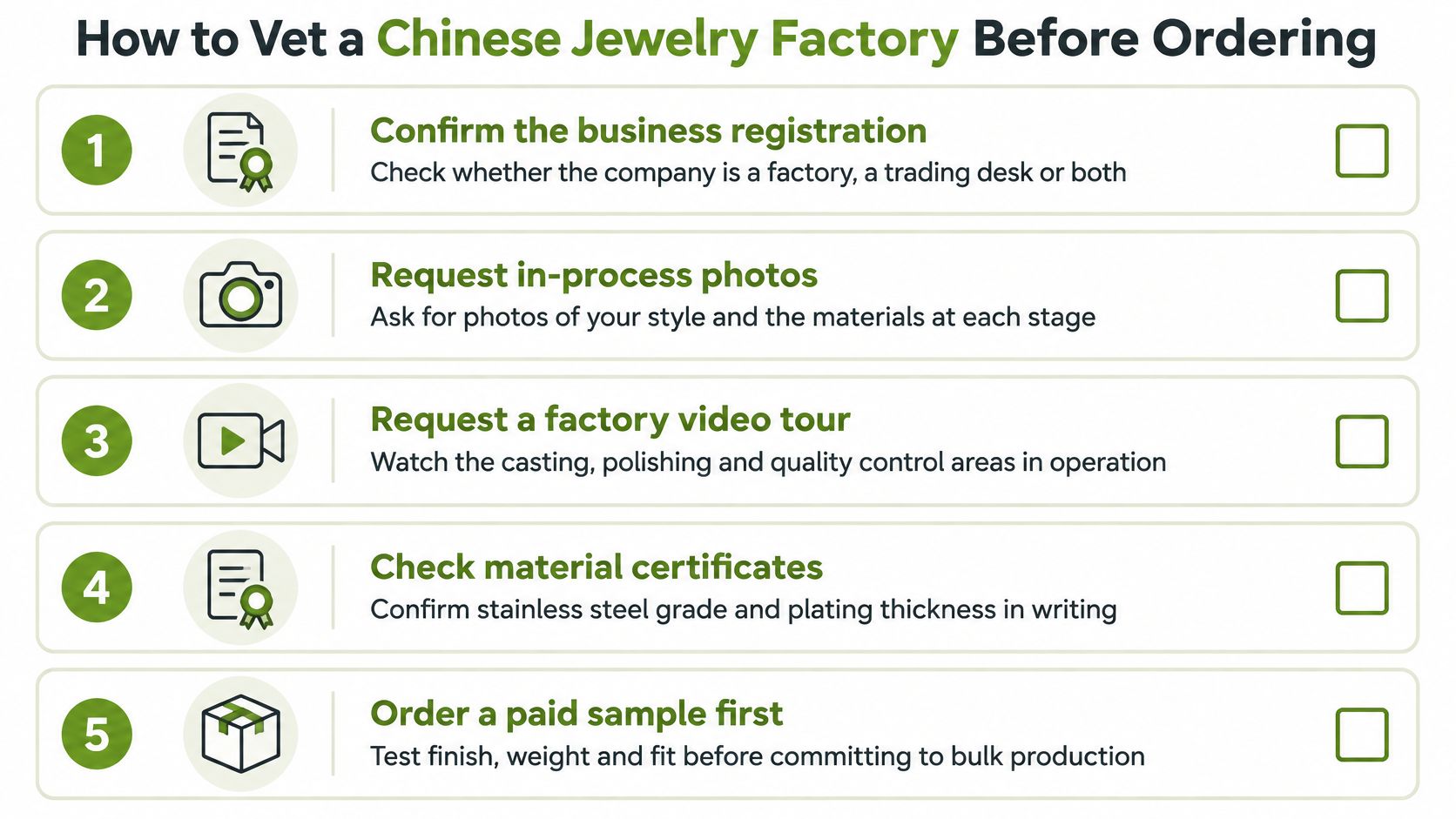
- Confirm registration: Check the business registration and whether you're dealing with a factory, a trading desk, or both.
- Request in-process photos: Ask for photos of your style, plus the plating and finishing line that will handle it.
- Order a true sample: Get a sample in the same material and finish you plan to buy, not a close substitute.
- Test the coating: Run simulated wear, sweat or corrosion exposure, and adhesion testing, then inspect edges and recesses.
- Measure at several points: Ask for thickness readings at multiple locations rather than one average.
- Fix commercial terms: Confirm MOQ, lead time, revision rounds, and sample costs in writing.
- Agree inspection terms: Set a pre-shipment inspection with acceptance limits before payment.
Step five matters more than buyers expect. The FTC technical basis for the revised Jewelry Guides states that coating thickness affects abrasion resistance, with thicker coatings generally taking longer to wear through under appropriate plating chemistry and process control. Thin edges and pores expose a reactive base metal early, and a single average reading hides exactly those spots.
Test Where the Piece Actually Rubs
High friction zones need stricter checks than flat display surfaces. Test ring shanks, bracelet clasps, pendants that rub against clothing, and earring posts first. A finish that survives on a pendant front can still fail on its bail.
Silver tones need a tarnish check as well, since unprotected silver surfaces can darken through silver sulfide formation in sulfur containing environments. Specify a measurable finish stack: substrate, barrier layer if used, topcoat, nominal thickness, test method, and acceptance limit. Our overview of choosing a wholesale jewelry supplier covers the commercial side of that conversation.
When a remote visit is practical, ask the actual supplier to walk through the production and inspection steps relevant to your order. The third-party video below is a general factory-tour example; it is not HonHo production evidence and cannot verify any supplier on its own.
Red flags are consistent. No written material spec, prices far below comparable quotes, unwillingness to send samples, and vague plating descriptions all predict later disputes. A supplier who welcomes tests is usually easier to work with when something goes wrong.
Confirm Your Sample and Order Plan Before Committing
A sample can look right and still leave room for disagreement once production begins. For a resale assortment, use ready-stock stainless steel, brass, or 925 sterling silver pieces to gauge demand before committing to custom development. For a private-label line, plan around the sampling windows and MOQ covered in the timing and cost sections. Build those windows into the launch calendar; a schedule based on best-case sampling can push the launch back.
Before payment, keep the final checks focused on what determines whether the factory and buyer agree on the production reference and release of funds:
- Sample approval recorded: Identify the approved piece and retain a dated record, including any agreed changes, as the production reference.
- Payment gate confirmed: Put the payment schedule and the point when production may proceed in writing. Release payment against the agreed stage, not an informal promise.
Use the jewelry sample approval checklist to make the approval routine repeatable. For material specifications, construction terms, HS codes, and packaging claims, refer to the earlier comparison, cost, compliance, and factory-vetting sections rather than leaving those details to a final order check.
HonHo Wholesale Jewelry offers ready-stock assortments as well as OEM/ODM development for custom lines. For a useful quotation, send the design or reference, material, finish, key dimensions, quantity per color, destination market, packaging needs, and target delivery date through the wholesale contact page. Confirm the sample window, final MOQ, bulk schedule, testing, and shipping terms in the project quotation before committing.


