

Choose stainless steel wedding bands for her by checking five details in writing: alloy grade, finished surface, inner dimensions, interior profile, and evidence for any skin-contact claim. Photographs cannot confirm those details. Two similar bands can carry different coating, fit, care, and after-sales risks.
Table of Contents
- Why Material Details Matter for Women's Bands
- Verify Stainless Steel Grades and Construction
- Compare Popular Band Styles and Finishes
- Choose a Comfort Fit That Holds Up
- Evaluate Plating and Skin Compatibility
- Plan Customization and Wholesale Orders
- Apply the Framework to Real Ring Examples
- Build a Resellable Wedding Band Assortment
Why Material Details Matter for Women's Bands
A typical supplier listing may say stainless steel, comfort fit, and hypoallergenic without naming the alloy, coating process, or inner dimensions. That is not enough for a wedding band listing. Ask whether the gold-tone version is plated, whether the base is 316L stainless steel, and which claims apply to the finished ring rather than to the base metal alone.
A wedding band is likely to meet water, lotion, heat, sweat, and daily abrasion. Its color tells you little about how it will respond, and nothing about which performance or skin-contact claims you can support. Treat the photograph as a style reference; build the product description from the written specification and approved sample.
Three Rings That Only Look Alike
Put three similar bands side by side and the buying job becomes clearer. The first has a confirmed alloy designation, listed dimensions, and a disclosed finish process. The second says stainless steel but gives no grade, no plating disclosure, and no inner diameter. The third is an open adjustable style, so it solves part of the sizing problem but raises different questions about shape retention and edge comfort.
None of those rings is automatically good or bad. They are different products wearing the same photograph. Your margin, return rate, and customer reviews depend on telling them apart before you describe them all with the same warm sentence.
Practical rule: If a supplier cannot state the grade, finish, and dimensions in writing, you do not have a product description yet. You have a picture.
What to Ask Before You List Anything
Before you place a band in a bridal or everyday assortment, work through five questions. They take minutes to ask and save weeks of correction later.
- What's the exact alloy? Ask for the grade designation, not the family name.
- What's on the surface? Separate bare steel, gold plated, and PVD described finishes.
- How is it sized? Get inner diameter or circumference, not only a US size label.
- What's the inner profile? Rounded interiors and edges affect comfort and residue buildup.
- What documentation exists? Request any compliance or nickel release testing for the finished ring.
Price is not the problem. Copying an unverified claim is. Your product page becomes the promise the customer sees, so every statement about grade, finish, fit, and skin compatibility needs a specification or test record behind it.
Verify Stainless Steel Grades and Construction
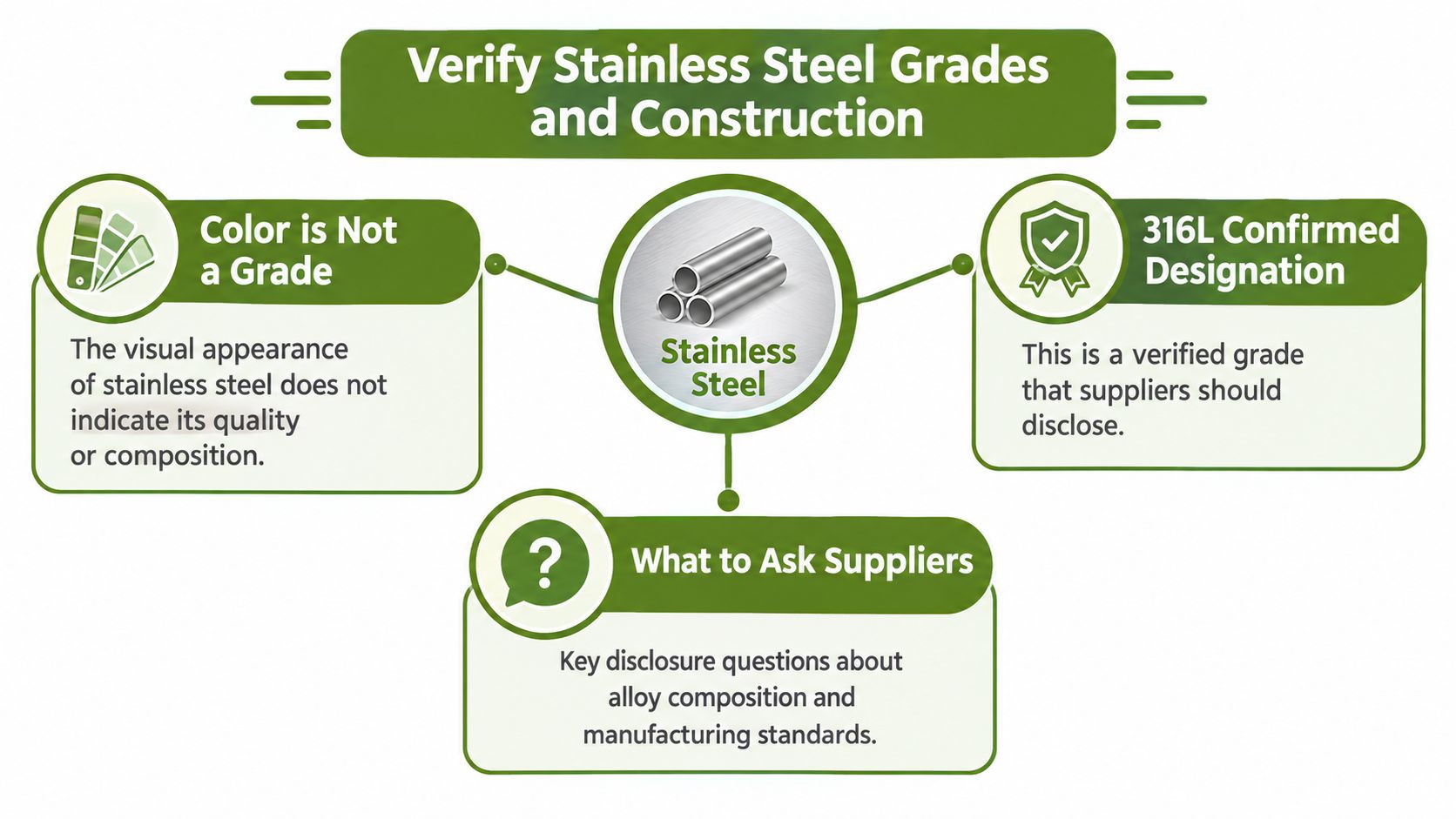
Stainless steel is an alloy family, not a single recipe. Chromium helps form the passive surface film associated with corrosion resistance, but performance still depends on the grade, surface condition, environment, and construction. For purchasing purposes, “stainless steel” is an incomplete specification.
Request the grade designation, such as 316L or UNS S31603, and keep that separate from the finish description. The grade identifies the base alloy. Polished, brushed, plated, and PVD describe what was done to the surface. Neither a silver color nor a gold color proves the alloy underneath.
The diagram below turns that distinction into three supplier checks.
Why 316L Gets Specified for Rings
Grade 316L stainless steel commonly falls within ranges of roughly 16 to 18.5% chromium, 10 to 14% nickel, and 2 to 3% molybdenum, with carbon no higher than about 0.03%. The materials study on 316L corrosion behavior in chloride solution discusses how the alloy behaves in a controlled chloride environment. Those composition ranges describe the grade; they do not prove that a supplier's ring is 316L.
Molybdenum generally improves resistance to localized corrosion compared with 304 in many chloride-containing environments. The Cleveland Cliffs product data sheet for 316 and 316L stainless steel supports specifying 316L or UNS S31603 rather than accepting “stainless steel” alone. An Outokumpu stainless steel datasheet also explains that chromium, molybdenum, and nitrogen influence pitting and crevice-corrosion resistance. None of these sources makes 316L immune to chlorides, wear, or poor finishing.
For a fuller explanation of grades before you brief a supplier, work through the guide to what 316L stainless steel jewelry means and then compare its distinctions against your supplier's written specification.
Construction Claims to Separate
Ask these questions in this order, because each answer changes the next one.
- Is the band solid 316L? Distinguish solid construction from a thin steel colored coating over another metal.
- How was the surface finished? Polished, brushed, gold tone, and two tone are appearances, not grades.
- What finishing steps were used? Ask about polishing, cleaning, and any passivation process. Do not infer those steps from shine alone.
- What care limits apply? Chlorine, harsh cleaners, abrasion, and decorative plating can still change appearance over time.
When you write the listing, keep alloy and coating in separate sentences. 316L stainless steel describes the base. Gold plated describes the surface. Mixing them into one vague phrase is how customers end up believing the color runs through the metal. Clear separation protects the buyer, and it protects you when a ring needs rinsing, drying, or replacement years later.
Compare Popular Band Styles and Finishes
A common wholesale error is ordering twelve versions of the same narrow polished band and calling it a range. Your customer doesn't shop that way. She might want a band that sits under an engagement ring, one that reads as a standalone statement, or one she can wear at the gym without thinking about it. Build families around those jobs instead.
Narrow minimalist bands suit stacking and low profile wear. Broad polished bands carry more presence and more visible surface, so finish quality shows faster. Textured or engraved profiles hide minor marks differently than mirror polish. Open adjustable designs reduce size sensitivity but introduce edges and flex points you need to inspect on a sample.
The ring in this image shows how width and negative space change the merchandising job.
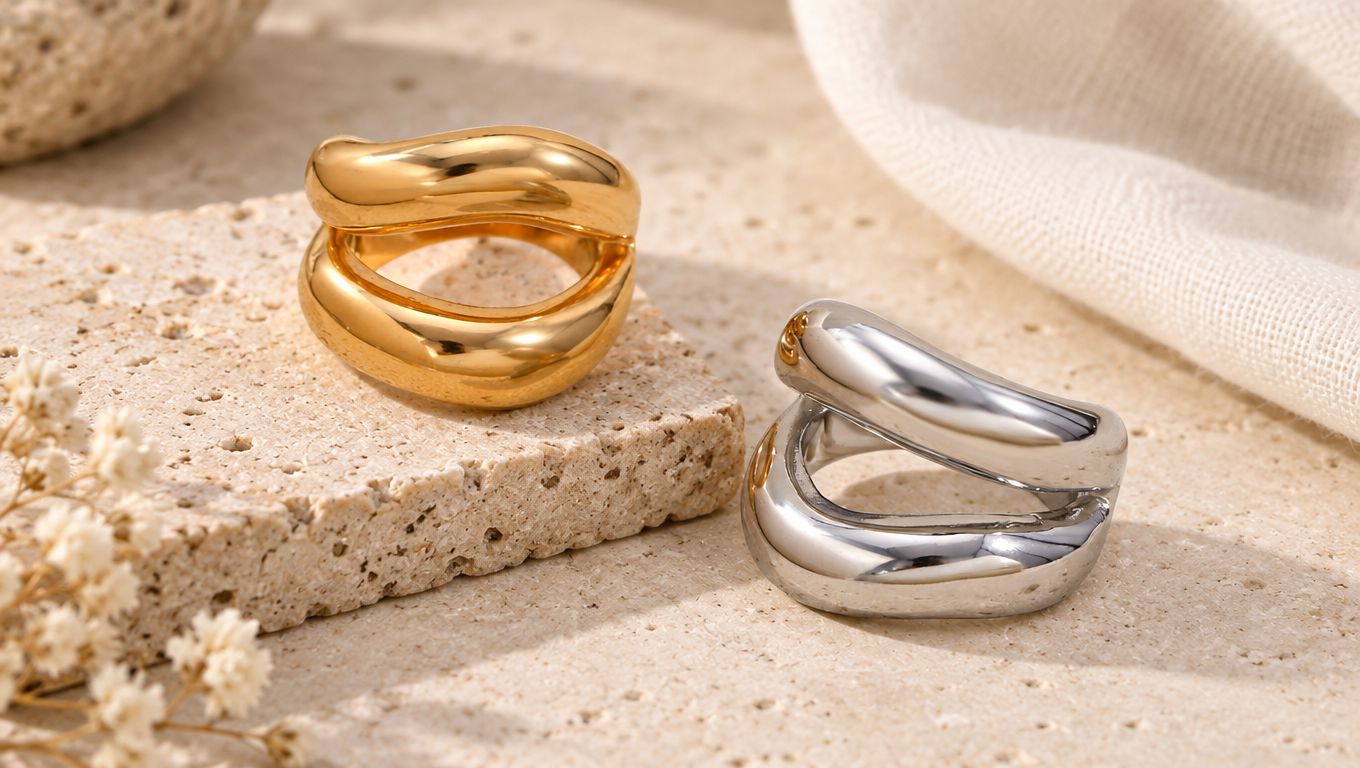
Consider the Sculptural Triple-Band Stainless Steel Ring in Gold Plated or Silver Finish as a structural example. Three rounded curves cross and separate across the front, creating two windows of negative space, with an approximate overall height of 23.1 mm, front detail of 6.7 mm, listed weight of 12.2 g, and sizes US 6 to 8. It reads as one fluid form rather than three stacked rings. That's a statement band, and you'd merchandise it differently from a slim stacking piece.
Women's Stainless Steel Band Selection Matrix
| Band Family | Visual Character | Fit Consideration | Best Merchandising Use |
|---|---|---|---|
| Narrow minimalist | Quiet, low profile | Layers easily, less knuckle pressure | Stacking and bridal sets |
| Broad polished | Bold, reflective | Feels tighter at same size | Standalone everyday band |
| Textured or engraved | Detailed, patterned | Check pattern continuity | Customers wanting visible detail |
| Open adjustable | Modern, flexible | Tolerates size fluctuation | Gift buyers and uncertain sizes |
| Statement with embellishment | Expressive, focal | Height may catch on clothing | Occasion and fashion led edits |
Use the matrix as a planning tool, not a popularity ranking. It doesn't tell you what will sell in your store. It tells you whether your assortment covers different customer problems.
Finish Is a Process, Not a Color Name
Polished and brushed describe surface texture on the steel itself. Gold tone and two tone describe an applied appearance. When you list stainless steel wedding bands for her in a gold tone, name the process the supplier confirms, such as gold plated or PVD, and never let a color word stand in for that disclosure. A customer comparing two gold looking rings deserves to know whether she's comparing two coatings, or a coating against bare metal.
Choose a Comfort Fit That Holds Up
Sizing is where good rings get returned. A finger measured on a cool morning before coffee isn't the same finger at the end of a warm workday. Heat, exercise, travel, pregnancy, and time of day all shift measurements. If your listing treats one number as permanent, your customer will learn otherwise on her own, and she'll blame the ring.
Publish millimetres alongside local size labels. A shopper can measure the circumference of her finger or the inside diameter of a ring that already fits, then compare that number with your chart. The source already linked here as Cartier ring sizing instructions referenced through verified sizing guidance currently resolves to Pandora's sizing guide, which maps a 60 millimetre circumference to US size 9 and 64 millimetres to US size 10.5. Treat any consumer chart as a reference, not as proof of your SKU's actual inner diameter.
The flow below shows why the approved sample, band width, and repeatable measurements matter as much as the printed size label.
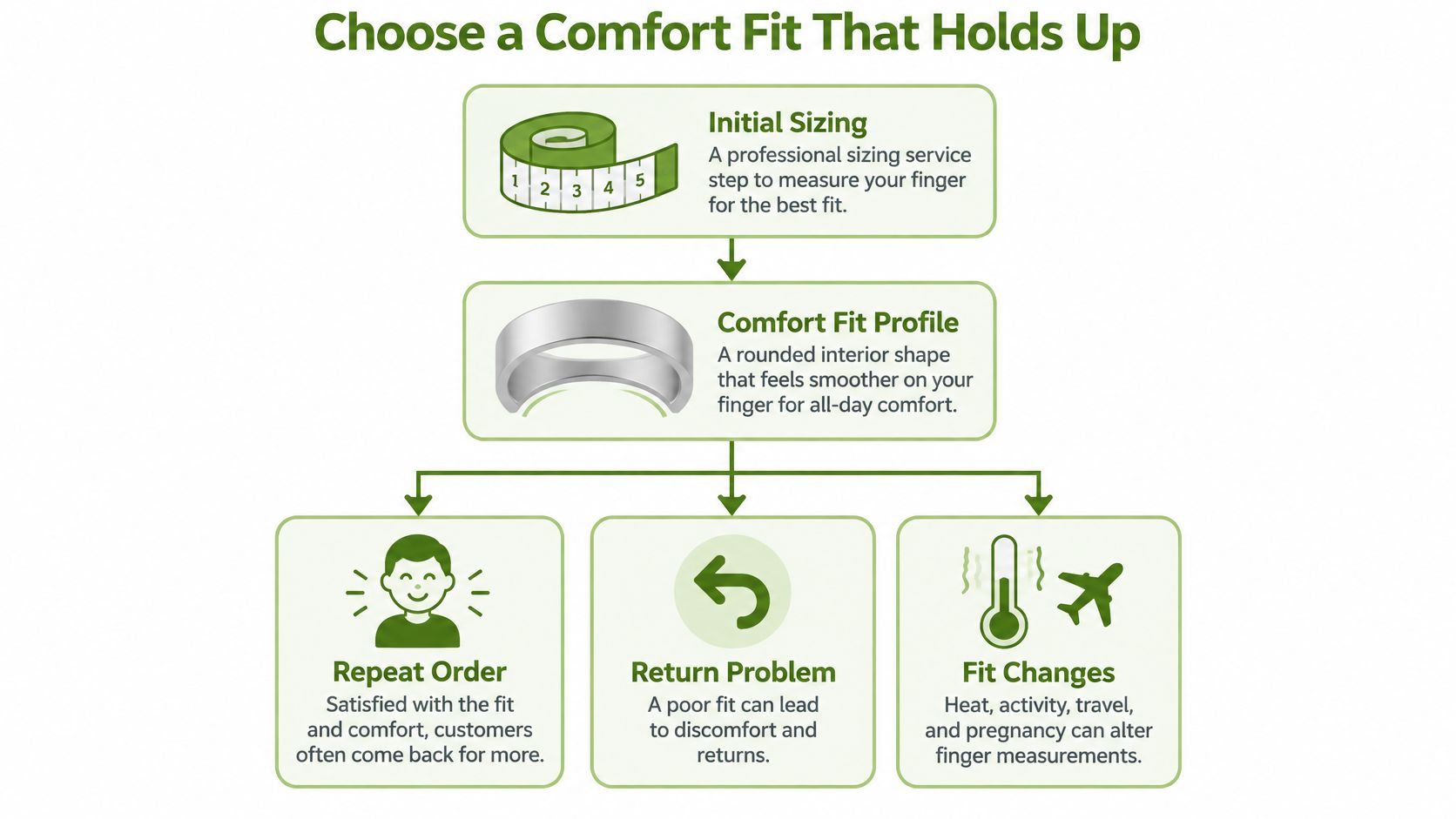
How to Measure and Publish Sizes
Give shoppers a sequence they can repeat, and link them to the jewelry size guide for measurement conversions so they aren't guessing between US, UK, and European systems.
- Measure more than once. Take readings at different times of day, including the evening.
- Check the knuckle. The ring must pass over it without forcing.
- Match width to size. A wide band feels tighter than a slim band at the same nominal size.
- Publish inner dimensions. Show diameter or circumference where the supplier provides them.
Fixed, Comfort Fit, or Adjustable
A comfort fit interior is rounded, so the ring contacts less skin and slides over the knuckle with less friction. That curvature also means the measured size can feel slightly different from a flat interior band. Tell customers that plainly rather than letting them discover it.
Stainless steel generally cannot be resized the way many precious-metal rings can, so fixed bands require accurate size planning. Open adjustable construction accommodates some fluctuation, but its edges, gap, and shape retention still need sample review. For customers whose finger size changes noticeably, a replaceable fixed band or a well-made adjustable design may be more practical. Fit flexibility belongs in the buying decision alongside durability.
Evaluate Plating and Skin Compatibility
A polished bare-steel band and a gold-coloured plated band are not the same product in two colours. The finish changes what contacts the skin, how the piece should be cared for, and which claims need evidence.
316L can contain nickel, so the grade name does not support a “nickel free” claim. For articles intended for direct and prolonged skin contact, the EU REACH restriction uses a nickel-release limit of 0.5 μg/cm²/week; the European Chemicals Agency guidance on prolonged skin contact explains the threshold and the need to consider how an item is used. Check the rules for the destination market and request evidence for the finished ring.
The comparison below is a planning aid for three finish situations, not a test certificate for any particular SKU.
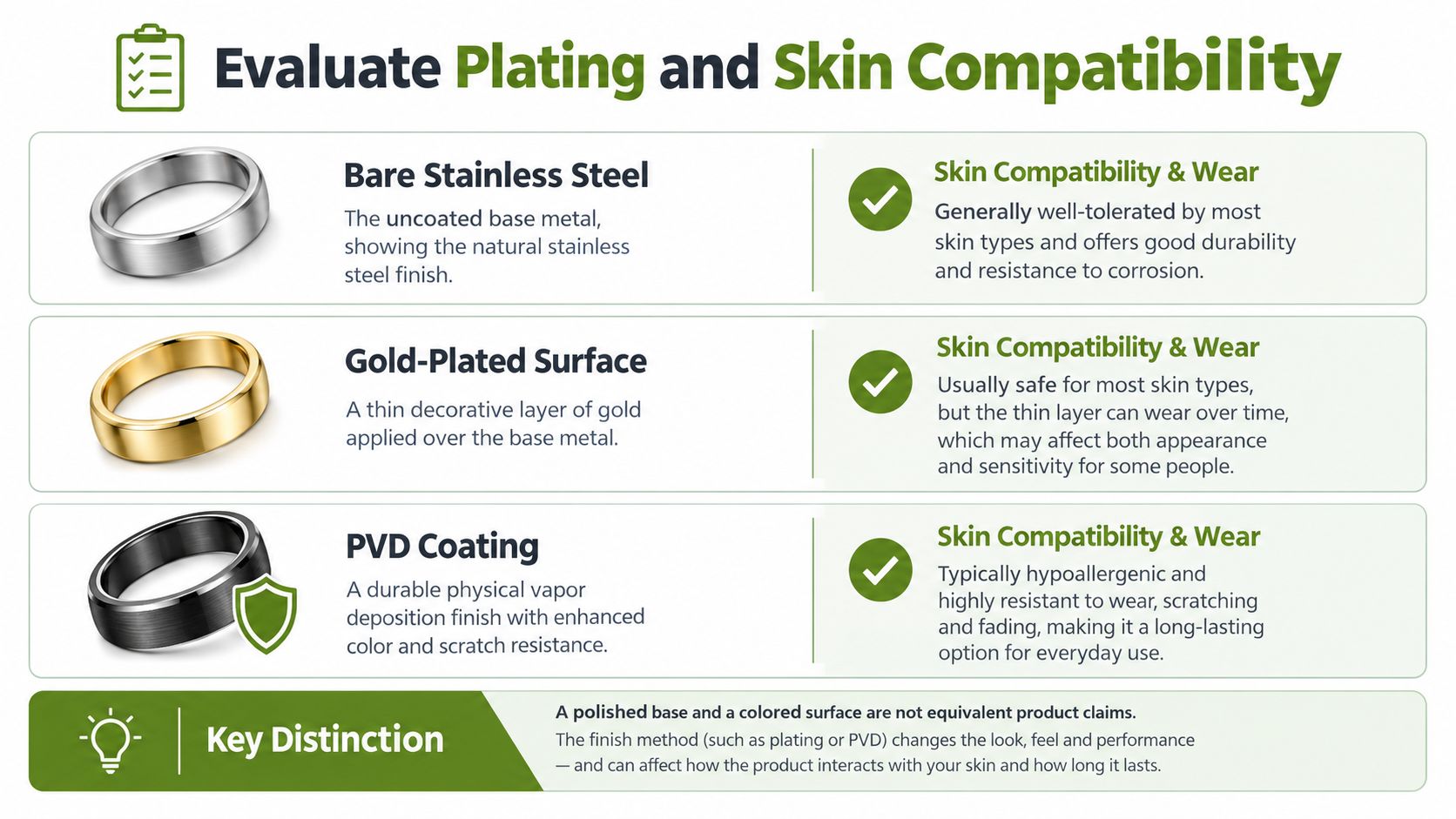
Buyer note: Terms such as “hypoallergenic,” “durable,” and “scratch resistant” still require product-specific evidence. A finish method alone does not establish how every batch will wear or release nickel.
Test the Finished Ring, Not the Label
The passive film on stainless steel helps limit interaction between the alloy and its environment, but polishing, plating, cleaning, and coating defects can change the finished surface. A 2024 laboratory study using EN 1811:2023 reported 0.03 ± 0.04 μg/cm²/week for the untreated 316L base material and 0.28 ± 0.31 μg/cm²/week for one electroplated configuration. The study of nickel release from plated 316L stainless steel is useful evidence that surface processing matters, but its configurations are not a substitute for testing the ring you intend to buy.
The base alloy passing a limit doesn't prove the plated, polished, finished ring in your carton behaves the same way.
So ask for EN 1811 testing on the final production finish, especially for gold colored bands. Ask whether the finish is electroplated or PVD, whether the surface was polished and passivated, and whether results apply to the exact color and coating stack you're ordering. If you need the process distinction explained before that conversation, the explanation of gold PVD coating for jewelry covers how that finish differs from conventional plating.
This short video walkthrough shows finish differences at a practical level before you finalize claims.
Words You Should Not Use Lightly
316L stainless steel band is a material specification. Safe for all sensitive skin is a medical promise. The American Academy of Dermatology notes that nickel allergy is common in North America in its patient guidance on nickel allergy and jewelry exposure, and rings are one possible exposure source. Avoid unsupported hypoallergenic and nickel free claims. State the base material and finish, publish applicable test documentation when you have it, and tell highly sensitive customers to seek appropriate medical advice.
Plan Customization and Wholesale Orders
Ready stock and custom manufacturing solve different problems, and confusing them costs money. Ready stock lets you test a style, fill a gap, and ship to your own customers quickly. Custom work lets you control engraving, plating choices, logo placement, and branded packaging, but it adds approval steps and minimum quantities. Decide which problem you're solving before you request a quote.
For context on how that decision is structured, the overview of custom stainless steel jewelry manufacturers and their processes outlines the development path. HonHo currently lists a US$100 minimum wholesale order for ready stock and a standard custom minimum of 50 pieces per style and colour. The current sample and MOQ guide gives a general range of 25 to 35 days for stainless steel samples and 35 to 45 days for bulk production after sample approval. In-stock orders usually dispatch within 3 business days after payment confirmation. These are planning ranges; the approved quotation controls the scope, minimum, and schedule for a specific project.
From Approved Sample to Bulk Order
Use the sequence below to keep the approved sample, specification, and purchase order aligned.
- Define the product. Write the alloy, finish, width, inner profile, and size range in one document.
- Confirm the specification. Get the supplier to repeat it back in writing, including plating process.
- Review a physical sample. Check edges, interior rounding, finish consistency, and dimensions.
- Approve sizing and artwork. Sign off on size markings, engraving depth, and logo position on the sample.
- Plan quantities by size and color. Order depth where your customers buy, not evenly across the chart.
- Calculate landed cost. Include freight, duties, packaging, and your return allowance, not only unit price.
- Verify before shipment. Request photos, measurements, and a count check against the approved sample.
Where Custom Choices Add Complexity
Engraving inside a band affects which sizes you can stock as blanks. A logo on packaging is simple. A logo engraved on every ring ties that inventory to your brand permanently, which is fine for a proven seller and risky for an untested one. Plating options multiply SKUs fast, since each color in each size becomes its own inventory line.
Cost discipline: Every customization should either raise your achievable retail price, reduce returns, or strengthen repeat purchase. If it does none of those, it's decoration on your purchase order.
A sensible path for most small retailers is staged. Buy ready stock stainless steel wedding bands for her first, learn which widths, sizes, and finishes your customers choose, then customize the proven styles. You'll spend your minimum quantity on evidence instead of optimism.
Apply the Framework to Real Ring Examples
The same framework works on very different ring constructions. The examples below illustrate the checks; they are not bestseller claims or batch-performance evidence.
Start with a linked triple band design with pearl look accents on the center band. Don't begin with whether it's pretty. Begin with structure. Three connected bands move as one unit, so the effective width on the finger is the combined span, not one band's width. That affects the size recommendation, because wider coverage feels tighter. Check how the accents are attached, since raised elements change cleaning and snag behavior. Then separate the tone choices into individual SKUs with their own finish disclosures, because a silver finish version and a gold tone version may involve different surface processes.
A Second Example With an Open Profile
Now consider the Gold Plated Stainless Steel Sculpted Flower Open Band Ring. A row of sculpted flowers spans the front, with raised petals and recessed details over a stainless steel base in a gold plated finish, and an open back. Run the same questions. The open construction tolerates some size variation, which helps gift buyers. The raised petals create recesses where lotion and soap collect, so your care instructions should mention rinsing and drying. The gold plated surface means skin compatibility documentation should cover the finished, plated ring rather than the bare steel beneath it.
Notice what the framework did. It turned two attractive photographs into decisions about width, sizing tolerance, finish disclosure, care wording, and SKU structure. It also left honest gaps. Catalog confirmed details tell you material, finish, and design. They don't tell you nickel release results or passivation steps unless the supplier states them.
That distinction is the whole skill. A confident buyer isn't the one with an answer for everything. She's the one who knows which answers are confirmed, which are pending, and which claims she won't print until the paperwork arrives.
Build a Resellable Wedding Band Assortment
A resellable assortment is verified, sized, priced, and replenishable. A low unit price does not offset missing specifications, and a dramatic design can create size and taste risk if demand is unknown. Use ready stock to test width, finish, and size demand before committing custom inventory.
A review of nickel allergy research and stainless steel release levels reported a worldwide prevalence estimate of about 8.6%, with higher estimates in some young-female populations. Treat those figures as market context, not as the expected rate for every customer group. They are a reason to avoid unsupported hypoallergenic claims and to request the evidence required in the destination market.
For broader assortment planning beyond rings, the guidance on wholesale jewelry for boutiques and small retailers connects category depth to store positioning.
Your Pre Order Checklist
Run every candidate band through these checks, in writing, before money moves.
- Verified alloy. Grade designation confirmed, not inferred from color.
- Finish wording. Plating or PVD process named exactly as the supplier states it.
- Dimensions listed. Width, height, weight, and inner measurements recorded.
- Size coverage planned. Depth in your market's common sizes, millimeter chart ready.
- Comfort details inspected. Inner curvature and edges checked on a physical sample.
- Skin contact evidence requested. Nickel release or compliance documents for the finished ring.
- Care instructions written. Rinsing, drying, and chemical exposure guidance prepared.
- Margin calculated. Landed cost, packaging, and return allowance included.
- Replenishment confirmed. Restock route and timing agreed before launch.
Balance the range deliberately. Classic narrow and broad bands give you adaptable, repeatable inventory that pairs with engagement rings and stacks. Statement and textured pieces give your store a point of view, but they carry more size and taste risk. Neither group is better. Together, verified properly, they make stainless steel wedding bands for her a category you can stand behind at the counter and in the inbox.
Browse current ring collections, materials, and finishes at HonHo Wholesale Jewelry, then compare each candidate against your size range, finish disclosure, evidence, and margin targets. For a ready-stock or custom ring brief, send the material, finish, dimensions, quantities by size, destination market, and required timing through the wholesale contact and quotation form.


