

Choose wholesale jewelry for a boutique by checking five things before you place a purchase order: the exact material and finish, the sample result, landed cost at your expected quantity, the role of each SKU in the assortment, and the supplier's reorder terms. Style still matters, but a piece is difficult to resell when you cannot describe it accurately, price it profitably, or replenish it while demand is active.
Use this guide to turn those checks into a buying record. It separates ready-stock purchasing from custom development, distinguishes factory capability from the specification of one SKU, and shows where a sample can reduce risk without pretending that a laboratory result predicts a fixed wearing life.
| Decision | Confirm before ordering | Reason to pause |
|---|---|---|
| Product claim | Base metal, finish, stones, dimensions, weight, closure and skin-contact parts | The listing uses broad terms such as “premium,” “waterproof” or “hypoallergenic” without a SKU-level specification or supporting document |
| Commercial fit | Unit price, quantity, packaging, freight, duties/taxes, payment fees and expected return allowance | The margin works only when freight or returns are left out |
| Assortment role | Staple, display-led statement piece, seasonal buy or test SKU | Several products serve the same customer need but leave a gap elsewhere |
| Reorder path | Ready-stock availability or custom lead time, repeatability of color/specification and reorder quantity | The supplier cannot separate an initial sample timeline from production and replenishment timing |
Table of Contents
- Why Boutique Buyers Get Wholesale Jewelry Wrong
- Choosing the Right Material for Resale Demand
- Calculating Real Margins Beyond Wholesale Price
- Planning an Assortment That Sells and Restocks
- Making Smart Buying Decisions with Suppliers
- Next Steps for Building a Wholesale Jewelry Program
Why Boutique Buyers Get Wholesale Jewelry Wrong
A product photo can confirm the look, but it cannot confirm the alloy, coating, closure tolerance, stone security or repeatability of a reorder. When those details remain vague, the boutique inherits the risk: listings become harder to write, customer expectations become harder to manage, and a successful SKU may be difficult to replenish consistently.

The hidden mistake is buying by image, not by structure
Approve the product as a set of components, not as one attractive image. Record the base metal separately from the surface finish; identify the post, hook, clasp or other skin-contact part; and confirm whether stones are glued, prong-set or held another way. For plated pieces, ask what is specified for that SKU rather than assuming one factory process applies across the catalog.
Turn the answers into customer-facing language only after they are supported. A product name such as “gold-colored stainless steel necklace” communicates something different from solid gold, gold vermeil or gold-plated sterling silver. Accurate distinctions reduce avoidable disputes without requiring exaggerated durability claims.
Practical rule: if the supplier's specification cannot be converted into one accurate product sentence, the item is not ready for a volume order.
Why the supplier relationship matters before the first sale
A useful supplier gives the boutique enough information to compare samples and repeat an approved result: written specifications, a clear route for changes, packaging details, and separate timelines for samples, production and ready-stock dispatch. “Factory direct” can describe the business relationship, but it does not replace SKU-level evidence.
HonHo supports ready-stock assortments and custom development. Treat those as different buying routes. Confirm current stock, dispatch timing and reorder availability for ready-stock items on the quotation; for custom work, approve the exact sample and written specification before production.
Choosing the Right Material for Resale Demand
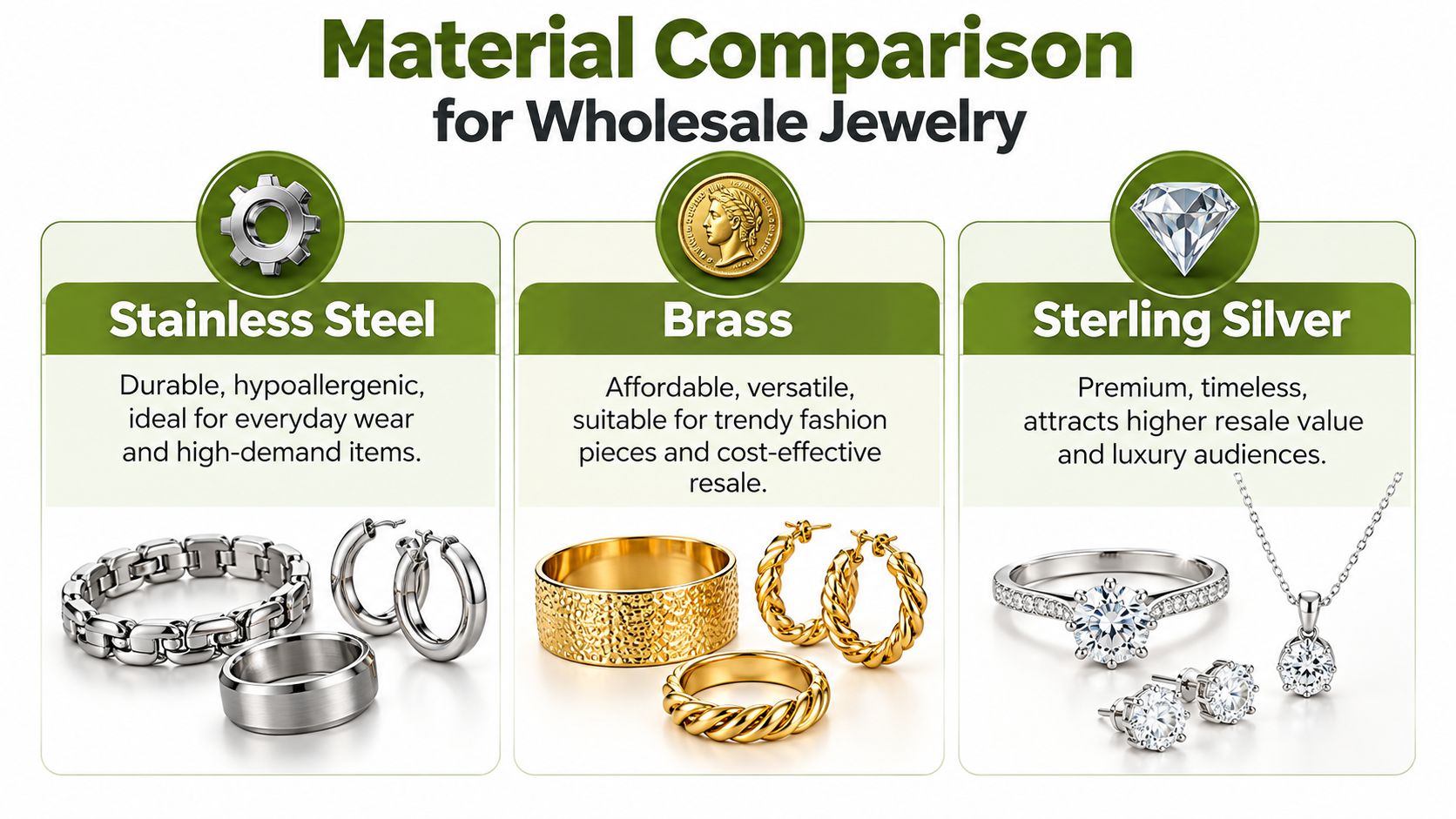
There is no single best jewelry material for every boutique. Choose by customer expectation, design requirements, target retail position and the claims you can substantiate. Stainless steel can suit frequent-wear designs, brass gives designers flexibility for fashion-led shapes, and sterling silver supports precious-metal positioning. The exact grade, finish and component construction still need confirmation for each item. HonHo's 316L stainless steel guide provides background on that alloy, but it should not be read as proof that every stainless steel SKU is 316L or that every finish performs identically.
Stainless steel, brass, and sterling silver each sell differently
Stainless steel: confirm the stated grade and every attached component. Corrosion resistance is influenced by alloy, fabrication, surface condition, coating and use; it is not a universal promise that a finished piece will never change color or irritate a wearer.
Brass: useful for formed, cast and fashion-led designs, but the visible result depends strongly on the finishing system and care conditions. Ask how exposed edges, solder points and high-friction areas are handled.
Sterling silver: in the United States, a “Sterling” or “Sterling Silver” representation means at least 925 parts per thousand pure silver under the FTC jewelry guides. The existing sterling silver sourcing guidance is a useful prompt for inspection; buyers can also check the current 16 CFR § 23.5 silver-content guidance before writing U.S. claims. A “925” stamp alone is not a substitute for reliable supplier documentation.
Hallmarking rules depend on the market, article and applicable exemptions. The existing Hallmarking guidance can help a buyer recognize marks, while businesses selling precious-metal articles in the UK should use the current UK government hallmarking guidance. Do not assume that one UK statement describes every EU market.
| Material route | Useful boutique fit | Sample and listing checks |
|---|---|---|
| Stainless steel | Everyday silhouettes and designs that benefit from a strong, corrosion-resistant base | Grade, finish, welded/soldered areas, closure, edges and all skin-contact components |
| Brass | Fashion-led forms, color variety and designs where finishing carries the visual story | Base-metal disclosure, plating/coating specification, exposed surfaces, stones and care language |
| 925 sterling silver | Precious-metal positioning where customers expect purity information | Composition documentation, marks required in the sales market, finish if plated, components and accurate claim wording |
Keep the Jewelry Materials & Plating Guide open while comparing SKUs. The Gold Plated Stainless Steel Red Rose Pendant Necklace, for example, is described as a stainless steel design with a gold-plated finish, rhinestone color details and an approximate 45 cm chain plus 5 cm extender. Confirm the live product specification and quotation at the time of purchase; one example does not establish the construction of another SKU.
Calculating Real Margins Beyond Wholesale Price
Calculate margin from landed and sale-related cost, not the supplier's unit price alone. At minimum, model product cost, packaging, freight, duties or taxes, payment and marketplace fees, expected returns or defects, and any discounting needed to clear slow inventory. Use the same currency and order quantity throughout the worksheet.
Markup bands only make sense after you know the all-in cost
Fixed markup bands are not universal benchmarks: rent, labor, channel fees, tax treatment, return rates and customer price tolerance differ by retailer. The existing Wholesale jewelry pricing guidance can help frame the calculation, but a boutique should set its price from its own cost and margin target rather than copy a multiplier.
| Worksheet field | What to record | Decision it supports |
|---|---|---|
| Landed unit cost | Goods, allocated freight, duty/tax and payment costs at the quoted quantity | Whether the intended retail price leaves enough gross contribution |
| Sale-related cost | Packaging, channel fee, fulfillment, return allowance and planned promotion | Whether the channel is viable after the sale occurs |
| Inventory exposure | MOQ, units per SKU, sample cost and cash tied up until the review date | Whether to reduce breadth, depth or customization |
| Reorder scenario | Restock quantity, current quote, lead time and acceptable stockout window | Whether a winning SKU can be replenished without breaking the retail price |
Compare at least a base case and a stress case. The stress case might use a smaller order, higher freight allocation or a realistic return allowance. A fast seller with a reliable reorder route can justify a higher unit cost; a low-cost item that needs heavy discounting may not.
Use the MOQ and wholesale pricing page beside the worksheet, then confirm the current quotation. Published planning information is not a guarantee that every ready-stock or custom SKU has the same minimum.
Planning an Assortment That Sells and Restocks
Give every SKU a job. A compact opening assortment normally needs dependable staples, a small number of visual anchors for display and content, and controlled tests that answer a specific question about price, shape, color or material. Avoid buying several near-duplicates simply because each looks attractive on its own.
Order in phases, not all at once
- Define the customer and price architecture. Set the use occasion and retail range before selecting products.
- Approve samples or ready-stock references. Record dimensions, weight, finish color, closure function, symmetry, stone security, sharp edges, packaging fit and listing claims.
- Place a controlled opening order. Buy enough depth to learn, while preserving budget for reorders or gaps found after launch.
- Review on a fixed date. Track units received, units sold, returns with reasons, remaining stock, current reorder quote and whether the product evidence was adequate.
Order structure differs by category. The wholesale earrings guide focuses on paired components, posts, backs and closure checks. The existing Wholesale buying guidance offers another supplier perspective, but its commercial statements apply to that business; verify HonHo terms independently.
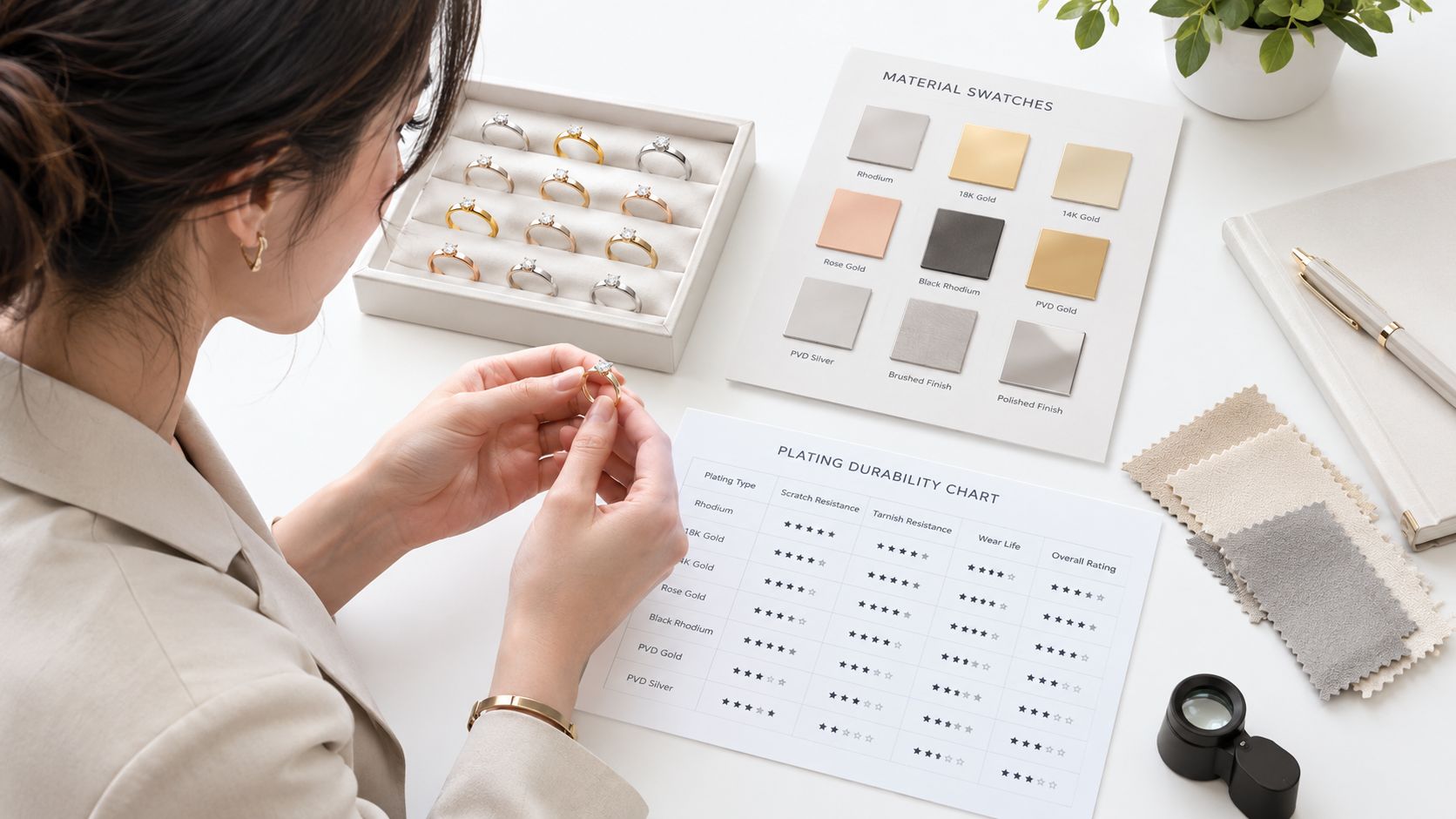
Do not convert a sample test into a promised wearing lifespan. A visual check, tape test or corrosion test can compare controlled samples only when the method, substrate, coating, preparation and acceptance criteria are recorded. Real customer use adds sweat, cosmetics, friction, storage and cleaning variables that a short test cannot reproduce completely.
Making Smart Buying Decisions with Suppliers
Request a written specification and quotation that can be attached to the purchase record. It should identify the SKU or drawing revision, base metal, finish, stones, dimensions, weight tolerance, closure, skin-contact components, packaging, quantity, price, lead time and the evidence available for any regulated or performance claim.
Compare suppliers on the facts you can verify
Separate factory capability from the finished product you are buying. A supplier may be able to produce several alloys or plating systems, but that does not prove which one is used for a particular item. Likewise, a test method offered during development is not evidence that an untested production batch passed it.
| Approval point | Record | Example acceptance question |
|---|---|---|
| Identity | SKU/drawing revision, photos and sample seal/reference | Does the shipment match the approved version rather than a similar catalog image? |
| Construction | Materials by component, finish, dimensions, weight/tolerance and closure | Are listing claims supported at component level? |
| Workmanship | Edges, symmetry, joints, stone setting, moving parts and finish consistency | Which defects trigger rework, replacement or rejection? |
| Packaging | Unit protection, labels, barcode/card and carton configuration | Does packaging protect the item and fit the boutique's display/fulfillment process? |
| Repeat order | Color reference, retained sample, current MOQ/price and lead time | What evidence will be used to judge consistency on the next batch? |
For custom development, HonHo's current planning baseline is 50 pieces per style and color, with brass or 925 silver samples typically planned at 25–30 days, stainless steel samples at 25–35 days, and bulk production at 35–45 days after approval. These are custom-program planning figures, not a promise for every SKU or order; ready-stock availability and dispatch timing should be confirmed on the current quote.
Use the jewelry sample approval checklist to document the review. Keep the approved sample or clear reference images with the specification, and record any waiver rather than relying on memory.
Practical rule: scale only when the sample, written specification and customer-facing claim tell the same story.
Next Steps for Building a Wholesale Jewelry Program
Start with one buying record per SKU. Attach the current specification, quotation, sample decision, landed-cost scenario and intended listing claim. After launch, add sales, return reasons, remaining stock and the current reorder terms. That record makes the next purchase easier to defend than a decision based on appearance alone.
Before requesting a quote, send the supplier the information needed to answer precisely:
- target market, customer and intended retail positioning;
- product category, reference image or drawing, dimensions and quantity by style/color;
- preferred base metal, finish, stones, closure and skin-contact components;
- required packaging, labeling and destination;
- claims or compliance documents that must be supported; and
- sample deadline, launch window and whether the request is ready stock or custom development.
Browse the current assortment or send a specification-led inquiry through HonHo Wholesale Jewelry. Ask for the current SKU details and quotation before relying on a planning baseline, and keep the approved record for the reorder.


