

316L stainless steel jewelry is made from a low-carbon alloy containing chromium, nickel and molybdenum. It resists corrosion and is widely used for everyday jewelry. The grade identifies the base metal. A gold-colored coating needs its own specification, and skin-contact claims need evidence from the finished piece.
Before buying wholesale, check the alloy documentation and agree on the finish. Any test report should identify the style you plan to order and address the requirements of its destination market. Labels such as “surgical steel,” “hypoallergenic” and “waterproof” leave those questions unanswered.
| Supplier claim | Evidence to request | What the evidence supports and its limits |
|---|---|---|
| 316L stainless steel | Material declaration, mill certificate, or composition result tied to the sampled lot | Supports the base-alloy claim; does not establish coating life or nickel-release compliance |
| Hypoallergenic | Finished-piece nickel-release report that identifies the style, finish, method, lab, and date | Supports a defined test result; does not guarantee zero reactions for every wearer |
| Gold PVD or plated | Base metal, coating process, color standard, approved sample, and agreed wear/corrosion test route | Defines the finish for purchasing; does not justify a universal number of wear years |
| Waterproof | Written use conditions and a relevant finished-piece test method | May support a limited care claim; does not mean chlorine-, chemical-, or scratch-proof |
Table of Contents
- What Is 316L Stainless Steel Jewelry
- Why the Alloy Composition Matters for Jewelry Performance
- Understanding Hypoallergenic Claims and Nickel Release Limits
- Comparing 316L Stainless Steel With Brass and Sterling Silver
- How to Verify Supplier Material Claims Before Buying Wholesale
- Retail Positioning and Resale Strategy for Stainless Steel Jewelry
- Key Takeaways for Wholesale Jewelry Buyers
What Is 316L Stainless Steel Jewelry
316L is an austenitic stainless steel commonly specified as UNS S31603 or EN 1.4404. Jewelry applications include rings, chains, earrings, bracelets and body-jewelry components, although the grade name alone does not establish suitability for a particular piercing. Its silver-colored surface and resistance to corrosion make it useful for pieces exposed to moisture and perspiration. Composition limits depend on the specified standard: the cited EN 1.4404 datasheet lists 16.5–18.5% chromium, 10–13% nickel and 2–2.5% molybdenum, with carbon limited to 0.03%. Thyssenkrupp Materials explains the composition and grade designation of 316L stainless steel.
The “L” means low carbon. During welding or other heating, lower carbon reduces chromium-carbide precipitation and helps retain corrosion resistance around the affected area. The finished result also depends on weld quality, polishing, crevices, plating and storage. Confirm the material specification for the actual part and manufacturing route, including cast components.
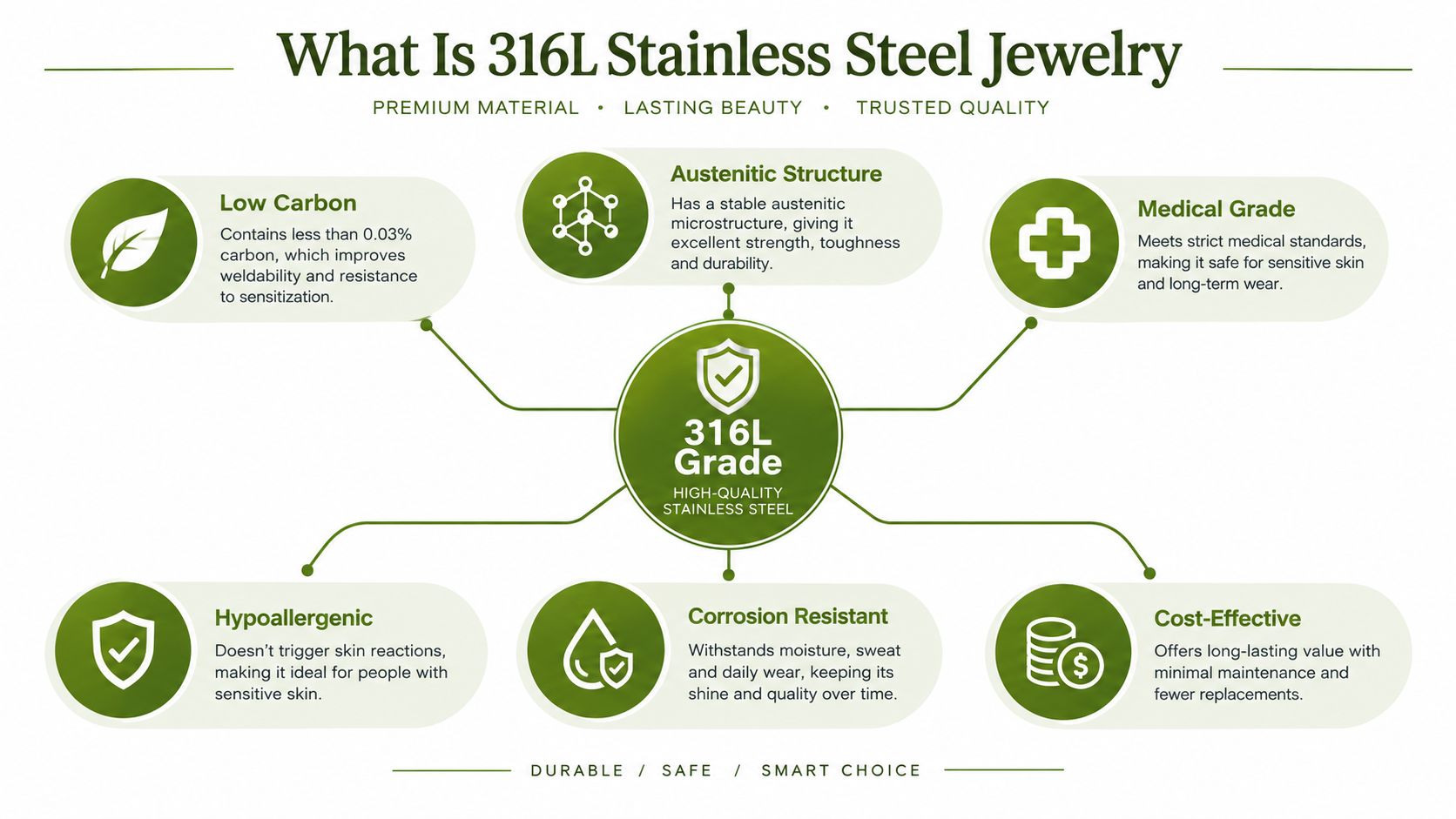
What the grade means for resale
Uncoated 316L can suit an everyday-wear range that needs relatively little maintenance. For colored pieces, ask how the surface treatment will be specified and cared for. That gives customers a clearer expectation than applying the same durability claim to every finish.
Ask the supplier to name the grade and provide composition documentation. Relevant nickel-release evidence should cover the finished product. Together, these records give your staff something concrete to use when writing product pages or answering customer questions. The guide linked as HonHo's stainless steel wholesale collection explains sourcing considerations; confirm the material of each SKU before using a grade claim in a listing.
Why the Alloy Composition Matters for Jewelry Performance
Chromium helps form the passive oxide layer on stainless steel. Molybdenum improves resistance to localized pitting and crevice corrosion, which is relevant when jewelry encounters chlorides. The 316L technical datasheet from Upmet describes these corrosion-resistance characteristics. Salt, chlorine, cosmetics and moisture still need attention in the care instructions for the finished piece.
Three elements with different jobs
- Chromium supports the protective surface layer that gives stainless steel its corrosion resistance. It helps explain why an uncoated 316L chain can retain its appearance with less maintenance than ordinary carbon steel.
- Molybdenum is especially relevant where chlorides are present. Sweat, seawater, and some cleaning solutions can create conditions for localized attack, so this addition matters for bracelets, rings, and necklaces worn during active daily routines.
- Nickel contributes to the austenitic structure and is part of the standard alloy. It also means that 316L is not nickel-free, an important distinction for earrings and piercing-related products.
- Low carbon reduces the risk of chromium-carbide formation during heating and welding. For manufacturers, this helps preserve corrosion resistance around joins and processed areas.
Localized corrosion can occur when chloride-rich moisture remains in a crevice. Check polishing, joins and places where residue can collect when reviewing a sample. Rinsing after seawater exposure and drying before storage may be appropriate for plain steel; the care method must also suit any coating, stones or other components. HonHo's jewelry materials guide provides context for comparing the available materials.
Describe the care limits alongside the finish. Corrosion resistance does not prevent scratches or damage from every chemical.
On uncoated, silver-colored 316L, the visible surface is the steel itself. A gold-colored piece normally has a plated or coated surface. Ring edges, clasps and points where chain links rub deserve a close look during sample approval because color can wear in those areas while the underlying steel remains sound.
Understanding Hypoallergenic Claims and Nickel Release Limits
316L contains nickel. UNS S31603 specifications commonly allow 10–14%, so “nickel-free” would be an inaccurate description. The amount released from a finished surface is a separate measurement, and a compliant test result cannot guarantee that every wearer will tolerate the piece.
For the EU market, REACH Annex XVII, entry 27 sets nickel-release limits of less than 0.2 micrograms per square centimeter per week for post assemblies inserted into pierced parts of the body, and no more than 0.5 micrograms per square centimeter per week for parts intended for direct and prolonged skin contact. EN 1811:2023 is a reference method for measuring release, rather than the alloy's nickel content. Surface condition, processing, coatings, wear and corrosion can affect the result. ASTM's material reference discusses 316L history and nickel-release considerations.
What changes real-world exposure
When reviewing nickel-release evidence, check the following details:
- Surface condition: Scratches, rough polishing, and damaged areas can change skin exposure.
- Manufacturing details: Welds, joins, and localized heating require quality control.
- Finish and plating: A coating may alter exposure, but it can also wear through use.
- Product category: Earrings and piercing-adjacent pieces deserve closer documentation because they remain in prolonged or inserted contact.
- Testing records: Supplier declarations and independent nickel-release testing are more useful than the phrase “surgical grade” by itself.
On the product page, state “316L stainless steel base” only when supported, then name the finish. Avoid “100% allergy-free.” For earrings and piercing jewelry, request documents that identify the relevant components and finished style, particularly when customers ask about nickel sensitivity. HonHo's hypoallergenic helix earrings guide discusses the product distinctions; the documentation still needs to match the assortment you order.
Comparing 316L Stainless Steel With Brass and Sterling Silver
Compare 316L, brass and 925 sterling silver by the design, finish and care instructions you intend to offer. Each can serve a different part of an assortment. The material name alone will not tell you how well a particular piece is made.
| Material | Practical strength | Main maintenance consideration | Resale positioning |
|---|---|---|---|
| 316L stainless steel | Strong everyday-wear base with good resistance to general corrosion and chloride exposure | Rinse and dry after prolonged salt, chlorine, or heavy perspiration exposure; monitor colored finishes | Accessible, durable, low-maintenance jewelry |
| Brass | Flexible base for many plated and decorative designs | Requires more careful protection from moisture and surface changes, especially under plating | Fashion-led, margin-conscious, finish-focused collections |
| 925 sterling silver | Precious-metal positioning with established customer recognition | Can tarnish and usually needs more regular polishing and storage care | Higher perceived material value and gift-oriented ranges |
For a frequently worn range, review stainless-steel rings, hoops, chains and bracelets alongside the finishes offered. Brass gives buyers options for plated, decorative designs. Sterling silver suits customers looking for a precious-metal base, with tarnish care explained at purchase. Choose the construction and finish together with the material.
Base material versus finish
A gold-plated brass necklace can look much like a gold-plated 316L necklace when new. As the finish wears, the exposed base metals can behave differently. Gold-colored 316L is not solid gold; its appearance depends on the coating process and surface preparation as well as friction, chemical exposure and the way it is worn.
You might use stainless steel for everyday basics, brass for seasonal statement designs and sterling silver for a precious-metal range. These are assortment choices, not fixed rules for the materials. The non-tarnish cross necklace guide is relevant when discussing wear and care, but its title should not be treated as a performance guarantee for an individual SKU.
How to Verify Supplier Material Claims Before Buying Wholesale
Before requesting a quotation, specify the grade and finish you need. Ask the supplier which documents cover the material and which tests apply to the finished style.
A practical verification sequence
- Request the stated grade. Look for 316L, UNS S31603, or EN 1.4404, rather than a generic stainless-steel label.
- Check composition documentation. For UNS S31603, commonly specified limits include carbon up to 0.03%, chromium 16–18%, nickel 10–14%, and molybdenum 2–3%. Use the standard stated on the supplier’s document; the EN 1.4404 ranges quoted above differ. Published 316L material specifications provide these benchmarks for supplier comparison.
- Separate base metal from finish. Ask whether the item is uncoated, gold plated, silver finished, enamelled, or treated with another surface process.
- Request finished-product testing where relevant. For earrings and prolonged skin-contact products, ask about nickel-release documentation rather than relying on the grade name.
- Approve a physical sample. Inspect edges, clasps, welds, polish, crevices, symmetry, and the way the finish covers recessed areas.
- Record the approved specification. Your purchase order, product page, and incoming inspection should describe the same material and finish.
| Sample checkpoint | Record before approval | Reason |
|---|---|---|
| Base material | Claimed grade, supporting document, supplier, and lot or sample reference | Keeps “stainless steel” from becoming an unverified blanket description |
| Finish | Process, color standard, coated areas, and any agreed test route | Separates coating performance from the 316L substrate |
| Skin contact | Applicable market requirement and finished-piece nickel-release evidence | Supports compliant, qualified wording for earrings and prolonged-contact styles |
| Construction | Dimensions, weight, edges, joins, clasp function, symmetry, and stone security | Turns a material specification into a sellable, repeatable item |
| Approval record | Dated photos, sealed sample, purchase-order wording, and acceptable tolerances | Gives incoming QC a clear reference |
A magnet cannot confirm that a piece is 316L or establish its nickel release. Cold forming can increase magnetic response in austenitic stainless steel, so a simple magnetic pass/fail check can be misleading. Use composition documentation and the relevant finished-product tests, then record sample approval with a jewelry sample approval checklist.
Retail Positioning and Resale Strategy for Stainless Steel Jewelry
Build the retail description from the approved sample and its records. Explain the material, finish and care needed for frequent wear. For a gold-colored piece, include the coating details you can support and avoid promising that the color will remain unchanged permanently.
Polished hoops, simple chains, stacking rings, signets, cuffs and pendant necklaces are options for a core assortment. Compare their fit, finish and price against the customers you serve, whether you sell through a boutique, Shopify store, marketplace or social channel. Use your own sales and return records to decide what to reorder; a familiar silhouette alone does not establish demand.
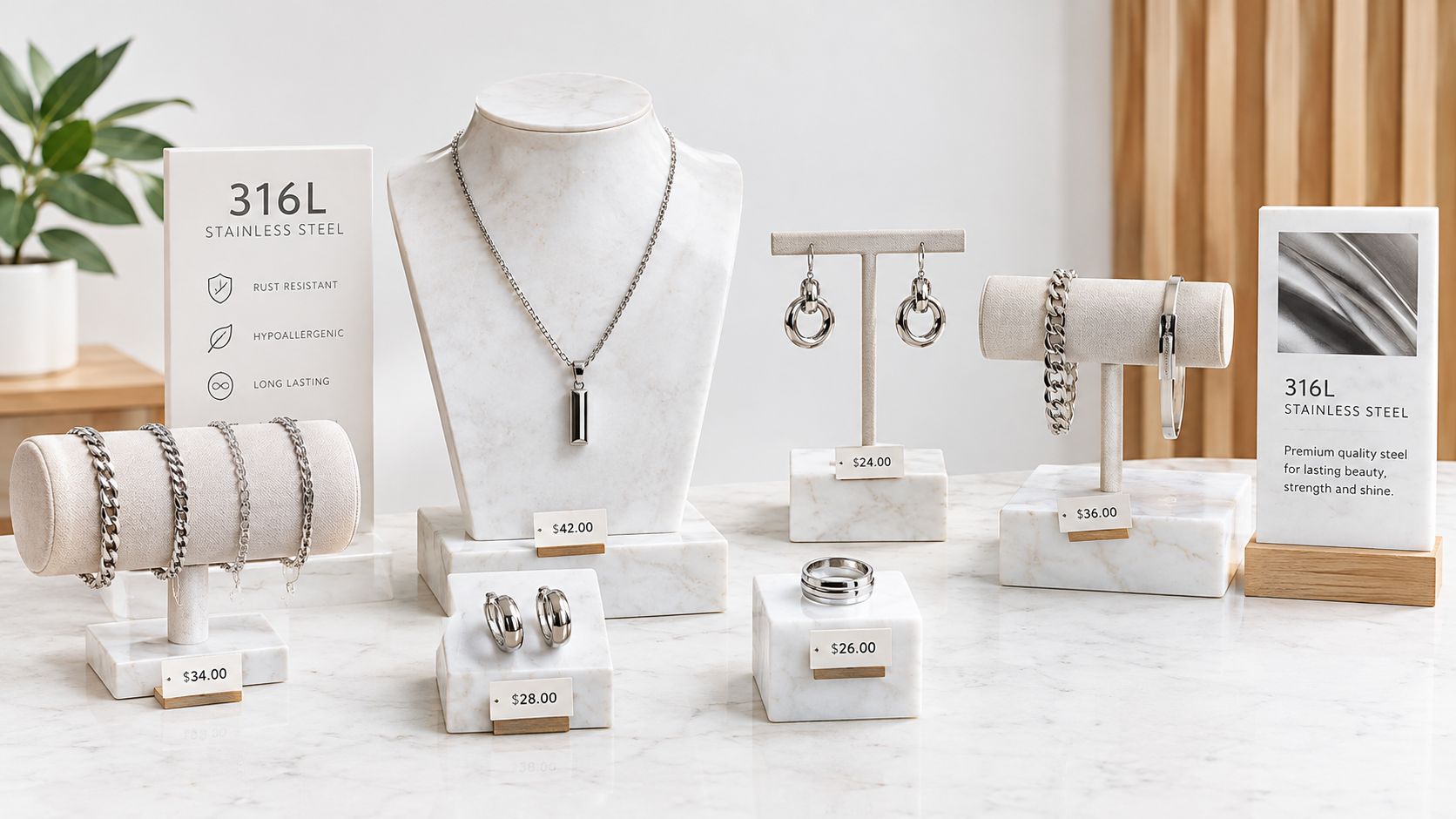
Make the finish part of the product story
Give customers the information they need to choose and care for the piece:
- The base material, such as 316L stainless steel.
- The visible finish, such as gold plated or silver-colored.
- Basic care, including rinsing and drying after saltwater or heavy perspiration.
- Skin-contact wording, without promising universal allergy protection.
- The style use case, such as daily hoops, stackable rings, or layering chains.
HonHo's wholesale range includes stainless steel, brass and 925 sterling silver across earrings, rings, necklaces and bracelets. Compare the available SKUs when building your price and style range. Verify each item's specification before publishing the listing, especially when several pieces look alike but use different base metals or finishes.
Key Takeaways for Wholesale Jewelry Buyers
Before placing the order, match the material documents and any required nickel-release report to the sample being approved. Record the finish and care limits in the purchase order and product listing. Keep the approved sample available for incoming inspection and reorders so the next batch can be checked against the same reference.
Browse HonHo's wholesale jewelry collections for stainless steel, brass and 925 sterling silver styles, and confirm the base material and finish of the SKUs you shortlist. For ready stock or custom development, send HonHo the style reference, quantity, destination market, and required material or test documentation. Include the finish you need so the team can review the request.


