

For a retail buyer, the useful number is landed cost per sellable ring—not the 925 stamp or melt value alone. A 5 g sterling silver ring contains 4.625 g of fine silver. At the LBMA Silver Price of US$53.90 per troy ounce on 23 October 2026, that metal was worth about US$8.01. Fabrication, finish, stones, quality control, packaging, freight, fees, and channel margin sit above that metal value.
Treat an S925 stamp as a claimed fineness designation that still needs supplier documentation and, when the risk justifies it, material verification. The mark does not establish the ring's actual weight, plating, stone identity, workmanship, or resale value.
Before ordering, date the metal input, separate the supplier quote from landed cost, and calculate markup and margin from the same cost base. The figures below are worked examples, not HonHo quotations or resale forecasts.
Table of Contents
- Typical S925 Ring Prices and Melt Value by Weight
- What the 925 Stamp Does and Does Not Tell You
- The Cost Layers Behind a Finished Ring Price
- How Silver Market Swings Change Ring Prices and Stock Choices
- Markup Math and Resale Margins for 925 Rings
- Wholesale Order Terms That Change Your Real Cost
- Common Questions About 925 Ring Pricing
- Choose Your Ring Price Strategy Before You Order
Typical S925 Ring Prices and Melt Value by Weight
One 2025 market listing analysis put selected 925 sterling silver rings between US$14.88 and US$22.99, according to Accio's review of listed women's rings. Treat that as one style band, not a market-wide average. Heavier signets and branded pieces sit above it.
Fine silver content equals ring weight in grams multiplied by 0.925. Divide that result by 31.1035 (grams in a troy ounce), then multiply by the dated silver price per ounce. For the table below, the LBMA displayed US$53.900 per troy ounce on 23 October 2026. The Silver Institute's review of what sets the silver price uses older averages to explain market drivers; it is context, not today's quote.
Melt value at one dated price
| Ring weight | Fine silver content | Silver value at $53.90 per ounce |
|---|---|---|
| 2 g | 1.85 g | $3.21 |
| 3 g | 2.775 g | $4.81 |
| 5 g | 4.625 g | $8.01 |
| 8 g | 7.40 g | $12.82 |
| 10 g | 9.25 g | $16.03 |
A 5 g ring holds about 4.625 g of fine silver, worth about US$8.01 at that input. Cents are rounded. The calculation excludes stones, plating, manufacturing loss, labor, packaging, freight, and seller costs. Replace the dated benchmark before using the table for a live quote.
Do not infer a universal retail multiple from the listing band above. Style, weight, construction, brand, channel costs, and saleability can move the finished price independently of melt value.
What the 925 Stamp Does and Does Not Tell You
Under the U.S. Jewelry Guides, an item described as “sterling silver” or “sterling” should be at least 925 parts pure silver per 1,000; see 16 CFR Part 23. The balance is alloying metal. For background, sterling silver's standard definition describes copper as a common addition, while the Royal Mint's explanation of metal fineness traces the historical sterling standard. Neither source verifies an individual ring.
For pricing, apply 0.925 to the ring's actual weight: a 3 g band contains 2.775 g of fine silver if the stated fineness is accurate. A stamp is not, by itself, an assay result, and it adds no weight or price.
Three misreadings that distort an offer
A 925 mark is a fineness claim, not a weight reading. A ring weighing 3 g contains 2.775 g of fine silver only if the claim is accurate; weigh the piece rather than treating the stamp as a weight.
The mark also does not set a resale price. Two rings of the same purity can have different weights, designs, stones, finishes, workmanship, and brands. For a concrete comparison, the previous table values the fine silver in a 5 g ring at US$8.01 using its stated silver-price input. That is a melt-value example, not a resale quote or guarantee.
Finish and stone details require their own specifications. The stamp does not establish plating thickness or identify a stone, so list purity, finish, and stone type separately on the quote. The distinction applies beyond rings: these Gold Plated and Silver-Finish Stainless Steel Interlocking Drop Earrings have two stated finishes on stainless steel, measure about 3.13 cm, and have no stone. Those details come from the product description, not a stamp.
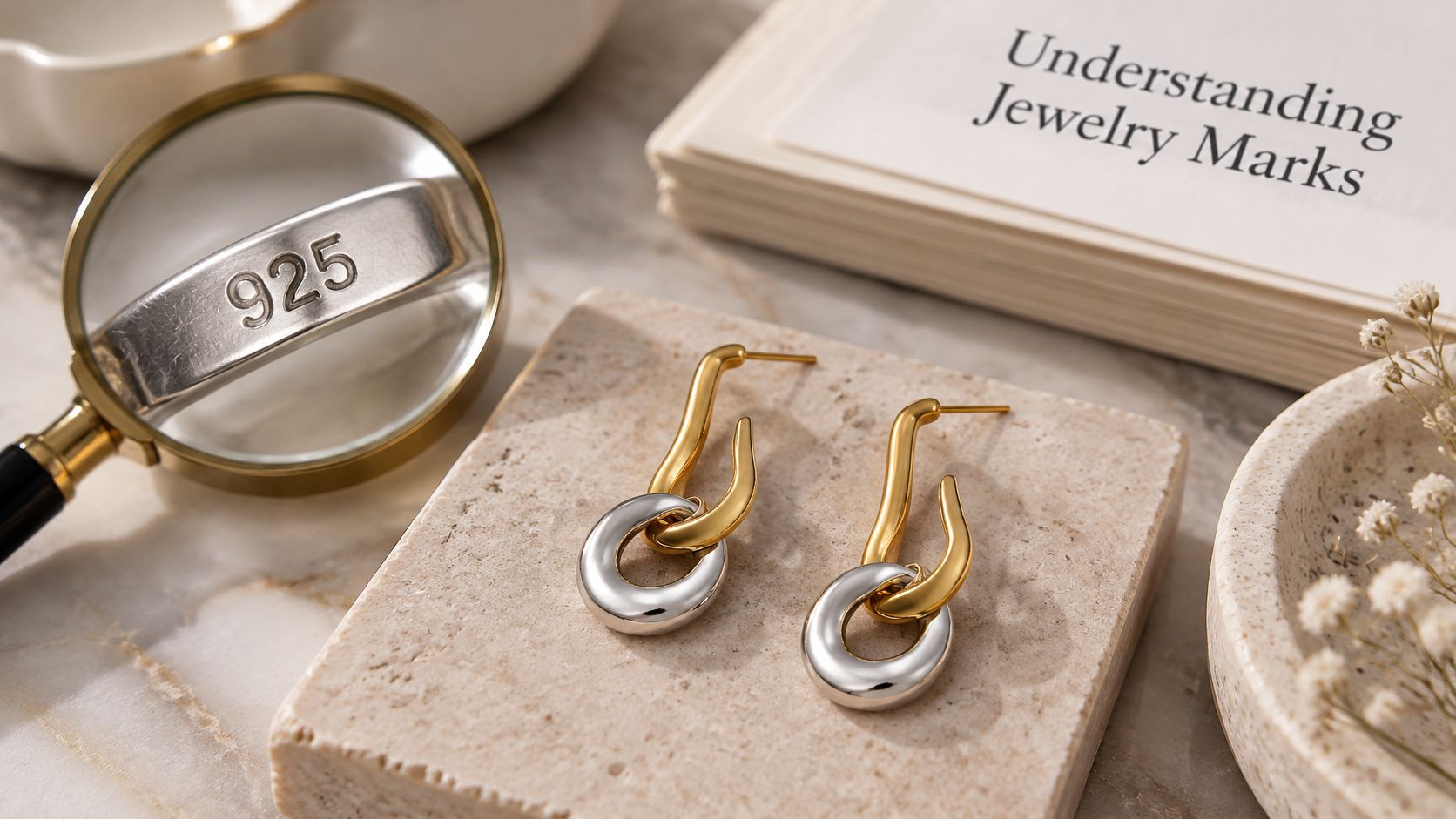
Before comparing unit prices, check the order details later in this guide. This silver necklace buying note shows how to assess purity language for another jewelry category.
The Cost Layers Behind a Finished Ring Price
At the dated input above, the fine silver in a 5 g ring is worth about US$8.01. The finished price also pays for making, finishing, inspection, packing, shipping, and the seller's margin. Those costs explain why melt value and retail price can move very differently.
The Silver Institute's historical series records silver at $5.50 per troy ounce in 2004, $48.70 in 2011, and $13.58 five years later (Silver Institute historical data). Finished rings do not follow those price changes one for one, because metal is only one part of the ticket. Sterling silver and investment silver are different purchases: a ring's commercial price includes the work and selling costs that bullion does not.
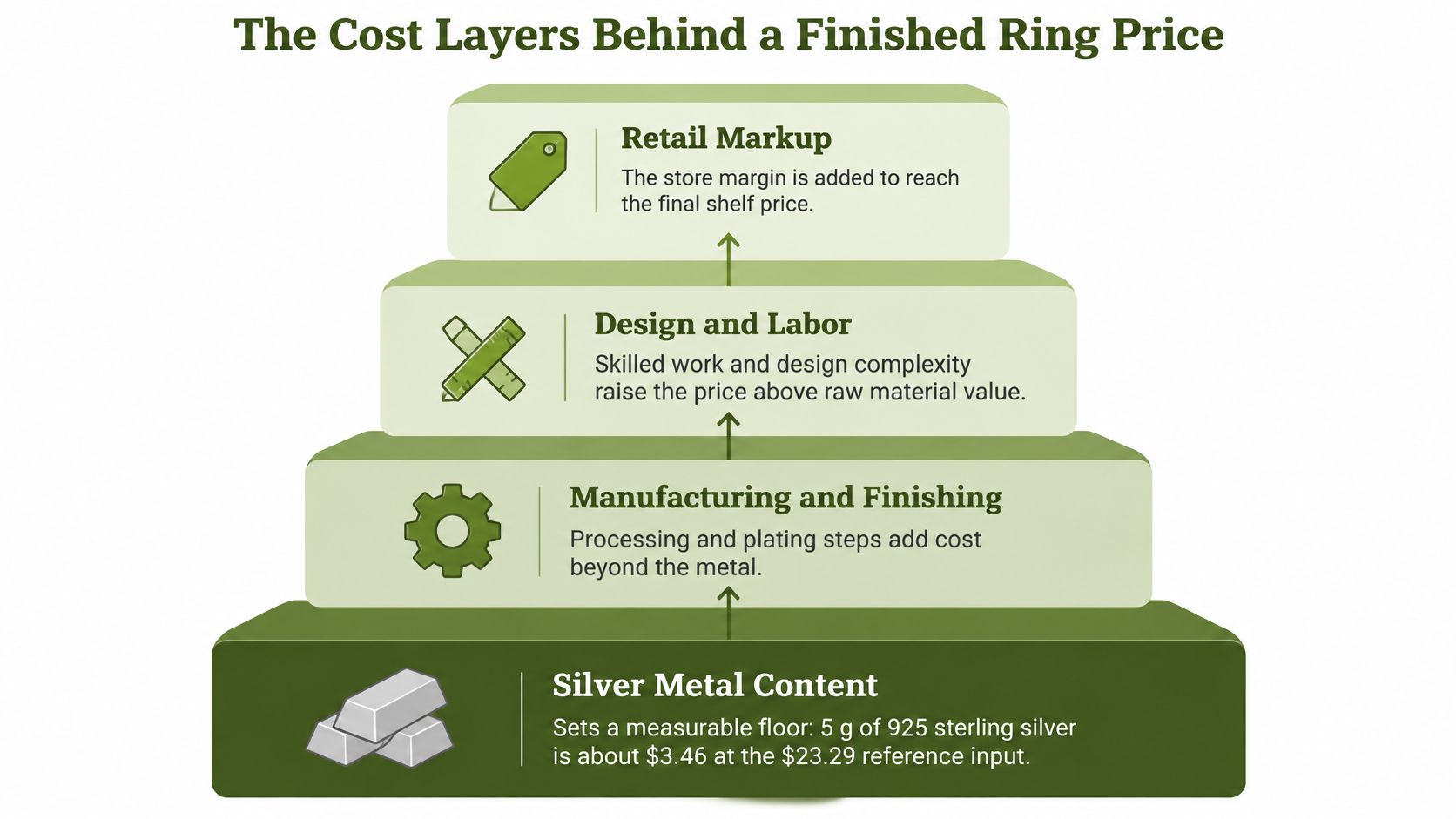
What each layer adds
| Cost layer | What it covers | Effect on price |
|---|---|---|
| Silver content | 92.5% of ring weight at the prevailing silver price | Sets the metal floor and moves with the market |
| Fabrication | Casting or forming, soldering, sizing, and assembly | Rises with design complexity and handwork |
| Finishing and plating | Polishing and any gold plating | Adds a per-piece cost that depends on the finish |
| Stones | Zirconia, pearls, or other stones and their setting | Varies with stone count, size, and setting method |
| Quality control | Inspection and an allowance for rejected pieces | Spread across the order; higher on complex designs |
| Packaging and freight | Boxes, cards, bags, and shipping | A per-piece share that falls as the order grows |
| Brand and margin | Retail positioning and seller margin | Usually the largest and most variable layer |
Read the stack from the metal outward. The market sets the silver cost; buyers have more control over fabrication, finishing, stones, and packaging. A simple band generally takes less work than an openwork signet. Plating and stones are specification choices with costs to confirm on the quote. For finish comparisons, see this gold PVD coating explainer. Quality control also affects unit cost: rejected pieces leave fewer sellable rings to absorb the order's expenses. Packaging and freight can add up quickly when spread across a small order.
Practical rule: Compare landed cost per sellable piece. Add the supplier price, packaging, freight, applicable duties, and a defect allowance, then divide by the number of pieces you can sell.
For example, a supplier quotes $4 per ring for 100 pieces, with $60 freight and 10 rings expected to fail inspection. The $460 total order cost spread across 90 sellable rings comes to about $5.11 each. A second supplier quotes $4.50 per ring, with $20 freight and no rejected pieces. That order costs $470, or $4.70 per sellable ring. The lower quote produces the higher unit cost once freight and rejects are included.
A lightweight minimalist ring may contain little recoverable silver while its finished price reflects design, surface quality, and presentation. Compare the stated weight and finish, then price the order by sellable unit rather than by stamp or headline price.
How Silver Market Swings Change Ring Prices and Stock Choices
Silver's benchmark price can move sharply within a year, while the melt value of a ring accounts for only one part of its finished price. The LBMA Silver Price is set once daily at 12:00 p.m. in U.S. dollars per troy ounce, providing wholesalers a shared reference, as the LBMA daily auction description explains. Convert the benchmark to a per-gram figure and date each quote. Fabrication, finishing, and other costs do not automatically follow spot prices.
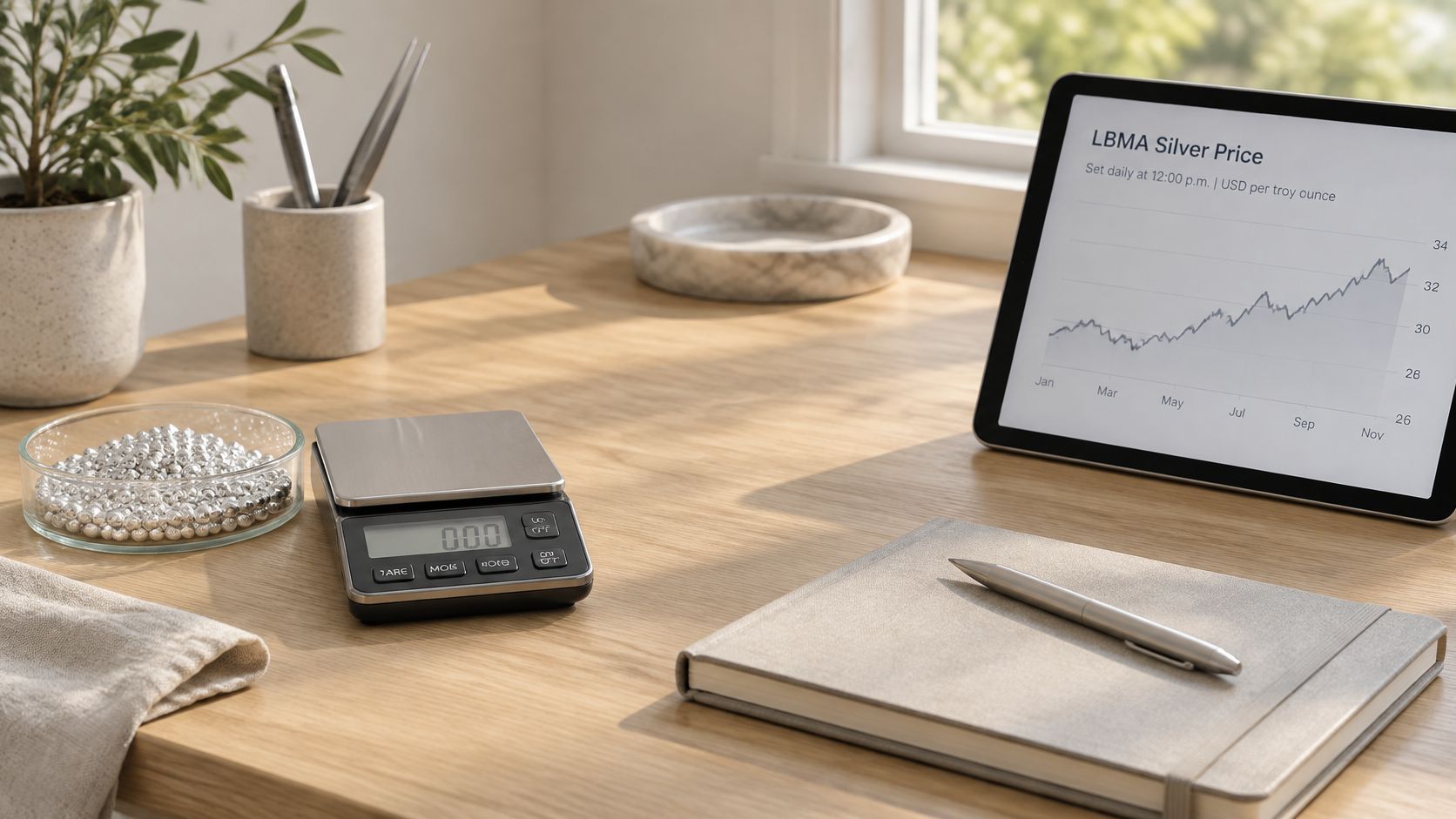
A published silver market record listed silver at $53.88 per troy ounce on 23 October 2026, down 1.30% that day and 15.58% over the preceding month, while remaining up 10.88% year over year. It also listed a high of $121.64 in January 2026. For a boutique buyer, the practical response is to ask how long the supplier will honor a quote and whether the metal component can be repriced after that period. Put the validity date in writing before placing an order.
Demand doesn't rise just because the metal did
Higher silver prices can squeeze jewelry demand as well as raise metal costs. JewelleryNet's 2026 report, citing the Silver Institute, says global silver-jewelry demand fell 8% in 2025, from 205.1 million ounces to 189.3 million ounces, as higher prices and macroeconomic volatility reduced affordability (JewelleryNet's report on that dip). The report says spot silver rose from about $29 per ounce in January 2025 to $74.8 in December, an increase of about 158%. It also reports the Silver Institute's projection that jewelry demand will decline by more than 9% in 2026, to 178 million ounces, with China a relative exception, where innovation and gold-plated silver are gaining popularity.
The market rise may affect a heavy ring more than a lightweight design because the metal makes up a larger share of its cost. Lighter styles can also give a retailer more accessible price points when shoppers resist higher tags.
| Ring style | Sensitivity to silver price | Why |
|---|---|---|
| Heavy statement or chunky ring | Higher | More silver per piece, so the metal share of cost rises |
| Signet or thick band | Higher | Weight-driven metal content |
| Standard band | Moderate | Metal share depends on width and profile |
| Lightweight minimalist ring | Lower | Little silver per piece |
| Stacking band | Lower per piece | Small weight, often sold in sets that spread cost |
| Adjustable or open ring | Lower | Lighter construction, one size covering several customers |
| Gold-plated silver ring | Depends on base metal and plating cost | Plating adds a finish cost on top of the base metal |
Keep several weights and styles in the assortment instead of committing the case to heavy pieces. Melt value tracks silver content and the benchmark; the finished price also reflects costs the buyer can influence through design and product selection.
Markup Math and Resale Margins for 925 Rings
A ring price breakdown used as a retail reference illustrates markups of 200% to 300% for some physical retailers and much thinner margins for some online sellers. Treat those figures as that publisher's examples, not a channel benchmark. Rent, staff, security, platform fees, advertising, returns, discounts, and inventory age all change the margin a ring must earn.
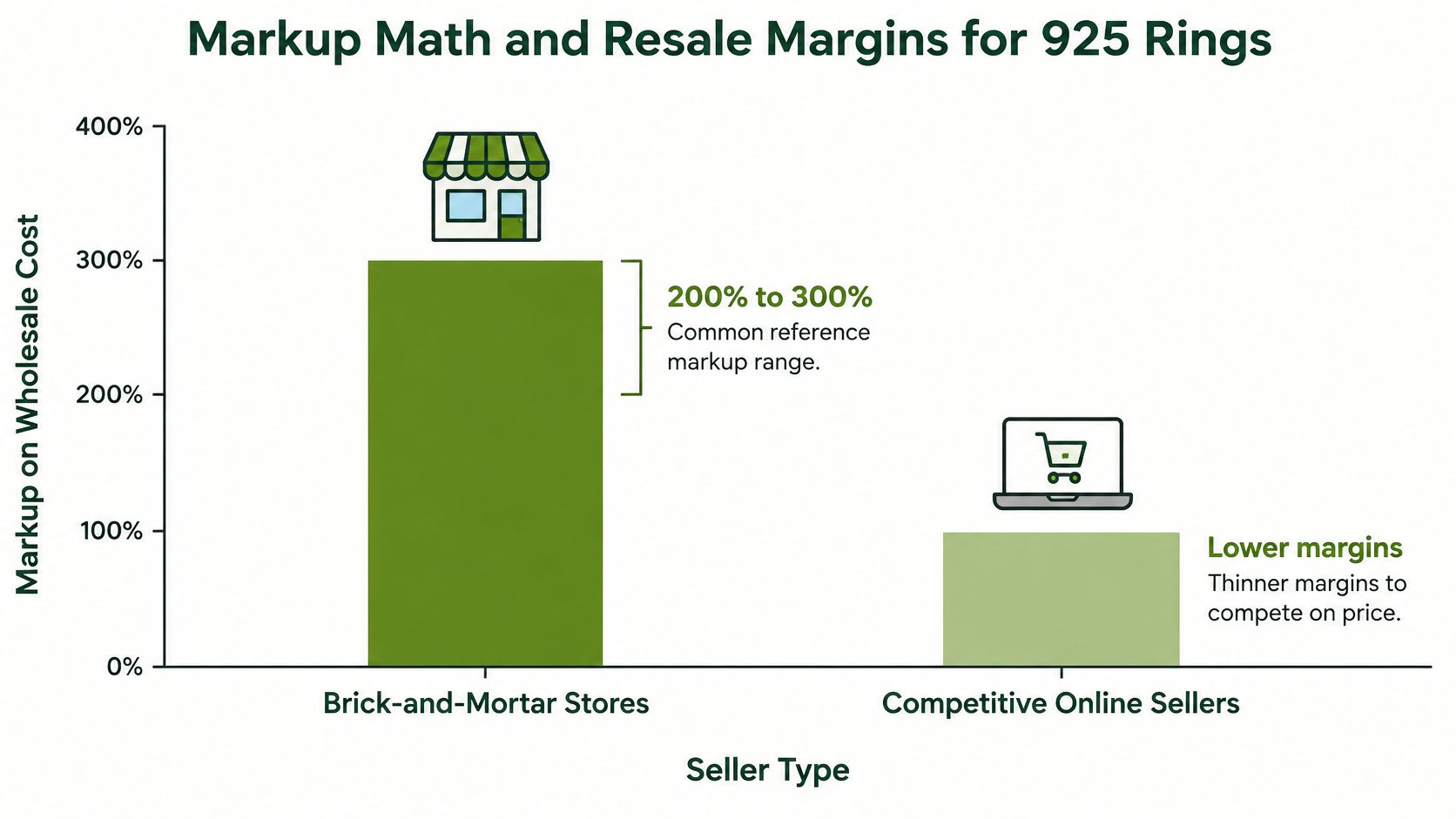
Markup is not margin
A 200% markup means the selling price is three times cost. A 300% markup means four times cost. On a ring bought wholesale at $10, those marks produce $30 and $40. These are examples, not guaranteed market prices.
| Wholesale cost | Price at 200% markup | Price at 300% markup | Gross margin at 200% markup |
|---|---|---|---|
| $5 | $15 | $20 | about 66.7% |
| $10 | $30 | $40 | about 66.7% |
| $15 | $45 | $60 | about 66.7% |
Gross margin is calculated on the selling price, not on cost. At a 200% markup the gross margin is about 66.7% before anything else. At 300% it is about 75%. Shipping, transaction fees, returns, discounts, and taxes come out after that. A "keystone-looking" ticket can land near a thin margin once those lines are real.
Build one cost sheet with landed cost, channel fees, and a target margin on separate lines for Shopify, marketplaces, the boutique, and social commerce. Copying one competitor's shelf price doesn't protect you when replenishment quotes move.
Wholesale jewelry for boutiques is easier to price when the wholesale line and the direct-to-consumer line are not the same number. Don't treat markup and gross margin as interchangeable words on a spreadsheet.
Wholesale Order Terms That Change Your Real Cost
The listing price is only one input. Confirm these details before building a cost sheet:
- Purity and material: Sterling, brass, or stainless stated in writing, not inferred from a photo.
- Weight per piece: This drives the metal share. Confirm it per SKU, not from a similar style.
- Plating: Type, and whether thickness is specified. Unstated thickness is an unfinished cost.
- Stones: Type and count, so a "clear stone" quote isn't zirconia on one invoice and glass on the next.
- Defect allowance: Who pays for rejects, and whether that allowance is already in the unit price.
- Minimum order: A low unit price at a quantity you can't sell is a high landed cost.
- Samples and quote validity: How long the silver-linked price holds, and how long a sample takes.
- Currency, origin, and packaging: These change the per-piece share as soon as the carton is small.
Weight moves the metal floor. Plating adds a finish cost on every piece. A quote with no validity period expires the day silver moves, which is why the benchmark section matters at reorder time.
HonHo Jewelry Wholesale currently lists a US$100 ready-stock merchandise minimum, custom work from 50 pieces per style and color, brass and 925 silver samples at 25–30 days, and in-stock dispatch usually within 3 business days after payment. These are different ordering routes. Recheck the current sample and MOQ guide, the relevant product page, quote validity, and ring weight before finalizing a cost sheet.
Two ways to place the order
Ready stock is the test path. You buy a short mixed assortment, watch sell-through, and you aren't waiting on a production slot to learn that a chunky band is too heavy for your customer.
Custom or private label is the second path, for a logo, a plating choice, or packaging once demand is clear. Minimum and timing belong on the quote, not in a guess. A low-MOQ jewelry manufacturer note is the right place to pressure-test that second commitment. Don't start there.
Common Questions About 925 Ring Pricing
Is a 925 ring worth its silver content?
Melt value is a floor for the metal only. The finished price depends on design, finish, and positioning, which is what the cost-layer stack is for. Paying melt, or pricing a resale at melt, ignores every layer above it.
Does a gold-plated 925 ring still count as 925?
The 925 mark describes the base silver. Plating is a separate finish the stamp doesn't describe, so the supplier has to state plating type and whether thickness is specified. Don't treat "925" and "gold plated" as the same claim.
Is a much cheaper stamped ring a warning sign?
A low price with no stated weight, plating, or stone detail is a reason to ask questions before you buy. It isn't, by itself, a verdict on quality. Compare landed cost and specifications, not the stamp and the cheapest unit price.
Choose Your Ring Price Strategy Before You Order
Decide the price method before the carton ships. A reorder during a silver spike is a bad time to invent a margin.
- Convert the day's silver benchmark into a per-gram figure and record the quote date.
- Calculate fine silver and melt value for each weight you might stock, using the melt table above.
- Add the cost layers that apply to that design. Compare landed cost per piece, not the headline price.
- Set a target gross margin for each channel. Keep wholesale and direct-to-consumer prices on separate lines.
- Build a mixed-weight assortment. Lightweight, adjustable, and stacking styles next to a few heavier pieces, using the sensitivity table as the filter.
- Start with ready stock and watch sell-through. Commit to custom quantities only after demand is clear and the minimum is confirmed on the quote.
A target margin formula beats copying a neighbor's ticket. When the replenishment quote changes, you change the sheet, not the story you tell yourself about "what rings sell for."
Run a physical sample against the same list you used on the quote. A jewelry sample approval checklist keeps weight, finish, and stone notes attached to the SKU instead of to a memory of the photo. From there, look through 925 silver jewelry, rings, new arrivals, and best sellers as separate assortment decisions, not one blended cart.
Use HonHo Wholesale Jewelry to compare ready-stock materials and styles. For a ring quotation, send the target material and weight range, sizes, finish, stone specification, quantity, packaging, destination market, and requested price-validity period through the B2B enquiry page. That gives the factory enough detail to separate the metal input from the production and landed-cost questions.


