

For wholesale buyers, affordable stainless steel jewelry works when the grade, finish, findings, and finished-article evidence match the retail claim. A low unit price is useful only if closures work, skin-contact surfaces are smooth, and the coating can support the care and durability wording used in the listing.
Table of Contents
- Why Affordable Stainless Steel Jewelry Holds Up
- Cost Drivers Behind a Low Wholesale Unit
- How 316L and Surface Finishes Behave
- Nickel Release Tests and Honest Product Claims
- Styles That Resell in Stores and Online
- Pricing, Markup and Inventory Planning
- Stainless Steel Jewelry FAQs
- Build the First Ready-Stock Order
Why Affordable Stainless Steel Jewelry Holds Up
Affordable stainless steel jewelry is a workable resale category because it offers a silver-tone or gold-tone appearance without the precious-metal content of 925 sterling silver or gold. The alloy and the surface treatment do different jobs: the alloy provides the base, while customers see and touch the finish, edges, and closures. A sound substrate does not make an unspecified coating reliable.
Say you're comparing similar hoops for a boutique. Both look bright in the supplier's photographs, and both carry a stainless steel description. One has cleanly polished edges and a well-fitted closure; the other has rough contact points and an unspecified colored coating. Their purchase prices might look comparable, but their chances of satisfying customers aren't.
Buying principle: Compare the complete piece, not just the metal named in the title.
Chromium is central to stainless steel's corrosion resistance, as the U.S. Geological Survey's chromium summary explains. For jewelry buyers, the practical benefit is a durable base material that generally needs less maintenance than many inexpensive untreated alloys. That doesn't make the finished article immune to damage.
What separates otherwise similar pieces
Keep these specifications visible when selecting an assortment:
- Base grade: An identified alloy gives you something concrete to verify.
- Polish quality: Inspect edges, recesses, welds, and skin-contact surfaces, not just the front.
- Coating type: A gold-colored photograph doesn't identify the process.
- Nickel-release evidence: Finished-article documentation matters more than a reassuring material nickname.
Stainless steel resists corrosion well, but it isn't scratch proof. Colored layers can wear through at clasps, edges, and other contact points while the underlying steel remains usable. No piece stays perfect under every combination of chemicals, friction, and careless storage.
This balance suits high-volume fashion shapes such as hoops, chains, rings, pendants, cuffs, and charms. Boutiques can offer accessible metallic styles without positioning them as precious-metal investments. Online stores can build coordinated assortments, provided their listings distinguish appearance from composition.
The useful buying question is therefore not whether steel is affordable, but whether the grade, finish, paperwork, and construction support the price you intend to charge.
Cost Drivers Behind a Low Wholesale Unit
What moves the wholesale cost of stainless steel jewelry
| Cost driver | What you are paying for | Ask before you compare quotes |
|---|---|---|
| Base grade | 304, 316L, or an unnamed stainless alloy | Is the body specified as 304 or 316L, with a composition note? |
| Forming and assembly | Stamping, links, stone setting, layering, edge polish | Is the sample the same construction as the bulk style? |
| Surface finish | Bare polish, electroplate, PVD, enamel, resin, or two-tone | What process and color name will appear on the invoice? |
| Findings | Posts, backs, clasps, jump rings, extenders | Are findings the same grade family as the body? |
| Compliance paperwork | Finished-article testing for markets that require it | Is a nickel-release report offered for the finished piece? |
| Packaging | Polybag, card, box, or branded pack | Is packaging included in the unit price or billed apart? |
Use this table as a quote checklist. An empty answer isn't a saving; it's an unresolved purchasing condition.
Start with the base grade. A named 316L alloy has a different alloying specification from 304, while generic stainless steel leaves the comparison open. Don't assume a grade premium explains the whole price, though. Weight, construction, finishing, and order conditions can outweigh the material difference.
Forming comes next. A stamped band needs a different production route from a linked bracelet or stone-set earring. Every joint, setting, recess, and layered surface adds work to assembly or polishing. The approved sample must represent the construction you'll receive, rather than a simplified version of it.
Read the finish and findings separately
Surface treatment is often the hidden premium. Polished silver tone, gold electroplate, PVD gold tone, enamel, resin, and two-tone work aren't interchangeable names for a color. Ask what process the quote includes.
The dome shape below is useful for assessing how a broad polished surface and a hinged closure affect inspection.
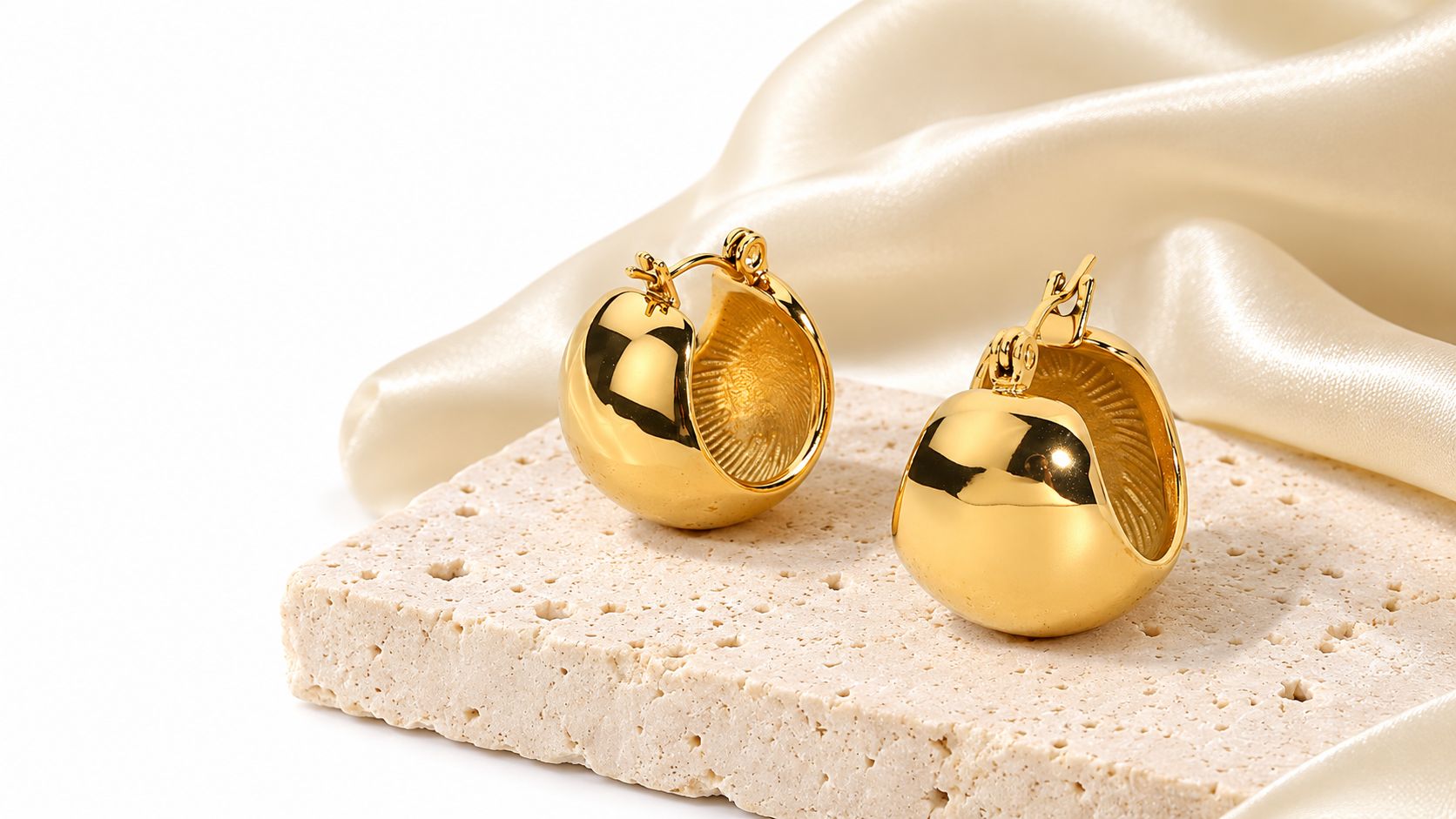
The Gold Plated 316L Stainless Steel Chunky Dome Huggie Earrings specify a rounded dome front, recessed inner hoop, hinged closure, and no stones. That description supports a construction comparison. It doesn't establish a PVD process, coating thickness, or wear-test result.
Findings deserve their own line because a steel body doesn't establish the composition of its post, back, clasp, or extender. Check those components individually, especially where they touch skin or carry tension.
Account for the costs outside the shape
Documentation and packaging complete the comparison. Finished-article testing is separate from purchasing metal, while a branded box adds a different expense from a protective polybag. Neither should disappear into an unexplained unit price.
In a hypothetical quote comparison, the same hoop shape could have a lower polished-steel price, a middle gold-plated price, and a higher price after adding PVD, stones, and gift packaging. That's a purchasing scenario, not a fixed price hierarchy.
Reject a quote that lists only color and piece price. If a small opening order matters, use the low-MOQ jewelry buying guide to separate assortment flexibility from development costs before committing.
How 316L and Surface Finishes Behave
316L describes the substrate, not the lifespan of its color. The Cleveland-Cliffs 316/316L product data sheet specifies approximately 16–18% chromium, 10–14% nickel, and 2–3% molybdenum, with a maximum carbon content of 0.03% for 316L. Those characteristics make it a strong cost-to-performance option, but they don't identify any coating applied afterward.
Chromium supports the passive protective film. Molybdenum improves resistance to chloride-induced pitting compared with 304, while low carbon reduces sensitization risk after welding. These are properties of the metal, not promises that a gold-tone surface will retain its original appearance indefinitely.
The visual below separates alloy composition from surface appearance.
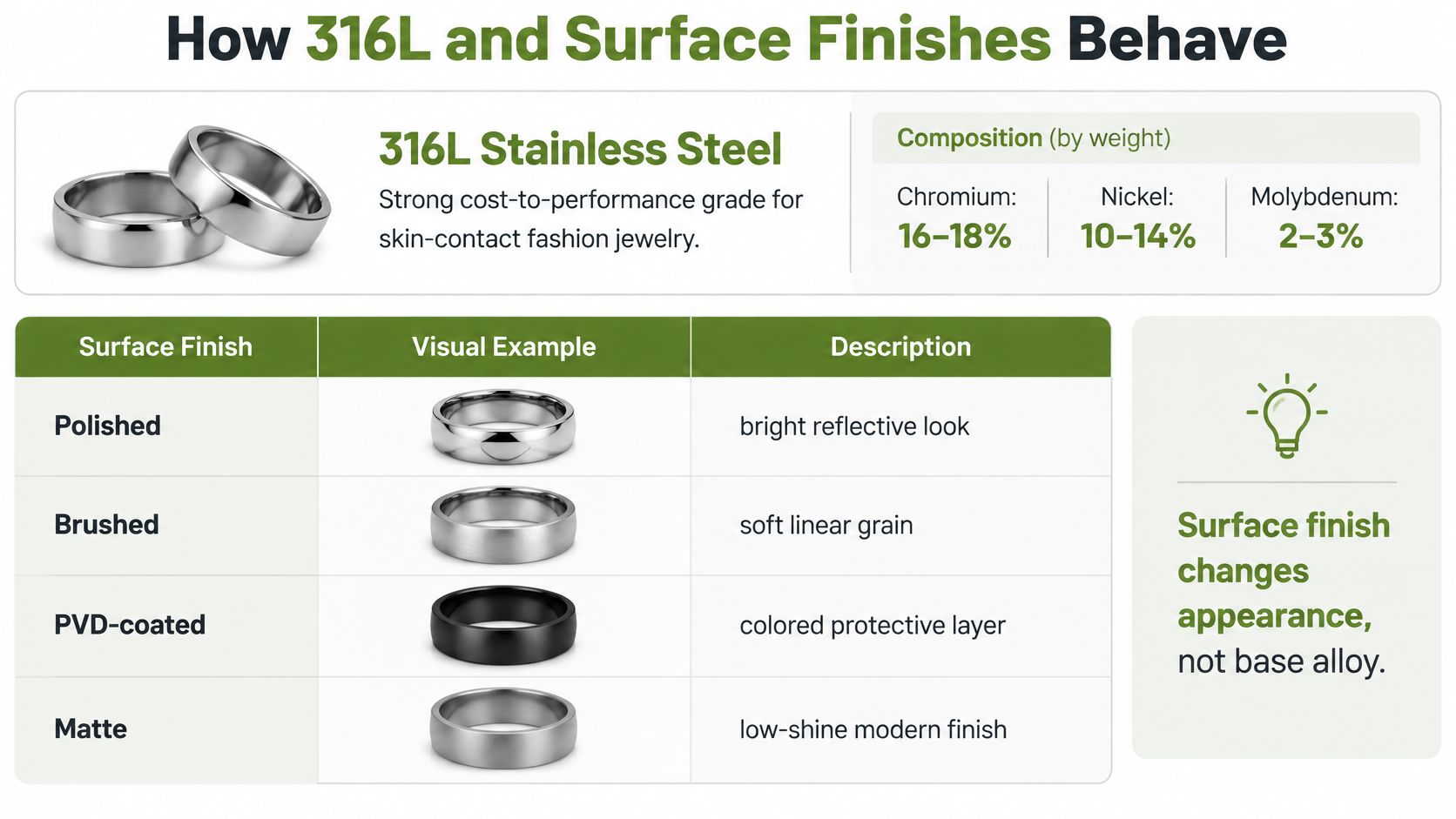
Bare steel and coated finishes compared
| Surface | Judge it by | How wear usually shows | Accurate retail wording |
|---|---|---|---|
| Polished silver-tone 316L | Corrosion resistance, polish, edges | Scratches; possible localized staining under damaging conditions | Stainless steel, polished silver tone |
| Gold electroplate on steel | Process, edges, high-friction points | Color thins where the piece rubs | Gold plated stainless steel, not solid gold |
| PVD gold tone | Surface preparation and adhesion | Color wear at high-friction points; the rate depends on preparation, coating system, geometry, and use | PVD gold-tone stainless steel; no lifetime color claim |
| Enamel or resin color | Chip and impact resistance | Color can chip if struck | Stainless steel with enamel or resin color |
| Two-tone | Each surface on its own | Steel and color layer age differently | Name both the steel and each finish |
Technical guidance from Perles & Co on stainless steel jewelry distinguishes coating performance from the underlying alloy and describes properly prepared PVD coatings as more abrasion-resistant than thin electroplated layers. Preparation matters: an impressive process name can't compensate for poor adhesion.
For a closer look at coating terminology, use the gold PVD coating guide. Request the actual process, any stated nominal thickness, available adhesion or wear evidence, and a care line suitable for the finished piece.
The following video provides an additional visual reference.
Inspect the places customers will touch
On samples, check polish uniformity, weld zones, clasps, and cut edges. Look for burrs, uneven color inside recesses, and rough joints. Embedded iron contamination and aggressive chemicals can cause localized problems even when the specified alloy is corrosion-resistant.
Care instructions should tell customers to avoid prolonged contact with bleach, pool chemicals, and strong acids. For colored surfaces, also discourage abrasive cleaning and storage that lets pieces rub together.
A sound steel base doesn't rescue an unattractive coating. Buy the surface performance your retail description promises.
Nickel Release Tests and Honest Product Claims
A steel grade alone cannot establish how much nickel a finished jewelry item releases. For buyers, the useful distinction is between the material description and test evidence for the finished piece.
For the European Economic Area, ECHA's nickel-restriction guidance explains the limits in REACH Annex XVII: 0.2 micrograms per square centimeter per week for parts inserted into pierced ears or other pierced body parts, and 0.5 micrograms per square centimeter per week for articles intended for direct and prolonged skin contact. Where a non-nickel coating is used to meet the restriction, it must keep nickel release within the applicable limit for at least two years of normal use. These are surface-release limits, not total-nickel limits, so request evidence for the finished article and the intended use.
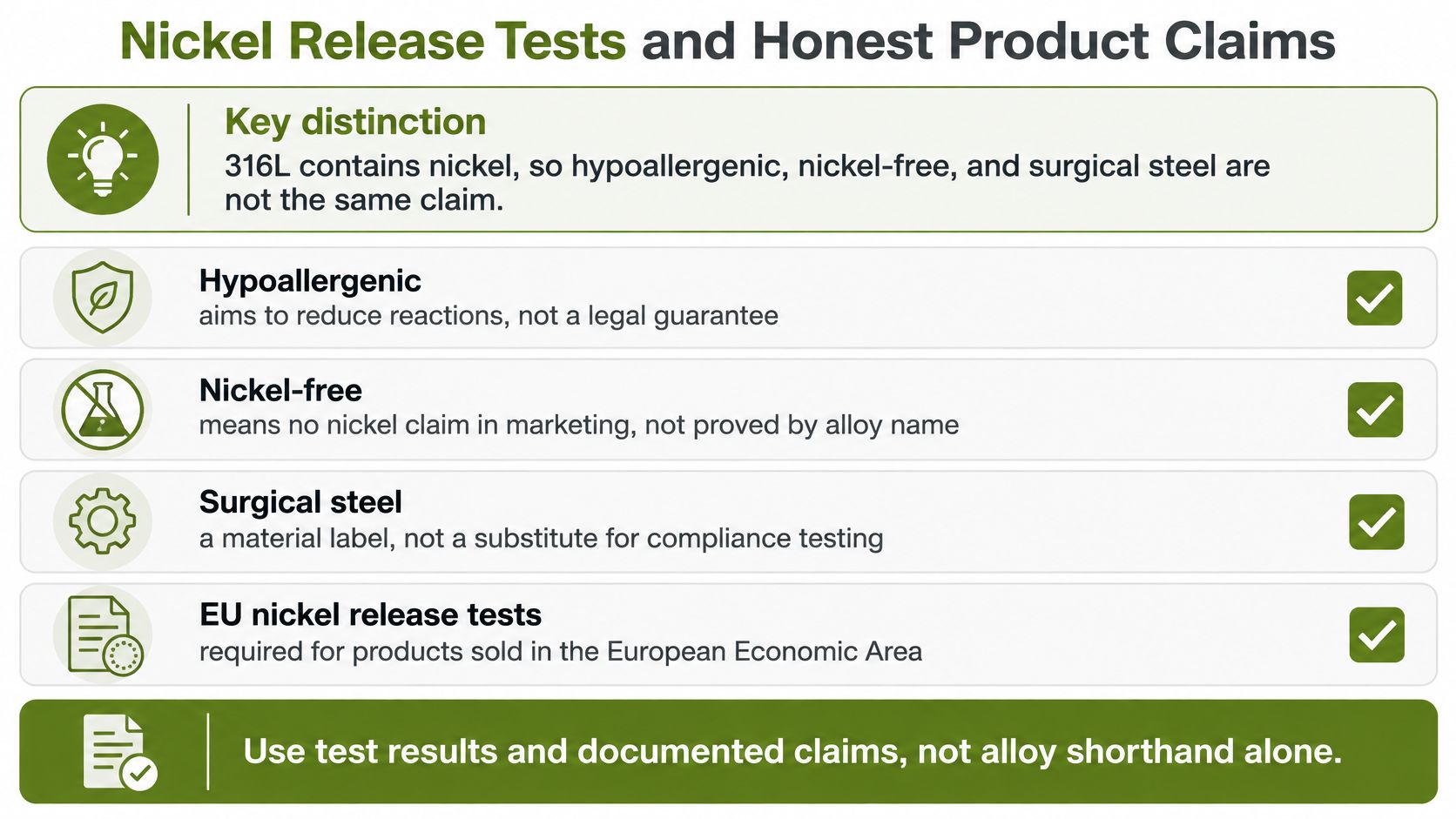
Request evidence that matches the finished article
Ask the supplier for documents tied to the specific item and its construction:
- Material grade: Identify the body and any separate skin-contact components.
- Finished-article report: Confirm that the tested product description matches the item being purchased, not just a raw-metal sample.
- Coating process: Record the finish used on the tested version.
- Intended wear: Distinguish a piercing post from other components designed for prolonged contact.
Posts, clasps, soldered areas, polishing, and plating can affect the finished article. A report for an unrelated chain does not automatically support a newly plated earring. If the construction or finish changes, ask whether the existing documentation still applies.
For sensitive-ear assortments, the guide to hypoallergenic helix earrings provides context for assessing material descriptions. Customers with severe allergies should consult a clinician rather than treat a broad jewelry label as medical reassurance.
Keep product copy narrower than the evidence
For U.S. listings, describe the product's type, grade, metallic content, treatment, durability, and value only as far as the available evidence supports. The FTC Jewelry Guides call for truthful representation of a jewelry item's metallic content, treatment, durability, and value. Write stainless steel with gold plating, not gold alone, and avoid allergy-proof, waterproof forever, and lifetime-finish claims.
The Danish Environmental Protection Agency's nickel guidance explains why nickel release matters for skin-contact products.
Keep alloy, coating, intended use, and test documentation in separate product-record fields. This makes it easier to keep marketplace titles and advertising within the limits of the evidence.
Styles That Resell in Stores and Online
Recognizable shapes are easier to merchandise than designs that need a long styling explanation. Huggies, medium hoops, flat studs, fine chains, and simple pendants can anchor an assortment. Adjustable or stackable rings and cuffs add variety without requiring a deep selection of fixed sizes.
One MarketIntelo fashion-jewelry market estimate projects continued online growth. Treat that third-party forecast as directional, not as demand evidence for a specific store. For assortment decisions, give more weight to your own search terms, product-page engagement, sell-through, returns, and repeat orders.
Build around the buying situation
| Buying situation | Useful assortment direction | Listing priority |
|---|---|---|
| Everyday self-purchase | Huggies, studs, chains, bands | Size, closure, finish |
| Coordinated styling | Layerable necklaces and stackable rings | Length, profile, compatibility |
| Small gifts | Pendants and recognizable motifs | Presentation and material clarity |
| Visual discovery | Floral, heart, bow, star, and insect designs | Clear close-ups and searchable motif names |
A layered floral lariat shows how to present a necklace by arrangement and neckline. A multicolor ladybug stud offers a motif-led option alongside plain hoops. These are assortment concepts, not evidence that either design will outperform a basic shape.
Don't infer stone composition, exact dimensions, or base grade from a photograph. Confirm those details on the product page before publishing. A colorful accent might be enamel, resin, or a set component, and those descriptions aren't interchangeable.
Merchandise depth before adding breadth
Organize category browsing around stainless steel jewelry, earrings, necklaces, rings, and bracelets, then use finish and motif filters where the assortment supports them. In a physical shop, place a core hoop beside a related pendant so customers can compare complementary styles.
The wholesale earrings in bulk guide can help with planning category depth. For online listings, photograph the closure and profile as carefully as the decorative front.
Reorder shapes that sell through with acceptable returns. Keep trend motifs as a shallow layer over hoops, chains, and bands, so visually distinctive designs don't consume the replenishment budget.
Pricing, Markup and Inventory Planning
Set prices against the full cost of selling each piece. A merchandise-cost multiple can help screen a retail price, but it leaves out advertising, fulfillment, returns, and time spent resolving product questions.
Price from the sale backward. Start with expected net sale proceeds, then subtract landed merchandise cost, packaging, payment or marketplace fees, subsidized freight, advertising allocation, and an allowance for returns. If the remaining contribution misses your target, change the retail price, the cost structure, or the product choice; a fixed merchandise-cost multiple cannot make that decision for you.
Work backward from the sale
Use a worksheet with separate fields for each cost:
- Landed merchandise cost: Purchase cost plus allocated inbound freight and applicable import charges.
- Sale preparation: Packaging, labels, and handling before dispatch.
- Channel expenses: Payment fees, marketplace charges, advertising, and shipping subsidies.
- After-sale allowance: Expected replacements, refunds, and support costs.
Keep inbound freight out of the calculation if it is already included in landed cost. Compare markup on cost with margin on selling price using the same definitions across reports.
Pricing check: A finish premium is defensible when the specification and presentation support it, not merely because the piece looks gold.
Keep core hoops, chains, and bands at steady prices unless costs or customer response justify a change. Use shorter price tests for motif pieces, where demand may depend more on presentation and timing. A higher price cannot compensate for weak coating performance.
Make the opening assortment easy to measure
Treat the first buy as a labeled test rather than applying a universal core-to-trend ratio. Separate evergreen shapes from motif or color tests, keep the finish range narrow enough to photograph and explain consistently, and assign quantities from the channel budget and evidence you actually have.
Set a reorder trigger before stock arrives, choosing a sell-through level that fits your cash cycle. Track sell-through, return rate, and average order value weekly during the opening quarter.
A fast seller with persistent closure complaints needs a defect review before reordering. Identify the complaint, then decide whether a corrected version merits another purchase.
Stainless Steel Jewelry FAQs
Is stainless steel jewelry hypoallergenic?
That depends on the finished piece and the wearer. Use a hypoallergenic claim only when you have evidence for the specific product, and avoid promising that any metal will suit everyone with sensitive skin.
How should I list gold-plated stainless steel?
Name both the base metal and finish, such as “gold-plated stainless steel.” Keep that wording consistent in the product title, description, packaging, and advertising. Never describe a plated finish as solid gold.
How should I handle a return for a sizing issue?
Check the stated measurements against the item before deciding whether the listing or the piece caused the problem. A customer who found an accurately described size unsuitable may need a different response from someone reporting a faulty clasp or unexpectedly quick finish wear.
How can I check whether a closure is reliable?
Inspect the closure and its connection points, then record complaints by failure type. A piece that sells well still needs review if customers report recurring clasp problems.
What should staff say when customers ask about materials or care?
Give staff the product's exact material and finish wording, along with any relevant care guidance and documentation. That keeps answers consistent without making claims the product record cannot support.
Build the First Ready-Stock Order
A low unit price is only one part of an order's cost. Choose styles with specifications you can record, sample, and price accurately, then check how each item fits your assortment before checkout.
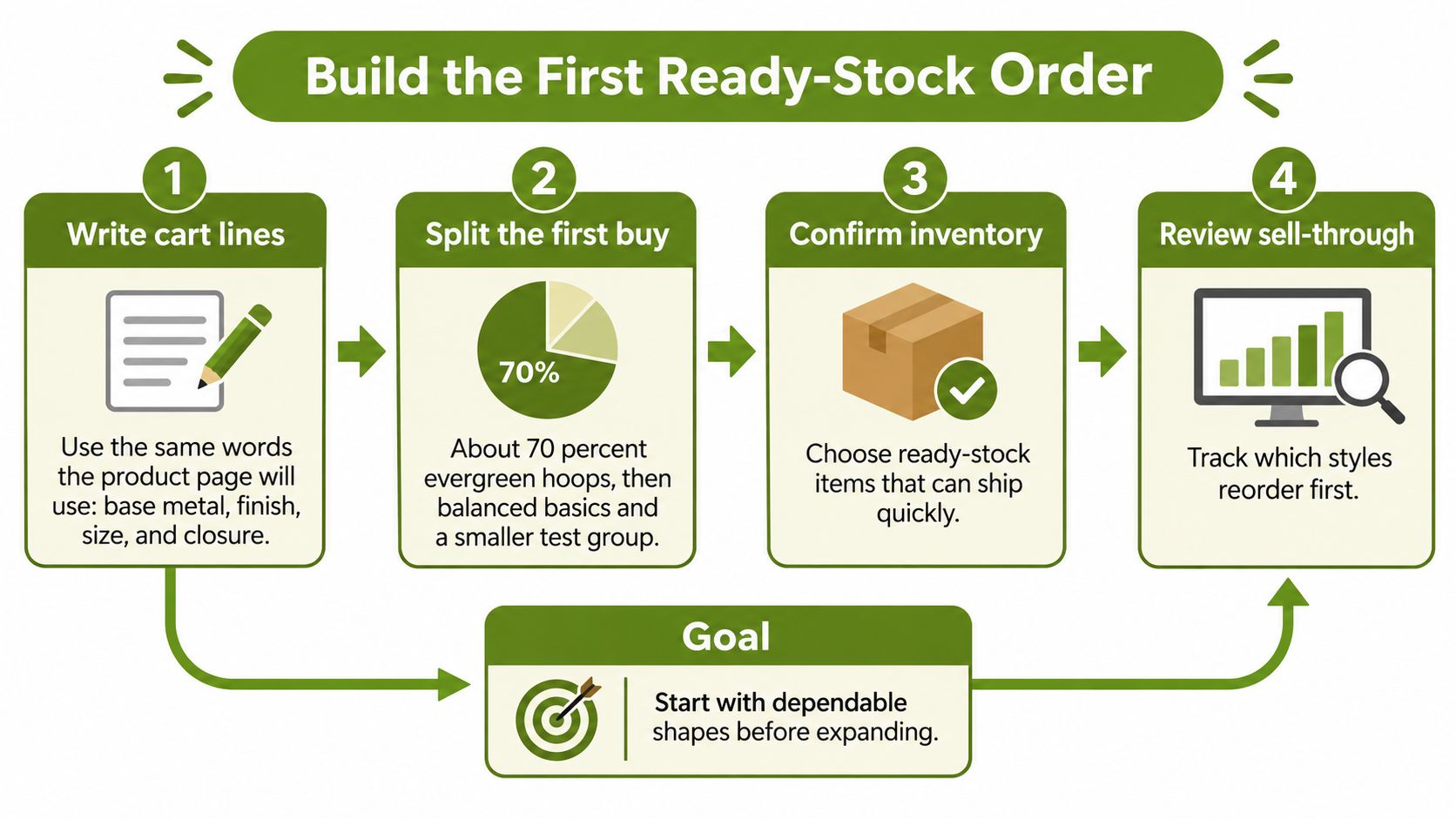
Complete the ordering checks
- Write complete cart lines. Record base metal, confirmed grade, finish, size, and closure using the wording you plan to publish. If the grade is unconfirmed, list it as stainless steel rather than assuming it is 316L.
- Start with core shapes such as hoops, studs, chains, bands, and cuffs, then add a smaller group of motif styles. A narrow finish selection makes it easier to compare color across the assortment.
- Limit fit risk. Consider adjustable rings and cuffs before committing to a full size run. Choose post, hoop, huggie, or clip-on formats from customer demand and recorded return reasons; none is a default substitute for another.
- Choose packaging for the sales channel. A sealed polybag with a material card may suit marketplace fulfillment; a display card or box may suit a boutique counter. Confirm whether packaging is included or charged separately.
- Confirm order details. Check current stock, minimum order, shipping terms, and any other charges before payment. Availability and delivery arrangements can change, so get current terms for the items in your cart.
- Approve a representative sample where appropriate. Use the jewelry sample approval checklist to record closure function, finish consistency, edge quality, and packaging condition.
Keep the catalog record consistent
For every selected item, keep the product name and material details consistent across your order records, labels, product pages, and advertising. A shortened marketplace title should not imply a different metal or finish.
HonHo lists 304 and 316L stainless steel as available material routes and states that it has in-house PVD capability; that does not make every ready-stock SKU 316L or PVD-coated. Check the selected product's material and finish fields before publishing a claim. Current product prices are variant-specific and can change, so use the product page and checkout total rather than copying a catalog price into a long-lived sourcing plan.
Use HonHo's catalog categories to shortlist earrings, rings, necklaces, bracelets, anklets, and pendants, then check each item's specifications. Keep brass and 925 sterling silver in distinct material and price tiers so customers can compare like with like.
Custom logos, plating, and branded packaging can follow once a shape proves suitable for replenishment. The first order should give you a clear basis for comparing construction, finish, and retail price. HonHo's current ordering guide states that ready-stock styles can be mixed from one piece each, subject to a US$100 minimum order after discounts. Custom manufacturing follows separate terms: a baseline of 50 pieces per style and color, stainless-steel samples in 25–35 days, and bulk production in 35–45 days after approval. Confirm the selected SKU, quotation, and schedule before payment because product-level availability and project requirements can change.
HonHo Wholesale Jewelry offers ready-stock earrings, rings, necklaces, bracelets, anklets, and pendants in stainless steel, brass, and 925 sterling silver. Visit HonHo Wholesale Jewelry to browse the catalog and shortlist styles that fit your assortment.


