

A “low MOQ” quote is useful only when it states exactly what the minimum applies to. Before comparing jewelry manufacturers, ask whether the requirement is per style, color, finish, size, component, logo method, or packaging item. Then compare the total cash commitment, sample approval path, and reorder terms—not the headline unit count alone.
| Check first | Why it changes the decision | What to record |
|---|---|---|
| MOQ scope | Each color, finish, or size may create a separate minimum | Quantity by style and variant |
| Development scope | CAD, tooling, stones, logos, testing, and packaging may be quoted separately | Included work and separate charges |
| Approval point | Bulk production should follow an approved sample and specification | Dated sample, measurements, finish, and packing details |
| Reorder route | A small first batch has limited value if the approved result cannot be repeated | Current reorder minimum, timing, and retained tooling or files |
Table of Contents
- What a Low MOQ Jewelry Manufacturer Actually Means
- How MOQ Changes With Materials and Processes
- Steps to Evaluate and Negotiate With Suppliers
- Stock Orders Versus Custom Manufacturing Paths
- Pricing, Markups, and Profit Planning
- Why Low MOQ Is About Testing Demand, Not Just Cost
What a Low MOQ Jewelry Manufacturer Actually Means
MOQ is the smallest quantity or order value a supplier will accept for a defined transaction. It may be simple, or it may combine several constraints such as finished-piece quantity, material lot, component minimum, and order value. That distinction matters in jewelry because a quote can appear small while its required variants multiply the real commitment. This difference between simple and complex minimums is also explained in Oracle NetSuite's MOQ overview.
There is no dependable industry-wide number that makes a factory “low MOQ.” The useful comparison is whether two suppliers have quoted the same design, specification, variant split, packaging, and delivery assumptions. The linked industry guidance on wholesale jewelry sourcing may provide broader market context, but it does not replace a project-specific quotation.
What buyers usually miss
The most common gap is the unit of the minimum. A requirement of 50 pieces per style and color means one style in two colors is 100 pieces in total before any separate component or packaging minimum. Size changes, stone layouts, or construction changes may also create distinct production variants; the quotation should say whether they do.
Buyer rule: convert every quotation into a variant matrix before comparing price.
| Variant field | Question for the supplier | Approval record |
|---|---|---|
| Style and dimensions | Which changes create a separate style? | Drawing or measured specification |
| Color and finish | Can finishes share a minimum? | Color reference and coating description |
| Stones and findings | Do components have supplier minimums? | Stone map and component list |
| Branding and packaging | Are logo and packaging minimums separate? | Artwork, material, dimensions, and pack-out |
HonHo's current custom-production planning baseline is 50 pieces per style and color. Special stones, components, techniques, or packaging can require different minimums, so the approved quotation controls the project. The sample MOQ guide shows how that baseline works and what to confirm before development.
How MOQ Changes With Materials and Processes
Material choice does not determine MOQ by itself. The minimum can be shaped by raw-material purchasing, tooling, machine setup, casting or machining route, surface finishing, stone setting, logo application, testing, and packaging. A supplier should identify the constraint that drives the quoted minimum rather than presenting a process-wide number as a universal rule.
Process drives the minimum
Process capability also needs to be separated from the specification for one finished SKU. A factory may offer casting, CNC, stamping, electroplating, or PVD development, but that does not mean every design uses every process or shares the same minimum. The linked low-MOQ process guide is one supplier's explanation of its services; use it as a question prompt, not as a HonHo specification or a market-wide benchmark.
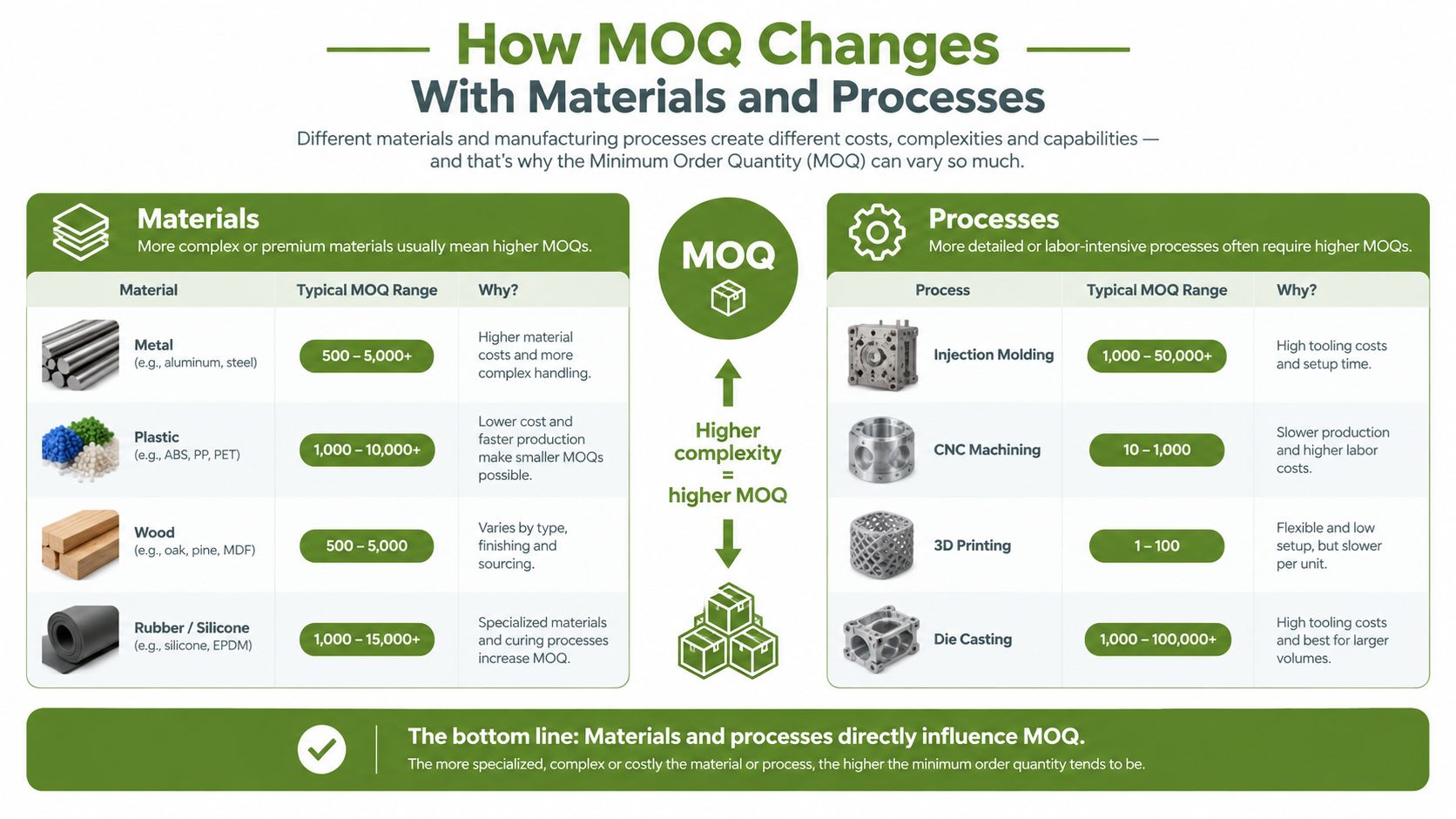
For a useful quotation, define the base metal, dimensions, target weight or construction, finish color, coating method where relevant, stones, closures, logo, and packaging. “Gold necklace” is not a production specification: it does not identify the substrate, coating structure, chain, clasp, pendant construction, or finished dimensions.
Use the jewelry materials and plating guide to prepare the material and finish portion of the brief. Factory development capability is not evidence that a particular ready-stock SKU has the same grade, coating, or test result; confirm product-level details separately.
The embedded video below is retained from the original article. Its presence is not a claim that its content has been independently tested or that every shown process applies to the quoted item.
A lower minimum can reduce the size of the first commitment, but it does not by itself prove lower landed cost, faster delivery, or repeatable quality.
Steps to Evaluate and Negotiate With Suppliers
Send the same brief to each shortlisted supplier. That makes differences in MOQ, price, scope, and timing visible. Negotiating only the headline minimum can remove work or quality controls from the quote without making the project safer.
A practical checklist for first contact
- Define the product. Send the drawing or reference, dimensions, material, finish, stones, closure, logo, and quantity by color or size.
- Separate sample and production terms. Ask what the sample includes, which revisions are included, and what must be approved before bulk production.
- Itemize one-time and recurring costs. Request separate lines for CAD, tooling, samples, testing, unit price, packaging, and freight assumptions.
- Confirm the production clock. Ask what approvals and payments start each stage, and whether revisions reset the schedule.
- Document the reorder path. Confirm retained tooling or files, current reorder minimum, allowable changes, and how a repeat order is matched to the approved sample.
Supplier sample policies vary. The linked sample policy reference describes another company's terms and should not be treated as HonHo's promise. For HonHo custom development, the current general planning ranges are 25–30 days for brass and 925 silver samples, 25–35 days for stainless steel samples, and 35–45 days for bulk production after sample and specification approval. Complexity and revisions can change a project schedule; the written quotation is controlling.
What to inspect when samples arrive
| Check | How to record it | Why it matters for bulk |
|---|---|---|
| Dimensions and weight | Measured values and tolerances | Prevents an unmeasurable “same as sample” instruction |
| Function | Closure, hinge, chain, fit, or moving-part notes | Separates appearance approval from mechanical approval |
| Surface and setting | Consistent lighting, close-up photos, and defect notes | Creates a reference for color, polish, edges, and stones |
| Branding and pack-out | Logo position, cards, labels, pouch or box, and barcode | Avoids a correct product packed the wrong way |
Do not translate a sample result or accelerated test into a promised number of months of wear. Approval confirms the agreed reference and inspection method; it does not predict every customer's use, storage, sweat exposure, cleaning, or abrasion. Keep the dated sample, specification, and revision list together.
The wholesale ordering guide provides the fields to carry from the inquiry through quotation, sample approval, production confirmation, QC, and shipment.

Stock Orders Versus Custom Manufacturing Paths
Ready stock and custom manufacturing solve different buying problems. Ready stock is usually the clearer route for testing an assortment quickly; custom development is appropriate when the product specification or brand detail creates value that an existing SKU cannot provide.
When stock makes more sense
Choose ready stock when the main decision is which proven catalog items to test, when the launch window is short, or when you want more style breadth with less development work. Check the current product-level quantity, tier price, availability, material statement, and dispatch terms. Do not assume a ready-stock order inherits the custom MOQ or custom lead time.
When custom is worth the wait
Choose custom when dimensions, construction, finish, stone layout, logo, or packaging are part of the selling proposition. The extra decisions should be intentional: every variation can affect sampling, minimums, cost, and repeatability. The linked wholesale stainless steel jewelry guide is another supplier's perspective, not a universal MOQ table or a promise about HonHo products.
Review HonHo's current custom jewelry options for the development route, then request a quote against one defined brief. Special components, techniques, testing, or packaging may require a project-specific minimum even when the standard custom baseline is suitable.
A simple decision rule
| Your priority | Likely route | Decision checkpoint |
|---|---|---|
| Test category demand quickly | Ready stock | Availability, product evidence, landed cost, and reorderability |
| Own a defined product or finish | Custom development | Approved sample, specification, MOQ structure, and production schedule |
| Launch now and develop later | Phased stock plus custom | Keep the test assortment and custom line financially separate |
Pricing, Markups, and Profit Planning
A low MOQ can reduce inventory exposure while raising the share of setup and handling cost allocated to each piece. Neither outcome is automatically better. Compare the expected total exposure and the evidence needed for a reorder decision instead of applying a universal markup multiple.
Published markup ranges often mix manufacturers, trading companies, distributors, retailers, materials, and markets. The linked wholesale jewelry pricing guide can provide background, but your price architecture should be built from the actual quotation, selling costs, return exposure, taxes, and channel fees.
What actually affects margin
Calculate landed exposure for the whole trial: products + samples + CAD/tooling + testing + branding/packaging + freight + duties/taxes + payment or inspection costs. Then allocate the order across styles and variants. A lower factory unit price can still create greater exposure if it requires more variants or excess depth in a slow-moving style.
Buyer rule: compare quotes only after the included specification, quantities, packaging, and delivery basis match.
A quick planning check
- Set the test hypothesis. State which customer, price point, and product role each SKU is meant to test.
- Set the financial limit. Record the maximum landed exposure, not only the target unit price.
- Set the evidence threshold. Decide what sell-through, return reasons, defect observations, or customer questions will trigger reorder, revision, or exit.
- Keep an approved baseline. Save the sample, specification, quote, pack-out, and supplier reference needed for a repeat order.
HonHo offers ready-stock ordering and custom development, but they should be budgeted and scheduled as separate routes. Current stock quantities and prices belong to the relevant product page or quotation; the 50-piece-per-style-and-color baseline applies to standard custom planning, not every ready-stock SKU.
Why Low MOQ Is About Testing Demand, Not Just Cost
A smaller first commitment is valuable when it buys a clearer decision. It should help you learn which silhouettes, finishes, price points, and product-page claims work—without turning one launch into excess inventory. It is not evidence that an item will sell or that the supplier can repeat the result.
The linked Alibaba B2B sourcing guide reflects marketplace sourcing advice; treat any example quantities or cost premiums there as contextual, not as current HonHo terms or universal market facts.
The real payoff
Design the trial so that its result changes the next order. Track sales and returns by exact SKU and variant, record customer questions, and separate product issues from merchandising issues. A reorder decision made from a clean SKU record is more useful than a general impression that the collection “did well.”
For assortment roles, landed-cost fields, sample checks, and reorder triggers, use the wholesale jewelry for boutiques guide alongside this supplier-evaluation checklist.
The rule buyers should keep
A low MOQ is worthwhile when the minimum is clearly scoped, the sample and bulk specifications are connected, and the reorder path is documented. If those points are missing, a small first invoice can still produce an expensive, non-repeatable test.
To request a useful quote from HonHo Wholesale Jewelry, send the design or product reference, dimensions, material, finish, quantity by style and color, logo and packaging needs, destination market, target delivery date, and any testing requirements. HonHo will confirm whether ready stock or custom development fits the brief and identify any project-specific minimums before approval.


