

Most advice on how to polish stainless steel jewelry starts in the wrong place. It tells you to grab toothpaste, baking soda or a silver cloth and rub until the piece shines. That approach can permanently remove the color, haze a mirror finish or flatten a brushed grain. For boutiques, online sellers and resellers, the cost isn't just a duller piece. It's a return, a refund or stock you can't sell as new. The safer rule is simple: identify the surface first, then decide whether it should be polished at all. On many pieces, the coating, not the steel underneath, is what needs protecting.
For routine cleaning of mixed-finish stock, use our guide to shining stainless steel jewelry safely. This guide focuses on the harder decision: whether a marked piece should be cleaned, refinished or kept out of saleable stock.
Table of Contents
- Identify the Finish Before You Polish
- Bench Tools and What to Keep Off Stainless Jewelry
- How to Polish Uncoated Stainless Steel Step by Step
- Why Stainless Steel Jewelry Spots, Dulls or Rusts
- Stainless Steel Polishing Questions Answered
- Confirm the Finish Before You Restock or Return
Identify the Finish Before You Polish
Coated jewelry gets cleaned, not polished. Uncoated stainless steel can take light buffing, but plated, PVD-coated, enamelled, resin, stone-set, blackened or antiqued pieces should be cleaned only.
That distinction matters because generic guides treat stainless steel jewelry as one material. The Fossil jewelry cleaning guide supports separating plain polished steel, which can be buffed with a soft, non-abrasive cloth, from plated or coated pieces that should get only mild soap, water and very light handling. Abrasion can remove or thin a decorative layer even while the steel underneath stays intact. You restore shine and lose the gold tone, blackening or distressed effect the customer paid for.
Look for wear where handling concentrates. Check edges, clasp tongues, post backs and inner ring surfaces for a gold or colored layer thinning, or a different base metal showing where the surface has rubbed. Then check whether enamel, resin or adhesive-set stones are present. If any of those are there, don't treat the whole piece as bare steel.
Do one quick test before any polishing. Rub a hidden area, such as the inside of a clasp, with a clean dry cloth. If color transfers onto the cloth, stop. The coating is already vulnerable, and further rubbing will only widen the worn patch. If you're checking grade claims for stock you're buying, our guide to what 316L stainless steel jewelry is explains what the designation means before you rely on it in a listing.
Safe Polishing Method by Surface Finish
| Finish | Safe method | Limit |
|---|---|---|
| Confirmed bare stainless steel, mirror-polished | Mild soap and a soft cloth first; use corrective compound only if the finish and product instructions allow it | Can reduce fine haze, not deep gouges; repeated polishing removes metal |
| Confirmed bare stainless steel, brushed or satin | Mild soap and a soft cloth following the existing grain | Generic metal polish can flatten or cross-hatch the directional finish |
| Gold plated stainless steel | Mild soap, warm water and soft cloth; light handling only | Polishing can remove or thin the plating |
| PVD-coated gold-tone stainless | Mild soap, water and soft cloth | Abrasion can alter the coating |
| Enamel, resin or adhesive-set stones | Use a barely damp soft cloth only where the component guidance permits it | Avoid immersion and abrasion; cleaning does not repair lifting, looseness or missing finish |
| Blackened or antiqued finish | Clean only; do not buff | Buffing removes the intended tone |
Silver polishing cloths, baking soda, toothpaste, vinegar and lemon juice are poor default choices for gold-colored stainless steel: their abrasives, acidity or residues may be incompatible with the finish and attached components. When the finish is unknown, start with the more sensitive assumption and use only a soft, barely damp cloth. A cautious clean can be stopped; polishing away a coating cannot be undone.
Bench Tools and What to Keep Off Stainless Jewelry
Set up a small, labelled kit and keep it for stainless steel only. For small batches, consistency matters more than owning many products. One clean kit, used the same way each time, gives you a uniform finish and fewer surprises when pieces go back into stock.
Bench Kit for Stainless Steel Polishing
| Tool or compound | Job | Note |
|---|---|---|
| Soft microfiber cloth | Routine wiping and final buff | Use a clean section for each session |
| Soft-bristled brush | Clasps, crevices and setting edges | Press lightly; keep away from stones |
| Fine nonwoven abrasive | Controlled refinishing of confirmed bare brushed steel | Match the existing grain; keep it out of routine counter care |
| Fine abrasives in progressive grades | Corrective refinishing of confirmed bare steel | Controlled or professional work; the wrong sequence can alter geometry and finish |
| Very fine buffing compound | Final bright finish on confirmed bare mirror-polished steel | Test first, apply sparingly and rinse residue fully |
| Mild liquid soap in warm water | Degreasing before and after polishing | Rinse thoroughly and dry at once |
Store those tools in a separate bin, away from iron and carbon steel brushes, wheels and files. Ordinary steel particles can embed in a stainless surface and later show as orange-brown rust staining. That appearance can come from transferred iron, but it can also accompany localized corrosion; clean and inspect before deciding which condition you have.
What Stays Off the Bench
Keep these away from stainless jewelry, particularly gold-tone stock:
- Silver cloths and silver dips: They are formulated for silver tarnish and may contain abrasives or chemicals that are unsuitable for plating or PVD. Use them only when the product instructions explicitly allow it.
- Baking soda, toothpaste and scouring powder: These abrade rather than clean, leaving fine scratches that read as haze under shop lighting.
- Vinegar and lemon juice: Do not use them as default jewelry remedies. Their acidity and residues are not validated for every coating, stone or adhesive.
- Bleach, ammonia and chlorine cleaners: These are harsh chemicals, not jewelry cleaners, and they risk localized damage.
- Iron or carbon steel tools: Shared brushes and wheels are a contamination source, even if they look clean.
If you're selling gold-tone stainless styles, our explainer on gold PVD coating is useful background for writing care instructions that match the finish.
Don't confuse polishing with passivation. The British Stainless Steel Association guidance on corrosion mechanisms describes passivation treatments as a separate finishing operation that may involve nitric acid, while stainless steel naturally self-passivates when a clean surface has access to enough oxygen. Household acids aren't a polishing step. Any chemical treatment belongs with a qualified finishing service that understands the piece's plating, stones and adhesives.
Routine care should usually stop at gentle cleaning: remove oils and dirt, rinse only when the construction permits it, then dry completely. Don't ask customers to restore a protective layer with acid.
How to Polish Uncoated Stainless Steel Step by Step
This sequence is for bare, uncoated stainless steel only. Use it on mirror or brushed pieces with no plating, enamel or adhesive-set stones in the work area. The visual summary below covers the core flow before the full steps.
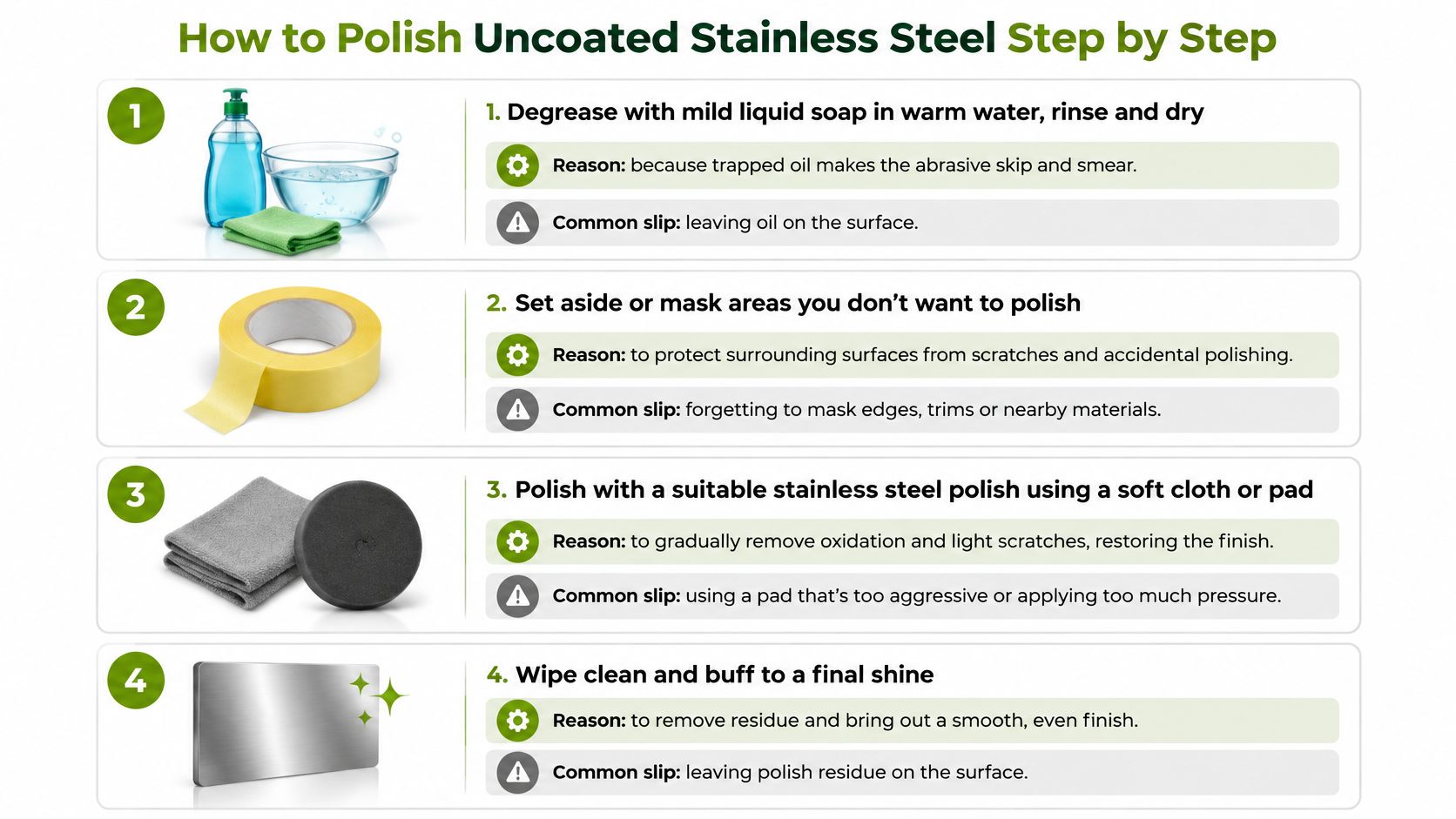
- Degrease first. Wash with mild liquid soap in warm water, rinse and dry. Trapped oil makes an abrasive skip and smear, so you end up rubbing dirt across the surface instead of removing the mark.
- Isolate anything that isn't bare steel. Set aside or mask stones, enamel and plated parts before any abrasion. A piece such as the Gold Plated Stainless Steel Oval-Link Pearl Accent Bracelet, with gold plated oval links and small freshwater pearl accents, shouldn't enter this process at all. Clean it gently instead.
- Start with the finest abrasive that removes the mark. Use only tools dedicated to stainless steel. Ordinary steel particles embed in the surface and later appear as rust spots, which customers will read as a quality failure.
- Work through progressively finer grades. Don't jump straight to compound. Fine compound can't erase deep lines, it just makes the metal around them shinier and the lines easier to see.
- Keep the piece moving with light pressure. Work along the grain on brushed steel, or along the link length on chain. Excess pressure rounds crisp edges, distorts small links, loosens stones and can discolor nearby coatings.
- Finish with a very fine buffing compound. Apply it sparingly on a soft cloth or wheel. The aim is a bright, uniform surface, not maximum shine at the cost of the original finish.
- Wash off all compound residue. Pay attention to recesses, clasp hinges and link joints, then rinse and dry immediately. Residue left in detail is where staining starts.
- Inspect under directional light. Tilt the piece until leftover scratch lines and haze show. If a coarse line remains, go back one grade rather than pressing harder with compound.
The embedded Renegade Products video demonstrates industrial stainless polishing. It is not jewelry-specific and does not establish a safe method for plated, PVD-coated, stone-set or adhesive-assembled pieces; keep it as process context only.
The World Stainless surface treatment guide provides industrial context for step 4. It notes that corrosion resistance can decrease markedly when surface roughness rises above approximately Ra 0.5 micrometres, roughly associated there with a 320-grit ground surface, and describes successively finer abrasives followed by buffing for an industrial No. 8 mirror finish. Those figures are not a universal jewelry acceptance limit or proof about a finished assembly. They explain why a bright appearance alone cannot establish that coarse scratches and contamination were removed.
Don't use scouring powders to speed this up. They can leave permanent scratches, and grinding dust from ordinary steel can introduce the iron particles you're trying to avoid. Mechanical polishing also doesn't guarantee maximum corrosion resistance after aggressive abrasion. Production pieces that need controlled corrosion performance should get a qualified passivation process, not an improvised acid treatment at the bench.
Why Stainless Steel Jewelry Spots, Dulls or Rusts
Protect the coating before chasing the shine. A dull patch on gold-tone jewelry calls for cleaning first, because abrasive polishing can remove the finish. Oils, lotion and fingerprints can leave a haze, and cleaning may reveal scratches or coating wear underneath. Wash with diluted mild soap, rinse and dry before deciding whether further work is needed.
Dark marks and tea-colored spots need closer inspection. Residue, dried water marks, iron contamination and localized corrosion can look similar until the piece is clean.
Chlorides and the Protective Surface
Stainless steel relies on a thin chromium-rich passive film. Chlorides from salt water, sweat, pools and some cleaners can locally weaken that protection. The Norse Garde steel jewelry care guide gives consumer-facing care advice; for the alloy distinction, BSSA's corrosion-resistance overview explains that the molybdenum in 316 helps resist localized chloride attack. That advantage is conditional, not a promise against staining, pitting or crevice corrosion in every use.
Stainless Steel Jewelry Symptoms, Causes and Fixes
| Symptom | Likely cause | Fix |
|---|---|---|
| Dull haze after wear | Oils, lotion and fingerprints | Wash with diluted mild soap, rinse and dry. Consider fine polish only on confirmed bare steel if haze remains. |
| Tea-colored or dark spots | Residue or dried water marks; persistent spots may indicate corrosion | Clean, rinse fully and dry immediately. Inspect any remaining marks before using abrasives. |
| Dark spots after swimming or sweating | Chloride exposure from salt water, pools or sweat | Rinse promptly, wash with mild soap and gently brush crevices. Dry thoroughly and inspect for persistent damage. |
| Orange-brown spots | Iron contamination or localized corrosion | Clean first. Keep ordinary steel tools away; use stainless-only abrasives only on bare steel. Deep pitting needs professional assessment. |
| Scratches that remain after light polish | Scratches deeper than the polishing step can remove | Stop repeated light buffing. Assess the depth before further abrasion; deep gouges need professional work. |
After pool or sea exposure, rinse promptly, wash with diluted mild soap, rinse thoroughly and dry immediately. Use a soft cloth or soft-bristled brush around crevices. Avoid bleach and ammonia. Our guide to whether stainless steel jewelry is waterproof explains the care limits behind that water-resistant label.
A persistent mark is a reason to inspect, not press harder. On coated jewelry, stop after gentle cleaning if the mark remains. On bare steel, distinguish a surface stain from a scratch or pit before polishing. Deep damage cannot safely be treated as a simple loss of shine, and affected stock should not be sold as restored merely because the surrounding surface looks brighter.
Stainless Steel Polishing Questions Answered
Can a returned gold-tone piece be polished back to its original appearance? Polishing cannot replace worn plating or PVD coating. If the dullness is surface residue, cleaning may restore its appearance; if the finish has worn through, more abrasion will expose more of the metal underneath. Use “Identify the Finish Before You Polish” before choosing any treatment.
Can I use toothpaste or baking soda instead of jewelry polish? Keep both off the bench. Their abrasive action can leave fine scratches and wear gold-tone coatings. A household cleaner that makes bare steel look brighter can still damage a coated piece. Start with mild soap and a soft cloth; reserve the bare-steel polishing method for confirmed uncoated surfaces.
Should customers wait until jewelry looks dull after swimming or sweating? No. Prompt care matters more than visible dullness. Salt, pool water and sweat should not be left on the surface until the next scheduled cleaning. Follow the rinse, wash and dry sequence in “Why Stainless Steel Jewelry Spots, Dulls or Rusts.”
What should I tell a customer when marks remain after cleaning? Explain the limit before offering more polishing: cleaning removes residue, while polishing removes surface material. Persistent marks need assessment rather than repeated buffing. The troubleshooting section separates removable deposits from pitting and deep scratches; heavily pitted stock should not be described as restored.
Do customers need different instructions for every order? Use consistent wording, but distinguish coated pieces from bare stainless steel. Point buyers to our jewelry care guide, and make clear which finish their piece has. A general instruction to “polish regularly” leaves out the detail that determines whether polishing is appropriate.
Confirm the Finish Before You Restock or Return
A clean surface is not enough to clear a piece for resale. Confirm what covers the steel, record its condition and check that the care instructions match the finish before returning it to a customer or stock.
Use this checklist at sample approval and again when assessing returned pieces:
- Record the finish: Identify bare uncoated steel, plating, PVD coating or intentional darkening. Note enamel, resin and stone-set details separately. Put the finish and permitted care method on the approval record so staff do not treat a coated style as bare steel.
- Confirm the base metal and grade: Record 304 or 316L only when the supplier lists it. Leave an unspecified grade unconfirmed rather than guessing. HonHo Wholesale Jewelry offers 304 and 316L stainless steel options with in-house PVD coating for durable gold-tone finishes, alongside brass and 925 sterling silver jewelry.
- Inspect details and remaining damage: Check enamel, resin and adhesive-set stones for lifting or looseness. Record worn coating, pitting or deep marks before deciding whether the piece can return to sale. A brighter surface does not restore missing finish.
- Check tools and packing: Use stainless-only tools where polishing is appropriate, then dry the piece fully before packing. Keep any item with unresolved finish damage or loose details out of saleable stock.
For wholesale orders, get each style's grade and finish in writing before approving samples. Use the jewelry sample approval checklist to keep those details with the approval record. Add a short care card that distinguishes routine cleaning from damage polishing cannot reverse.
Sourcing a mixed-material assortment? HonHo Wholesale Jewelry supplies ready-stock stainless steel, brass and 925 sterling silver earrings, rings, necklaces and bracelets. Before committing to stock, request the material and finish details for your selected styles so your approval records and customer care instructions agree.


