

Choose wholesale jewelry pouches by the packed product, not by fabric name alone. The useful specification is the combination of internal size, lining, seams, closure, insert or card, branding method, and the evidence behind any anti-tarnish claim. Approve the pouch with the actual ring, earrings, bracelet, or necklace inside it before placing a bulk order.
A pouch can support presentation and short-term storage, but it is not automatically a complete shipping or preservation system. Retailers still need enough structure to protect posts and settings, a way to control chain movement, and an outer pack that resists crushing in transit.
Table of Contents
- Why Jewelry Pouch Selection Matters More Than You Think
- Choosing the Right Material for Your Jewelry Line
- Understanding Anti-Tarnish Technology and Performance
- Sizing Standards and Order Minimums for Bulk Buyers
- Customization and Branding Options for Retailers
- Sustainability Trends and Compliance for Global Markets
- Frequently Asked Questions About Wholesale Jewelry Pouches
Why Jewelry Pouch Selection Matters More Than You Think
The pouch is the surface the jewelry touches, the space it moves in, and often the first branded component the customer handles. A visually premium pouch can still fail if its seam catches a chain, its closure lets a stud escape, or its size allows pieces to strike each other. Conversely, a simple pouch can be suitable when its construction matches the product and the retail position.
That distinction matters across boutiques, direct-to-consumer stores, marketplaces, and gift programs. The pouch may be used at the counter, inside a mailer, or later for travel storage. Judge it as a product component with a defined job, not as decoration added after the jewelry order is complete.
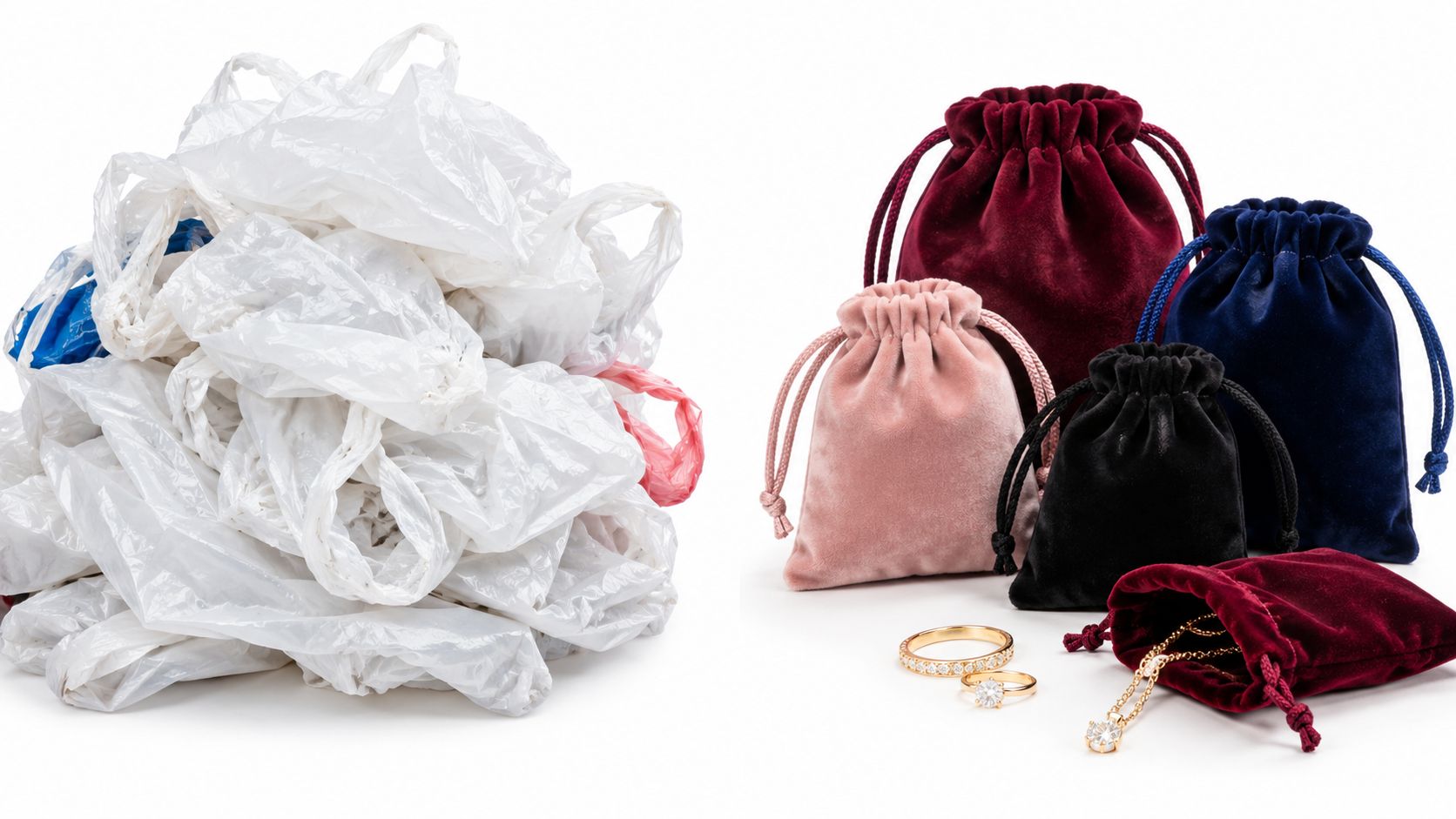
The operational cost of a cheap pouch
A low quote is only useful if the pouch survives packing, transport, display, and the expected customer use. Check whether staff can insert and remove the item without snagging it, whether the closure stays shut, whether fibers transfer to polished surfaces, and whether the packed unit fits the outer mailer or box. A pouch that needs rework, an extra insert, or replacement after arrival can erase a small unit-price saving.
| Jewelry risk | Pouch feature to specify | Sample approval check |
|---|---|---|
| Fine chain tangling | Card, chain slots, internal tie, or separate compartment | Pack, shake gently, unpack, and inspect the chain path |
| Earring posts or sharp edges | Enough clearance plus a card or protective layer | Confirm posts do not pierce the pouch or rub the opposite piece |
| Prongs and textured settings | Tight weave, smooth lining, and covered seams | Insert and remove repeatedly; inspect for caught fibers |
| Polished or plated surfaces | Clean, non-abrasive contact surface and limited movement | Compare the packed sample under consistent light before and after handling |
Approval rule: A pouch passes only when the complete packed unit works. Fabric swatches and empty-pouch photos cannot reveal fit, movement, snagging, or shipping-volume problems.
A sourcing review for wholesale jewelry for boutiques should therefore include the pouch specification beside material, finish, clasp, and presentation requirements. Record the approved pouch, insert, closure, logo position, and packing method against each jewelry SKU or product family.
Choosing the Right Material for Your Jewelry Line
“Velvet,” “microfiber,” “satin,” and “organza” describe broad material families, not a guaranteed level of protection. Pile density, backing, weave, dye, seams, lining, and cleanliness vary by construction. The supplier’s quoted weight or fabric name should therefore be treated as part of the specification, not as proof that the finished pouch is suitable.
Some packaging references describe microfiber, velvet, satin, organza, and paper formats for different presentations; this jewelry packaging material reference is one supplier example. Keep it as a source of options, then verify the actual sample rather than carrying another supplier’s dimensions, fabric weight, price, or performance claim into your order.
Match construction to the product
| Format | Where it can work | Limitation to check |
|---|---|---|
| Velvet or other pile fabric | Gift presentation and cushioning for compact pieces | Fiber shedding, dye transfer, seam bulk, and snagging around prongs |
| Microfiber-style fabric | Smooth presentation for polished surfaces | Actual weave and cleanliness; do not assume every microfiber pouch is a polishing cloth |
| Satin or organza | Lightweight decorative packing | Limited cushioning, transparency, drawstring gaps, and abrasion at seams |
| Paper or kraft-based format | Flat presentation and a natural visual direction | Creasing, moisture response, closures, and whether mixed components change disposal claims |
For 925 sterling silver jewelry, plated brass, stainless steel, stones, pearls, and enamel, specify every contact surface rather than relying on the visible outer fabric. Review the jewelry’s exposed points, polish, and finish using this jewelry materials guide, then test representative products from the intended assortment. Factory capability to source or customize a material does not mean every pouch or jewelry SKU has the same construction.
Unit prices are project-specific. Fabric, dimensions, quantity, logo method, lining, cord, inserts, individual packing, freight, and commercial terms all change the landed cost. Compare quotations only after suppliers are pricing the same approved specification.
Understanding Anti-Tarnish Technology and Performance
Softness is not an anti-tarnish mechanism. The Canadian Conservation Institute explains that silver tarnish forms through exposure to sulfur-containing gases and that even a nominally sealed enclosure can fail if its materials are unsuitable or it is not sufficiently airtight. Humidity, contamination, handling, storage time, and the jewelry surface also affect the outcome.
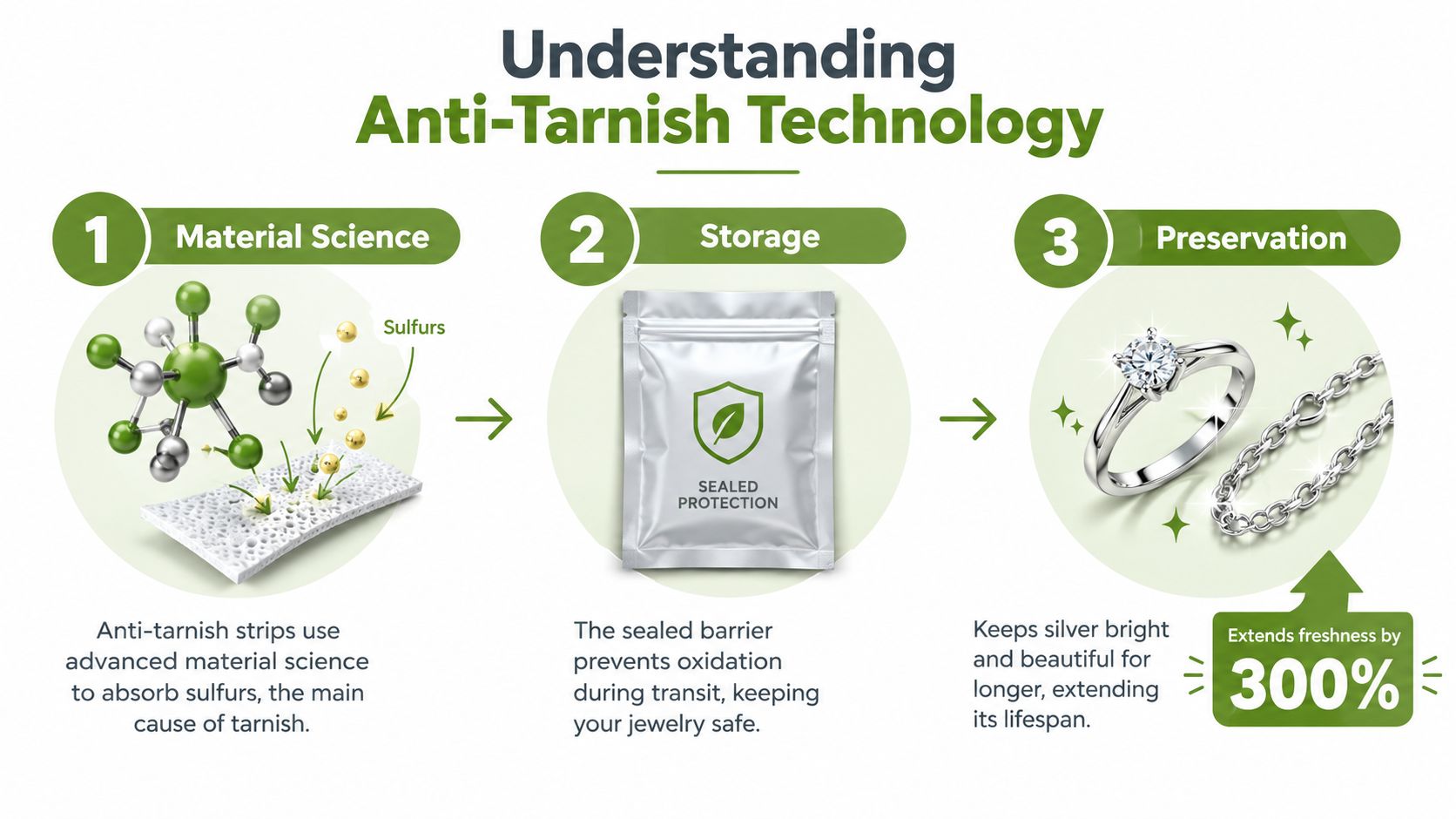
What to check in a supplier claim
Ask what the claim covers: a treated cloth, a removable intercept or scavenger component, a barrier package, or a combined system. Then ask for the intended metal, test method, exposure conditions, test duration, storage instructions, and any replacement or shelf-life guidance. A supplier statement about a material is not evidence that your finished, packed SKU achieved the same result.
- Name the mechanism. Record the active component and whether it is integral or removable.
- Define the enclosure. A drawstring presentation pouch is not equivalent to a verified airtight barrier.
- Check all nearby materials. Fabric, rubberized parts, adhesives, inserts, inks, cords, and outer packaging may affect the storage environment.
- Request relevant evidence. The report should identify the tested construction and conditions, not only use the phrase “anti-tarnish.”
- Approve with representative jewelry. Keep a control sample and document the product, packaging lot, storage conditions, and inspection dates.
The Canadian Conservation Institute also publishes a specialized sulfur test for materials; it is a conservation method with handling and interpretation limits, not a casual substitute for supplier documentation or appropriate laboratory testing. Do not convert a short packaging test into a promised number of wear years.
Anti-tarnish packaging can reduce exposure under defined conditions. It cannot replace clean handling, dry storage, suitable surrounding materials, or a clear product-care policy.
For sterling silver inventory, pair the pouch specification with your guide to preventing sterling silver from tarnishing. Keep the limits of any packaging claim visible to buyers and customer-service staff.
Sizing Standards and Order Minimums for Bulk Buyers
Pouch labels such as mini, small, medium, and large are supplier-specific. One supplier’s standard jewelry pouch dimensions can help illustrate the range, but those dimensions are not universal and should not be copied into a purchase order without checking the current item and construction.
A practical size comparison
| What to measure | Why it changes the pouch | Approval evidence |
|---|---|---|
| Finished jewelry at its natural shape | Rigid bangles, hoops, and pendants need different clearance | Internal usable width and height with seams excluded |
| Card, tag, protective film, and insert | The accessory may be larger than the jewelry | Photo and dimensions of the complete packed unit |
| Closure zone and finger access | An item can technically fit but be difficult to pack or remove | Timed packing trial and repeated closure check |
| Outer mailer or box | An oversized pouch can increase shipping volume or crease | Final pack-out test using the intended shipper |
For necklaces, test the chain-control method rather than simply moving to a larger pouch. For earrings, check whether posts, hoops, or hooks need a card. For sets, confirm that components cannot rub or tangle. Record tolerances where fit is critical so a production variation does not turn an approved sample into a tight or loose pack.
Plan quantities by SKU behavior
Keep pouch quantities tied to sales and replenishment behavior. Core earrings may share a tested format, while statement necklaces, rigid bracelets, and gift sets may need separate constructions. Track the jewelry SKU or family, pouch code, approved revision, color, current stock, consumption rate, and reorder point.
Separate ready-stock packaging from custom development. Ready-stock pouches can support a small test buy, while custom colors, logo methods, inserts, and constructions can change minimums and lead times. Review HonHo’s MOQ and wholesale pricing information, but request a project quote for the pouch itself: jewelry MOQ and timing are not automatic packaging commitments.
Customization and Branding Options for Retailers
Branding should follow the approved protective construction. First decide what the pouch must hold and how it will be packed; then choose color, logo method, print area, and finish. A logo cannot correct a rough seam, weak closure, unsuitable lining, or poor product fit.
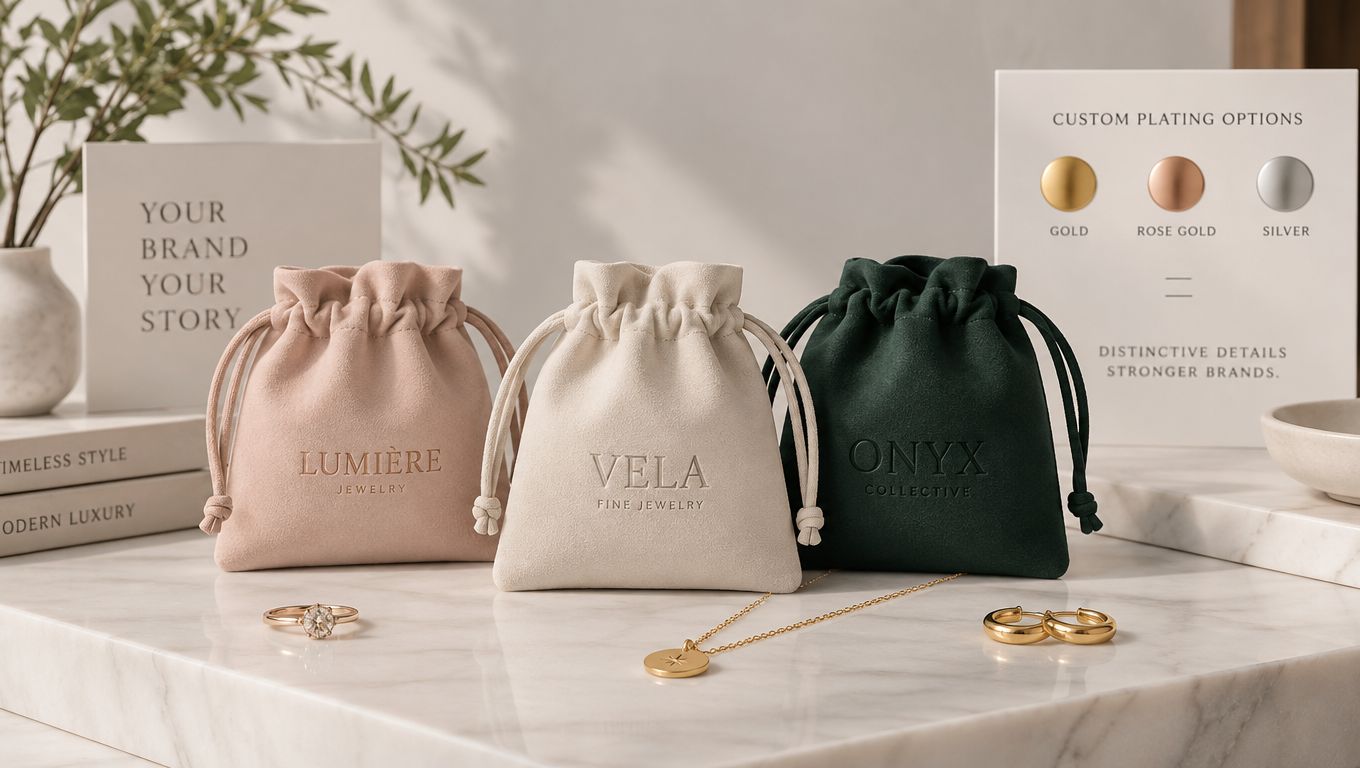
Build the brand system before adding decoration
- Light branding: apply a logo to an existing, sample-approved pouch construction.
- Coordinated packaging: align the pouch, card, insert, box, care copy, and outer pack.
- Custom development: define the fabric, lining, dimensions, closure, insert, color, and logo method as one specification.
For an RFQ, provide the jewelry category or SKU, packed dimensions, contact surfaces, expected quantity by color, logo artwork, target market, outer shipping method, and required evidence. Ask the supplier to state what is included in the quote and which elements remain subject to sample approval.
HonHo's custom packaging service can coordinate packaging with a jewelry program. A useful sample approval records color under agreed lighting, logo position and legibility, seam and closure quality, odor or visible residue, packed fit, and consistency across several pieces—not only the best sample.
The embedded video below is retained as an existing visual reference. Treat it as presentation inspiration unless its specific claims and production context are separately verified.
Sustainability Trends and Compliance for Global Markets
Environmental claims should describe the verified component and market context. “Eco-friendly,” “recyclable,” “recycled,” and “compostable” are not interchangeable. A pouch may combine fabric, lining, thread, ink, cord, metal ends, adhesive, and an anti-tarnish component, so a claim about one material should not be presented as a claim about the entire pack.
Request proof before using a sustainability claim
- Material identity: request the fiber or paper specification for the exact production construction.
- Recycled content: record the percentage and whether it applies by weight to a component or the whole item.
- Disposal route: check whether local collection and processing options exist in each target market.
- Mixed components: review linings, cords, coatings, inks, closures, and anti-tarnish elements separately.
- Production control: prevent an unapproved substitution from changing the basis of the claim.
The U.S. Federal Trade Commission’s Green Guides summary explains why recyclable claims may need qualification based on access to facilities and why recycled-content claims should identify the supported amount. Other markets have their own rules, so final customer-facing wording should be reviewed for the places where the pouch is sold.
Reusability is also a design decision rather than a guaranteed customer behavior. A useful size, durable closure, and clean construction can make reuse more plausible, but do not claim a repeat-purchase or environmental outcome that has not been measured.
Frequently Asked Questions About Wholesale Jewelry Pouches
Is velvet better than microfiber?
Neither name is a complete specification. Velvet-style pile can provide cushioning and a premium presentation; microfiber-style fabric can provide a smooth contact surface. Approve the actual weave, backing, lining, seams, dye, cleanliness, and packed performance for the intended jewelry.
How can I verify an anti-tarnish claim?
Ask the supplier to identify the protective mechanism, tested pouch construction, metal, method, exposure conditions, duration, and storage instructions. Then run a documented packed-sample comparison with representative jewelry and a control. The result applies to those conditions; it does not establish indefinite protection or customer wear life.
Should every jewelry category use the same size?
Usually not. Fit depends on the complete packed product, including cards, tags, inserts, and chain-control features. Consolidate sizes only after each product family passes the same packing and transit checks.
Is custom branding worthwhile for a small retailer?
It can be when the added setup and inventory are justified. A logo on an existing approved format often carries less development risk than a fully custom pouch. Compare minimums, sampling, setup charges, production timing, and the cost of holding unused packaging.
Will a reusable pouch guarantee repeat purchases?
No. A reusable pouch can support presentation and storage, but repeat purchasing depends on the jewelry, price, service, and fulfillment. Treat reuse as a design goal unless customer behavior has been measured.
When requesting a quote from HonHo Wholesale Jewelry, send the jewelry SKUs or categories, packed dimensions, pouch material and lining, closure, insert or card, logo method, quantities by color, target market, outer shipping pack, and the sample checks you need. HonHo can then confirm what is available or requires custom development; final specifications, minimums, pricing, and timing should be stated in the project quotation.


