

There is no single “hypoallergenic” helix earring that suits every piercing. A wholesale buyer should first separate initial or healing-piercing jewelry from jewelry for a fully healed helix. Initial jewelry needs documented material standards, an appropriate gauge and wearable length, a smooth finish, and hardware chosen for the client’s anatomy by a professional piercer. A healed-piercing assortment can include a wider range of steel, silver, and plated fashion styles, but “hypoallergenic” still needs product-specific support.
That distinction prevents the most common buying mistake: treating a decorative hoop, a flat-back labret, and a plated fashion earring as interchangeable because all three are described as sensitive-skin friendly. Material, construction, fit, intended use, and evidence all matter.
Use this guide to decide what belongs in each part of your range, what to request from a supplier, and what must be confirmed on a sample before a larger order.
Table of Contents
- Why Hypoallergenic Helix Earrings Matter for Your Customers
- Understanding Nickel Regulation and Skin Contact Limits
- Comparing Hypoallergenic Materials for Cartilage Jewelry
- How to Verify Hypoallergenic Claims from Suppliers
- Building a Hypoallergenic Helix Earring Assortment
- Your Next Steps as a Wholesale Buyer
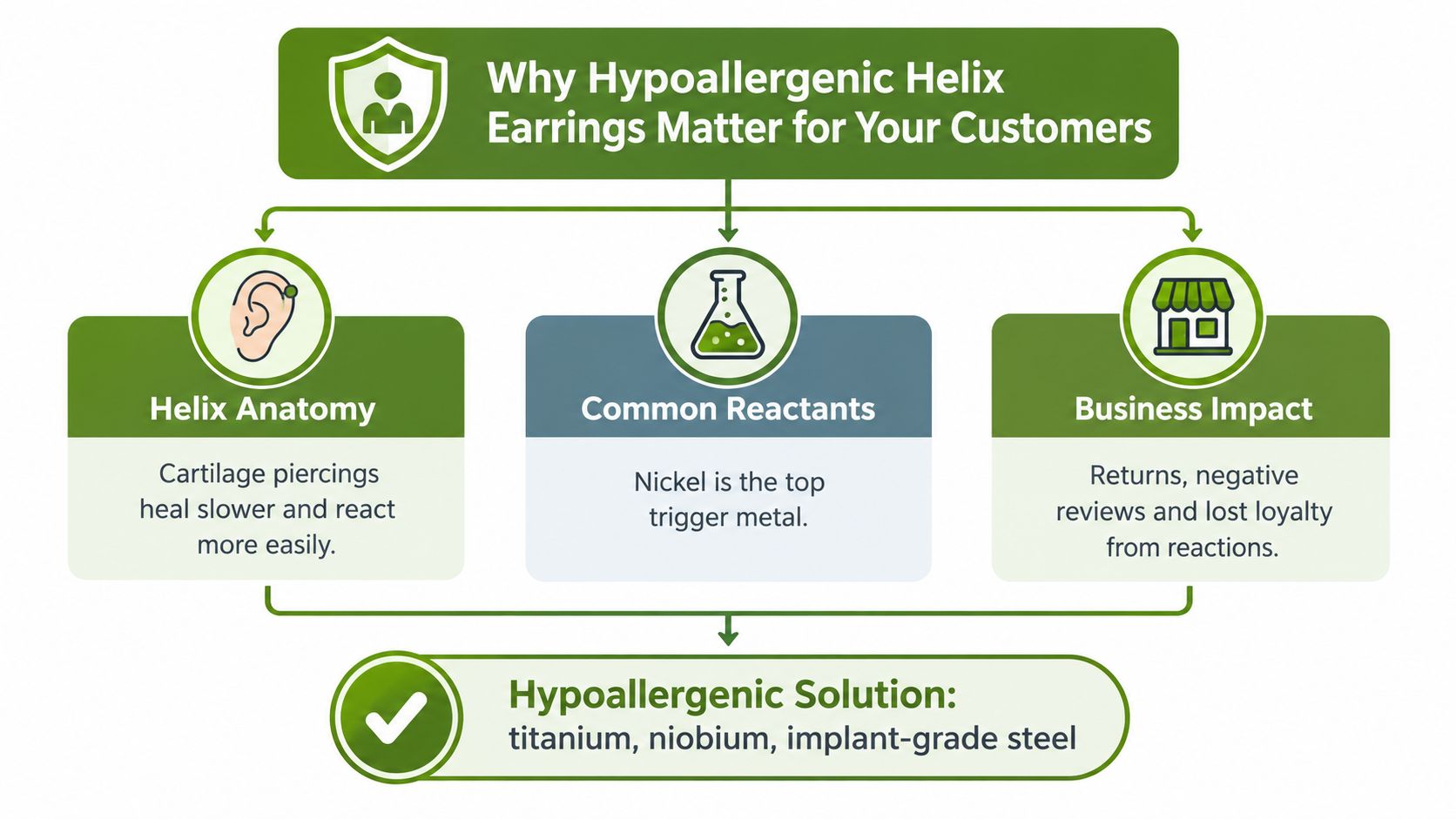
Why Hypoallergenic Helix Earrings Matter for Your Customers
A helix piercing passes through ear cartilage, so a customer may wear the same piece continuously for months while the site heals. Cleveland Clinic lists helix piercings among those that can take six to 12 months to heal and advises waiting until the piercing is fully healed before changing jewelry (Cleveland Clinic's piercing guidance). Retailers should avoid diagnosing a reaction or telling customers to change healing jewelry themselves; persistent pain, swelling, discharge, or suspected infection belongs with a qualified piercer or clinician.
The Association of Professional Piercers notes that size, style, material, surface finish, and quality all affect healing. Its guidance for initial jewelry includes implant-certified grades of titanium and steel, suitable anatomy-specific dimensions, smooth surfaces, and internally threaded or threadless construction. That is a higher bar than a generic “316L,” “titanium,” or “nickel-free” label.
Why cartilage changes the buying decision
Cartilage makes fit and movement part of the buying decision. A post that is too short can leave no room for swelling, while one that remains too long may catch on hair or clothing. A ring can move differently from a straight post. There is no universal post length or diameter for every ear, so initial fitting and later downsizing should be handled by a professional piercer rather than set by a retailer’s one-size claim.
- Name the use: State whether the product is sold for a healed piercing or is supported by documentation for initial-piercing use.
- Specify what touches the skin: Record the post, backing, solder, decorative top, and coating, not only the headline base metal.
- Confirm the fit fields: Gauge, wearable post length, top size, backing profile, closure, and overall dimensions should be on the sample record.
- Set a defensible expectation: “Hypoallergenic” means lower risk in a defined context, not allergy-proof performance for every wearer.
A consumer comparison can help explain common material names, but it should not replace a supplier’s test file. See this guide to compare hypoallergenic earring materials, then verify every commercial claim against the actual SKU. Boutique buyers can also review wholesale jewelry for boutiques when placing helix styles within a broader assortment.
Understanding Nickel Regulation and Skin Contact Limits
For a wholesale buyer, hypoallergenic is a product description, not compliance evidence. A document that names the alloy may be useful, but it does not by itself show what the finished post assembly releases during wear.
EU REACH Annex XVII Entry 27 sets a nickel-release limit below 0.2 µg/cm²/week for post assemblies inserted into pierced ears or other pierced parts of the body. For parts of articles intended for direct and prolonged skin contact, the limit is 0.5 µg/cm²/week (EU nickel-release compliance reference). The post assembly and the other skin-contact parts can therefore fall under different wording, which is why the test report’s sample description and component scope matter.
For the legal text and current scope, consult REACH Annex XVII on EUR-Lex. EN 1811 is the referenced test method for nickel release from post assemblies and articles in direct and prolonged skin contact; coated items also use an accelerated wear and corrosion method such as EN 12472 before release testing where applicable. A test-method name is not a pass result, and a report for one construction should not be silently extended to another.
What the regulatory history tells buyers
European controls on nickel in jewelry date to the 1990s and now focus on nickel release from the relevant parts of finished articles. A useful overview remains available in this jewelry metal-content and safety guidance, but the consolidated REACH entry should control current EU decisions.
Coated jewelry needs a separate durability check. Where a non-nickel coating is relied on for compliance for prolonged skin-contact articles, Entry 27 requires the coating to keep nickel release within the stated limit for at least two years of normal use. This is a regulatory condition for the covered use, not a general promise that plating will look new for two years.
Review this jewelry materials and plating guide when comparing base metals and finish routes. Then put the chosen alloy, coating stack, color standard, contact parts, and evidence requirements into the RFQ. HonHo’s ability to develop a material or finish does not make every ready-stock SKU identical.
Buying rule: Match the claim to the exact finished item, target market, intended piercing stage, and components covered by the report.
Comparing Hypoallergenic Materials for Cartilage Jewelry
Material choice begins with intended use. Jewelry for an initial or healing piercing needs a narrower specification than fashion jewelry for a fully healed helix. The table below is a sourcing framework, not a declaration that every item in a material category is suitable.
Hypoallergenic Helix Earring Materials Compared
| Material route | Best purchasing use | Evidence to request | Important limit |
|---|---|---|---|
| Implant-certified titanium | Initial or healing jewelry supplied through a professional piercing channel | ASTM F136, ASTM F1295, ISO 5832-3, or ASTM F67 documentation tied to the material source, plus the finished-jewelry specification | “Titanium” alone does not identify an implant-certified grade or prove the finished piece matches the document |
| Implant-certified steel | Initial or healing jewelry when the exact grade and finished construction are supported | ASTM F138 or ISO 5832-1 material documentation, surface and construction specification, and applicable nickel-release evidence | “Surgical steel” and “316L” cover broader commercial descriptions than the initial-piercing standards |
| 925 sterling silver | Healed-piercing retail styles where the buyer wants a recognized precious-metal position | Silver fineness, alloy and solder details, skin-contact scope, and finished-item evidence required for the target market | The Association of Professional Piercers does not list sterling silver as suitable for initial piercing jewelry |
| Plated brass | Healed-piercing fashion styles after the base metal, coating, wear points, and claims are reviewed | Brass composition, post material, underlayer and topcoat details, plating method, thickness where specified, and relevant finished-item test evidence | Gold-plated, gold-filled, overlay, or vermeil constructions are not accepted by APP guidance for fresh piercings |
Where each material fits
Implant-certified titanium is the clearest premium route for nickel-sensitive customers in a professional initial-piercing context, provided the material documentation and product construction are in order. Do not advertise a style as ASTM F136 merely because it is titanium.
Stainless steel can be a durable, commercially accessible base for healed-piercing jewelry. For initial jewelry, a 316L label is not enough; ask for the applicable implant-material standard and finished construction. For retail-sensitive-skin claims, request evidence appropriate to the market rather than relying on the grade name.
925 sterling silver suits familiar, giftable styles for healed cartilage. Confirm the post, solder, decorative top, and finish because “925” describes silver fineness, not every component or every performance claim.
Plated brass can create trend-led color and detail for healed piercings. It should be clearly separated from initial-piercing jewelry, and a PVD or electroplating process should be described only when it is the actual approved finish. PVD is a process family, not a synonym for all gold plating.
The commercial mistake is not offering several materials. It is using one broad “hypoallergenic” badge for products with different intended uses, evidence, and wear limits.
How to Verify Hypoallergenic Claims from Suppliers
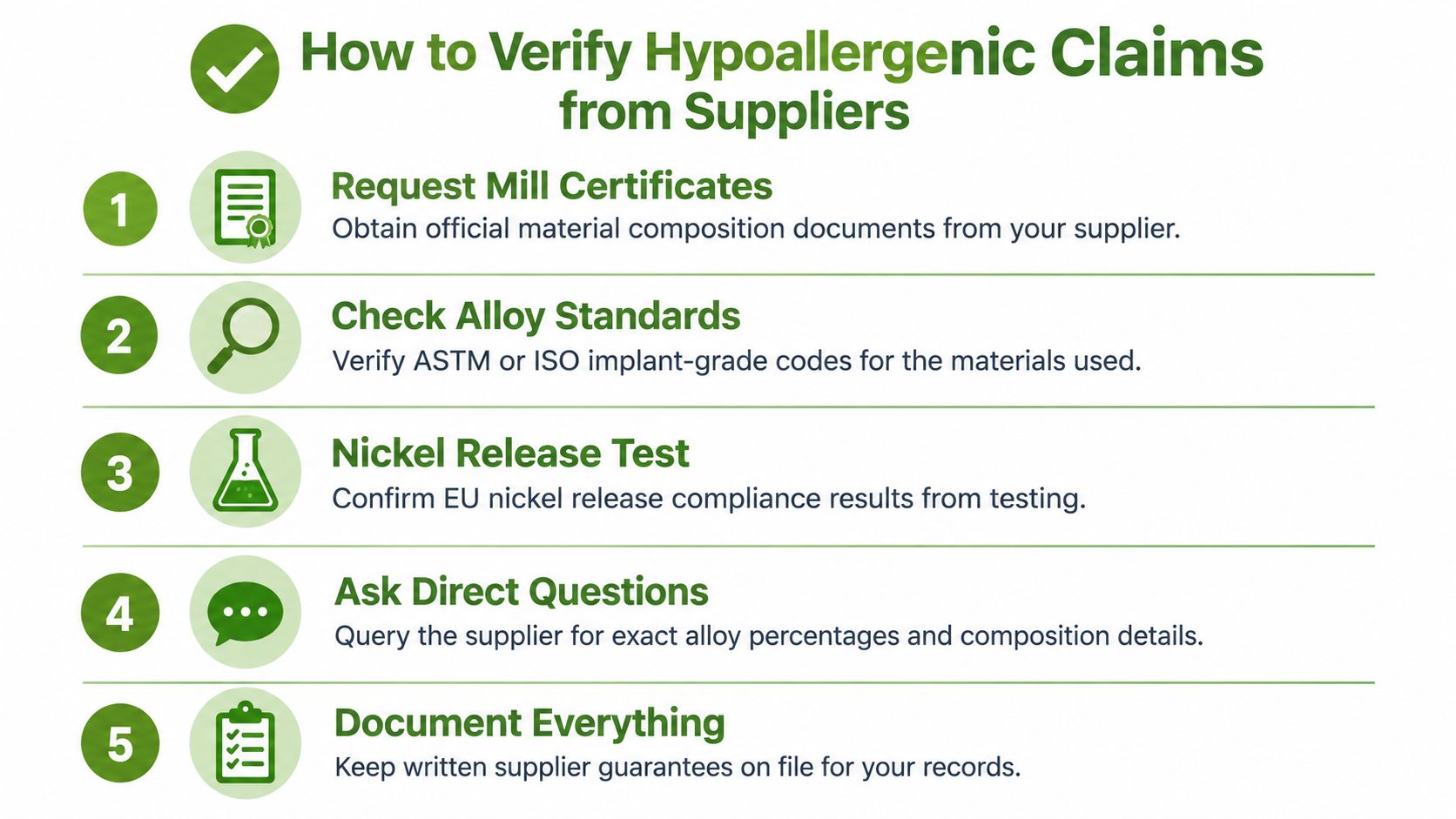
A useful supplier file connects the quote, approved sample, purchase order, test report, and reorder to the same construction. If any part changes, such as the post, solder, backing, coating, or decorative top, confirm whether the old evidence still applies.
A practical supplier verification sequence
- Define the use before the material. State whether the SKU is for a fully healed helix or a professional initial-piercing program. Do not let a fashion brief drift into a healing claim.
- Write the full component specification. Record base metal, post and backing material, gauge, wearable length, top size, closure type, solder or joining route, surface finish, coating stack, stones, and packaging.
- Check the document identity. The report should show the tested sample, date, laboratory, method, result, and product or material family it covers. A raw-material certificate and a finished-item nickel-release report answer different questions.
- Inspect sample fit and finish. Check flat-back diameter, edges, polish, thread or threadless fit, closure security, stone setting, color consistency, and contact points. Internally threaded or threadless construction avoids exposed threads passing through tissue, but the complete piece still needs the right fit and finish.
- Lock the approval record. Photograph the sample, note measurements and documents, and assign a version or SKU reference before bulk production. Retailers comparing communication and fulfillment across vendors can also review this guide to vetting wholesale distributors for Amazon.
- Reconfirm before a reorder. Ask whether the post, backing, alloy, coating, factory route, or component supplier changed. Use the same jewelry sample approval checklist when a material or construction changes.
| If the sample shows | Check first | Buyer action |
|---|---|---|
| Post is too short or leaves excessive length | Wearable length, anatomy, backing profile, and intended piercing stage | Do not set one universal fit; agree the dimension range and user guidance |
| Rough edge, gap, or exposed thread | Machining, polishing, assembly, closure, and inspection standard | Reject or correct the sample before approving bulk production |
| Color loss at contact points | Coating stack, thickness where specified, wear points, care statement, and durability evidence | Revise the finish or narrow the claim and intended use |
| Report does not identify the SKU | Sample photo, product code, material lot, test scope, and component list | Request a traceable link before using the result in product copy |
Building a Hypoallergenic Helix Earring Assortment
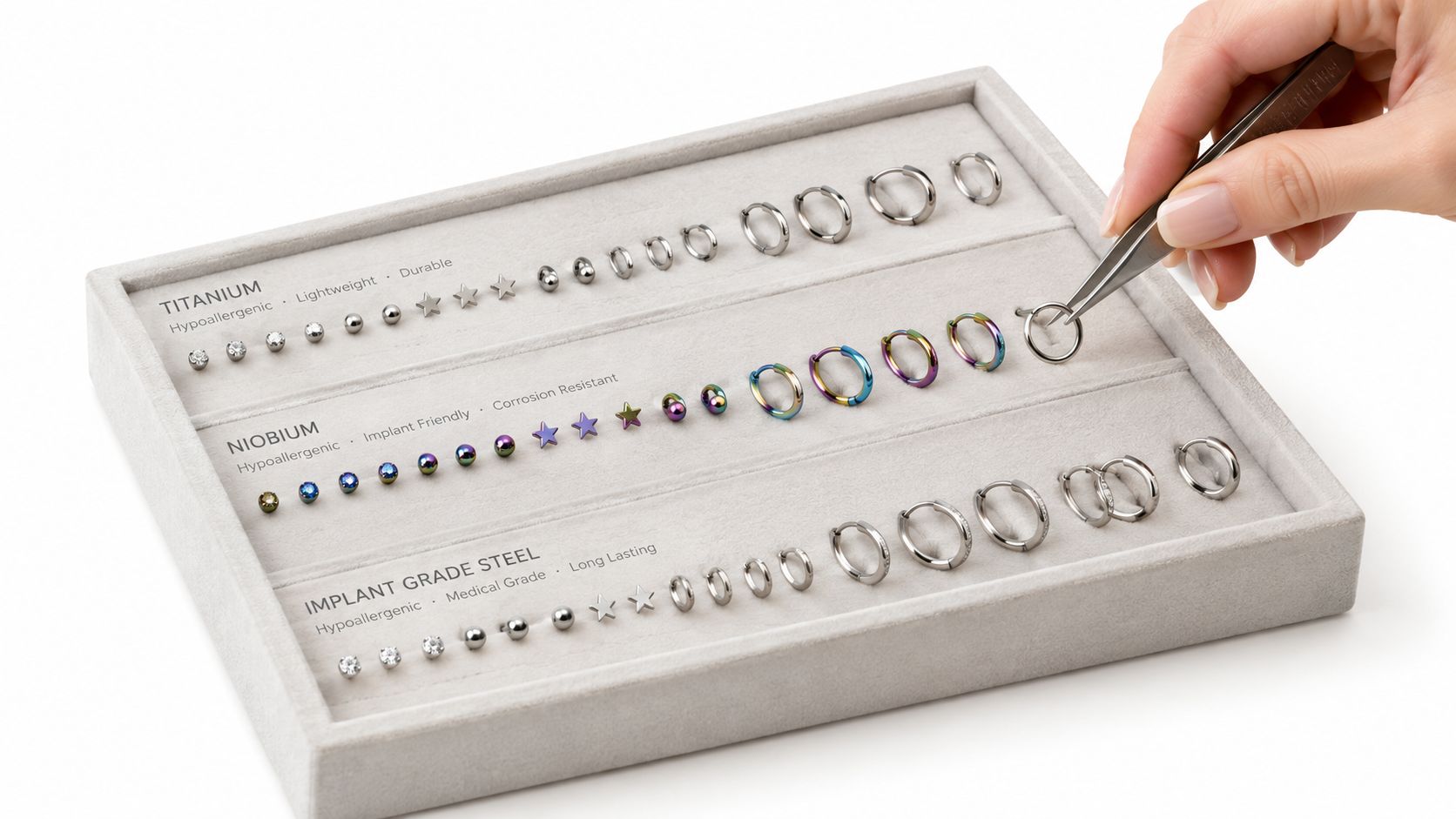
Build the range by use case rather than arranging it only by color. This makes product copy clearer and prevents an attractive fashion finish from being mistaken for initial-piercing jewelry.
Build the range by customer decision
- Professional initial-piercing route: Use only products with the required material documentation, anatomy-appropriate sizes, smooth finish, and suitable closure system. Fitting belongs with a qualified piercer.
- Healed everyday route: Prioritize comfortable post and backing options, documented skin-contact claims, simple tops, and reorderable dimensions.
- Healed premium route: Use implant-certified titanium where supplied and documented, or clearly specified sterling silver styles whose complete construction fits the target-market claim.
- Healed fashion route: Offer plated brass, decorative hoops, enamel, or mixed finishes with accurate base-metal and coating disclosure.
Keep the assortment commercially readable
Use product filters and labels that answer six questions quickly: Is it for a healed piercing? What are the contact materials? What is the gauge? What is the wearable length or ring diameter? What closure does it use? Does the color rely on a coating? Put care and use limitations near the product claim rather than hiding them in a general policy page.
For a broader purchasing plan, review wholesale earrings in bulk. A disciplined test range usually needs fewer duplicated designs and more meaningful differences in fit, material, closure, and price position.
Your Next Steps as a Wholesale Buyer
Start with one approval sheet per construction, not one generic certificate folder. The sheet should identify the intended piercing stage, all contact materials, dimensions, closure, finish, test scope, packaging copy, sample photos, and approved date. Carry the same reference into the purchase order and reorder.
A sensible buying path
- Choose the selling route. Separate professional initial-piercing supply from jewelry marketed only for fully healed cartilage.
- Write the specification. Include the exact alloy or silver fineness, every contact component, gauge, wearable length, backing, finish, stones, packaging, target market, and evidence request.
- Test a small ready-stock mix where appropriate. HonHo’s current wholesale ordering guide states a US$100 merchandise minimum for wholesale orders; product-level quantities and price tiers are shown on the relevant pages. Confirm current availability and product specifications before purchase.
- Approve custom development by sample. HonHo’s current custom baseline is 50 pieces per style and color. Brass and 925 silver samples normally take 25–30 days, stainless steel samples 25–35 days, and bulk production 35–45 days after the required approvals. These are custom-program planning figures, not specifications for every ready-stock SKU or a promise that titanium is available.
- Scale with a controlled reorder. Compare returns and customer questions by SKU, then reconfirm construction and documents before repeating the order.
This process gives sales staff a precise answer when a customer asks why two helix earrings have different prices or use instructions. It also gives the supplier a better RFQ than “hypoallergenic gold helix earring,” which leaves the important variables undefined.
HonHo Wholesale Jewelry supplies ready-stock and custom jewelry in the material ranges shown on its current store, including stainless steel, brass, and 925 sterling silver. Visit HonHo Wholesale Jewelry to compare suitable healed-piercing styles or send an RFQ with the material, fit, finish, test, packaging, quantity, and timing requirements for your project.


