

Anillo de acero inoxidable means a stainless steel ring, but that phrase is only the start of a wholesale specification. Before buying, confirm the alloy grade, surface or coating, finished-ring size matrix, quantity by size, and the evidence needed for the destination market. A grade name alone does not prove nickel release, and a gold color does not reveal how the coating was made.
For a reseller, the practical decision is not “stainless steel or not.” It is whether the supplier can tie the delivered ring to a written material and finish specification, then reproduce the approved sample across the ordered size run. Use this guide to separate material identity from finished-product performance and to build an order that can be checked on receipt.
Table of Contents
- Defining the Ring Grade: What 316L Specifies
- Ring Grades Compared by Nickel Release
- Finishes and Gold Plating That Last on a Hand
- Measuring Ring Sizes Before You Buy
- Styles and Sizes Worth Keeping in Stock
- Skin Safety Claims a Retailer Can Defend
- Pricing, First Order and Next Steps
Defining the ring grade: what 316L specifies
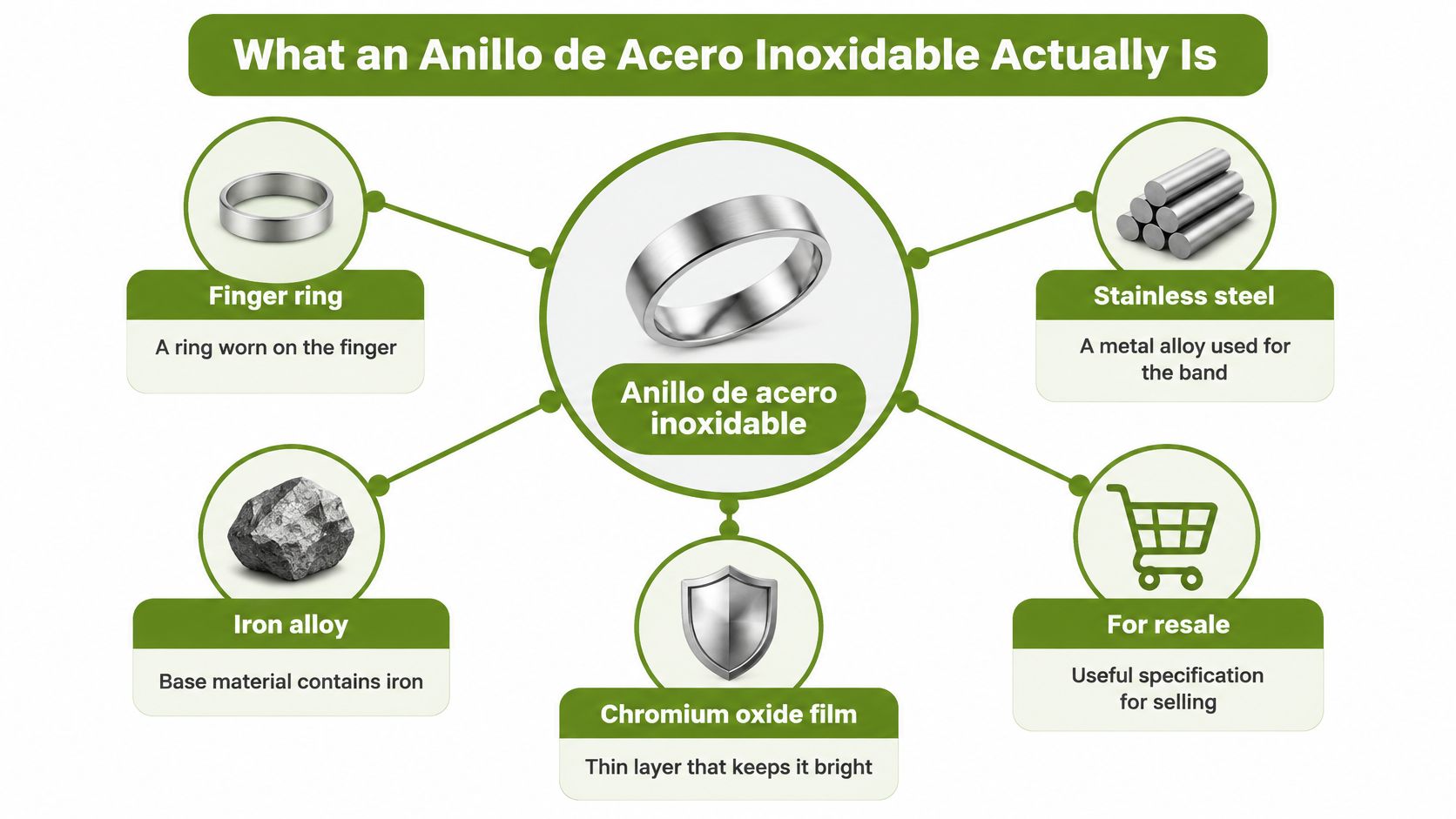
A ring can be advertised as stainless steel without naming its grade. That leaves the buyer unable to connect the product name to a defined alloy. Stainless steel resists corrosion because chromium supports a passive surface film, but composition, fabrication and surface condition all affect the finished item.
When 316L is required, put 316L—also identified as UNS S31603 or EN 1.4404—in the purchase specification. A Cleveland-Cliffs 316/316L data sheet gives composition ranges including chromium at 16.0–18.0%, nickel at 10.0–14.0%, molybdenum at 2.0–3.0%, and a maximum carbon content of 0.03% for 316L. Those figures define the alloy; they do not certify a particular ring or its coating.
Nickel is still in the alloy
316L contains nickel. A material certificate can support the alloy identity of the supplied metal, while a nickel-release report addresses the finished article under stated test conditions. They answer different questions. “Surgical steel” and “hypoallergenic” do not replace either document.
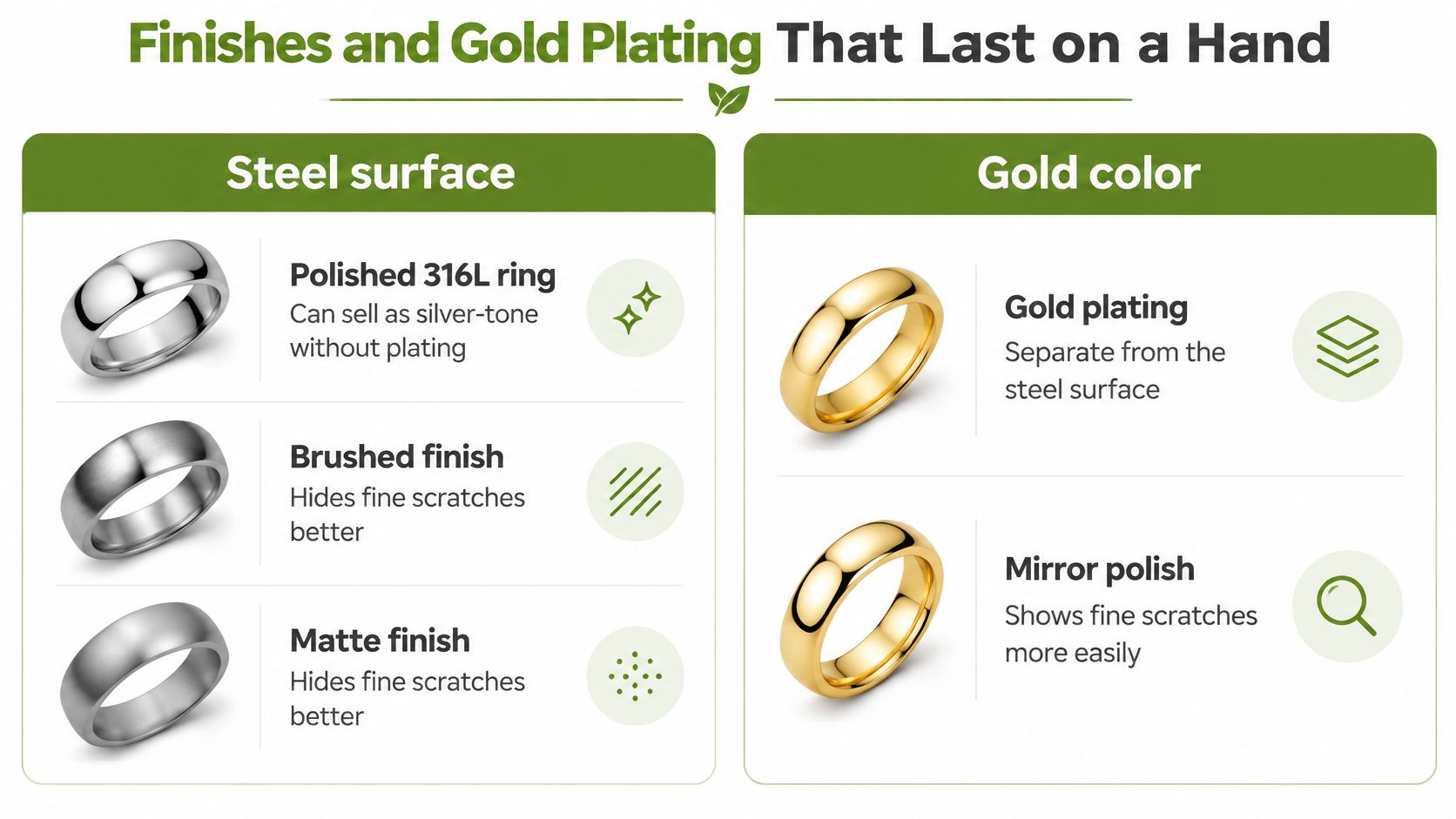
Separate the base metal from the finish in listings and quotations. An unplated polished 316L band may be silver-tone. A gold-color ring has a coating over its base metal, so the quote should identify both the base and the coating route. If the supplier cannot confirm those details, do not assign a grade or process based on appearance.
Buyer rule: Write the required grade, finish, dimensions and evidence into the order. Treat a sample, certificate and finished-product report as separate approval records.
Ring grades compared by nickel release
Grade comparisons are useful only when their limits are clear. A 2015 laboratory comparison of jewelry steels reported lower nickel release for its tested 316L and 304 specimens than for its tested 201 and 303 specimens. The result belongs to those samples, surfaces and methods; it is not a blanket pass or failure for every ring made from the same nominal grade.
| Evidence | What it supports | What it does not establish |
|---|---|---|
| Named grade on the order | The alloy the buyer requested | That the delivered batch matches it |
| Material or mill certificate | Composition or batch identity within its stated scope | Finished-ring nickel release or coating durability |
| Finished-item nickel-release report | Results for the identified ring, surface and method | Every future batch or every market |
| Approved sample and inspection | Dimensions, finish, edges and workmanship | Chemistry that was not tested |
What each grade means on a finger
316L is often selected for rings because the alloy includes molybdenum and is widely used where corrosion resistance matters. That is a material-selection reason, not a guarantee that every 316L-labelled ring will suit every wearer. Surface finishing, contamination, coating wear and the finished construction remain relevant.
Do not convert one research table into a universal buying rule. If 316L is part of the offer, confirm it on the order and request evidence with a clear link to the supplied batch. If 304 or another grade is proposed, evaluate it against the intended product, market and claims instead of relying on a generic “stainless” label. See how 316L stainless steel jewelry differs from unnamed stainless steel for a broader material overview.
Finishes and gold plating that last on a hand
A finish describes the visible surface; a coating describes an added layer or process. Mirror polish, brushing and texture change appearance and how scratches show. Electroplating and PVD are process terms. A buyer should not infer one from the other.
Thickness is the specification
A “gold plated” label does not disclose the layer thickness. UPA's guide to gold plating thickness summarizes common trade terminology. For a current U.S. consumer reference, the Federal Trade Commission explains gold-plated jewelry and describes “gold electroplate” as at least 10-karat gold applied electrolytically at a thickness of at least 0.175 microns. The FTC also notes that plating eventually wears and that wear depends on use and thickness.
That definition is not a promise of wear life. Rings receive frequent friction, so a quotation should state the process, base metal, gold karat where relevant, target thickness and any clear coat. Ask how thickness is checked and whether the reported value applies to the actual ring surface rather than to a general factory capability.
| Finish route | Quote these details | Sample check |
|---|---|---|
| Unplated steel | Grade, polish or texture, color standard | Edges, scratches, welds and consistency |
| Gold electroplate | Base metal, process, karat, target thickness, underlayer | Color match, coverage and high-friction areas |
| PVD color coating | Base metal, process, color target and agreed coating specification | Shade, coverage, edges and sample-to-bulk match |
| Two-tone finish | Each surface and masking boundary | Alignment and clean transition lines |
Use the term gold PVD coating only when the supplier confirms that process. PVD describes a deposition route; it should not be used as a substitute for the agreed coating specification or finished-product test plan.
The same separation of base metal and finish applies to earrings. Gold Plated 316L Stainless Steel Chunky Dome Huggie Earrings identify a 316L base and a gold-plated finish, but the public listing does not state a micron thickness. Confirm any thickness requirement in the quotation rather than adding one to retail copy.
The retained video below is a general visual reference for ring textures. It is not evidence of the material grade, coating method or thickness for a product you are buying.
Measuring ring sizes before you buy
For wholesale ordering, a size label is not enough. Record the sizing system and a measurable dimension—usually inside diameter or inside circumference—then check the supplier's packing labels against the approved sample. This prevents a nominal US, EU or UK size from being mapped to the wrong physical ring.
Three ways a reseller can measure
Ring mandrel and gauge: Use calibrated tools for sample approval and in-store fitting. Confirm that the mandrel scale matches the sizing system on the order.
Inside-diameter measurement: Measure a round ring that already fits, across the interior without including the metal. A suitable caliper is more repeatable than judging against a printed screen image.
Finger strip or sizer: Useful for customer guidance, but temperature, knuckle width and measurement tension can change the result. Treat it as a fit aid, not as the factory's finished-ring inspection method.
Width changes the feel of the same number
A wide band generally feels tighter than a narrow band at the same nominal size because more metal contacts the finger. Do not apply a universal “half size up” rule: approve the actual width and profile, then give customers the fit guidance supported by that sample.
Fixed bands need a defined size run. Open or adjustable rings still need minimum and maximum dimensions plus an agreed adjustment method; repeated bending can deform or fatigue a design. Use the jewelry size guide as a reference, and keep one conversion system consistent across the product page, order and packing labels.
| Sample checkpoint | Record | Why it matters |
|---|---|---|
| Nominal size | US, UK, EU or another named system | A number without a system is ambiguous |
| Physical dimension | Inside diameter or circumference and tolerance | Creates an inspectable acceptance point |
| Band geometry | Width, thickness and inside profile | Changes fit and comfort |
| Size marking | Ring, bag and carton label format | Reduces picking and listing errors |
Styles and sizes worth keeping in stock
There is no universal wholesale size curve. Build the first allocation from your market, selling channel and available evidence. If you already sell rings, use units sold and return reasons by style and size. If you do not, keep the first fixed-size run shallow and place reorders only after the data becomes useful.
Evergreen before trend
“Core” should mean proven in your assortment, not timeless by assumption. Separate styles into a replenishment group and a test group. A plain band can still fail if its width, finish or price misses the customer. A bold design can earn a reorder if actual sell-through supports it.
Review demand by construction as well as appearance. Stone-set and pearl-accented rings add setting and handling checks. Textured rings need a reference surface. Adjustable rings reduce the number of fixed sizes but introduce opening dimensions and deformation risk.
A starter mix you can photograph
A controlled first order gives buyers useful comparisons without pretending to predict demand:
- One unplated reference style to evaluate polish, edge quality and the supplier's size mapping.
- One coated style with the process and target color recorded, so the sample becomes a bulk reference.
- One wider or textured style to test how band geometry changes fit and customer response.
- One adjustable option only if its opening range and adjustment method are approved.
Photograph the approved samples under consistent light and keep the sample IDs with the quotation. Use the photos for color and construction reference, not as a substitute for dimensions or written finish details.
Skin safety claims a retailer can defend
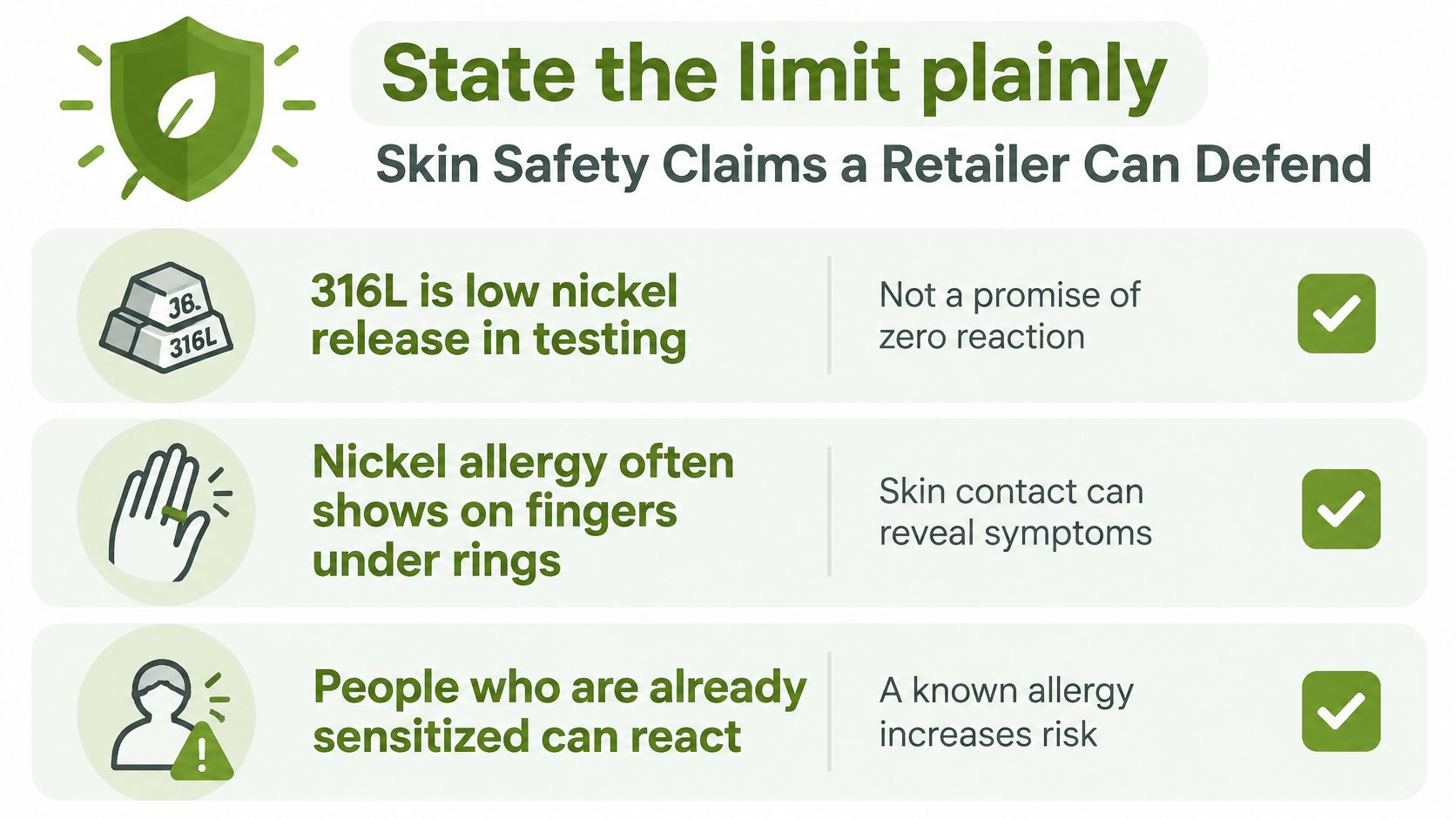
316L is not nickel-free, and no grade label can promise that every wearer will avoid a reaction. The American Academy of Dermatology advises that nickel contact can trigger allergic contact dermatitis in sensitized people. Claims should therefore follow the product evidence, not a broad material slogan.
The limit and the paperwork
For rings intended for direct and prolonged skin contact in the EU/EEA, the EU REACH nickel restriction sets a nickel-release limit of 0.5 micrograms per square centimeter per week. The Danish Environmental Protection Agency's nickel fact sheet identifies EN 1811 as the release-test method and explains that coated products must keep release within the limit for at least two years of normal use, with EN 12472 used to simulate wear and corrosion before release testing.
Ask for a report that identifies the finished ring, finish, sample date, method and result. A certificate for raw steel does not answer that question. If polished, engraved, textured and plated versions create different contact surfaces, confirm which variants the report covers.
The same distinction appears in piercing jewelry. A hypoallergenic helix earring claim still needs evidence appropriate to its market and construction rather than a slogan alone.
Wording you can defend
Do not call 316L “nickel-free.” If a current finished-item report supports a low-release statement, identify its scope internally and make sure the retail claim does not extend beyond it. “Grade stated by supplier” is not the same as “batch verified,” and “tested sample” is not the same as “every future production run.”
Promise only what the specification and evidence support: the stated grade, the identified finish and the documented test result.
Care guidance can reduce avoidable damage without turning into a durability promise. Tell customers how to dry the ring after sweat or water exposure and how to avoid harsh cleaners. For plated rings, explain that friction and use affect wear; do not translate a coating thickness into a guaranteed number of months or years.
Pricing, first order and next steps
Normalize supplier quotes before comparing unit prices. Two rings that look similar can differ in metal weight, size allocation, finish build, packaging and test scope. Ask each supplier to quote the same written brief and separate any tooling, sample, testing and freight charges.
A first number, then your own costs
Build a landed-cost sheet instead of applying a universal markup. Include product cost, sample and tooling allocation, inspection or testing, packaging, payment fees, freight, duties or taxes where applicable, and an allowance based on your own return data. Then set the retail price against the margin and service costs of your channel.
Check the current terms on the MOQ and wholesale pricing page before budgeting. HonHo's current planning reference for custom production starts at 50 pieces per style and color. The quotation for the selected products or custom brief controls; different styles and colors do not automatically combine toward one minimum.
What to confirm before you pay
For planning, HonHo currently lists stainless-steel samples at 25–35 days and bulk production at 35–45 days after sample approval and confirmation of final order details. Ready-stock orders usually dispatch within three business days after payment confirmation, stock verification and final checks. These are planning references, not unconditional delivery guarantees; carrier transit is additional.
Before payment, attach a size-and-quantity matrix and confirm the base material and required grade, dimensions and tolerances, finish process and color, coating details, sample approval points, packaging, test documents, destination and target timing. For a gold-color ring, do not accept a color name as the full coating specification.
HonHo's custom development capability does not mean every ready-stock SKU has the same alloy grade, coating thickness or test record. Request the specification for the exact item and order route you are considering. Visit HonHo Wholesale Jewelry to compare current styles, materials and finishes, then send the selected product links and quantity split for a project-specific quotation.


