

A useful bulk earring order is built around four decisions: which SKUs deserve depth, which materials and closures fit the target customer, what evidence is required before approval, and when a reorder should be triggered. A catalog photo cannot answer those questions.
Separate ready-stock buying from custom production at the start. For ready stock, verify the exact SKU specification and delivery terms. For custom earrings, write one comparable brief, approve a physical reference, and keep the approved component and finish details attached to every repeat order. That is how a mixed assortment becomes manageable instead of a collection of unrelated bets.
Table of Contents
- Why Bulk Earrings Deserve a Serious Spot in Your Assortment
- What the Earring Market Actually Looks Like for Wholesale Buyers
- Matching Earring Styles to Resale Velocity and Margin
- Comparing Stainless Steel, Brass, and 925 Silver for Bulk Orders
- Price Tiers, Markups, and Landed Cost for Wholesale Earrings
- Quality and Compliance Checks Before You Approve a Bulk Lot
- MOQs, Samples, Packaging, and Shipping Logistics
- Putting Your First Bulk Order Together and Next Steps
Why Bulk Earrings Deserve a Serious Spot in Your Assortment
Earrings can cover several retail price points without ring sizing, but that does not make every style low-risk. A bulk order still concentrates cash in small components that are easy to overlook: posts, backs, hooks, hinges, jump rings, solder joints and stone settings.
Bulk buying works when you separate core from test
Assign every SKU an inventory role before deciding quantity:
- Core depth buy: a style supported by your own sales, wait-list, preorder or close comparison data.
- Controlled test: a new silhouette, finish or price point bought in a quantity small enough to learn from.
- Range coverage: a style included for a specific need, such as clip-ons, flat backs or a premium silver option.
Studs, hoops and huggies may become core products, but the label should come from channel-specific evidence rather than a universal claim about what always sells.
One weak component can ruin a whole lot
Review an earring as an assembly. A decorative front can look right while the post is soft, the butterfly back is inconsistent, the hinge has excessive play, or a plated contact surface differs from the approved sample. Record those details by SKU; a generic “quality approved” note is not enough for a repeat order.
Practical rule: approve the component that carries the risk, not only the part that carries the design.
What actually deserves working capital
Commit depth only after you can identify the selling channel, target retail price, landed-cost ceiling, sample reference, component specification and reorder lead time. If one of those is missing, keep the quantity conservative until the gap is closed.
What the Earring Market Actually Looks Like for Wholesale Buyers
Published market estimates can help define a category, but they cannot forecast an individual boutique's sell-through. The report linked where DataIntelo found presents estimates for market size, product share, online channels and regions; check its methodology and definitions before using those figures in a buying plan. Treat them as context, not proof that a particular stud, hoop or drop earring will sell.
Likewise, Grand View Research's jewelry market analysis describes growth at the broader jewelry-market level. A growth projection does not establish demand for a specific SKU, material, price point or customer. Your purchase order should be based on observed channel data and a controlled test, not a forecast copied into a margin sheet.
The category earns budget only if you read it correctly
Build an opening order from comparable evidence:
- Use your own orders, wish lists, inquiries or return reasons when they exist.
- For a new store, test one variable at a time—silhouette, metal, finish or price—so the result is interpretable.
- Keep pairs, backs and packaging identified by SKU and lot so a component problem does not become an assortment-wide mystery.
This turns “earrings are popular” into a measurable question: which configuration sells, at what margin, with which return pattern and replenishment time?
Matching Earring Styles to Resale Velocity and Margin
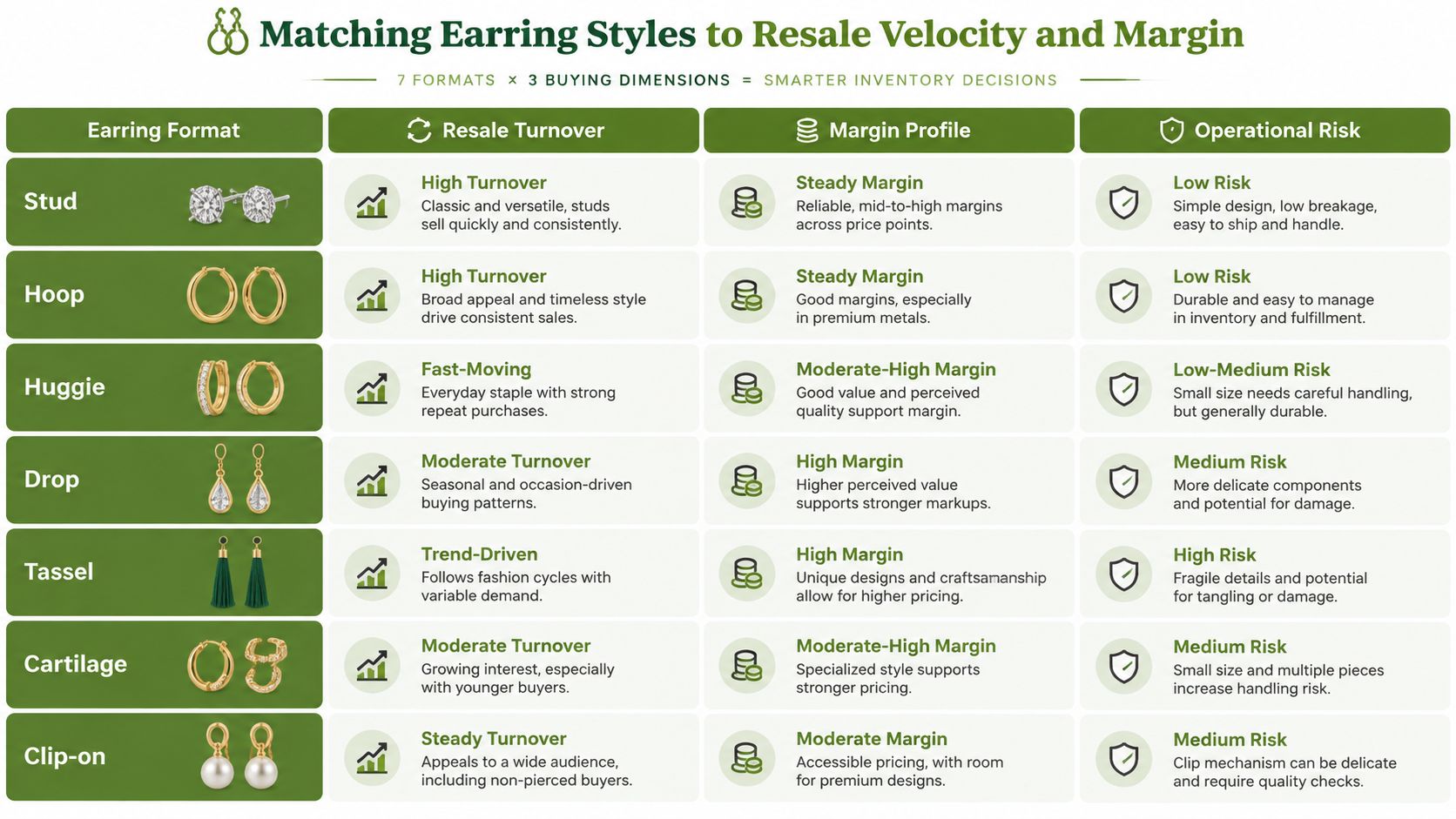
Style names alone do not determine velocity. Size, pair weight, closure, finish, stone security, price and how clearly the product can be shown online all affect the result. Use the retained visual below as a discussion aid, not as measured demand evidence for your store.
Buy deep in the formats that repeat
Depth is justified when a format has repeatable sales and the replacement specification is stable. Record the approved diameter or drop, pair weight, post or wire dimensions, back or clasp type, finish reference and packaging. “Same hoop as last time” is not a reorder specification.
Keep trend-led styles on a short leash
For sculptural drops, tassels and statement pieces, first confirm balance, movement, exposed edges, attachment points and packaging clearance. These designs may support a higher ticket, but additional joints and surface area also create more inspection points. Test the product and the listing presentation before increasing quantity.
The following original video embed is retained as a third-party reference. Its playback and claims were not independently verified for this edit; do not use it as product or demand evidence without reviewing the source.
Niche formats still matter, but don't let them eat the budget
- Flat-back and cartilage styles: specify gauge, wearable length, threading or closure direction and the intended placement.
- Clip-ons: check pad area, spring pressure, decorative weight and whether a replacement component is available.
- Ear cuffs: approve the opening, internal profile, edge finish and retention on the intended ear position; one fit claim will not suit every wearer.
Keep these formats when they serve a defined customer or merchandising role, not simply to make the line sheet look broad.
Comparing Stainless Steel, Brass, and 925 Silver for Bulk Orders
Base metal, finish and skin-contact components are separate specifications. A gold-colored surface does not establish the substrate, plating route, nickel release or wear performance. Start with the exact SKU record, then use HonHo's jewelry materials guide to frame the questions you still need answered.
What each material is actually good at
Stainless steel: suitable for many structural and everyday designs when the grade, post material, finishing route and assembly are confirmed. The linked 316L stainless steel jewelry guide explains why molybdenum-bearing 316L differs from common 304 grades, but that general distinction does not prove every stainless-steel SKU is 316L.
Brass: workable for detailed fashion shapes and conventional plated finishes. Quote the brass item with its actual base metal, finish stack, contact parts and approved color; “brass” alone does not establish plating performance.
925 sterling silver: the 925 designation refers to silver fineness, while hallmarking and labeling obligations depend on the target market and item. The retained UK silver hallmark guide is one overview; buyers should confirm the rules that apply where the product will be sold.
Bulk Earring Materials Compared
| Route | Useful when | Confirm on the quote | Sample check |
|---|---|---|---|
| Stainless steel | Structure, repeatable shapes and many everyday formats | Grade by component, post/back material, finish route, dimensions | Closure cycle, edge finish, pair symmetry, color reference |
| Brass | Detailed cast forms and plated fashion designs | Base alloy, plating specification, soldered parts, protective finish | Finish coverage, solder area, stone security, contact surfaces |
| 925 sterling silver | Silver-led positioning and premium basics | Fineness/marking, component metal, finish, weight and target market | Marks, post/back fit, surface finish, pair weight and dimensions |
My buying recommendation
Choose the route that matches the selling claim and the approved evidence. If customers are buying “925 silver,” metal identity and marking matter. If the design is sold on color and shape, finish consistency and component disclosure matter. For any route, avoid universal “hypoallergenic,” “waterproof” or wear-life claims unless the exact finished product and target market support them.
Price Tiers, Markups, and Landed Cost for Wholesale Earrings
A supplier unit price is not a retail price and not a landed cost. Use the retained wholesale jewelry pricing guide and jewelry markup calculator guide as planning references, but do not treat any fixed multiplier as a rule. Margin needs differ by channel, returns, promotional policy, tax treatment and operating cost.
Wholesale Price Tiers and Margin Math
Compare quotations on the same scope. HonHo's MOQ and wholesale pricing page helps separate current ready-stock terms from custom planning, but the buyer still needs a SKU-level landed-cost sheet.
| Cost line | Record before approval | Common omission |
|---|---|---|
| Product | Unit price, quantity tier, currency and included components | Backs, spare parts or mixed component materials |
| Sampling/setup | Sample, mold/CAD, color or packaging setup | Assuming setup is included in unit cost |
| Packaging | Card, pouch, bag, label, barcode and packing labor | Packaging volume that changes freight |
| Freight/import | Incoterm, cartons, chargeable weight, duty and brokerage | Comparing EXW with delivered quotes |
| Operating allowance | Payment fees, inspection, expected returns and markdown room | Pricing from product cost alone |
The $1.80 mistake
A hypothetical $1.80 quote is incomplete until its scope is known. It may exclude backs, cards, labels, freight, duty, inspection, payment fees or a returns allowance. Add the actual costs first; then choose a retail price that fits the channel and value proposition. No universal conversion turns $1.80 into one correct retail price.
What to do instead
- Normalize every supplier quote to the same product, component, packaging, Incoterm and test scope.
- Calculate contribution after landed cost and channel fees, not from markup alone.
- Keep a target margin range and a stop point: if the approved specification cannot meet it, change the product plan before production.
Quality and Compliance Checks Before You Approve a Bulk Lot
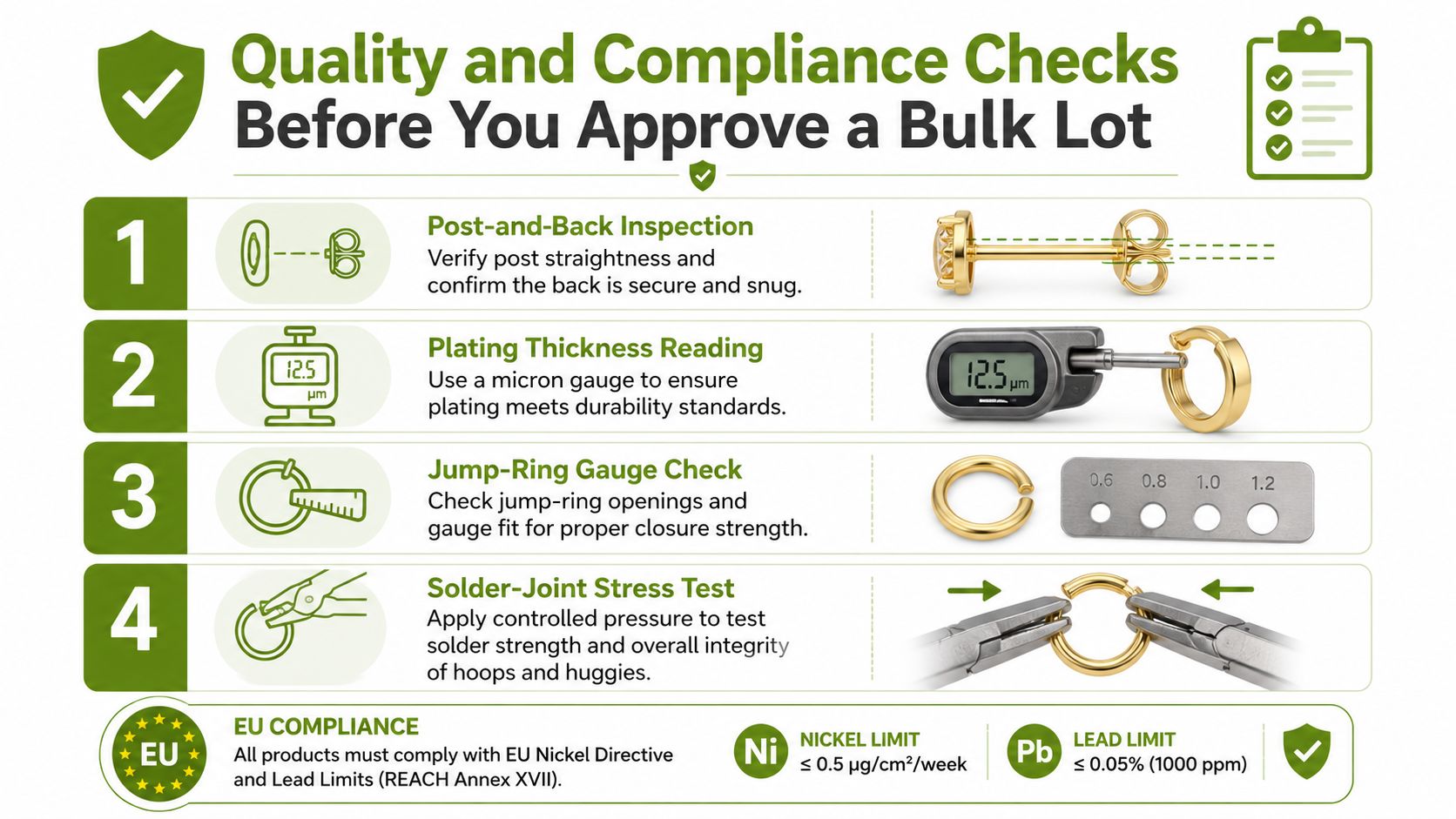
Use the jewelry sample approval checklist to identify the approved reference, inspection points and release decision. For earrings, the record should cover both pieces in the pair and every component that touches the wearer.
The compliance points buyers can't ignore
Requirements depend on the market and use. For England, Scotland and Wales, the retained Business Companion guidance on jewelry safety and metal content states a nickel-release limit below 0.2 µg/cm²/week for post assemblies used in piercings and no more than 0.5 µg/cm²/week for products in direct and prolonged skin contact. It also explains that the post assembly includes the inserted part and faces such as a butterfly or ball that hold the piece against the wound.
The same guidance, also retained as Business Companion guidance on lead and cadmium restrictions, describes lead and cadmium restrictions for jewelry parts. Check current target-market rules, exemptions, the applicable test method, laboratory competence and the identity of the tested sample. A cited rule or supplier report does not prove that an untested SKU, later batch or different component complies.
What to inspect before payment
| Area | Check | Record |
|---|---|---|
| Pair identity | Dimensions, pair weight, color, orientation and symmetry | Measurement method and approved tolerance |
| Post/back or hook | Straightness, fit, insertion surface, edge finish and material | Component type and supplier specification |
| Hinge/latch | Opening, closure engagement, play and repeated cycles | Cycle plan and accept/reject observation |
| Joints/settings | Solder, jump rings, stones, pearls and moving elements | Inspection points and failure photos |
| Finish | Coverage, color reference, contact and high-wear areas | Approved reference and any test location |
| Documents | Market, method, sample identity, date and result | Report number and exact SKU/component mapping |
The retained review on nickel allergy and earring compliance discusses nickel allergy and market testing. It is useful context, not evidence about HonHo products or a specific order. Do not convert population or market findings into a claim that one material is universally safe.
MOQs, Samples, Packaging, and Shipping Logistics
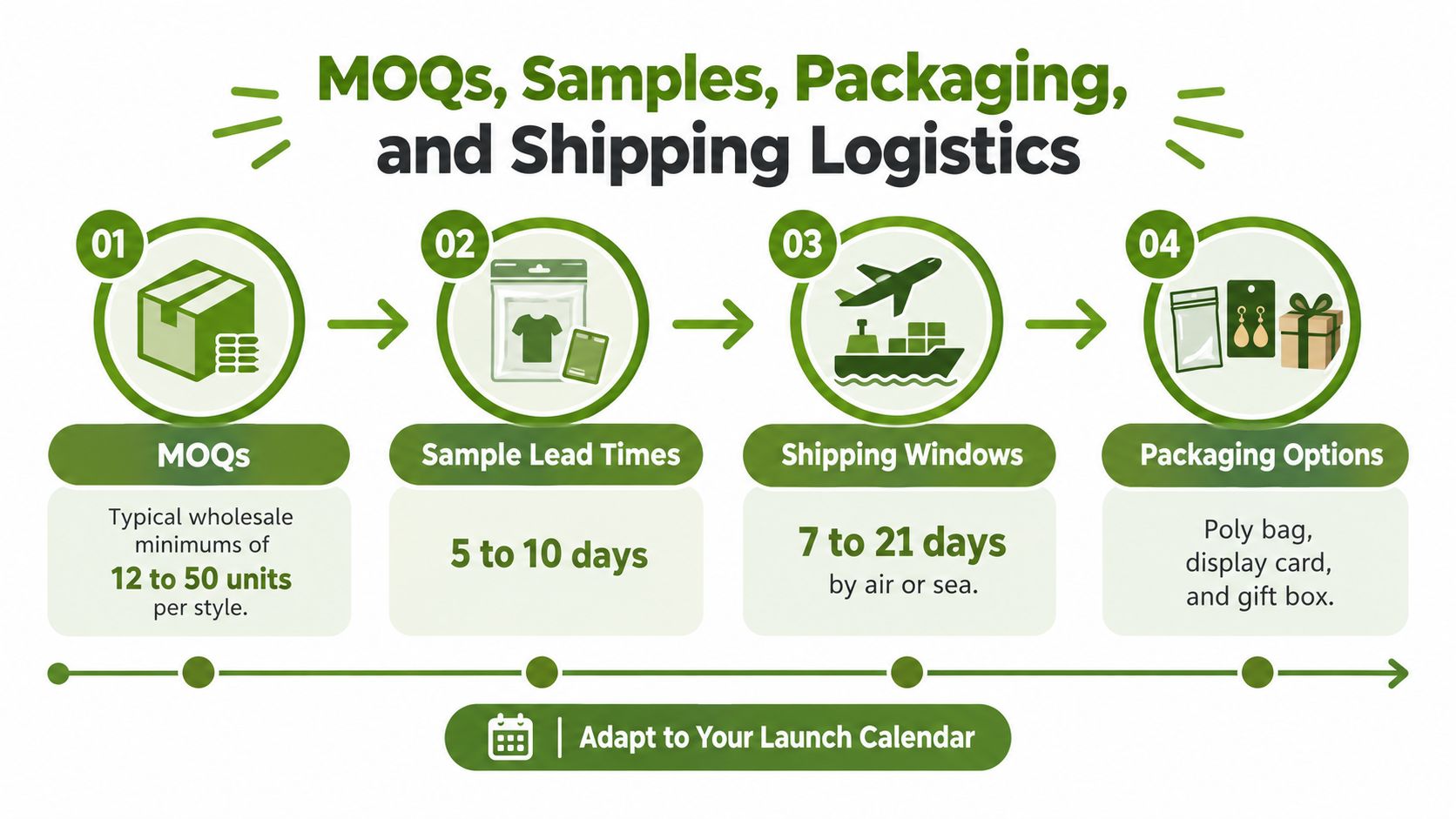
Keep ready-stock dispatch and custom development on separate schedules. The sample and MOQ guide provides the planning context; confirm the exact SKU, stock status, quantity and destination on the current quotation.
Don't let MOQ decide the assortment by accident
HonHo's current custom-development baseline is 50 pieces per style and color. Planning baselines are 25–30 days for brass/925 samples, 25–35 days for stainless-steel samples and 35–45 days for bulk production after details are confirmed. These are custom-planning ranges, not promises for every SKU or ready-stock dispatch.
Use MOQ to plan the route, not to force an unsupported quantity. A design may be better sourced from ready stock, tested in one finish, simplified for a first run or deferred until there is enough evidence for custom depth.
Packaging and freight affect margin more than buyers expect
Approve packaging with the earring, not after it. Record card hole position, pair orientation, closure clearance, abrasion protection, barcode location, individual packing and carton method. Large drops and rigid posts need different protection from compact studs; a packaging sample should survive the intended fulfillment route without bending posts or marking finishes.
Reorder planning is the real shipping strategy
Before launch, record the supplier lead-time assumption, receiving buffer, sales window and reorder trigger. On repeats, reference the approved sample and specification revision. If a component source, finish route or packaging changes, treat it as a new approval point rather than silently carrying forward the old result.
Putting Your First Bulk Order Together and Next Steps
A strong first order is easy to compare and inspect. It does not need an arbitrary number of “hero styles”; it needs a clear reason for each SKU and enough structure to learn what worked.
A first-order checklist that actually works
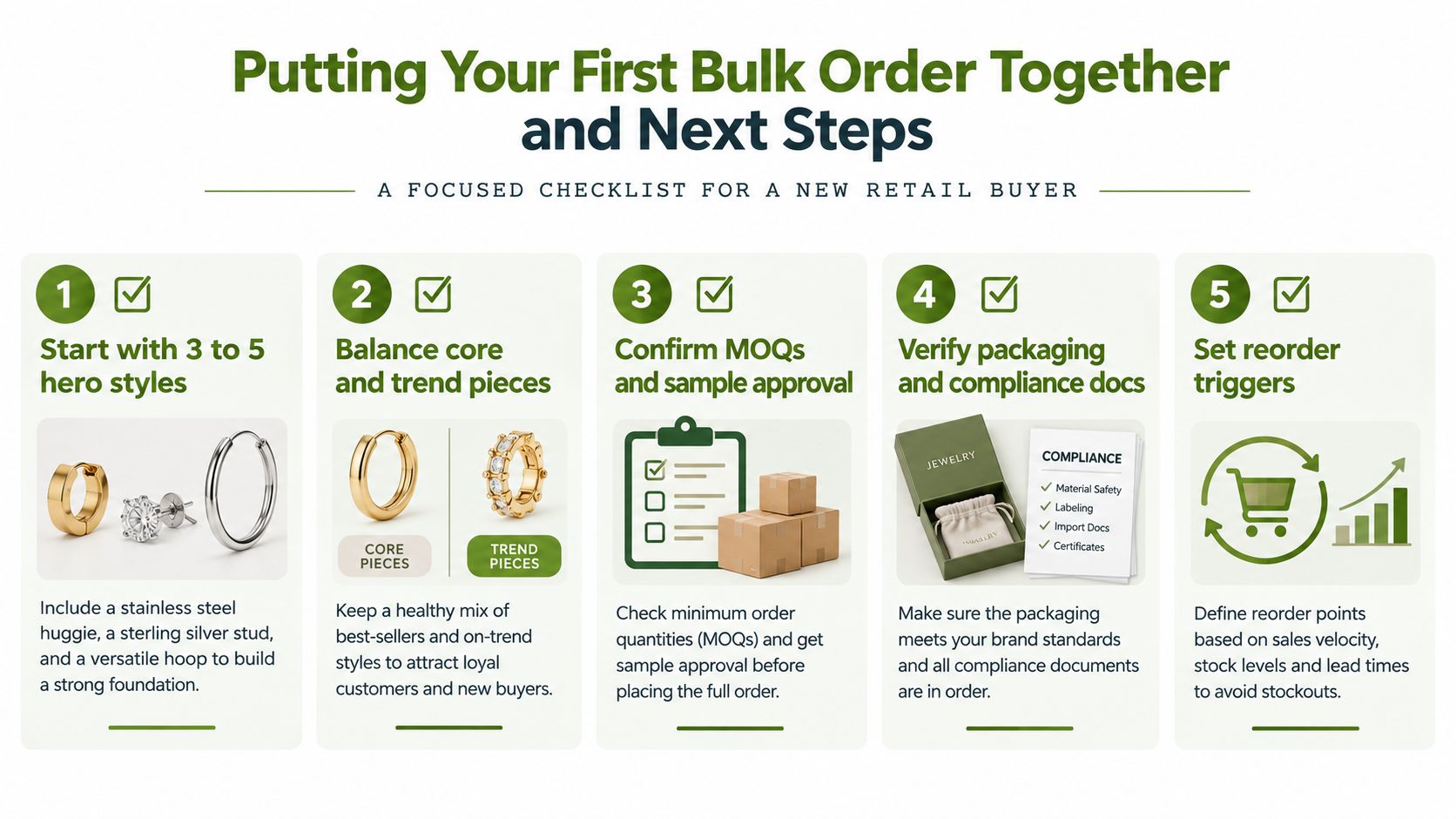
- Assign each SKU a role: core evidence, controlled test or range coverage.
- State base metal, component materials, finish, dimensions, pair weight and closure.
- Identify the target market and the documents or tests required for that market.
- Approve the complete pair, packaging and labeling against one dated reference.
- Compare landed cost on the same scope and set a reorder trigger before launch.
Use HonHo's wholesale ordering guide to organize the commercial steps. For a custom quotation, send the design or reference, target dimensions and pair weight, base metal, finish/color, post/back or closure, stone details, target market, quantity by style/color, packaging, test expectations and required delivery window.
HonHo Wholesale Jewelry supplies ready-stock and custom jewelry in stainless steel, brass and 925 sterling silver. Ask for a SKU-specific specification or custom-development quotation rather than assuming that a factory capability applies to every listed item.


