

For wholesale buyers, the safest way to source a gold multi-strand necklace is to treat it as two specifications at once: a material-and-finish claim, and a moving chain system. Approve the base metal and finish terminology first; then test the strand lengths, connector geometry, clasp load and high-friction contact points on the actual sample.
Extra strands add visual volume, but they also add rub points, moving joints and opportunities for uneven drape. The buying decision should answer two questions: can the retail copy describe the material precisely, and will the necklace keep an intentional shape through normal wear, handling and pack-out? This guide turns those questions into a sourcing brief and sample-approval record.
Buyer decision at a glance
| Decision | Approve when | Clarify or reject when |
|---|---|---|
| Material claim | Base metal, finish process and any karat claim are documented separately | “Gold” describes color but the substrate or coating is missing |
| Layering performance | Strand spacing, pendant balance and clasp routing remain stable in a recorded movement check | The sample looks correct only when arranged by hand on a static display |
| Finish evidence | The report identifies the sample, method, measurement locations and acceptance criteria | A generic test name or supplier capability is presented as proof for the SKU |
| Bulk approval | The signed sample record includes dimensions, color reference, assembly and packaging | The purchase order relies on a photo or verbal description alone |
Table of Contents
- What Gold Means in Multi-Strand Necklaces
- Comparing Materials for Durability and Margins
- Understanding Plating Thickness and Wear
- Design Strategies to Prevent Tangling
- The Importance of Accurate Terminology
- Historical Context of Multi-Strand Construction
- Sampling and Quality Control Checklist
What Gold Means in Multi-Strand Necklaces
In wholesale jewelry, gold may describe the metal itself or only the visible surface. Those are very different products, with different costs, durability expectations, retail positioning, and disclosure requirements.
A solid-gold item is gold alloy throughout, with hollow construction disclosed separately when relevant. Gold-filled describes a mechanically bonded gold-alloy layer over a base metal; it is not simply a thicker electroplate. Vermeil is gold over sterling silver and is a regulated term in some markets. Gold-plated states that gold is present as a surface layer, while gold-tone describes appearance without establishing gold content. These terms are not interchangeable, and the destination market's rules still govern the final label.
The U.S. Federal Trade Commission advises that an unqualified use of “gold” can mislead customers when an item isn't made throughout from gold or gold alloy. Its guidance also distinguishes “gold electroplate,” which describes an electrolytically applied layer of at least 10-karat gold with a minimum thickness equivalent to 0.175 microns of fine gold. See the FTC jewelry terminology guidance before approving packaging or marketplace copy.
Read the specification, not the color
For most fashion wholesale assortments, a gold-finish multi-strand necklace uses a base metal such as brass, stainless steel, or 925 sterling silver. The gold appearance is a finish applied to that base. That construction can be commercially sound, but customers need an accurate description so they understand what they're buying.
Ask suppliers to state:
- Base metal: Brass, stainless steel, or 925 sterling silver.
- Surface treatment: Gold plated, gold electroplated, vermeil, gold-filled, or another documented finish.
- Karat information: Whether the stated karat applies to the coating or the entire article.
- Plating thickness: The nominal thickness in microns, where available.
- Construction details: Clasp, connector rings, soldering, and whether strands are fixed together or separately adjustable.
This information affects more than compliance. A gold-plated brass necklace may fit an accessible fashion assortment, while a gold-finished sterling silver piece can support a more premium retail story. A stainless steel version may suit customers who prioritize daily wear and low-maintenance care.
For an expanded explanation of how surface finishes affect wholesale positioning, review HonHo's guide to gold-plated wholesale jewelry. The practical rule is simple: sell the design clearly, but describe the material precisely.
Comparing Materials for Durability and Margins
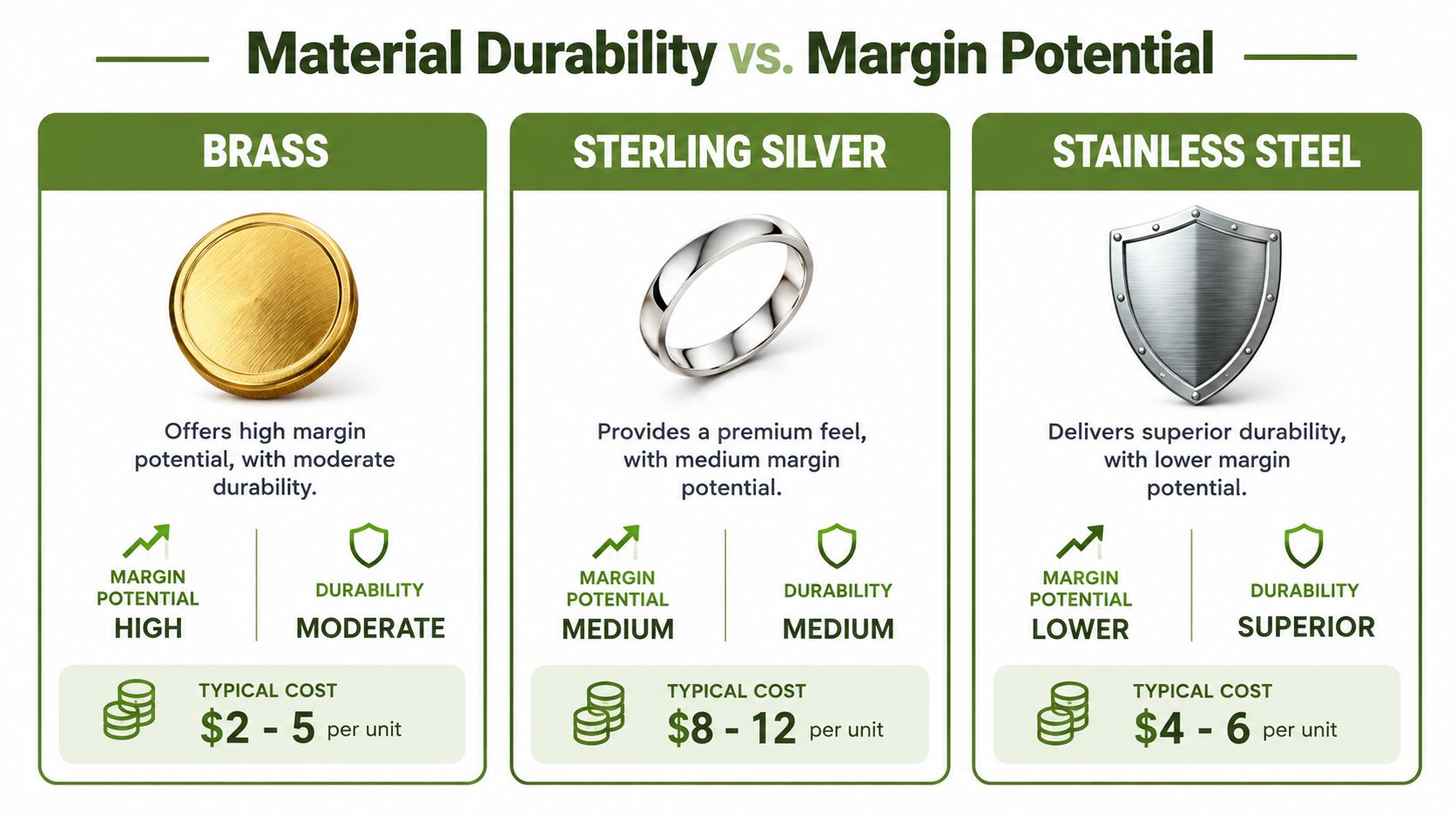
The base metal affects weight, forming options, corrosion behavior and the way a finish is prepared, but it does not determine the final performance by itself. Compare a documented construction, not three material names in isolation.
| Base-material route | Useful when | Ask the supplier to verify | Do not assume |
|---|---|---|---|
| Brass | The assortment is fashion-led and needs broad design flexibility | Alloy, surface preparation, finish system and treatment of edges and junctions | That a warm color or heavier hand proves gold content or long wear |
| 925 sterling silver | The silver substrate is part of the value proposition | 925 claim, any intermediate layer, gold finish and applicable vermeil requirements | That a precious-metal base prevents plating wear at moving contacts |
| Stainless steel | The design and target price suit a steel construction | Grade, finish process, color standard, joining method and component compatibility | That “steel” means 316L, or that every gold-colored steel item uses PVD |
Brass
Brass can support detailed forming and a wide range of fashion-jewelry constructions. Approve it by alloy, surface preparation and finish system—not by color or weight. On a multi-strand sample, inspect exposed cut ends, soldered terminals, jump rings and the inner faces of connectors, because these locations may behave differently from broad decorative surfaces.
For retail copy, identify the brass substrate and the documented gold finish. Care language should come from the approved construction and intended use, not from a generic assumption that every brass item needs the same warning.
925 sterling silver
Sterling silver is relevant when the silver substrate is part of the product promise. A gold-over-silver construction may qualify for a regulated description such as vermeil only when the applicable composition and coating requirements are met. The silver base does not remove the need to inspect strand friction, plating continuity, soldered areas and clasp quality.
Use this route when the customer values the precious-metal foundation and the documentation supports it. Price and merchandising should still distinguish a gold-finished silver piece from solid-gold jewelry.
Stainless steel
Stainless steel can be a strong option when the chain geometry, joining method and target price suit it. Require the grade and finish process to be stated separately: “stainless steel” does not by itself mean 316L, and a gold-colored steel necklace is not automatically PVD-coated.
Material selection also shapes customer expectations. A shopper expecting a precious-metal substrate may object to plated steel, while another may prefer steel for a practical fashion purchase. The correct choice depends on the documented SKU and the promise made at retail. For care expectations and finish longevity, use this guide to how long gold plating lasts as part of your buying review.
Understanding Plating Thickness and Wear
Multi-strand construction multiplies friction. Strands touch one another, links articulate repeatedly, and connectors experience movement from both the chain and the customer's clothing. A finish that appears even on a static sample may wear differently at crossing points, clasps, outer links, and junction rings.
The FTC's jewelry guidance states that gold-electroplated items may use gold or gold alloy of at least 10 karats with a minimum overall thickness equivalent to 0.175 microns of fine gold. The agency also notes that thickness doesn't need to be uniform because different surfaces experience different levels of wear. That distinction matters for a necklace whose highest-friction areas aren't necessarily its largest visible surfaces.
Request a usable plating specification
Don't accept “gold tone” or “gold plated” as the complete technical description. Ask for a specification that separates appearance from construction:
- Confirm the karat. Establish whether it describes the gold layer or the entire article.
- Request nominal thickness. Ask for the plating thickness in microns and whether it applies uniformly or varies by component.
- Identify the substrate. Confirm whether the base is brass, stainless steel, or 925 sterling silver.
- Map high-contact parts. Ask how the supplier treats outer links, clasp components, connector rings, and strand junctions.
- Clarify the finish process. Determine whether the item uses flash plating, standard electroplating, a heavier deposit, or another surface process.
- Review test evidence. Record the tested sample, method, instrument or laboratory, measurement locations, sample count and acceptance criteria. A named test without those details is not batch evidence.
“Flash,” “electroplated” and “PVD” describe different process routes, not guaranteed service life. Require the process and measurable specification for the approved SKU. If a supplier provides XRF, abrasion, adhesion or corrosion results, treat each result as evidence for the tested sample and protocol only; do not convert a laboratory reading into a universal number of months or years of wear.
| Evidence | What it can answer | What it cannot prove alone |
|---|---|---|
| Coating measurement | Reported composition or thickness at stated locations | Uniform coverage on every moving component |
| Adhesion or abrasion test | Performance under the named method and cycles | Customer wear time across climates and care habits |
| Corrosion test | Response under the stated exposure and evaluation rule | Tangle resistance, clasp security or real-life longevity |
| Movement sample check | Drape, migration and contact points for the approved design | Production consistency without a matching bulk inspection plan |
Practical rule: Ask suppliers to evaluate the places where strands touch, not only the broad visible faces of the necklace.
Research on bulk gold-alloy wear is not proof of coating life for a supplied necklace. For a multi-strand design, the production brief should instead define link-wire diameter, connector geometry, solder or weld method, finish process, measurement locations and any proof-load or movement check. If the supplier shares a report, match its sample, components and acceptance criteria to the SKU being approved.
A finish can be attractive at launch and still perform poorly if the underlying links deform or the coating abrades at moving interfaces. HonHo's information on gold PVD coating can help buyers frame finish conversations, but supplier-specific documentation remains essential.
Design Strategies to Prevent Tangling
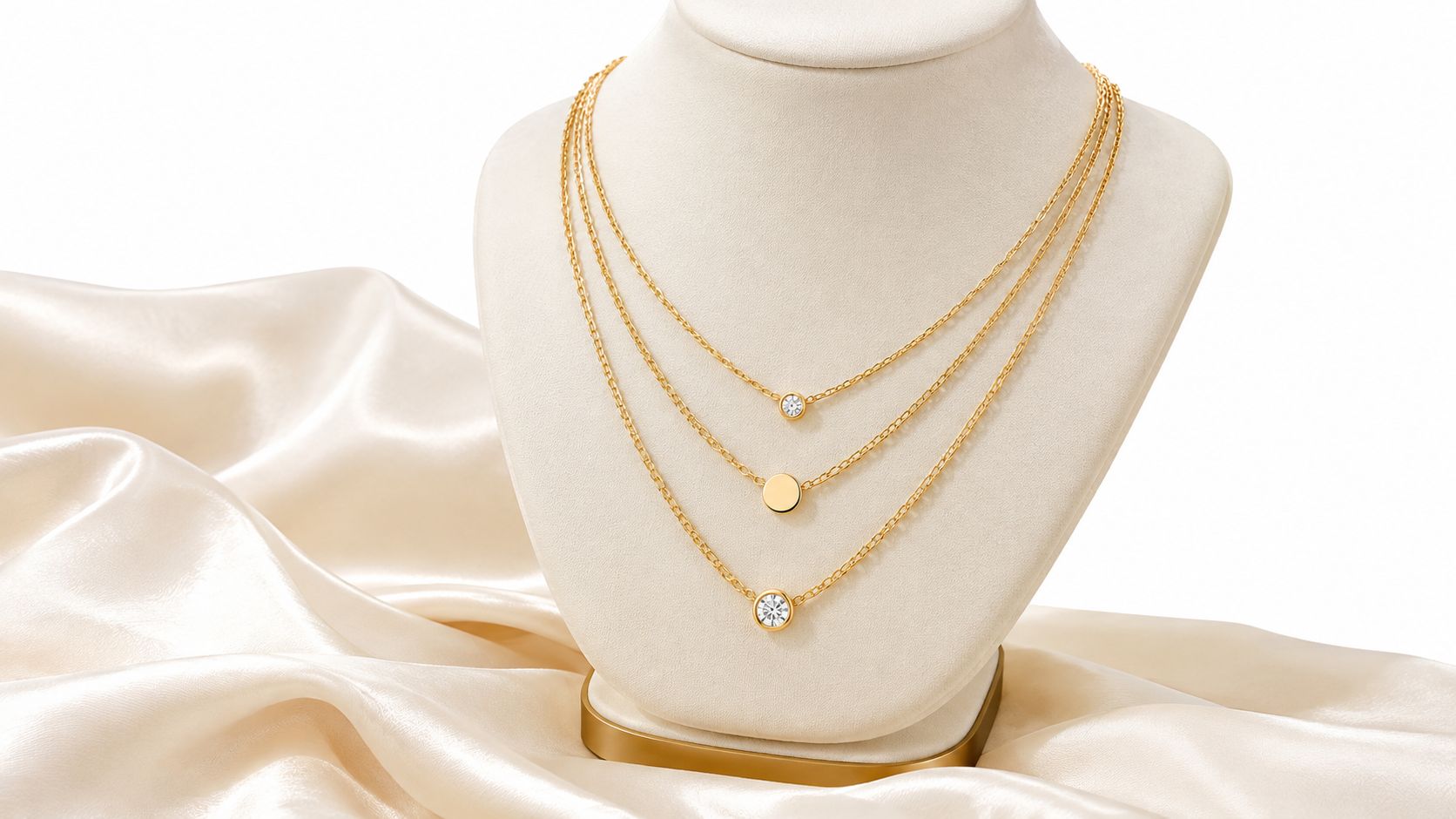
How a multi-strand gold-finish necklace moves matters as much as how it looks on a display bust. Tangling can create uneven drape, twist pendants out of position, concentrate weight on one strand, and make the clasp difficult to operate. A design that appears separated in-store may behave differently while walking, sitting, or rubbing against a collar.
Design choices that influence movement
Different strand lengths create visual separation, but the spacing must match the chain gauge and pendant weight. Small differences may disappear during movement, allowing strands to cross. Large differences can make the layers look disconnected rather than deliberately arranged. For a closer look at how length and arrangement affect movement, see this long multi-strand necklace guidance.
Spacer bars and fixed junctions can hold strands in position, reducing crossover near the neckline. They also introduce contact points where chains may rub. Check each junction for smooth edges, secure soldering, and consistent spacing. A poorly finished bar can accelerate wear on a gold finish while increasing snagging.
Chain gauge affects drape, tension, and load distribution. A fine chain may wrap around a heavier pendant or adjacent strand. A rigid mix of gauges may resist tangling but sit unnaturally across the neckline. Match strand weight to pendant mass instead of selecting every chain for appearance alone.
Clasp architecture affects both handling and stress. One clasp keeps the retail experience simple, yet it can route too much tension through one connector. Separate clasps improve adjustment between layers, although customers may find them slower to fasten. The right choice depends on the intended price point and how much adjustment the product needs.
Test samples under movement
The practical question is whether the necklace stays wearable during normal activity. Use the same protocol for every sample:
- Walk test: Photograph the necklace before and after walking, then compare strand separation and pendant orientation.
- Seated test: Check whether the strands migrate when the wearer sits or bends forward.
- Neckline test: Try smooth fabric and a higher collar to identify friction and snagging.
- Clasp review: Check whether one strand carries more load than the others.
- Repeated handling: Open and close the clasp, reposition the strands, and inspect connector rings for distortion.
- Adjustment check: Confirm that the wearer can change the length without creating an unstable drape.
- Pack-out check: Place the necklace in the intended card, insert or pouch; repeat the agreed handling or transit simulation and record knots, scuffs and reset time.
Varying lengths, adding spacers, separating clasps, and combining light and heavy chains can improve movement, but none should pass on appearance alone. The 2025 layering discussion in Uno de 50's necklace layering guide provides styling context, not proof that a construction will resist tangling.
For wholesale approval, record the strand-length differential, chain gauge, pendant mass, clasp position, and movement-test result. Keep those details with the sample record. They help the product team approve consistently and give customer service practical answers before poor drape or difficult fastening becomes a return. A necklace that works only on a static display can create avoidable support costs after launch.
The Importance of Accurate Terminology
A product title can create a material promise before a customer sees a single specification. Calling a plated brass necklace “gold jewelry” without qualification may lead shoppers to infer solid-gold construction, especially when the listing omits the base metal.
The FTC advises sellers to distinguish solid gold from surface treatments and to identify the construction clearly. Its consumer guidance explains that a karat mark expresses gold purity out of 24 parts, so an 18K item contains 18 parts gold and six parts other metal. It also advises consumers to look for a company name or registered trademark near the karat mark, identifying the party standing behind the stated quality. Review the FTC consumer guidance on buying gold jewelry when checking supplier marks and retail copy.
Build product pages from verified fields
Use language that tells the customer exactly what the necklace is:
| Less precise wording | More useful wording |
|---|---|
| Gold necklace | Gold-plated brass multi-strand necklace |
| 18K gold chain | Gold-plated chain with 18K plating, if documented |
| Tarnish-proof gold jewelry | Gold-plated stainless steel, with care guidance |
| Premium gold layers | Multi-strand fashion necklace with a documented gold finish |
A clear listing should include the necklace length, extension chain where applicable, number of strands, pendant dimensions, base material, finish description, and care instructions. If a supplier hasn't confirmed a karat, don't add one to improve the title.
This precision protects more than regulatory compliance. It reduces marketplace disputes, helps staff explain value, and gives customers a fair basis for comparing a fashion necklace with a sterling silver or solid-gold alternative. A boutique can still merchandise a plated style as elegant, giftable, and visually substantial without implying that its main material is precious metal.
Online shoppers cannot inspect strand separation, clasp construction, scale or surface finish in person. The U.S. Census Bureau's retail e-commerce report provides broad channel context, but it does not predict demand for this necklace. The useful procurement conclusion is narrower: verified technical product information is part of merchandising, not an afterthought.
Historical Context of Multi-Strand Construction
Multi-strand gold jewelry isn't a modern layering invention. The Metropolitan Museum of Art records an Etruscan gold necklace dated to the 4th to 3rd century BCE or later, built from linked chain ropes.
The Metropolitan Museum of Art collection record describes five cords, each composed of eight strands, joined into one rope with transverse threads. Cylindrical clasps were attached with bronze pins and decorated with filigree. That is 40 individual strands grouped into five cords—a useful reminder that strand grouping and terminal construction are separate specification decisions.
What the historical design teaches current buyers
Ancient goldsmiths used repeated strands to create more visual volume, establish a structured rope-like form, and support detailed surface ornament. Those same principles remain useful when assessing modern multi-strand assortments:
- Repeated strands create scale: Several fine chains can produce a fuller appearance without relying on one heavy central chain.
- Connections shape performance: Transverse threads, clasps, and junctions aren't decorative afterthoughts. They control how the structure holds together.
- Surface detail adds perceived value: Filigree-inspired elements, textured links, and considered clasp design can give a layered necklace a more developed visual story.
- Strand count can define the product: The number and grouping of strands influence both appearance and engineering, so they belong in the product specification.
The historical example doesn't prove that every contemporary necklace will be durable. It does show that multi-strand construction has long combined volume, structure, and ornament. For a boutique, that supports a product narrative centered on design lineage rather than a temporary styling cycle.
Use that story carefully. Don't imply that a modern gold-plated fashion necklace is an ancient gold artifact. Instead, explain that contemporary designers continue to work with an established visual language of repeated strands, connected forms, decorative clasps, and layered surface detail.
Sampling and Quality Control Checklist
Approve the sample against a written record that can also guide the bulk inspection:
| Approval block | Record | Pass question |
|---|---|---|
| Material and finish | Base metal, grade or fineness, process, color reference and declared thickness where applicable | Does every retail claim match the supporting document? |
| Geometry | Each strand length, spacing, gauge, pendant position and extension range | Are measurements within the signed tolerance? |
| Movement | Neckline, test duration or cycles, before/after photos and any crossing or migration | Does the drape remain intentional without repeated hand-setting? |
| Assembly | Connector alignment, jump-ring closure, clasp action, solder or weld appearance and sharp-edge check | Do all load paths and touch points remain secure and smooth? |
| Packaging | Card or insert, tie points, protective layers and unpack/reset result | Does pack-out limit tangling and finish-on-finish rubbing? |
| Bulk control | Golden sample ID, inspection level, defect classes and rework rule | Can the incoming inspector reproduce the approval decision? |
Use this jewelry sample approval checklist before committing inventory. A short approval process can identify finish, drape, and terminology problems before they become customer returns.
HonHo Wholesale Jewelry supports ready-to-buy and custom jewelry in stainless steel, brass and 925 sterling silver. For custom development, the current storefront states an MOQ from 50 pieces per style and color, with typical sample timing of 25–30 days for brass and 925 silver and 25–35 days for stainless steel. These are capability guidelines, not specifications or delivery commitments for every SKU; confirm the material route, sample scope and schedule in the project quotation.
Visit HonHo Wholesale Jewelry to review the assortment, or send a sourcing brief with the target market, base metal, finish, strand count, dimensions, quantity, packaging and evidence requirements.


