

There is no dependable calendar answer to how long gold-plated jewelry lasts. A thicker gold layer can improve wear resistance, but it cannot by itself predict months or years of use. The result also depends on the base metal, underlayers, surface preparation, product geometry, high-contact areas, moisture and chemical exposure, and how the piece is handled.
For a wholesale buyer, the useful question is not “Will this last two years?” It is: What finish was specified, where was it measured, and does the approved sample match the way customers will wear the product?
Gold-Plated Jewelry at a Glance
| Buyer question | Practical answer |
|---|---|
| Does thicker plating always last longer? | It generally provides more gold to wear through, but adhesion, porosity, underlayers, geometry and use conditions still matter. |
| Can microns be converted into years of wear? | No. A thickness reading is a coating measurement, not a wear-life guarantee. |
| Where does wear usually appear first? | High-contact points such as ring shanks, bracelet edges, clasp areas, chain links and earring posts. |
| What should a buyer request? | Base metal, gold fineness/color, coating route, target thickness and measurement basis, underlayers or sealer, test method, measurement locations and an approved sample. |
Table of Contents
- How Long Gold Plated Jewelry Really Lasts
- What Gold Plated Means and How Thickness Is Measured
- Gold Plating Thickness and Realistic Lifespan by Microns
- How Long Gold Plating Lasts by Jewelry Type
- What Makes Gold Plating Fade Faster
- How to Make Gold Plated Jewelry Last Longer
- Choosing Gold Plated Jewelry for Resale and Wholesale Buying
How Long Gold Plated Jewelry Really Lasts
Gold-plated jewelry can remain attractive for very different lengths of time. Two pieces with the same stated thickness may age differently because one is a low-contact pendant and the other is a ring shank that rubs against skin, work surfaces and hard objects every day.
Commercial jewelry articles often publish broad lifespan estimates, including the JewelTrendPro lifespan guide. These ranges may help explain relative wear, but they are not an industry standard, a laboratory result for a particular SKU or a warranty. The same caution applies when a wear-pattern guide compares categories: the useful lesson is that contact conditions differ, not that every ring or earring will reach the same age.
The real buying lesson
Wear is usually local rather than perfectly even. Ring shanks, bracelet edges, clasp points and moving chain links tend to change first because they see repeated contact; the durability overview offers a general discussion of that relationship. In practice, buyers should inspect those zones on the finished sample instead of judging durability from the front view alone.
Better buying rule: specify the finish, record the measurement locations and approve the completed sample. Do not turn a micron value into a promised number of months.
This distinction also improves customer-facing language. “Designed for occasional wear” or “remove before swimming and applying cosmetics” is more useful and defensible than an unsupported claim that a finish will last a fixed number of years.
What Gold Plated Means and How Thickness Is Measured
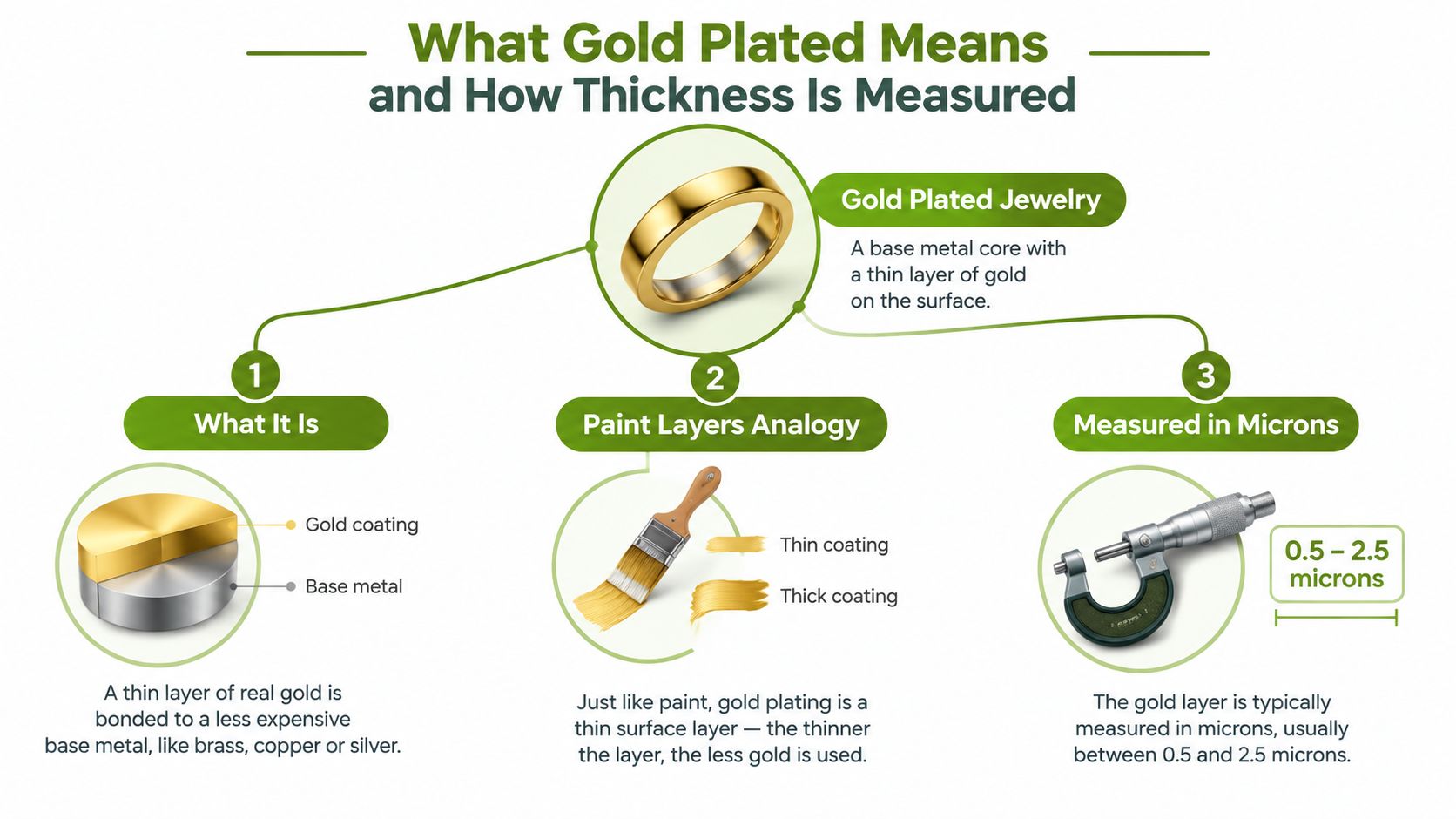
Gold-plated jewelry has a base material covered by a gold or gold-alloy layer. The description should not hide the base metal, the fineness of the applied gold, the coating method or a material difference that would affect the buying decision. Market-specific labeling rules also matter: terminology that is acceptable in one country may carry a defined meaning in another.
Microns are the number that matters
A micron, or micrometre, is one thousandth of a millimetre. It is a practical unit for coating thickness, but the number needs context. Ask whether the supplier is stating the actual gold-alloy layer or an equivalent fine-gold thickness, and whether the figure is a target, a minimum or a measured result.
Some commercial descriptions divide finishes into flash, standard and heavy categories, as shown in this thickness breakdown. Treat those labels as a starting vocabulary, not universal specifications. In the United States, the FTC Jewelry Guides set specific conditions for representations such as “gold electroplate” and “heavy gold electroplate,” including a 2.5-micrometre equivalent-fine-gold threshold for the latter. They also recognize that different surfaces can experience different wear. See 16 CFR §23.3.
For production approval, X-ray fluorescence can measure coating thickness without cutting the piece. The result still depends on the coating system, calibration or reference model, measuring spot and instrument setup. Record those details so the next sample or reorder can be compared on the same basis.
Why microinches still show up in specs
Some suppliers express coating thickness in microinches. One micron is approximately 39.37 microinches, so the units can be converted; the underlying requirement should not change. A plating durability guidance page may use thresholds differently, which is exactly why purchase specifications should state both the unit and the measurement basis rather than relying on “standard” or “heavy” alone.
For related finish terminology and sample discussions, use HonHo Jewelry Wholesale's plating finish guide. The exact route should still be confirmed for the particular SKU; a custom capability is not automatically the specification of every ready-stock item.
Gold Plating Thickness and Realistic Lifespan by Microns
Thickness affects how much coating must wear before the underlying layer becomes visible, but it does not create a universal lifespan. A useful specification connects the number to the substrate, underlayer, top protection, product category, wear zones and verification method.
| Specification item | Why it matters | What to record |
|---|---|---|
| Base metal | Surface preparation and the appearance after wear depend on the substrate. | Stainless steel grade, brass or 925 sterling silver, as applicable. |
| Gold layer | Fineness, color and thickness are separate variables. | Karat/fineness, color reference, target or minimum thickness, and whether the value is actual or equivalent fine gold. |
| Underlayer or sealer | These layers can affect adhesion, color migration and exposure resistance. | Selected coating stack and any market restrictions. |
| Measurement plan | Curves, edges, recesses and contact points may not read alike. | Instrument, calibration/reference method, spots measured, sample ID and result units. |
The gold plating lifespan breakdown and a separate replating guide give commercial estimates for different thicknesses. Keep their numbers in perspective: they do not control for every substrate, geometry, process, care routine or wear environment, so they should not be copied into a product warranty.
What buyers should pay for
Pay for a finish specification that matches the product's job. A high-contact ring or bracelet normally deserves closer attention to wear zones than a pendant or earring. If color consistency across a collection matters, approve the gold-color reference under controlled lighting as well as the thickness; “18K color” describes an appearance target and does not, by itself, state thickness or durability.
Gold vermeil needs a separate labeling check. The linked vermeil threshold explains the familiar 2.5-micron figure. For the US market, the legal definition also requires a sterling-silver base, gold of at least 10 karat on all significant surfaces and a minimum thickness equivalent to 2.5 micrometres of fine gold. See 16 CFR §23.4.
HonHo Jewelry Wholesale's plating finish guide can help frame the supplier discussion. The purchase order and approved sample should carry the project-specific requirements.
How Long Gold Plating Lasts by Jewelry Type
Product type changes the exposure pattern. The goal is not to assign a fixed life to every category, but to identify where friction, movement, moisture and handling concentrate before the order is approved.
Why rings and bracelets wear out sooner
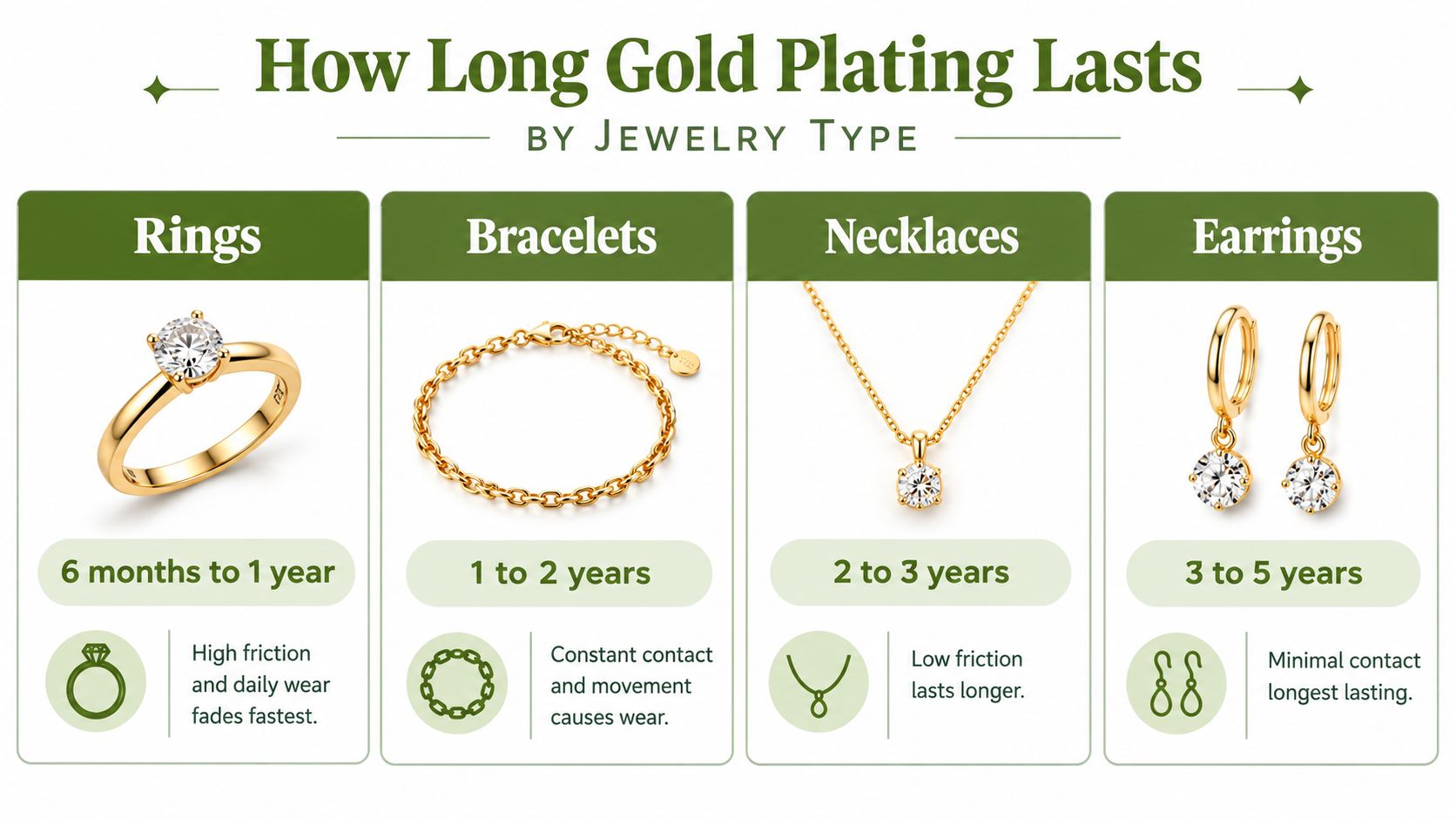
A commercial fade timeline guide assigns estimated ranges to rings, bracelets, chains, earrings and pendants. The underlying ranking can be useful: rings and bracelets usually encounter more abrasion and repeated wetting than earrings. The exact timelines in the graphic and guide remain illustrative, not verified performance for a HonHo SKU or any other specific product.
The same fade timeline guide and its durability summary publish longer estimates for heavier coatings and lightly handled decorative pieces. Use them as consumer education, not as a conversion formula from microns to years. If durability matters to a program, agree on the test conditions and acceptance criteria before sampling.
Category by category, the wear story changes
- Rings: Check the inside and outside of the shank, prong shoulders and edges. These zones combine hand contact, impact and frequent washing.
- Bracelets: Inspect the clasp, end links, underside and projecting details that touch desks, sleeves or skin.
- Necklaces: Look at chain articulation, jump rings, clasp components and the back of the pendant rather than only the front face.
- Earrings: Check posts, hinges, friction backs and areas handled during insertion and removal.
A wear-point guide gives a numerical example for early exposure at clasp edges, ring shanks and posts. The more reliable takeaway is the location: request readings at representative flat areas and inspect high-wear zones during sample approval. A single convenient XRF spot cannot describe the entire piece.
What Makes Gold Plating Fade Faster
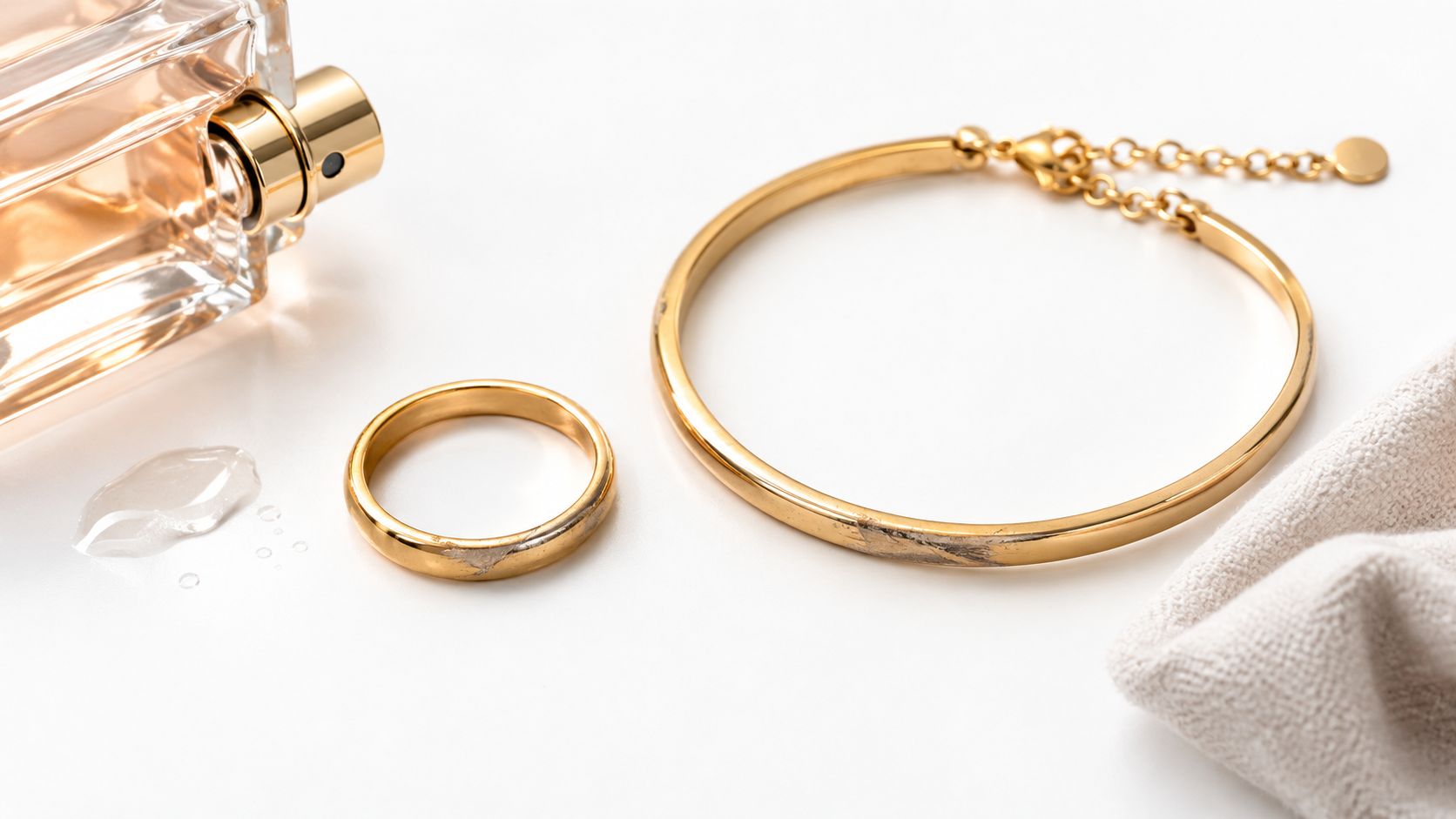
Gold plating changes through a combination of abrasion, adhesion loss, porosity, chemical exposure and wear of the layers beneath or above the gold. Time alone is not the mechanism. This is why two customers can report different results from the same style.
The damage usually starts where people touch the piece most
Edges, bends, catches and moving joints deserve attention. Polishing and cleaning before plating are also important because a coating follows the surface beneath it; a bright finish cannot correct every pit, scratch or poorly prepared solder area. Review the assembled sample, not only a loose component or drawing.
Chemical exposure matters more than most customers think
Sweat, perfume, lotion, cleaning products, chlorinated water and salt water create different exposure conditions. The wear-off guide notes that visible change can appear quickly on thin coatings and high-contact zones. That is plausible as a scenario, but it is not a prediction for every wearer or finish.
For retailers: describe the intended use and care conditions clearly. “Waterproof” or “never fades” should not replace a documented finish specification and an appropriate test plan.
HonHo Jewelry Wholesale's jewelry care guide provides customer-facing care points. Keep them consistent with the particular material and coating route supplied.
How to Make Gold Plated Jewelry Last Longer
Care cannot repair weak adhesion or an incorrect specification, but it can reduce avoidable abrasion and chemical exposure after purchase.
Care habits that actually change outcomes
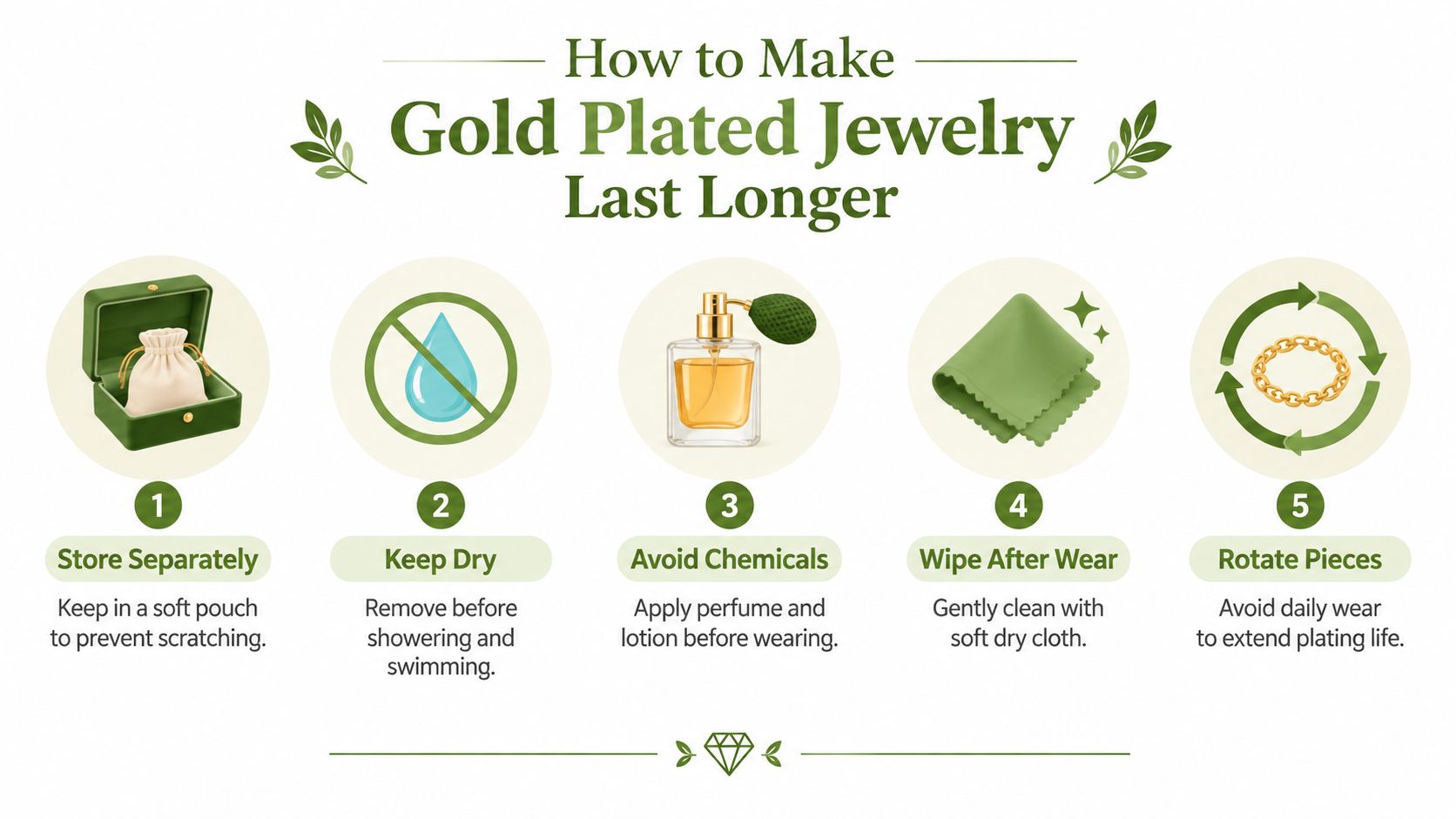
- Store pieces separately: A soft pouch or divided box reduces rubbing against harder jewelry.
- Remove jewelry for wet or high-friction activities: Showering, swimming, exercise and manual work add moisture, chemicals or abrasion.
- Apply cosmetics first: Let perfume, lotion and hair products dry before putting jewelry on.
- Wipe gently after wear: Use a clean, soft, dry cloth; avoid aggressive compounds unless the supplier has approved them for the finish.
- Rotate high-contact pieces: A ring or bracelet worn continuously will accumulate more wear than one used occasionally.
These instructions should appear on the product page, care card and customer-service script. Consistent expectations are part of product quality, especially when an assortment combines different base metals or coating routes.
Replating and replacement need different expectations
Replating may make sense for a valued design with a sound base. Replacement may be more practical for a low-cost trend item once preparation, shipping and service labor are considered. Before promising replating, confirm that stones, adhesives, solder joints and other components can tolerate the stripping, cleaning and recoating route.
For a comparison with a different deposition route, HonHo Jewelry Wholesale's gold PVD coating guide explains why PVD terminology, layer structure and testing must be specified separately. PVD performance should not be assumed from an electroplating thickness—or vice versa.
Choosing Gold Plated Jewelry for Resale and Wholesale Buying
Start with the intended wearer, price tier and contact pattern. Then set a finish route that can be sampled, measured and repeated. This is more dependable than asking a supplier for the “best” plating without defining what success means.
Base metal matters as much as the finish
Gold plating can be developed over stainless steel, brass or 925 sterling silver, but the preparation and coating stack are not interchangeable. The substrate affects forming, soldering or welding, polishing, adhesion planning, weight, cost and what becomes visible if the surface eventually wears.
For US-facing vermeil claims, sterling silver is not optional; it is part of the definition. For other plated products, identify the actual base metal rather than letting “gold plated” stand in for a complete material description.
Do not approve the color alone. Record the base metal, finish stack, gold-color reference, target thickness and measurement plan on the sample record.
A practical assortment strategy
Use the same decision sequence for each category:
- Define the target customer, market and expected wear.
- Identify high-contact and difficult-to-measure areas on the design.
- Select the base metal and coating route for the intended price and use.
- Specify the color, fineness, thickness basis, underlayers or sealer, and any testing requirement.
- Approve the finished, assembled sample and record measurement locations.
- Use the same reference sample and method when checking production or reorders.
If you are developing a private-label finish, HonHo Jewelry Wholesale's custom plating page is the next step for discussing project options. Available routes and specifications must be confirmed for the selected design and material.
Questions to Send with a Gold-Plated Jewelry Inquiry
To make a plating quotation comparable, send:
- front, back and side references or a CAD file;
- product category, dimensions and intended wear;
- preferred base metal;
- target gold color and karat/fineness description;
- target market and labeling requirements;
- requested thickness and whether it is a target or minimum;
- expected exposure, test method and acceptance criteria;
- order quantity, packaging requirements and approval timeline.
Browse HonHo Wholesale Jewelry for current categories, or use those details to start a project-specific finish discussion.
Frequently Asked Questions
How many years does gold-plated jewelry last?
There is no universal number. Thickness matters, but so do the base metal, coating stack, preparation, geometry, contact points, chemicals, moisture and wearing frequency. A supplier should not convert one micron value into a guaranteed number of years without a defined product and test basis.
Is 2.5-micron gold plating permanent?
No. A thicker layer provides more material to wear through, but it can still change with abrasion or chemical exposure. In US terminology, 2.5 micrometres is relevant to defined “heavy gold electroplate” and vermeil representations; it is not a lifetime guarantee.
How should gold-plating thickness be verified?
XRF is commonly used for non-destructive coating-thickness measurement. The report should identify the coating system, instrument or method, calibration/reference approach, units, sample ID and measuring spots. ISO 3497 covers X-ray spectrometric methods for metallic coating thickness: ISO 3497. Instrument guidance also stresses the importance of the coating system, calibration model and measuring location: Helmut Fischer FAQ.
Does “18K gold plated” tell me the thickness?
No. “18K” describes the fineness of the gold alloy used for the coating or a related representation; it does not state how thick the layer is. Ask for fineness, color reference and thickness as separate fields.
What should a wholesale buyer inspect first?
Check the finished sample at high-contact zones, edges, joints, recesses and moving parts. Compare color under consistent lighting, confirm the recorded measurement basis and keep an approved sample for production and reorder checks.


