

Long multi-strand necklaces are worth testing when the sample proves comfortable, keeps its layers separated, and gives shoppers a complete layered look in one SKU. Strand count alone is not enough. Before ordering, compare the construction, each strand's measured length, total finished weight, clasp and connector design, finish specification, and packing method.
For boutiques and Shopify stores, the real decision is whether a style earns its space after the buyer accounts for fit, handling, photography, returns risk, and reorder flexibility. This guide turns those checks into a practical sample and purchase-order process without relying on market-size forecasts or assuming one silhouette works for every customer.
Table of Contents
- Why Long Multi Strand Necklaces Deserve a Spot in Your Wholesale Mix
- What Actually Makes a Necklace a Multi Strand Design
- Standard Lengths and Spacing Rules for Layered Looks
- Material and Finish Choices That Hold Up at Retail
- Planning Your First Multi Strand SKU Assortment
- The Layering Trend Is Not One Trend
- Pre-Order Checklist for Wholesale Multi Strand Orders
- Bringing Your Multi Strand Assortment to Market
Why Long Multi Strand Necklaces Deserve a Spot in Your Wholesale Mix
A long multi strand necklace can solve a clear merchandising problem: it gives the shopper a coordinated layered look without requiring several separate purchases. That benefit is only real when the necklace stays comfortable, the layers remain readable on the body, and the price reflects the construction rather than strand count alone. Treat the first order as a controlled sample-led test.
The category works because it does the styling for the shopper
Multi-strand neckwear can add depth to flat lays and on-body shots, but only if the layers remain separated and the lowest strand is visible in the crop. One SKU can present a finished layered look without merchandising three separate products together. Photograph the actual sample on a neck form and a person before assuming the construction will read clearly online.
Practical rule: stock this category in two tracks, lightweight layering sets for everyday wear, and bolder statement strands for shoppers who want one obvious focal piece.
That split is the part buyers miss. Some customers want delicate stacked lines that feel easy and wearable. Others want a single long strand with enough visual weight to anchor a tee, a blouse, or tailoring. If you treat those as one audience, your order gets muddy fast.
For a new buyer, the right answer is usually a controlled test, not a big commitment. Put a small number of multi-strand options into the mix, then watch which ones get saved, clicked, and reordered. HonHo Jewelry Wholesale's ready-to-buy assortment makes that kind of test easier because you can source necklaces alongside other core categories like Earrings, Rings, and Bracelets without building your launch around one look.
What Actually Makes a Necklace a Multi Strand Design
A buyer needs to be precise here, because “multi-strand” can mean several different constructions. If you don't describe the build correctly, you'll get samples that look close but merchandize differently. That's how deadstock starts.
The build can change the way it sells
At the wholesale level, describe the construction before discussing styling. A fixed connector plate holds strands in set positions and usually gives a more controlled drape. An open connection at a shared ring or clasp moves more freely, but the strands may shift or cross during wear. A detachable layered set offers more styling options, yet it also adds closures and more points to inspect. No strand count is automatically the most sellable.
Clasp choice must be assessed with the necklace's finished weight and balance. A lobster clasp, spring ring, toggle, or magnetic closure can each be appropriate when correctly sized and assembled. Record the clasp dimensions, extension length, connector orientation, and total finished weight on the approved sample; changing any one of these can change how the necklace settles.
Buyer decision: choose controlled construction when consistent layer spacing matters; choose freer drape when movement is part of the design, then verify tangling and clasp balance on the physical sample.
Use working terms in supplier messages so there's no confusion:
- Graduated drop for strands that step down in length
- Uniform drop when the layers hang close together
- Clustered clasp for pieces that join at one point
- Drapey lariat for a separate vertical-drop silhouette; confirm whether it is combined with multiple strands
| Construction choice | Useful when | Sample risk to check |
|---|---|---|
| Fixed connector plate | You need repeatable layer spacing and a controlled silhouette | Plate rotation, sharp edges, and uneven pull |
| Open drape at a shared ring or clasp | Movement and a softer fall are part of the design | Crossing strands, tangling, and weight shifting |
| Detachable layered set | You want several styling combinations from one offer | Extra closures, mismatched lengths, and customer setup friction |
| Graduated fixed strands | Each layer should remain visible in product photography | Bottom-heavy balance and crowding near the neckline |
The wrong description can cost you a sample round. The right one gets you closer to the piece your customer will keep.
Standard Lengths and Spacing Rules for Layered Looks
Treat length as a fit specification, not just a style label. Common reference charts list lengths such as 16, 18, 20, 22, 24, 30, and 36 inches (TTT Jewelry), while layering guides often illustrate visible spacing between strands (Brilliant Earth). These are reference points, not a universal formula: body size, neckline, pendant weight, connector position, and chain thickness all change the final drape. Put the measured length of every strand and the measurement method into the PO.
Use the longest strand to define the silhouette
Start with the lowest strand because it defines the overall silhouette, then confirm the upper strands stay visibly separate on the intended wearer. A long strand may sometimes be styled in more than one way, but do not promise a doubled configuration until the clasp, pendant, connector, and total length of the actual sample support it. Use the common length labels as orientation only (TTT Jewelry).
“Matinee” is commonly used for a mid-length necklace range, but where it lands varies by wearer and construction (Jewelry Making Journal). Use the label to organize options, then approve the actual measurements and on-body position from the sample rather than assigning shelf space from the label alone.
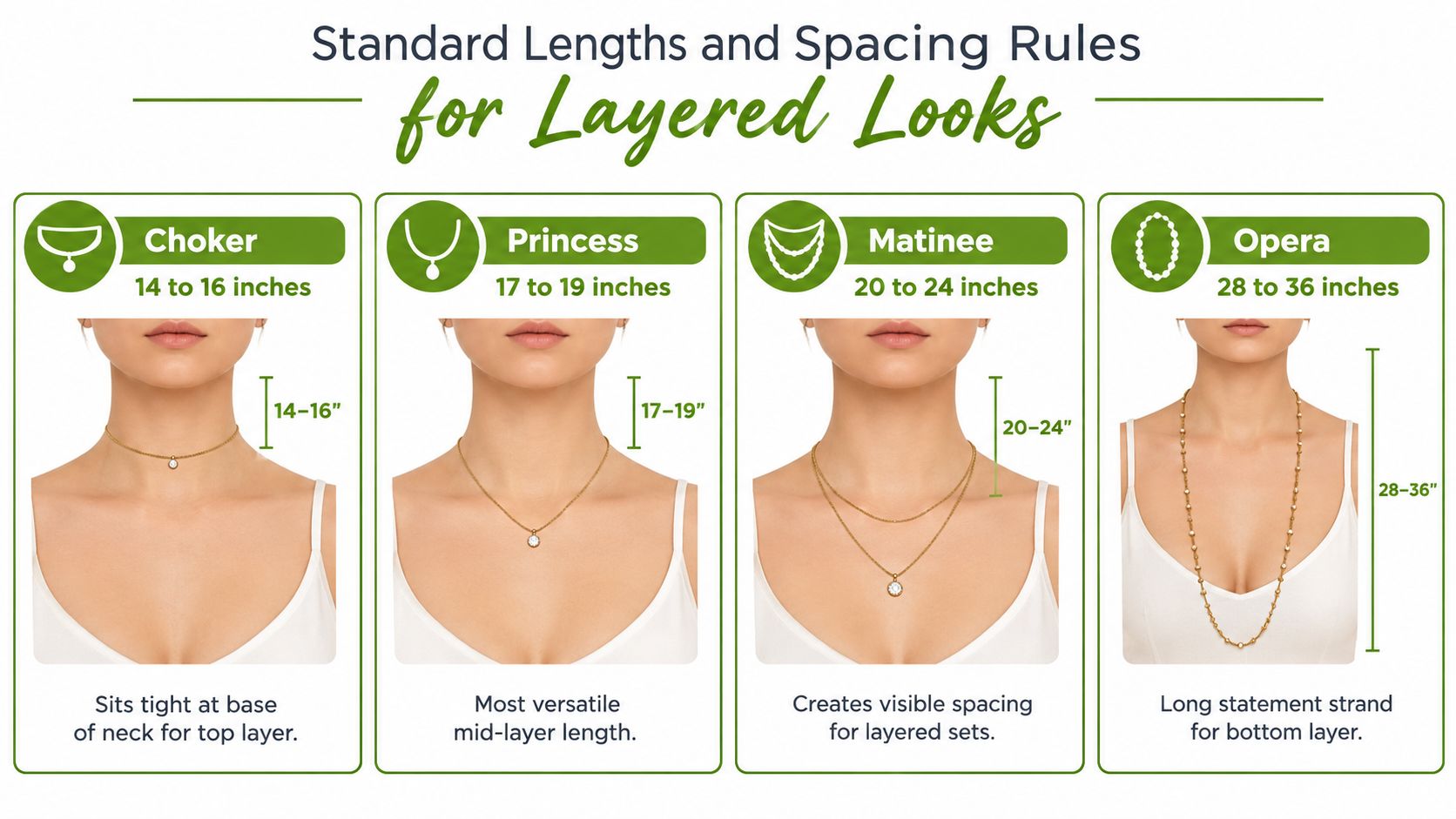
For a purchase order, spell it out plainly:
- Measurement method: state whether each length includes the clasp and connector
- Each strand: list its approved measurement, not only the longest drop
- Extension: record usable adjustment and the position of the end tag
- Spacing: approve the visible separation on the intended wearer or display form
Do not sell the piece as “layered” and stop there. Give the actual lengths, then decide whether the necklace reads delicate or bold on the body. A useful sizing reference is built into HonHo Jewelry Wholesale's jewelry size guide, which is worth keeping open while you finalize a sample order.
How do you choose the length of a lariat or Y necklace?
Measure the neck chain and the center drop separately. A Y silhouette can have a fixed junction, a front fastening or a sliding arrangement; its name alone does not tell you what adjusts. Ask whether the listed chain length includes the clasp, how much extension is usable, and where the drop starts. For a layered display, check the Y necklace beside the shorter strands on the same person or form so the center drop remains visible.
Check the lowest point against the intended neckline while sitting and moving, as well as standing. Record whether the chain crosses another strand, the junction shifts, or the drop catches on the garment. Keep those observations with the measurements. A photo of the necklace laid flat cannot establish where it will sit on every wearer.
Compare the wholesale lariat and Y necklace selection when a vertical drop would complement your layered assortment. The T-bar stainless steel lariats offer separately selectable fine-link and paperclip-link designs. Confirm the chain and drop dimensions for the option you choose; the product's two designs are individual selections, not a two-necklace set.
Material and Finish Choices That Hold Up at Retail
If you want long multi-strand necklaces to survive retail, stop choosing materials by vibe alone. Choose them by wear behavior, feel, and the price ceiling you're targeting. The right base material can make the same design look like a bargain, a mid-tier piece, or a premium add-on.
Pick the material that matches the customer, not your personal taste
Stainless steel, brass, and sterling silver are different sourcing routes, not quality grades by themselves. Compare the exact alloy or fineness claim, component construction, finished weight, surface treatment, color target, and care instructions for the specific SKU. A material that works for one multi-strand design may feel too heavy, too rigid, or too costly in another.
For plated pieces, ask which parts receive the specified finish, because chains, clasps, jump rings, connector plates, and pendants may use different components. Inspect high-contact areas on the approved sample and define acceptable color variation and surface defects in writing. HonHo's customization capability does not mean every ready-stock SKU uses the same base material, plating process, or test route; confirm the specification for each item and purchase order.
Buyer note: the more strands you add, the more important clasp strength and joint quality become. Pretty construction isn't enough if the piece feels awkward in hand.
For plating, keep the supplier conversation focused on the specified base material, color target, pretreatment, coating route, inspection method, and care expectations—not color alone. HonHo Jewelry Wholesale's gold PVD coating guide explains the questions to ask when comparing gold-tone finishes. A process described in that guide should not be treated as confirmation that a particular necklace or production batch uses it; verify the SKU and PO.
| Material route | Ask the supplier to specify | Sample limitation to check |
|---|---|---|
| Stainless steel | Alloy claim for each component, finish route, and finished weight | Rigidity, connector balance, edge finish, and color consistency |
| Brass | Base-metal composition, plating stack or finish route, and care guidance | Finish at joints, high-friction points, and soldered areas |
| Sterling silver | Fineness claim, component construction, finish, and hallmark requirements for the destination market | Tarnish expectations, weight, softness, and price fit |
One piece that fits the statement lane is the Gold Plated Stainless Steel Green Glass Link Necklace. It uses a cushion-shaped green glass accent in a softly irregular gold plated frame, on an elongated-link chain with a 40 cm plus 5 cm extender length and a supplier-listed weight of approximately 16.3 g. That's the kind of focused statement that helps a buyer see how stainless steel can sit inside a more polished retail story without overcomplicating the assortment.
Planning Your First Multi Strand SKU Assortment
A first order should answer a specific question without crowding the assortment. Choose the sample count from your budget, customer profile, sales channel, and existing necklace range; there is no universal SKU count or fixed layering-to-statement ratio. Give each test style a distinct role, such as lightweight everyday layering, a controlled graduated silhouette, or one stronger focal piece, so results are easier to interpret.
Start with the core colors and lengths
Build a test matrix around visibly different choices: finish family, construction, weight band, lowest-strand position, and focal element. Select only the combinations that match your customer's wardrobe and price architecture. This makes the sample review more informative than buying several near-duplicates in arbitrary length ranges.
Use product examples to study construction rather than to impose a universal size band. A ready-stock style like this triple-layer stainless steel necklace with an oval clear pendant shows a graduated silhouette; confirm its live product specification and approve the physical sample before using it as the standard for a broader assortment.
HonHo Jewelry Wholesale's ready-stock necklace assortment also makes it easier to pair these with related pieces, including necklaces and the broader buying guides you should use before scaling.
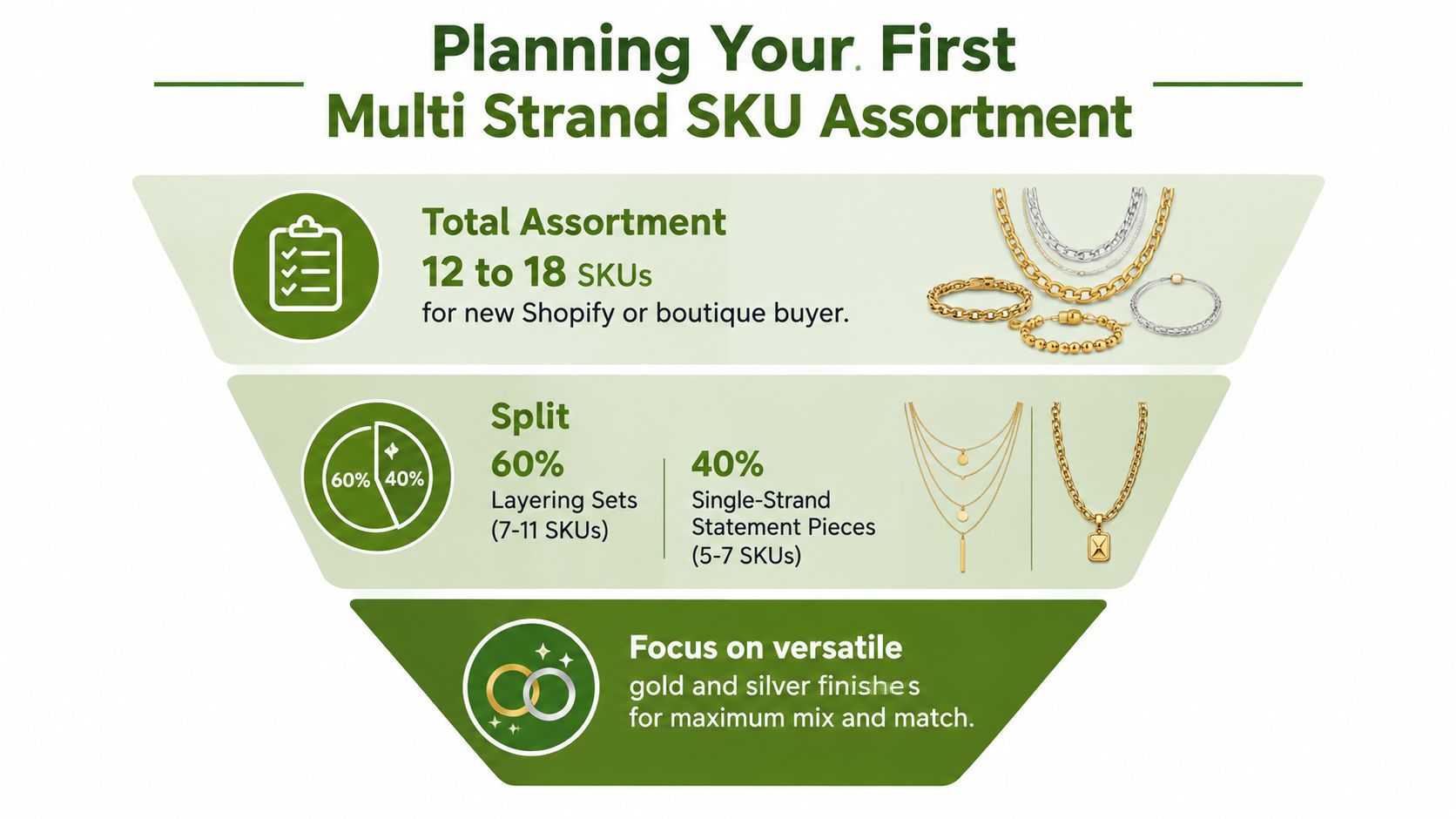
Don't crowd the assortment with nearly identical layered styles. Two listings that differ only by a tiny charm or a slightly longer drop may leave buyers unsure which to choose. Explain the practical difference before carrying both. Build around distinct silhouettes, then let color and finish do the rest.
I'd also coordinate necklace weight with your earring and bracelet range. A chunky long strand looks better when the matching earring is simple, not noisy. That balance makes the whole cart feel intentional.
The Layering Trend Is Not One Trend
A lot of buyers talk about layering like it's a single market movement. It isn't. There's a clear split between shoppers who want delicate multi-strand layering and shoppers who want single long-strand statement pieces, and they're not always the same person.
Two shoppers, two buying behaviors
The delicate end usually means thin chains, smaller details, and a lighter look that works for everyday wear. That customer likes pieces that are easy to stack with other jewelry and easy to style with a basic outfit. The statement end is different. It leans into bold links, larger pendants, or beaded designs that carry the outfit on their own.
Trade coverage has highlighted renewed interest in multistrand layering (JCK), but editorial trend coverage is a directional signal, not a demand forecast for your store. Use it to frame two hypotheses—coordinated delicate layers versus one decisive statement piece—then let sample response, product-page behavior, returns, and sell-through determine the local mix.
Don't treat the category like one trend line. Treat it like two product bets competing for the same budget.
A practical store strategy is simple. Keep lightweight layered sets for the shopper who wants the look to feel effortless. Keep bolder strands for the shopper who wants one item to carry the look. If you only stock the delicate end, you can miss the customer who wants impact. If you only stock the statement end, you narrow your reach too far.
The contrarian part is that the most elaborate design isn't always the one that sells easiest. Clear packaging, adjustable lengths, and easy-to-wear materials often beat visual complexity when the customer is deciding what to add to cart. That's where your margin usually gets protected.
Pre-Order Checklist for Wholesale Multi Strand Orders
A multi-strand sample can look strong on a tray and fail during handling or wear. Review the physical sample against a written checklist and record the conditions, observations, and approver. A quick handling check helps screen obvious issues, but it does not predict months of wear or replace any testing required for your market or specification.
Check the mechanics before you scale
Start with the clasp and connector assembly. Cycle the closure repeatedly using the same method for every sample; note sticking, accidental opening, rough edges, or deformation. Check the extension chain at its shortest and longest usable positions, then record the necklace's total finished weight instead of relying on “lightweight” or “substantial” as subjective labels.
Next, place the sample on a person or suitable form, walk and turn, and observe whether strands cross, twist, or pull the clasp off-center. Repeat the check after the piece has been packed and unpacked. These checks compare samples under defined conditions; they do not establish a universal lifetime or prove a production batch will match the sample.
Use the jewelry sample approval checklist as your buying sheet if you want a cleaner way to review samples before you reorder.
- Identity: match the sample to the SKU, revision, material claim, and finish code
- Dimensions: measure every strand, connector, extension, and clasp using the agreed method
- Weight and balance: record total finished weight and whether the clasp stays centered
- Clasp action: use a repeatable cycle check and record any sticking or accidental opening
- Movement: observe strand separation, crossing, and twisting during normal motion
- Surface and assembly: inspect color, high-friction points, edges, joints, settings, and symmetry under neutral light
- Packing: confirm the approved packing method prevents tangling and abrasion in transit
Photograph measured dimensions and any defects, then keep the approved sample or approval record as the comparison point for production. If laboratory or supplier testing is required, name the test method, sample selection, acceptance criteria, and reporting requirement in the PO. A test result describes the submitted specimen under that method; it should not be converted into a promised number of wear years.
Bringing Your Multi Strand Assortment to Market
Launch this category with a clean split in your merchandising. Use one track for delicate layered pieces, another for bold single-strand styles, and don't blur the pricing so much that shoppers can't tell why one necklace costs more than another. The buyer should understand the difference at a glance.
Photograph for drape, not just for sparkle
Shoot each necklace on a neutral neck form and on a live model. The neck form tells the shopper what the piece looks like in a controlled setting, but the model shot shows whether the layers stay separated and where the bottom strand lands. That matters more for multi-strand pieces than for simple chains.
Your product copy should name the strand count, total drop length, clasp type, and material. That helps with search, and it also tells the customer you're not hiding the details. Pair each necklace with stud or huggie earrings in the same metal tone, because simple add-ons usually make the cart cleaner without stealing attention from the neck piece.
If you're sourcing from a ready-stock supplier, use a reliable hub instead of scattering reorder decisions across too many tabs. HonHo Jewelry Wholesale's wholesale jewelry buying guide is a useful place to anchor that process when you're comparing necklace buys against the rest of your assortment.
Set a review cadence that fits your traffic and buying cycle. If you do not already have one, 30-, 60-, and 90-day checkpoints can be a starting example, not a universal benchmark. Review units sold, margin after returns, product-page conversion, reasons for returns, and remaining depth by finish and length before reordering.
Questions to Settle Before Your Purchase Order
How should a multi-strand necklace be measured? Agree on whether measurements include the clasp and connector, then record every strand separately, the extension range, and the lowest on-body position from the approved sample.
What reduces tangling? Construction, strand spacing, chain type, weight distribution, and packing all matter. Approve the sample after movement and unpacking checks; no connector design makes every necklace tangle-free.
What should the inquiry include? Send the target material and finish, strand-by-strand measurements, total weight range, clasp and connector requirements, focal components, packing method, destination market, sample quantity, and any test or documentation requirements. Ask HonHo to confirm which points are standard for the selected SKU and which require custom development.
If you want multi-strand to earn its place in your store, treat it as a sample-led buying decision. Compare wearable layered sets with stronger statement pieces, document the approved construction, and reorder from your own evidence. Browse HonHo Wholesale Jewelry, then send the specification above with your B2B inquiry so availability, sample terms, and SKU-specific details can be confirmed.
To choose ready-stock styles, open the lariat collection above, select the individual design and compare its confirmed measurements with your planned display. Keep the selected option and quantity in your order record so repeat orders use the same construction.


