

A boutique owner can choose a beautiful gold-plated collection, place a wholesale order, and still have no clear answer when a customer asks, “How long will this last?” The problem usually isn't the design. It's that “gold plated” describes a finish, not a complete quality specification.
Before you commit your buying budget, identify three things: the gold thickness, the base metal, and the product category. A plated ring, hoop earring, necklace, and bracelet face different levels of friction, moisture, and skin contact. Treating them as the same product is how retailers end up with avoidable fading, returns, and disappointed customers.
Table of Contents
- What Wholesale Gold-Plated Jewelry Means in 2026
- How Gold Plating Actually Works
- Plating Thickness and the 0.5-Micron Benchmark
- Choosing the Right Base Metal Under the Plating
- Wear Life by Category and Replenishment Planning
- MOQ, Sampling, and Private-Label Options
- Buyer Checklist Before You Place a Wholesale Order
- Putting It All Together for Your Store
What Wholesale Gold-Plated Jewelry Means in 2026
A boutique can order a polished gold-plated collection, then lose sales when customers ask how long it will last. The problem is usually the buying specification, not the design. Wholesale gold-plated jewelry describes a product finished with a layer of real gold over another metal, but that label alone does not identify thickness, substrate, or expected wear life.
The underlying metal may be brass, stainless steel, or sterling silver. The gold layer supplies the visible color and finish, while the substrate provides the shape and structural support. That combination gives retailers a lower-cost alternative to solid gold for boutiques, Shopify stores, marketplaces, and private-label collections.
Commercial gold electroplating has a long history, as recorded in JCK's jewelry history timeline. For a current wholesale order, that history is background only. The quotation still needs to identify the substrate, process, gold fineness, layer thickness and any barrier or protective layer used on the actual sample.
The three specifications that control the buying decision
Approve the specification before judging the photograph. Require the supplier to state:
- Plating thickness: Get the measurement in microns or microinches. Two pieces can look identical while carrying very different deposits.
- Base metal: Confirm whether the item uses brass, stainless steel, or 925 sterling silver. The substrate affects the result once the gold surface begins to wear.
- Market description: For the United States, the FTC Jewelry Guides use a minimum equivalent of 0.175 microns of fine gold for “gold plate” or “gold electroplate,” while “heavy gold electroplate” starts at an equivalent of 2.5 microns. The commonly cited 0.5-micron benchmark in Professional Plating's technical overview of gold plating is a trade reference, not the federal minimum. Check the current FTC Jewelry Guides in 16 CFR Part 23 and the rules of the market where the product will be sold.
A thin decorative finish can suit low-contact earrings or occasional-use pieces, but it should not be presented as equivalent to a thicker specification for a high-friction ring or bracelet. “18K gold plated” should describe the fineness of the gold or gold alloy used for the deposit, not merely a yellow color. It still does not disclose the thickness, underlayer, measurement method or expected performance of the finished item.
Buying rule: Approve a wholesale order only after matching the plating thickness and substrate to the product category and the customer's expected use.
For quotation comparison, keep electroplating, PVD, gold filled and vermeil in separate rows. Similar color photographs do not make these constructions interchangeable, and a lower quote may simply cover a different substrate or layer build.
How Gold Plating Actually Works
Read a plated jewelry piece as a layer system. The base metal provides the form and mechanical support. Preparation and any barrier or bond layer affect adhesion and migration from the substrate. The gold-containing top layer provides the visible finish, but its stated karat, thickness and measurement location must be recorded separately.
Electroplating uses an electrical process to deposit metal onto a prepared surface. The supplier must clean and prepare the jewelry before applying the finish, because oil, oxidation, or residue can interfere with adhesion. Once the topcoat is applied, polishing and finishing determine how evenly the surface reflects light.
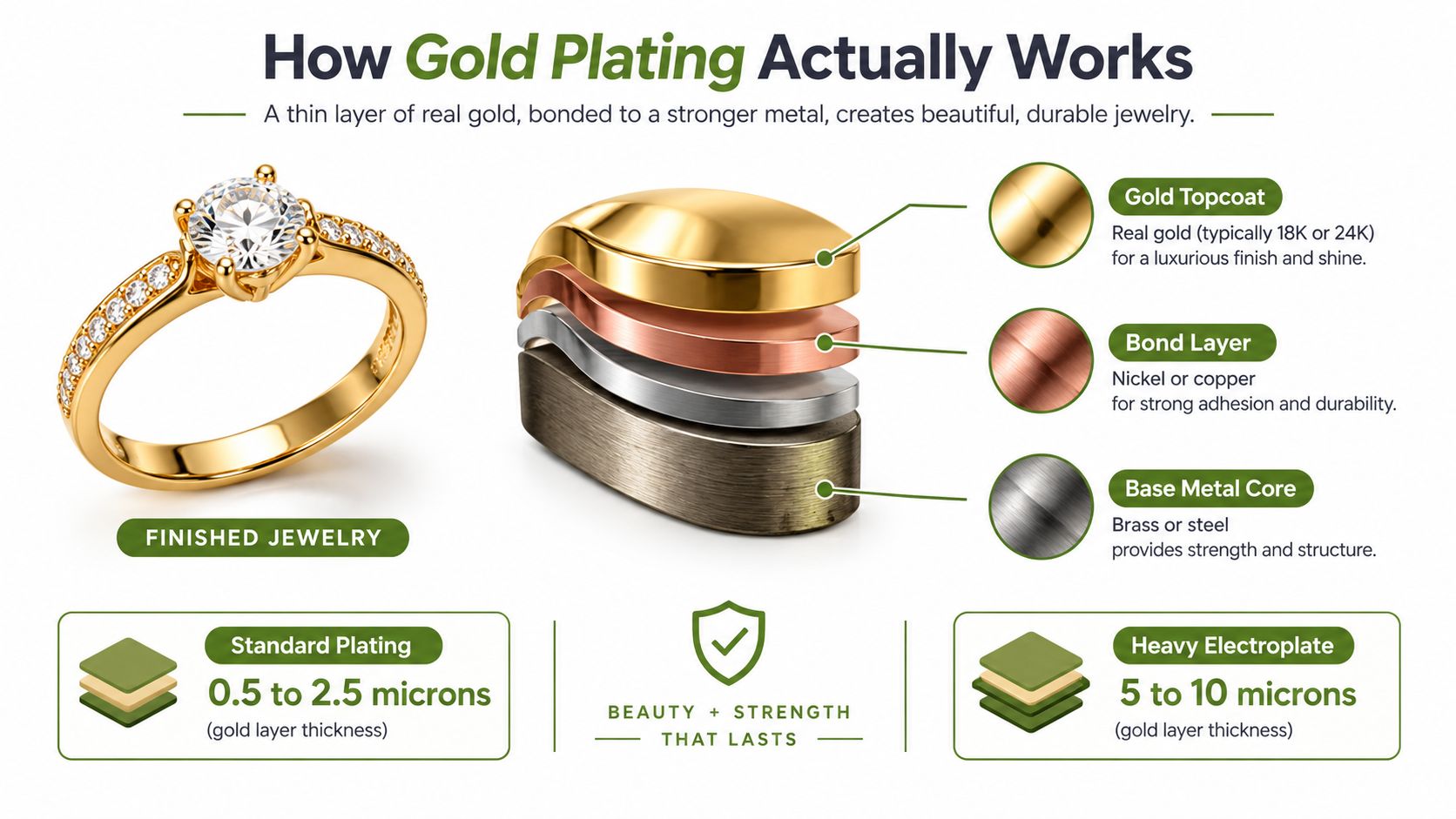
What each layer does
The substrate carries the mechanical load. Brass is common in fashion jewelry because it can be shaped and finished efficiently, while stainless steel offers a more stable surface when the coating wears through. Sterling silver provides a different positioning altogether, since the underlying material itself has recognized precious-metal content.
The bond layer is part of the finishing system, not a substitute for gold thickness. It can support adhesion and help isolate the topcoat from the substrate, but a retailer still needs the supplier to disclose the actual plating method and gold deposit. Color consistency, edge coverage, clasp areas, and recessed details matter just as much as the broad front surface.
Gold plated, gold-filled, vermeil and solid gold are different product descriptions. Gold-filled jewelry uses a mechanically bonded gold layer, while vermeil is a gold-coated sterling-silver product subject to market-specific naming rules. In the United States, the FTC guide specifies sterling silver, gold of at least 10 karat and an equivalent minimum thickness of 2.5 microns for the term “vermeil.” Solid-gold jewelry uses a gold alloy throughout the relevant part rather than relying on a surface deposit. Do not group these constructions solely because they share a yellow-gold appearance.
For a deeper comparison of surface treatments, use HonHo's guide to gold PVD coating when evaluating whether a supplier is discussing electroplating, PVD, or another finish.
Supplier question: “What is the substrate, what is the plating method, and what thickness do you guarantee on the finished piece?”
The method affects how you describe the item, how you price it, and what care instructions you give the customer. A product listing that says only “gold jewelry” hides the exact information a reseller needs to protect the sale.
Plating Thickness and the 0.5-Micron Benchmark
A ring sold as everyday jewelry needs a different plating specification from a pendant designed for occasional wear. Wholesale buyers who treat gold plating as one standard finish usually under-specify high-contact products and overpay for low-contact ones. Thickness, product category, substrate, and customer expectation must be matched before you set the retail price.
Thickness is one durability variable, not a complete performance claim. A decorative flash layer contains less gold to absorb rubbing from skin, clothing, counters, clasps and neighboring pieces. A heavier deposit can provide more material before wear exposes the underlying layer, but surface preparation, underlayers, design edges, polishing and use conditions still matter. Treat 0.5 microns as a selectable commercial specification when relevant, not a universal definition or a promised wear life.
Gold Plating Thickness Tiers for Wholesale Buyers
| Plating Tier | Micron Range | Typical Wholesale Price Impact | Best-Fit Categories |
|---|---|---|---|
| Decorative flash | Supplier must confirm | Lowest finish cost | Low-contact fashion pieces and short-season designs |
| Standard decorative | Supplier must confirm | Accessible fashion positioning | Earrings and pendants with limited rubbing |
| Mid-tier | Supplier must confirm | Moderate finish investment | Mixed retail collections and better everyday pieces |
| Heavier deposit | Supplier must confirm | Higher finish cost | Rings, bracelets, and premium daily-wear positioning |
The table uses supplier-confirmed ranges deliberately. Factories label tiers differently, so a buyer should reject vague terms such as “thick gold” or “premium plating.” Require a written micron or microinch value for the finished piece. Ask whether the measurement is taken before or after final polishing, because polishing can reduce the remaining deposit.
Match the finish to the product
Earrings and pendants usually experience less friction than rings. They can therefore carry a lighter finish when the design hangs away from the skin and avoids constant contact. Rings and bracelets need a stronger specification because their shanks, inner bands, clasps, and contact points rub repeatedly throughout the day.
A thin layer can sell successfully when the retail price, design cycle and wear expectation match. Problems start when a decorative finish is marketed as a daily-wear solution without supporting evidence. X-ray fluorescence, or XRF, can measure metallic coating thickness without sectioning the item, but the result depends on calibration, the declared layer system, substrate, geometry and measurement point. Ask which layer was measured, on what sample and where; the scope of ISO 3497 is measurement, not a prediction of consumer wear life.
| Claim in the quote | Evidence to request | What it does not prove |
|---|---|---|
| 18K gold plated | Deposit fineness plus the complete layer specification | Thickness, gold mass or wear duration |
| 0.5 μm gold | Method, calibration, sample identity and measurement points | Uniform coverage on edges, joints and recessed areas |
| Water or sweat resistant | Finished-item test method, conditions and acceptance criteria | Permanent waterproofness or a fixed service life |
| Nickel compliant | Market-relevant finished-item test report tied to the SKU or batch | Universal allergy safety for every wearer |
Use qualitative wear language in product copy unless the supplier provides a verified test result. Wear life depends on habits, category, construction, and contact points, so do not promise a fixed lifespan from thickness alone. State the finish level, explain care requirements, and describe the product for its intended use.
Practical rule: Put the stronger plating specification on high-friction categories first. Do not allocate the same finish budget to a pendant and a ring when customers wear them differently.
Choosing the Right Base Metal Under the Plating
The base metal determines what customers see after the gold layer starts to thin. This is why the same plating thickness can produce different retail outcomes across brass, stainless steel, and sterling silver.
Brass is a common fashion-jewelry substrate. It supports accessible pricing and works well for designs that prioritize shape, texture, and trend speed. Once the coating wears through, however, brass can develop green or dark tarnish more quickly than a stainless-steel substrate. That visible change often becomes the customer's complaint, even though the original issue began with wear at a high-contact point.
Stainless steel can suit frequent-wear SKUs when its grade, forming, polishing and coating route are appropriate. The substrate may remain visually more stable than brass after localized wear, but that does not make every stainless-steel item hypoallergenic, corrosion-proof or equivalent. Record the actual grade and request finished-item evidence for the target market.
Base Metal Comparison for Gold-Plated Wholesale Jewelry
| Base Metal | Relative Cost | Behavior After Wear-Through | Evidence to Request | Best-Fit Retail Category |
|---|---|---|---|---|
| Brass | More accessible fashion positioning | May show green or dark tarnish | Confirm alloy and compliance documentation | Trend-led pieces and lower-priced collections |
| Stainless steel | Higher material positioning than basic brass | More stable backup surface | Confirm the exact grade and testing | Everyday hoops, rings, chains, and bracelets |
| 925 sterling silver | Precious-metal positioning | Silver substrate remains, but the gold finish can still wear | Confirm alloy and nickel documentation | Premium plated lines and vermeil-style positioning |
Sterling silver is defined by its silver fineness, not by one universal recipe for the remaining alloy. The 925 hallmark refers to a minimum of 925 parts per thousand silver, as outlined by USA Jewels' sterling-silver education page. The mark alone does not establish the exact alloy, plating thickness or authenticity of a specific piece. A 925 item with a gold surface is generally gold-plated sterling silver rather than solid gold, as discussed in TrueFacet's explanation of the 925 mark; verify the material and finish through supplier documentation and sample inspection.
Use HonHo's jewelry materials and plating guide when comparing substrate and finish specifications for different SKUs.
Your resale price should reflect the complete construction. A brass-based fashion ring and a gold-plated sterling-silver pendant shouldn't carry the same material story, even if the gold color looks similar in product photography.
Wear Life by Category and Replenishment Planning
A ring that looks flawless in your product photos can show wear quickly in a customer's hands. Wear life varies by category because friction, sweat, water exposure, storage, plating thickness, and base-metal condition all affect the finish. Rings usually wear fastest. The inner band and outer surface face constant contact, while earrings and pendants generally experience less continuous abrasion.
Do not convert a micron value into a fixed number of months. Category, contact points, underlayers, coating uniformity, care and wear habits all change the result. Rings and bracelets usually deserve closer scrutiny because they see more friction, while earrings and pendants often have lower-contact surfaces but still include posts, backs, chains, clasps and edges that can wear. Use this guide to how long gold-plated jewelry lasts to frame customer expectations without promising a universal lifespan.
Expected Wear Life and Replenishment Cycle by Jewelry Category
| Category | Avg Daily-Wear Life | Primary Wear Point | Suggested Reorder Cycle |
|---|---|---|---|
| Rings | Shortest among common categories | Inner band, edges, and finger contact | Review sell-through and returns frequently |
| Bracelets | Shorter than low-contact pieces | Wrist contact, clasp, and surface rubbing | Replenish proven styles before stock becomes thin |
| Earrings | Generally longer than rings and bracelets | Posts, backs, hoops, and skin-contact areas | Maintain dependable core styles alongside trends |
| Necklaces and pendants | Generally among the longer-wearing categories | Chain, clasp, pendant edges, and storage friction | Reorder evergreen shapes while testing new motifs |
Plan stock around the weakest contact point
Do not apply one replenishment forecast to every category. Review rings and bracelets more frequently, because visible finish complaints can arrive before the rest of the collection needs attention. If a category sells well but generates repeated wear-related returns, upgrade its plating tier or substrate before increasing the order depth.
Earrings need separate inspection points. Stud posts, lever-backs, and backs can face direct skin contact even when the decorative front still looks attractive. For pendants, the visible face may retain its finish longer, but chains, clasps, pendant edges, and packaging can create rubbing during wear and storage.
The yellow-gold look remains commercially relevant, but retailers must describe plated jewelry accurately. Tell customers that wear habits affect longevity, recommend dry storage, and provide care guidance. A plated item should not be presented as maintenance-free or positioned as a direct substitute for solid gold.
Match the specification to the category and the expected customer behavior. Use thinner plating for trend-led pieces with shorter selling cycles, and reserve heavier tiers for rings, bracelets, or everyday designs where repeat wear will test the finish sooner.
Retail planning rule: Replenishment is not only about units sold. Track which category generates finish complaints, then improve that category's specification before increasing its order depth.
MOQ, Sampling, and Private-Label Options
Wholesale programs usually separate ready-to-buy stock from custom development. Ready-stock buying lets a retailer test existing designs with less development work. Custom OEM or ODM sourcing adds logo, shape, finish, or packaging decisions, so the supplier needs a clearer specification before production begins.
Ask whether the minimum applies per SKU, per color, per style, or across the full purchase order. A supplier may allow a mixed assortment across several SKUs, while another may calculate each variation separately. Those rules affect how much inventory risk you take before you know what sells.
Separate the buying paths
For a first order, request physical samples of the categories you plan to sell. Inspect color consistency, edges, clasp function, post alignment, surface scratches, and the finish around recessed details. A sample should represent the actual material and plating specification, not a visually similar substitute.
For customization, define the finish in writing. State the desired gold color, substrate, plating method, thickness, logo placement and packaging requirement. HonHo's current custom-planning baseline is 50 pieces per style and color. Brass and 925 silver samples generally require 25–30 days; stainless-steel samples generally require 25–35 days; approved bulk production generally requires 35–45 days. These are planning ranges for custom development, not dispatch promises for every ready-stock SKU, and the project quotation controls. Do not accept “premium gold” or “long-lasting plating” as a substitute for a measurable specification.
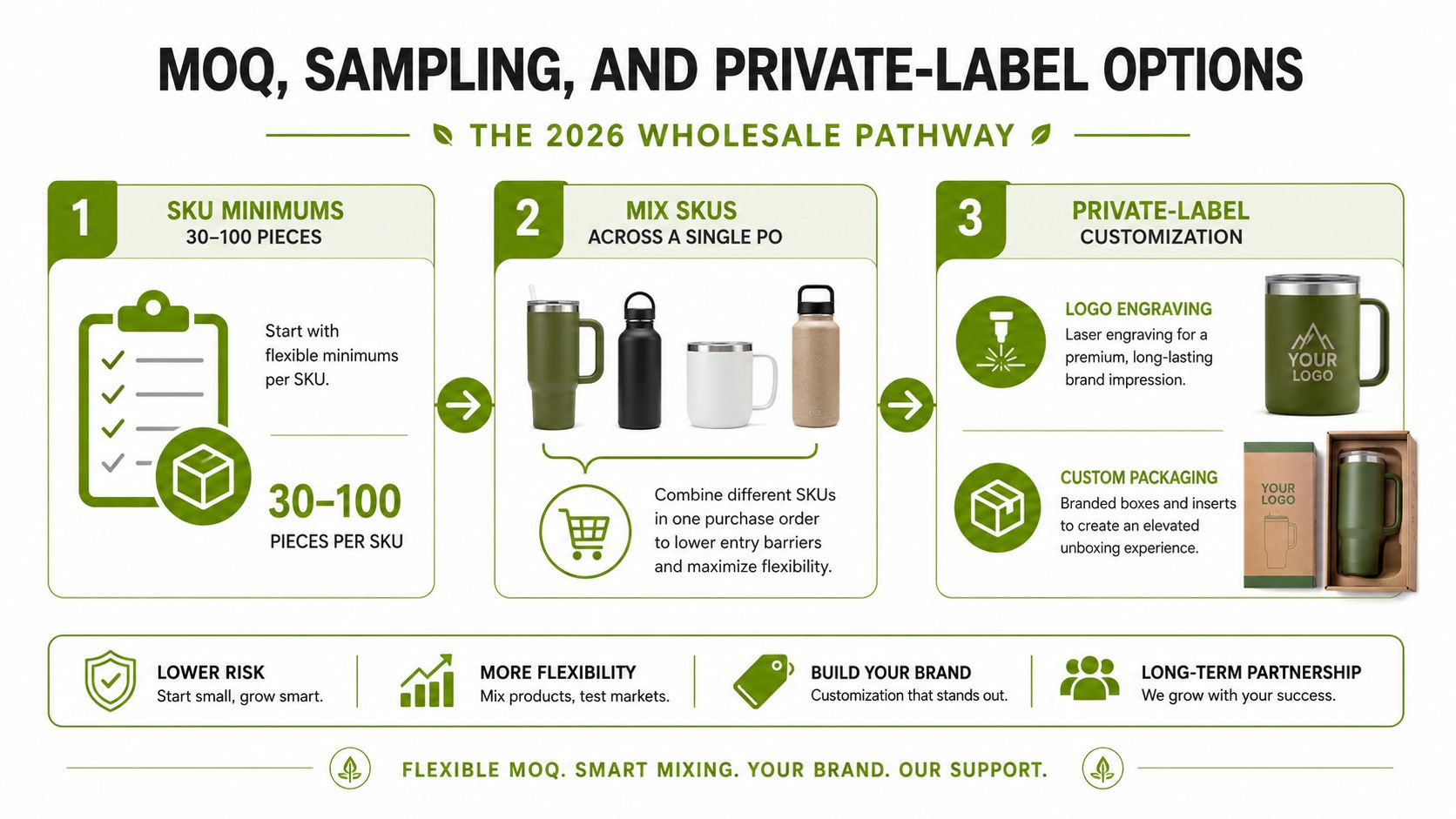
Packaging also changes the retail experience. Poly bags suit straightforward wholesale fulfillment. Branded cards, barcode hangtags, pouches, and gift boxes support a more developed store presentation, but each option should be priced and approved before production.
Know what private label actually includes
A light private-label order may add a logo card or packaging to ready-made jewelry. A full OEM or ODM program can involve design development, custom tooling, sample approval, plating changes, engraving, and branded packaging. Those are different commercial commitments, so ask for a written workflow and approval points.
Use HonHo's low-MOQ jewelry manufacturing guide as one reference when comparing ready-stock and custom-order pathways. The key question isn't whether a supplier offers customization. It's whether the service matches your current sales volume and launch schedule.
Buyer Checklist Before You Place a Wholesale Order
A supplier quote is only useful when the specification behind it is clear. Before sending a deposit, turn the product page into a short purchasing document. Record the material, finish, category, approved sample, packaging, and expected reorder conditions for every SKU.
Print this pre-PO checklist
- Gold thickness: Request the plating measurement in microns or microinches, plus the supplier's written specification. Stop if the supplier only describes the item as “gold plated” without a measurable thickness.
- Base metal: Confirm brass, stainless steel, or 925 sterling silver. Stop if the answer changes between the product listing, invoice, and sample.
- Plating method: Ask whether the finish uses electroplating, PVD, or another process. Don't assume the method from the color name.
- Sample approval: Keep an approved physical sample and compare the production order against it. Test high-contact areas rather than judging only the front face.
- Wear evaluation: Use representative finished samples and record discoloration, edge wear and clasp issues under a defined trial. Log any reported irritation separately; an informal wear trial is not a regulatory compliance test or proof of universal allergy safety.
- Compliance documents: Request available nickel and lead compliance documentation for the markets where you sell. Don't make a hypoallergenic claim without support.
- Price-break math: Compare the unit cost at each order level, including packaging and sampling costs. A lower unit price isn't useful if it leaves you with slow-moving inventory.
- Packaging and barcodes: Approve the card, box, pouch, hangtag, and SKU information before production. Check that the packaging matches your store's fulfillment process.
- Reorder planning: Ask how the supplier handles repeat orders, material consistency, and finish matching. A reorder should reproduce the approved specification, not just the same photograph.
A stamp can help identify a product, but it isn't proof by itself. Hallmarks may be copied or worn down, and verification may require inspection beyond the mark, as explained by Prism News' overview of 925 hallmarks and testing.
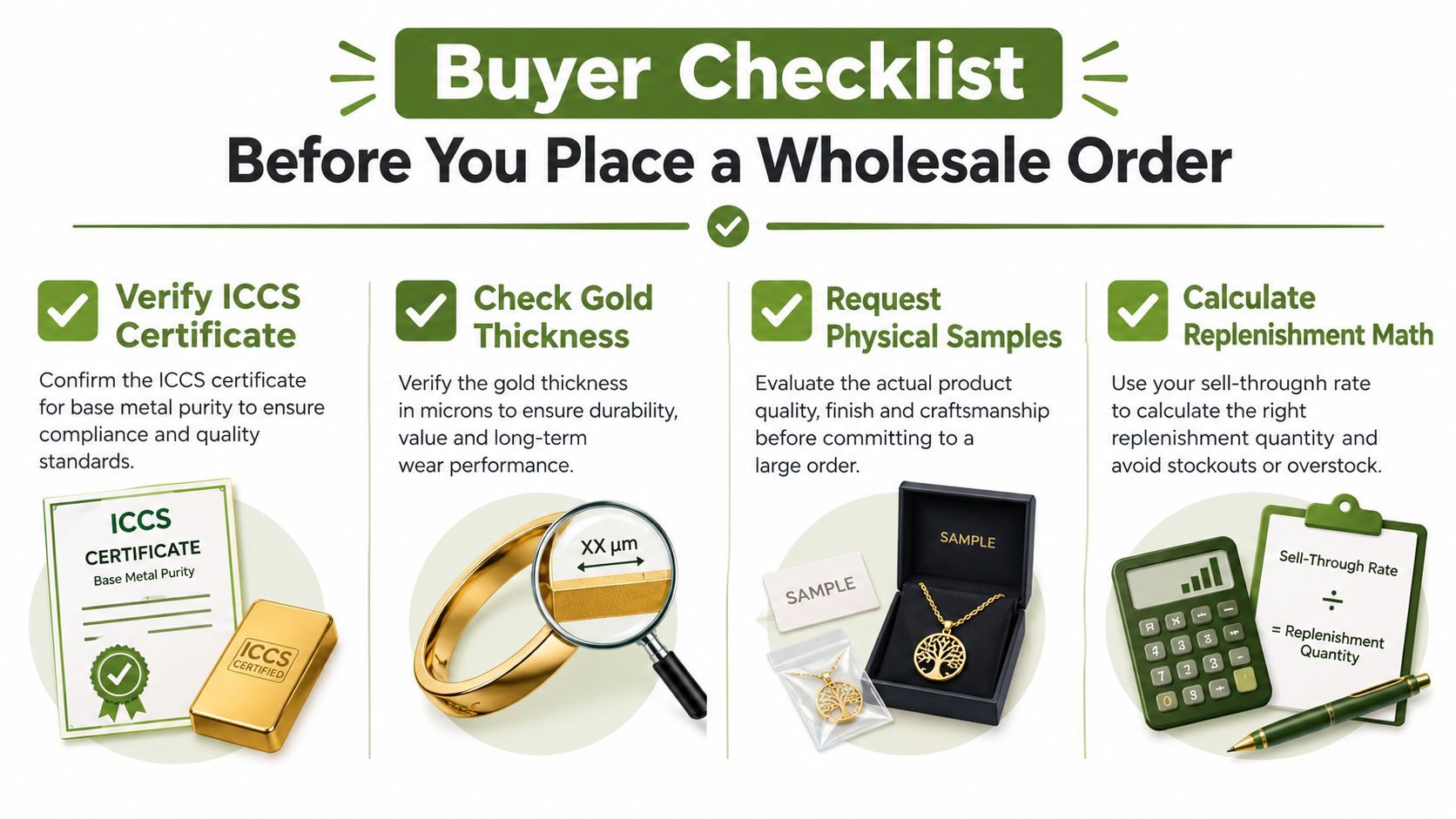
Order-stop signal: If a supplier won't disclose the substrate or plating thickness, you can't accurately set the product claim, retail position, or customer expectation.
Use HonHo's wholesale ordering guide to organize the commercial details before you issue a purchase order. Keep the approved sample, written specification, and packaging approval together rather than relying on a chat message or memory.
Putting It All Together for Your Store
The right wholesale gold-plated jewelry assortment starts with the customer's use case. Choose the category first, then assign the base metal, complete layer build, evidence requirement, retail position and order size. That sequence avoids buying a finish label before deciding how the customer will wear the piece and what the retailer must be able to substantiate.
Gold-Plated Wholesale Sourcing Matrix by Buyer Profile
| Buyer Profile | Plating Spec | Base Metal | Core Categories | MOQ Range |
|---|---|---|---|---|
| Shopify starter | Confirm a practical finish for low-contact testing and a stronger option for rings | Brass or stainless steel, depending on retail position | Earrings, pendants, a small ring test | Confirm supplier minimum and mixed-SKU rules |
| Mid-volume boutique | Use category-specific specifications rather than one finish for every item | Brass for fashion depth, stainless steel for daily-wear styles | Earrings, rings, necklaces, and bracelets | Negotiate by style, color, and total order |
| Private-label brand | Approve a written thickness, color, substrate, and packaging standard | Stainless steel or 925 sterling silver for a more defined material story | Coordinated collections across core categories | Confirm custom minimum per style and color |
A Shopify starter should reduce risk through a focused assortment. Start with earrings and pendants that are easier to merchandise, then add rings after testing customer response and finish performance. If the store sells everyday basics, push the supplier to disclose a stable substrate and a measurable plating specification before expanding.
A mid-volume boutique can separate its assortment into clear tiers. Use accessible brass-based fashion pieces for trend-led designs, then reserve stainless steel or plated sterling silver for products positioned as longer-wearing. Don't let one low-cost SKU determine the quality language for the entire collection.
A private-label brand needs tighter documentation. Approve the color, substrate, thickness, engraving, packaging, and barcode format as one system. The brand promise should match the construction. If the customer is paying for a premium material story, the product page must identify the material accurately instead of relying on a gold-color photograph.
Push back on incomplete quotes
Ask the supplier to revise any quote that leaves out the base metal, plating thickness, finish method, or packaging scope. Ask whether the stated thickness is measured before or after polishing, and request a sample that uses the same process as the production order.
Build replenishment around category behavior. Keep reliable earring and pendant styles available as core inventory, review rings and bracelets more closely for wear feedback, and avoid overcommitting to trend designs before they show repeat demand. The best sourcing workflow is repeatable: define the use case, specify the construction, approve the sample, test the retail response, and reorder the winners.
HonHo Wholesale Jewelry offers ready-stock and custom sourcing routes across stainless steel, brass and 925 silver. For a useful quotation, send the product category, reference images, base metal, target gold color, plating method and thickness, quantity per style and color, destination market, required testing, packaging and target date. HonHo can then confirm the feasible layer build, sample route and project-specific terms.


