

Stainless steel jewelry is water-resistant, but “waterproof” is too broad unless the claim is tied to a defined product construction and test. Solid 316L generally handles routine freshwater contact better than many fashion-jewelry metals. Pool chemicals, seawater, hot tubs, trapped residue, plated finishes, adhesives, stones and mixed-metal findings introduce separate failure points.
For wholesale buyers, the practical decision is not simply “304 or 316L?” It is whether the assembled piece, its finish and every component match the exposure claim you plan to print on the product page.
| Construction | What water can change | What to verify before ordering |
|---|---|---|
| Solid, unplated stainless steel | Chlorides can still cause localized pitting or crevice corrosion | Exact alloy grade and the intended exposure conditions |
| PVD-coated stainless steel | Color performance depends on the complete coating system, surface preparation and wear | Base alloy, coating specification and an agreed finished-piece test |
| Stone-set or enamel jewelry | Water and residue can collect around settings; adhesives may fail before the steel | Setting method, adhesive limits and cleaning instructions |
| Mixed-metal findings | The weakest post, clasp, chain, solder or jump ring may govern the claim | Material for every water-exposed component, not only the main body |
Table of Contents
- The Waterproof Myth That Hurts Wholesale Jewelry Buyers
- How the Chromium Passive Film Protects Stainless Steel
- Why 316L Stainless Steel Is a Different Story from 304
- Real World Water Exposure Scenarios and What Actually Happens
- What to Tell Your Customers About Care and Maintenance
- How to Position Stainless Steel Jewelry for Resale Success
The Waterproof Myth That Hurts Wholesale Jewelry Buyers
“Waterproof” sounds absolute. A customer may reasonably read it as permission for repeated showers, swimming, workouts and damp storage with no change to the metal, color, stones or assembly. That is a much wider claim than “water-resistant,” and it needs correspondingly specific evidence.
Stainless steel must contain at least 10.5% chromium by weight under BS EN 10088-1. Chromium supports a thin passive oxide film that gives stainless steel its corrosion resistance. The British Stainless Steel Association explains how that film forms and why a surface can switch between passive and active behavior (British Stainless Steel Association).
Buyer rule: use “water-resistant” by default. Use “waterproof” only when the claim names the relevant construction and exposure, and you hold evidence for the finished item.
This is both a technical and a merchandising issue. The base steel may remain sound while a decorative coating changes, a glued element loosens or residue marks a tight setting. Product copy should therefore separate the base alloy, finish and construction. For a materials reference your team can use alongside samples, see HonHo Jewelry Wholesale's jewelry materials page.
For sellers serving the United States, the FTC’s general advertising-substantiation policy is a useful benchmark: objective product claims should have a reasonable basis before they are published. That principle is worth applying in every market, even where the exact legal test differs.
How the Chromium Passive Film Protects Stainless Steel
The surface layer does the real work
The passive film is why stainless steel behaves differently from plain iron. It forms naturally at the surface when chromium and oxygen interact. In ordinary conditions it is strongly adherent and can reform after minor damage, which supports good resistance to routine moisture (British Stainless Steel Association).
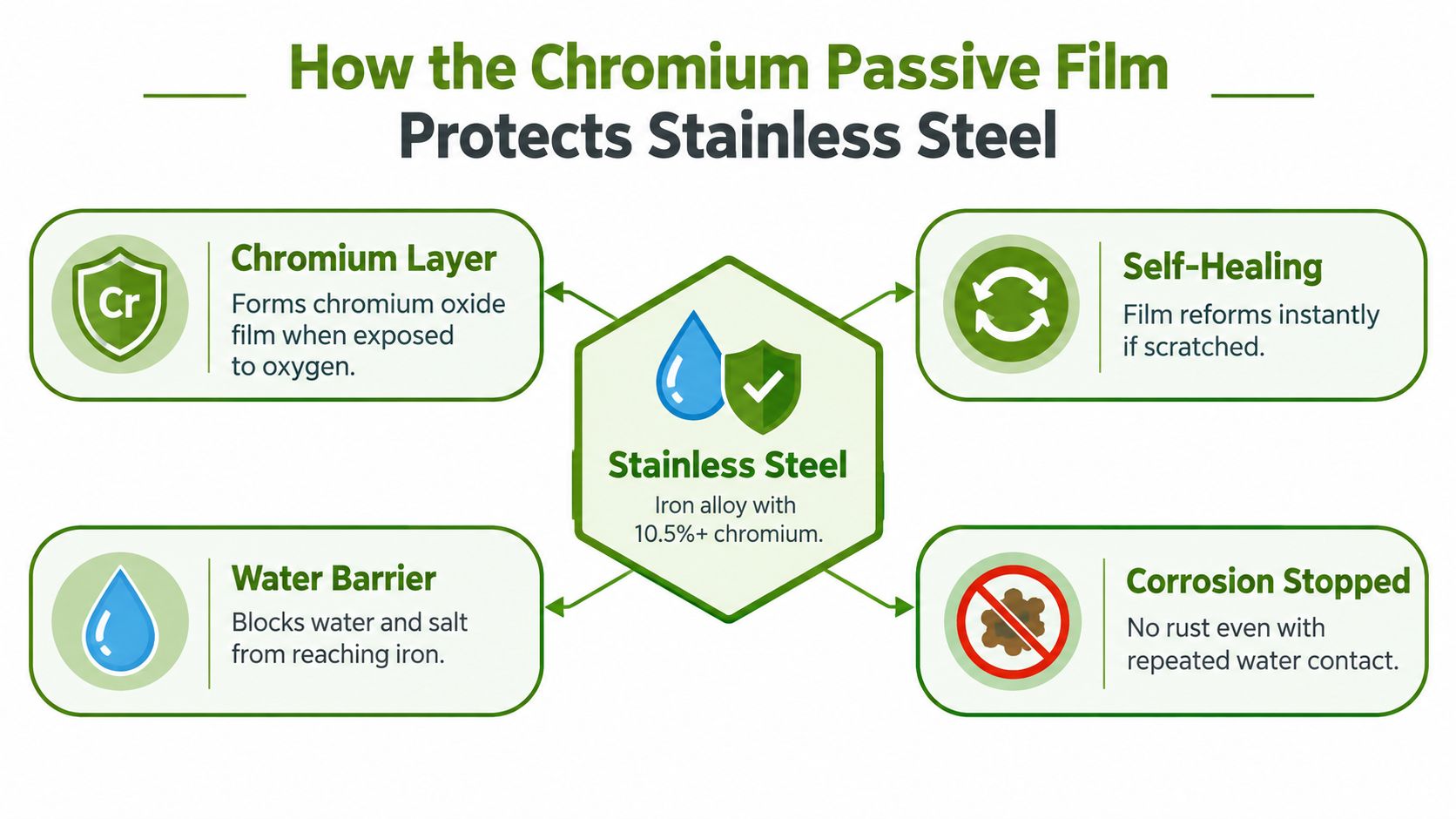
Self-repair is not the same as immunity. Industry guidance notes that stainless steels can still corrode under certain conditions, particularly where chlorides, acidity or mixed metals are involved. A scratch on an open, clean surface is not the same problem as salty residue trapped behind a stone setting.
Why crevices change the outcome
Tight links, hinged clasps, hollow parts and stone settings create small spaces where moisture can linger and oxygen exchange is limited. Salts and cleaning-product residue can concentrate as water evaporates. This makes the assembled design—not only the alloy grade—part of the water-resistance decision.
During sample review, inspect these areas after exposure and drying. Check clasps, jump rings, posts, backs, soldered joints, stone seats and the underside of decorative parts. A bright front surface does not prove that hidden areas are unaffected.
Why 316L Stainless Steel Is a Different Story from 304
316L contains molybdenum, which generally improves resistance to chloride-related pitting and crevice corrosion compared with 304. That makes 316L a sensible specification for many jewelry programs exposed to sweat, humidity and frequent splashes. It does not make every 316L item safe for unlimited pool or seawater wear.
A comparative supplier data sheet lists a higher pitting-resistance equivalent number for 316/316L than for 304 (Quest4Alloys data sheet). Treat that as a material comparison, not as proof for a finished necklace or ring. The components, manufacturing history, polish, finish and crevices still affect performance. For more sourcing context, see stainless steel rings for wholesale.
What to ask before you buy
- Exact grade: ask whether the main body, posts, chain, clasp and findings use the same alloy.
- Material verification: agree how the supplier will verify grade. XRF can check elemental composition at measured points; it does not by itself prove waterproof performance.
- Finish specification: record the coating type, color target and any project-specific thickness or process requirement separately from the base steel.
- Construction: identify glued elements, stones, enamel, soldered areas, cavities and tight crevices.
- Claim conditions: define whether the intended statement covers splash, showering, sweat, pool water, seawater or something narrower.
Do not convert a factory capability into a claim for every SKU. If HonHo can develop a 316L or PVD specification for a custom project, that does not mean every ready-stock item shares the same alloy, coating or test result. Confirm the exact item or approved sample.
Real World Water Exposure Scenarios and What Actually Happens
Fresh tap water is usually less demanding than chlorinated pool water, hot tubs or seawater, but soap, hard-water deposits and slow drying can still affect appearance and coatings. Chlorides are particularly relevant to localized corrosion. Research on stainless steels in seawater and residual-chlorine conditions helps explain the mechanism, but laboratory or engineering results must not be translated into a guaranteed jewelry wear life (MDPI study on localized corrosion).
Exposure matrix for buyers
| Exposure | Main buyer concern | Safer approval approach |
|---|---|---|
| Handwashing, rain and occasional splash | Residue and wet storage, especially around closures | Check the complete item after repeated wet-dry cycles |
| Repeated showering | Soap, shampoo, friction and finish wear | Do not infer shower-safe from the base alloy alone |
| Sweat and cosmetics | Chlorides, acids, perfume, lotion and abrasion acting together | Test the intended finish and high-contact components |
| Swimming pools and hot tubs | Chlorine chemistry, temperature and prolonged immersion | Use a qualified claim only if the finished item was assessed for that condition |
| Seawater | High chloride exposure and residue trapped in crevices | Avoid a blanket seawater-proof promise; define rinse, drying and test conditions |
For plated styles, the finish needs its own evidence. A PVD process can produce a durable coating, but “PVD” is a process family, not a single performance grade. Substrate preparation, layer system, color chemistry, thickness, geometry and wear all matter. Keep those distinctions clear when sourcing gold PVD coating styles.
What to Tell Your Customers About Care and Maintenance
Care copy should protect the steel, the decorative finish and the assembly. It should also match the claim. If the listing says only “water-resistant,” advise customers to rinse after saltwater, pool water or heavy sweat and then dry the piece completely, especially around chains, hinges and settings.
Rinse after chlorine, saltwater or heavy sweating. Dry the piece fully before storage, with extra attention to clasps, links and stone settings.
Copy you can adapt for product pages
- For a general listing: “Water-resistant stainless steel construction. Rinse and dry after chlorine, saltwater or heavy sweat.”
- For a plated item: “The stainless steel base and decorative finish have different wear characteristics. Avoid harsh chemicals and dry after water exposure.”
- For a tested program: state the exact product, exposure method and acceptance result. Do not turn one sample result into a promise for unrelated SKUs.
Store damp pieces only after they are fully dry. Avoid bleach, acidic cleaners and abrasive polishing on plated surfaces. For customer inserts and staff training, use HonHo Jewelry Wholesale's care guide as a starting point, then add any SKU-specific instructions from the approved sample.
How to Position Stainless Steel Jewelry for Resale Success
Precise language is more useful than a louder promise. “316L stainless steel,” “PVD-coated stainless steel” and “water-resistant under routine splash exposure” tell a buyer more than “waterproof” on its own. If you do use an objective performance claim, keep the product and test records that support it.
Salt-spray testing can be useful for comparing coatings or detecting defects under a specified procedure. ISO 9227 defines salt-spray methods, but it does not prescribe a universal exposure time or how every product result should be interpreted. A salt-spray hour count is therefore not a conversion into months or years of wear.
For a useful finished-piece test plan, record the assembled SKU, sample count, exposure liquid and concentration, temperature, duration, wet-dry or cleaning cycles, inspection points and pass/fail criteria. Photograph the same areas before and after. If a result applies only to a development sample, say so.
A quick buyer checklist
- Material: exact alloy for the body and each water-exposed component
- Finish: coating or plating process, color target and approved sample
- Construction: crevices, hollow parts, glued stones, enamel, solder and mixed-metal findings
- Use case: splash, shower, sweat, pool, seawater or another defined condition
- Evidence: test method, sample count, acceptance criteria and which SKU or batch the result covers
- Care copy: rinse, drying, chemical and storage instructions that match the product
- Skin-contact claims: nickel-release evidence where the market and product category require it
Ask for evidence before finalizing listing copy, not after a claim creates returns. If a test is needed, agree the protocol during sampling so the factory and buyer inspect the same failure modes.
If you are sourcing stainless steel pieces for resale, browse HonHo Wholesale Jewelry for ready-stock collections or send a reference image, target material, finish, quantity and intended exposure claim for a project review. We can help define what must be confirmed on the sample before production; final specifications remain item- and project-specific.


