

A wholesale custom stainless steel ring order is ready for production only when five things are fixed in writing: the design revision, the size-by-size quantity, the approved physical sample, the finish reference and the delivery plan. Start with those decisions—not the launch date alone—because a missed size or an ambiguous finish can force another sample round.
| Decision | Record before sampling | Approve before bulk production |
|---|---|---|
| Ring geometry | Size system, inner diameter or circumference, width, thickness and edge profile | Measured sample dimensions and agreed tolerance |
| Material | Actual alloy, not a broad label such as “stainless steel” | Supplier declaration or agreed material evidence |
| Finish | Color reference, surface texture and plated or unplated areas | Physical finish sample, inspection method and acceptance notes |
| Order split | Quantity by size and color | Final purchase-order matrix and production reference |
| Branding | Engraving file, placement and packaging brief | Marked-up proof or physical sample |
Table of Contents
- How Long a Custom Stainless Steel Ring Order Takes
- Choosing Between Ready-Stock and Custom Rings
- Specifying Design, Alloy and Size Before Sampling
- Finish Options, Plating and Sample Approval
- MOQ, Branding and Pricing Your First Custom Run
- Written Sign-off Checklist Before Production Payment
How Long a Custom Stainless Steel Ring Order Takes
A custom order moves through sampling, approval and bulk production. For stainless steel, the current planning range is 25–35 days for a sample and 35–45 days for bulk production after sample approval. These are production ranges, not promised delivery dates. Design revisions, a size-set sample, testing, packaging approval and transit can add time.
| Custom ring order stages and typical timing | Typical time | What you provide or approve |
|---|---|---|
| Design brief and quote | Allow time to confirm the design and quote | Drawing or reference, alloy, size matrix, finish, branding and quantity |
| Stainless steel sample | 25–35 days | Fit, dimensions, finish and engraving on the agreed sample size |
| Brass or 925 sterling silver sample | 25–30 days | Same review, plus the material and finish specification |
| Bulk production after sample approval | 35–45 days | Final quantity by size, style and color |
| Ready-stock order | About 3 business days for in-stock orders | Catalog items and quantities; no development sample |
| Transit to your location | Unknown until confirmed | Carrier, service level and transit estimate before payment |
The sample windows and usual shipping time for in-stock orders are listed with HonHo's shipping and production information. Bulk production is quoted at 35–45 days on the current custom product listing. Ask when the clock starts, which approvals pause it and whether the quote includes a revision round. Shipping and transit remain separate until the carrier and route are confirmed.
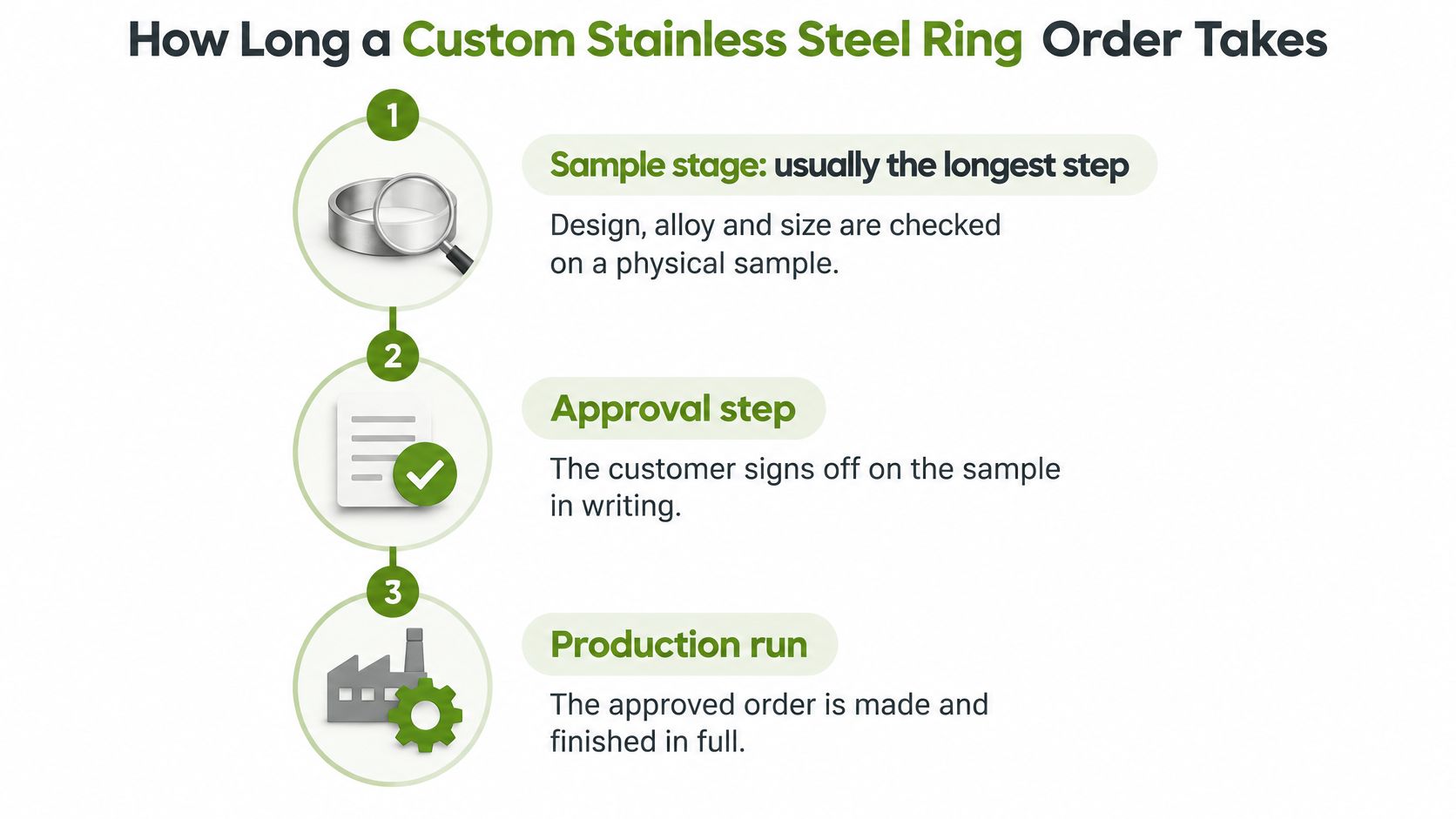
The order path
- Send one controlled design brief. Give the file a revision number and include the alloy, dimensions, size system, quantity by size, finish and branding.
- Confirm the custom minimum and size split. The stated custom MOQ is 50 pieces per style and color. The final minimum and how those pieces may be divided among sizes belong in the project quote.
- Choose the sample strategy. A single sample can confirm appearance, but a representative size set is more useful when band width, comfort fit or grading may change across sizes.
- Measure and inspect the physical sample. Compare dimensions, fit, finish and engraving with the same revision of the brief.
- Close changes in writing. Record accepted deviations and issue a new revision if the sample changes. “Looks good” is not a production specification.
- Confirm the purchase-order matrix. List quantity by size and color, the approved sample ID, packaging, production start and inspection responsibility.
- Approve packing, then shipment. Confirm the pack-out and request carrier and transit details from Dongguan before treating the launch date as secure.
Count back from launch: reserve time for the brief, sample, at least one decision round, bulk production, inspection, packing and transit. A production range should never be copied into the calendar as a guaranteed arrival date.
HonHo's contact hours are Monday to Saturday, 9:00–18:00 HKT. Buyers in another time zone should group questions and set written approval deadlines; scattered replies make it harder to know which revision is current.
Choosing Between Ready-Stock and Custom Rings
Choose ready-stock to test a price point, finish direction or merchandising idea with an existing design. Choose custom when the ring's geometry, size range, finish placement or branding is central to the offer. Ready-stock removes the development sample; custom work gives you more control but adds approval gates.
| Ready-stock versus custom ring orders | Ready-stock | Custom |
|---|---|---|
| Design | Fixed catalog design and available finishes | Your approved design revision, dimensions and finish map |
| Size planning | Available catalog sizes | Quantity by size and an agreed sizing standard |
| Sample step | No development sample | Physical sample before bulk production |
| Branding | Logo engraving is a separate question before ordering | Engraving and packaging set in the brief |
| Best use | Demand tests, mixed assortments and proven reorders | Private-label designs where specification control matters |
A boutique unsure whether customers prefer gold-tone or silver-tone stacking styles can first test catalog designs through the Rings collection and Stainless Steel Jewelry collection. The Stainless Steel Linked Triple Ring with Pearl-Look Accents suits that kind of test: three connected bands, a row of white pearl-look accents on the center band, and plain outer bands, offered in gold-tone and silver-tone. Treat the result as a directional signal, not proof that finish alone caused the difference; price, imagery, stock by size and merchandising can also affect sales.
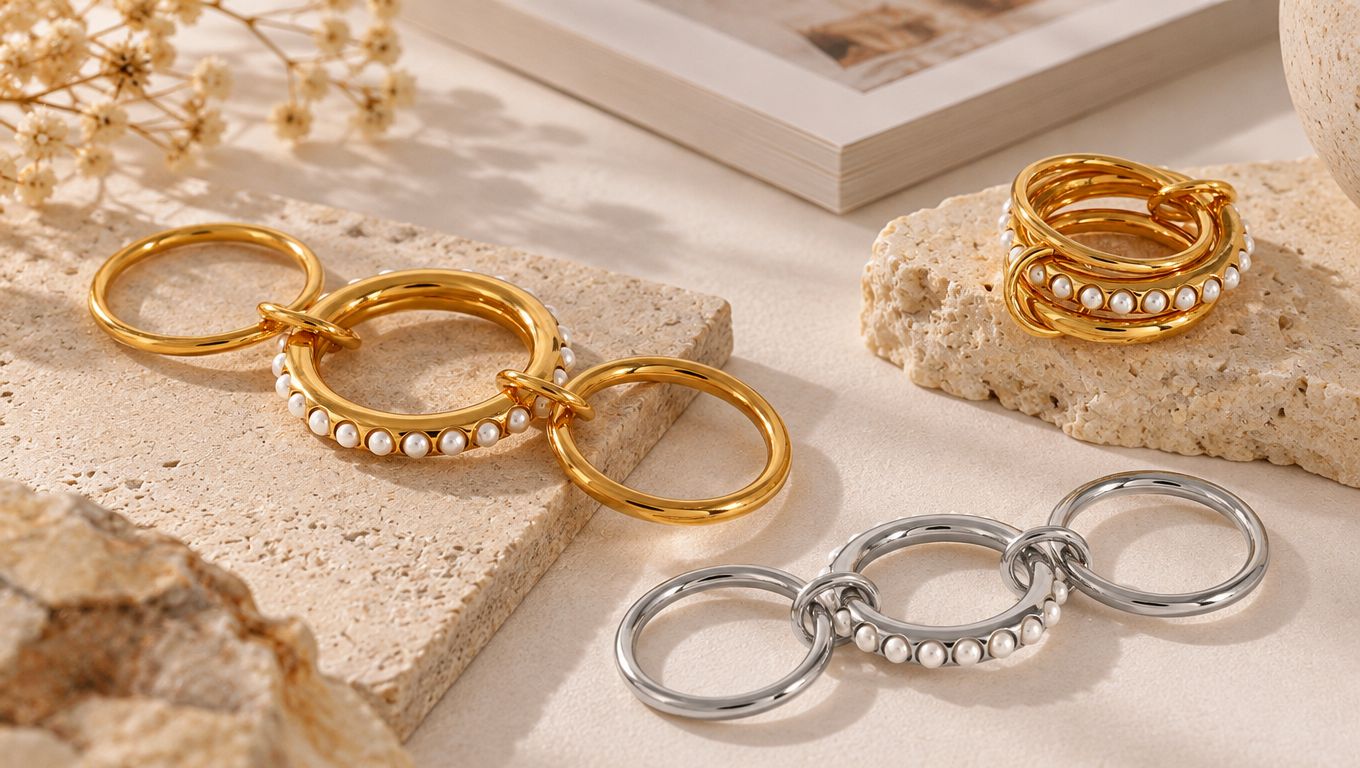
Standard catalog designs do not automatically include logo engraving or branded packaging. Confirm both before ordering. If either changes how the product reaches your customer, move the requirement into a controlled custom brief.
Specifying Design, Alloy and Size Before Sampling
A workable ring brief names the alloy, geometry, sizing method, finish and inspection points. “Durable stainless ring” is not enough: it does not identify the grade, the fit or what the buyer will measure on the sample.
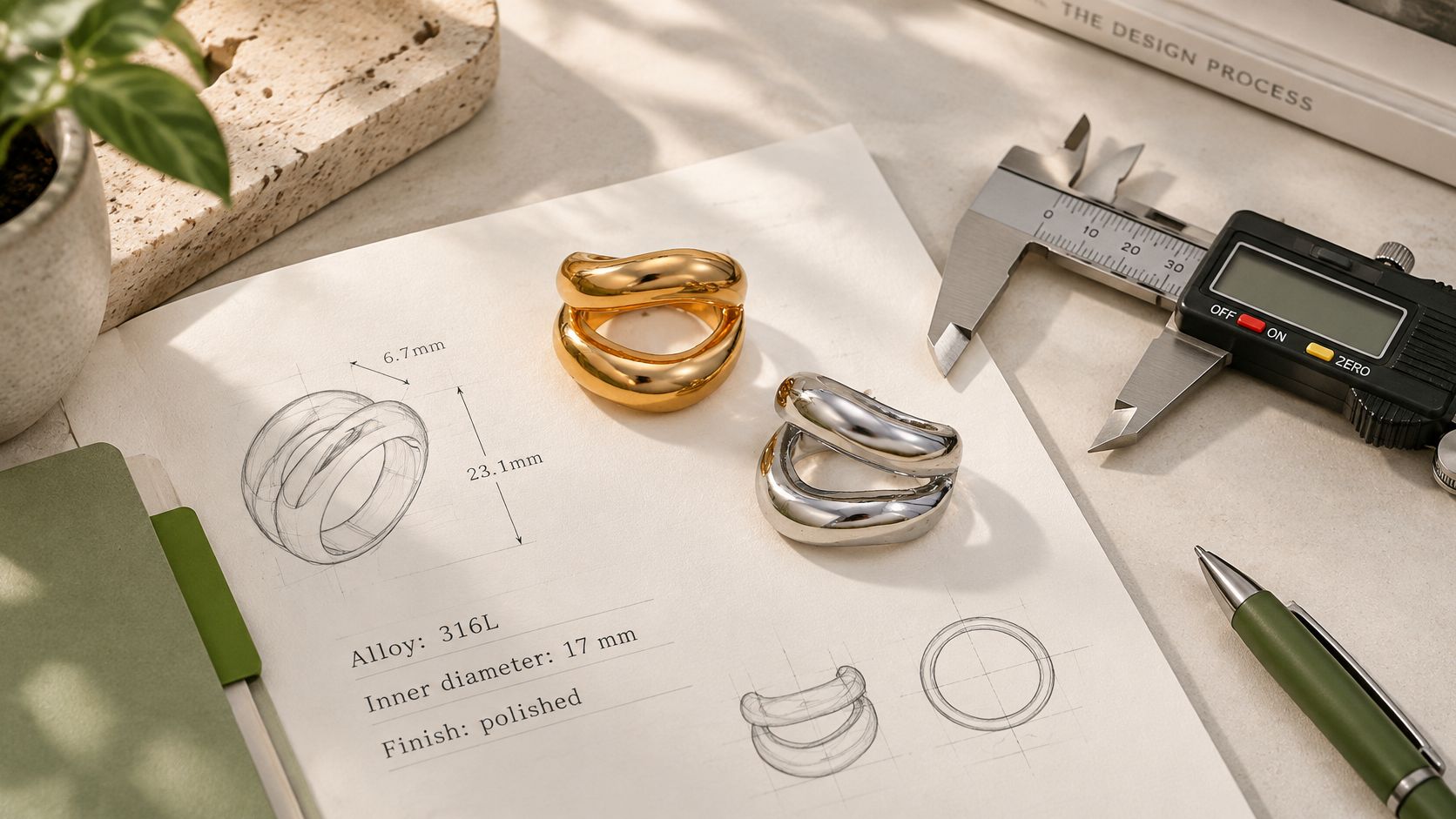
Name the material and measurements
If the ring is specified as 316L, put that grade in the order rather than relying on a general label. The 316 and 316L stainless steel datasheet gives 316L a composition of 16.0–18.0% chromium, 10.0–14.0% nickel and 2.0–3.0% molybdenum, with carbon limited to 0.030% maximum. Chromium supports the passive surface film, while molybdenum improves resistance to localized attack in chloride environments. Those material properties do not establish the finish quality or compliance of a particular finished ring.
316L isn't nickel-free. If nickel release matters in the destination market, ask for evidence tied to the finished ring and its coating system rather than treating the alloy name as proof. A material certificate or supplier declaration can help confirm the specified grade. HonHo's 316L stainless steel jewelry guide explains the terminology, but the purchase order still needs the actual material and agreed evidence.
Build a size-by-size order matrix with these fields:
- Size system and control dimension: State the market size and its corresponding inner diameter or circumference. Name the chart or standard used.
- Width, thickness and profile: Record them in millimetres. A wide comfort-fit band and a thin stacking ring should not inherit the same assumptions.
- Quantity by size: Do not approve only a total quantity. A ring order can meet the total and still fail commercially if the size mix is wrong.
- Sample size or size set: Identify which size was sampled and whether other sizes are scaled from it. Ask for a size set when geometry or settings may change across the range.
- Tolerance and measuring method: Agree what is measured, with which tool and at which points. The tolerance belongs beside the dimension, not in a separate chat message.
- Edge profile: Record the radius or reference profile because it affects comfort, appearance and the areas you will inspect for wear.
- Finish by surface: Mark plated, polished, brushed, textured, enamelled or uncoated areas on the drawing.
- Engraving and packaging: Provide the exact file, placement, readable size, pack-out and approval proof.
- Reference sample: Say which details are references and which must change. Never leave a factory to infer whether the goal is an exact copy.
Brass and 925 sterling silver are alternatives when stainless steel does not suit the design. Call brass brass, not copper, and name the actual material being ordered. Avoid unsupported descriptions such as “surgical steel,” “implant grade” or “waterproof.” Put every controlled specification in the purchase order or attached brief.
Finish Options, Plating and Sample Approval
Artwork approval and finish approval are different gates. A render can confirm placement, but the physical ring must still show whether the color, texture, edge coverage and interior surface match the brief.
| Finish options and what to check at sample approval | Appearance | Inspection focus | Record from the supplier |
|---|---|---|---|
| Silver finish | Bright, neutral metal tone | Polish consistency, scratches, pits and tool marks | Surface preparation and finish reference |
| Gold plated | Specified gold tone | Rim, shoulder, inside curve and other contact zones | Coating process, color reference and agreed thickness |
| Two-tone | Two defined finish areas | Boundary line, masked areas and coverage at joins | Finish map and whether each area was evaluated |
| Colored enamel or resin | Specified color and fill level | Edges, bubbles, gaps and high points exposed to knocks | Color reference, fill method and agreed defect limits |
A ring's finish changes what you inspect. Gold-tone and colored surfaces often show problems first at edges and contact areas, so judge the rim, shoulder and inside curve as well as a flat section. Care instructions should also distinguish a polished uncoated band from a plated, engraved or textured ring. The jewelry material and finish reference provides general background; the accepted sample and written specification remain the production reference.
If a supplier proposes a PVD gold-tone finish, treat PVD as a process name, not a durability grade. Ask how the supplier defines the coating chemistry, color, thickness, surface preparation and inspection plan. The supplier's gold PVD coating description can frame the discussion, but any numeric coating claim must be confirmed for the quoted project or SKU. ASTM D3359 is a qualitative cut-and-tape method developed for coating films on metal; do not require or cite it as a sample result unless buyer and supplier agree that the specimen geometry, coating system and method are applicable.
Inspect the physical sample
Use the same checklist and lighting for every approval:
- Measure the control dimensions and record the tool, points measured and result.
- Inspect visible surfaces under magnification for pits, pinholes, burrs and incomplete polishing.
- Check engraving for legibility, rough edges and finish build-up.
- On two-tone pieces, inspect the boundary and masked areas separately from flat surfaces.
- Compare the sample with the approved color reference in consistent lighting and file the photos.
- When a test is required, record the method, specimen, exposure, acceptance criterion and result.
Salt-spray, artificial-sweat and abrasion tests are accelerated screens, not conversions to years of wear. The current ISO 9227 salt-spray standard specifies test procedures but does not set the specimen, exposure period or interpretation for a particular product, and it is not intended to predict long-term corrosion resistance. Agree those details before testing and keep the result tied to the actual sample or production lot tested.
MOQ, Branding and Pricing Your First Custom Run
The published custom baseline is 50 pieces per style and color. Treat that as a planning figure. The final project quote must state what counts as one style or color and how the quantity may be divided among ring sizes. A total without a size allocation is not a complete ring order.
A Shopify report on ecommerce returns, citing the National Retail Federation and Happy Returns, estimates that 19.3% of online sales were returned in 2025, compared with 15.8% of retail sales overall. The benchmark covers large U.S. retailers, so it is context rather than a forecast for a jewelry boutique. For rings, the useful response is practical: publish the same size system used in the purchase order, show band width and multiple angles, explain finish care and track the return reason by size.
Decide branding, then test the margin
Custom options can include logo engraving, custom plating and branded packaging, with OEM or ODM development for a new design. Approve the ring and finish before final packaging artwork. A late change to band width, logo placement or color can force a new insert or proof.
Work backward from the target retail price. Subtract wholesale cost, freight and duty where applicable, payment fees, packaging, customer-service cost and a realistic reserve for returns or replacements. Then test the margin at several sell-through speeds. The low-MOQ jewelry ordering guide provides more context for an initial commitment.
A 50-piece total may still be too much of one slow size and too little of another. Use ready-stock sales, returns and customer enquiries to build the size curve. If that evidence is weak, keep the first custom range narrow, document why each size is included and avoid presenting a speculative sell-through date as a forecast.
Written Sign-off Checklist Before Production Payment
Do not approve production until the sample reference, dimensions, finish, engraving, packaging, size quantities and dates appear in one written record. The point is not more paperwork; it is to make the production target unambiguous and reusable for a reorder.
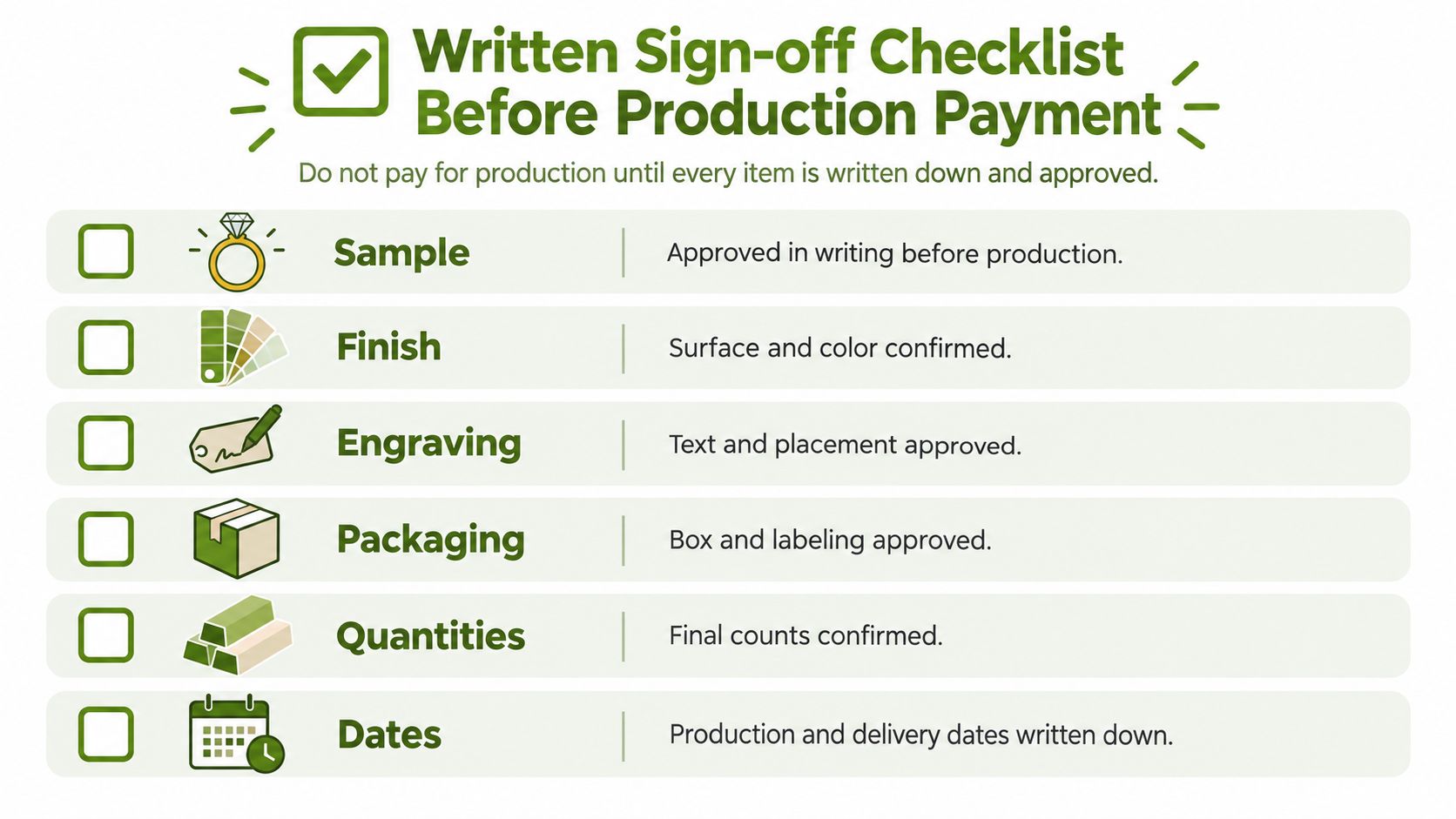
| Approval record | Minimum detail |
|---|---|
| Brief revision | File name, revision number and date |
| Physical sample | Sample ID, sampled size, photos and accepted deviations |
| Dimensions | Target, tolerance, measuring points, tool and recorded result |
| Finish | Color or texture reference, process description and inspection notes |
| Order matrix | Quantity by size, style and color; total piece count |
| Testing | Method, specimen, exposure, criterion, result and report reference |
| Branding and packaging | Approved engraving proof, packaging artwork and pack-out |
| Commercial plan | Price, production start, inspection responsibility, remedy and shipping estimate |
- Sample: Keep front, side, interior and detail photos with the approved sample ID.
- Finish: Record the physical reference and any accepted variation. Do not approve from a render alone.
- Alloy and nickel release: Confirm 316L or the actual alloy purchased and the evidence required for the destination market. The EU REACH nickel restriction sets a release limit of 0.5 µg/cm²/week for rings and other articles intended for direct and prolonged skin contact; coated articles must remain below that rate for at least two years of normal use. This is a regulatory condition, not a lifetime-wear promise.
- Engraving: Sign off on the exact file, readable size, placement and orientation.
- Packaging: Approve materials, artwork, labels, inserts and the unit pack-out.
- Quantities: Confirm the minimum, size allocation, color allocation and total.
- Dates and shipping: Record when production begins and ask for the carrier, service level and transit estimate before payment.
Keep the email trail as the order record. For another review aid, use HonHo's jewelry sample approval checklist. Send consolidated questions within Monday to Saturday, 9:00–18:00 HKT, and leave room for a written reply before approval.
HonHo Wholesale Jewelry offers ready-stock rings alongside custom options for retailers developing private-label designs. Browse HonHo Wholesale Jewelry, review the Custom Jewelry process, or request a project quote with the size matrix and brief attached.


