

Conjunto de dos piezas para mujer means a women’s two-piece jewelry set. For a retailer, visual coordination is only the starting point. Decide whether the pieces will be sold as one fixed set, as two linked listings, or as a main item with an add-on. That choice affects the SKU structure, packaging, photography, margin calculation and reorder plan.
Approve the two components separately as well as together. Each needs its own material description, dimensions, closure and finish reference; the packaged set also needs a final comparison for color, scale and presentation.
Table of Contents
- What Makes a Two-Piece Jewelry Set
- Common Two-Piece Set Combinations and Who Buys Them
- Stainless Steel, Brass, 925 Silver and Gold Plated Compared
- How to Style a Set So Each Piece Works Alone
- Pricing, Markup and Inventory for Set Sales
- What to Verify Before Ordering Wholesale Sets
- Plan Your First Coordinated Set Order
What Makes a Two-Piece Jewelry Set
A two-piece jewelry set pairs two coordinated pieces, usually earrings with a necklace, bracelet, or ring. Coordination can come from the same motif, finish, stone color, pearl tone or visual weight. It does not mean the components share every specification.
For buying and listing purposes, record the component relationship explicitly:
| Offer structure | What the customer sees | What the retailer must control |
|---|---|---|
| Fixed set SKU | One listing, one price and both pieces in the parcel | One pack-out standard plus component-level specifications |
| Linked individual SKUs | Either piece can be bought alone; coordinated images connect them | Separate stock, pricing and product claims for each component |
| Main item with add-on | The second piece is offered at product page, cart or checkout | Add-on margin, availability and substitution rules |
A fixed set is the simplest gift offer, but it can stop selling when either component is unavailable. Linked listings preserve more flexibility. An add-on can increase basket value, provided the second item remains in stock and the combined price still meets the retailer’s margin requirement.
A Coordinated Set Versus a Bundle
A bundle groups products for a commercial offer. A coordinated set makes a visual promise: the pieces should look intentional together. The promise may rest on a repeated motif, a shared color reference or closely matched metal finish.
Wholesale catalogs often list coordinated sets alongside single earrings, rings, necklaces, and bracelets. Retailers can buy a ready-made set or pair two products themselves. If the components come from different runs, compare the samples side by side before calling them a matched set. Gold tone, silver tone, stones and simulated pearls can differ even when product photos look similar.
For a more detailed purchase-order workflow, use HonHo’s wholesale two-piece jewelry set sourcing guide. This article focuses on choosing the offer structure and approving the components that support it.
Common Two-Piece Set Combinations and Who Buys Them
| Combination | Likely retail job | Approval point | Listing opportunity |
|---|---|---|---|
| Stud earrings + pendant necklace | Compact gift and everyday offer | Compare motif scale and stone color | Show the necklace and earrings together and separately |
| Hoop earrings + chain bracelet | Casual coordinated metal look | Compare finish reference and visual weight | Link the standalone products if sold individually |
| Pearl drop earrings + pearl-accent ring | Occasion or gift presentation | Approve pearl tone, size range and setting security | State whether the pearls are cultured, simulated or another material |
| Stacking rings + bangle | Layering-oriented offer | Confirm ring sizing and bangle dimensions independently | Provide the size information before the customer chooses the set |
Choose the pairing by the job it needs to do in the assortment. A gift set benefits from one clear presentation and a complete pack-out. A layering offer needs better sizing information and individual product photos. If either component could sell strongly alone, separate SKUs may protect more revenue than a set-only listing.
Evergreen Versus Trend-Led
Simple hoops, studs, pendants and pearl-inspired pairings can support a core assortment because they are easier to merchandise across several occasions. The white glass bead necklace and drop earrings set shows a direct necklace-and-earring relationship.
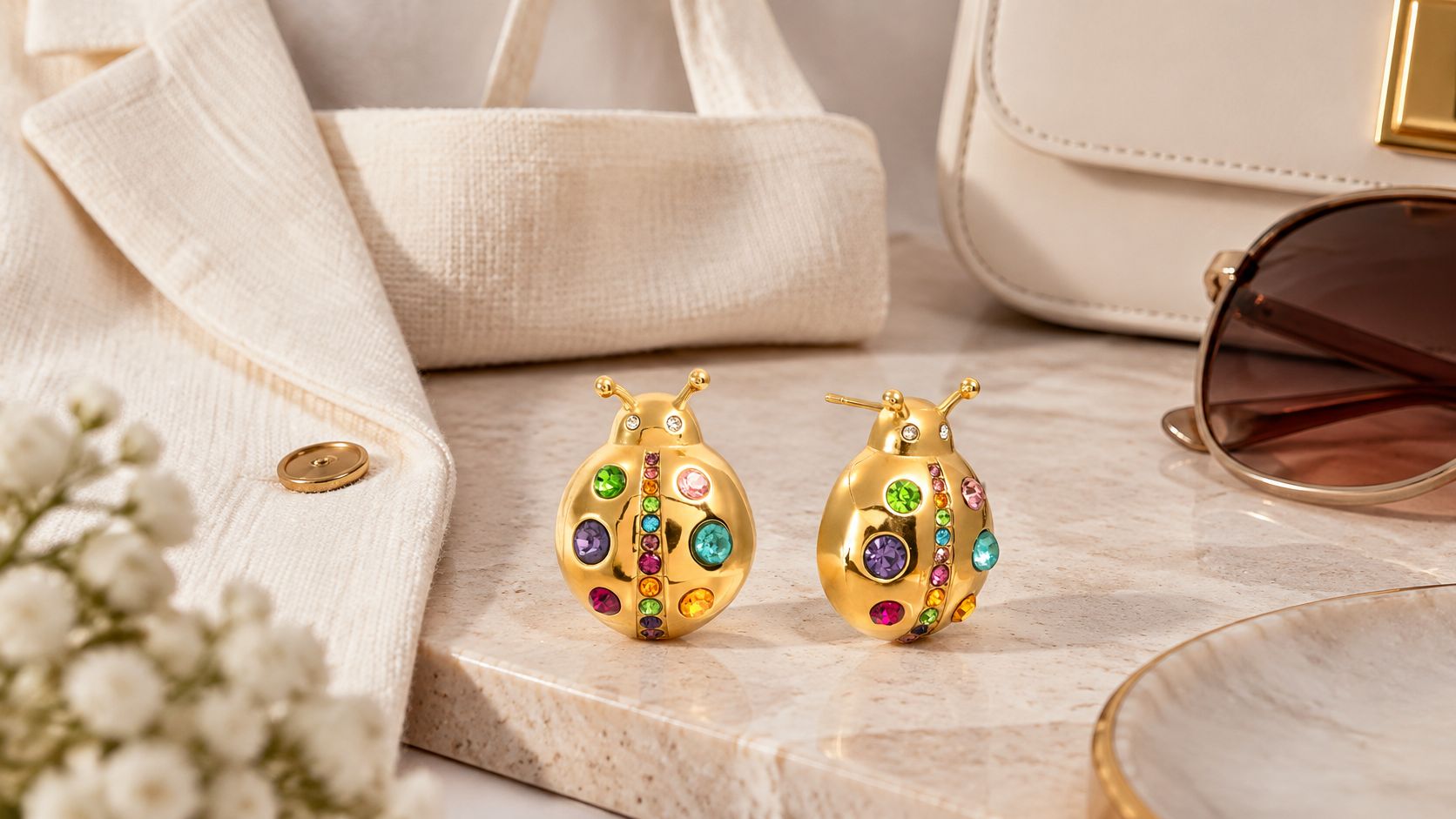
Motifs such as bows, shells, animals or celestial forms can give a set a clearer point of view. They also narrow the audience. The Gold Plated Stainless Steel Multicolor Ladybug Stud Earrings illustrate how a distinctive motif can lead an assortment; a matching partner should echo that motif without competing with it.
Do not label a design “evergreen” or “trending” as a sales prediction. Use those terms as assortment roles, then let actual sales by component and by set decide the reorder.
Stainless Steel, Brass, 925 Silver and Gold Plated Compared
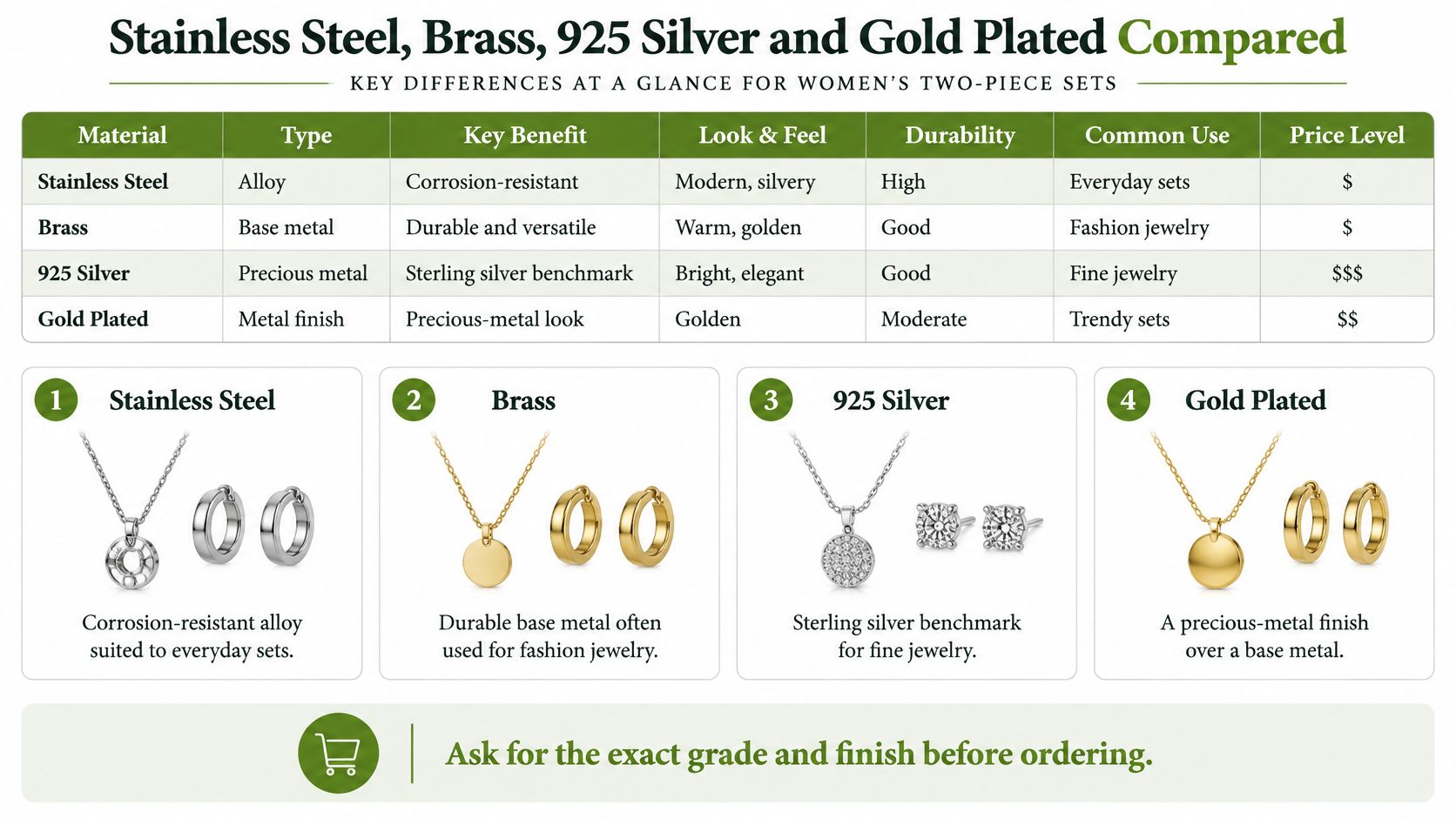
Material and finish are separate fields. “Gold plated” describes a finish, not the base metal. “925 sterling silver” describes metallic content. A two-piece set can also contain different materials, but the listing must say which claim belongs to which component.
| Material or finish | What to request | What to compare on the sample | Claim boundary |
|---|---|---|---|
| Stainless steel | Exact grade if it will be stated; finish route and color reference | Edges, posts, clasp action, polish and color match | Do not copy a grade from a similar style |
| Brass | Base metal, plating or coating, and any supplier-stated finish specification | High-contact areas, solder points, edges and recesses | Do not promise a wear period from appearance alone |
| 925 sterling silver | Component-level silver specification and marking details | Marking, construction, closure, surface and stone setting | The sterling claim applies only to qualifying components |
| Gold plated | Base metal, finish description and available process details | Color consistency across both pieces and likely contact points | Gold plated is not solid gold |
| Silver-tone or silver plated | Base metal and the supplier’s finish description | Color match, coverage and finish defects | Silver color alone does not make an item sterling silver |
When stainless steel is specified, use the documented grade for the actual style. A factory’s ability to work with several grades does not establish the grade of every SKU. The same caution applies to finish routes: a supplier’s general process capability is not proof of the construction used on one ready-stock item.
For brass or any plated piece, approve the finished sample rather than relying on a rendered image. Record the reference color and inspect the areas most likely to show uneven coverage. Finish thickness, pretreatment, top coating, wear conditions and geometry can all affect performance, so one number should not be converted into a promised wearing lifetime.
The Silver Rule You Cannot Blur
For U.S. listings, the Federal Trade Commission guide on buying platinum, gold and silver jewelry explains that items described as “silver,” “sterling,” and “sterling silver” contain at least 92.5% pure silver, while “925” indicates 925 parts per thousand. Apply the claim to the actual component, not automatically to the full set.
A silver-colored finish on another base metal is silver plated or silver-tone, not sterling. Keep the wording aligned across title, specifications, packaging and advertising. The HonHo guide to silver and gold plated finishes provides more detail on separating base metal from finish.
Gold plated likewise identifies a gold layer over a base material. State the base metal when it is known and relevant. Do not describe an entire set as sterling silver, stainless steel or another material if only one component meets that description.
How to Style a Set So Each Piece Works Alone
Styling is a product-development check as much as a marketing exercise. The set should read clearly in one coordinated photograph, while each component should still make sense in its own image and listing. If the pieces are sold separately, this matters even more: the customer needs to understand both the standalone item and the relationship between them.
Three Rules That Keep a Set Flexible
- Choose one lead piece: Let the more detailed component carry the motif; the second can repeat the finish, color or a smaller design element.
- Match with a reference, not a color name: “Gold” or “silver” is too broad for sample approval. Use the approved sample, color standard or supplier reference agreed for the project.
- Check proportion on the body: Pendant scale, chain length, earring drop, bracelet width and ring size can change how balanced a set feels.
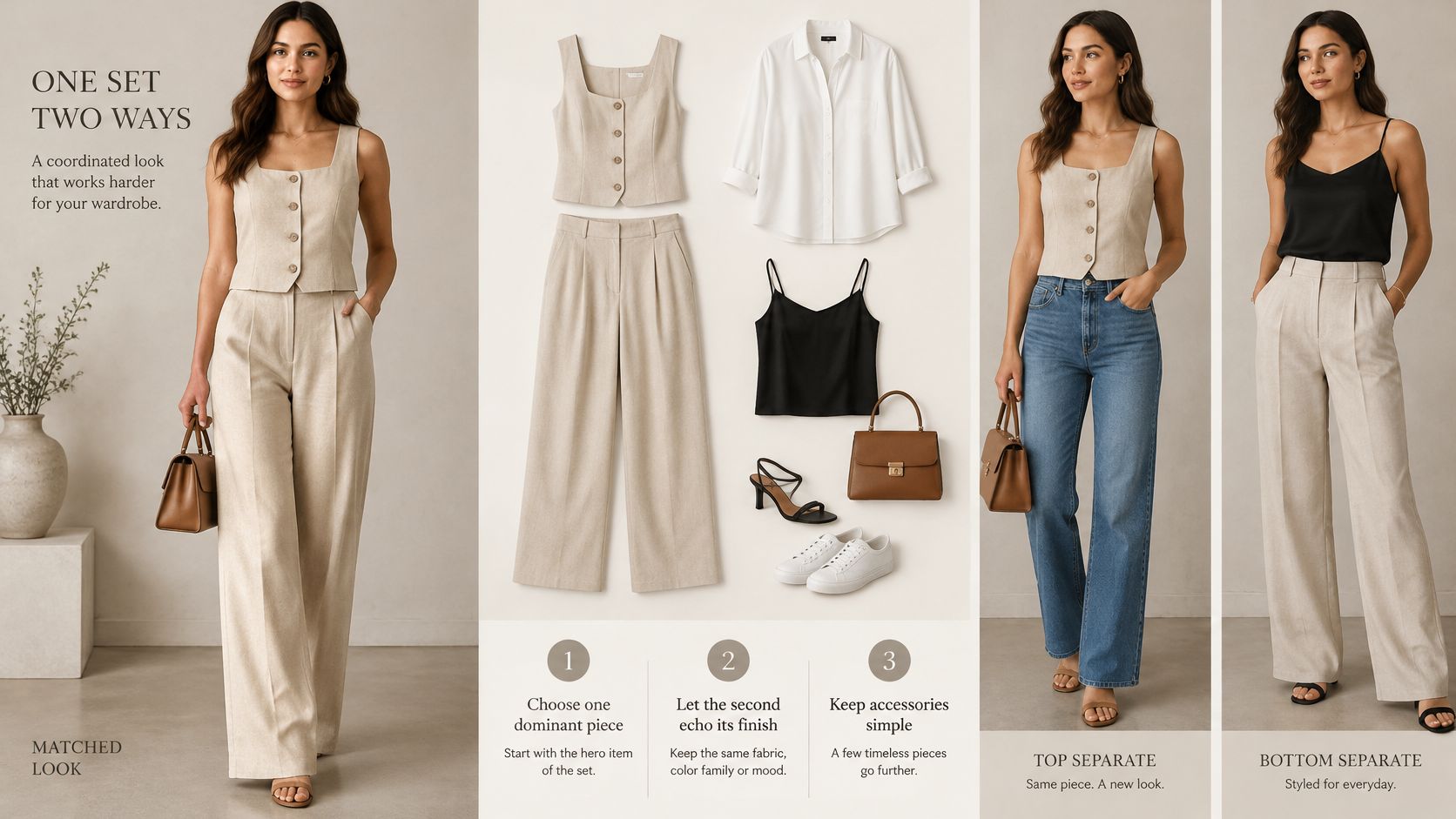
Build the product page around verifiable views. Photograph the complete set, each piece alone, the closure or fastening, and the packaged contents. Add dimensions or a scale reference where an image could mislead. For earrings paired with a necklace, show the earring front and post as well as the necklace clasp and pendant.
If the set is intended for office, occasion or casual merchandising, treat that as positioning rather than a performance claim. A buyer can judge whether the proportions and finish fit the collection; the listing should supply the concrete details needed for that judgment.
Two Mistakes and the Fix
Mistake one: approving the pieces in separate photos. Lighting and editing can hide a color mismatch. Fix it by requesting one unedited comparison view or checking the physical samples together.
Mistake two: showing a styled combination that does not match the parcel. A customer may assume that every visible item is included. Fix it by identifying both components in the title, image set and package-contents field.
For sellers: A useful image sequence is set together, component A, component B, fastening details and final packaging. It answers more buying questions than several near-identical lifestyle images.
Pricing, Markup and Inventory for Set Sales
Start with landed cost, not the sum of two retail prices. Include the two components, set packaging, inbound freight allocation, payment costs, expected handling and any other costs your business uses in its pricing model. Then test the proposed selling price against the required gross margin.
For a proposed selling price P and landed cost C, gross margin percentage is (P − C) ÷ P × 100. The acceptable result depends on your channel, overhead and promotion plan; this article does not set a universal markup. Recalculate after any set discount or add-on offer.
| Approach | How it works | Operational advantage | Main risk |
|---|---|---|---|
| Sell as one set SKU | One listing and price cover both components | Simple gift decision and one pack-out | One unavailable component stops the set |
| Sell pieces separately | Each component has its own listing and price | Independent demand and replenishment remain visible | Customers may miss the intended pairing |
| Discounted add-on | The second piece receives a conditional price | Flexible cross-sell without a permanent set SKU | Discount and stock logic must remain accurate |
Stock by Component, Not by Bundle
A single set SKU is still constrained by two component counts. If 40 necklaces and 27 matching earring pairs pass inspection, no more than 27 complete sets are immediately available. Reserve quantities carefully if the same components are also sold on their own.
Track sales and returns for each component even when checkout uses a set SKU. If one piece sells alone faster or creates more returns, the combined figure can hide the reason. The assortment framework in plan wholesale jewelry for boutiques can help place the set within a broader category plan.
Define what happens when one component is unavailable: pause the set, substitute only after written approval, or continue with separate listings. A silent substitution can change the material claim, dimensions, color match or photographed contents.
What to Verify Before Ordering Wholesale Sets
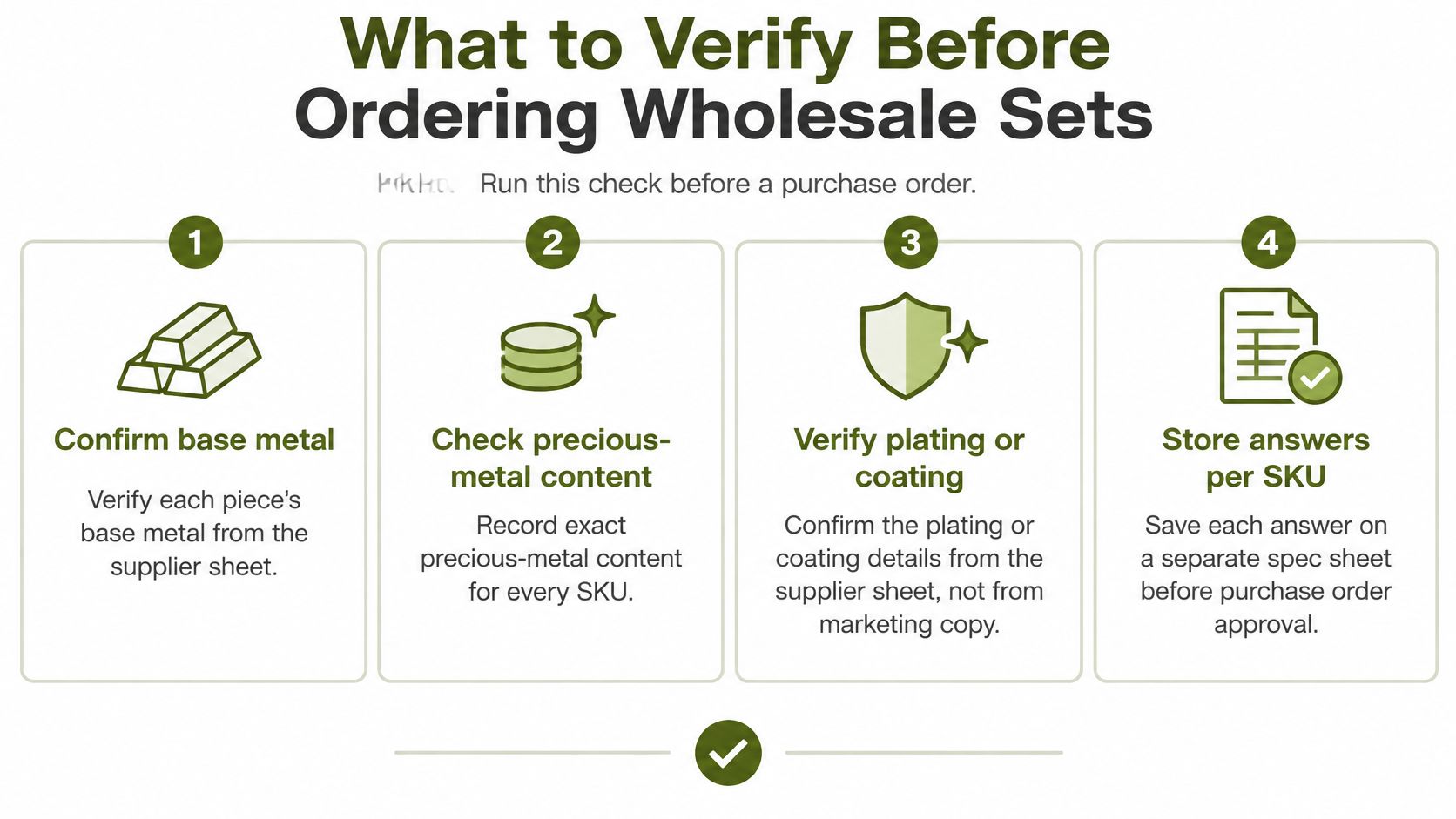
Use one approval record for the commercial set and a specification line for each component. A useful record makes the sample, purchase order, inspection and product page refer to the same approved details.
| Field | Component A | Component B | Set-level approval |
|---|---|---|---|
| Identity | Component code and name | Component code and name | Set code and exact package contents |
| Material | Base metal, precious-metal content, stone or pearl description | Base metal, precious-metal content, stone or pearl description | Claims assigned to the correct component |
| Finish | Finish route and approved color reference | Finish route and approved color reference | Side-by-side color and surface match |
| Construction | Dimensions, weight if relevant, closure and findings | Dimensions, weight if relevant, closure and findings | Scale, motif direction and presentation |
| Commercial terms | Availability or production requirement | Availability or production requirement | MOQ, sampling route, production timing and packaging |
- Confirm each piece separately: Record the base metal, precious-metal content, finish, dimensions and closure for both pieces.
- State mixed claims clearly: If one piece is 925 sterling silver and the other is silver-tone, assign each description to the correct component.
- Check consistency across pieces: Compare finish, color, motif scale and any stone or pearl reference on the same sample approval.
- Sample both pieces in hand: Check fastening, edges, settings, movement and how the pair sits together. A visual check is not a substitute for a defined performance test when one is required.
- Record the supplier’s terms: Separate ready-stock availability from made-to-order minimums and timelines. Confirm current terms for the actual order.
- Check the photography: Make sure the listing shows what arrives, including both components and the packaging when packaging is part of the offer.
- Verify private-label options: Approve the artwork, placement, packaging material and any effect on minimums or timing before production.
Why the Spec Sheet Matters
The FTC Jewelry Guides address representations including metallic content, size, weight, color, treatment, durability, origin and price. A written specification helps keep those details aligned across the purchase order, inspection record, product page, marketplace feed and packaging.
Testing must be tied to a stated method, specimen and acceptance criterion. A factory capability or test route does not mean every ready-stock style, production lot or finished set has passed it. If a report is relevant to the order, verify that its sample identity and scope match the product being sold.
Use a jewelry sample approval checklist for both components and the packaged set. Store the approved references with the purchase order so later substitutions or reorders can be compared against the same record.
Plan Your First Coordinated Set Order
Start with a small, measurable assortment role rather than an unsupported sales forecast. The goal of the first buy is to learn whether customers prefer the complete set, one component, or a conditional add-on.
- Choose the offer structure: Decide between a fixed set SKU, linked individual SKUs and an add-on before building the listing and inventory rules.
- Define the exact pair: Record component codes, material claims, finish references, dimensions, closures and package contents.
- Approve the sample three ways: Check component A, component B and the packaged set. Keep photographs and written notes with the approval.
- Calculate the commercial case: Use landed cost and the margin formula for the actual channel. Include the effect of any set discount.
- Confirm current order terms: For custom work, use the supplier’s current MOQ and schedule for the material and project. The overview of low-MOQ options for jewelry manufacturers explains why those terms should be checked rather than assumed.
- Set component-level triggers: Track available, reserved, sold and returned quantities for each piece. Reorder or pause the set before one component becomes the bottleneck.
For ready-stock sourcing, compare the pieces by documented material, finish, construction and current availability. For private label, send both component specifications and the intended pack-out for review. HonHo’s custom-order planning banner currently lists a MOQ from 50 pieces per style and color, sample timing of 25–30 days for brass and 925 silver, and 25–35 days for stainless steel; these are planning ranges, not a promise for every design, so confirm the actual route before ordering.
Visit HonHo Wholesale Jewelry to compare ready-stock options, or send the two component references, target finish, quantity and packaging requirement for a project-specific review.


