

Gold-plated sterling silver is 925 sterling silver with a real-gold surface coating. For a wholesale buyer, the decisive questions are not simply whether the piece looks gold, but what the substrate is, which surfaces are coated, the minimum gold thickness and fineness, how the finished design is measured, and how it will be labeled for sale.
This construction can sit between fine jewelry and lower-cost fashion jewelry: the sterling silver provides the precious-metal base, while the gold coating provides color. It is not solid gold, and no single thickness can guarantee a fixed wear life. Design, friction, preparation, porosity, chemicals, care, and measurement location all matter.
Table of Contents
- What Silver Gold Plated Actually Means
- How Gold Plating Over Sterling Silver Works
- Why Gold Plating Wears Off and How Silver Reacts
- Comparing Silver Gold Plated With Other Gold-Finish Options
- How to Specify Gold Plating on a Wholesale Order
- Selling and Marketing Silver Gold Plated Jewelry Honestly
- Frequently Asked Questions and Final Takeaways
What Silver Gold Plated Actually Means
Silver gold plated jewelry is made from a 925 sterling silver base with a layer of gold applied to the surface, commonly by electroplating. The silver provides the underlying precious-metal construction; the gold creates the visible color and finish. The coating does not turn the whole piece into gold.
That distinction matters when comparing supplier quotations. Gold-filled jewelry uses a mechanically bonded gold layer and follows a different construction model. Solid gold is a gold alloy throughout. A gold-colored finish over brass or stainless steel may look similar in a product photograph, but it has a different substrate, cost structure, labeling requirement, and after-wear appearance.
In the United States, “vermeil” is not merely a premium-sounding synonym for any gold-plated silver. The federal Jewelry Guides describe a sterling silver base, gold of at least 10 karat on all significant surfaces, reasonable durability, and a minimum fine-gold-equivalent thickness of 2.5 µm. They also require disclosure when a base-metal layer is used under the gold. Check the current rule in 16 CFR § 23.4 before using the term for U.S. sales.
Silver itself also sits inside a wider commodity market. The U.S. Geological Survey's 2026 silver summary estimated U.S. mine production at approximately 1,100 metric tons in 2025, valued at about $1.4 billion. The same source estimated that jewelry and silverware represented 6% of U.S. silver use, while electrical and electronics accounted for 25% and photovoltaics for 15%. These figures provide commodity context; they do not prove the composition or quality of a particular jewelry lot.
Approval rule: Do not approve a piece because it looks gold in a sample photograph. Confirm the substrate, coating type, gold fineness, minimum thickness, intermediate layers, covered surfaces, and evidence tied to the finished sample.
The finish can work well when a store wants the material story of sterling silver in a warmer color without positioning the item as solid gold. HonHo's jewelry materials and plating guide is a useful starting point for comparing material and finish terminology.
How Gold Plating Over Sterling Silver Works
Gold plating starts with preparation, not the gold bath. The sterling silver surface must be cleaned, degreased, and activated so contaminants and oxides do not interfere with adhesion. A thicker deposit cannot reliably compensate for poor preparation, rough finishing, trapped polishing compound, or weak coverage around joints and recesses.
During electroplating, current deposits gold from an electrolyte onto the conductive jewelry surface. Coverage must be controlled across curves, edges, recesses, solder joints, posts, and moving parts. A flat color chip can help approve shade, but it cannot represent every geometry on a finished ring, clasp, or earring.
Thickness is the buying variable
“Gold plated” alone tells a buyer little about the intended construction. State a minimum coating thickness in micrometers (µm), name the gold fineness, identify the substrate, and define where measurements will be taken.
The FTC consumer explanation says gold electroplate is at least 10K gold with a minimum thickness of 0.175 µm applied electrolytically. It also distinguishes thinner “gold flashed” or “gold washed” finishes. Review the terminology in the FTC consumer guide to buying platinum, gold, and silver jewelry and the agency's jewelry guides statement of basis and purpose. These are labeling references, not promises of service life.
| Term or requirement | What it establishes | What it does not establish |
|---|---|---|
| Gold electroplate in the FTC consumer explanation | At least 10K gold and at least 0.175 µm by an electrolytic process | A guaranteed wear period or coverage at every high-friction edge |
| Vermeil under the U.S. Jewelry Guides | Sterling silver base, qualifying gold, coverage, durability, and at least 2.5 µm fine-gold equivalent | That every gold-plated silver item is vermeil |
| Project-specific plating specification | The buyer's required minimum, gold fineness, surfaces, measurement plan, and acceptance rule | Performance outside the agreed design, use, and test conditions |
ASTM B488 is often cited in industrial electrodeposited-gold discussions, but an engineering coating class should not be used as a loose jewelry marketing label. The purchase order still needs to name the applicable edition, substrate and underplate, service condition, thickness class, significant surfaces, and inspection method. The technical overview from Douglas Manufacturing provides background on this coating framework; it is not evidence that a specific HonHo or supplier lot has passed that specification.
X-ray fluorescence (XRF) is useful because it can estimate coating thickness and composition without cutting the piece. ISO 3497 describes X-ray spectrometric measurement of metallic coating thickness. An XRF result applies to the measured spot and method; it does not by itself prove uniform thickness over the whole three-dimensional piece or predict years of wear.
Why Gold Plating Wears Off and How Silver Reacts
Gold plating does not fail for one single reason. Friction removes material from exposed areas. Pores or thin areas can create pathways to the substrate. Sweat, cosmetics, cleaning agents, chlorine, moisture, and sulfur-containing environments can accelerate discoloration once the protective surface is compromised. Adhesion and porosity also depend on surface preparation, deposit chemistry, intermediate layers, and the geometry of the part.
Sterling silver beneath the coating may become visible as high-contact gold wears. Silver can also react with sulfur-containing compounds, producing tarnish that may appear at exposed areas or through defects. This is why a universal “plating thickness equals X years” claim is not credible without a defined design, process, exposure, and acceptance test.
The wear map matters
Flat, protected surfaces are rarely the first places to show wear. A ring's outside edge, a bracelet's underside, a necklace clasp, an earring post, a raised motif, or a moving joint receives more contact than a recessed center. Polishing and assembly can also alter coverage after deposition.
| Measurement or inspection zone | Why it matters | Approval evidence |
|---|---|---|
| Ring edge or bracelet underside | Repeated friction and impact | Minimum-thickness readings at agreed high-contact points |
| Flat face or pendant center | Useful color and process reference | Color standard plus thickness reading |
| Clasp, joint, recess, or soldered area | Geometry and preparation can reduce coverage | Magnified visual check and design-specific readings where accessible |
| Earring post and skin-contact component | Direct contact and separate component materials | Component identity and finished-product compliance evidence for the target market |
Ask for testing on the actual finished design, not only on a flat coupon. A coupon can monitor a process under simple conditions, but it does not reproduce sharp edges, recesses, joints, or contact zones. Keep the tested sample's SKU, color, size, production date or lot, and measurement map with the report.
Retailers should also give customers practical care instructions. Recommend avoiding chlorine, abrasive polishing, perfume, and prolonged sweat or water exposure. These factors can attack the surface or increase wear. A concise gold-plated jewelry care guide gives retailers a basis for customer-facing care language.
A coating can meet an agreed reading at one point and still wear unevenly if the design concentrates friction elsewhere.
For product development, agree on design-relevant adhesion, appearance, wear, tarnish, or corrosion checks before bulk approval. Record the method and acceptance rule; do not translate a laboratory result into a guaranteed wearing period unless the evidence supports that exact claim.
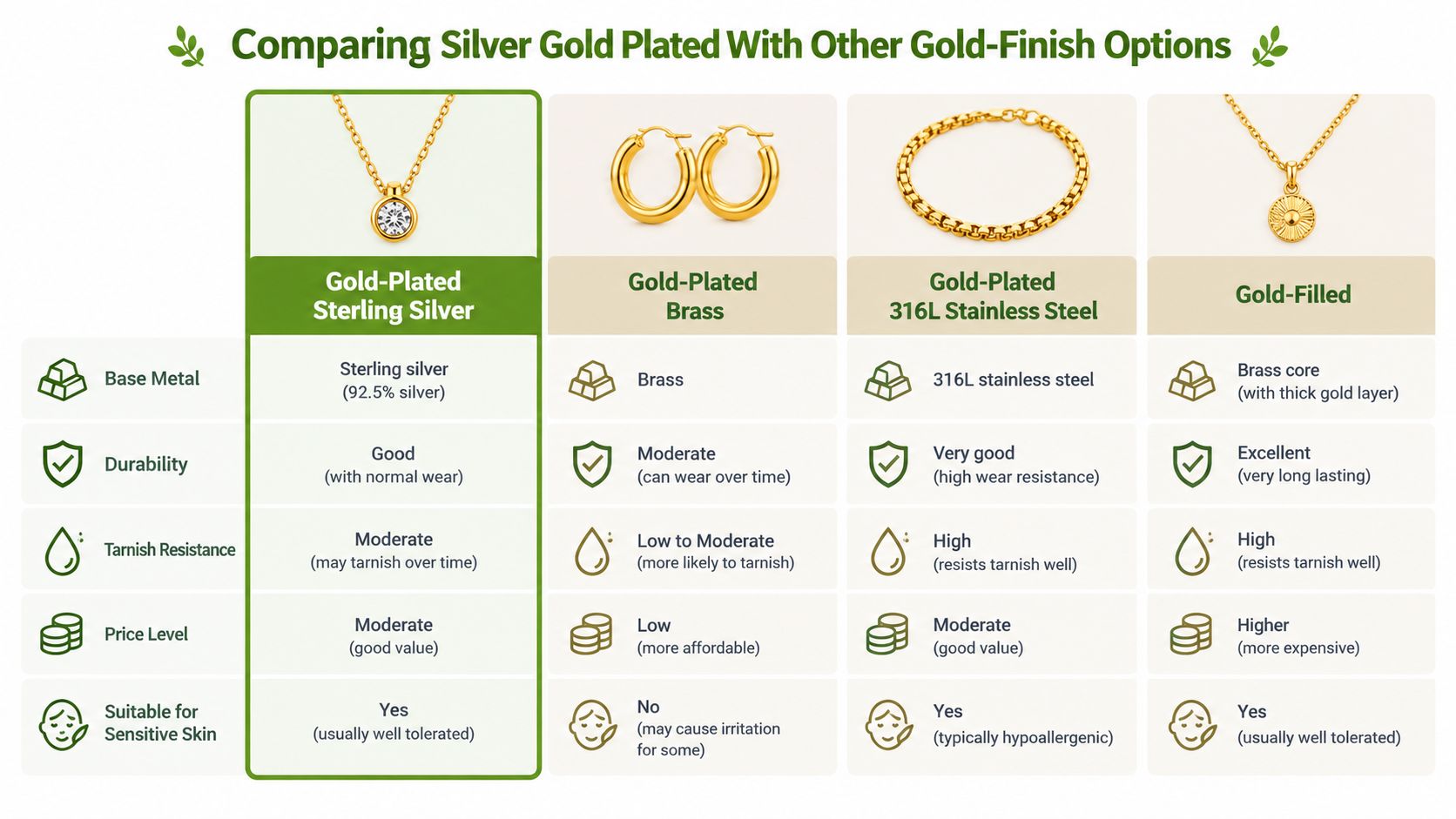
Comparing Silver Gold Plated With Other Gold-Finish Options
The right finish depends on the store's price architecture, target customer, market requirements, and after-wear expectations. Gold-plated sterling silver offers a precious-metal base. Plated brass and plated stainless steel have different substrate stories. Gold-filled construction is mechanically bonded and should be sourced and labeled according to its own definition.
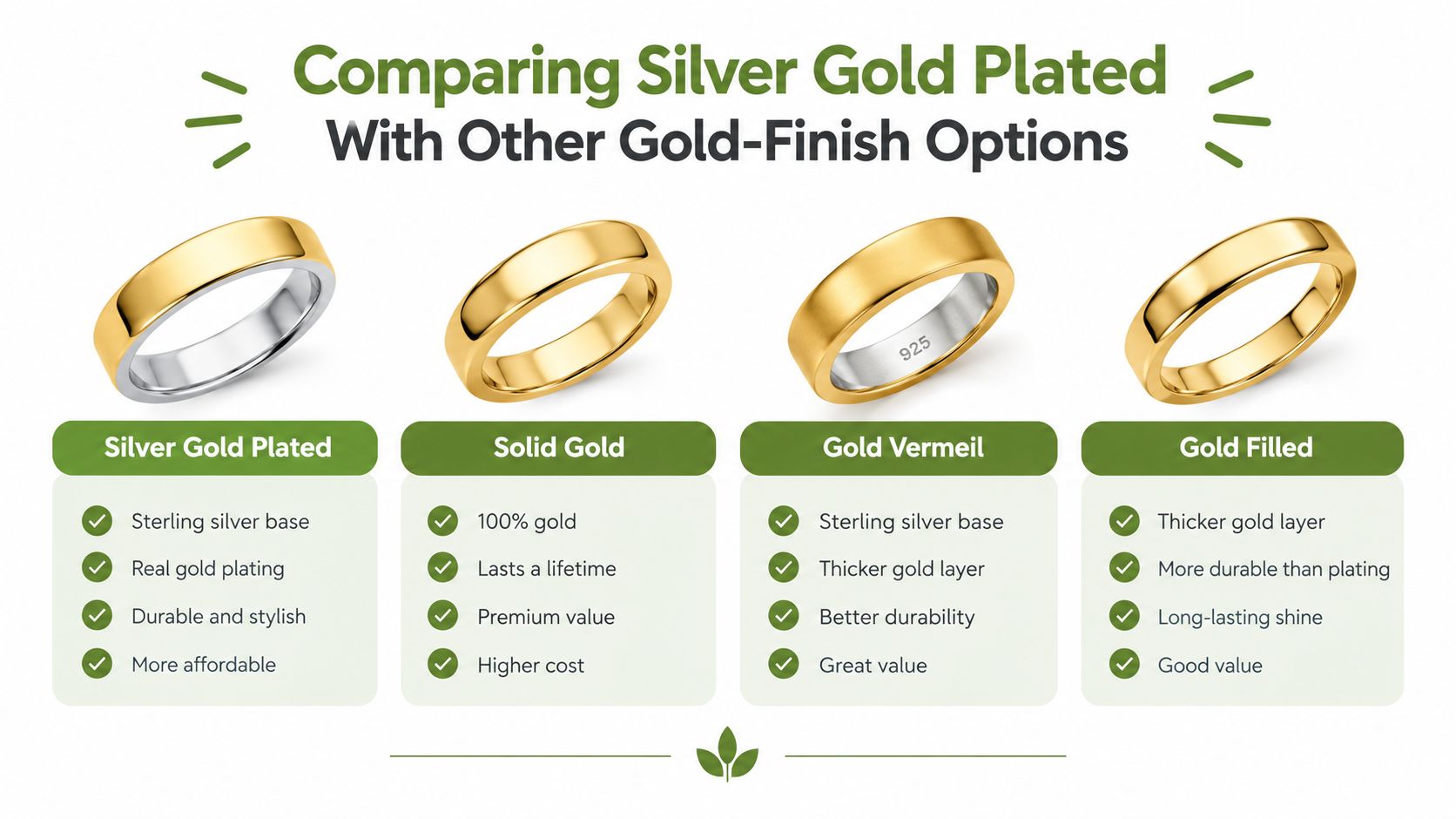
| Option | Underlying construction | Useful retail position | What the buyer must verify |
|---|---|---|---|
| Gold-plated sterling silver | Gold coating over 925 sterling silver | Demi-fine or accessible premium where the silver base matters | 925 substrate, gold fineness, minimum thickness, surfaces, intermediate layers, and measurement plan |
| Gold-plated brass | Gold coating over brass | Fashion price points | Alloy, coating system, skin-contact components, finish specification, and target-market compliance |
| Gold-plated stainless steel | Gold-colored coating system over a specified steel grade | Lifestyle or fashion lines where steel is part of the product brief | The actual grade for the SKU, coating process, color, thickness or process control, and finished-product evidence |
| Gold-filled | Mechanically bonded gold layer over a base-metal core | Higher demi-fine positioning when construction and gold content justify it | Gold content, construction, markings, exposed components, and legal terminology in the sales market |
A boutique does not need one material for every customer. A mixed assortment can create fashion, mid-range, and material-led tiers, but the product page and staff training should explain the differences. Rings and cuffs normally deserve more attention to friction zones than protected pendants or occasional-wear pieces.
Do not transfer claims from one coating process to another. For example, gold PVD coating describes a different deposition route and must be evaluated through its own substrate, layer system, color, thickness or process specification, and test evidence.
The buying decision is therefore not “which option lasts forever?” None should be presented that way. Choose the construction that matches the retail promise, then make the purchase order, sample approval, labeling, and care message agree with one another.
How to Specify Gold Plating on a Wholesale Order
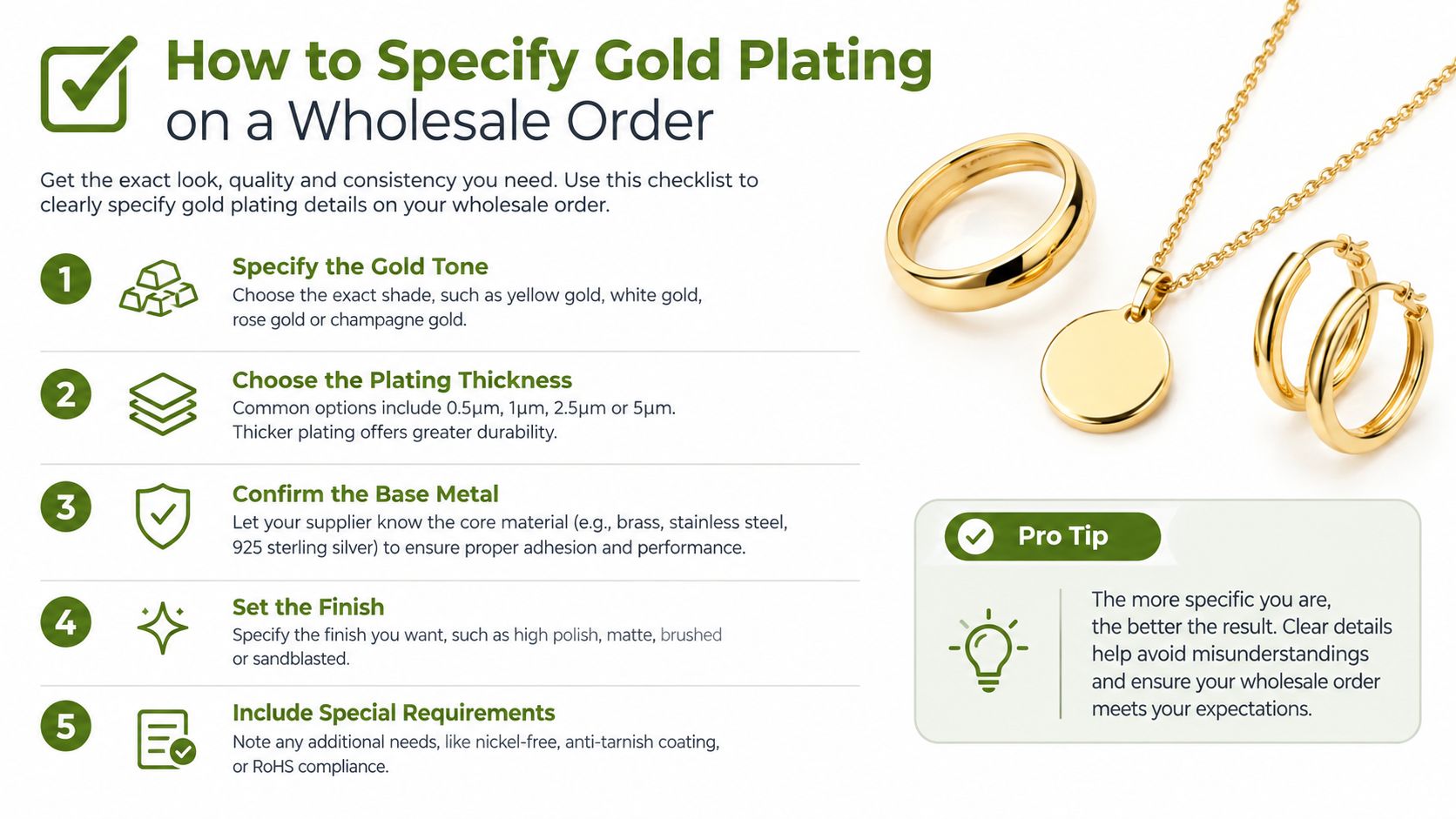
A purchase order should describe the finish in measurable terms. “Gold plated” is a category, not a complete production specification. Two batches can look similar in a studio photograph while differing in substrate, intermediate layers, coverage, and inspection results.
Use this order checklist:
- Identify the exact base and components. State 925 sterling silver where agreed, and list any posts, clasps, solder, springs, or findings that use another material.
- Name the gold fineness and color. Record the karat requirement and approved color reference. The historical FTC benchmark for gold electroplate uses at least 10-karat gold, as described in the agency's Federal Register jewelry guides notice.
- State a minimum thickness and significant surfaces. Avoid an unspecified average. Mark edges, undersides, posts, clasps, raised details, and other high-contact zones on a drawing or sample.
- Disclose intermediate layers. Record any barrier or underplate material, especially when legal terminology or skin-contact claims depend on the full layer system.
- Agree on verification. Name the method, instrument or laboratory where relevant, calibration or reference approach, number of pieces, measurement locations, rounding rule, and acceptance criterion. XRF readings should be traceable to the sample and measured spots.
- Freeze the approved sample. Link the sample identity, finish color, texture, dimensions, coating specification, report, packaging, and care copy to the production order.
Add process controls for repeat production
The coating requirement should sit beside the pretreatment and inspection plan. Ask the supplier to define cleaning, activation, barrier or intermediate layers where used, and any adhesion, appearance, wear, tarnish, or corrosion checks required for approval. A nominal thickness reading does not erase poor preparation or weak coverage at difficult geometry.
For custom HonHo 925 sterling silver development, the current planning baseline is 50 pieces per style and color, approximately 25–30 days for samples, and approximately 35–45 days for bulk production after approval. These are planning ranges for custom development, not a promise for every design or a ready-stock dispatch time; the project quotation and confirmed production plan control.
A supplier who can answer these questions is showing production control rather than quoting only a color and price. HonHo's wholesale ordering guide can help buyers organize material, finish, quantity, packaging, and order details before requesting a quotation.
Selling and Marketing Silver Gold Plated Jewelry Honestly
A product title should tell the customer what the piece is, not what the photograph suggests. A clear format is “925 sterling silver, gold plated”, followed by the jewelry type and design. Use “vermeil” only when the construction meets the applicable definition. Avoid titles that imply solid gold when gold is only a surface coating.
The same discipline applies to sensitive-skin claims. Gold-plated silver is not automatically hypoallergenic. The base alloy, underplate, solder, clasp, earring post, and any nickel release after wear can affect exposure.
For products sold in the European Union, the REACH nickel restriction sets release limits for items inserted into pierced body parts and for articles intended for direct and prolonged skin contact. It also addresses coated articles over normal use. Buyers should check the current consolidated REACH Annex XVII nickel entry and the applicable referenced test standards for the target market, rather than treating “nickel-free” as a substitute for finished-product evidence.
Request reports that represent the actual posts, clasps, plating, solder, and exposed components customers will receive. Record the tested SKU or sample, market, method, dates, and result. Do not apply one report to a materially different construction without technical justification.
Gold-colored silver can also attract attention when gold prices rise. The World Gold Council's 2025 gold demand report reported record global gold-jewelry demand value of US$172 billion, an average gold price of about US$3,431 per ounce, up 44% year over year, and 1,404 tonnes of recycled gold supply. Those figures offer market context, not a sales forecast. Gold-plated sterling silver can provide a gold-colored route with less gold input, but it does not provide solid-gold value, durability, or end-of-life characteristics.
Price the item according to the actual construction, design, coating specification, packaging, landed cost, service level, and customer promise. Care guidance and returns policy should match the product. Do not charge a fine-jewelry premium for an unspecified flash finish while describing it as permanent.
Frequently Asked Questions and Final Takeaways
Is gold-plated sterling silver the same as vermeil?
No. Gold-plated sterling silver describes a gold coating over sterling silver. “Vermeil” has additional requirements in markets such as the United States, including gold fineness, coverage, durability, and minimum thickness. Verify the actual construction and the law where the item is sold.
Does an XRF report prove the whole piece has the stated thickness?
It supports the readings at the reported locations under the stated method. Ask for a measurement map covering representative flat and high-contact zones, plus the sample identity and acceptance rule.
How long will the gold finish last?
There is no responsible universal answer from thickness alone. Geometry, preparation, layer system, friction, sweat, chemicals, frequency of use, and care all affect wear. State the construction and care requirements; do not promise a fixed wearing period without design-specific evidence.
How should I explain wear to customers?
Say that gold is a surface coating and that wear varies with friction, water, sweat, cosmetics, chemicals, and care. Explain that exposed sterling silver may tarnish and can require appropriate cleaning or refinishing.
Can plated silver sit beside two-tone and silver-finish jewelry?
Yes. Group pieces by design or color story, then use accurate material cards and product descriptions to distinguish gold-plated sterling silver, brass, stainless steel, gold-filled construction, and solid gold.
How should I plan a first custom order?
Choose a focused mix of designs and wear zones, confirm the current MOQ and timeline in the quotation, approve the actual finished samples, retain the specifications and reports, then expand only after evaluating appearance, customer response, wear feedback, and returns.
Takeaway: Choose the substrate for the material and price position. Specify the complete coating system and high-contact zones. Verify the finished sample with a traceable measurement plan, then give customers clear instructions through your jewelry care guide.
For a useful HonHo quotation, send the design or reference, target market, base material, gold karat and color, minimum thickness, important wear zones, quantity by style and color, packaging needs, and required test or report. Visit HonHo Wholesale Jewelry to compare current styles and materials, or prepare a custom gold-plated sterling silver brief for review.


