

A wholesale two-piece jewelry set is easy to list and surprisingly easy to mismanage. The buying decision is not simply whether the necklace and earrings look coordinated. A reseller needs to confirm the exact components, base metals, finishes, packaging, compliance scope, replacement options, and reorder method before treating the pair as one sellable SKU.
For a first order, the safest route is to test a narrow group of ready-stock sets, approve one packed sample for each configuration, and track the finished set alongside its two component references. That prevents a missing earring pair, finish mismatch, or packaging change from turning usable inventory into incomplete sets.
| Decision | Confirm before ordering | Why it matters |
|---|---|---|
| Set definition | Exact pieces, quantities, component codes, set SKU | Prevents packing disputes and makes replacements traceable |
| Material and finish | Base metal and finish for each visible and functional component | A coordinated color does not prove identical construction |
| Sample approval | Appearance, measurements, closures, posts, packaging fit, labels | The approved sample becomes the reference for bulk production |
| Inventory | Whether components can be reordered or sold separately | The lower-stock component limits complete-set availability |
| Compliance | Target market, applicable test scope, report identity and date | Evidence for one loose component may not cover the finished set |
Table of Contents
- Why Resellers Are Paying Attention to Coordinated Sets
- What Counts as a Wholesale Two-Piece Set
- Choosing the Right Materials for Coordinated Pieces
- MOQ, Minimums, and Sample Lead Times
- Forecasting and Replenishing a Linked Assortment
- Private Label and Branded Packaging Options
- The Hidden Cost of the Cheapest Set
- A Practical First Order and What to Do Next
Why Resellers Are Paying Attention to Coordinated Sets
A necklace-and-earring set gives a retailer one product story, one giftable presentation, and one main product image. It can also reduce styling work for customers who would otherwise choose two pieces separately. Those advantages are most useful when the set is genuinely easier to buy, receive, and reorder.
Earlier fashion coverage, including Business of Fashion's analysis of matching sets and historical search commentary from HashPedia, shows why coordinated products received attention. Those apparel and search figures do not forecast demand for a particular jewelry set. A reseller still needs evidence from its own audience, price point, return reasons, and reorder data.
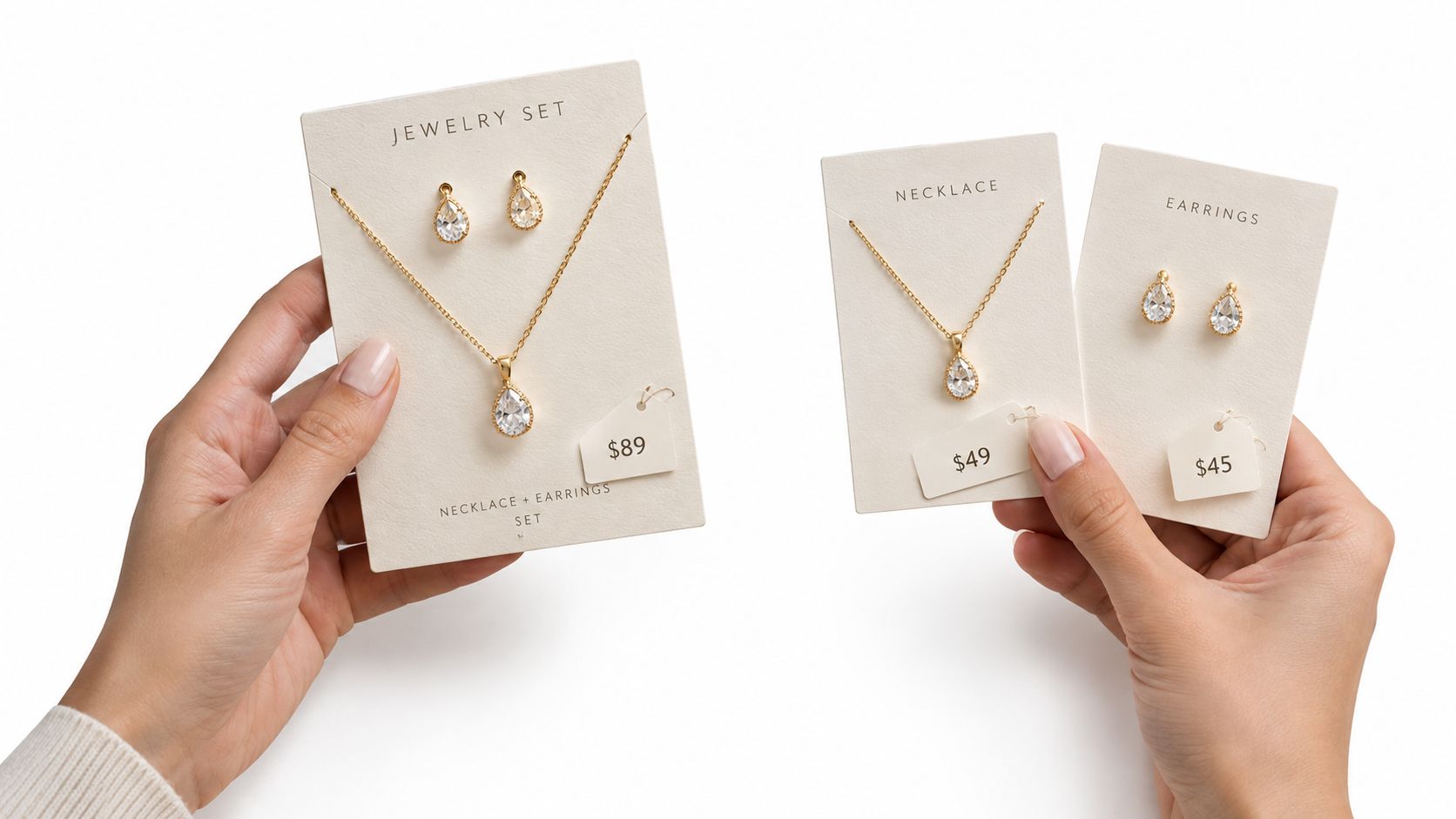
Use giftability as a merchandising benefit rather than a demand guarantee. A useful wholesale jewelry buying guide should help you confirm what ships, what each component is made from, how the set is packed, and what can be reordered if one part sells or fails faster than the other.
What Counts as a Wholesale Two-Piece Set
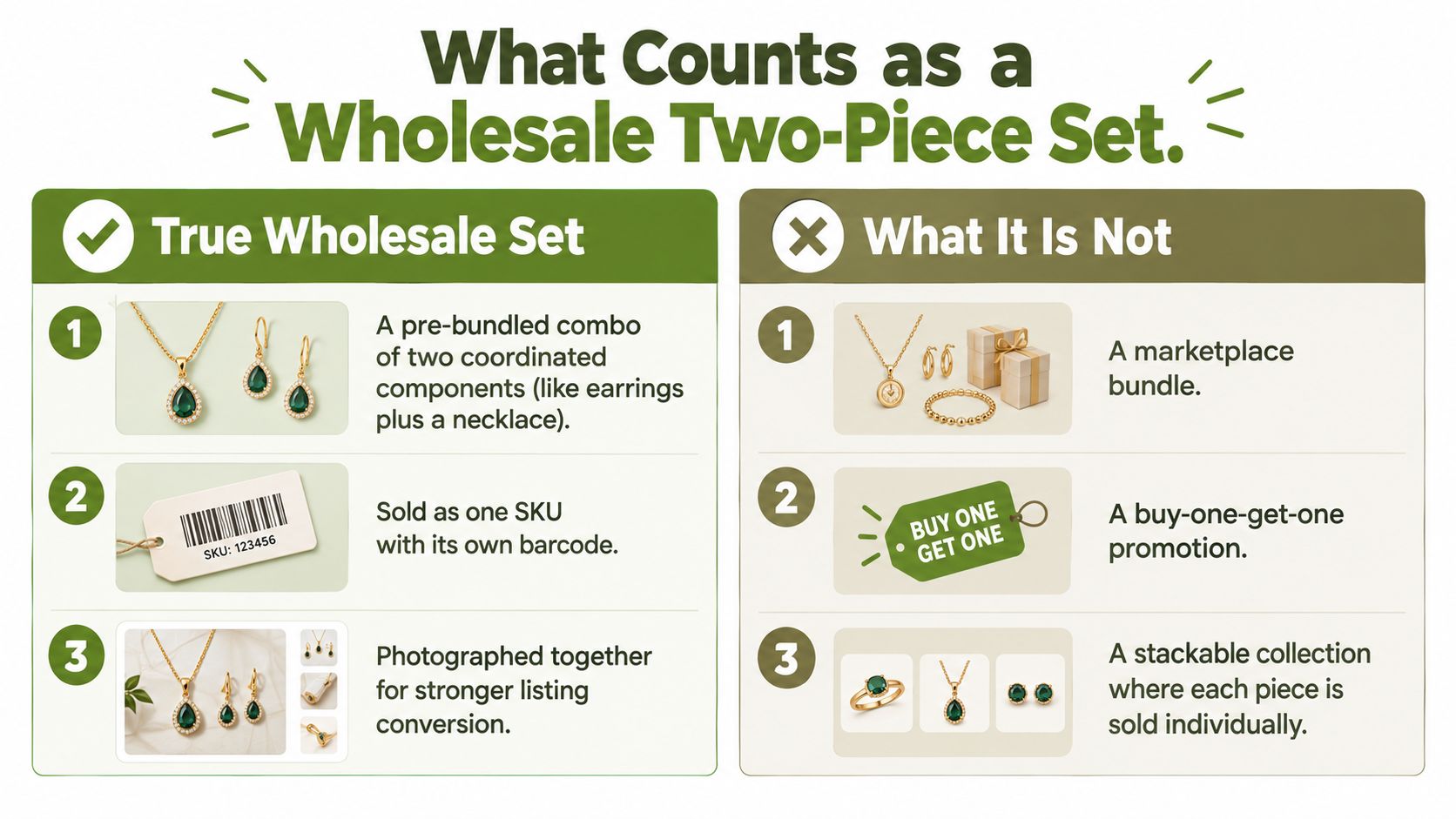
A wholesale two-piece jewelry set is a defined combination of two coordinated components sold and packed as one commercial unit. The common example is one necklace with one pair of earrings. A bracelet and ring can also form a set when the quotation, sample, SKU, packaging, and invoice all describe the same configuration.
Do not rely on the word “set” alone. Ask the supplier to state:
- the exact contents and quantity of each component;
- the finished-set SKU and the reference for each component;
- whether replacement components can be supplied;
- whether either component is also sold separately;
- which packaging, barcode, labels, and care information are included.
A checkout bundle or temporary promotion is different. Two independent items may be grouped for a discount without sharing a sample, packaging specification, or set-level inventory record. For wholesale purchasing, the commercial unit must match what appears on the purchase order and what the customer receives.
Approval rule: The packed sample, component list, written specification, and product photography should describe the same set. If one of those changes, confirm whether reapproval or additional testing is needed.
Keep the finished-set SKU and component references together. If 100 necklaces are available but only 70 earring pairs pass inspection, the maximum complete-set stock is 70. The remaining necklaces need an approved separate use or they become stranded inventory.
Choosing the Right Materials for Coordinated Pieces
Visual coordination does not prove material coordination. A pendant, chain, clasp, earring post, jump ring, and decorative setting can use different metals or finishes. Ask for a component-level material statement instead of accepting one broad description for the whole set.
| Route | Useful for | What to specify | Common mistake |
|---|---|---|---|
| Stainless steel | Daily-wear and lower-maintenance ranges | Grade where material identity matters, finish, post and clasp materials | Assuming every small finding is the same steel as the main piece |
| Brass | Fashion-led shapes and plated finishes | Base metal, plating route, color target, contact-point construction | Calling a gold-tone surface “gold jewelry” without qualification |
| 925 sterling silver | Precious-metal and gifting collections | Which components are sterling, markings, finish and stone-setting details | Applying the sterling claim to an entire set when only one component qualifies |
The FTC explains that “silver,” “sterling,” and “sterling silver” describe products containing 92.5% pure silver, commonly marked 925. See the original FTC jewelry guidance and the current FTC consumer guidance on gold, silver, and platinum. The claim still needs to match the component being described.
For plated jewelry, record both the base metal and surface finish. “Gold-plated brass” gives a buyer more useful information than “gold set.” If the necklace and earrings use different substrates or plating processes, approve their color together under the same lighting and keep the accepted sample.
Use the jewelry materials guide to prepare the brief, then add component details that are specific to the set: post material, clasp type, chain length, extender length, pendant dimensions, earring weight, stone or pearl identity, and the finish for small findings.
Sample approval checklist
| Check | Record | Reject or clarify when |
|---|---|---|
| Color match | Necklace, earrings and findings under the same light | One component reads noticeably warmer, darker, or glossier |
| Measurements | Chain and extender length; pendant and earring dimensions | Dimensions differ from the approved drawing or listing |
| Function | Clasp closure, post straightness, backs, jump-ring closure | Closures bind, posts bend, or gaps remain visible |
| Surface | Front, edges, back, solder areas and contact points | There are scratches, pits, exposed base metal, excess solder, or sharp edges |
| Pack-out | Card slots, chain restraint, earring spacing, barcode and labels | Pieces rub, tangle, move, or obscure required information |
MOQ, Minimums, and Sample Lead Times
Ready-stock wholesale and custom manufacturing create different commitments. At HonHo, ready-stock styles can be mixed from one piece per style toward a US$100 minimum order after discounts. In-stock orders usually dispatch within three business days after payment confirmation; transit time depends on the destination and service.
Custom development currently starts at 50 pieces per style and color. Brass and 925 silver samples generally take 25–30 days, while stainless steel samples generally take 25–35 days. Bulk production normally takes 35–45 days after the sample and specification are approved. These are working production ranges, not a promise that every project follows the same calendar. Tooling, revisions, packaging, testing, material availability, holidays, and shipping can change the agreed schedule.
The low-MOQ jewelry manufacturing guide explains how to separate a pilot order from a production order. For a set, confirm whether the MOQ applies to complete sets, each component, each color, or each combination of material and finish. Write that unit into the quotation.
A set sample is not complete until it has been inspected in the intended packaging. Approving loose components and choosing the package later can introduce tangling, scratching, bent posts, or a poor retail presentation.
Forecasting and Replenishing a Linked Assortment
Track the product at two levels: the finished set that customers buy and the components needed to make it complete. The available-to-sell quantity is limited by the component with the lowest usable stock.
Use four records:
- Finished sets: packed units that can ship immediately;
- component stock: usable necklaces, earring pairs, backs, cards, boxes, and replacements;
- exceptions: incomplete sets separated because of damage, mismatch, or missing parts;
- variant results: sales, returns, and customer questions by color, motif, and finish.
External seasonal inventory planning guidance can provide a starting framework, but a universal sell-through target is not reliable for every jewelry set. A seasonal gift line, an evergreen stainless steel set, and a limited bridal style may need different review periods and reorder points.
The embedded video is retained as an additional resource. Confirm the supplier's current written terms and your own inventory data before using any general merchandising advice.
For the first reorder, ask three questions: Can the same color be repeated? Can one component be replaced without remaking the whole set? Will a component or packaging change require a new sample? Written answers are more useful than assuming a visually similar reorder will match.
Private Label and Branded Packaging Options
Private label can begin with ready-stock jewelry and an approved branded presentation, or with a fully custom set. The right route depends on what makes the product distinctive and how much inventory risk the launch can carry.
| Route | Use it when | Approve before ordering |
|---|---|---|
| Ready stock with branded packaging | Speed and a lower initial commitment matter most | Actual set, card or box fit, logo artwork, label placement, barcode and pack-out |
| Modified stock design | A finish, charm, length, or logo change creates enough distinction | Revised sample, component specification, color reference and price effect |
| Full custom OEM/ODM set | The design and construction are central to the collection | Drawings, materials, dimensions, finish, packaging, tests, sample and bulk tolerances |
Treat the custom packaging service as part of the product specification. The package must keep the necklace restrained, protect the earrings and posts, and present both components without rubbing. If the card, insert, or box changes after the sample, repeat the pack-out and transit check.
The Hidden Cost of the Cheapest Set
The quotation is only one part of the landed cost. Add packaging, freight, duties, inspection, relabeling, replacement pieces, customer service, markdowns, and unusable components. A low-priced set that creates mismatches or incomplete units can cost more than a better-documented option.
Shopify's ecommerce returns analysis discusses apparel return drivers. Apparel sizing data should not be presented as a jewelry-set return rate, but the operational lesson is relevant: vague descriptions and a gap between the listing and the delivered product create avoidable returns.
Before bulk approval, check:
- the base metal and finish for each component and finding;
- the target-market compliance documents and the exact samples they identify;
- the necklace clasp, earring posts and backs, jump rings, solder points, and sharp edges;
- the consistency of claims across packaging, product pages, invoices, and marketplace feeds;
- the cost and lead time for replacement parts or component-only reorders;
- the packed set after handling and transport simulation.
For EU sales, nickel-release review must cover the relevant finished articles and contact components. AFNOR's EN 1811 reference describes the reference test method. A material name such as “316L” does not by itself prove that a finished earring or necklace meets the applicable release limit.
A Practical First Order and What to Do Next
Start with a small number of ready-stock necklace-and-earring configurations that suit the same customer and price band. Photograph the complete set and each component, then retain one approved packed unit as the receiving reference.
When the order arrives, compare a sample from the shipment with the approved unit. Check color, measurements, closures, posts, surface finish, component count, packaging, and labels. Record incomplete or mismatched sets separately instead of counting them as sellable inventory.
For a custom project, send the set configuration, target material, finish, dimensions, quantity per color, packaging files, market, and requested tests. The wholesale ordering guide can help organize the purchase order and approval steps.
HonHo supplies ready-stock jewelry sets and develops stainless steel, brass, and 925 sterling silver collections for qualified wholesale and private-label buyers. Browse HonHo Wholesale Jewelry, or use the jewelry-set collection and contact options on the store to share the set components, quantity, finish, packaging, and target market you need.
Evidence note: Material claims should follow the current FTC Jewelry Guides. For EU nickel restrictions, review the current ECHA Annex XVII restriction text and confirm the applicable test plan for the finished set. These sources describe regulatory and marketing requirements; they do not certify a particular HonHo SKU or production batch.


