

Buy wholesale stainless steel chains by the complete use case, not by link name or alloy label alone. Before approving a sample, specify whether you need loose chain, a finished necklace, a pendant carrier or a stand-alone statement chain. Then record the finished dimensions, component-level steel grade, finish system, clasp and end construction, pendant compatibility, test scope and tolerances.
The useful question is not whether a chain sounds “strong.” It is whether the approved production sample fits the intended pendant and customer, closes reliably, supports accurate product claims and still works at the landed cost. This guide turns those decisions into a practical RFQ and sample-check process.
Table of Contents
- What Wholesale Buyers Need From Stainless Steel Chains
- Understanding the Stainless Steel Behind the Chain
- Common Chain Link Types and Their Best Retail Uses
- Gauge, Width, and Length Translated Into Buyer Terms
- Finishes and Plating Options From Silver Look to PVD Gold
- Clasps, Jump Rings, and Where Chains Actually Fail
- Pricing, Markup, and Inventory Planning for Chain Programs
- Private Label, OEM, and ODM Options for Chain Collections
What Wholesale Buyers Need From Stainless Steel Chains
The first specification should describe what the customer will do with the chain. A finished pendant chain has to pass through the pendant bail, sit correctly with the pendant's weight and close comfortably. A stand-alone curb or rope chain is judged more by visual scale, articulation and clasp balance. Loose chain supplied by the meter needs a separate plan for cutting, end components and assembly.
| Product role | RFQ priority | Sample decision |
|---|---|---|
| Loose chain or spool | Material by component, link dimensions, cut length tolerance and compatible ends | Confirm your assembly process can finish the chain without deforming links or exposing weak joints |
| Finished pendant chain | Finished length, terminal and clasp dimensions, pendant bail opening and pendant weight | Fit the actual pendant to the complete chain; do not test the chain alone |
| Layering chain | Length, width, drape, extender and color match across the set | Check tangling, visual spacing and hardware comfort when the set is worn together |
| Stand-alone statement chain | Link geometry, articulation, surface consistency, clasp scale and finished weight | Inspect the full circumference because the chain itself is the design |
Start with the use case
Before comparing supplier prices, write down the intended wear pattern, load, exposure, retail position and target market. “Daily wear” is not a test method, and “waterproof” or “hypoallergenic” should not be used as blanket claims without evidence for the finished SKU.
Practical rule: Approve the chain as a complete product. The links, welds, terminal, jump rings, clasp and coating all affect the result your customer receives.
The wholesale jewelry buying guide is a useful reference for placing chain decisions alongside the rest of a resale assortment.
Understanding the Stainless Steel Behind the Chain
Stainless steel is a family of alloys, not one uniform jewelry specification. A grade statement also needs scope: the visible chain, spring inside a clasp, solder, jump ring, logo tag and decorative coating may not share the same material.
Type 304 is widely used and can be suitable for many controlled applications. This wholesale material guide compares 304 and 316L stainless steel. Type 316/316L contains molybdenum and generally has better resistance than 304 to pitting in chloride-bearing environments, but that does not make every 316L chain immune to corrosion or prove how a coating, weld or clasp will perform.
The 316L chain buying guide explains this difference. For technical context, worldstainless notes that Type 316 contains 2–3% molybdenum and has better corrosion resistance than Type 304, especially where chlorides can cause pitting, while also stressing that material selection depends on the actual environment. See the worldstainless design guidelines.
| Buyer question | What to request | What not to infer |
|---|---|---|
| Which grade is used? | Grade declaration for the chain, clasp, terminal and jump rings | One “316L” label does not automatically cover every component |
| Will it resist the intended exposure? | Finished-product evidence tied to the SKU, finish and test conditions | A general alloy comparison is not a lifetime guarantee |
| Is it suitable for skin contact? | Market-specific release or chemical evidence for the finished product | Steel grade alone does not prove “hypoallergenic” performance |
| Will the welds and joints hold? | Defined mechanical checks on representative production samples | Base-metal chemistry does not prove connection strength |
What the grade changes commercially
The grade can affect corrosion resistance, fabrication and cost, but it should not be used as a shortcut for the complete quality decision. Position a chain from the documented finished specification and intended use, not from a “marine grade,” “medical grade” or daily-wear slogan.
The stainless steel chains market history discusses this development, but its industrial-chain history and market projections do not establish jewelry demand, an individual alloy claim or likely sales for a jewelry SKU. They should not be used to forecast a chain collection.
Common Chain Link Types and Their Best Retail Uses
Link shape changes appearance, drape, repair options, pendant fit and where wear is concentrated. A practical assortment usually needs fewer constructions with clearer roles, not every name in a supplier catalog.
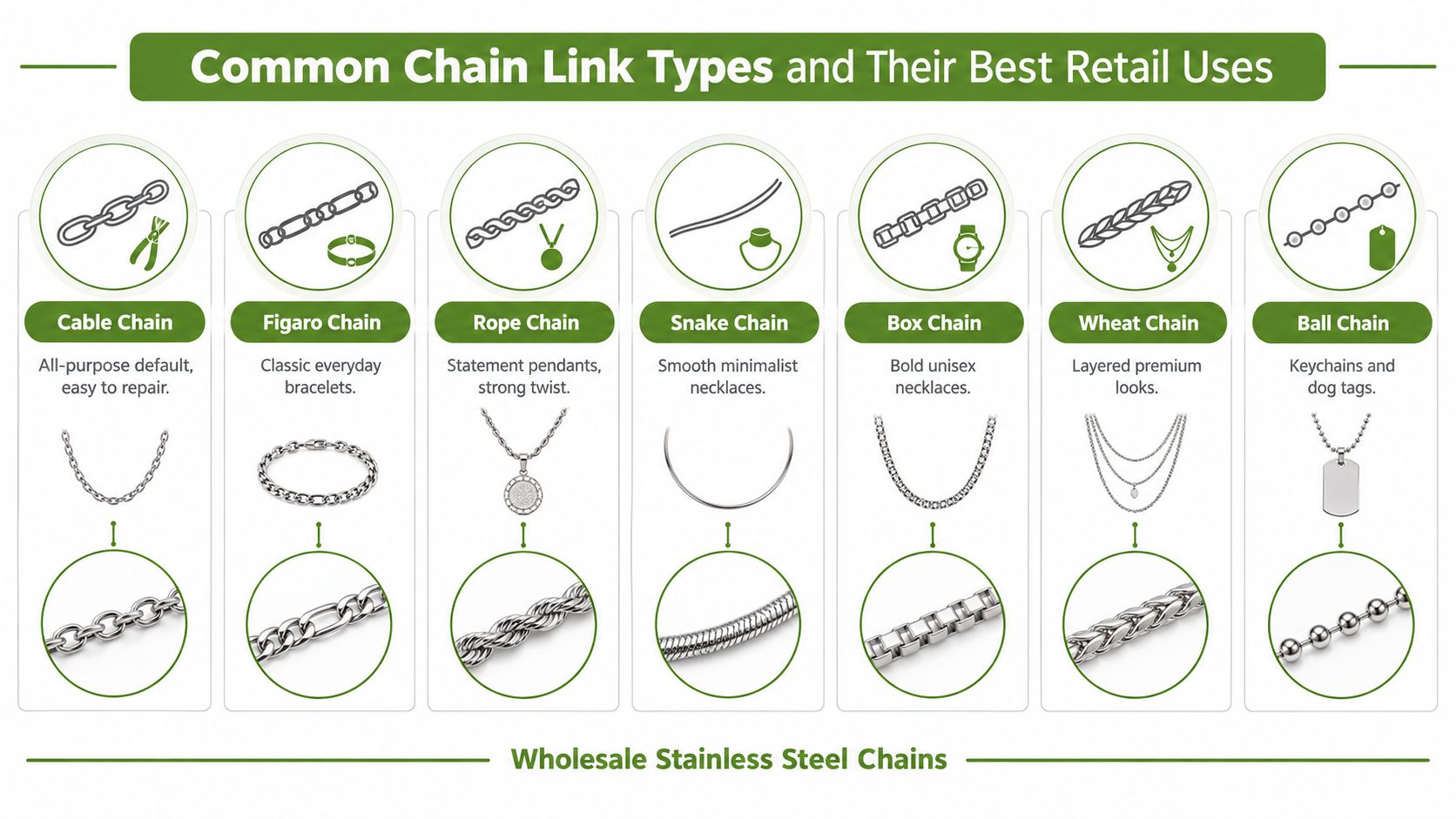
The practical core assortment
Cable chain is a versatile pendant and layering option because its open links accept many findings. Confirm that the terminal and clasp, not only the chain body, pass through the intended pendant bail.
Curb chain has flattened interlocking links and can work as a unisex or stand-alone style. A square-profile chain can fill a similar design role in a more geometric assortment; compare that construction in this square chain necklace reference.
Figaro chain alternates link sizes and can carry visual weight without relying only on overall width. Rolo chain uses rounded links with clear attachment points, which can suit charms and beaded designs.
Where the More Specialized Styles Fit
Box chain gives a clean geometric line, but pendant compatibility still depends on the terminal. Snake chain has a smooth continuous surface that makes dents, kinks and coating inconsistency easy to see. Rope chain depends on even twisting, articulation and clean end finishing; the clasp should look and feel proportionate to the chain.
Do not choose by construction name alone. Request the finished width, wire diameter or structural thickness, link pitch and inside opening, terminal dimensions, clasp specification, finished weight and measurement tolerance. Two chains sold under the same name can be materially different products.
Gauge, Width, and Length Translated Into Buyer Terms
Gauge, width and length describe different things. Gauge may refer to wire diameter or another structural measure; finished width describes the visible envelope of the link or chain. Suppliers may use the terms differently, so the RFQ should define each dimension with a drawing or annotated sample.
Read the dimensions in this order
- Set the product role. Decide whether this is loose chain, a layering chain, a pendant carrier or a statement piece.
- Record the finished chain envelope. Measure maximum width and thickness, not a descriptive “fine” or “heavy” label.
- Record the link geometry. Include wire diameter or structural thickness, pitch and inside opening where relevant.
- Measure the largest end component. The terminal, end tab, jump ring or clasp must pass through the pendant bail if the design requires it.
- Confirm finished length and tolerance. State whether the clasp and extender are included in the measurement.
- Match the pendant. Check pendant weight, bail opening, movement and whether a hard steel chain could wear against a softer bail.
| Sample record | Why it matters | Approval evidence |
|---|---|---|
| Finished width and thickness | Controls visual scale and whether the chain fits the intended channel imagery | Caliper reading at defined points plus tolerance |
| Terminal and clasp maximum dimensions | These parts often block a pendant even when the chain itself would fit | Pass/fail check with the real pendant or a dimensioned gauge |
| Finished length and weight | Affects neckline position, handling and landed cost | Method states whether clasp and extender are included |
| Link inside opening and pitch | Affects articulation, charm attachment and repair options | Dimensioned drawing verified against the sample |
| Measurement tolerance | Prevents an approved sample from drifting into a different retail product | Purchase-order tolerance and incoming inspection record |
There is no universal “best” width for a small, medium or heavy pendant. The chain, pendant bail, pendant weight and clasp must be approved together. If a retailer sells chain and pendant separately, publish the dimensions customers need to check compatibility instead of promising a broad fit.
Finishes and Plating Options From Silver Look to PVD Gold
Separate the substrate from the surface system. A polished uncoated steel color, electroplated color, PVD coating and protective topcoat are different specifications. “Gold,” “black” or “IP” describes appearance incompletely unless the supplier identifies the process and layer build used on the actual SKU.
This guide to 316L jewelry and plating explains the substrate and coating trade-off. Keep it as a background reference, then ask the supplier for product-specific evidence rather than copying another seller's parameters.
| Finish route | Buyer specification | Sample focus |
|---|---|---|
| Polished or brushed steel color | Grade, surface preparation, texture or gloss target and passivation status where applicable | Scratches, tool marks, edge finishing and consistency across components |
| Electroplated color | Base metal, underlayers, decorative layer, thickness method and any topcoat | Color at moving contact points, coverage and adhesion |
| PVD color | Substrate, pretreatment, coating material/process, color target and measurement plan | Shade consistency, high-contact areas and the actual clasp/end components |
| Two-tone or mixed finish | Layer system and color master for each surface | Boundary cleanliness and batch-to-batch matching |
ISO 3497 describes X-ray spectrometric methods for metallic coating thickness. If XRF is part of the inspection plan, record the measurement location and method because curved links, edges and mixed materials can produce different readings. A thickness value from one point does not describe the whole chain.
ISO 9227 defines salt-spray test methods. ISO states that these tests are suitable for checking maintained quality but are not intended to rank different materials or predict long-term corrosion resistance. A quoted test duration therefore cannot be converted into a universal number of months or years of wear.
For a broader explanation of finish terminology, use the jewelry materials and plating guide. For EU articles in direct and prolonged skin contact, review the current REACH Annex XVII nickel-release restriction and the applicable test route. A material or coating name alone does not establish compliance.
Clasps, Jump Rings, and Where Chains Actually Fail
Many returns start at a detail: the clasp does not close, an open jump ring separates, a terminal pulls free, a weld cracks or a contact point loses color. Sample approval should name the failure mode, the test method and the record to keep.
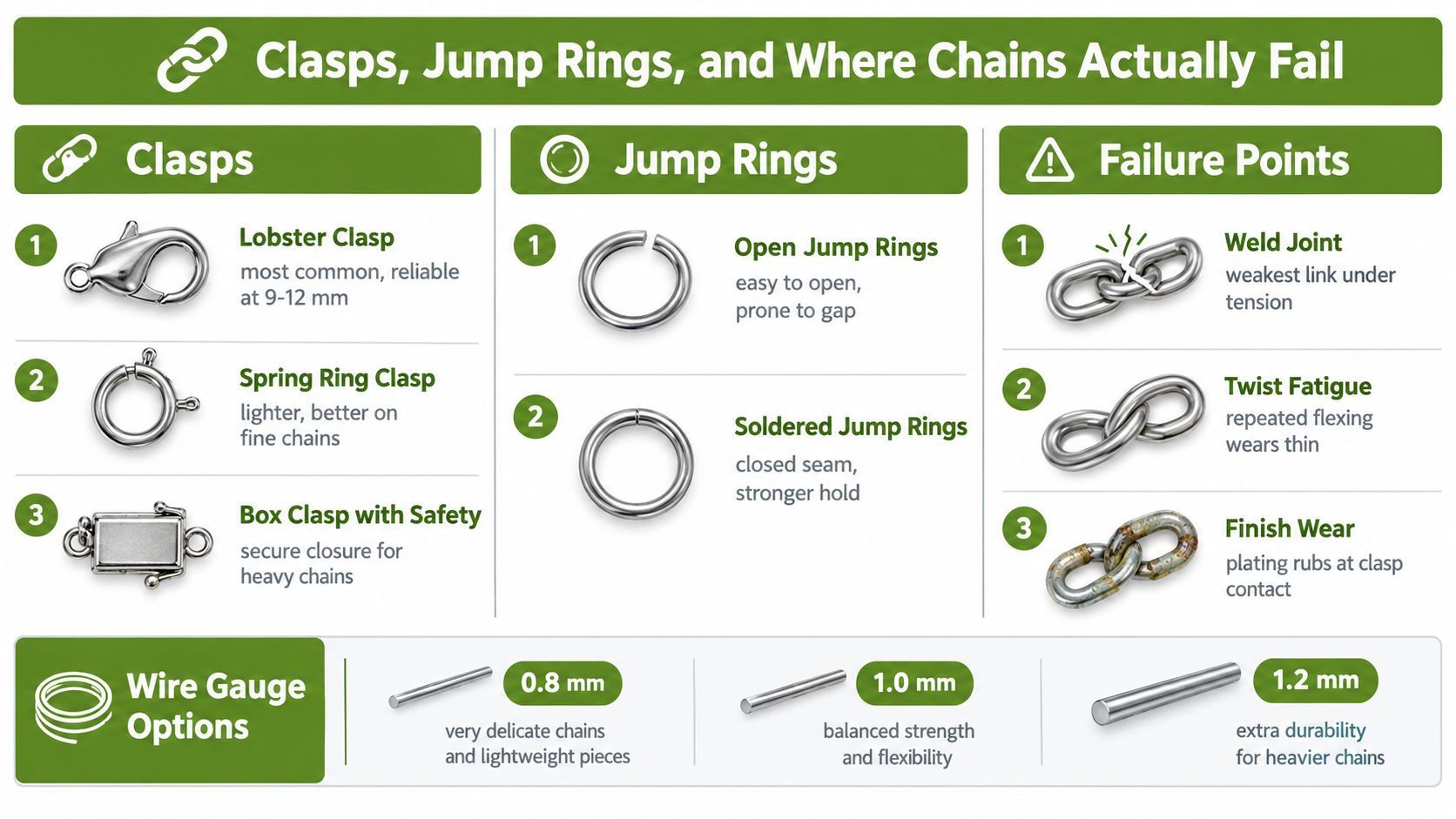
Lobster and spring-ring clasps can both be appropriate when their scale, spring action and attachment match the chain. Box or magnetic clasps need their own retention and safety review; a clasp name is not a strength rating. Closed or welded connections reduce one common opening path, but the actual joint still has to be inspected.
Use this first-article checklist
| Check | Record | Reject when |
|---|---|---|
| Clasp cycling | Method, cycle count and whether the clasp closes fully each time | It sticks, does not return or can remain partly open |
| Connection security | Defined pull or handling check at terminal, jump ring and clasp | A seam opens, twists or separates under the agreed method |
| Articulation | Chain movement before and after handling | Links bind, kink or no longer return to the intended shape |
| Surface and edges | Lighting, magnification if used and defect limit | Sharp edges, exposed base material, pits or visible finish gaps exceed the approved standard |
| Pendant compatibility | Pendant ID, bail dimensions and assembled movement | The pendant cannot pass the terminal, binds or visibly damages the bail |
The original video embed is retained as a visual reference. The purchase order should still rely on the approved physical sample and written inspection method, not on a general demonstration. Keep the sample ID, grade by component, dimensions, clasp, connection method, finish and production-lot reference together.
Pricing, Markup, and Inventory Planning for Chain Programs
Calculate chain economics from the landed cost of a sellable finished unit. Include chain, clasp and assembly, finish, packaging, inspection, freight, duties and taxes where applicable, payment fees, channel fees, returns and defect allowance. Do not use a generic markup as a substitute for the channel's actual costs.
One wholesale jewelry pricing guide gives those discount frameworks, while This jewelry pricing guide explains the landed-cost approach. Retain them as planning references, but do not copy their percentages or multiples into a price decision without the same business model and cost base.
| Inventory role | Buy depth | Reorder evidence |
|---|---|---|
| Core pendant chain | Deeper only after pendant compatibility and repeat demand are proven | Sell-through, return reasons and attachment to pendant sales |
| Unplated steel-color basic | Useful as a simpler finish route, not automatically a universal daily-wear promise | Surface complaints, clasp performance and replenishment consistency |
| Colored plated/PVD chain | Control shade and finish risk by color and batch | Color returns, measured evidence and approved master sample |
| Statement construction | Smaller opening quantity unless proven as a core SKU | Full-price sell-through and returns caused by weight, scale or clasp |
This stainless steel jewelry trade guide discusses HS classification and tariff exposure, but tariff rates and classification can change and a third-party guide is not a customs ruling. Confirm the exact product classification, origin and current import treatment for the destination market before using duty in the margin model.
Also review the MOQ and wholesale pricing structure before committing to quantities. A lower unit price can increase inventory risk if the chain's dimensions, finish or pendant compatibility are not yet proven.
Private Label, OEM, and ODM Options for Chain Collections
Private label, OEM and ODM indicate different development scopes; they do not by themselves prove quality. Private label usually starts with an existing construction and changes branding or packaging. OEM follows a buyer-defined specification. ODM uses a supplier-developed design that is selected or adapted for the buyer.
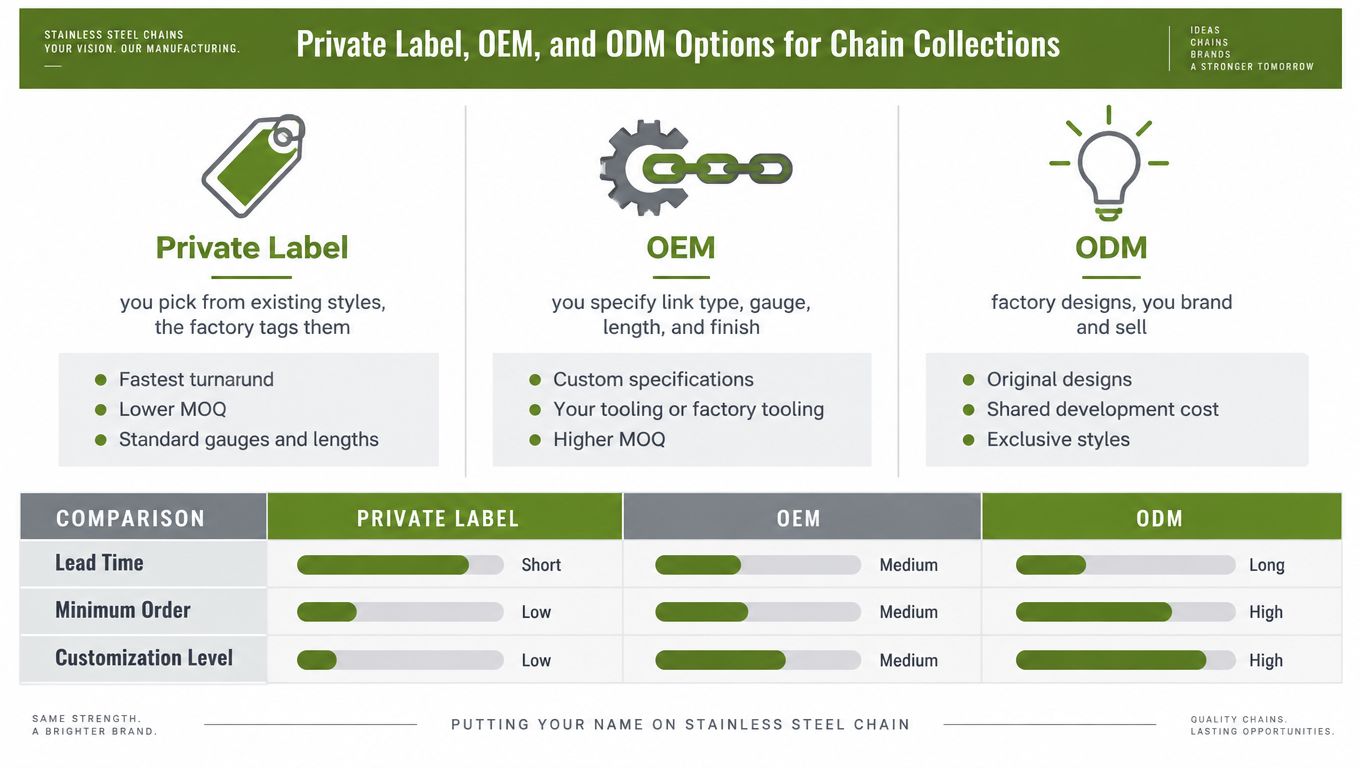
What Can Be Customized
- Construction: Link pattern, wire or structural thickness, width, pitch, terminal and finished length.
- Hardware: Clasp, jump ring, extender and end details, with agreed component materials.
- Finish: Surface preparation, silver-color or colored layer system, shade target and measurement plan.
- Branding: Logo tags, engraving, cards, pouches and packaging.
- Product format: Loose chain, finished necklace, pendant-ready assembly or coordinated set.
For HonHo custom-project planning, the current baseline is 50 pieces per style/color. Typical planning windows are 25–35 days for stainless-steel samples and 35–45 days for bulk production after approval. Brass or 925 silver sample projects generally use a 25–30 day planning window. These are project-planning baselines, not promises for every ready-stock SKU; confirm the written quote, production scope and delivery terms for the actual project.
Confirm the current specification, timing, and quotation before ordering because production conditions can change. Buyers comparing private-label routes can also review this guide to custom stainless steel jewelry manufacturing.
A useful RFQ names the product format, link geometry, dimensions and tolerances, grade by component, finish system, clasp and connection method, pendant or bail details, target market, test scope, packaging, quantity by style/color and required date. Approve one assembled sample and a color master where applicable before bulk production.
Browse HonHo Wholesale Jewelry for ready-to-buy stainless steel chains and related wholesale jewelry. You can also compare the chain necklace collection and send a detailed brief through the contact page. Factory development capability does not mean every ready-stock SKU shares the same grade, coating, testing or lead time, so confirm the exact item before ordering.


