

A square chain necklace, also sold as a box chain or Venetian chain, is defined by its compact geometric links. That name describes the design, not a guaranteed strength level. For wholesale buyers, the useful decision is whether a specific chain's construction, base metal, finished width and length, clasp, finish, and intended pendant all work together.
Before approving a bulk order, compare the physical sample with a written specification. Record the finished dimensions and weight, inspect link and clasp consistency, confirm the finish system, and agree on any mechanical or coating tests in advance. This guide turns those checks into an RFQ, sample-approval, and reorder process.
Table of Contents
- The Anatomy of a Square Chain Necklace
- Material and Plating Choices for Durability
- Gauge and Length Specifications for Retail Success
- Manufacturing Details and Quality Control Checks
- Comparing Square Chains to Other Popular Styles
- Building a Profitable Necklace Inventory Strategy
The Anatomy of a Square Chain Necklace
Square, box, and Venetian are often used for the same chain family, although naming can vary by supplier. The links create a four-sided profile and interlock at right angles, producing a smooth, continuous surface. Consumer guides describe the same basic geometry in different ways; Learn more about box chain construction and related necklace styles.
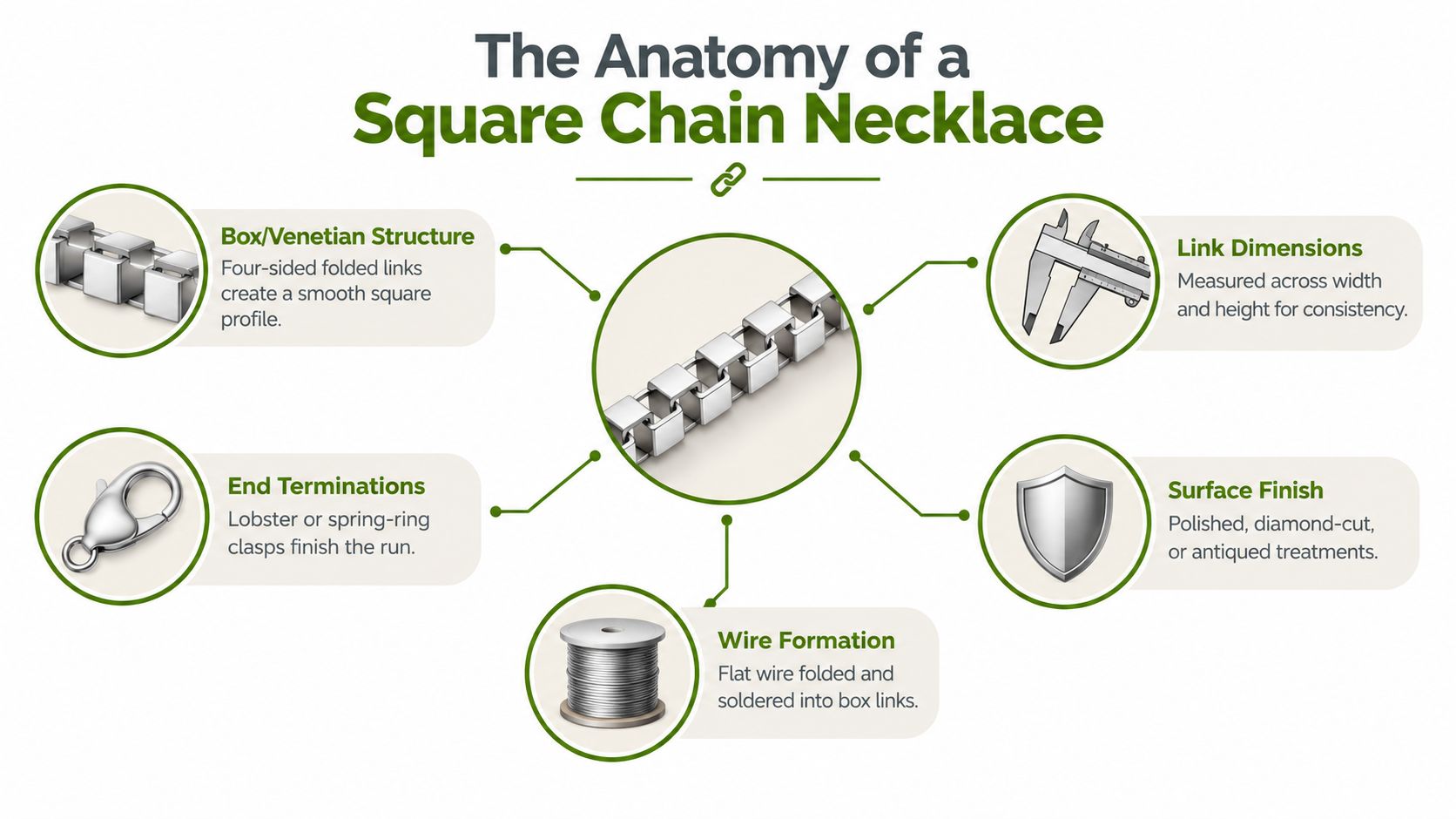
The design name alone does not reveal whether a chain is solid, hollow, or semi-hollow, how its links were formed, or how its joints were closed. One retailer also presents a history-oriented account of the style: Explore the history and construction of box chains. Treat that as background, not as evidence for a product specification.
In modern manufacturing, wire or strip can be formed into consistent link elements, closed, joined, polished, and finished. SuperbMelt's public description of its box-chain equipment, for example, refers to cutting, bending, buckling, welding, and continuous link formation. Those steps help explain the process, but the machine maker's dimensions and tolerances are not HonHo product specifications.
Why the geometry appeals to retailers
The flat faces and repeated corners give the chain a clean, architectural appearance. A narrow version can sit quietly under a small pendant; a wider version can be sold as a standalone necklace. This range makes the style useful in minimalist, unisex, pendant-led, and layering assortments.
Geometry affects drape and rotation, but it does not make every box chain kink-proof or stronger than every round-link chain. Wall construction, alloy, link closure, clasp assembly, and wear conditions can change the result. Use the customer's intended use as the starting point, then judge the actual sample.
Retail explanation: Describe the square profile, controlled look, and intended use. Do not use the shape alone as proof of exceptional strength.
Uniform links, smooth articulation, and a well-aligned clasp are visible signs customers can understand. A precise-looking chain with crushed corners, sharp seams, or weak end fittings still creates a poor retail experience. Add the style to a focused wholesale chain necklace collection, then approve each SKU against its own specification.
Material and Plating Choices for Durability
Base metal and finish should be separate fields on the purchase order. Stainless steel, brass, and 925 sterling silver each support a different price point, care message, and production route. The words “gold,” “silver,” or “stainless” in a title are not enough to establish grade, coating, or performance.
| Base metal | Why a buyer may choose it | What still needs confirmation |
|---|---|---|
| Stainless steel | Consistent color in an unplated finish and suitability for PVD color systems | Steel grade, construction, finish stack, dimensions, and clasp material |
| Brass | Fashion positioning and compatibility with conventional electroplating | Plating specification, exposed areas, care language, and component consistency |
| 925 sterling silver | Recognizable precious-metal positioning | Fineness evidence, tarnish care, finish, soldered parts, and weight |
Material choice does not override construction. A hollow stainless-steel chain can dent; sterling silver can tarnish; a plated brass chain can show wear at high-friction points. This consumer comparison can help frame common care differences: Compare chain longevity across stainless steel, silver, and plated metals. It should not replace the supplier's SKU-level specification or agreed test plan.
Plating changes the customer promise
PVD and conventional electroplating are different production routes. HonHo's current plating and finish guide lists a general custom-development reference of 0.03–0.10 μm gold plus about 0.5 μm TiN for stainless-steel PVD, while conventional gold electroplating for brass and 925 silver is listed at 0.03–5 μm depending on the project. These are development ranges, not a promise that every ready-stock square chain uses the same stack.
Ask for the target color, coating process, thickness or range where relevant, and any agreed verification method. A gold-color photograph cannot confirm the base metal or coating. Plated surfaces also wear differently at corners, the clasp, and other contact points, so permanent-color claims are inappropriate without SKU-specific evidence.
What to ask before placing a wholesale order
| RFQ field | Record in writing | Why it matters |
|---|---|---|
| Construction | Solid, hollow, or semi-hollow; link and joint method | Changes weight, deformation risk, and repair expectations |
| Base metal | Alloy or fineness for chain, clasp, and end fittings | Prevents a design name from standing in for material evidence |
| Finished dimensions | Width, link dimensions, necklace length, extension length, and tolerances | Creates an objective sample and reorder check |
| Mass | Finished sample weight and agreed production range | Can expose an unapproved construction change |
| Finish | Color, process, coating specification, and reference sample | Supports color and wear expectations |
| Use case | Standalone, layering, or a named pendant with known bail and weight | Connects the specification to actual use |
| QC plan | Measurement method, sampling level, defect rules, and test conditions | Makes reorder acceptance repeatable |
Use a clear jewelry materials and plating guide to establish terminology, then place the SKU-specific requirements on the quotation, approved sample record, and purchase order.
Gauge and Length Specifications for Retail Success
Suppliers may use “gauge” to mean finished chain width, wire size, or another internal measurement. Avoid that ambiguity. Request a dimensioned drawing or specification that states what is being measured, the units, measurement points, and allowed tolerance.
Visible width is not a load rating. Two chains with the same outside width may have different wall construction, mass, joints, or clasps. This independent article discusses width and load as related topics: Review the technical relationship between box-chain gauge, construction, and load capacity. Do not reuse its universal load figures as a guarantee for another product.
Match width to the selling occasion
| Sample decision | What to check | Approval question |
|---|---|---|
| Delicate standalone or layering style | Link uniformity, articulation, clasp scale, and handling feel | Does the chain look intentional without feeling sharp or easily distorted? |
| Pendant chain | Pendant weight, bail opening, connector clearance, drape, and clasp assembly | Can the exact pendant move freely without crowding the end fittings? |
| Wider statement style | Neck comfort, corner finish, total weight, stiffness, and clasp balance | Does the sample sit correctly through normal movement? |
| Multi-width program | Consistent naming, photography scale, and measurable differences | Can staff and customers distinguish each option without guessing? |
Some wholesale listings offer one square-chain design in several widths, which shows how strongly width changes its visual position. Review a wholesale square-chain listing with multiple width options. Use listings for assortment context, not as engineering evidence for your order.
Length affects sell-through
Finished necklace length and extension length should be stated separately. HonHo's size guide covers common necklace positions from 14 to 30 inches and recommends recording dimensions in millimeters for production. A premium retailer's examples also show how standard lengths and adjustment points are presented: See examples of standard necklace lengths and shorter adjustment points.
- Shorter positions: Useful for close-to-neck styling and layered sets, subject to the target customer's fit.
- Mid-length positions: Often the most versatile for small pendants and everyday standalone wear.
- Longer positions: Create more drape and change how a pendant sits over clothing.
- Adjustable designs: Need a separate main-chain and extension measurement so the maximum length is not mistaken for the base length.
Before confirming dimensions, use a jewelry size guide, then measure the physical sample from the same agreed points. Check the fit with the intended pendant and with the packaging or display card.
Manufacturing Details and Quality Control Checks
Square links make repeated defects easy to see. Uneven corners interrupt the reflective surface, inconsistent spacing changes the drape, and rough seams can catch on fabric or skin. The clasp and end fittings deserve the same attention as the central links because an assembly can fail at its smallest component.
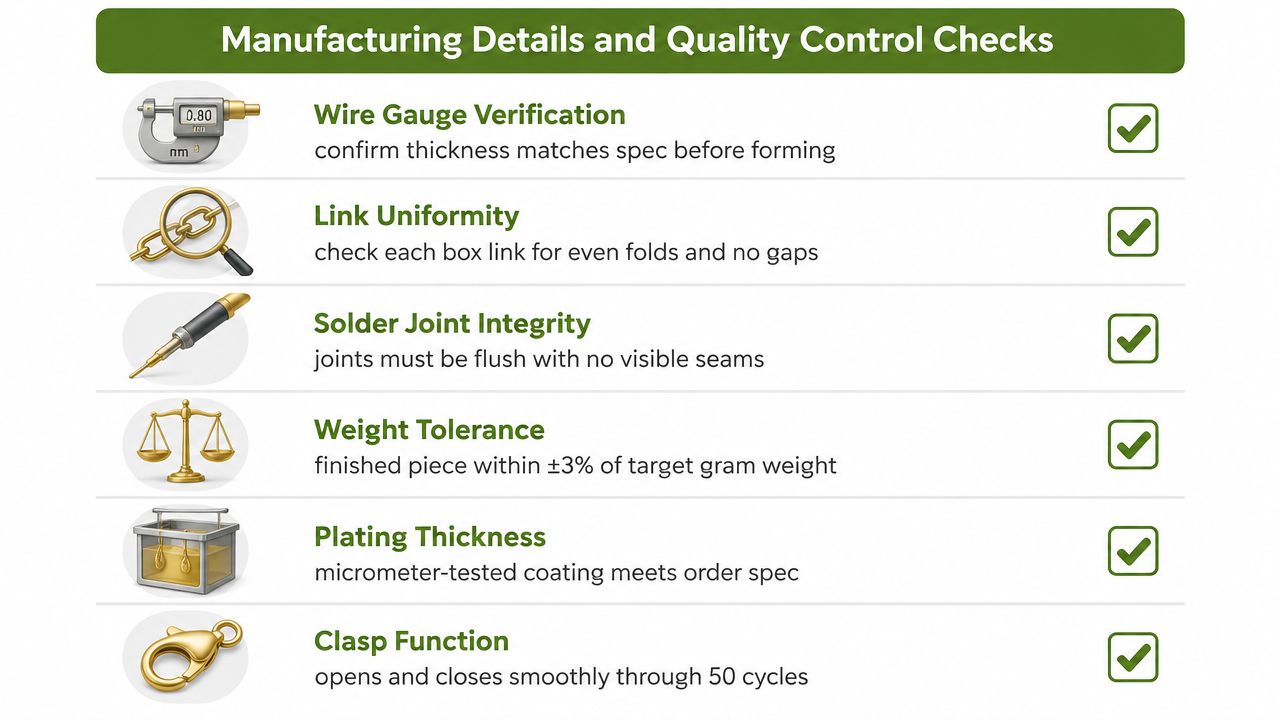
Do not adopt a generic minimum wall thickness or breaking-load number from another seller. Construction, alloy, heat-affected joints, dimensions, and test setup all influence the result. If mechanical performance matters to the program, define the finished assembly, conditioning, pull direction, fixture, speed, endpoint, sample count, and acceptance rule before testing.
Inspect the sample in a fixed order
- Confirm identity. Match the sample to its SKU, material, finish, color standard, and drawing revision.
- Measure dimensions and mass. Record finished width, length, extension, end fittings, clasp, and total weight with the agreed tools.
- Inspect link geometry. Look for repeated dimensions, closed corners, smooth faces, and no crushed sections.
- Review joints under magnification. Note gaps, pits, cracks, sharp protrusions, or excess solder rather than accepting “welded” as a quality result.
- Check articulation and drape. Move the chain gently through its normal range and flag stiff, catching, or twisting sections.
- Cycle the clasp. Confirm alignment, closure, end-ring security, and operation without excessive play.
- Inspect the finish. Compare the approved color reference and check corners, clasp, end rings, seams, and outer faces for uneven coverage or polishing marks.
Bureau Veritas notes that jewelry programs can include clasp evaluations and tensile testing of chains and clasp-to-chain assemblies. It also notes that there is no single commonly accepted mechanical performance standard for all jewelry, which is why the parties need agreed conditions and pass criteria. ISO 6892-1 defines room-temperature tensile testing for metallic materials, but a material test by itself does not certify the performance of a finished necklace assembly.
Buyer's rule: Approve a written construction and QC specification before negotiating only on unit price. Otherwise, a cheaper reorder can quietly become a different product.
Ask whether destructive testing, dimensional inspection, coating measurement, or third-party verification is appropriate for the order. The requested test should answer a defined risk, not produce an impressive number with no comparable method. For smaller runs and private-label programs, low-MOQ jewelry manufacturing guidance can help organize sample and production questions.
Comparing Square Chains to Other Popular Styles
A square chain earns its place through controlled geometry and a clean surface, not universal superiority. Compare styles by drape, texture, pendant fit, inspection points, and customer preference.
| Chain style | Visual and handling character | Buyer focus |
|---|---|---|
| Square or box | Geometric faces and a continuous, architectural line | Corner consistency, articulation, seams, and end fittings |
| Cable | Familiar round or oval links with an open rhythm | Link closure, pendant clearance, and connector wear |
| Curb | Flattened links and a broad surface against the skin | Lay-flat behavior, link alignment, edges, and clasp balance |
| Rope | Twisted texture with repeated light reflection | Pattern consistency, snag points, flexibility, and finish coverage |
| Rolo | Rounded links and a softer visual rhythm | Link uniformity, charm attachment, and joint finish |
Stability isn't the same as repairability
The square profile can feel controlled on the neck, but repair options depend on alloy, link access, finish, and local workshop capability. A neat-looking weld is not automatically repairable after damage, and a repaired area may need refinishing. Ask about spare components and the supplier's defect or repair route before making service promises.
Product copy should therefore stay specific: describe the profile, material, finish, dimensions, and approved use. Avoid “unbreakable,” “waterproof,” or “supports heavy pendants” unless a clearly defined SKU-level claim is backed by suitable evidence.
Use comparison to build bundles
A narrow square chain can contrast with a flatter curb or textured rope in a layered display. A pendant can be photographed on the exact chain that passed the fit check, while a wider square version can demonstrate the same design language as a standalone piece. That gives shoppers a reason to choose between functions instead of comparing near-identical SKUs.
Merchandising insight: Use square chains as one purposeful option in the assortment. The customer should be able to see why its geometry, width, length, and pendant pairing suit a specific look.
Building a Profitable Necklace Inventory Strategy
Third-party market reports can provide category context, but they do not predict demand for a particular store, width, finish, or price point. This is one published projection buyers may encounter: Review the 2026 necklace market projection and product context. Use your own sales, returns, customer questions, and replenishment data to decide what to reorder.
A useful launch is usually narrower than a supplier's full catalog. Test clearly separated use cases, document the approved sample, and make the reorder specification identical to the one your team actually inspected.
Build around use cases
- Everyday standalone chain: Prioritize comfort, finish consistency, clasp operation, and an easy-to-explain specification.
- Pendant chain: Approve the exact pendant weight, bail clearance, drape, and connector combination rather than relying on width alone.
- Layering chain: Test how the length and surface interact with the other pieces in the set.
- Statement chain: Check total weight, neck comfort, stiffness, clasp balance, and packaging support.
For every SKU, store a control sheet with the approved sample photos, measurements, mass, component list, finish reference, packaging, defect examples, and test report where applicable. On reorder, investigate any meaningful shift before accepting production. This is more reliable than approving by catalog title or photography.
A balanced plan can place square chains beside cable, curb, rope, and pendant necklaces. For more assortment planning ideas, see this guide to wholesale jewelry for boutiques.
For custom development, HonHo currently lists a general MOQ of 50 pieces per style and color. Its planning references show approximately 25–30 days for brass or 925 silver samples, 25–35 days for stainless-steel samples, and 35–45 days for bulk production after approvals. These are planning baselines, not guarantees for every design; drawings, stone setting, coating, testing, and packaging can change the schedule.
The practical conclusion is simple: choose the square profile for a defined customer use, then make construction, dimensions, mass, components, finish, and QC measurable. That is what lets a buyer compare samples, protect the reorder, and explain the product accurately.
HonHo Wholesale Jewelry supplies ready-to-buy and custom necklace programs in stainless steel, brass, and 925 sterling silver. Visit HonHo Wholesale Jewelry to review chain collections or send a target drawing, material, finish, quantity, and use case for a product-specific quotation.


