

A blue eye gold ring is a design category, not a material specification. Before a wholesale order, confirm five details: the base metal, the gold-colored finish, the blue accent, the ring size or adjustable range, and the sample standard you will use for approval. Two rings can look similar in a thumbnail while differing sharply in construction, comfort, care, and the claims a retailer can make.
This guide is for boutique buyers comparing ready-stock and custom styles. It explains how to separate an eye motif from an evil-eye claim, how to describe the materials without guessing, and what to inspect before photography or a bulk order.
Table of Contents
- What a Blue Eyes Gold Ring Is and Why Buyers Are Stocking It
- Design Inspiration Behind the Blue Eye Motif
- Materials and Finishes Wholesale Buyers Can Choose
- Karat, Plating, and Sensitive-Skin Compliance
- Customization Options for Private-Label Collections
- Building a Tiered Blue Eye Ring Assortment
- Sourcing Blue Eye Rings From a Wholesale Supplier
- FAQ on Stocking Blue Eyes Gold Rings
What a Blue Eyes Gold Ring Is and Why Buyers Are Stocking It
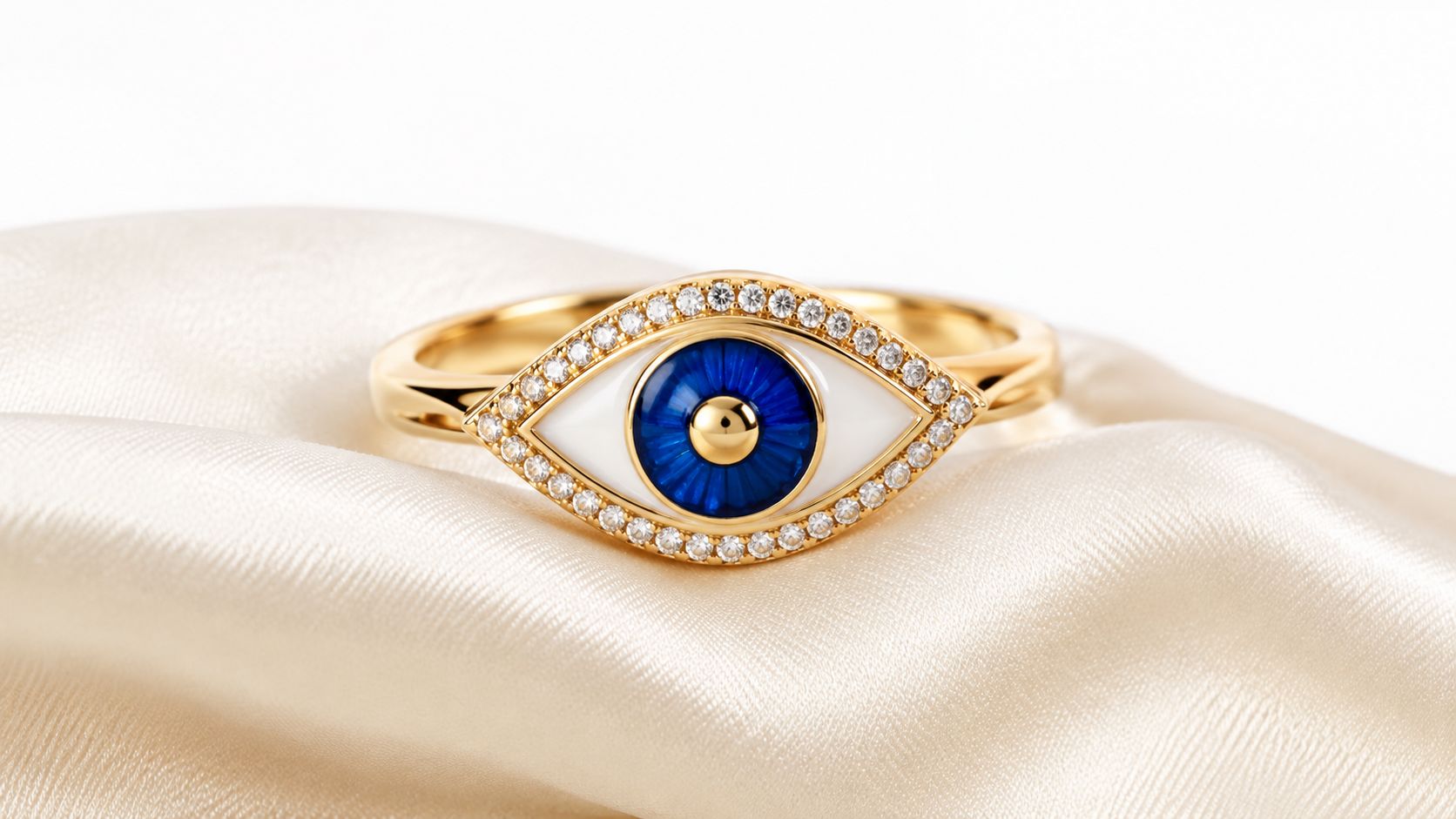
In wholesale catalogs, “blue eye gold ring” usually means a ring with a gold-colored band or setting and a blue eye-like center. The blue detail may be enamel, resin, glass, cubic zirconia, another stone, or a combination. The phrase does not establish solid-gold content, plating, stone identity, or suitability for sensitive skin. Each of those points needs its own specification.
An eye-shaped design is not automatically an evil-eye product. “Evil eye” carries a protective-symbol association in several traditions; a plain eye motif may be sold simply for its color and shape. Use the cultural term only when it matches the design and the way the supplier presents it. Avoid promising protection or assigning a belief to the customer.
Why the pairing works in a retail assortment
Blue against a warm gold color stays legible in a display tray and in a small product image. A slim ring can work as a stackable accent, while a larger eye face is easier to merchandise as a statement piece. That visual range is useful, but it does not prove demand. Choose the role of each SKU before deciding the quantity.
Eye-color prevalence is not a sound demand signal for jewelry. All About Vision's eye-color overview is useful background on how human eye color varies, but it cannot tell a retailer whether customers will buy this motif. Use your own sales history, customer requests, and a small ready-stock test when the design is new to your assortment.
Start with visibly different roles rather than several near-duplicates. One restrained band can cover the everyday position, while a larger eye-shaped ring can test gift or statement demand. Check whether the motif remains clear in the exact crop used for collection pages and marketplace thumbnails.
Design Inspiration Behind the Blue Eye Motif
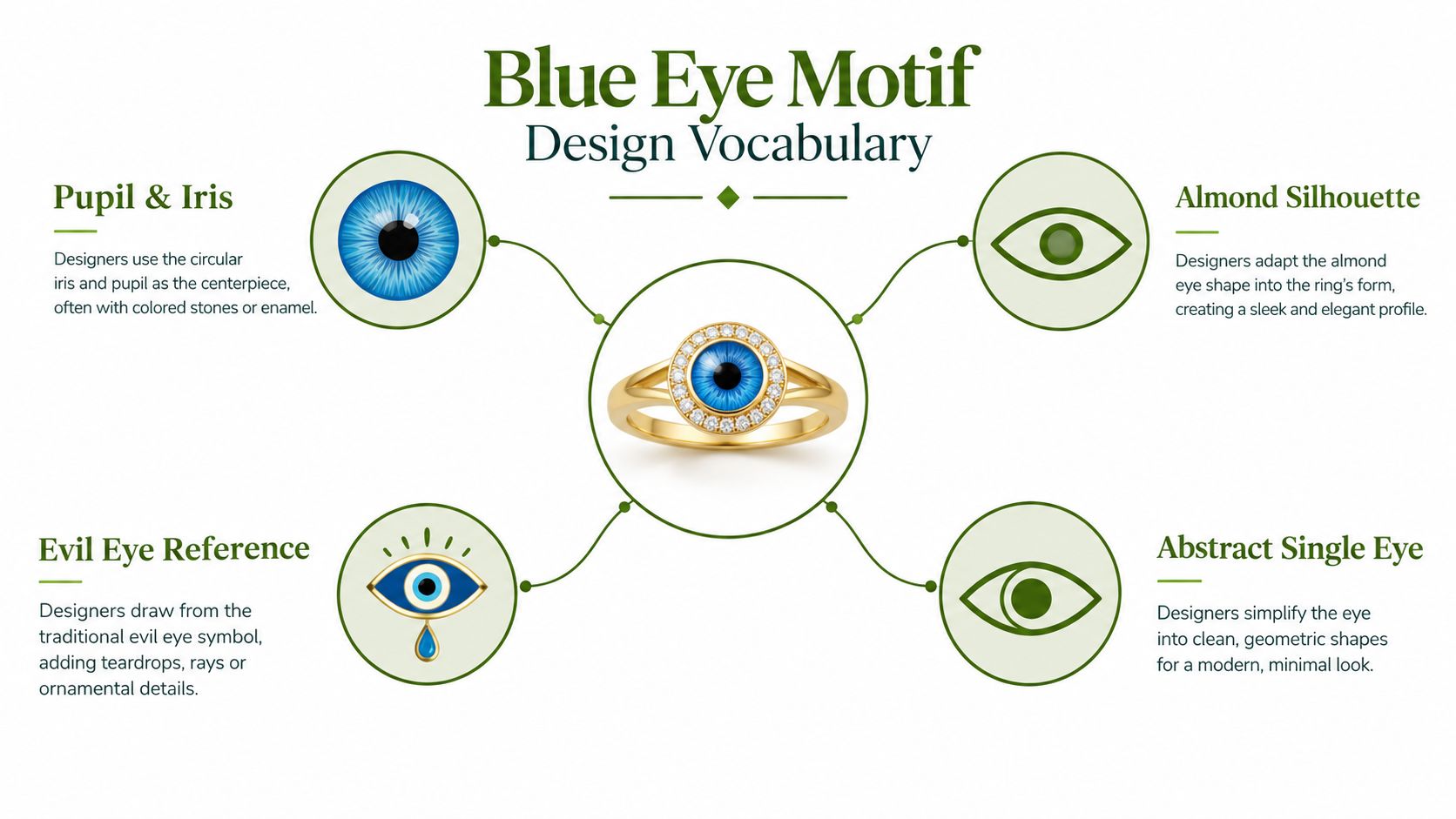
Blue-eye rings use a compact visual vocabulary, but small changes in shape can change the customer's first impression. A circle with a centered pupil feels graphic and direct. An elongated eye outline looks more decorative, while an abstract blue stone on a gold band may suggest the motif without spelling it out.
Choose the motif by scale and selling context
A centered pupil-and-iris layout often stays recognizable at a small scale. An almond outline allows room for edging, lashes, or a second color, but fine details may merge in a thumbnail. A more explicit evil-eye design suits stores whose customers already look for that symbol; an abstract blue oval is easier to place in a general color-led assortment.
Judge the ring at three distances: a face-on thumbnail, a normal product-page view, and a close-up. The first should make the motif readable; the second should show proportion on a hand or size reference; the close-up should reveal enamel edges, stone setting, raised parts, and surface marks. Keep a side view so a buyer can see height and likely snag points.
Surface reflectivity changes how the blue center photographs. A polished finish can produce bright highlights; a brushed finish is quieter but may reduce contrast at some angles. These are appearance notes, not evidence of metal content or wear life. Record the approved color under consistent lighting instead of relying on a dramatic campaign image.
Think beyond the hero image
A centered circular motif is generally straightforward to photograph and can translate into a clean engraving or coordinated set. A detailed eye with multiple colors may stand out in a close-up, but tiny details can become hard to distinguish in a small listing image. Before choosing a style, compare its face-on view, side profile, and appearance alongside a plain band. That gives you a better read on whether the ring works as a solo statement or as part of a stack.
Materials and Finishes Wholesale Buyers Can Choose
The accent creates the motif, but the base metal and surface finish determine how the ring should be specified and positioned. HonHo develops jewelry in stainless steel, brass, and 925 sterling silver; that factory capability does not mean every pictured or ready-stock SKU is available in every material. Confirm the construction for the exact style, color, and size you plan to order.
| Base material | Common retail positioning | What to clarify with the supplier |
|---|---|---|
| 316L stainless steel | Everyday fashion option | Confirm the grade and the exact finish |
| Brass | Flexible base for detailed designs | Confirm plating or coating and care guidance |
| 925 sterling silver | Precious-metal base for a more curated offer | Confirm silver fineness and whether the gold surface is plated |
Balance the band, finish, and blue accent
Gold plating describes a surface finish, not a solid-gold ring. “Gold-tone” describes color and should not be used to imply gold content. Wear depends on the full construction, contact, care, and use; do not promise a fixed lifespan without SKU-specific evidence. Buyers can understand gold PVD coating, then ask which finish is actually used on the shortlisted item.
For the blue detail, name only what the supplier confirms. Enamel should be checked for clean borders, pinholes, and consistent fill. Resin needs an even surface and a clear statement that it is resin, not a gemstone. For a faceted stone, confirm the stated identity and inspect the setting, symmetry, and visible chips. Do not upgrade “blue stone” to sapphire or call an imitation a natural gemstone.
| Blue accent | What the name should tell buyers | What to inspect on the sample |
|---|---|---|
| Enamel | Color-filled decorative surface | Edges, pinholes, fill level, color consistency |
| Resin | Resin insert or coating, not a gemstone | Bubbles, scratches, haze, bond to the setting |
| Cubic zirconia or glass | Exact confirmed material, shape, and color | Chips, alignment, setting security, matching across units |
| Other stone | Supplier-confirmed identity and any required treatment disclosure | Visible variation, setting, and whether the sample matches the written specification |
Build price steps from documented differences that a customer can understand. A slim stainless-steel or brass style may suit an accessible fashion position; a larger face, more detailed setting, or confirmed precious-metal base may justify a higher tier. A richer photograph alone is not a product specification.
Ask for separate specifications for the base metal, finish, and blue accent. One broad label like “gold eye ring” leaves too much open to interpretation.
Karat, Plating, and Sensitive-Skin Compliance
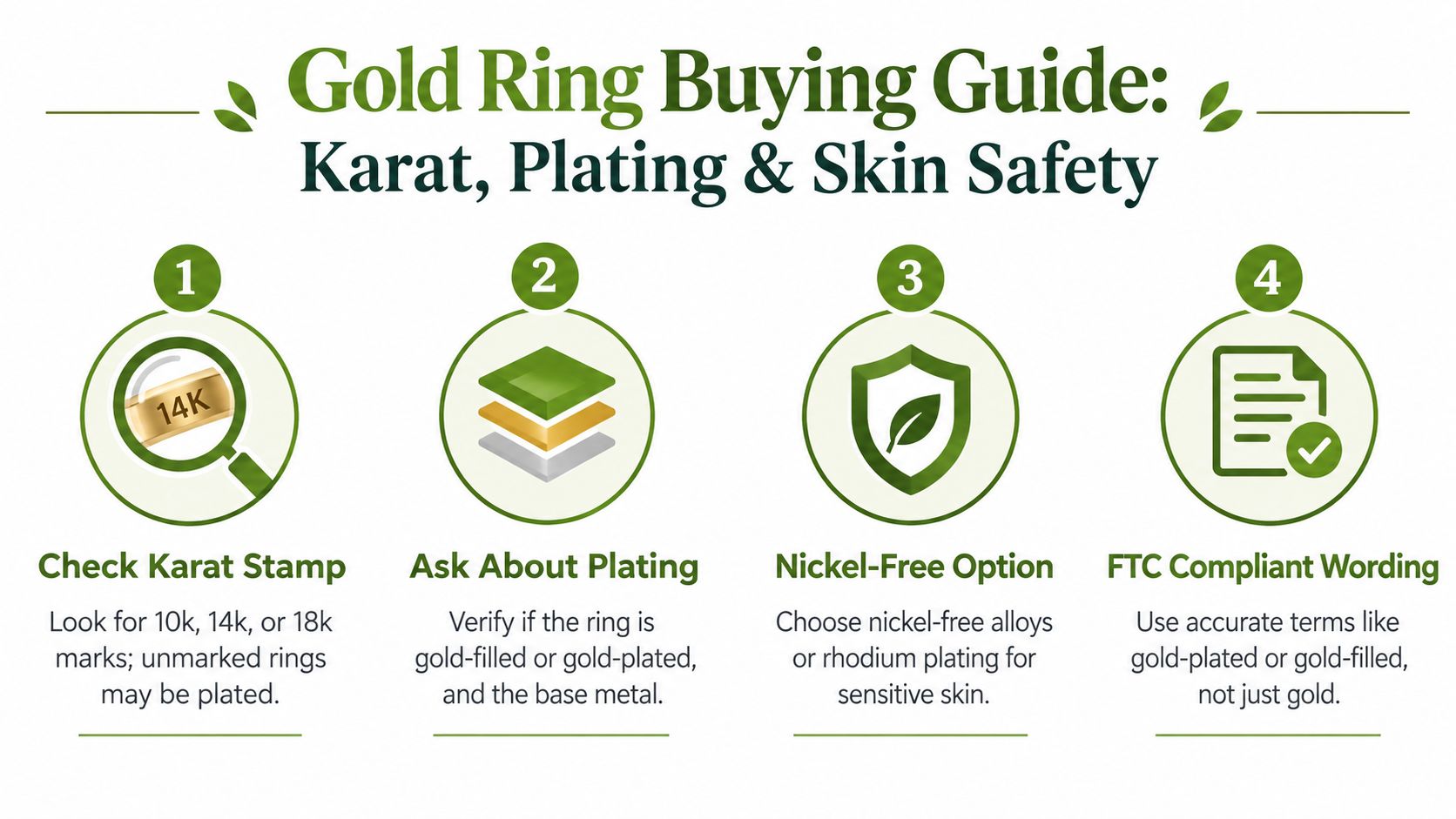
“Gold ring” is incomplete when the piece is plated or merely gold-colored. U.S. guidance requires jewelry claims to match the product's actual precious-metal and gemstone construction. The FTC Jewelry Guides explain how marketers can avoid misleading descriptions. Buyers selling in other markets should also check the rules that apply at the destination.
Use a description that separates base metal from surface finish. “Gold-plated brass” identifies both; “gold-tone stainless steel” describes color without asserting gold content. A 14K claim refers to an alloy of about 58.3% gold by mass, as outlined in FTC's gold and silver buying guidance. Do not infer karat from color or price.
Treat skin-safety claims as a documentation issue
Nickel can trigger allergic contact dermatitis, including where a ring touches the skin. A gold color does not establish suitability for sensitive skin, and a surface layer may expose a different material as it wears. American Academy of Dermatology's nickel-allergy guidance supports treating nickel exposure as a real customer-care issue rather than a marketing shortcut.
Ask for the base-metal declaration, the coating or plating description, care instructions, and any compliance information relevant to the destination market. Keep those records by SKU and production run. Avoid a universal “hypoallergenic” promise; individual sensitivity varies, and the claim needs evidence for the finished item.
A practical product-page checklist
- Name the base metal: Use brass, 316L stainless steel, or 925 sterling silver only when confirmed.
- Describe the surface accurately: Distinguish gold-plated from gold-tone, and state a karat claim only when supported by the specification.
- Identify the accent: Name enamel, resin, zirconia, or sapphire only when the supplier confirms it.
- Keep listing and packaging consistent: Use the same material wording on product pages, labels, and inserts.
- Offer care information: Tell customers how to reduce unnecessary exposure to water, chemicals, and abrasion, using guidance appropriate to that product.
For customer questions about wear, use a product-specific answer rather than a broad promise. This guide to gold-plated jewelry wear can help frame the discussion, but the supplier's construction details should determine what you claim about a particular ring.
Customization Options for Private-Label Collections
Customization is useful when it solves a merchandising problem. An adjustable opening may reduce size complexity; a signet face gives the motif more room; a compact stackable band supports add-on selling. Choose the format first, then decide whether a custom blue tone, engraving, logo, or packaging adds enough value to justify sampling.
Customize the details customers notice
Match the blue tone to a defined range rather than approving it from a screen. Request a physical sample or a supplier-agreed color reference, then compare it under at least two ordinary lighting conditions. For a small face, simplify the iris or border so the design remains readable after photography and resizing.
Engraving can personalize an existing form, while a custom logo or box makes more sense for a named private-label release. Confirm the available engraving area and minimum readable size before promising the option. For a quick add-on item, packaging or artwork changes may add cost without improving the customer's choice.
Personalization is most useful when it gives the customer a clear choice, not when it adds details that disappear in the product photo.
For custom development, the current stated MOQ is 50 pieces per style and color. Brass and 925 sterling silver samples are typically quoted at 25–30 days; stainless-steel samples are typically quoted at 25–35 days. These are planning ranges, not a promise for every project. Confirm the specification, artwork, quantity, and schedule for your design, then use this jewelry sample approval checklist to record what was accepted.
Keep the first custom version focused. Add a second finish or accent only when it creates a clear customer choice rather than another nearly identical SKU.
Building a Tiered Blue Eye Ring Assortment
A single hero ring can make a strong display, but it leaves little room for shoppers with different budgets or tastes. A tiered assortment lets you test the motif at accessible and more gift-oriented positions without asking one SKU to do every job. The tiers should reflect real differences in base material, finish, design detail, and product story.
Broad gold-market data should not be used to predict sales of a blue eye ring. The World Gold Council's Q2 2025 jewelry report describes jewelry demand by weight and value across the market; it does not measure this motif, your customer segment, or your price point. Treat it as macro context only. Set opening quantities from your own sales evidence, budget, and the supplier's ready-stock or custom terms.
| Tier | Base Material | Finish | Typical Use | Wholesale Approach |
|---|---|---|---|---|
| Entry | 316L stainless steel | Gold-tone or confirmed gold-plated finish | Everyday fashion or an add-on purchase | Start with a simpler band and clearly described eye detail |
| Mid-range | Brass | Gold-plated | Giftable design with a more detailed eye | Compare the face size and finish in sample photography |
| Premium | 925 sterling silver or karat gold | Gold-plated silver or confirmed karat-gold alloy | Curated gifting or a higher-value collection | Verify metal claims and disclose the full construction |
Use the table as an assortment map, not a quality ranking. A well-specified entry ring may suit a customer better than an elaborate piece. A higher tier should be supported by confirmed materials, workmanship, and presentation rather than by the word “gold” alone.
Compare expected weight, band style, and the story you can substantiate before choosing quantities. A customer looking for a lightweight fashion ring may respond to a different offer than someone shopping for a keepsake. For a material-focused premium edit, wholesale sterling-silver rings provide a useful category reference.
Sourcing Blue Eye Rings From a Wholesale Supplier
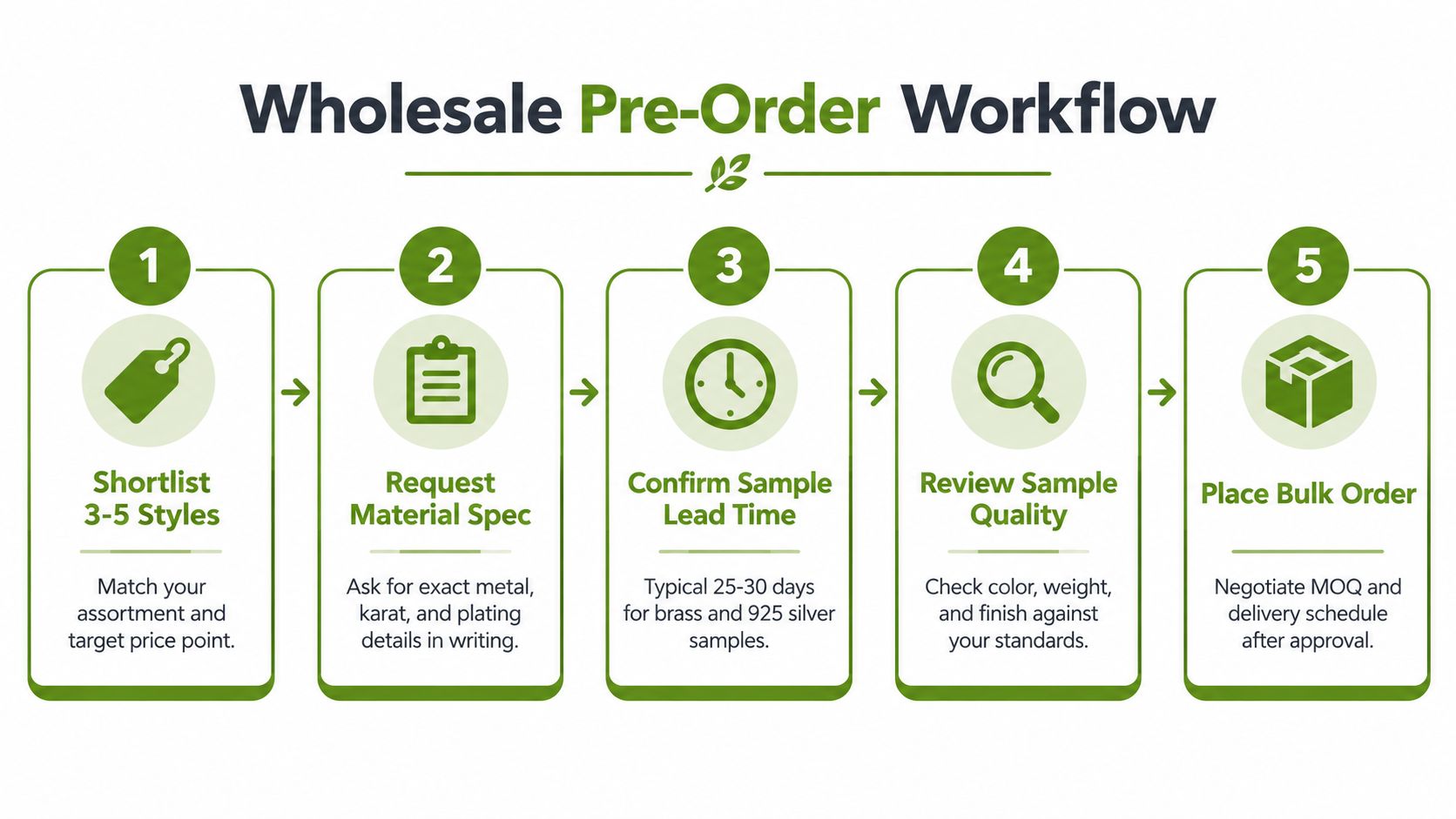
A supplier listing is a starting point. Shortlist styles that have different jobs in the range, then request the exact specification for each candidate. Comparing one slim band, one adjustable or signet style, and one statement ring gives you more information than comparing several versions that differ only in a tiny detail.
Confirm the details before you commit
The written specification should identify the base metal, surface finish, blue accent, ring size system, face dimensions, weight tolerance if relevant, and any karat claim. If a listing says “gold-plated,” ask what sits underneath. If it says “gold-tone,” do not convert that phrase into a gold-content claim.
Build approval time into the launch plan. Current typical sample ranges are 25–30 days for brass and 925 sterling silver and 25–35 days for stainless steel, subject to the design and confirmed order. When the sample arrives, compare it with the written specification before commissioning final photography or packaging.
| Sample checkpoint | What to record before approval | Why it matters |
|---|---|---|
| Motif and front view | Eye outline, symmetry, blue tone, and legibility at thumbnail size | Prevents a detailed sample from becoming unclear online |
| Accent construction | Confirmed material, edges or setting, visible chips, bubbles, or adhesive | Keeps the product claim aligned with the finished piece |
| Fit and comfort | Size system, adjustable range, inside edges, face height, and balance | Reduces avoidable fit and snag complaints |
| Finish and color | Approved sample under two ordinary lighting conditions | Creates a usable reference for later units and photography |
| Packing | Separation between rings and protection for raised details | Limits ring-to-ring abrasion and pressure on the motif in transit |
After the sample passes those checkpoints, finish the order review:
- Shortlist styles with different jobs: Include options that serve everyday wear, gifting, or statement styling.
- Get specifications in writing: Match every public product claim to the supplier's description.
- Review the sample closely: Check the blue detail and gold finish under more than one lighting condition.
- Confirm order terms: Make sure the MOQ fits your cash flow and the range of sizes or colors you plan to carry.
- Set the launch sequence: Approve the sample before building product photography and listing copy around it.
Pause when a listing uses “gold ring” without a base metal, leaves the blue accent unnamed, or makes a gold-content claim without a matching specification. HonHo's current custom MOQ is 50 pieces per style and color, while ready-stock wholesale orders start at US$100 and can mix styles from one piece each. Confirm availability and terms for the selected SKUs; ready stock can test the motif while a custom design is being sampled. The low-MOQ jewelry sourcing guide explains how those two paths affect assortment planning.
FAQ on Stocking Blue Eyes Gold Rings
How should I describe a blue eyes gold ring on a marketplace?
State the base metal, surface finish, and confirmed blue accent. “Gold-plated brass with blue cubic zirconia” and “gold-tone stainless steel with blue enamel” describe different products. Do not call either solid gold.
Does gold-plated stainless steel or brass hold up better for everyday wear?
Neither base metal gives a universal wear-life answer. Compare the exact finish, construction, care advice, and an approved sample. Use product-specific evidence for durability claims.
What minimum first order makes sense for a new motif?
For a first test, cover two or three distinct design roles without buying several near-duplicates. Ready-stock orders currently start at US$100 and can mix styles from one piece each; custom manufacturing starts at 50 pieces per style and color. Reconfirm both availability and terms before ordering.
Can I offer personalization without full custom manufacturing?
Possibly. Confirm which ready-stock styles have enough engraving area and whether the service is available for that SKU. Show the approved character limit and placement before advertising the option.
Browse HonHo Wholesale Jewelry for ready-stock options across several materials and finishes. For a private-label blue eye range, send the intended material, finish, blue accent, size plan, target quantity, and launch date through the B2B quotation form. HonHo can then confirm which details apply to a ready-stock SKU and which require custom development.


