

PVD, or physical vapor deposition, deposits a thin metallic or compound coating onto a prepared surface in a vacuum. On jewelry, it changes the surface finish while stainless steel, brass or 925 sterling silver remains the structural material. A gold-colored PVD coating can contain real gold, or get its color from a compound such as titanium nitride. The process name alone does not tell you which.
For wholesale buyers, read the base metal first, then the layer specification, then the evidence for the finished design. This guide focuses on how preparation, coverage and assembly affect that decision. For a closer look at gold-layer quotations, see the gold PVD coating guide.
Table of Contents
- What PVD Coating on Jewelry Means
- PVD Versus Electroplating and Solid Gold
- How the PVD Process Works Step by Step
- Durability and Benefits by Base Metal
- Limits and Allergy Claims
- Caring for PVD Jewelry to Make It Last
- Choosing PVD Styles to Stock and Pricing Them
- Confirm These Specs Before You Order PVD Pieces
What PVD Coating on Jewelry Means
A customer holding a gold-colored steel bangle may ask whether it is real gold. Ask the supplier to identify the surface material before answering. PVD can deposit metals or form compounds through a reaction with process gases. Titanium nitride (TiN) and zirconium nitride (ZrN), for example, can give a gold-like appearance without being gold. Other systems place an actual gold or gold-alloy layer over a support coating.
The structural metal still carries the weight, the spring of an open ring and the strength of a clasp. The coating sets the surface color and affects wear. A specification should identify both, including the alloy grade where verified.
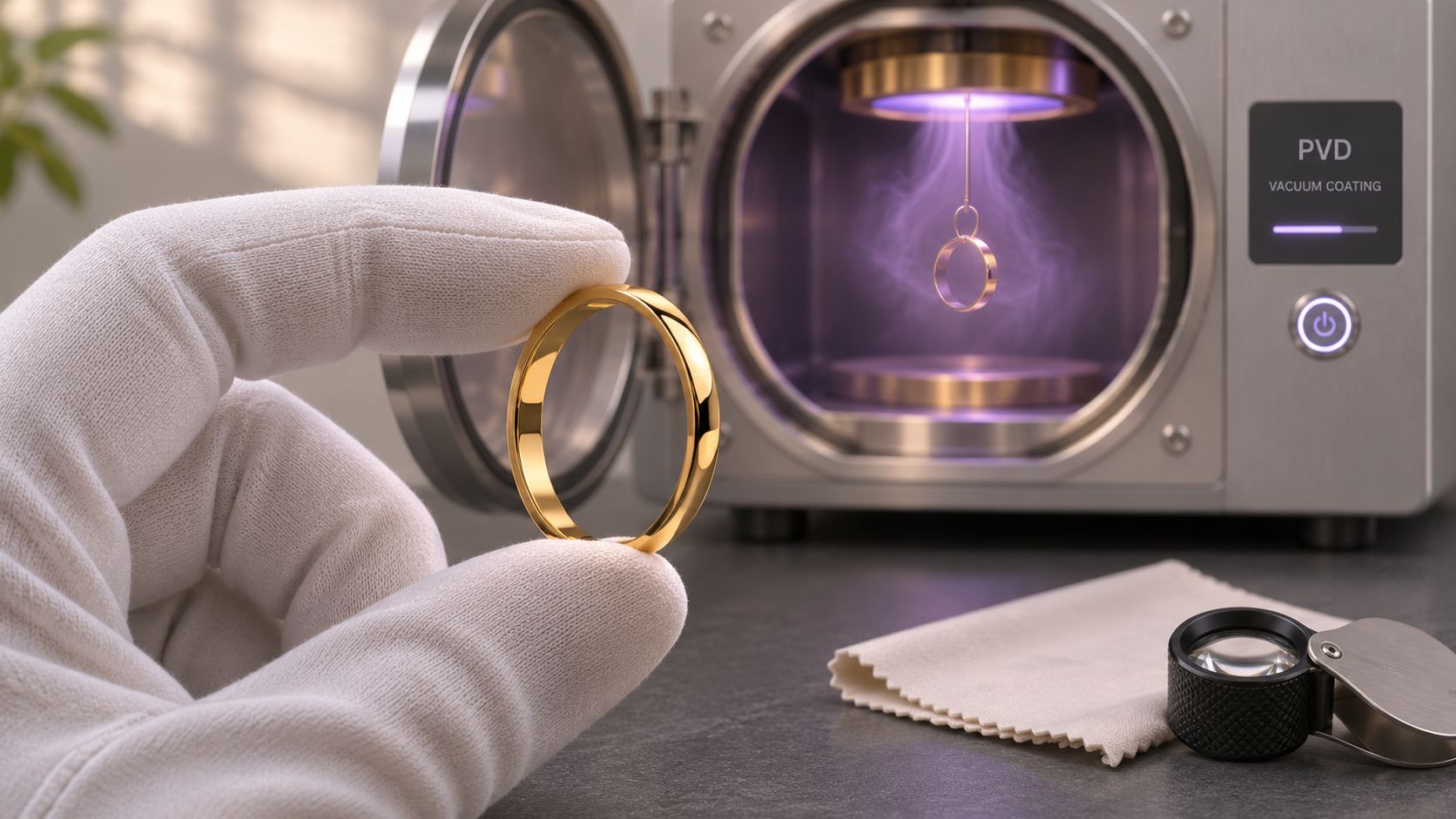
PVD on a label names a process, not a specification.
Color and wear still depend on coating chemistry, thickness, how the surface was prepared, and how the piece is worn. Before you write a product page, ask for the base metal, the coating material, the measured thickness, the adhesion standard, and the test data. Those five items are what you can explain to a customer without overselling the finish.
PVD Versus Electroplating and Solid Gold
Two supplier quotes can both say "gold" while describing different products. Compare the structural material, finish and evidence before comparing prices.
| Factor | PVD coating | Electroplating | Solid gold |
|---|---|---|---|
| Process | Vacuum deposition onto a prepared surface | Electrochemical deposition in a plating bath | The stated component is made from a gold alloy, rather than coated base metal |
| Thickness to request | Identify each layer and the total system separately. The jewelry production note on PVD thickness is a supplier-side overview, not a universal thickness specification. | Specify the deposited metal, underlayers and any protective topcoat separately | No coating thickness comparison; confirm alloy fineness and construction, including whether the piece is hollow |
| Base material | Stainless steel; suitable brass or silver designs after process review | Brass, sterling silver and other compatible substrates | Gold alloy, with findings and other components confirmed separately |
| Color | Depends on the coating chemistry and surface texture | Depends on the deposited metal and finish | Depends on the gold alloy; some designs also have surface treatments |
| Buyer check | Coverage on recesses and contact points, layer identity, adhesion and wear evidence | Layer thickness, barrier system, coverage and wear evidence | Fineness evidence, weight, dimensions, construction and findings |
| Performance limit | A hard support film does not guarantee an unworn gold top layer or an undamaged assembly | Thickness alone does not determine wear; preparation and exposure matter | The alloy can still scratch or deform; a higher material value is not a scratch-proof guarantee |
PVD and electroplating are process routes, not fixed quality tiers. Either needs a product-specific specification. For plated-karat wording, the guide to 18k gold plating explains why "18K" does not tell you coating thickness.
For custom stainless steel development, HonHo's Plating & Finish Guide separates a default 0.5 μm TiN support layer from gold generally specified at 0.03–0.10 μm, with higher gold thicknesses reviewed by project. These are custom-development references, not specifications for every ready-stock item. Confirm the recipe, color and measurement scope in the quotation.
How to choose by use
Consider PVD for a stainless steel range when the proposed coating and sample checks match the intended use. Electroplating can suit detailed brass and silver designs, including precious-metal finishes. Solid gold suits a collection whose value includes the alloy itself. Price and seasonality alone do not establish which finish will perform better.
A small charm raises the same labeling question. The gold horseshoe charm buying guide discusses solid-gold and plated choices; it is a retail buying reference, not technical evidence for a PVD coating. Use the named metal and finish on the line sheet, then confirm the actual construction.
How the PVD Process Works Step by Step
Preparation and fixture design affect the coating before the chamber cycle starts. Oils and polishing residue can impair adhesion, while recessed or shielded surfaces may receive less coating. Rotation helps expose surfaces, but does not guarantee complete coverage inside a hinge or between touching links.
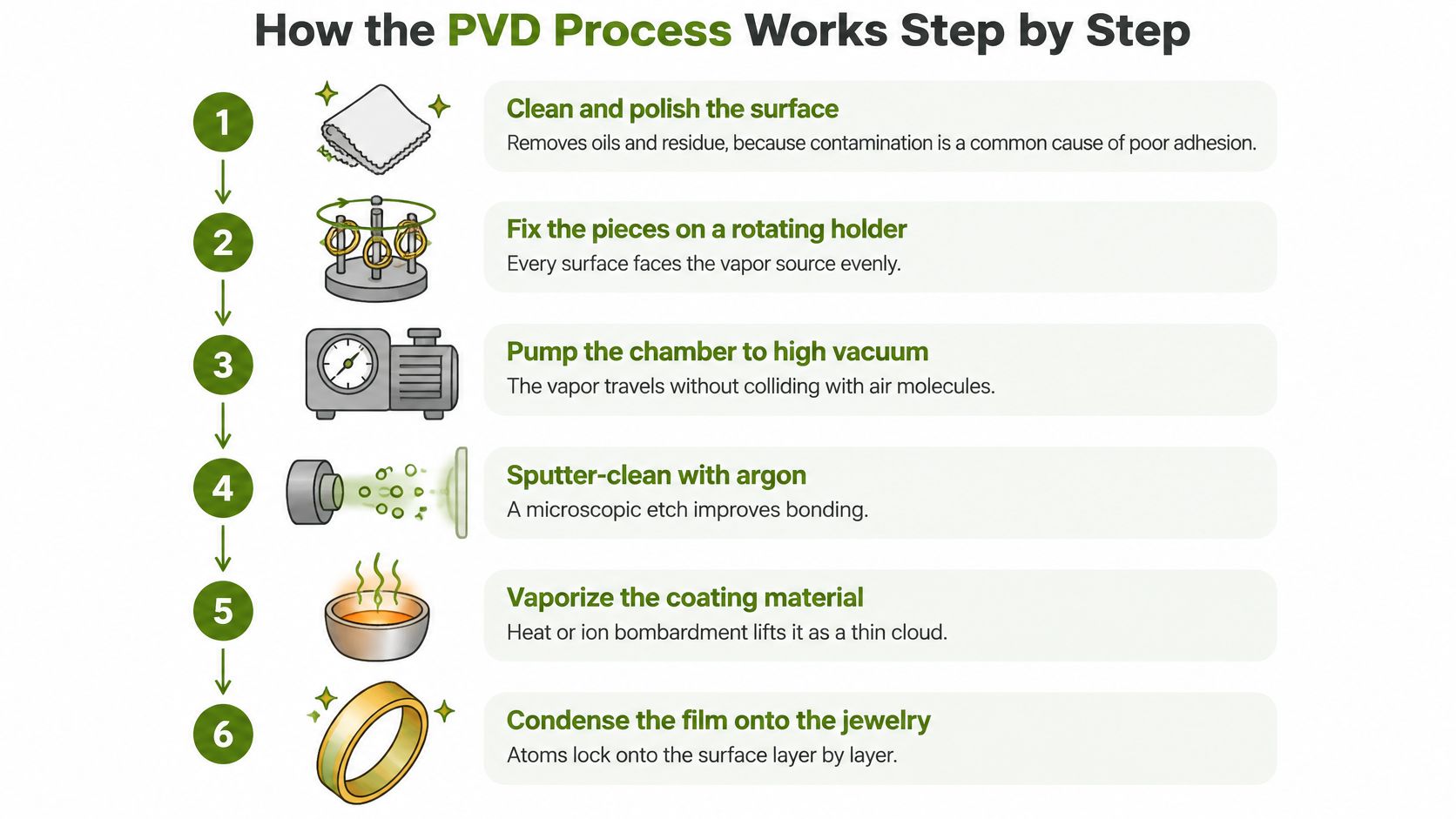
- Clean and polish the surface. Remove oils, polishing compound and fingerprints. PVD generally follows the texture beneath it, so it should not be expected to fill scratches or level a poor polish.
- Fix the pieces on racks. Review ring undersides, link interiors and clasp contact faces. Agree acceptable fixture-contact marks and any intentionally uncoated areas before approval.
- Pump the chamber down and establish the specified process atmosphere. Vacuum conditions and controlled gases are part of the coating recipe; reactive deposition may deliberately introduce gases such as nitrogen.
- Prepare the surface in the chamber where the route requires it. Ion or plasma cleaning can remove residual contamination before deposition.
- Deposit the selected material. Sputtering uses energetic ions to release material from a target; cathodic arc uses an electrical arc. The selected target and reactive gases determine the film chemistry.
- Cool, unload and inspect. Check color, coverage and the agreed measurement locations on the finished geometry. A flat coupon is useful process evidence but does not represent every hinge, edge or inner face.
Ionbond's PVD process explanation describes sputtering, cathodic arc, surface preparation and line-of-sight coverage. Its industrial process ranges are not jewelry specifications or HonHo production settings.
The diagram simplifies the sequence: rotation improves exposure, but cannot make vapor reach every hidden surface equally. Confirm temperature compatibility and the assembly sequence for solder, stones, enamel, adhesives and moving parts. Do not assume a fully assembled design can go through any PVD cycle.
What the film actually is
The deposited material may be a metal, a nitride such as TiN or CrN, a carbonitride or another specified coating. The hardness of one support film does not describe the hardness or wear life of an outer gold layer. Request the complete stack instead of borrowing a hardness value from a different material or coating recipe.
Exposed edges, clasp contact points and ring undersides can lose coating and show the base metal. On a finished batch, check consistent color and the absence of unacceptable bare patches against the approved sample. Record any intended masking separately so it is not confused with a coverage defect.
Durability and Benefits by Base Metal
The base metal supports the thin film. Differences in substrate hardness, corrosion behavior, surface condition and deformation can change the result even when the coating has the same color. A hard coating on an open ring still has to tolerate the way that ring flexes.
The peer-reviewed review of decorative PVD discusses decorative coating systems and their performance. Results from particular samples and scratch methods are not a general percentage ranking of brass, silver and steel, nor a prediction of customer returns. Compare representative finished samples under the same agreed conditions.
| Base metal | Design-specific check | What to record |
|---|---|---|
| Brass | Surface preparation, barrier layers, soldered joints and any flexing areas | Base alloy, layer sequence, joint condition and observed coating damage |
| 925 sterling silver | Deformation, surface condition, assembly and suitability for the coating cycle | Verified silver specification, preparation route and results on the actual design |
| Stainless steel | Verified grade, recess coverage, link contact and clasp movement | Alloy evidence, measurement locations and wear at contact points |
HonHo reviews PVD for selected brass and 925 silver designs as well as stainless steel. Its current brass/silver PVD offering excludes styles containing cubic zirconia. That is a scope limit of this offering, not a claim that all manufacturers have the same restriction.
Why the substrate changes the result
A coating that resists scratching on a rigid surface may behave differently when the underlying part bends or when links rub together. Review the completed assembly, not only a coating coupon.
The comparison of PVD coating and gold plating discusses durability and salt-fog results. It does not establish a test pass for a HonHo item. A corrosion-exposure result needs the sample identity, layer build, method, duration and acceptance criteria; it cannot be converted into years of wear or a waterproof promise.
Ask for abrasion and adhesion results on the finished ring or bracelet, not only on a flat coupon. Coupons miss the edge, the clasp and the underside.
For the alloy distinction, the guide to what 316L stainless steel jewelry is separates the base from the finish. The Gold Plated Stainless Steel Blue Enamel Turtle Open Ring is currently listed as stainless steel with a gold plated finish and blue enamel. Its custom-PVD options do not establish the coating route, steel grade or thickness of that stocked ring. Use it to plan checks on the open band and decorated face, then request the missing specifications.
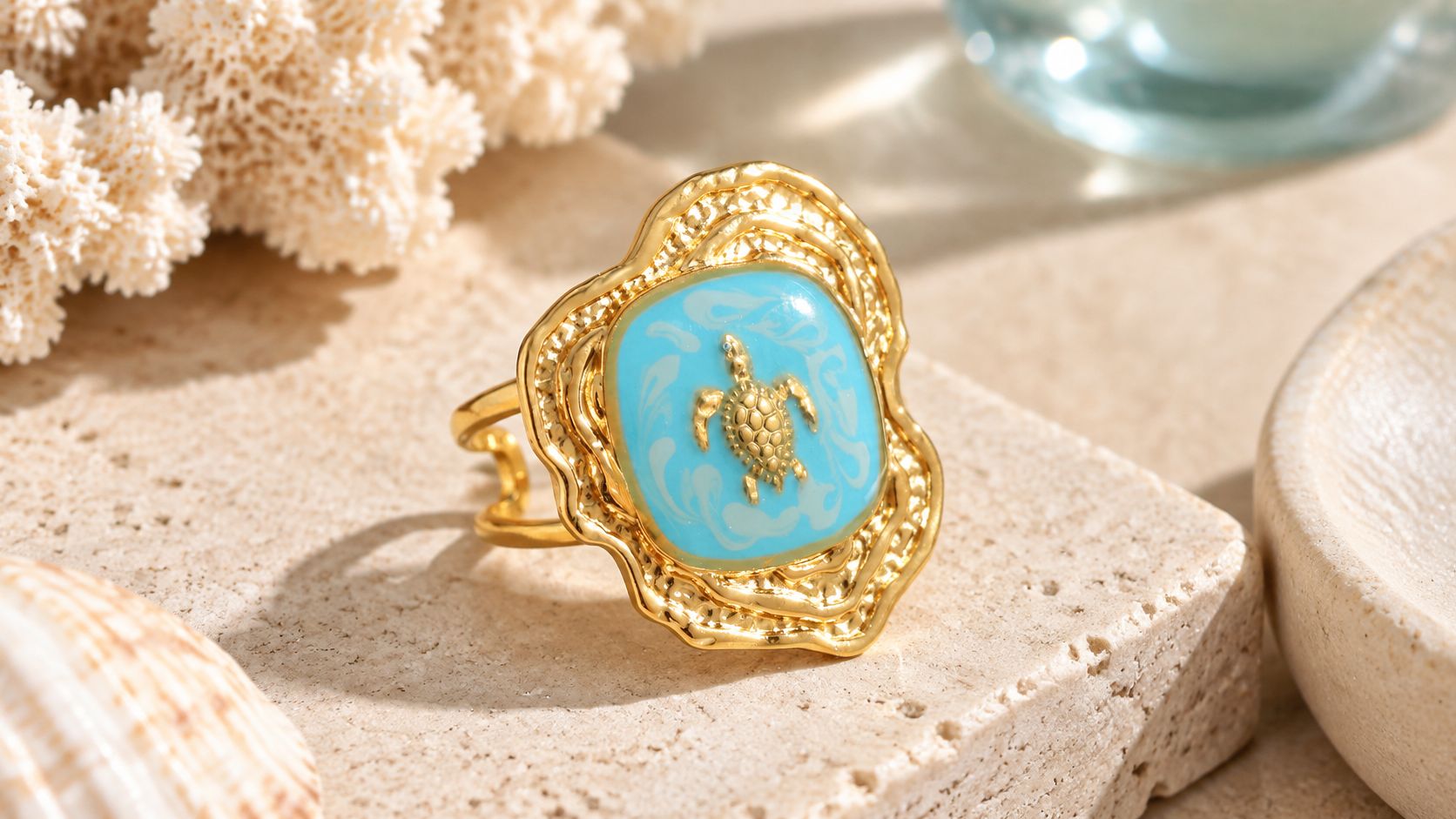
Avoid "waterproof" and "scratch-proof" claims based only on the word PVD. Name the verified base metal and finish, and provide care advice for the complete item.
Limits and Allergy Claims
PVD does not by itself establish that jewelry is hypoallergenic. Skin-contact exposure depends on the base alloy, underlayers, uncoated components and coating condition. Stainless steel can contain nickel; nickel content and nickel release are different measurements.
Pores, pinholes, contamination or weak adhesion can allow exposure to the underlying layers. Check posts, earring backs, inner faces and moving contact points as well as the visible front. Lead and cadmium restrictions require their own market- and product-specific assessment; a nickel-release report does not settle them.
The test that matches the claim
The decorative-coating overview at Encyclopedia.pub discusses wear/corrosion simulation and nickel-release testing. The linked comparison of PVD coating and gold plating also makes safety claims, but its 0.2 μg/cm²/week figure should not be applied to every prolonged-skin-contact item.
ECHA's REACH Annex XVII entry 27 distinguishes post assemblies inserted into pierced body parts, which require nickel release below 0.2 μg/cm²/week, from direct and prolonged skin-contact parts, for which the restriction threshold is 0.5 μg/cm²/week. It also sets a coating-durability condition for the latter category. Confirm the applicable category and current test edition with a qualified laboratory; these limits are not a general allergy-safety guarantee.
For coated articles, agree whether EN 12472 wear/corrosion simulation is required before EN 1811 nickel-release testing. Obtain a report identifying the submitted item, tested parts, method edition, pretreatment, result and applicable acceptance decision. A fresh coating measurement is not evidence of release after simulated wear.
For earrings, the material that actually touches skin matters. The guide to hypoallergenic helix earrings discusses that distinction. A finish on the decorative front does not establish the specification of the post or back.
Do not claim "hypoallergenic" from a coating name or a single unrelated report.
For thickness checks, ask the laboratory which method resolves the specified layers. Fischer's measurement guidance explains that XRF suitability depends on the layer system, while sample positioning, composition and calibration affect the result. Record the measurement location and uncertainty; do not treat one reading as proof of coverage across the whole item.
Caring for PVD Jewelry to Make It Last
Give retail staff care instructions for the complete piece, including pearls, stones, enamel and adhesives. A finish that tolerates a cleaning step does not establish that the assembled jewelry does.
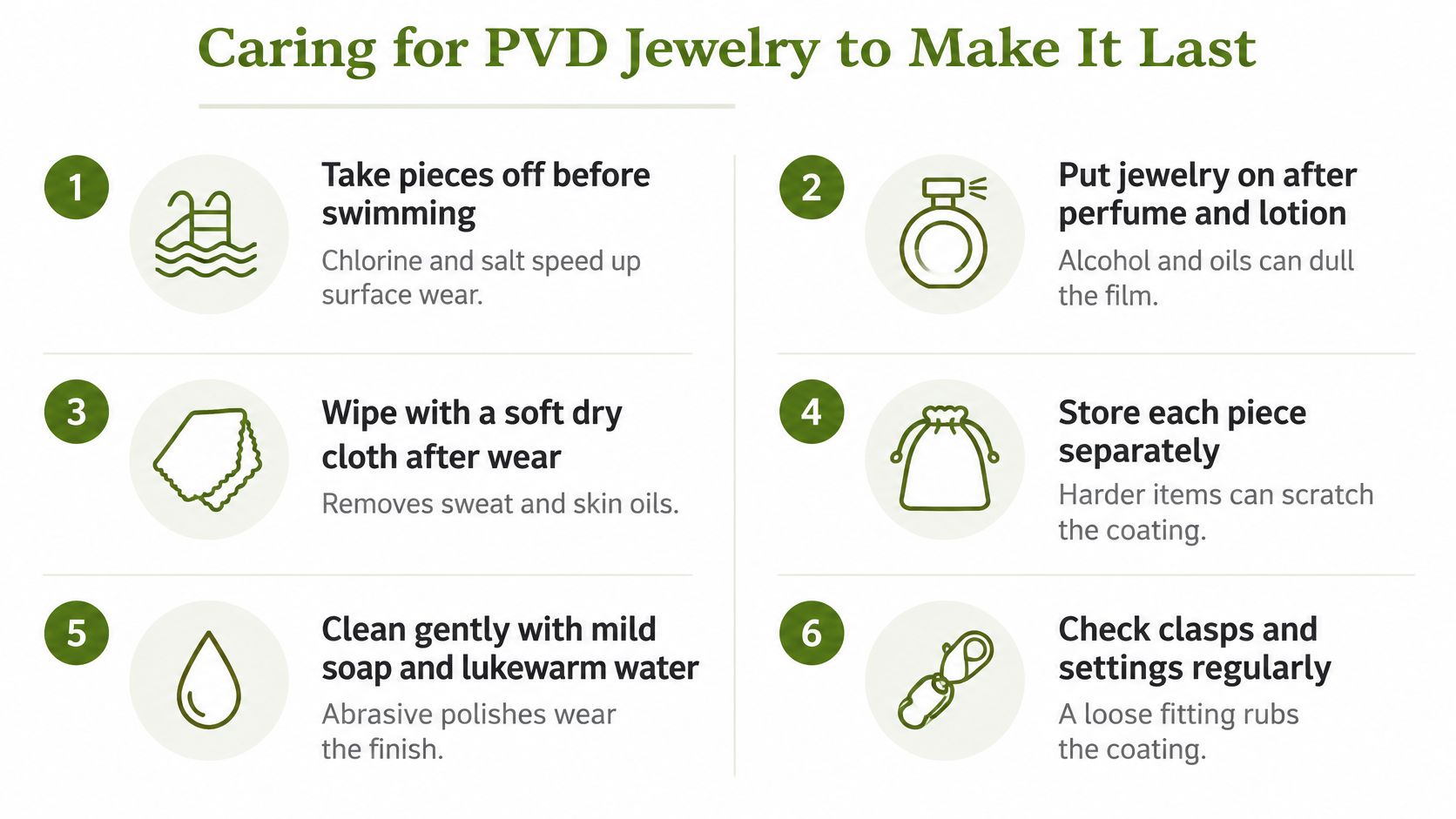
- Take pieces off before swimming, cleaning and activities that expose them to abrasion or chemicals.
- Apply perfume, lotion and hair products before putting on jewelry. Avoid household bleach, solvents and abrasive polishing pastes.
- Wipe with a soft cloth after wearing and store each piece separately so harder items do not rub against the finish.
- Use mild soap and water only where the product's care instructions allow it. Avoid soaking pearl-set or adhesive-assembled pieces without confirmation.
- Inspect edges, clasps, link interiors and ring undersides. Record flaking, exposed metal or a change in clasp function and investigate before making further wear claims.
The care illustration is a general reminder. Its washing advice is conditional on the assembly; follow the specific product instructions and the Jewelry Care Guide.
What to tell the customer
A worn spot can reflect friction, poor adhesion, inadequate coverage or another cause. Its location alone does not settle a warranty question. Compare the returned item with the approved sample, photographs, care instructions and order specification before deciding.
The guide to how long gold plated jewelry lasts explains why plated-color wear depends on the product and use. Avoid assigning a lifespan from the finish name or promising the same result for every customer.
Choosing PVD Styles to Stock and Pricing Them
Choose styles that let you test the construction you plan to sell: a ring for underside contact, a chain for rubbing links or a bracelet for clasp movement. Compare samples against the same color reference and agreed checks. The coating route alone does not justify a premium price or predict sales.
Price from the specification you can document. Work back from a realistic retail price to landed cost, including shipping, packaging, inspection, testing and likely returns. Keep findings and assembly scope consistent between quotes. Start with an assortment sized to your budget and customer demand; there is no universal number of styles or trial season.
If you sell on Etsy, an Etsy fee calculator can help estimate fees. Check its country and payment assumptions against your own account before using the result in a margin calculation.
The Gold Plated Stainless Steel Freshwater Pearl Link Bracelet has rectangular links, freshwater pearls, a lobster clasp and an extender according to its current listing. It is listed as gold plated stainless steel; the page's custom-PVD options do not prove the finish of that ready-stock bracelet. Inspect link contact, pearl attachment and clasp action, and request any unlisted grade or coating details before resale claims are written.
Confirm These Specs Before You Order PVD Pieces
Ask the supplier to complete the specification before approving a product page or bulk order:
- Base metal and verified alloy grade, named separately from the coating.
- Full layer sequence: underlayers, decorative compound, any actual gold layer and protective treatment.
- Thickness scope, method and measurement locations. Separate gold thickness from TiN support and total film.
- Physical color reference, surface texture, approved coverage and any intended masking or fixture marks.
- Adhesion, abrasion and corrosion checks appropriate to the geometry, plus market-specific chemical or release testing.
- Care copy, claims and repeat-order criteria that match the approved item.
PVD sample approval record
Copy this record for each design and finish. Blank fields remain unapproved; a completed form records an agreement, not a test pass unless the evidence is attached.
| Field | Supplier/buyer entry |
|---|---|
| Style, finish, sample revision and date | ________ |
| Base alloy and evidence reference | ________ |
| Layer sequence and separate thickness targets | ________ |
| Color reference and surface texture | ________ |
| Measurement points: outer face / inner face / clasp / other | Locations: ________; method/report: ________; results: ________ |
| Coverage and assembly inspection | Fixture marks/masking: ________; link/clasp/hinge findings: ________ |
| Agreed wear and market-specific checks | Method/edition: ________; sample ID: ________; criteria: ________; result: ________ |
| Release decision | Approve / revise / hold: ________; unresolved points: ________; approver/date: ________ |
For example, if the outward-facing chain link matches the approved color but its contact face has an unexplained bare patch, hold approval and ask whether the patch is an agreed fixture/masking area or a coverage defect. Photograph the location and compare the assembled sample. This is a hypothetical inspection decision, not a report of a tested HonHo batch.
The Gold Plated Stainless Steel Freshwater Pearl Oval Bead Jewelry Set offers necklace and bracelet options in gold plated stainless steel with freshwater pearl. Confirm which option is quoted and how pearls are attached. The listing's 50-piece per-style/per-color custom MOQ does not make its custom coating options the specification of every stocked variant.
Use the jewelry sample approval checklist before signing off on the full order. For custom work, the current baseline is 50 pieces per style and color; special components or packaging may have separate minimums. Brass/925 silver samples normally take 25–30 days, stainless steel samples 25–35 days and bulk production 35–45 days after sample and specification approval. Allow for revisions, testing and transit; ready-stock dispatch is a separate schedule.
To request a PVD development quotation, send front/back references, dimensions, base metal, color reference, quantity by finish, destination market and expected wear. Include the completed sample record or identify the specifications still undecided so the coating route and checks can be agreed before production.


