

US retailers can buy stainless steel jewelry from domestic stockists, overseas ready-stock wholesalers or a custom manufacturer. Choose by dispatch location, finished-product specifications and the cost of getting saleable stock to your store. Serving US buyers, dispatching from a US warehouse and manufacturing in the US are different claims.
Before comparing unit prices, confirm the steel grade, finish, quantity per variant, delivery terms and sample approval record. A named alloy or a report for another style does not establish the specification or compliance of your order.
Table of Contents
- Where US Buyers Source Stainless Steel Jewelry Wholesale
- Choosing Between 316L, Brass and 925 Silver
- Supplier Checklist to Run Before You Order
- Compliance and Labeling for US Listings
- How to Move From Sample to Stocked Order
- Pricing, Markup and Trend-Versus-Evergreen Planning
- Confirm Your Order Plan Before You Buy
Where US Buyers Source Stainless Steel Jewelry Wholesale
For example, two quotes for similar hoops may cover different alloys, coatings, packaging and delivery terms. Put them into the same quotation format before deciding which costs less. A photograph cannot resolve those differences.
The three routes below differ in replenishment, customization and the import work the buyer handles.
US distributors holding ready stock: Confirm the physical dispatch location, available quantities, dispatch date and return address. A domestic warehouse still doesn't rewrite the factory spec, so the alloy and coating have to be in the file.
Overseas factory-direct wholesalers: Compare the delivered quote rather than assuming factory-direct always costs less. The same habit in Next Point Digital's Amazon sourcing guide applies here. Price is one column. The paper trail is another.
Private-label manufacturers: Your brand goes on the card or the piece only after metal, finish, and origin marking are already settled. Jewelry manufacturing in China is the longer look at what that factory relationship asks of a small brand before a logo goes on anything.
The U.S. Census Bureau profile for NAICS 4239 describes a broad wholesale category, not stainless steel jewelry alone. It cannot establish demand for your assortment. Use your own sales and replenishment constraints instead of treating category-wide figures as a product forecast.
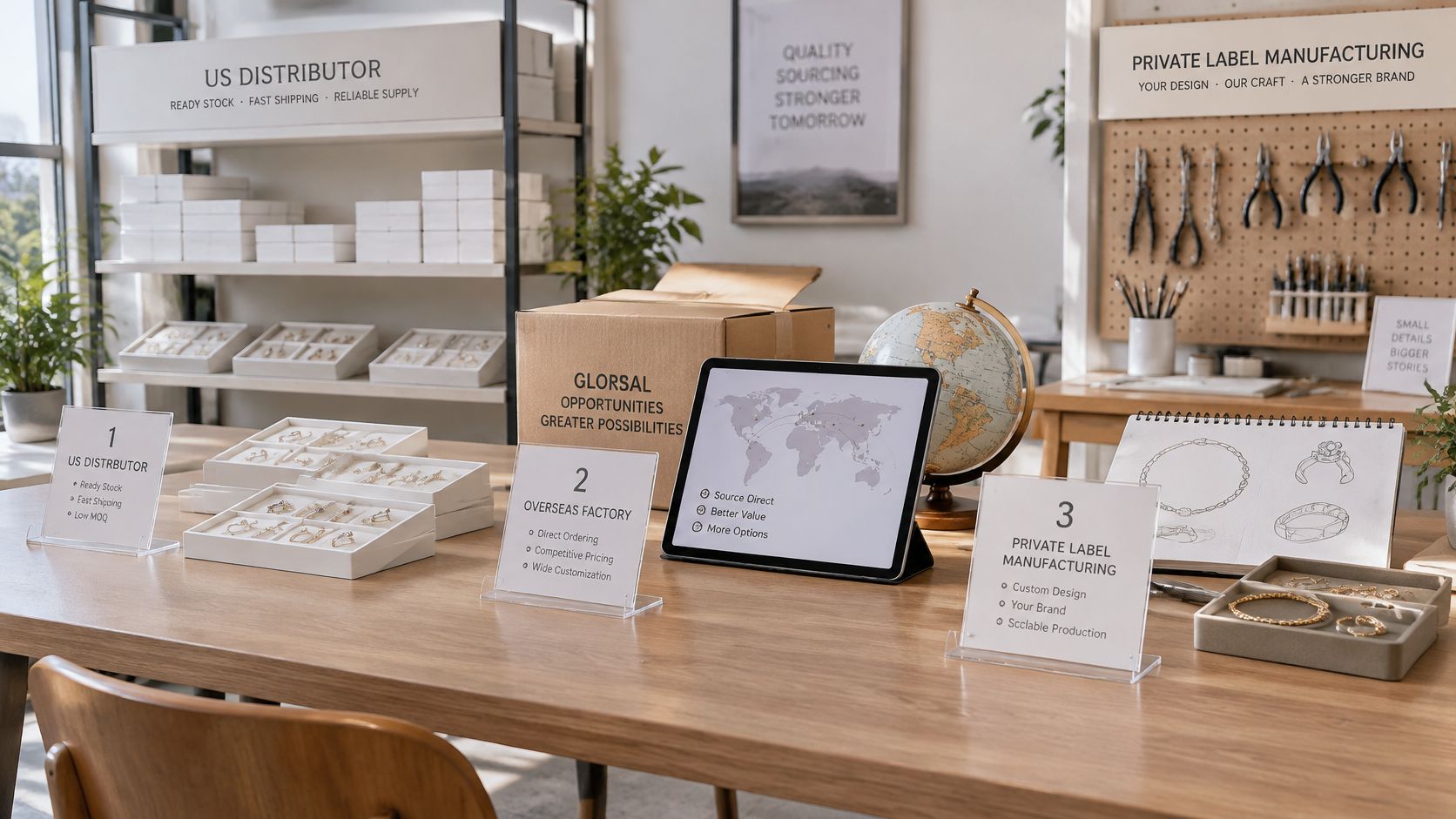
Ask the supplier to resolve missing alloy or finish information before approving the quotation.
Choosing Between 316L, Brass and 925 Silver
Specify the base metal separately from its finish. The grade of the main body does not identify every clasp, post or coating in the assembly. Check the supplier’s declaration against the finished sample.
| Material | Tarnish or corrosion | Skin contact and nickel | Durability note |
|---|---|---|---|
| 316L stainless steel | Corrosion resistance depends on exposure, surface condition and construction; no promise against every form of discoloration | A "tested for low nickel release" claim needs batch data on the finished piece. No absolute nickel-free claim | The base is durable. A gold-tone coating wears separately |
| Brass | May tarnish; confirm whether it is bare, plated or otherwise protected | Request a release test on the finished, plated piece before any sensitive-skin wording | Wear follows the coating over the brass, not the brass alone |
| 925 sterling silver | May tarnish; cleaning must suit any plating, stones and surface treatment | Request release data on the finished piece. Polishing doesn't prove low nickel release | Check scratches, deformation and the finish on the actual design |
| Gold plated over base metal | A finish category, not a separate base metal; identify both substrate and coating | Test the plated article, not the raw base, before any skin-contact claim | Ask which surfaces, clasp, edge, or face, take the coating |
Why the grade has to be named
Specify 304, 316L or the actual declared alloy for each relevant component. A general factory material option does not prove the grade of a stocked SKU. The European Commission nickel-release file concerns a European technical and regulatory context. It is not a US approval or a test report for your order; do not transfer its specimen results to your supplier's finished jewelry.
Use low-nickel-release wording only when an applicable report supports the claim about the finished item. A release test does not establish nickel-free composition. Our guide to what 316L stainless steel jewelry is explains why the alloy name and finished-product claims need separate evidence.
Claims that outrun the test
Waterproof, tarnish-free, and hypoallergenic are shortcuts. They don't name sweat, chlorine, perfume, or daily abrasion, and they don't say which surface was coated. The 2018 Federal Register notice on the FTC jewelry guides requires that plating, coating, thickness, and durability claims not mislead, and that a gold-plated description rest on a coating of reasonable durability.
Check the substrate, coating and finished assembly separately before making a durability claim.
Agree the expected exposure and inspection locations before selecting a finish. Clasps, edges and moving contacts deserve attention. Occasional-use earrings are not automatically suitable for a thinner coating.
Supplier Checklist to Run Before You Order
Keep this table open while you compare quotes. Each row is something you request in writing before you pay for samples.
| Check | What to request | Why it matters |
|---|---|---|
| Base metal | Alloy named in writing: 316L stainless steel, brass, or 925 sterling silver | A generic stainless label can't be compared between suppliers |
| Coating or plating | Coating type, base metal, karat, and plating method, with thickness if the supplier has it | Gold-tone finishes wear differently from solid metal |
| Test documentation | Reports tied to the specific SKU or production batch | Supports marketplace listings and retailer checks |
| Order minimum | Total order minimum, and whether it applies per style | Sets the cost of testing a range of designs |
| Custom run minimum | Minimum per style and color for private-label or OEM work | Decides how many pieces you commit to per design |
| Sample and production time | Days for samples, production, and ready stock, per material | Controls when a collection can launch |
| Resale and export rights | Written confirmation of commercial resale and export terms | Confirms you can sell the goods you buy |
What a usable answer looks like
Base metal: You want "316L stainless steel," "brass," or "925 sterling silver" on the invoice or declaration. "Premium stainless" hasn't answered the question.
Coating: Separate the base from the surface. Gold plated, silver finish, and two-tone are different products. If thickness isn't available, the supplier should say that in writing rather than imply a heavy plate.
Tests: Check whether the report identifies this SKU or an applicable component. Ask the supplier or laboratory to document why it covers the order.
Minimums: A total minimum and a per-style minimum change how many designs you can test. Get both numbers before you sketch an assortment.
Lead time: Days, not "soon," and split by material. Confirm the material-specific schedule and when its clock starts.
Rights: Resale and export terms belong in the order file, not in a chat thread you can't find later. A short guide to choosing a wholesale jewelry supplier pairs well with this list when you're narrowing names.
Keep unanswered fields open rather than turning them into a supplier score. Check the laboratory, method, date, sample identity, result and acceptance limit. A report for another style needs a documented applicability assessment. Resolve differences among the specification, proforma and sample before payment.
Compliance and Labeling for US Listings
Split the audience before you split the shipment. Adult fashion jewelry and children's jewelry don't share one paperwork path, even when both are stainless steel.
Adult fashion versus children's jewelry
The Consumer Product Safety Commission business FAQ identifies ASTM F2999 for adult jewelry and ASTM F2923 for children's jewelry as industry consensus standards. Children's products stay under mandatory chemical limits. Accessible component parts can't exceed 100 ppm total lead. Treat that figure as a ceiling, not a target. Children’s products subject to applicable CPSC safety rules require certification based on CPSC-accepted third-party testing, subject to applicable exemptions. Consult the CPC guidance, including current certificate eFiling information for importers.
Do not infer children’s-product compliance from the main alloy. Review solder, clasps, inserts and coatings too. CPSC identifies separate limits of 100 ppm total lead in accessible components and 90 ppm lead in paint and similar surface coatings. Plan the applicable tests with the laboratory; its lead-content guidance explains the distinction.
Adult jewelry still needs accurate claims and assessment of applicable federal, state, retailer and marketplace requirements. ASTM F2999 is a consensus standard, not a universal clearance certificate. Our 316 stainless steel jewelry guide explains materials; it cannot determine whether a design is suitable for children. Agree the intended age and product classification with a qualified laboratory.
Words a listing can carry
The PDF linked as FTC quality-mark rule in 16 CFR 23.11 includes the legibility note under § 23.10; § 23.11 itself addresses corrosion claims. Keep material and coating descriptions clear. A brand logo identifies a business and does not establish material content.
The FTC jewelry guides address truthful claims on metallic content, quality, treatment, durability, origin, and manufacture. If the precious metal is only on the surface, "gold" has to be qualified as plated or coated. "Gold plated" needs a coating of reasonable durability, and the purity of that coating may need disclosure. Vermeil has sterling-silver and coating requirements, so don't use it on stainless steel.
Build a listing pack per SKU and keep it with the batch:
- Base metal: 316L stainless steel, brass, or 925 sterling silver, as declared.
- Coating: metal, karat if stated, and plating method.
- Nickel information: only what the finished-piece test supports.
- Care limits: perfume, cleaners, and pool chemicals called out where the finish needs it.
- Approved sentence: for example, "316L stainless steel with gold-plated finish."
Keep the approved listing wording with its supporting specification and reports so the same claims can be checked on reorders.
How to Move From Sample to Stocked Order
The spec sheet is the document you'll check the carton against. Order samples only after that sheet exists for the exact SKU.
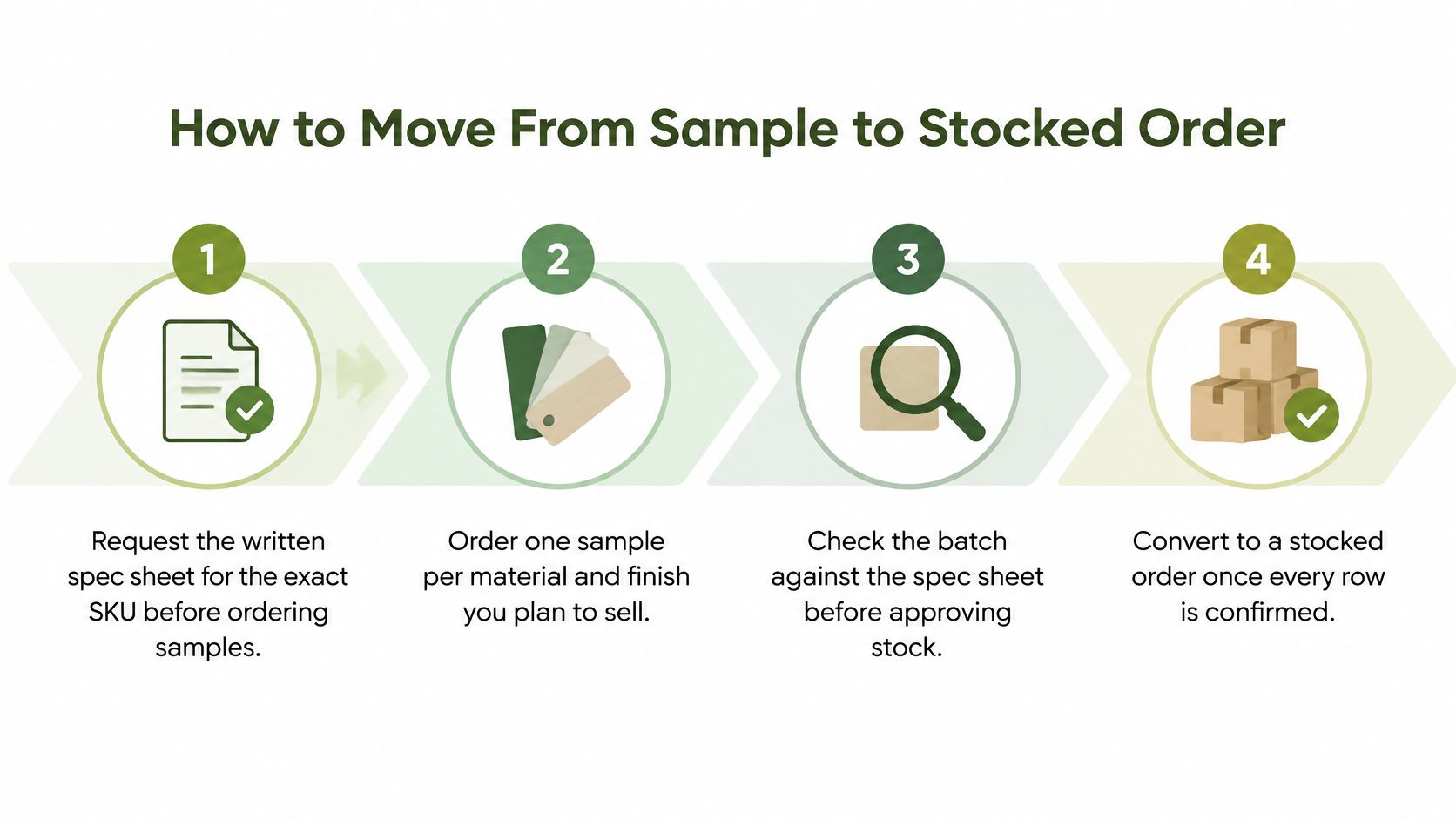
- Request the written spec before samples. Name the base metal, the coating, and the SKU on one page. The common slip is approving a pretty photo while the paper still says "gold color."
- Order one sample per material and finish you plan to stock. Compare color, edges, and the clasp with the spec. A piece can look right and still miss the coating named on the sheet. On an open ring such as the Gold Plated Stainless Steel Cowrie Charm Open Ring with Pearls, check the gold-plated stainless steel band and the moving cowrie cluster together. Pearl type and the pale blue bead material are still pending supplier confirmation, so don't write pearl species into the listing until that line is filled in.
- Agree a sample handling and wear-evaluation plan. Record the exposure, duration and inspection locations. Short handling trials can reveal fit and snagging issues, but cannot establish long-term coating life, allergy safety or regulatory compliance.
- Confirm origin marking before you print packaging. Ask your customs broker to confirm the country-of-origin marking, placement and applicable exceptions for the shipment. Calling the metal stainless steel doesn't replace the country name, including on private-label cards.
- Put lead times on a calendar in days. HonHo’s custom planning ranges are 25–30 days for brass and 925 silver samples, 25–35 days for stainless steel samples and 35–45 days for bulk production after approval and final order confirmation. Allow separately for revisions, transport and clearance. Ready-stock dispatch has a different schedule.
- Confirm the total minimum and any per-style minimum, then split the first order. Put more units into core earrings, rings, necklaces, and bracelets, and fewer into trend styles. Products purchased from us may be used for commercial resale or export, subject to applicable laws and the agreed order terms.
- Inspect the shipment against the sample and the spec, then file both with the batch number. A later return or listing question gets answered from that folder, not from memory.
The jewelry sample approval checklist is the working list to tick while the sample is still on the desk. Use written approval criteria and a retained reference sample to agree what the production order must match.
Sample approval record
Copy these fields into the order file. Agree acceptance criteria before testing; a blank is unresolved, not a pass.
| Field | Buyer entry | Evidence to retain |
|---|---|---|
| SKU, variant and sample revision | _____ | Dated photos and matching quotation |
| Body and component materials | _____ | Declaration covering clasps, posts and findings |
| Finish and measurement scope | _____ | Layer specification, locations and method if measured |
| Dimensions, closure and stone security | Criteria: _____; result: _____ | Readings, conditions and defect photos |
| Test applicability | Report: _____; item match: _____ | Lab, method, sample identity and limitations |
| Release decision | Approve / revise / hold: _____ | Approver, date and retained reference sample |
Pricing, Markup and Trend-Versus-Evergreen Planning
A 2× markup is a pricing scenario, not a retail margin standard. AJ Luxe's jewelry pricing guide provides broader pricing context but does not establish your shop's margin. Separate gross margin from the contribution left after selling expenses.
Landed cost, not the invoice
Illustrative calculation: a $6 landed inventory cost and $12 net selling price give a 50% gross margin before selling expenses: ($12 − $6) ÷ $12. Landed inventory cost includes the purchase and allocated inbound costs. If selling fees are hypothetically $1.80 and outbound fulfillment plus a returns allowance is $1.20, contribution is $3 before overhead and tax. These assumed costs are not a platform tariff or profit forecast. Replace them with your amounts, and avoid counting freight or packaging twice.
Price the line only after the paperwork matches the words you will print: alloy grade, finish, and what the listing is allowed to claim. A number that looks fine on the invoice fails if the product page states a spec the supplier never confirmed in writing.
If you sell on a marketplace, the fee stack changes the math again. The 1P vs 3P margin breakdown from Online Brand Growth is a useful side-by-side when you're deciding whether a first-party or third-party setup leaves enough after the platform's cut.
Where the units should sit
Separate repeat sellers from experimental designs using your own results. Set a review date and reorder trigger based on sales pace, available stock and replenishment time. An untested coastal design does not deserve a larger order solely because it is described as a trend.
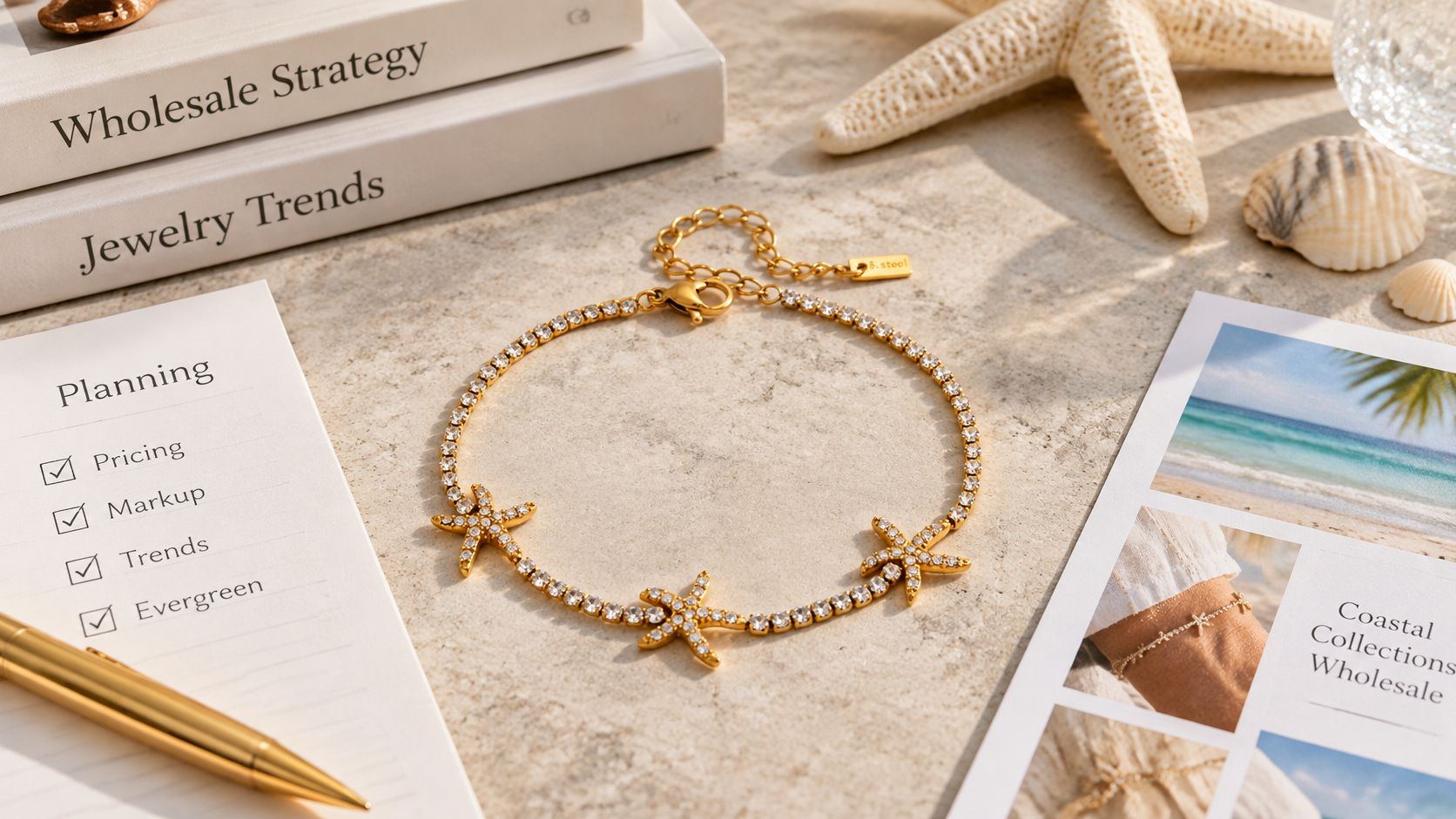
Track three numbers per style each month: sell-through rate, return rate, and gross profit per unit. Cut styles that stall. Stainless steel fits a value-oriented resale plan because you can judge durability, finish, and price together. A slim coastal piece like the Stainless Steel Clear Stone Starfish Bracelet shows the kind of piece worth pricing from: a stainless steel coastal style with a displayed price. Check its current variant price and quantity tier; the listing does not establish an unlisted alloy grade or coating thickness. For a custom coastal run, confirm bulk production days in writing once the specifications are settled, the same way you confirm sample lead times.
Confirm Your Order Plan Before You Buy
Don't place the stock order because the photos are ready. Place it because every checklist row is answered in writing for the exact SKUs you will receive.
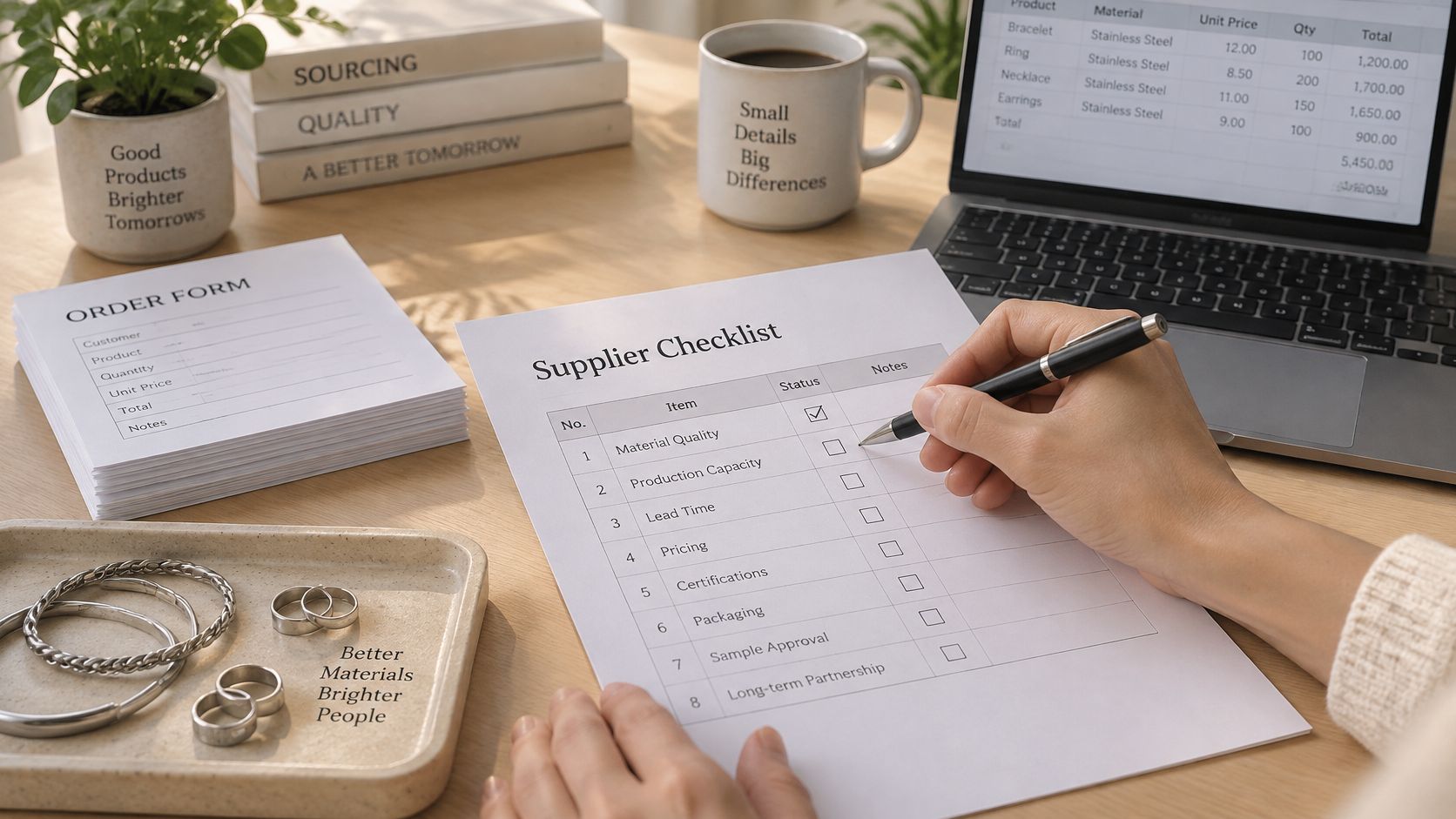
HonHo’s current ready-stock storefront permits mixed styles from one piece each, with a US$100 merchandise minimum after discounts. Confirm quantities and availability for the selected variants at checkout. Custom production starts from 50 pieces per style and color, with size and component minimums confirmed in the quote. See the sample and MOQ guide.
HonHo manufactures in China and Thailand. This US sourcing guide does not claim US manufacture or a US warehouse. Ask for the dispatch location, delivery estimate, import responsibilities and return terms for your order. Factory material and PVD options are not specifications of every stocked item.
Before releasing the order:
- Approve one sample per finish you intend to stock, and keep it with the spec.
- Split the first order between core everyday earrings, rings, necklaces, and bracelets, and a smaller set of trend pieces. A Shopify seller trying to prevent stockouts on Shopify still shouldn't fill the back room with untested styles.
- Set the launch date from confirmed sample and production days, not from a hoped-for ship week.
Custom branding is an option for qualified private-label projects, with its own per-style minimum confirmed in writing. It isn't the default path for a first ready-stock order.
Send HonHo your US sourcing brief with product links or drawings, quantity per variant, required grade and finish, destination ZIP code, target arrival date, intended age group and retailer testing requirements. Request ready-stock and custom options separately.
Review current collections at HonHo Wholesale Jewelry, then retain the agreed SKU list, specification and sample decision with your order.


