

Before ordering moon and star charm bracelets in bulk, confirm the metal and finish for each component, then check the finished sample for snagging, loose connections and a clasp shoppers can fasten one-handed. Start with a simple chain style for layering or a beaded style if the bracelet needs to stand on its own in the display.
Two bracelets can look alike in a catalog even when one is gold plated brass and the other is plated stainless steel. Your purchase order and retail listing should name the confirmed base metal and finish separately.
Table of Contents
- Moon and Star Charm Bracelet Styles That Sell Well
- Materials Compared for Daily Wear and Resale
- Plating, Finish and Tarnish Care for Stock
- Allergy Claims and Nickel Testing
- Designing for Daily Wear and Fewer Returns
- What to Verify Before You Order Wholesale Stock
- Confirm the Specs and Order Samples
Moon and star charm bracelet styles to sample
Use these formats to plan a small trial assortment. Check your own sell-through before expanding the range; the motif alone does not predict demand.
| Style | Design features | Suits | Resale note |
|---|---|---|---|
| Single moon charm on chain | One crescent or full moon with a low charm count | Minimalist boutiques and gift buyers | Light and easy to layer |
| Single star charm on chain | One star, often five or eight points | Everyday fashion and first-time buyers | Check how sharp the star points are |
| Moon and star pair | Crescent and star on one strand | Gift sets and mid-range boutiques | Confirm charm spacing so they don't tangle |
| Beaded celestial bracelet | Cube or faceted beads around a starburst or coin charm | Colourful and boho collections | Confirm bead material before listing |
| Layered celestial stack | Several chains or bangles with moon and star charms | Stores that sell coordinated stacks | Check whether the charms catch on neighboring chains |
On single-charm chains, check whether the moon or star hangs face-forward when the bracelet is fastened. If the star has long points, run them against the kind of knit sleeve your customers wear.
Match the design to the customer
If you plan to sell the moon and star together as a gift, check how both charms sit when the bracelet is fastened. The Victoria and Albert Museum's charm bracelet entry describes individually selected charms personalized with photographs, initials or locks of hair, a useful reminder that charm jewelry can carry personal meaning rather than decoration alone. Keep your gift copy open-ended instead of assigning every customer the same symbolism.
Beaded celestial styles suit shops built around colour, texture and boho styling. Describe bead colour and shape accurately, but don't call an unidentified bead gemstone, crystal or glass. For stacked sets, photograph the pieces together and check whether neighboring chains catch on the charms.
Use your sales records to distinguish an attractive product from a productive stock line. Chartsy's explanation of how to calculate sell-through rate helps you compare movement against inventory received, rather than judging demand from likes or enquiries.
For a broader comparison of charm formats, use our bracelet charm wholesale buying guide. Start with a minimalist option and a more decorative alternative, not a full range competing for the same customer.
Materials Compared for Daily Wear and Resale
Ask for the base metal and finish of the strand, charms, jump rings and clasp. A clasp or ring can differ from the decorative parts even when the whole bracelet is the same color. Inspect the spots where parts rub together.
Base metals for moon and star charm bracelets
| Material | Typical finish | Main care issue | Nickel evidence | When to sample it |
|---|---|---|---|---|
| 316L stainless steel | Polished, brushed or gold plated | Plating scratches expose the base | Lower reading than 304 in the cited lab study | Everyday and skin-contact lines |
| 304 stainless steel | Polished or gold plated | Plating wear on friction points | Higher reading than 316L in the same lab study | Everyday collections when the finished sample and quote meet your brief |
| 925 sterling silver | Polished or oxidized | Tarnish from sulfur and humidity | Request finished-piece test results | Gift and premium boutiques |
| Brass | Gold plated or gold tone | Coating wear at clasp and charm contacts | Request finished-piece test results | Mid-price trend pieces |
Use the material chart to identify what to check. Its resale labels are illustrative, not sales data; scratch resistance and wear depend on the finished item.
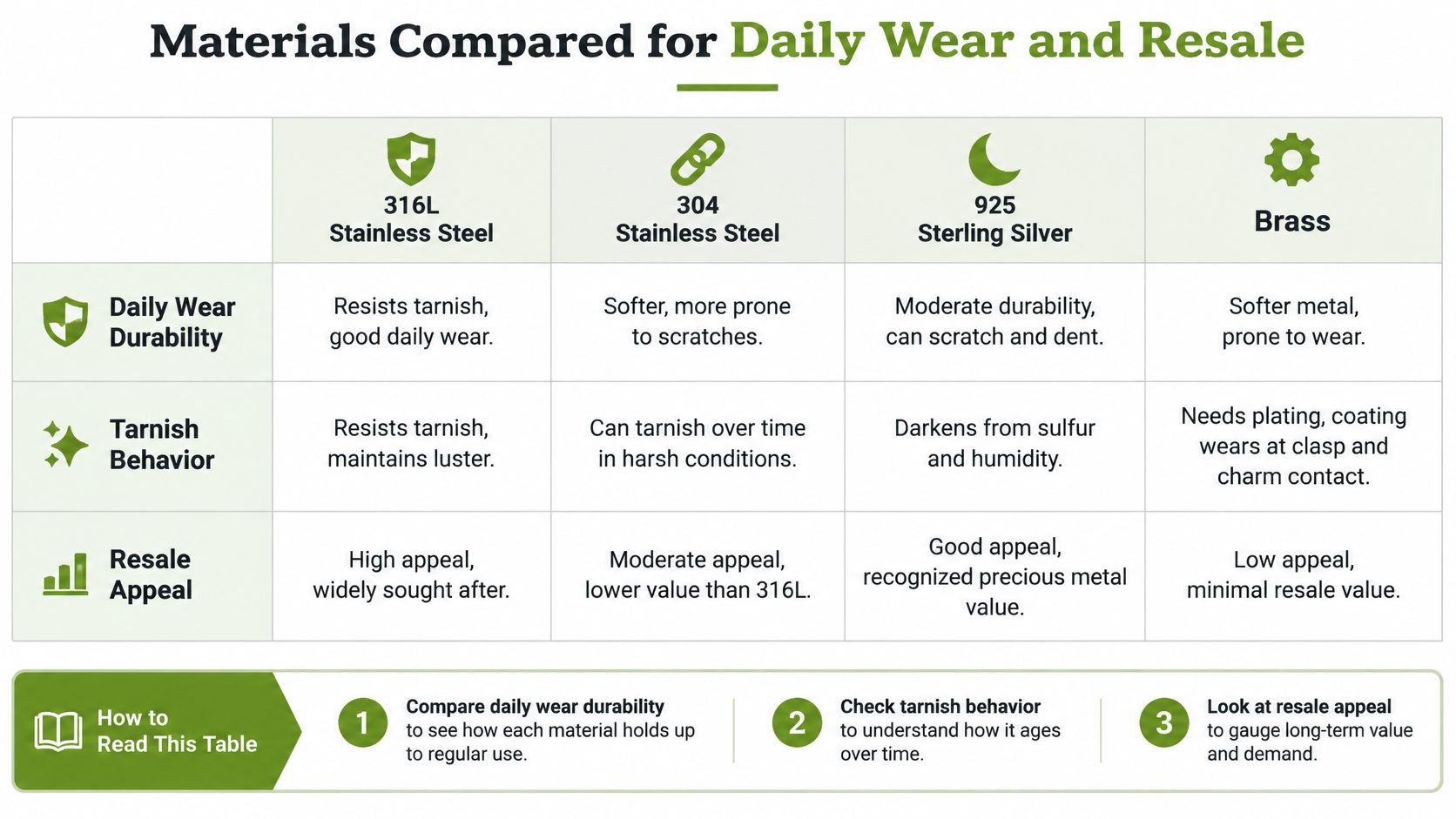
A gold plated brass bracelet and a gold plated stainless steel bracelet can look the same in a product photo. Once the coating wears, the exposed substrates are not interchangeable. Specify both layers when you compare samples, and do not treat matching colour as matching construction.
What the nickel evidence supports
An artificial-sweat study of stainless steels reported weekly nickel release of about 0.02 µg/cm² for 316L and 0.08 µg/cm² for 304 under the study conditions. The researchers tested solution-treated, mirror-polished steel. Both samples met the EN 1811 requirements cited in the study. Neither result applies to a plated bracelet, its clasp or its connecting rings.
REACH Annex XVII, Entry 27 limits nickel release to 0.5 µg/cm²/week from bracelet parts intended for direct and prolonged skin contact. Where a non-nickel coating is used on covered parts, the rule also requires that those parts stay at or below that limit for at least two years of normal use. Ask the laboratory which finished parts it tested and whether it used applicable wear and corrosion conditioning. This regulatory requirement is not a warranty or a measurement of this bracelet's service life.
Use the alloy comparison to shortlist samples, then request a finished-piece report for the style and finish sold. Silver and brass bracelets also need product-specific evidence if you plan to make a nickel-release claim.
Plating, Finish and Tarnish Care for Stock
Silver darkening is a chemical surface reaction, not dirt. The Canadian Conservation Institute's guide to silver tarnish explains that sulfur-containing gases form the discoloured surface layer; humidity and the storage environment also affect how stock holds its appearance.
Gold plated brass needs a different inspection emphasis: coating wear at clasp interfaces and charm contact points. A bracelet can look pristine in its pouch yet show weak finish performance once its moving parts rub together.
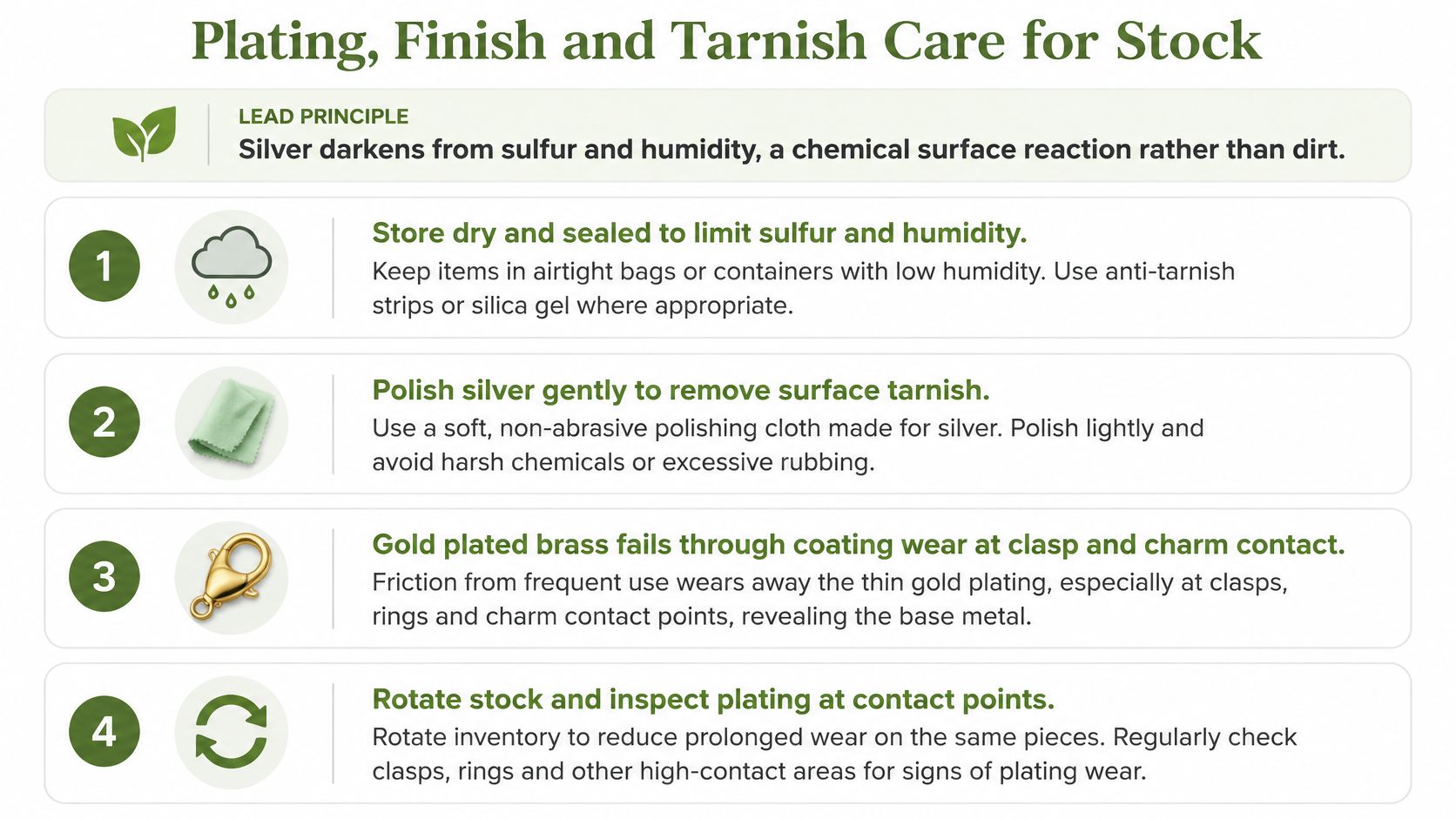
A practical storage and dispatch routine
- Seal silver individually. Use low-sulfur packaging and a tarnish-inhibiting insert suitable for jewelry. Individual packing also keeps neighboring pieces from rubbing against decorative surfaces.
- Keep stock dry. Store away from rubber, wool and polluted air, rather than treating any soft packing material as automatically suitable. Check the storage area as well as the pouch.
- Inspect recessed details before dispatch. Look around star points, jump rings and textured moon surfaces under good light. Dark films in these areas can make a bracelet look different from its listing photograph.
- Test plated samples in motion. Include rubbing and controlled sweat exposure, then inspect charm contact areas and clasp interfaces. Keep the test sample separate from saleable stock and record the method.
- Include specific care instructions. Tell wearers to remove the bracelet before swimming, showering or applying cosmetics. Don't undermine those instructions with an unsupported waterproof claim elsewhere on the listing.
For finish terminology, our gold PVD coating guide helps buyers distinguish a named process from a generic gold-coloured appearance. Don't describe a finish as PVD unless that process is confirmed for the item.
The embedded video is supplementary. Use the item-specific care instructions and the finished-sample report for your purchase decision.
Allergy Claims and Nickel Testing
Ask for finished-piece nickel-release reports before using allergy-related copy on a moon-and-star charm bracelet. Stainless steel names a material family, silver tone describes an appearance, and gold plated describes a surface treatment. None of these terms alone establishes how the complete bracelet will perform against sensitive skin.
A 2025 retrospective dermatology cohort found nickel sensitivity in approximately 41% and cobalt sensitivity in 10.3% of 5,234 patients who underwent patch testing at a specialist clinic. In the 2021–2023 subset with a recorded source, jewelry accounted for 59 of 82 nickel exposures (71.9%) and 9 of 18 cobalt exposures (50%). These figures describe the clinic population, not the risk for all shoppers or the performance of either bracelet shown here.
In a separate Korean study, a spot test detected nickel release in 47.8% of 471 jewelry and metal clothing items. The authors found positives more often in non-branded jewelry than in branded jewelry. That spot test did not measure a weekly release rate against the EU limit.
Turn allergy language into purchasing questions
Request product-specific documentation before listing a claim:
- Base alloy composition: Identify the chain, charms, clasp and connecting components, not only the most visible part.
- Plating description: Record the coating and any disclosed intermediate layers to clarify the finished construction.
- Finished-piece release testing: Check that the report identifies the relevant item, finish and test method.
- Claim support: Ask what the supplier means by “nickel-free” or “hypoallergenic” and what evidence supports that wording.
A composition declaration tells you what a part contains. A nickel-release report tells you what the test detected under specified conditions. A result below the release limit does not establish that a bracelet contains no nickel.
The 316 stainless steel jewelry guide provides material context, but it cannot certify an individual bracelet. Neither 925 sterling silver nor plated brass supports a blanket allergy promise without product-specific evidence.
Sensitivity varies, and labeling requirements differ by market. Give customer-service staff the same documented wording used on product pages so they do not make stronger assurances. A low price or celestial motif offers no evidence about metal exposure.
Designing for Daily Wear and Fewer Returns
A star that looks crisp in a close-up can catch on knitwear. A crescent tip can hook a sleeve or watch strap, while a cluster of hanging charms can pull the decorative section underneath the wrist.
The original moon-and-stars bracelet commentary from IIES is background reading. For an order decision, record what the actual sample does against the fabrics your customers wear.
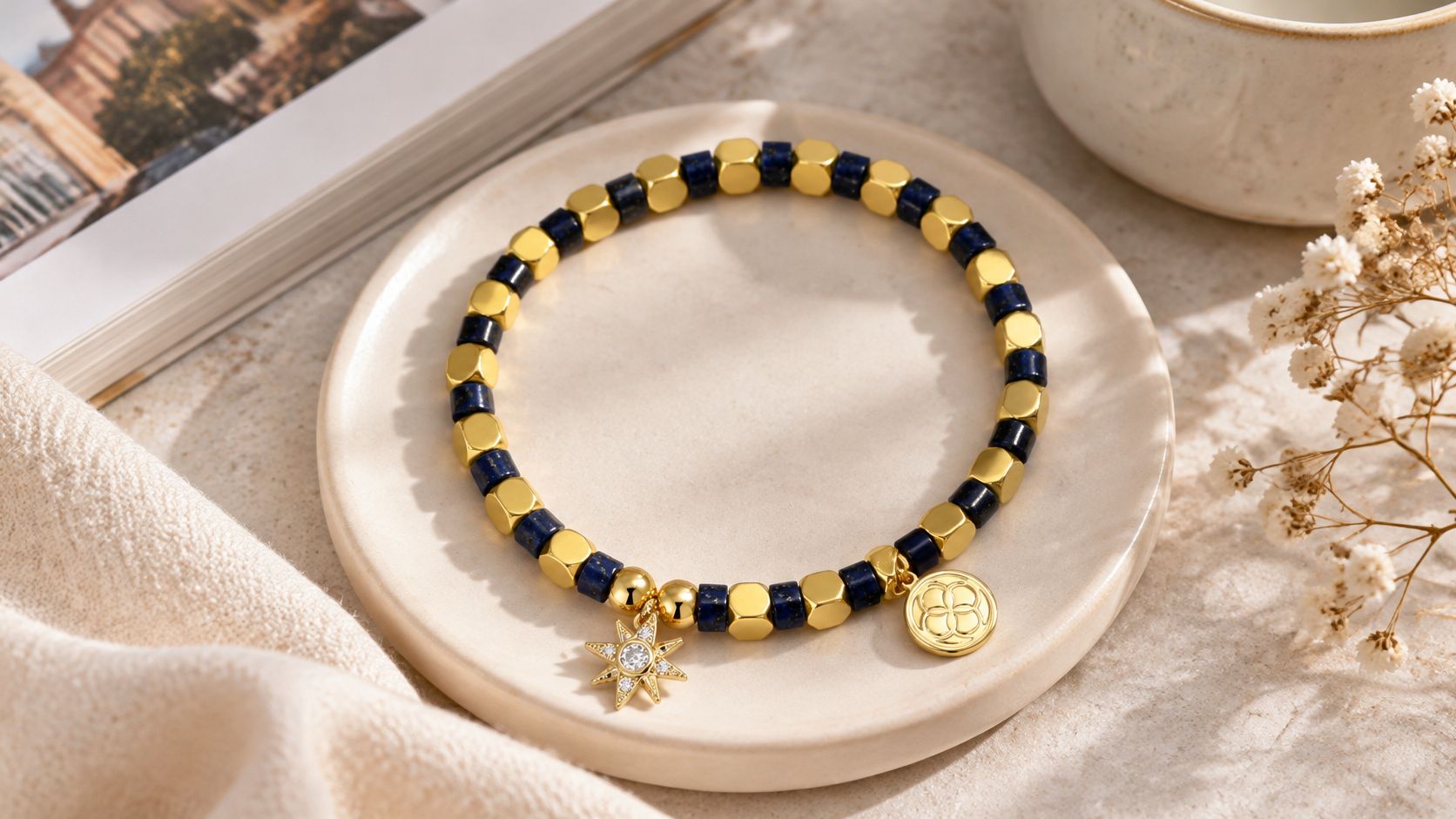
Questions that expose construction problems
- Edges: Are the star points and crescent tips rounded, smooth or noticeably sharp?
- Balance: What are the charm count and total mass, and does the decorative section rotate underneath the wrist?
- Movement: Can charms slide freely, or does fixed spacing keep them apart?
- Connections: Are jump rings soldered or merely closed, and are there visible gaps?
- Closure: Is the clasp proportionate to the bracelet, and can a wearer operate it without pulling on the charms?
Record whether the connectors are mechanically closed or permanently joined. On the approved sample, photograph the joint close up. Hold back a sample with a visible gap, a distorted ring or a charm that can slip out; do not use a soldered appearance by itself as proof of strength.
Test the sample as a wearable object
Use the assembled bracelet for wear checks. Agree on the setup and acceptance criteria with your supplier before approval. If you need a pull or clasp-cycle test, record the load or number of cycles, the fixture and which connection was tested. Use the sleeve check to screen for snags. Test nickel release and finish durability separately on the relevant samples.
| Check | How to check | Record before ordering |
|---|---|---|
| Star points and crescent tips | Fasten the bracelet and brush each charm against an agreed sleeve fabric. Look for pulled fibers. | Fabric ___; snag location or none observed ___ |
| Charm position and attachment | Rotate the wrist and flex the strand. Check whether charms flip, collide or open a connector. | Charm position ___; joint photo ___ |
| Clasp and usable fit | Confirm the shortest and longest usable settings and try fastening one-handed. Exclude decorative links the clasp cannot use. | Clasp-to-link reference ___; shortest ___; longest ___; closure result ___ |
| Finish at moving parts | Compare the clasp contact and jump rings against the approved sample in the same lighting. Keep separate samples for destructive or lab checks. | Reference sample ___; condition/method ___; report ID if required ___ |
For a minimalist shop, fewer, lighter charms may be the better buying decision. A fuller design can photograph well while creating more contact points and movement than your customer wants.
Product-page FAQs should answer practical questions:
- Can it be worn daily? Explain the intended use and care limitations supported by the sample.
- Should it be removed for sleeping? Recommend removal where projecting details or loose movement create snagging concerns.
- Is it suitable for exercise? State the relevant sweat and finish limitations without inventing a sports-durability claim.
What to Verify Before You Order Wholesale Stock
Unqualified gold wording can mislead when a bracelet is only plated. The Federal Trade Commission's jewelry buying guidance supports distinguishing the base metal from the precious-metal finish, rather than presenting a coated item as solid gold.
Gold plated and gold tone aren't interchangeable specifications. Identify a confirmed gold coating as plating; use gold tone to describe colour where that's the supported description.
Keep a pre-order checklist with the purchase record.
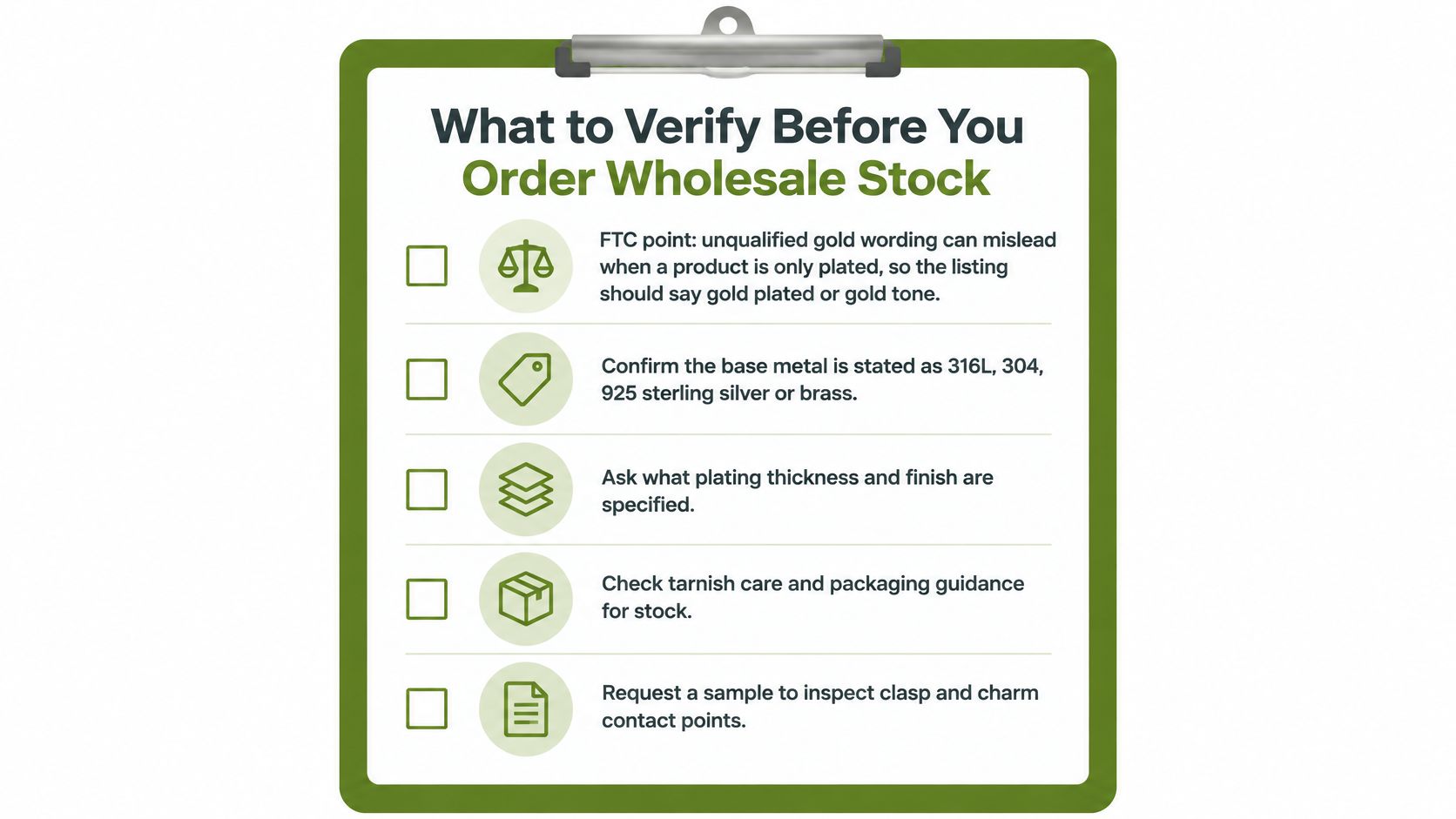
Build a resale-ready specification
- Base material: Record construction for the chain or strand hardware, charms and clasp so mixed components aren't hidden.
- Finish: Confirm coating identity, process and any supplied thickness specification.
- Fit: Obtain the length or adjustment range, including how the supplier measured it.
- Clasp type: Match the description to the sample and check operation.
- Charm details: Record count and dimensions for accurate scale descriptions.
- Charm movement: State whether the decorative pieces are fixed or movable.
- Use limitations: Capture supported durability wording and care restrictions.
- Test documentation: Match nickel-release and plating reports to the relevant construction.
- Packaging: Approve the pouch, protective materials and care-card wording.
- Sample results: Keep photographs and notes from rub and wear checks before authorizing stock.
The FTC Jewelry Guides cover truthful representation of type, quantity, metallic content, size, weight, durability and origin, among other characteristics. A vague gold bracelet label doesn't communicate enough for a buyer comparing products or a customer choosing between them.
For cross-border purchasing, African Import Export Solution's guidance on how to verify Chinese suppliers before paying is a useful companion to product inspection. Supplier verification and sample approval address different risks, so don't substitute one for the other.
Our wholesale bracelets and charms guide adds assortment context. Keep the final specification in reusable fields: the same approved record can support Shopify attributes, product feeds, marketplace titles and customer-service answers.
Confirm the Specs and Order Samples
Use the approved sample photos and finished measurements to write the listing. Keep that record with the first purchase order so the next delivery can be checked against it.
- Shortlist contrasting styles. Select a restrained chain design and a decorative beaded option that fit your store's price positioning.
- Approve representative samples. Use our jewelry sample approval checklist to record construction, fit and finish observations.
- Place a small first order. Commit only after the samples meet your documented expectations, then use actual sales and customer feedback to guide replenishment.
Ready-stock celestial examples include the Gold Plated Brass Starburst Beaded Charm Bracelet and Gold Plated Brass Crescent Moon Multicolor Bead Bracelet. Their bead and stone compositions remain unconfirmed, so retain colour-and-shape descriptions rather than assigning gemstone identities.
Use HonHo's Jewelry Materials and Plating Guide to compare finish routes for custom samples. Confirm the actual finish on the quote or item record; the guide's custom options are not specifications for these ready-stock bracelets.
Visit HonHo Wholesale Jewelry to compare ready-stock styles. For samples or a private-label quote, send HonHo your bracelet references with quantity by style, usable fit range, preferred finish and destination market. Include any test, engraving or packaging requirements you want reflected in the quote.


