

Quick answer: “non-tarnish” is not a permanent guarantee or a metal grade. For a wholesale cross necklace, approve the declared base metal, every surface finish, chain and finding materials, expected exposure, and the evidence used to assess the finished sample. Stainless steel, plated brass, and protected sterling silver can all fit different retail lanes, but none should inherit a lifetime or “waterproof” promise from a generic material description.
The original JewelTrend Pro on stainless steel jewelry explains the role of stainless steel's passive surface as background reading. Its published salt-spray and lifespan figures are not specifications or test results for HonHo cross necklaces, so buyers should not convert them into a wear-life promise for a particular SKU.
| Buyer decision | What to approve | Why it matters |
|---|---|---|
| Everyday, lower-care assortment | Declared stainless grade; bare or coated finish; all chain, clasp, jump-ring, and pendant components | A corrosion-resistant substrate helps, but coating wear and component differences still affect appearance. |
| Gold-tone fashion assortment | Base metal, coating process, gold fineness/color, thickness target, measurement points, and barrier layer if used | “Gold plated” alone does not describe the complete finish system. |
| Precious-metal or gift assortment | Sterling-silver declaration, stamp and evidence, any rhodium or anti-tarnish treatment, and care instructions | Silver can tarnish even when the item is correctly made and sold. |
Table of Contents
- What Buyers Mean When They Ask for a Non Tarnish Cross Necklace
- How Tarnish Actually Works on Different Metals
- Comparing Stainless Steel, Brass, and 925 Silver Cross Necklaces
- Gold Plating Thickness and What It Means for Finish Life
- Matching Cross Necklace Finishes to Real Wearing Conditions
- Wholesale Buying Mechanics for Non Tarnish Cross Pendants
- Common Misconceptions Wholesale Buyers Should Ignore
- Sourcing Non Tarnish Cross Necklaces for Your Store
What Buyers Mean When They Ask for a Non Tarnish Cross Necklace
A retailer asking for a non tarnish cross necklace usually isn't asking for chemistry. They're asking for a pendant that stays bright through sweat, perfume, showering, and everyday handling without turning dark, green, or dull on the sales floor or after it reaches the customer.
Start with the wearing promise, not the slogan
A useful promise starts with a defined use case. Stainless steel generally offers a lower-care substrate than copper alloys, while plated brass relies more heavily on its coating system and sterling silver needs an honest tarnish-and-care story. The original JewelTrend Pro on gold-filled and stainless steel behavior remains useful background, but the product claim must follow the documented construction of the sampled necklace.
Practical rule: define the intended exposure before choosing the claim. A supplier should not infer shower, pool, seawater, or gym suitability from the word “stainless,” “PVD,” or “non-tarnish” alone.
What qualifies and what doesn't
Potential fits to verify:
- Stainless steel: confirm the declared grade and whether the pendant, chain, clasp, and jump rings use the same material and finish.
- Plated brass: document the base, undercoat or barrier if used, decorative coating, target thickness, and color standard.
- 925 sterling silver: separate the silver-fineness claim from any rhodium, gold, or anti-tarnish surface treatment.
Claims that need more evidence:
- “Tarnish free forever,” “waterproof,” or a fixed wear-life promise without a defined product, test route, exposure, and acceptance criterion.
- A base-metal or grade claim that does not identify which necklace components it covers.
- “Hypoallergenic” used as a substitute for material disclosure, nickel-release compliance, or destination-market requirements.
For boutique buyers, the key question is not whether the pendant is “non tarnish” in the abstract. It's whether the necklace can hold color long enough to match your margin, your return policy, and your customer's wearing habits.
How Tarnish Actually Works on Different Metals
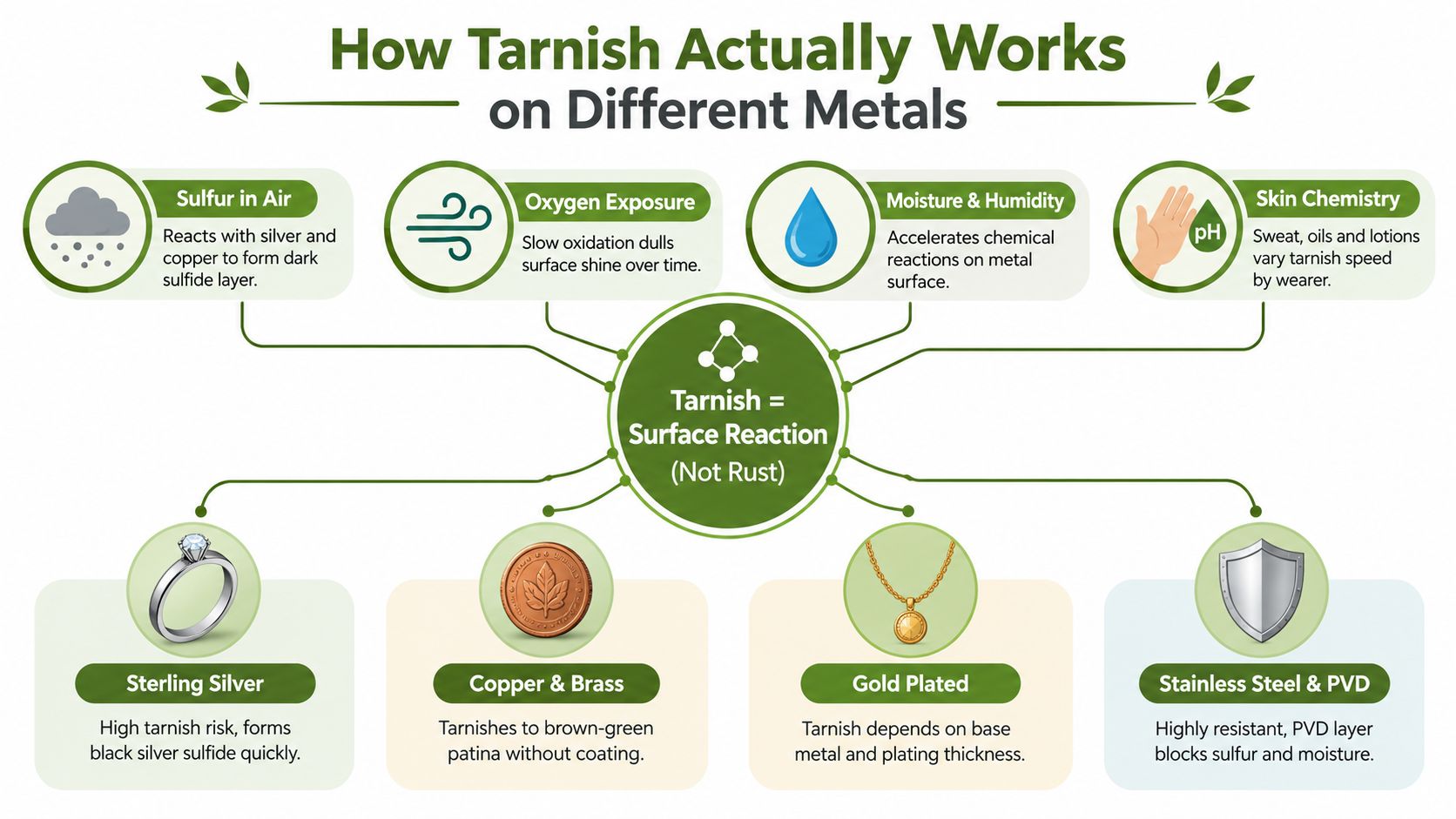
Tarnish is a visible surface reaction, but “tarnish,” corrosion, coating wear, residue, and exposed base metal are not interchangeable diagnoses. Record where the change appears—flat face, cross edges, bail, clasp, chain contact points, or soldered joints—before deciding whether the issue is cleaning, finish wear, or material attack.
Why silver and brass react differently
Sterling silver is nominally 925 parts silver per thousand; the balance is not automatically copper in every specification. Silver can form a dark silver-sulfide layer in the presence of sulfur-containing compounds and moisture, as the Smithsonian's conservation example illustrates. The original JewelTrend Pro on 925 sterling silver adds consumer care context. Brass contains copper and zinc and can also change color when exposed, but the rate depends on alloy, finish, environment, and handling.
Stainless steel relies on a chromium-rich passive surface for corrosion resistance; a gold-tone coating adds a separate appearance layer. That does not make every stainless necklace immune to deposits, scratching, coating wear, or aggressive chemical exposure. Treat substrate performance and decorative-finish retention as two approval questions.
Tarnish risk goes up fast when the piece is exposed to lotion, chlorine, salt water, or persistent humidity.
That's why the buyer who sells near the coast, around gyms, or into daily-wear wardrobes needs a different spec than a buyer sourcing occasion jewelry. A necklace can look perfect at launch and still come back dull if the wearer lives in a high-moisture environment or applies sunscreen before putting it on.
What that means at retail
A polished pendant that dulls after contact with sweat or sunscreen doesn't create a design problem, it creates a buying-spec problem. If the supplier's finish can't survive the wearer's routine, the retailer inherits the complaint.
That's why “non tarnish” should always be read as “resists the buyer's likely exposure conditions.” The same necklace can be a solid fit for one channel and a poor fit for another.
Comparing Stainless Steel, Brass, and 925 Silver Cross Necklaces
The easiest way to buy this category is to compare the three core constructions by durability, finish stability, skin sensitivity, and what kind of customer each one really serves. That keeps the conversation grounded in resale reality instead of marketing language.
| Construction | Buyer advantage | Limitation to disclose | Sample evidence to request |
|---|---|---|---|
| Declared stainless steel | Lower-care substrate and broad silver-tone or coated design options | Grade, finish, and component materials still vary; “stainless” is not a waterproof or nickel-release result | Material declaration, component map, approved color sample, and destination-market compliance plan |
| Plated brass | Design flexibility and a clear fashion-jewelry price lane | Finish retention depends on the complete coating stack, geometry, friction, and care | Base and undercoat, gold fineness/color, thickness target and measurement points, plus appearance criteria |
| 925 sterling silver | Recognizable precious-metal story for gift and keepsake ranges | Silver can tarnish; any rhodium or anti-tarnish treatment is a separate surface specification | Fineness declaration or agreed verification, component coverage, finish, and care instructions |
No construction is automatically the “safest” choice. Stainless steel may reduce maintenance risk, plated brass may fit a design or cost target, and sterling silver may support a precious-metal position. Compare the same design, finish color, dimensions, and intended exposure so the material choice is not confused with differences in geometry or coating.
Browse HonHo's current wholesale cross necklaces to identify suitable stock references, then confirm each SKU's own description and quote. Factory capability across stainless steel, brass, and 925 silver does not mean every ready-stock cross has the same grade, coating, thickness, or test history.
For a related cross-pendant format, this horseshoe nail cross pendant collection is worth reviewing if you're comparing symbolic cross styles across different retail tiers.
Gold Plating Thickness and What It Means for Finish Life
A lot of non tarnish claims fail at the plating layer, not at the design stage. Once the coating is too thin, the raised points of a cross pendant lose color first, especially on edges, bail corners, and spots that rub against clothing.
The thickness tiers buyers need to ask about
Plating terminology has legal and market context. In the United States, 16 CFR §23.3 describes “gold electroplate” at a minimum equivalent thickness of 0.175 µm of fine gold and “heavy gold electroplate” at 2.5 µm; the representation also depends on the stated gold fineness. The original Boera Jewelry on gold-plated jewelry is retained as supplier background, not as the source of a universal wear-life table. Other markets may use different requirements.
| Specification field | Record on the sample sheet | Common gap |
|---|---|---|
| Coating identity | Process, gold fineness and color, undercoat or barrier, and topcoat if any | “Gold tone” without a construction |
| Thickness | Target and tolerance, layer measured, method, and named measurement points | One micron number applied to every surface and component |
| Appearance | Approved color master; limits for pits, burns, exposed edges, stains, and scratches | A good photograph treated as production acceptance |
| Use and care | Defined exposure and care statement for that SKU | A thickness value converted into fixed months or years of wear |
X-ray spectrometry is one established coating-thickness route covered by ISO 3497. The method does not eliminate sampling, calibration, geometry, layer-model, or measurement-location limits. Agree which parts and points are measured and how results are reported; one reading cannot prove uniform coverage or predict consumer wear.
A thicker specified coating can provide more material before wear-through, but thickness alone does not rank finished necklaces. Surface preparation, layer adhesion, edge coverage, friction, cleaning chemicals, sweat, and the base construction all matter. A coated stainless cross still has two separate questions: how the substrate resists corrosion and how the decorative color layer retains its appearance.
Ask for the micron rating, not just the phrase “dipped in gold.” If a supplier can't give the coating build, the finish life is a guess.
The linked plating guide is the kind of spec sheet buyers should keep beside their buying notes when they compare gold-tone cross necklaces across tiers.
Matching Cross Necklace Finishes to Real Wearing Conditions
A necklace that survives in an office closet may fail in a beach town or gym-heavy customer base. The right finish depends on where the piece will live once it leaves your inventory.
Coastal and vacation buying
For coastal or vacation retail, begin with the actual exposure: salt mist, seawater immersion, sunscreen, humidity, abrasion, and wet-dry cycles are different challenges. A declared stainless substrate with a suitable PVD finish may be a candidate, but approve the specific construction and care statement instead of turning the process name into a blanket seawater claim.
If an accelerated salt-spray route is proposed, define the standard, sample preparation, duration, evaluation areas, and pass/fail criteria. ISO 9227 states that salt-spray methods can check whether quality is maintained, but are not intended to rank materials or predict long-term corrosion resistance. A test route is not evidence that an untested HonHo batch passed.
Gym, shower, and everyday lifestyle buyers
For active customers, separate perspiration, repeated rubbing, shower products, and chlorinated water in the brief. Stainless steel can support a lower-care direction, but “shower-safe” or “gym-proof” needs product-specific substantiation. Do not use a salt-spray result as a substitute for wear, coating-adhesion, or chemical-exposure checks.
Sterling silver can still belong in the assortment when customers accept cleaning and dry-storage guidance. Rhodium-plated silver has a separate coating that can wear at contact points, so its care and service story should follow the approved SKU rather than a general sterling claim.
Office, fashion, and gift scenarios
Plated brass can work well in fashion assortments when design, landed cost, care expectations, and the approved finish all align. Do not assume that fast inventory turnover removes the retailer's obligation to describe the material and care accurately.
For deeper context on finish behavior, the gold PVD coating guide helps buyers separate stable color systems from decorative gold-tone wording.
Wholesale Buying Mechanics for Non Tarnish Cross Pendants
Finish choice only matters when it fits the buying math. In wholesale, the best material on paper can still be the wrong buy if the reorder cycle, margin target, or customer profile doesn't match the construction.
How the order logic changes by material
Choose the buying lane from a written customer promise and landed-cost model. Stainless may suit a lower-care offer, brass may suit a shape or cost target, and sterling silver may suit precious-metal positioning. Order depth should come from your sales plan and sample evidence—not from an unsupported assumption that one material will sell faster or generate fewer returns.
What to check before you commit
| Cross-necklace check | Record before approval |
|---|---|
| Pendant and chain | Whether sold together; materials and finishes of pendant, chain, clasp, extension, jump rings, and soldered areas |
| Fit | Pendant dimensions and weight, chain length/width, extension range, bail opening, and whether the pendant moves freely on the approved chain |
| Finish | Color master, layer stack, target thickness and measurement points, deliberately uncoated areas, and visible-defect limits |
| Function | Clasp operation, jump-ring closure, pendant orientation, edges, stone security if used, and the agreed functional checks |
| Claims and care | Exact material wording, supported exposure claim, destination-market requirements, care card, and warranty scope |
| Reorder control | Approved physical sample, dated specification, sample ID, production color tolerance, and change-control contact |
For a practical procurement workflow, the jewelry sample approval checklist is useful when your team needs to compare cross pendants before placing a larger store order.
HonHo develops stainless steel, brass, and 925 silver jewelry. For custom work, the current planning terms are a 50-piece MOQ per style and color, generally 25–30 days for brass and 925 silver samples, 25–35 days for stainless steel samples, and 35–45 days for bulk production after sample approval and final order confirmation. Tooling, revisions, components, testing, packaging, and delivery can extend the schedule. Review the sample and MOQ guide and confirm the live quotation: custom-development capability and timelines do not automatically apply to every ready-stock SKU.
Common Misconceptions Wholesale Buyers Should Ignore
The most expensive mistake in this category is believing the slogan instead of the spec. A pendant can look gold, sound premium, and still fail fast if the coating is too thin or the base metal is reactive.
The phrases that cause the most confusion
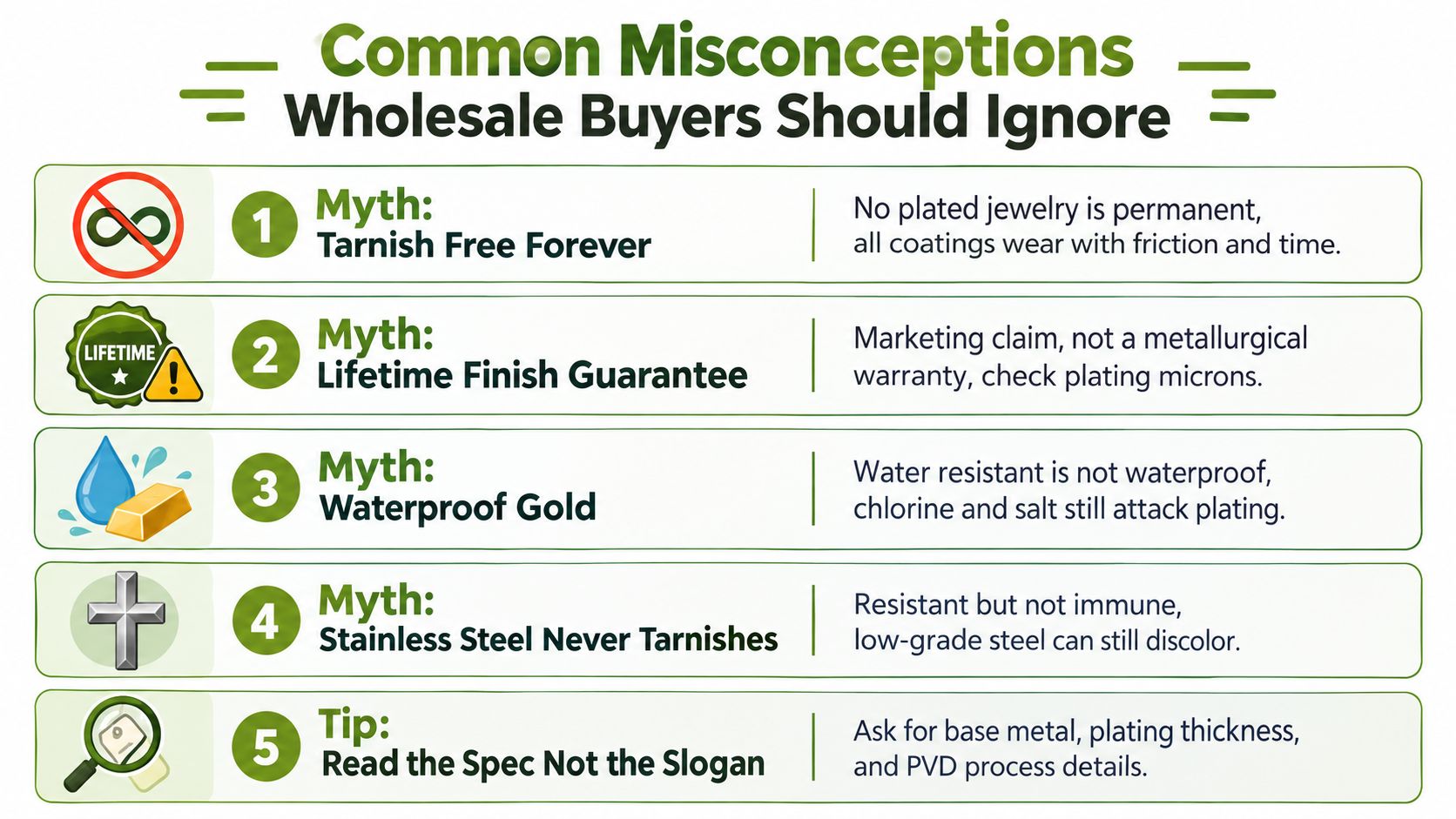
- “Tarnish free forever.” No plated jewelry is permanent, and all coatings wear with friction and time.
- “Lifetime finish guarantee.” That can be a sales claim, not a metallurgical promise.
- “Waterproof gold.” Water resistant wording doesn't mean chlorine and salt won't affect the finish.
- “Stainless steel never tarnishes.” Stainless steel is highly resistant, but even it can dull or discolor on polished surfaces when exposed to sweat, sunscreen, chlorine, or buildup (JewelTrend Pro on stainless steel vs sterling silver behavior).
The questions that protect your store
- What is the base metal? If the answer is vague, the risk is high.
- What is the plating thickness in microns? Thickness changes visible wear life.
- Is there a barrier layer? Without one, the base can show through faster.
- What test or inspection supports the claim? Record the sample, method, exposure, duration, evaluation points, acceptance criteria, report date, and laboratory or responsible party.
- What does the written warranty cover? A warranty should match the finish promise.
These questions matter because a good-looking cross can still be wrong for the intended claim. A report supports only the construction, samples, method, and criteria it identifies; it does not convert accelerated exposure into a guaranteed number of wearing years.
Does “316L” prove the whole necklace is nickel-safe? No. A grade declaration does not identify every component or prove compliance with a destination market's nickel-release limit. Confirm the component scope and the applicable compliance route.
Can a passed salt-spray test be marketed as waterproof? Not by itself. Salt spray, immersion, perspiration, chlorine, cosmetics, abrasion, and coating adhesion are different exposures. Use only the claim supported for the finished sampled construction.
Sourcing Non Tarnish Cross Necklaces for Your Store
A store doesn't need one universal answer here. It needs a buying lane that fits the customer and the margin target.
Three practical sourcing lanes
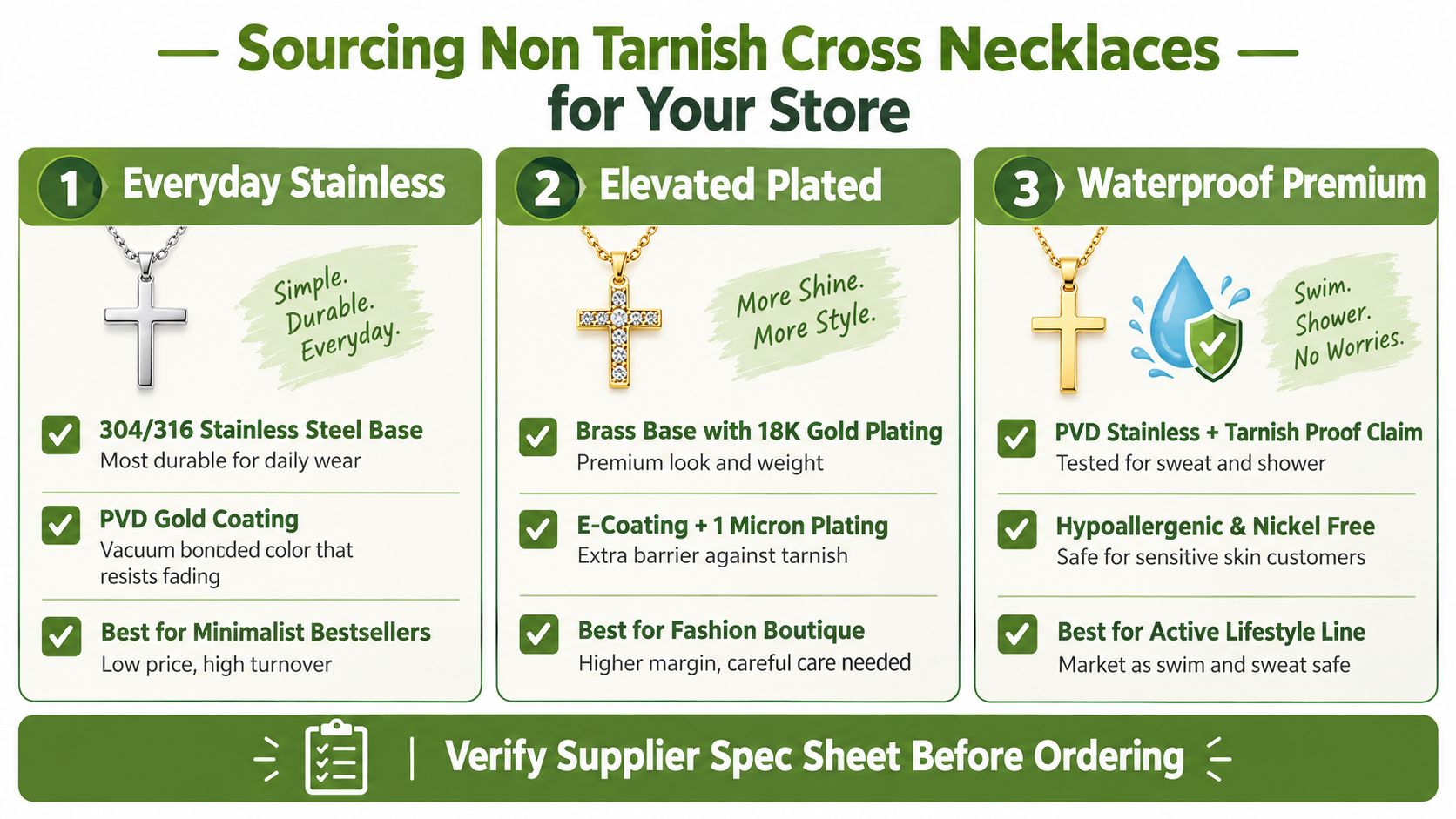
- Everyday stainless lane: specify the grade, component coverage, bare or coated finish, and a conservative care statement for the selected SKU.
- Enhanced plated lane: use brass when its design and cost benefits justify a documented coating stack and a more care-sensitive customer promise.
- Premium silver lane: use declared 925 sterling silver for a precious-metal offer, with any rhodium or anti-tarnish treatment recorded separately and periodic cleaning expected.
For buyers comparing finish systems, the gold PVD coating article is a useful reference when you're deciding whether to lean into stainless steel or plated brass for gold-tone cross pendants.
What to print on the tag
- Stainless steel: state the verified grade and finish; add care and exposure wording supported for that SKU.
- Plated brass: identify the brass base and gold-plated finish, then give care guidance without implying permanence.
- 925 silver: state sterling silver and any separate protective finish; explain that tarnish and periodic cleaning can still occur.
Tag copy must match the supplier declaration, approved sample, destination-market rules, and written warranty. Avoid adding “hypoallergenic,” “waterproof,” or “lifetime” language simply because another necklace uses it.
If you're building or refreshing a cross necklace assortment, review the ready-stock and material options at HonHo Wholesale Jewelry. For an actionable quote, send the target market, design reference, pendant and chain dimensions, material and finish, quantity by style and color, logo and packaging needs, intended exposure, test or documentation requirements, delivery destination, and launch date through the wholesale contact page.


