

316L is the low-carbon version of 316 stainless steel. It contains chromium, nickel and molybdenum, so it is not nickel-free, and the grade alone does not prove that a finished piece meets a nickel-release limit.
For resale, treat 316L as one line in the product specification. The buying decision is whether the stated grade, surface finish, construction and finished-piece evidence support the claims you plan to make. That distinction matters most for earrings, rings, chains and plated pieces exposed to sweat, cosmetics, friction and damp storage.
Table of Contents
- What 316L Stainless Steel Means on a Jewelry Label
- How 316L Compares With 304, Brass and Sterling Silver
- Where 316L Holds Up and Where It Fails
- Nickel Release, Allergy Claims and Compliance Limits
- PVD, Plating and Quality Checks for Resale Stock
- Where 316L Fits in a Resale Assortment and Pricing
- Confirm These Points Before Your First Wholesale Order
What 316L Stainless Steel Means on a Jewelry Label
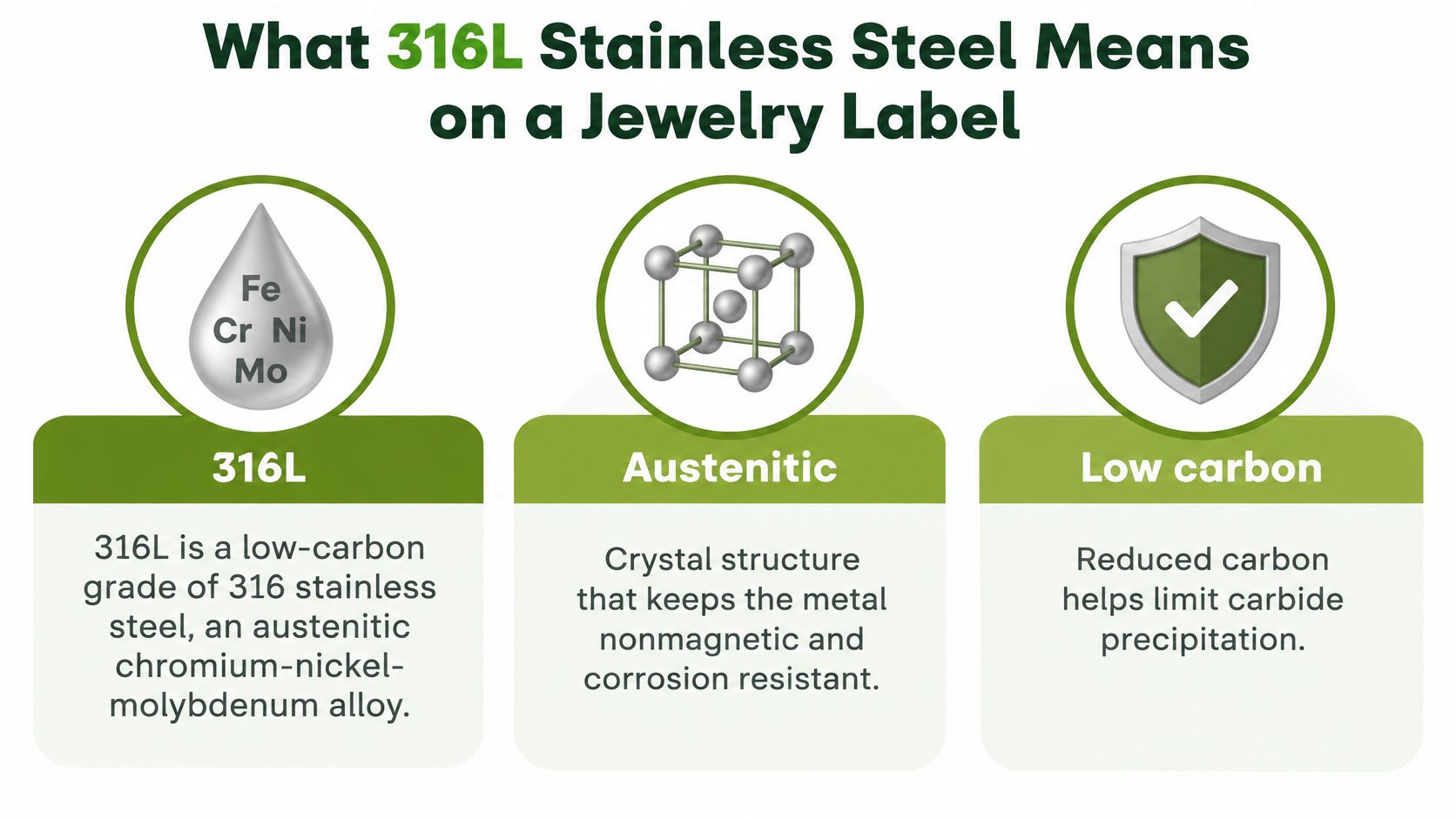
316L stainless steel is a low-carbon grade of 316 stainless steel, an austenitic chromium-nickel-molybdenum alloy. Austenitic describes the crystal structure that keeps the metal tough, formable and generally nonmagnetic. It's a material grade, not a color, coating or marketing finish.
The ESA materials listing for 316L gives the nominal specification as 16 to 18 wt% chromium, 10 to 14 wt% nickel, 2 to 3 wt% molybdenum, and no more than 0.03 wt% carbon. Standard 316 allows more carbon. The L identifies that lower carbon ceiling.
As a second primary reference, the current Outokumpu 316 and 316L datasheet identifies 316L/1.4404/UNS S31603 as a low-carbon chromium-nickel-molybdenum grade and explains why lower carbon improves resistance to intergranular corrosion after heat input. A mill datasheet defines a grade; it does not certify the chemistry of a finished necklace or earring.
What Each Element Does in a Finished Piece
Chromium supports the thin passive oxide film that gives stainless steel its corrosion resistance. The film can reform when the surface has access to oxygen, but deposits, chloride-rich moisture and tight crevices can interfere with that process. This is why a broad claim about the alloy should never replace inspection of joins, recesses and coating wear.
Molybdenum improves resistance to chloride-induced pitting and crevice corrosion relative to 304. It does not make a chain immune to salt, pool chemicals or trapped moisture. Surface finish, chloride concentration, temperature, deposits and crevice geometry still affect the result.
Nickel stabilizes the austenitic structure and supports toughness and formability. It's also built into the alloy at a substantial level, which is why you shouldn't treat 316L as nickel-free. Skin contact is a separate compliance question.
Why Low Carbon Matters at the Weld
Low carbon reduces the risk of chromium-carbide precipitation during welding and other significant heat exposure. That can help preserve corrosion resistance around a welded ring or clasp join. It is a process advantage, not proof that every finished component was welded, cleaned or passivated correctly.
Practical rule: If an invoice says only stainless steel, you don't know the chromium, nickel or molybdenum content. Ask for 316L in writing.
For 316 stainless steel jewelry, ask for the grade on the spec sheet or invoice and confirm it's written as 316L, or as UNS S31603 where that designation is used. A supplier who can't state the grade clearly is giving you a finish description, not a material specification you can build product claims on.
How 316L Compares With 304, Brass and Sterling Silver
Price is only one comparison point. For resale, also compare the evidence behind the material claim, the finishing route, likely care burden and what happens when the surface wears.
| Material | Tarnish and corrosion | Nickel in the base alloy | Common finishes |
|---|---|---|---|
| 316L stainless steel | Resists ordinary tarnish and general corrosion; molybdenum improves resistance to chloride pitting relative to 304 | 10 to 14% | Polished, brushed, PVD gold tone |
| 304 stainless steel | Resists ordinary tarnish; lacks the molybdenum addition used in 316L | Yes, nickel-containing alloy | Polished, brushed, PVD |
| Brass | Tarnishes unless plated; plated performance depends on the coating | Not defined by “brass” alone; verify the alloy, solder and underlayers | Electroplated gold, rhodium, silver |
| 925 sterling silver | Tarnishes with sulfur and moisture; polishing restores shine | Not defined by “925” alone; verify the remaining 7.5%, solder and plating | Polished, rhodium or gold plated |
316L Against 304
Both grades can look identical on a display card. The practical difference is that 316L includes molybdenum, while 304 does not, so 316L offers better resistance to localized chloride attack under comparable conditions. That advantage matters most where moisture and deposits can remain, such as ring interiors, clasps and chain joins. It still does not justify an unconditional waterproof claim.
Brass and 925 Silver Fill Different Jobs
Brass is primarily a copper-zinc alloy, but “brass” alone does not identify every minor constituent, solder or underlayer. Unplated brass develops surface tarnish; a plated piece depends on coating adhesion and wear at edges, prongs and ring interiors. Brass remains useful for detailed shapes, stone settings and enamel work, but the base alloy and full coating stack belong in the specification.
925 sterling silver is 92.5% silver. The “925” mark does not identify every metal in the remaining 7.5%, or the composition of solder and plating. Sterling silver can tarnish in sulfur-containing environments, and appropriate cleaning can remove surface tarnish. It offers a precious-metal position with a different care story from stainless steel.
Looking at how established direct-to-consumer brands present their ranges can help you set tiers, and a Mejuri store profile is useful context for that positioning work. For a product-level example of how material claims are framed, see this guide to a non-tarnish cross necklace and compare the wording with your own listings.
A workable assortment split is 316L for frequent-wear basics, brass for detailed fashion construction, and 925 silver where precious-metal positioning supports the price and care requirement. Treat that as a buying framework, not a universal rule for every design.
Where 316L Holds Up and Where It Fails
316L can still pit or develop crevice corrosion when chlorides, heat, deposits and trapped moisture combine. Brief rain, perspiration, pool exposure and seawater are not interchangeable test conditions. The point for a buyer is to identify where moisture can remain and to avoid turning a material advantage into a lifetime or waterproof promise.
Polished open faces dry fast and wipe clean. Hinges, weld seams, engraved recesses, chain joins and gaps where mixed metals meet hold moisture and salt far longer. Spotting usually starts there as a dull patch, dark residue or rough edge, which shoppers read as a quality defect even when the flat surfaces still look new.
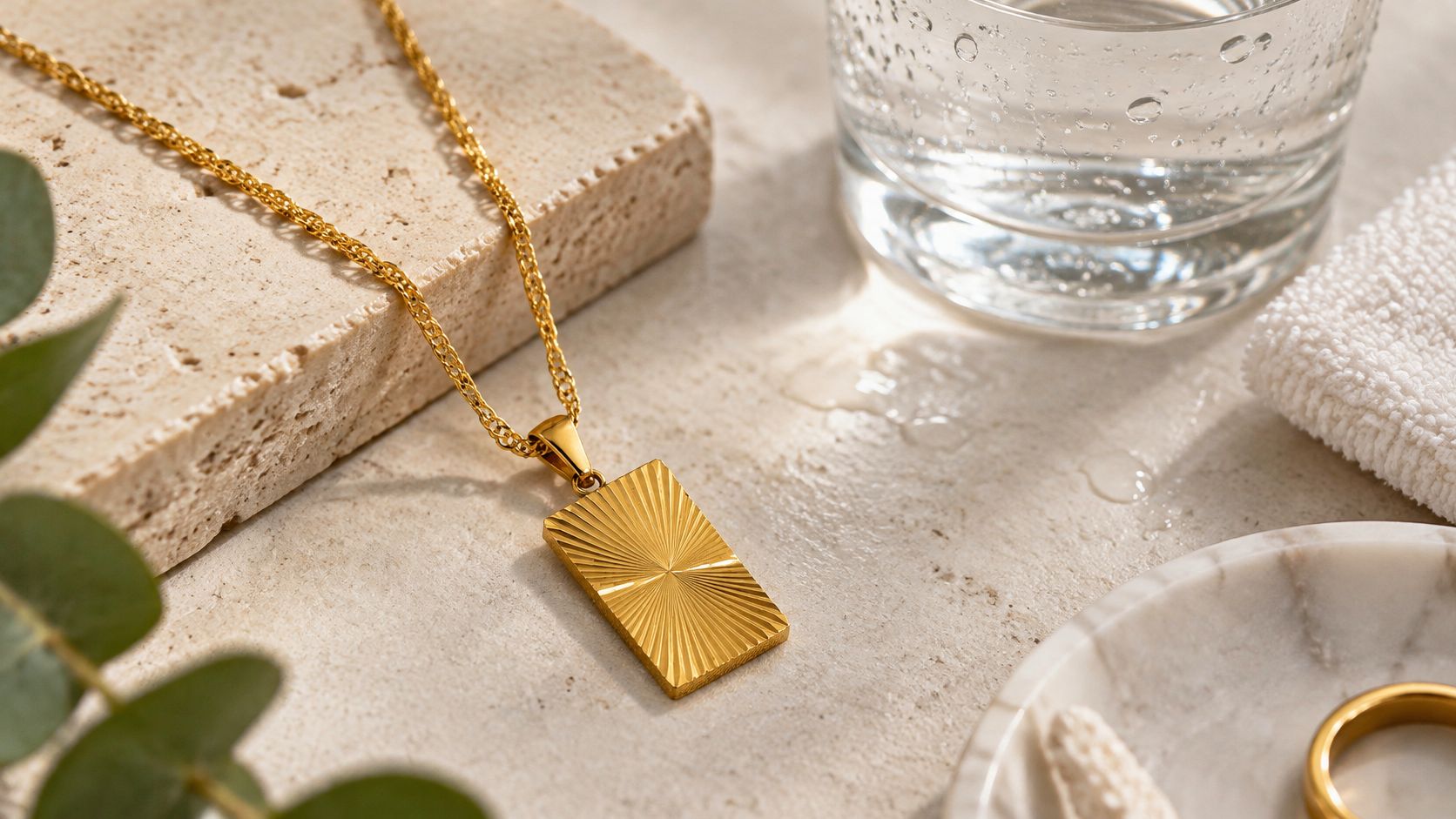
A piece such as the Gold Plated 316L Stainless Steel Sunburst Tag Necklace, listed with a 316L stainless steel base and gold plated finish, shows why base metal and surface need separate guidance. The steel underneath resists everyday exposure. The gold-colored layer thins first at friction points, and that changes how the necklace should be described and cleaned.
| Exposure | What changes the risk | Practical guidance |
|---|---|---|
| Everyday wear and light sweat | Usually limited when the surface is clean and intact; sweat chemistry and crevices still matter | Wipe off sweat and lotion after wear |
| Rain and humid weather | Standing moisture matters more than brief wetting | Dry pieces after wet days |
| Chlorinated pools | Chlorides, heat, crevices and the coating stack affect performance | Remove before swimming; rinse and dry |
| Saltwater and warm seawater | Chloride concentration, temperature and trapped moisture raise pitting risk | Remove before swimming; rinse with fresh water and dry |
| Abrasive gym or manual work | Friction can damage a coating before it damages the steel base | Remove before training |
| Sunscreen, perfume and cleaning chemicals | Effect depends on chemistry, concentration and contact time | Apply products before wearing; avoid bleach |
| Damp storage | Trapped moisture and deposits can promote localized attack | Store dry, in individual pouches |
Turn the Table Into Product Copy
A ring worn at a desk and the same design left damp after exercise face different combinations of friction, salt, cosmetics and trapped moisture. A single “waterproof” label hides those conditions and creates a claim that the grade alone cannot support.
State the grade and finish, then give care guidance and limits supported by product-specific evidence. Avoid a blanket waterproof promise based only on “316L.”
Use separate care copy for uncoated steel and gold-colored pieces. If a piece has contacted salt or chlorinated water, rinse it with fresh water when the approved care instructions allow, then dry the clasp and recesses fully. Store pieces dry and separately. The coating supplier's care limits still take priority for a plated item.
Give retail staff one diagnostic question. Where did the mark appear? Marks at a hinge, weld or recess point to trapped moisture or finish loss in a crevice. Even wear on high-friction edges points to coating thinning. That distinction tells you whether to revise the care card, the construction or the supplier.
Nickel Release, Allergy Claims and Compliance Limits
316L is not nickel-free. Nickel is part of the alloy by design, so the commercial question isn't whether nickel exists in the metal. It's how much nickel migrates from the finished surface to skin over time. Those are different measurements, and confusing them creates risky product copy.
Release is reported in micrograms per square centimeter per week, written as µg/cm²/week, using artificial sweat conditions. Polishing, passivation, surface damage, sweat chemistry, pH and plating condition can all change the result. A raw-material certificate therefore can't prove that a finished earring, soldered charm or worn coating performs the same way.
The current ECHA Annex XVII restriction text for nickel sets a migration limit of less than 0.2 micrograms per square centimetre per week for post assemblies inserted into pierced ears or other pierced body parts. For listed articles intended for direct and prolonged skin contact, the release rate must not be greater than 0.5 micrograms per square centimetre per week. These are finished-article release limits, not maximum nickel content in the alloy.
| Jewelry case | Limit or requirement | Reference method |
|---|---|---|
| Pierced ear posts and other piercing parts | Below 0.2 µg/cm²/week | EN 1811 |
| Earrings, necklaces, bracelets, chains, anklets and rings with prolonged skin contact | No more than 0.5 µg/cm²/week | EN 1811 |
| Coated items | Release limit maintained for at least two years of normal use | EN 12472 wear and corrosion simulation |
What the Test Methods Tell You
EN 1811 is the reference method for nickel release. It gives you a comparable result, but it isn't a perfect prediction of every wearer's skin. Results can vary with test conditions and real sweat chemistry, and the method has reproducibility limits. Treat a passing report as compliance evidence for that finished article, not as a promise that no customer will react.
Coated jewelry needs another layer of care. A coating can reduce initial contact with the substrate, then wear at a post, hook or ring interior. EN 12472 simulates wear and corrosion before release assessment, which is why it matters for gold-colored pieces sold for sensitive skin. Testing only a fresh, unworn sample misses the condition your customer will wear.
Stud earrings make the point clearly. A product such as the Gold Plated 316L Stainless Steel Spiral Pearl Stud Earrings, listed with a 316L stainless steel base, gold plated finish and imitation pearl accent, has skin-contact parts that should be judged as finished components. The grade name alone doesn't document release from the post and backing after plating and wear.
Safer Wording for Stores
- State the material exactly: Write 316L stainless steel rather than surgical steel alone.
- Name the finish: Separate unplated, PVD and electroplated pieces in the description.
- Avoid unsupported absolutes: Don't use hypoallergenic, nickel-free or safe for everyone unless finished-product testing supports the claim in your market.
- Identify contact parts: Posts, hooks, chains, clasps and ring interiors deserve the closest attention.
If you're building an ear edit for sensitive-skin shoppers, this discussion of hypoallergenic helix earrings is a useful companion to your supplier questions. Request the alloy grade, plating details, test method and nickel-release result for the finished article. A boutique selling studs into the EU shouldn't rely on the word 316L as its compliance file.
PVD, Plating and Quality Checks for Resale Stock
Gold tone tells you nothing about the process underneath it. Approve the base alloy, coating method, adhesion and wear behavior as a set. Color from a photo alone leaves resale risk on the table.
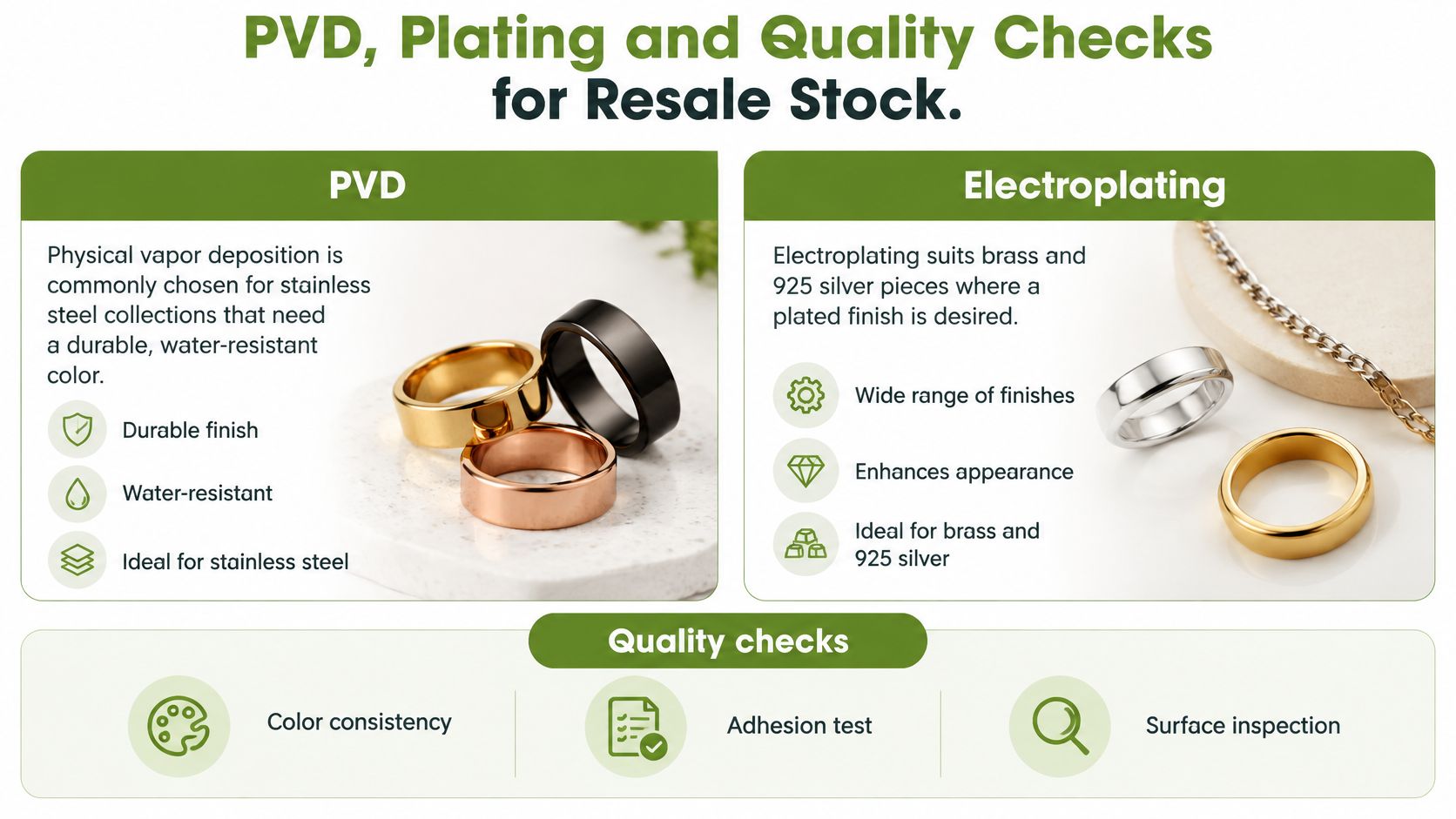
The infographic below sets out the two routes you will see most often in wholesale ranges.
Two Finishing Routes
PVD, or physical vapor deposition, is commonly used on stainless steel. Its performance depends on surface preparation, layer structure, thickness, geometry and the wear conditions used for evaluation. High-contact points can still lose color, so “PVD” is a process name, not a lifetime or waterproof guarantee.
Electroplating supports gold, rhodium, silver and other finishes on brass and 925 silver. It suits detailed fashion pieces and stone-set designs, but edge wear depends on the complete layer stack, adhesion, thickness and use. Two rings that match on arrival can age differently when those specifications differ.
HonHo Wholesale Jewelry lists 304 and 316L stainless steel options and in-house PVD and electroplating capabilities for custom development. Those capabilities do not establish the grade or coating specification of every ready-stock SKU. Confirm the selected product or quotation, then evaluate the exact style because a pendant face, hinged hoop and ring interior take friction in different places.
For a closer look at the process language suppliers use, read this overview of gold PVD coating before you compare quotations.
The embedded video is retained as an additional process reference. Verify any process claim against the supplier's written specification before using it in product copy or staff training.
Inspect Samples Like a Buyer
Start with hidden joins. Open and close clasps, inspect weld seams, and look inside chain links and engraved recesses under bright light. Define a handling or wear protocol before testing, then record what was done and inspect edges, posts and ring interiors for color change. Check the points that meet skin, clothing and other jewelry, not only the display face. Compare pieces side by side for color consistency, including extenders, backs and replacement components.
A substantial style such as the Gold Plated or Silver-Finish Stainless Steel Green Stone Signet Ring, listed in stainless steel with gold plated or silver-finish versions, needs checking at the tapered shoulders, stone corners and inner band. Those are the high-contact areas where rough finishing, coating loss or an insecure setting is most likely to become visible.
Ask every supplier four questions: What is the base alloy? What is the finishing method? Which wear or release test was run on the finished article? Can you supply a current sample in the exact color and size before commitment? If the answers stay vague, keep the order small.
Where 316L Fits in a Resale Assortment and Pricing
Category forecasts such as Accio can suggest broader interest, but they do not predict demand for a particular store, style or price point. Use your own sell-through, returns and reorder data to decide depth. A material trend is not a purchase order.
Build the core around pieces customers replace and wear weekly. Studs, hoops, plain chains and signet rings suit 316L because they are simple to size, easy to explain and less exposed to trend risk. Test charm bracelets, bangles and layered charm necklaces in smaller quantities. A style such as the Gold Plated Stainless Steel Multi-Cross Charm Y Necklace, listed with a stainless steel base and gold plated finish, belongs in that test group until reorder data justifies depth.
Position 316L as the low-maintenance everyday tier between plated fashion brass and 925 silver. Brass handles detailed fashion shapes and stone setting, 316L handles daily basics, silver handles the precious-metal sale. That split gives staff a clear sentence for each price step.
For broader assortment planning, this guide to wholesale jewelry for boutiques helps connect material tiers to store positioning. Resellers who also source secondhand lines can compare that approach with advice on how to find vintage treasures for eBay resale, where condition and turnover carry more weight than a standardized alloy grade.
Price from landed cost, not factory price alone. Add freight, duties where they apply, packaging, payment costs and expected returns, then apply the margin your channel needs. Check the final ticket against the finish in hand. A thin-looking edge at a premium price creates complaints.
Keep most open-to-buy money in proven basics. Limit each drop to a few trend tests, record sell-through by material and finish, and reorder only after customers validate the style.
Confirm These Points Before Your First Wholesale Order
First orders fail on paperwork more often than on design. A grade written three ways across an invoice, a spec sheet and a product page creates returns you cannot defend. Run the six checks below before you pay for quantity.
| Check | Why it matters | What to request |
|---|---|---|
| Alloy grade | 316L differs from 304 and standard 316 in chemistry | Grade stated as 316L or EN 1.4404 on invoice and spec sheet |
| Nickel release | Alloy content alone does not prove release levels | EN 1811 report for finished pieces |
| Finish method | PVD and electroplating wear differently | Coating method and wear test records |
| Sample lead time | Sets the launch calendar | For HonHo custom development: 25–30 days for brass/925 silver or 25–35 days for stainless steel, then confirm the project start point |
| Minimum order | Sets the first inventory cost | For HonHo custom development: 50 pieces per style and color, subject to the confirmed quotation |
| Bulk and shipping timeline | Sets restock planning | For HonHo custom development: generally 35–45 days after sample and specification approval, plus confirmed transit |
Turn each row into a direct supplier question. For the grade, reject "stainless steel" as a complete answer. All three documents should read the same.
HonHo's current custom sample and MOQ guide lists a custom minimum of 50 pieces per style and color, sample planning ranges of 25–30 days for brass and 925 silver and 25–35 days for stainless steel, plus 35–45 days for bulk production after sample and specification approval. These are custom-development planning figures, not ready-stock specifications or a delivery promise for every project. Confirm the scope, schedule start point, revisions, packaging and transit in the quotation.
The nickel and finish rows were covered in detail earlier. Apply them here as pass or fail gates. Keep the test report with the SKU record, and check that posts, clasps and ring interiors match the stated coating method.
Clean records also shorten resale conversations. These wholesale product sheet design tips help convert specifications into line sheets retail buyers can read fast. Attach the result to a structured jewelry sample approval checklist so each approved sample carries its material, finish and inspection result.
HonHo Wholesale Jewelry lists 316L stainless steel, 925 sterling silver, brass, gold plated and stainless steel as jewelry materials. Shortlist everyday basics plus one or two trend tests, then run the six checks on those pieces before you scale.
Browse HonHo Wholesale Jewelry to compare 316L stainless steel earrings, rings, necklaces and bracelets alongside brass and 925 sterling silver options. For a custom project, send the target grade, finish, quantity, market and required test evidence through the wholesale inquiry page.


