

For a retail buyer, a sellable pulseras para niñas range starts with five decisions: destination market, intended age group, wrist fit, component construction, and SKU-specific test evidence. Color and motif come after those checks.
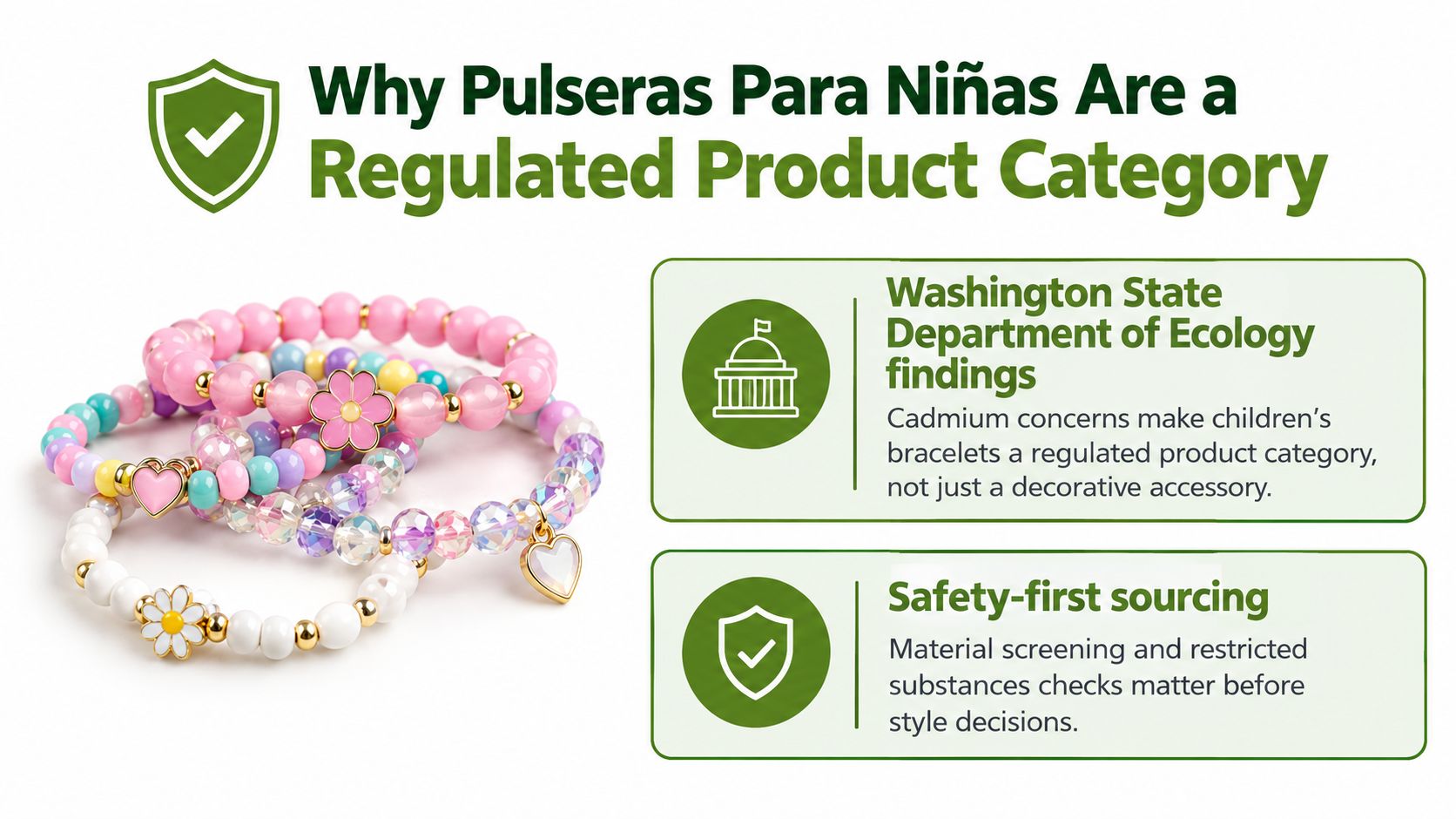
Why that order matters: in a 2015 Washington State Department of Ecology review of 159 children's jewelry products, cadmium showed up in 26 items (16%) and lead in 37 (23%). Of 38 pieces sent to the lab, 13 (34%) held at least one target metal at 100 ppm or higher. Lead in that selected laboratory set ran from below 1 ppm to more than 50,100 ppm, according to the Ecology children's jewelry study.
The study was a targeted screening project, not a forecast for every bracelet. It shows why two products that look alike can sit on opposite sides of a limit. For boutiques, Shopify sellers, and marketplace resellers, metal, coating, construction, age classification, and destination-market rules determine whether a style is ready to list.
Table of Contents
- Why Pulseras Para Niñas Are a Regulated Product Category
- Lead, Cadmium and Nickel Limits Buyers Must Verify
- Sizing, Closures and Construction Choices That Reduce Risk
- Comparing Materials for Girls Bracelet Assortments
- Popular Styles and Motifs for Resale
- How to Choose a Wholesale Supplier for Children's Bracelets
- Building a Compliant Girls Bracelet Range
Why Pulseras Para Niñas Are a Regulated Product Category
A girls' bracelet can stay on skin for hours, and a detached bead or charm may be mouthed or swallowed. That use pattern is why children's jewelry needs its own classification and review rather than being treated as a smaller version of adult fashion jewelry.
The CPSC children's jewelry topic page flags cadmium from mouthing or swallowing parts, chemicals in coatings, nickel sensitization, hazardous magnets, batteries, and strangulation. A motif doesn't change any of those exposures. A butterfly charm and a plain bead can carry the same alloy problem.
What the uneven results mean for a buyer
The Ecology results aren't a forecast of your next carton. They show why inexpensive mixed assortments are hard to trust from a hangtag. Contamination wasn't uniform. Some pieces were near background levels. Others were far beyond any children's limit you'd want on a sales floor.
Unknown charm alloys, unspecified plating, mixed-metal findings, and solder can create risk that a hangtag will not reveal. A documented chain does not automatically cover every clasp or charm. Buying an assorted lot without a style-level component specification makes it difficult to connect the finished product to the right evidence.
What actually gets assessed
Safety sits in product development, not in a bullet that says hypoallergenic. For a children's bracelet, the review covers:
- Base metal: the chain, cuff, or bead core.
- Plating and colorants: gold-tone, silver-tone, enamel, and pigment systems.
- Charms and stones: including how they're set.
- Solder and findings: clasps, jump rings, and crimps.
Stainless steel, brass, plated alloys, enamel, and decorative stones can each need a declaration or a test when the product is marketed to children. A clean base metal doesn't clear the charm.
The rest of this guide follows the order that keeps a program sellable. Set the limits for the markets you ship into. Lock sizing and construction. Pick materials on purpose. Merchandise styles you can reorder. Then vet the supplier before the purchase order.
Lead, Cadmium and Nickel Limits Buyers Must Verify
Limits aren't one global number. Write the destination market into the spec before you compare factories.
Lead and cadmium by market
Under the Consumer Product Safety Improvement Act, beginning August 14, 2011, children's jewelry with more than 100 ppm lead couldn't be manufactured, imported, distributed, sold, or offered for sale in the United States. That cap covers accessible parts, including chains, clasps, charms, beads, and decorative components, as set out in CPSC guidance on cadmium and lead in jewelry.
Lead-containing paint and similar surface coatings on children's products are limited to 90 ppm under federal rules. Cadmium needs different wording: the CPSC jewelry FAQ explains that there is no single mandatory federal standard specifically for jewelry, while children's jewelry still has to meet applicable children's-product rules. ASTM F2923 addresses cadmium and other hazards as an industry consensus standard, and state rules can impose separate total-content limits. Washington's Children's Safe Products Act sets 90 ppm for lead and 40 ppm for cadmium, per the state's children's jewelry limits summary.
Since June 1, 2020, California has barred more than 0.03% (300 ppm) cadmium by weight in any component of children's jewelry, and more than 0.0075% (75 ppm) soluble cadmium in surface coatings. Those rules cover jewelry manufactured, sold, offered, or transported in the state, according to California's cadmium-in-children's-jewelry page.
Canada's Children's Jewellery Regulations limit total lead to 90 mg/kg (90 ppm) across children's jewellery. The 130 mg/kg (130 ppm) total-cadmium limit applies when the item is small enough to fit completely in the prescribed small-parts cylinder under the specified force, as explained in Health Canada's children's jewellery guide. That scope difference should be written into the test request rather than reduced to one universal “Canada” number.
| Market | Lead limit | Cadmium limit | Nickel release |
|---|---|---|---|
| United States | 100 ppm total in accessible parts; 90 ppm in surface coatings | No single general federal total-content limit for all children's jewelry; ASTM F2923 addresses specified cadmium hazards | Addressed by ASTM F2923; verify the current edition and test method |
| Washington State | 90 ppm | 40 ppm | Not set in the sources cited here |
| California | Use the federal lead cap | 300 ppm by weight; 75 ppm soluble in coatings | Separate from the cadmium rule |
| Canada | 90 ppm total | 130 ppm total | Separate from content limits |
| European Union | Content rules differ | Content rules differ | 0.5 µg/cm²/week on prolonged skin contact |
Use this table to scope a compliance review, not as a substitute for legal advice or a laboratory test plan. Product classification, component accessibility, age grading, destination, and the current rule or standard edition can change what applies.
Nickel is a release test, not a content slogan
The active ASTM F2923-20 children's jewelry standard addresses nickel in metal components alongside specified chemical and mechanical hazards. For coated skin-contact parts, the buyer should confirm both the release method and any conditioning used to represent wear; an unused surface result does not describe a worn coating.
Under EU REACH Annex XVII, articles intended for direct and prolonged skin contact, including bracelets and chains, are subject to a nickel-release threshold of 0.5 µg/cm²/week, as explained in ECHA guidance on prolonged skin contact. “Nickel-free” on a line sheet does not answer that test. The useful question is how much nickel the skin-contact surface releases under the applicable method.
Practical rule: Classify the bracelet as children's jewelry, name the markets, then test the clasp, chain, extender, charm, enamel, and solder as separate risks. A passing chain doesn't clear a gold-tone charm.
Colorways aren't interchangeable. Plating chemistry and pigment systems change migration results, so a pink enamel version needs its own check even when the silver-tone version passed. Ask for that logic up front, and use a jewelry sample approval checklist so finish, solder, and small parts are signed off before you scale the style.
Sizing, Closures and Construction Choices That Reduce Risk
A limit on paper doesn't keep a bracelet on a wrist. Fit, edges, and how parts are attached decide whether the piece stays wearable or becomes a small-parts problem.
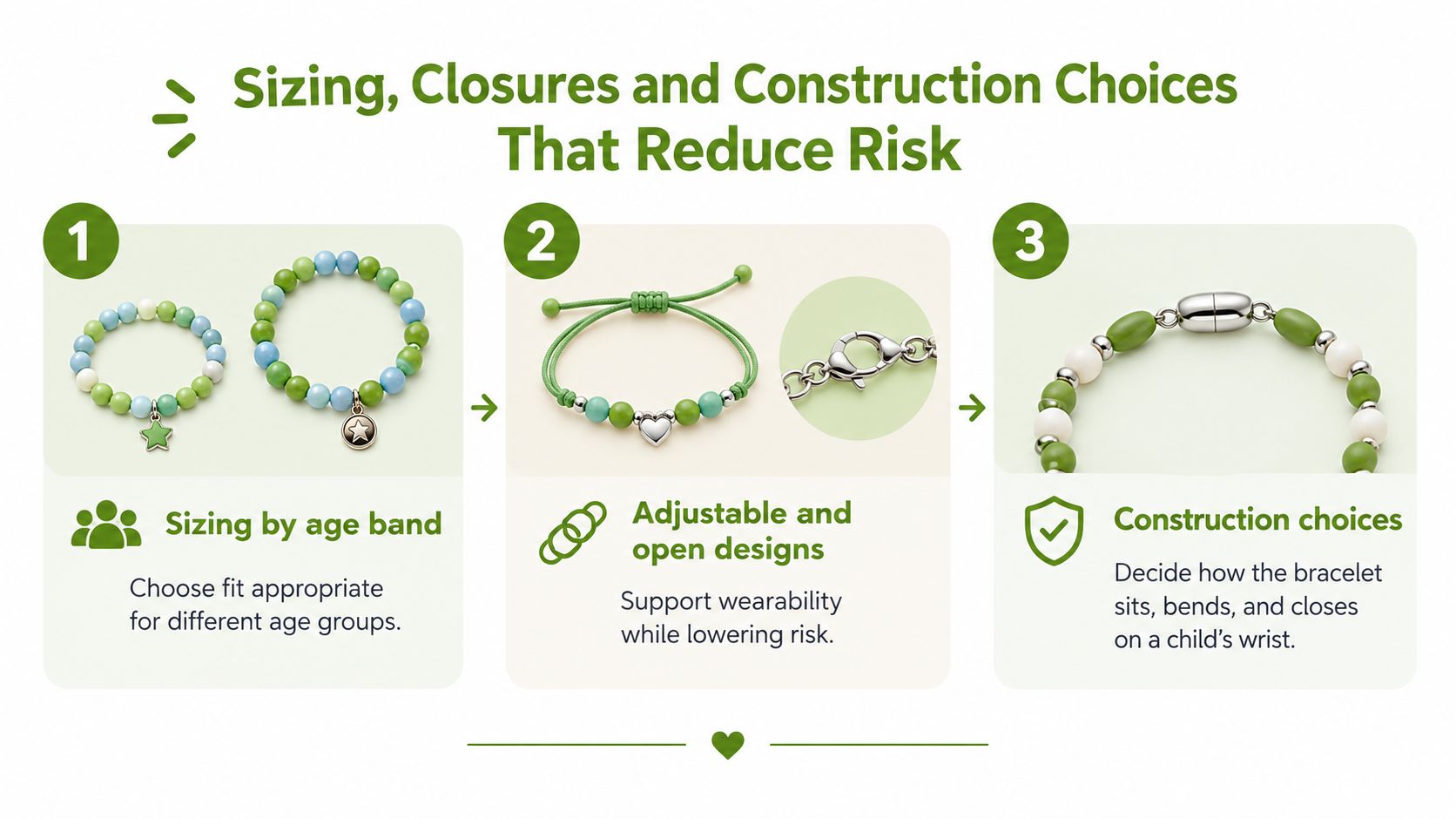
Fit by age, not by one "kids" size
Skip jewelry for infants and toddlers who still mouth objects. For older children, aim for snug but not tight, and tell retailers to supervise wear. The American Academy of Pediatrics guidance on children's jewelry warns that jewelry can create choking and strangulation risks, and it says children should be supervised and should take bracelets off when unattended or sleeping. A CPSC recall of children's identification bracelets classified those products as a choking hazard for children under three.
Build the care card around removal during sleep, bathing, rough play, and sport. Inspect after drops, stretched elastic, loose clasps, or cracked beads. Your jewelry size guide should show how an adjustable length maps to age bands so a buyer isn't guessing from a photo.
Closures and what adjustable designs trade away
Adjustable bracelets and open cuffs can accommodate more wrist sizes, but neither construction solves safety by itself. Extenders, hinges, jump rings, and other moving parts create extra wear points. If a coating is relied on to control nickel release, the test plan should account for wear rather than relying only on an unused sample.
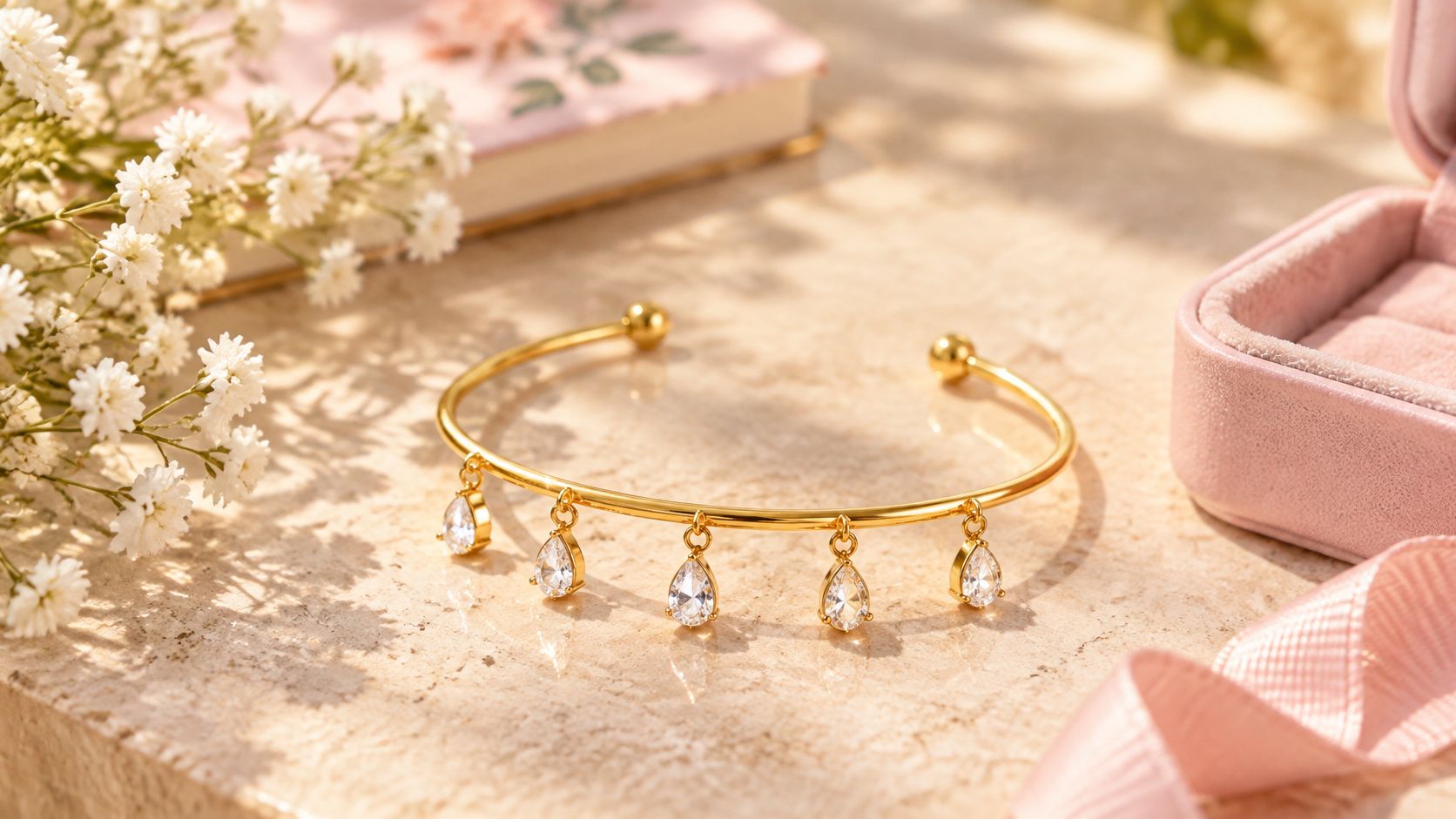
An open cuff removes the extender chain. The Gold Plated Stainless Steel Clear Stone Drop Open Cuff Bracelet shows that construction with a plated stainless-steel body and small clear stones. It is a general wholesale product example, not evidence that this specific SKU is classified or tested as children's jewelry. Any children's version still needs an age, edge, attachment, finish, and market review.
Specify these points in the tech pack:
- Closure retention: define an operation and pull check appropriate to the clasp and intended age, then record the result during sample approval.
- Rounded edges: no sharp link ends or unfinished charm backs.
- Low-profile charms: less snagging on sleeves and hair.
- Fixed attachments: minimize detachable micro-charms and brittle beads. A compliant metal doesn't remove a choking hazard after a part breaks.
Charm bracelets carry more loose parts than a simple cuff or chain. If you still want them, write the age range, the attachment method, and a sleep-removal line into the packaging before the listing goes live.
A short wear check on samples tells you more than a studio photo. Flex the cuff, work the clasp, and look at plating on high spots.
Comparing Materials for Girls Bracelet Assortments
Material choice sets durability, skin contact, price band, and how much testing paperwork you'll carry. Match it to the market, not to whichever finish is trending this month.
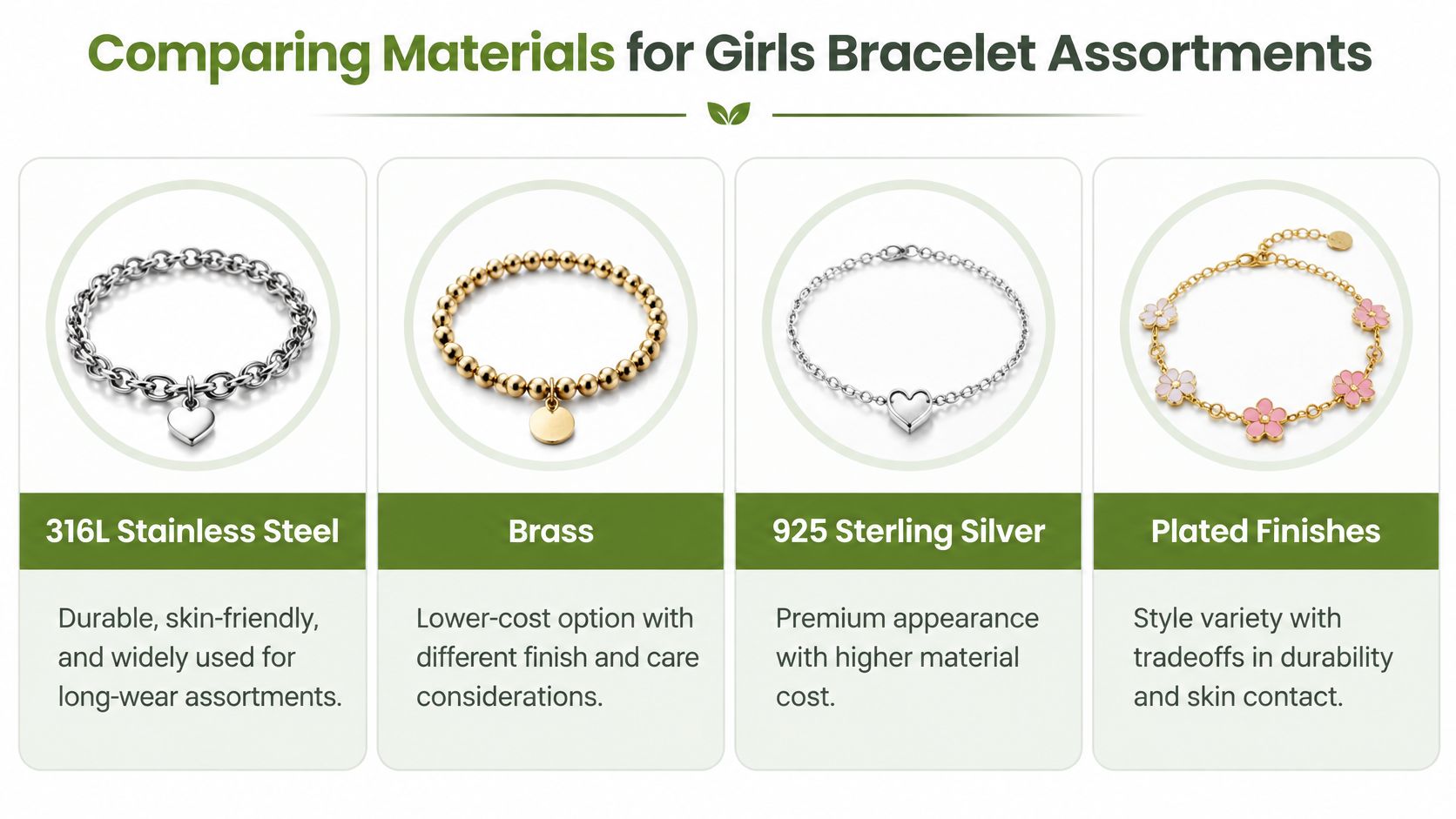
Four materials, four jobs
316L stainless steel is a practical substrate when corrosion resistance and repeatable finishing matter. It does not make the finished bracelet automatically suitable for children: plating, solder, stones, charms, edges, and attachments still need to be covered by the specification and the applicable evidence.
Brass gives you shapes and casts that steel doesn't love, at a lower metal cost. That's useful for floral cuffs and heavier motifs. Brass also means a finish system you have to specify. Bare or thinly coated brass is a poor bet for prolonged wear on a child, both for look and for skin contact.
925 sterling silver supports a gift and premium position, baptism bracelets and first-jewelry pieces included. It costs more, scratches, and tarnishes, so care copy matters. It doesn't exempt you from component tests when the piece is sold as children's jewelry.
Plated finishes (gold plated, silver finish, two-tone) are how most assortments get visual range without precious-metal pricing. Durability lives in the coating. Thin plate wears at clasps and high points first. That's the same abrasion problem adjustable chains create.
The jewelry materials and plating guide is the right place to align substrate and finish language before a listing is written.
Words that are legal terms, not vibes
The U.S. Federal Trade Commission says silver, sterling, and sterling silver mean 92.5% pure silver, and the mark 925 means 925 parts per thousand are pure silver. Gold electroplate means at least 10-karat gold applied electrolytically in a layer at least 0.175 microns thick, per the FTC jewelry guidance.
A gold-tone bracelet isn't automatically gold plated. A trace of silver isn't sterling. Hypoallergenic isn't a verified standard either. It doesn't prove lead, cadmium, or nickel-release performance, and it doesn't separate a sensitive wrist from a diagnosed allergy. Use "925 sterling silver" only when the metal meets the threshold. Name the base metal and the plating term when the piece is plated.
Don't let a finish name do the work of a lab report. Stainless underneath a gold-tone coating still leaves the coating, the solder, and the charm inside the compliance file.
Popular Styles and Motifs for Resale
Once the spec is real, merchandising is about what you can reorder without reopening every risk.
Styles that behave differently on a PO
Beaded bracelets sell on color and gifting, and they stack. They also multiply parts. Elastic, crimps, and coatings each need a look, and stretched cord is a common return. Read how shops buy them in this beaded bracelets wholesale guide before you load a rainbow assortment.
Chain bracelets are easier to inspect. Link quality, clasp, and extender length are the whole story. They photograph cleanly for marketplaces and don't depend on a trend motif.
Cuffs and open bracelets skip sizing hardware. They read as a single statement and fit a wide range of wrists. Edges and plate thickness at the opening are the spots that fail first.
Bangles are simple to specify and easy to display as a set of widths. A rigid bangle that's too large slides off. One that's too small won't go on. Offer a short size run rather than one "kids" diameter.
Layered and stackable sets lift average order value in boutiques because a girl, or her parent, buys the look rather than one chain. Keep the metal and finish consistent across the set so you aren't mixing an untested plating into a tested one.
Charm bracelets carry the highest attachment and small-parts load. They also carry the motifs parents search for. Use fewer, fixed charms rather than a dangly cluster if the age band includes younger school children.
Motifs worth stocking, and which ones to treat as fashion
Hearts, florals and leaves, stars and moons, butterflies and bows, shells, and simple geometrics are useful candidates for an evergreen test. Bright enamel, resin colorways, and seasonal motifs belong in a shallower trend layer until sell-through data justifies a repeat. Gold plated, silver finish, and two-tone can cover distinct fixture plans, while zirconia or pearl accents create a gift position without multiplying detachable charms.
Split the buy. Keep an evergreen core in one metal and two finishes, deep enough to restock. Add a shallow trend layer, enamel color or a seasonal motif, that you can exit without stranded compliance files. Coordinated anklets and small sets stretch one approved theme across a display instead of inventing a second alloy story.
What doesn't work is a 40-style charm dump with no age line, no shared finish spec, and no record of which colorway was tested. It looks full on a grid and falls apart the first time a retailer asks for paperwork.
How to Choose a Wholesale Supplier for Children's Bracelets
A usable supplier is one who can tie a test to the exact style, finish, and batch you'll receive. Price per piece comes after that.
Documents before you approve a style
Ask for four things, matched to the SKU rather than to the factory in general:
- Children's-product classification: is this bracelet being sold as children's jewelry, and for which age band?
- Material declarations: alloy, plating, enamel, solder, and charm metal, lot by lot.
- Applicable laboratory evidence: for U.S. children's-product rules that require third-party testing, use a CPSC-accepted laboratory; for other markets, confirm the required accreditation and method. Match reports to the finished style, components, finish, and color rather than accepting a generic metal certificate.
- Batch traceability: the report should name the style, the color, and the production lot.
Test color variants on their own. If the supplier only tested the plain gold-tone chain, the pink enamel charm isn't covered.
What to do with the sample
Don't stop at appearance. Check clasp security, edge finish, how charms are fixed, and whether the coating is already thin on high points. Where a coating is relied on to control nickel release, confirm the applicable wear or conditioning step with the laboratory instead of testing only an unused surface. Record the method and result; do not translate a laboratory exposure into a promised number of months of wear.
Packaging has to carry the guidance you can't fit on the product photo. Age range, supervision, and removal for sleep and sport belong on a retailer-ready card. If the supplier won't print it, budget to add it yourself before the listing goes up.
A wholesale jewelry supplier review should also cover minimums, sample timing, and how fast a core style comes back, because a compliant range you can't restock gets replaced by whatever is cheap that week.
How the numbers fit a small buyer
Factory-direct programs built for boutiques tend to separate ready stock from private label. HonHo Jewelry Wholesale produces in Dongguan and offers bracelet development across beaded, chain, cuff, open and adjustable, bangle, layered, and charm constructions, with 316L stainless steel, brass, and 925 sterling silver among the available material routes. The merchandise minimum is US$100. Current custom terms start at 50 pieces per style and color. Brass and 925 sterling silver samples typically require 25–30 days; stainless steel samples typically require 25–35 days. In-stock orders usually ship within 3 business days.
Those are factory and order capabilities, not a declaration that every ready-stock bracelet is classified, age-graded, or tested as children's jewelry. Ask HonHo to confirm the exact SKU, intended age group, destination market, component specification, and evidence package before using children's-product language.
Use ready stock for the evergreen core you can inspect and reorder. Use the custom path when a boutique needs a logo, a plating match, or packaging, and only after the children's spec is written. A low entry order doesn't replace component documents. It just lets you test demand without filling a warehouse with untested charms.
Plan inventory the same way. Protect units of the compliant core. Cap novelty designs so a short-lived motif doesn't crowd out the styles you can defend to a retailer or a marketplace.
Building a Compliant Girls Bracelet Range
Run the next order in one sequence, and don't swap the steps.
- Classify it. If you market the bracelet to children, it's children's jewelry, even when the design looks simple.
- Name the markets. U.S. retail, Washington, California, Canada, and the EU don't share one cadmium or lead figure. Nickel release is its own test.
- Pick metal and finish against those limits. Then describe them with the legal terms, not with "gold-tone" or "hypoallergenic" standing in for a spec.
- Specify fit and build. Age band, closure, edge finish, and whether charms are fixed.
- Verify, then list. Declarations, finished-sample tests, colorway checks, and a care card.
Four habits sink an otherwise decent assortment. Treating a stainless base as proof the whole bracelet complies. Calling a gold-tone coating gold plated. Skipping the second color. Listing charm-heavy styles with no age line and no removal guidance.
A bracelet is sellable when you can show what it's made of, which market's limits it was checked against, and how a child is supposed to wear it. Cute comes after that.
Review existing children's bracelet listings against that sequence. Pause the children's positioning for any SKU that cannot be traced to a component file, then decide whether to obtain the missing records, retest, relabel, or remove it for the destination market. Rebuild the range around styles, metals, and finishes that can be reordered with their documentation attached.
HonHo Jewelry Wholesale supplies ready-stock and small-run bracelets in 316L stainless steel, brass, and 925 sterling silver. For a children's program, compare chains, cuffs, bangles, and charm styles against the age, material, construction, and evidence checks in this guide before treating any SKU as children's jewelry. Visit HonHo Wholesale Jewelry to review current collections, then use the contact and quotation page to share the target age group, market, material, finish, quantity, and required test scope.


