

Yes. Gold-plated jewelry can wear off because the visible gold is a surface coating, not the full thickness of the piece. The first change usually appears at high-contact zones such as ring undersides, bracelet edges, clasps and raised details. Coating thickness matters, but no micron figure by itself can promise a set number of months or years.
Two pieces with the same “gold plated” label can age differently: a low-contact pendant may stay bright while a ring shows the base metal at its underside. For a boutique or online reseller, the useful buying questions are where the finish will wear first, what material sits underneath, how the coating was measured and whether the specification suits the customer's likely use.
Table of Contents
- What Gold Plated Jewelry Wear Means
- What Makes Gold Plating Wear Off
- How Plating Thickness Affects Wear
- What Changes the Wear Pattern
- Real Examples for Jewelry Resellers
- Care Tips That Can Extend Finish Life
- What Wholesale Buyers Should Verify
- Questions Buyers Still Ask
- Key Takeaways for Jewelry Sellers
What Gold Plated Jewelry Wear Means
A pale streak along the links that rest against the collarbone is a typical localized wear pattern. Nothing has to break for the appearance to change: repeated contact gradually thins the surface at the points doing the most work.
A plated finish is a wear layer. Handling and rubbing remove it first from corners, edges and contact points, eventually revealing the material underneath. Solid gold has no separate surface coating to lose; gold-plated jewelry does, even when the piece is well made and carefully handled.
That layer is far thinner than customers assume. Plating thickness is measured in microns: 1 micron equals 0.001 millimeter, or 39.37 microinches. At that scale, small specification differences carry real commercial weight. A coating with less gold on the surface has less material to lose before the base becomes visible, which is why two items with identical labeling can age very differently in the same jewelry box.
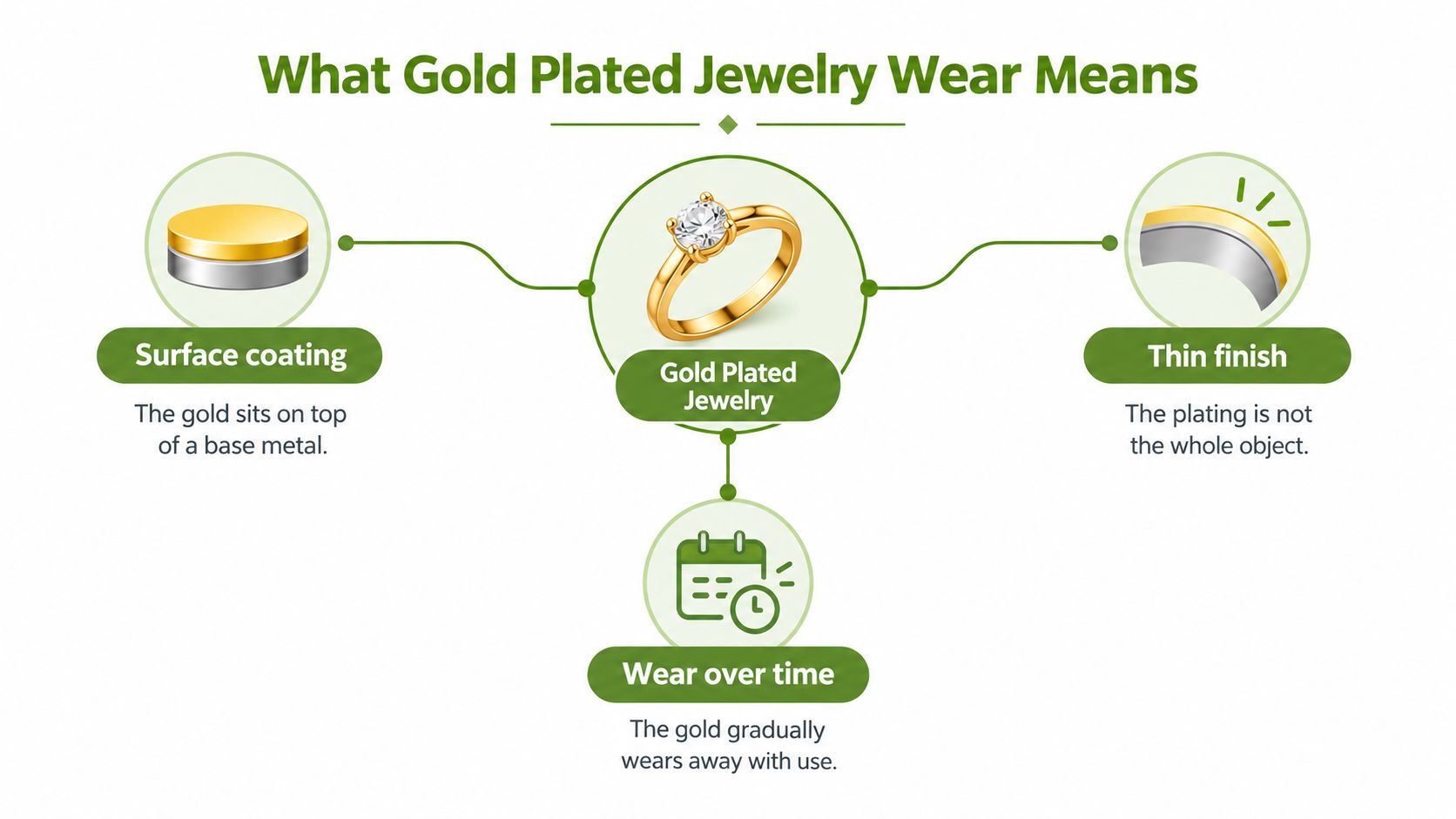
The Layer Stack Under the Shine
A plated piece reads most clearly as a stack. At the bottom sits the substrate, the base metal that gives the item its shape and strength. In wholesale assortments that may be brass, stainless steel, or 925 sterling silver. Above it sits the gold coating that supplies the color customers see at purchase. Some specifications add a barrier layer or protective treatment between or over these layers, though you should never assume one exists unless the supplier states it in writing.
Each layer answers a different buying question:
- Base metal: What shows if the coating is breached, and how does that exposed area look?
- Gold layer: How much gold is available to absorb normal rubbing before the color changes?
- Barrier or protective coating: Has anything been specified between or over the layers, and is it confirmed in writing?
- Karat and color: What gold tone is being used, separate from how thick the layer is?
The last distinction causes frequent confusion. Karat describes the purity of the gold itself, not the amount deposited on the piece. A higher karat description tells a buyer nothing about whether the coating is flash thin or comparatively heavy. Retailers comparing materials should also understand how a silver base differs from other substrates, which HonHo covers in its guide to silver with gold plating for wholesale assortments.
Similar Labels, Different Coatings
Terms such as gold plated, gold washed, and gold flashed can refer to materially different coating thicknesses. The current U.S. Jewelry Guides in 16 CFR 23.3 tie “gold plated” and “heavy gold electroplate” terminology to the fineness and equivalent thickness of gold on significant surfaces. That is labeling guidance, not a prediction of calendar life. For a reseller, the useful habit is to treat “gold plated” as a category label, then ask for the measurable specification behind it.
Practical rule: If a supplier can't state the plating thickness and base metal, you don't yet have enough information to write a confident durability claim.
The base also shapes what the customer sees after breakthrough. Exposed brass, sterling silver, and stainless steel differ in color and respond differently to air, moisture, and skin contact. Wear is therefore about more than gold disappearing. It is about what appears in its place, how visible the contrast is, and whether the customer reads that change as normal aging or a defect worth a return.
Electroplating made this construction widely practical because manufacturers could deposit a controlled gold film over a less expensive metal instead of forming the whole object from solid gold. That affordability is exactly what makes plated jewelry useful for trend led, giftable, and rotating retail assortments. The trade off is honest positioning: you are selling a finished surface with a finite service life.
Careful product page language protects both margin and trust. Describe the finish, the substrate, and the intended wear, and avoid implying that good care, high karat, or a premium label makes the coating permanent. Once abrasion exposes the base metal, restoring the original appearance generally requires replating. Polishing cannot bring gold back that is no longer there.
What Makes Gold Plating Wear Off
Gold plating usually disappears through a combination of mechanical abrasion and chemical exposure. It rarely fades evenly like a photograph. Rubbing removes microscopic amounts from the areas that work hardest, while everyday substances can reach tiny pores or affect the underlying alloy after the surface has been damaged.
Friction comes first from ring edges, bracelet undersides, necklace clasps, earring posts, raised details, and surfaces that repeatedly touch skin, fabric, counters, or other jewelry. Friction removes plating first from these high contact areas, which explains why the front of a pendant may stay bright while its bail or clasp changes color.
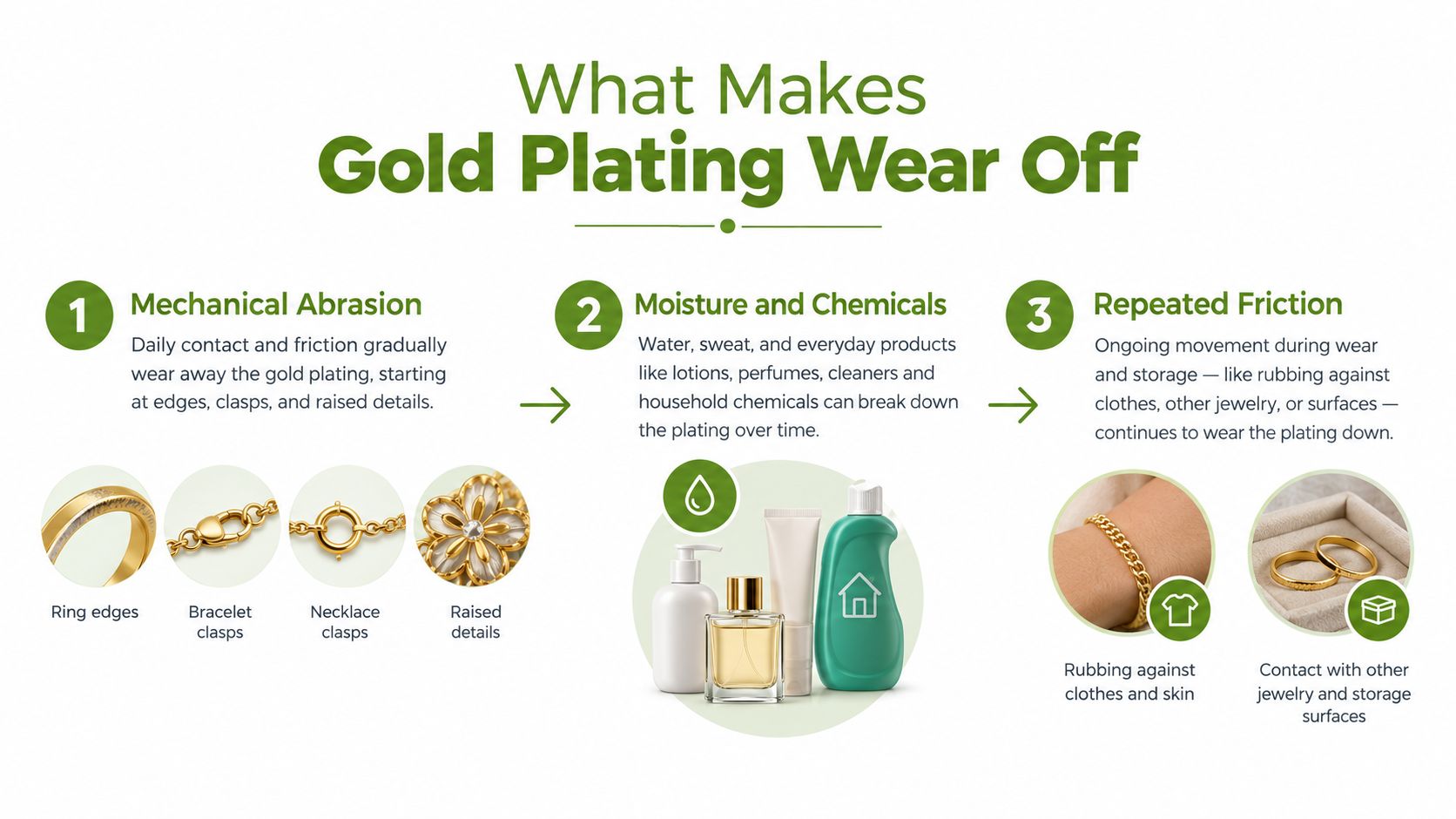
Chemistry adds a second pathway. Sweat, skin oils, cosmetics, perfume, chlorine, salt water, sulfur compounds, and acidic cleaners can penetrate microscopic pores or attack the underlying alloy after the gold layer is damaged. Body chemistry also varies, so two customers can wear the same style under seemingly similar routines and report different results.
Why Water Isn't the Whole Story
Many care cards focus almost entirely on water. That advice is useful, but incomplete. A waterproof claim can distract from localized friction, even though contact points can lose color before the rest of the item because rubbing removes the thin gold layer mechanically. A bracelet clasp opened every day may be under more threat from repeated movement than from a brief splash.
Abrasive particles make the process faster. Dust on a polishing cloth, rough storage, stacked rings, and contact with textured work surfaces all act like fine sandpaper. Polishing itself can also remove gold, especially if a customer uses a treated cloth intended for solid metal or presses hard on raised details.
The short demonstration below is useful for seeing plated jewelry as a surface finish rather than treating the whole piece as gold.
For retailers, the diagnostic clue is the wear map. A pale patch on one edge points toward contact. Broad dullness after lotions, exercise, or swimming suggests exposure played a larger role. Neither pattern proves a manufacturing fault by itself, but each gives you better questions to ask before deciding whether the issue is expectation, use, or specification.
How Plating Thickness Affects Wear
A thickness figure tells you how much coating is present at the measured point. It does not tell you whether preparation and adhesion were sound, whether edges and recesses received the same coverage, or how a customer will wear the piece. Those are separate questions, so a useful approval plan pairs thickness data with location-specific inspection and a defined performance test.
| Evidence to request | What it can support | What it cannot establish by itself |
|---|---|---|
| Target thickness in microns | Comparison of deposit targets when karat, method and significant surfaces match | A universal wear-life claim |
| XRF readings at named locations | Local coating-thickness checks under a defined measurement method | Adhesion or complete coverage across the whole piece |
| Controlled abrasion or rub test | Comparison of finish response under the same setup and endpoint | Calendar life in a customer's routine |
Read the evidence together. More deposited gold generally gives a surface more material to lose before breakthrough, but a high-contact ring edge can still change before a lower-contact pendant. Buyers comparing finish systems can weigh conventional electroplating against HonHo's overview of gold PVD coating, because the specification method and wear mechanism differ even when the color looks similar.
Ask for Units and Coverage
Confirm whether a quote is expressed in microns, nanometers, or millionths of an inch. Those units are easy to confuse in a spreadsheet, and a misunderstood unit can make a coating sound far more substantial than it is. Ask whether the target applies across all significant surfaces. Thin coverage inside a clasp or on an edge may determine the customer's first complaint, even if a flat front panel measures well.
A micron figure is useful for comparing suppliers. It becomes misleading when a seller turns it into a guaranteed number of months for every customer.
Terminology needs the same care. Under the U.S. Jewelry Guides, “heavy gold electroplate” uses a minimum equivalent thickness of 2.5 microns of fine gold on significant surfaces. That threshold governs the description; it does not guarantee a wear period. Record the stated karat fineness, equivalent thickness, substrate, significant surfaces and test method so reorders can be compared with the approved sample.
What Changes the Wear Pattern
Two pieces can share the same plating specification and age completely differently at retail. The reason is contact. Rings strike desks, door handles, weights, and countertops. Bracelets slide against sleeves and work surfaces, and their clasps open, close, and rub against the wrist. Earrings and pendants usually face less direct abrasion, though posts, hooks, bails, and chain edges still move against skin and fabric.
A shoe sole works the same way. The heel and the ball grind down first while the arch looks new for years. Jewelry has its own heel and ball: the zones that meet the world first and most often. That contact logic is why a single thickness target should not be copied across every category. The practical principle is simpler: higher-contact designs need more cautious durability language and a sample plan focused on their actual wear zones.
Consider a reseller stocking a ring and a pendant, both described as gold plated. The pendant rests against clothing and skin, with most movement concentrated at the bail. The ring's underside contacts whatever the hand touches throughout the day. If the two pieces age at different speeds, that does not automatically mean one batch was plated incorrectly. Their wear zones were never equivalent.
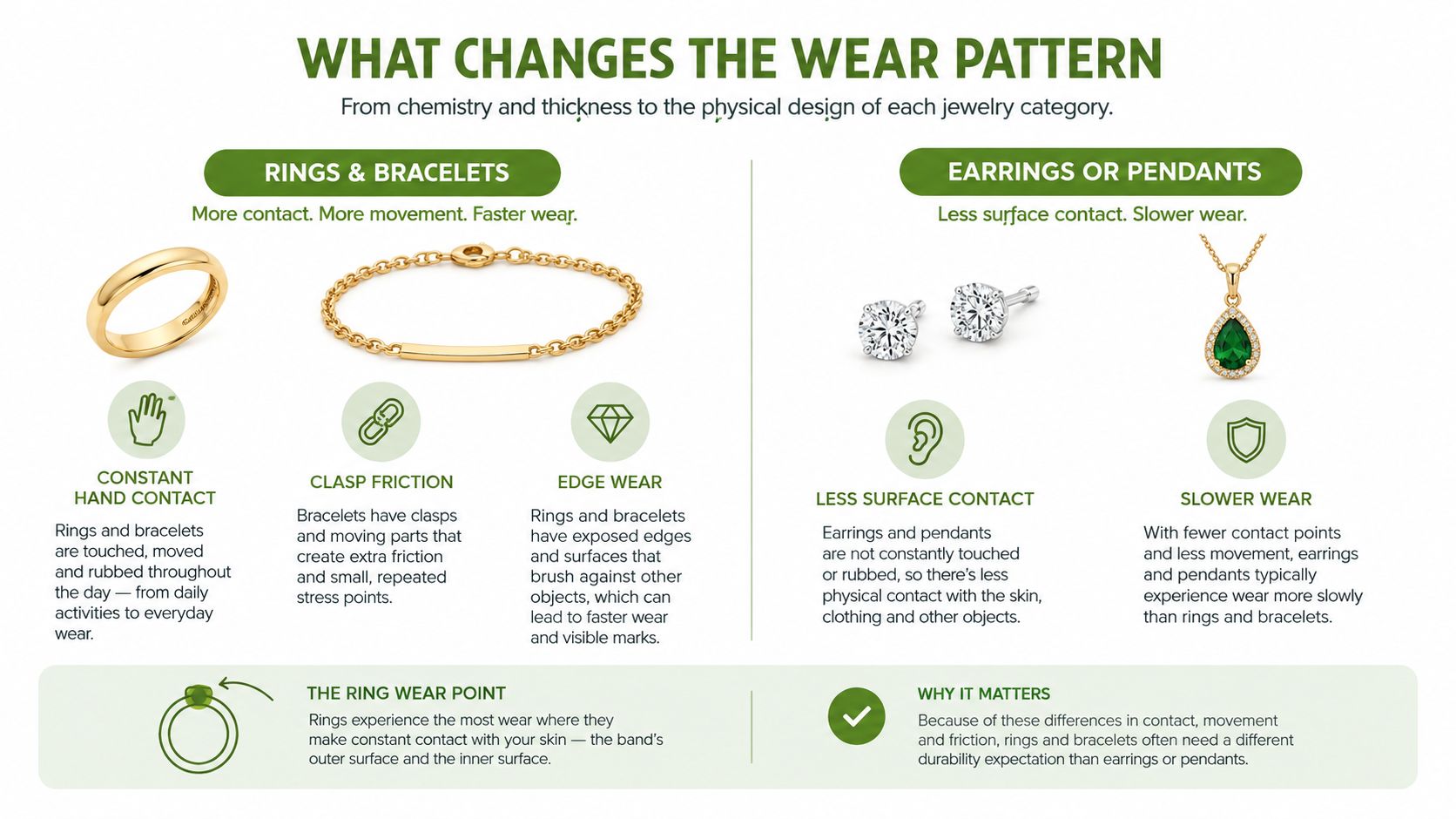
Within each category, design details create smaller zones of their own:
- Sharp or raised edges: These meet surfaces first and can brighten or lose color early.
- Clasps and hinges: Repeated operation concentrates metal to metal rubbing in one place.
- Open rings and cuffs: Flexing and adjustment add handling at the ends.
- Layered chains: Links and pendants can rub against each other during movement and storage.
- Textured surfaces: High points wear sooner than recessed areas, changing contrast over time.
This zone-based view improves merchandising. A delicate necklace can carry care copy focused on perfume, storage, and chain tangling, while a ring page should address hand contact and removal during manual tasks. Retailers building a necklace assortment around appearance retention may find HonHo's article on a non tarnish cross necklace useful for separating finish expectations by product type instead of applying one generic claim across the catalog.
Real Examples for Jewelry Resellers
Catalog examples make wear zones easier to discuss because you can point to a shape instead of relying on abstract advice. Start with the Gold Plated Stainless Steel Sculpted Wave Open Ring, a stainless steel sculpted open ring with a gold plated finish, no stone, approximate face measurements of 1.76 x 1.23 cm, and a supplier listed weight of approximately 4.2 g. Its wide polished ribbon curves around the finger and rises into an open wave at the front.
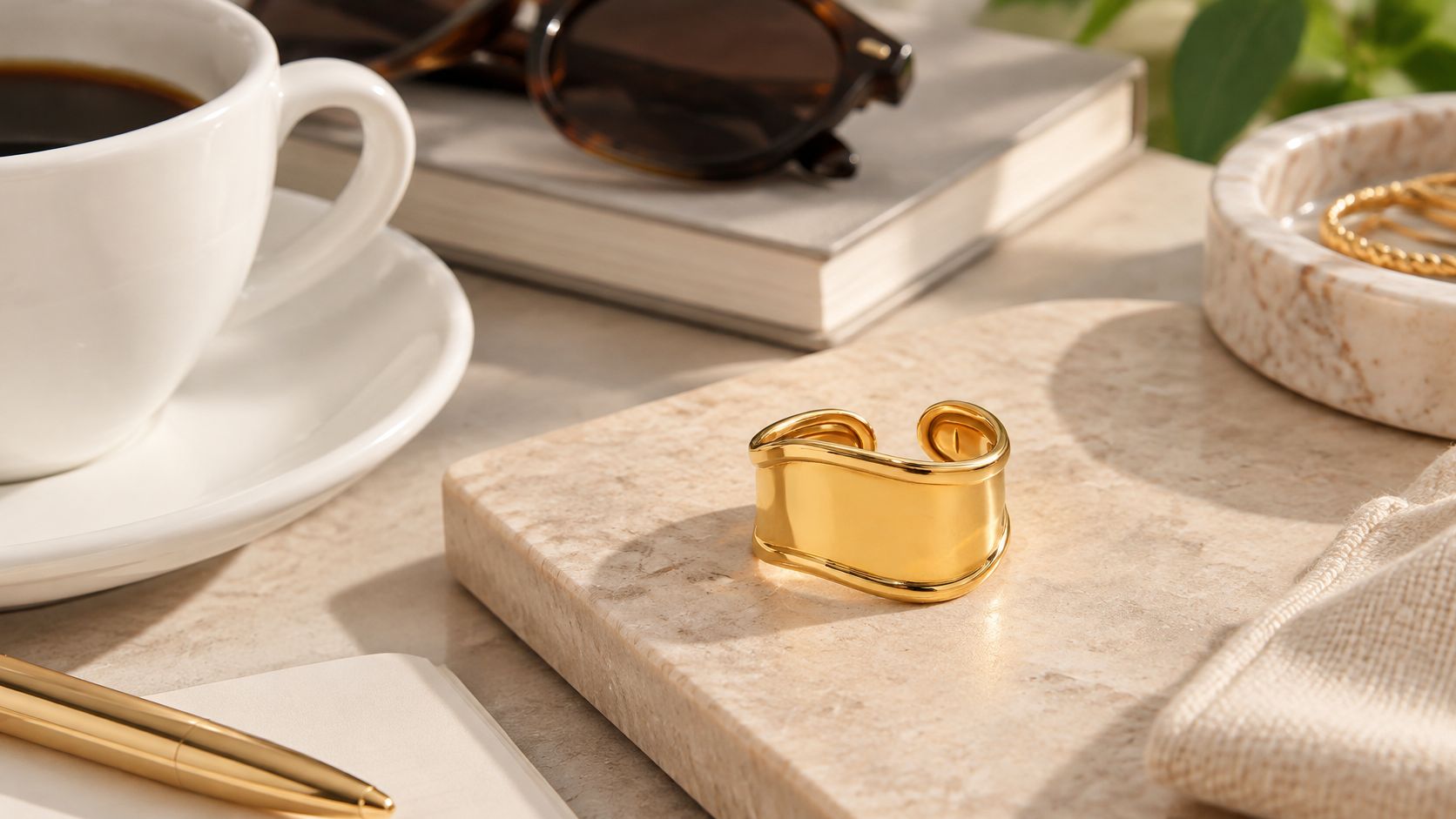
Use the design to set the inspection points: check the broad outer surface for contact with counters or other rings, and check the open ends for extra handling during fitting and adjustment. These observations do not predict a lifespan, and the catalog snapshot does not state a plating thickness. They show why a ring should not inherit the same wear language as a low-contact pendant.
A finishing industry discussion supports that caution. It notes that approximately 1 micron of gold may provide reasonable life for moderately priced jewelry under limited wear, while very thin flash deposits can fail much faster. It also warns that gold is relatively soft and substrate choice matters if base metal migration occurs. For a store, the lesson is to ask what specification sits behind the finish before deciding how to position a fashion ring.
Now picture a contrasting buying scenario with layered necklaces. Chains move against each other, a pendant can turn against fabric, and the clasp is handled at every wear. The contact is generally less forceful than a ring striking a hard surface, but it isn't friction free. Product photography, packaging, and care cards should therefore reflect the actual construction customers will handle.
HonHo Wholesale Jewelry supplies ready to buy wholesale jewelry across stainless steel, brass, and 925 sterling silver assortments. As one sourcing option, its catalog lets buyers compare categories and finishes side by side. The commercial decision still rests on your specification sheet. Match the design to occasional styling, regular fashion rotation, or more frequent wear, then write customer expectations from that use case rather than from the gold plated label alone.
Care Tips That Can Extend Finish Life
Good care slows avoidable exposure. It doesn't convert a coated piece into solid gold. The routine works because it reduces the two forces already discussed, rubbing and chemical contact, before either one has a chance to thin the surface.
A Routine Customers Can Actually Follow
- Remove before exposure: Take plated pieces off before showering, swimming, exercising, cleaning, or applying lotion, sunscreen, and perfume.
- Put jewelry on last: Let cosmetics dry first so the finish isn't sitting under a fresh layer of product.
- Wipe gently after wear: Use a damp microfiber cloth to remove surface residue without abrasive polish.
- Dry before storing: Moisture left in a pouch or box continues the exposure after the piece comes off.
- Store pieces separately: A dry, soft lined container reduces scratching and chain on chain rubbing.
A damp microfiber cloth is preferable because aggressive polishing removes material from the very layer customers are trying to preserve. They should avoid treating dullness with repeated scrubbing. If the base metal is already visible, stronger polishing won't restore gold. At that point, the honest service conversation is about replating, professional assessment, or replacement, depending on your store policy.
Resellers can shorten this routine for packaging without losing accuracy. Try language such as, "Gold plating is a surface finish. Remove before water, exercise, and cosmetics, wipe gently after wear, and store separately." That wording sets a realistic expectation while giving the customer a clear action. HonHo's jewelry care guide for retailers and customers offers a broader reference you can adapt to inserts, product pages, and aftercare emails.
Avoid turning care into a guarantee. Don't promise that following every step prevents all fading or delivers a specific lifespan. A ring worn daily at a manual job still faces substantial abrasion. Care can reduce unnecessary damage, but it can't suspend normal wear.
What Wholesale Buyers Should Verify
A reliable purchase starts with a specification sheet, not a polished sample photograph. Before placing a wholesale order, ask the supplier to confirm each item in writing so samples, production lots, and reorders refer to the same standard.
- Base material: Brass, stainless steel, 925 sterling silver, or another clearly named substrate.
- Measured thickness: The target in microns and the significant surfaces it covers.
- Plating method: How the gold layer is deposited, stated without vague premium language.
- Barrier or protective coating: Whether one is used and where it sits in the layer stack.
- Wear zones tested: Ring undersides, clasps, edges, posts, or other relevant contact points.
- Sample approval standard: The appearance and measurements your team will use to accept production.
Verification methods answer different questions. Technical guidance identifies XRF as a method for checking coating thickness, while Taber abrasion and controlled rubbing protocols record how a surface behaves under simulated friction. The current ISO 3497 standard covers X-ray spectrometric methods for measuring metallic-coating thickness. An XRF result is therefore useful when the method, calibration, measurement locations and layer stack are recorded; one spot reading does not prove adhesion or uniform coverage. Abrasion testing answers a different question: how the finished surface responds under a defined rubbing setup.
Buyer distinction: Thickness tells you what's there. Abrasion testing tells you how that finished surface performs under a defined rubbing method.
Two products can measure similarly and still behave differently if adhesion, underlayers, surface preparation or protective coatings differ. For private-label and custom orders, request the test method, tested areas, conditioning, cycle count or exposure time, endpoint and acceptance criteria before approving the sample. Photograph high-contact zones before and after the agreed sequence so the quality record does not depend on memory.
Salt-spray testing may be part of a project-specific quality plan, but it is not a shortcut to a customer wear claim. ISO 9227:2022 says its salt-spray methods are useful for checking maintained coating quality and detecting discontinuities, yet are not intended to rank different materials or predict long-term corrosion resistance. Record the exact method and acceptance criterion, and do not convert an exposure time into months or years of wear.
This framework also helps Shopify sellers and boutiques compare quotations fairly. A lower price may reflect a different substrate, thinner deposit, or narrower test scope. When researching assortment options, use HonHo's guide to gold plated wholesale jewelry alongside your own specification checklist. You're not looking for a universal best coating. You're looking for a documented match between material, design, price point, and intended customer use.
Questions Buyers Still Ask
Can worn gold plating be restored?
Usually, the finish has to be replated after enough gold has worn away to expose the base. Polishing may clean residue, but it cannot replace gold that is no longer on the piece and aggressive polishing can remove more of the remaining coating.
Does a thicker coating always last longer?
It provides more material before breakthrough at the measured point, but it is not the only variable. Design, surface preparation, adhesion, underlayers, protective coatings, contact pattern and care all affect the result. Compare thicker and thinner samples only when those conditions and the measurement method are clear.
What should a wholesale buyer approve?
Approve a written combination: base metal, gold fineness and color, target thickness, significant surfaces, underlayers or topcoat, measurement locations, performance-test method and acceptance criteria. Keep the approved sample and photographs with that specification so production lots and reorders have the same reference.
Key Takeaways for Jewelry Sellers
Gold plated jewelry can wear off because it's built around a thin gold surface, not because every worn piece was necessarily mishandled or poorly made. The change usually begins where the item works hardest. Ring undersides, bracelet edges, clasps, posts, and raised details reveal the base earlier than quieter areas.
Thickness matters, but it isn't a standalone promise. A thicker deposit gives the surface more gold to lose, while the substrate determines what customers see after breakthrough. Design, sweat, cosmetics, storage, cleaning habits, and wear frequency shape the result around that specification. A careful seller keeps those variables together instead of advertising one lifespan for an entire catalog.
Use your product pages to teach that distinction in plain language. Name the base metal, state measured plating information when it's confirmed, and explain whether a piece is positioned for occasional styling or regular rotation. Pair that copy with specific care instructions for the category. Customers are less likely to feel misled when normal localized wear was explained before purchase.
For inventory planning, avoid one finish strategy across every category. Low contact earrings and pendants can carry a different expectation from rings and bracelets that meet hard surfaces all day. Sample approval should reflect that difference, especially when you're building a private label line or committing to repeat orders.
Browse the relevant gold plated, stainless steel, brass, and 925 sterling silver collections with those questions in hand. Compare shape, substrate, finish, and intended use before you compare appearance alone. That specification led approach won't make plating permanent, but it will help you buy more accurately, write clearer listings, and reduce avoidable returns.
Browse HonHo's ready-to-buy rings, earrings, necklaces and bracelets in gold-plated finishes across stainless steel, brass and 925 sterling silver to build assortments matched to your customers' wear habits. Visit HonHo Wholesale Jewelry to compare materials, finishes and current collections for your boutique, online store or resale business. For private-label development, send the intended material, finish, quantity, target market and reference images through HonHo's B2B inquiry form so the coating and test plan can be agreed before sampling.


