

For a wholesale buyer, a Chinese beaded bracelet is only repeatable when six details are specified: bead material and treatment, bead-hole finish, stringing system, finished inner fit, metal components, and the standard used to approve bulk production. Color and symbolism may attract the customer, but those six details determine whether the item can be reordered without surprises.
This guide is for boutiques, online stores, marketplace sellers, and private-label buyers comparing Chinese beaded bracelets for resale. It separates cultural storytelling from product claims and turns the category into a practical sourcing brief.
Table of Contents
- Understanding the History and Modern Appeal of Chinese Beaded Bracelets
- Material Selection for Durability and Retail Value
- The Importance of Stringing Systems and Fit Standards
- Sourcing and Manufacturing Options for Resellers
- Pricing Models and Margin Strategy
- Safety Compliance and Material Transparency
- Building a Profitable Bracelet Inventory for 2026
Understanding the History and Modern Appeal of Chinese Beaded Bracelets
“Chinese beaded bracelet” describes a sourcing category, not one uniform material or tradition. It can refer to jade or other stone beads, glass, wood, seed beads, resin, or mixed-material designs made in China. A buyer should therefore treat origin, material, treatment, and cultural meaning as separate facts.
Consumer articles such as Spirituality Shepherd discuss symbolic meanings and publish market figures, but those figures are not a substitute for a supplier specification, sell-through data, or an independently reviewed market study. Use cultural material as context for merchandising, not as proof of future demand.
The same caution applies to historical timelines. Hand Myth's guide to Chinese bead bracelet meanings connects bead jewelry with long Chinese traditions. Retail copy should avoid turning a broad history into a precise claim about a particular modern bracelet unless the design, material, and source support it.
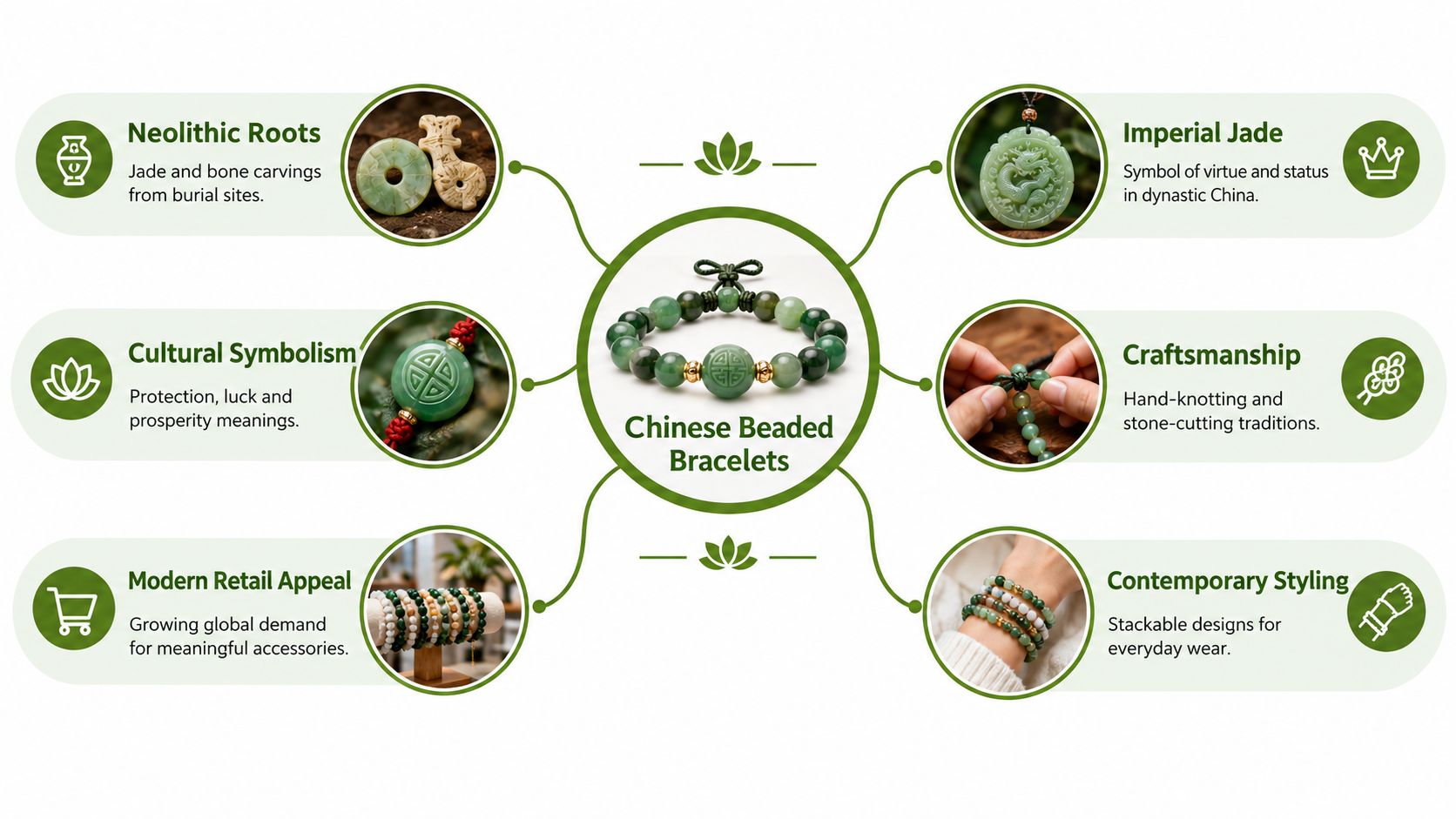
From ritual object to retail category
Prayer beads, auspicious materials, and symbolic colors all appear in Chinese cultural and religious contexts, but a modern wholesale bracelet should not be marketed as a ritual object by default. Ask what the supplier can actually document about the design. If the answer is simply “fashion bracelet,” sell it on its material, color, fit, and construction rather than inventing a spiritual origin.
That distinction protects both the customer and the retailer. A product page can explain that a color or material has cultural associations while making clear that the bracelet is jewelry, not a treatment or guarantee of luck, health, protection, or financial success.
| Buyer question | What to record | Why it matters |
|---|---|---|
| What are the beads? | Specific material name, natural/man-made status, and any treatment or dye | Controls the product description, care advice, and price comparison |
| How is it constructed? | Elastic, wire, cord, or chain; knot/crimp method; metal components | Reveals likely failure points and repair expectations |
| What size is it? | Bead diameter and verified inner circumference, not only cord length | Reduces fit-related returns |
| What approves the bulk order? | Signed sample, tolerance sheet, color range, and packaging standard | Keeps the repeat order tied to an observable benchmark |
Material Selection for Durability and Retail Value
Material choice affects more than appearance. It changes weight, surface wear, color consistency, moisture sensitivity, value perception, and the language a retailer can safely use. “Stone,” “jade,” and “crystal” are not interchangeable specifications.
Bracelets may use gemstone, glass, wood, metal, plastic or acrylic, ceramic, pearl, shell, seed beads, or mixed materials. The overview from 2H Wholesale Jewelry notes nickel as a common contact-allergy concern. For a wholesale order, the useful next step is to identify every metal part—including hidden crimp covers, spacer beads, clasps, logo tags, and plated caps—and request the relevant composition or test documentation for the destination market.
A practical material comparison
| Material group | Useful wholesale specification | Sample check | Retail limitation to disclose |
|---|---|---|---|
| Jade, agate, tiger's eye, and other stone | Trade name, natural/man-made status, treatment or dye, bead diameter, hole diameter, accepted color range | Compare beads under neutral light; check pits, cracks, polish, drilling and matching | Natural variation; care may depend on treatment |
| Glass and ceramic | Color process, coating, shape tolerance, edge finish | Look for chips, sharp edges, coating rub-off and uncomfortable weight | Impact damage and surface wear |
| Wood and porous materials | Species or material description, finish, dye, moisture-care requirement | Check odor, color transfer, cracking, rough holes and shade variation | Moisture and cosmetics may change the surface |
| Metal beads and spacers | Base metal, finish/plating process, color target, nickel-related documentation where relevant | Inspect edges touching the cord and areas where plating is likely to rub | Finish wear depends on base metal, coating and use |
| Resin, acrylic and clay | Material, pigment/coating, shape tolerance and temperature-care limits | Check seams, scratches, color consistency and deformation | Surface wear and heat sensitivity vary by formulation |
Cursa's stringing and layout guidance offers general craft advice, but a commercial specification should come from the actual bead and construction being ordered. A harder material is not automatically a better bracelet: brittle edges, poor drilling, heavy beads, or sharp spacers can still damage the cord.
Match material claims to evidence
Do not use “natural,” “untreated,” “hypoallergenic,” “waterproof,” or “safe for sensitive skin” as decorative copy. Each is a product claim. If a bracelet uses brass with a gold-colored finish, identify the confirmed base metal and finish rather than calling it simply “gold.” Buyers comparing finish terminology can review this guide to gold PVD coating, then verify whether PVD actually applies to the specific bracelet or metal component.
For gemstone beads, the supplier's invoice, treatment disclosure, and sample should agree. The same color name is not enough: “green jade look,” dyed quartz, treated jadeite, nephrite, glass, and resin can occupy very different price and care positions. If the supplier cannot substantiate a precise claim, use a narrower material description until it can.
The Importance of Stringing Systems and Fit Standards
Attractive beads cannot rescue weak construction. The main failure points are usually the bead hole, knot or crimp, cord-to-clasp transition, and any metal edge that contacts the stringing material. Heavy beads also demand more from the cord than a lightweight design.
this beading materials guide gives general cord suggestions, but there is no universal elastic diameter that fits every design. The cord must pass through the actual drilled hole, carry the bead weight, tolerate the selected knot, and leave enough reserve for production variation. Record the approved cord brand/type and nominal diameter when possible; “premium elastic” is not a reproducible specification.
Inspect the construction before ordering
| Check | How to inspect the sample | Reject or clarify when |
|---|---|---|
| Bead holes | Rotate several beads and inspect both hole edges under magnification | Edges are sharp, chipped, off-center, or visibly abrading the cord |
| Elastic recovery | Put the bracelet on and remove it repeatedly in normal use; then let it rest and compare with the original shape | Gaps remain, the knot moves, or recovery is inconsistent |
| Spacers and charms | Check every contact point between metal and cord | A thin metal edge can pinch or cut the elastic |
| Knot/crimp | Inspect the finish from all sides and compare multiple samples | The knot slips, adhesive is excessive, or crimps deform the wire |
| Surface consistency | Compare color, polish and plating in neutral light | The variation exceeds the written approval range |
Do not convert a controlled pull or wear check into a lifetime claim. A sample test only describes that sample under that method. Write down the method, number of cycles or duration, and acceptance rule so the next production lot can be checked the same way.
Plan length around bead size
Bead diameter changes the usable inner space. A bracelet made from large beads needs more cord length than one made from small beads to achieve the same inner fit. That relationship makes fixed “add this many centimeters” rules unreliable across materials and constructions.
Cursa's bracelet measuring guide describes general measuring practice. For an order, pair that with the HonHo jewelry size guide and approve a physical size sample. Record:
- nominal bead diameter and the allowed range;
- verified bracelet inner circumference or fit mandrel position;
- whether the measurement is taken relaxed or under tension;
- closure type and any extension range;
- size tolerance for bulk inspection.
Give customers a finished measurement, bead diameter, and simple fit instruction. “One size fits all” should only be used if the tested fit range genuinely supports it.
Sourcing and Manufacturing Options for Resellers
The sourcing route determines how much of the specification you control, how quickly you can replenish, and how much inventory risk you accept. Country of manufacture alone does not establish quality; the approval system does.
Spherical Insights' beaded jewelry market coverage discusses the category at a market level. Commercial market summaries can help frame questions, but they do not verify a particular supplier's capacity, regional share, quality system, or forecast. Base the purchase decision on supplier evidence, samples, order terms, and your own channel data.
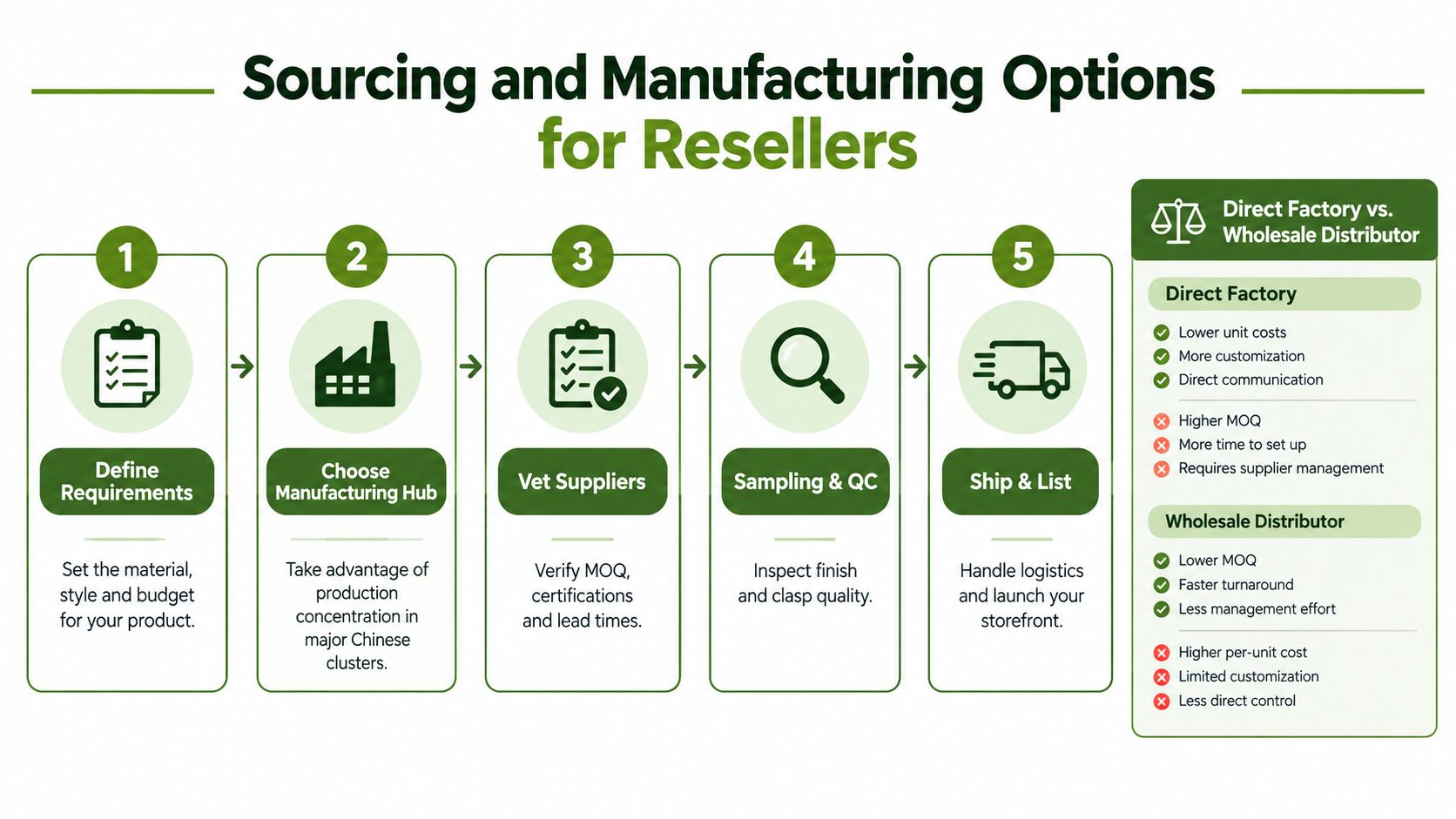
Ready-stock and custom production
| Route | Best use | What to confirm before paying |
|---|---|---|
| Ready stock | Testing a material, color story, or price point with less development | Exact stock identity, mixed-lot variation, replenishment likelihood, packaging and current lead time |
| Modified stock | Changing a charm, card, color mix or packaging around an existing construction | Which parts are being changed, approval sample, MOQ and whether old/new components may be mixed |
| Custom OEM/ODM | Creating a controlled bead mix, fit, logo element, finish or branded presentation | Bill of materials, sample stages, tolerances, ownership of custom parts and bulk approval method |
Do not approve a custom bracelet from a rendering alone. Confirm a physical sample, then attach the approved bead range, stringing system, dimensions, metal parts, logo placement, packaging, and defect rules to the purchase order.
A factory and a wholesale distributor solve different problems. A factory may provide closer development control; a distributor may make mixed ready-stock buying easier. Neither label guarantees traceability or consistency. HonHo's low-MOQ jewelry manufacturing guide explains the planning difference between ready-to-buy wholesale and custom work.
For HonHo custom projects, the current planning baseline is 50 pieces per style and color. General sampling baselines are 25–30 days for brass or sterling-silver styles and 25–35 days for stainless-steel styles, with bulk production typically 35–45 days after sample approval. A beaded bracelet may use different materials or processes, so the confirmed quotation and production plan for that design control.
Pricing Models and Margin Strategy
A bracelet can sell and still lose money if the buyer prices only from the supplier's unit quote. The working figure is landed, saleable cost: product, packaging, freight, duties, inspection, payment costs, expected defects, and any rework needed before sale.
HonHo's wholesale jewelry pricing guide discusses common wholesale pricing approaches. Treat percentage benchmarks as planning references, not a rule for every bracelet. A dyed-stone elastic style, a plated mixed-material design, and a sterling-silver clasp bracelet do not have the same cost structure or return risk.
Review HonHo's wholesale jewelry buying guide for assortment planning and reorder benchmarks before committing to depth. The first order should answer a question—fit, material acceptance, price, or color demand—not merely fill a large assortment.
Build the cost from the customer price
| Cost layer | Include | Decision it supports |
|---|---|---|
| Factory or wholesale cost | Bracelet, custom parts, logo, packaging and sample amortization | Whether the design fits the target price at all |
| Landed cost | Inbound freight, duties/taxes where applicable, inspection and handling | True gross-margin calculation |
| Sale cost | Payment, marketplace, fulfillment, promotion and customer service | Channel-specific profitability |
| Risk reserve | Defects, fit returns, markdowns and slow-moving colorways | How much depth is safe on the first order |
The jewelry store pricing strategy guide publishes broad COGS and wholesale-price benchmarks. Use them as a comparison point, then calculate from your own channel fees, return data, and required margin. A fixed 2× or 3× markup can hide a weak order when packaging, freight, and returns differ sharply between SKUs.
Before reordering, compare units sold, return reasons, discounting, gross margin after channel fees, and the number of days the style remained in stock. Reorder a specification, not just a photograph: retain the approved material, fit, cord, color range, and packaging record.
Safety Compliance and Material Transparency
Compliance depends on the product, customer age, materials, claims, and destination market. A certificate for one material or lot should not be presented as evidence for every bracelet in a collection.
Global Times' coverage of the issue concerns powered bead-craft products and related accessories, including electrical and heat hazards. It is not evidence that an ordinary finished beaded bracelet presents those same hazards. For finished jewelry, focus on the risks that actually apply: metal composition, coatings, dyes or treatments, small parts, sharp edges, cords, adhesives, and age grading.
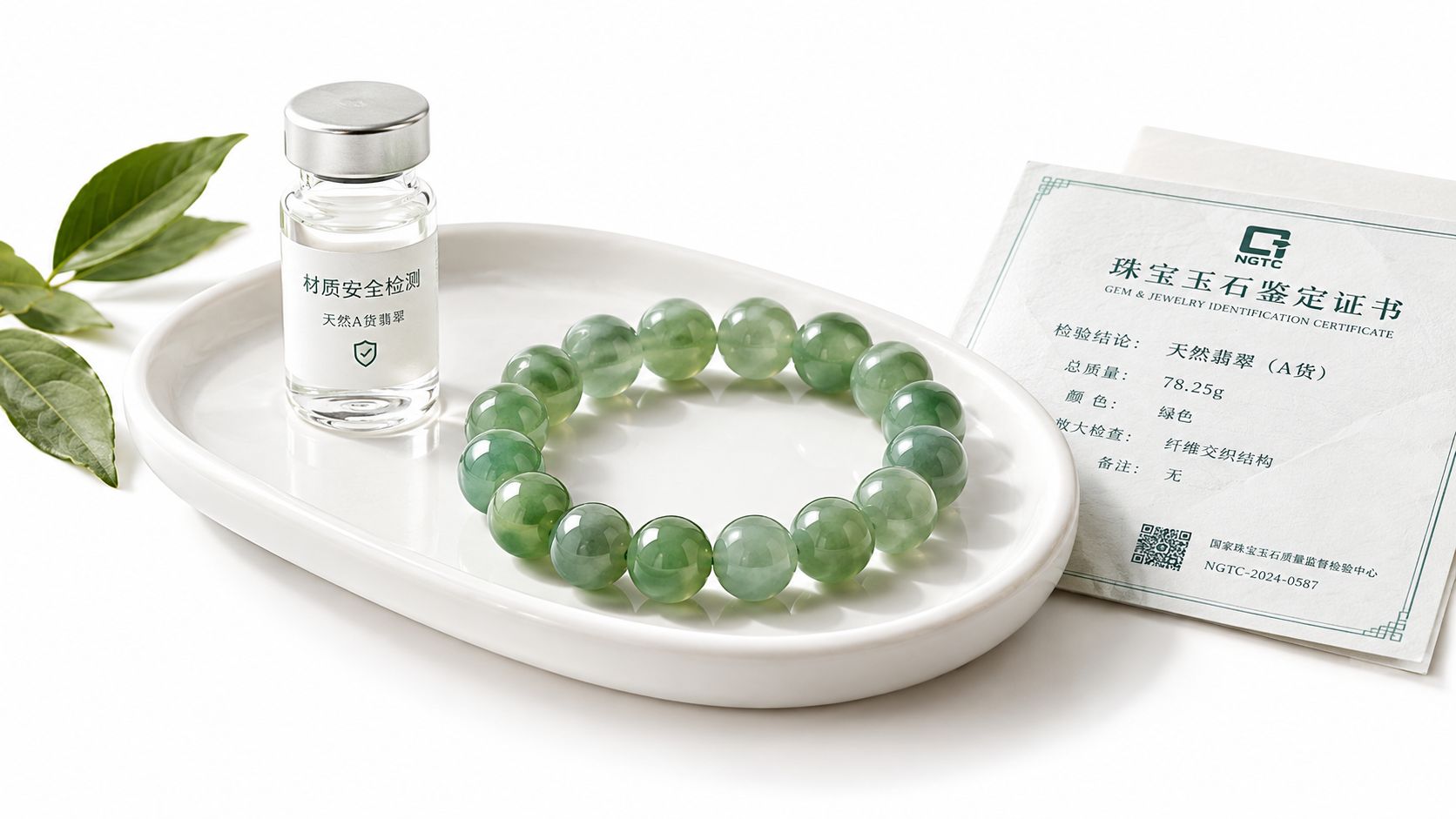
Ask for material-level information
The GIA overview of gem treatments explains why treatments and the resulting care requirements matter. Ask whether color or clarity is natural, treated, dyed, coated, impregnated, reconstructed, or simulated, using the terminology appropriate to the material. Then make the invoice, product page, and care card consistent.
For U.S. marketing, the FTC's guidance for advertising gemstones is a useful starting point for disclosures about non-permanent treatments, special-care requirements, and treatments that significantly affect value. Other markets have their own requirements; confirm the rules that apply to the intended destination and sales channel.
Keep a product file with the supplier quotation, bill of materials or component declaration, treatment disclosure, relevant reports, approved sample photos, measurements, packaging, and purchase order. Record which SKU and lot each document covers.
Use careful customer language
Use the narrowest description the evidence supports. “Gold-color plated brass spacer” is more useful than “gold bead.” “Dyed stone bead” is safer than “natural gemstone” when natural origin or treatment has not been confirmed. Avoid medical, healing, protective, waterproof, or universal skin-safety promises unless they are both substantiated and lawful in the destination market.
For children's products or jewelry marketed to children, treat age grading and applicable testing as a separate compliance decision. Do not assume an adult fashion-jewelry document automatically covers a children's SKU.
Building a Profitable Bracelet Inventory for 2026
A durable assortment starts with a small number of repeatable roles rather than many near-duplicate colors. One practical opening range is a neutral everyday style, a stronger color story, a culturally inspired design with careful copy, and one higher-value material or finish. The exact mix should reflect the store's customer and price architecture.
Use this guide to beaded bracelets wholesale for broader material, fit, and supplier comparisons. For every SKU, track the material description, treatment, bead size, inner fit, stringing system, metal parts, order lot, return reason, and reorder decision. Those fields make a future supplier comparison possible.
Before placing the order, send one written RFQ that asks for:
- material and treatment for every bead and metal component;
- bead diameter, hole diameter, finished inner fit, and tolerance;
- cord/wire type, nominal diameter, knot or crimp method, and spacer-edge control;
- sample stages, bulk approval standard, MOQ, unit price, packaging and lead time;
- available test or compliance documents tied to the exact material and lot;
- replacement or remake terms for defects outside the approved specification.
Browse HonHo Wholesale Jewelry for ready-to-buy bracelet assortments and related wholesale jewelry categories. For a custom inquiry, send the intended market, target price, quantity, bead material, size range, construction, metal parts, packaging, and launch date. That gives the team enough information to confirm what can be made, sampled, documented, and quoted for the specific project.


