

Plan a boutique jewelry assortment by giving every SKU a job before you buy it: core replenishment, controlled test, display-led statement piece, or date-bound seasonal stock. Then set a landed-cost limit, approve the material and presentation, and write the reorder or exit trigger in advance. That makes the first order a measured retail decision instead of a collection of attractive but overlapping pieces.
This guide focuses on assortment architecture and the operating rhythm after launch. For detailed supplier qualification, product specifications and component-level quality checks, use the companion buying guide linked below. Here, the key question is narrower: what should earn space and cash in the next boutique buy?
| SKU role | What it must prove | Decision before ordering |
|---|---|---|
| Core | Clear customer use, stable presentation and a workable replenishment route | Minimum on-hand level and reorder review date |
| Controlled test | One specific hypothesis about shape, material, color or price point | Test window, evidence to collect and maximum exposure |
| Display-led | Strong visual role without duplicating another SKU's customer need | Where it will be shown and whether it must sell or mainly support merchandising |
| Seasonal | A credible selling window and an exit path | Last reorder date and markdown or carry-forward rule |
Table of Contents
- What Boutique Buyers Really Need from a Wholesale Supplier
- Understanding Materials and Why They Matter for Resale
- Wholesale Pricing, Markup, and Landed Cost Basics
- Building an Assortment That Mixes Trends and Evergreen Sellers
- Branding and Packaging Options for Independent Boutiques
- A Pre-Order Checklist for Buying Wholesale Jewelry
- Sourcing Smarter and Planning Your Next Buy
What Boutique Buyers Really Need from a Wholesale Supplier
A boutique buyer is usually working against several limits at once: open-to-buy cash, display capacity, a launch date and the risk of tying money up in slow stock. The useful supplier is not simply the one with the largest catalog. It is the one that can distinguish ready stock from custom development, identify what can be repeated, and put the current quantity, price, lead time, packaging and claim support in writing.
Start by separating two buying routes. For ready stock, confirm live availability, dispatch timing and whether the same SKU is expected to remain reorderable. For custom work, confirm the sample, approved specification, production quantity and production timing as a separate project. A factory's broad material or finishing capability does not establish the specification of a particular catalog item.
Practical rule: a supplier is ready for an assortment plan when the buyer can tell which products are available now, which require development, what evidence supports each listing claim, and how a repeat order will be matched to the approved reference.
Keep one buying record per SKU. At minimum, record its intended assortment role, supplier SKU or drawing revision, exact material and finish language, dimensions, weight, closure, packaging, quantity, landed-cost scenario, sample decision and reorder route. HonHo's wholesale jewelry buying guide provides the broader sourcing framework; use this page to turn those checks into a balanced opening buy.
Understanding Materials and Why They Matter for Resale
Material choice is not a universal durability ranking. It affects the claim a boutique can make, the finish options available, the care information customers need, the sample checks that matter and the price position the store can support. Compare the complete item by component: base metal, surface finish, stones, posts or hooks, clasp, soldered or welded areas and other skin-contact parts.
Start with stainless steel for low-drama turnover
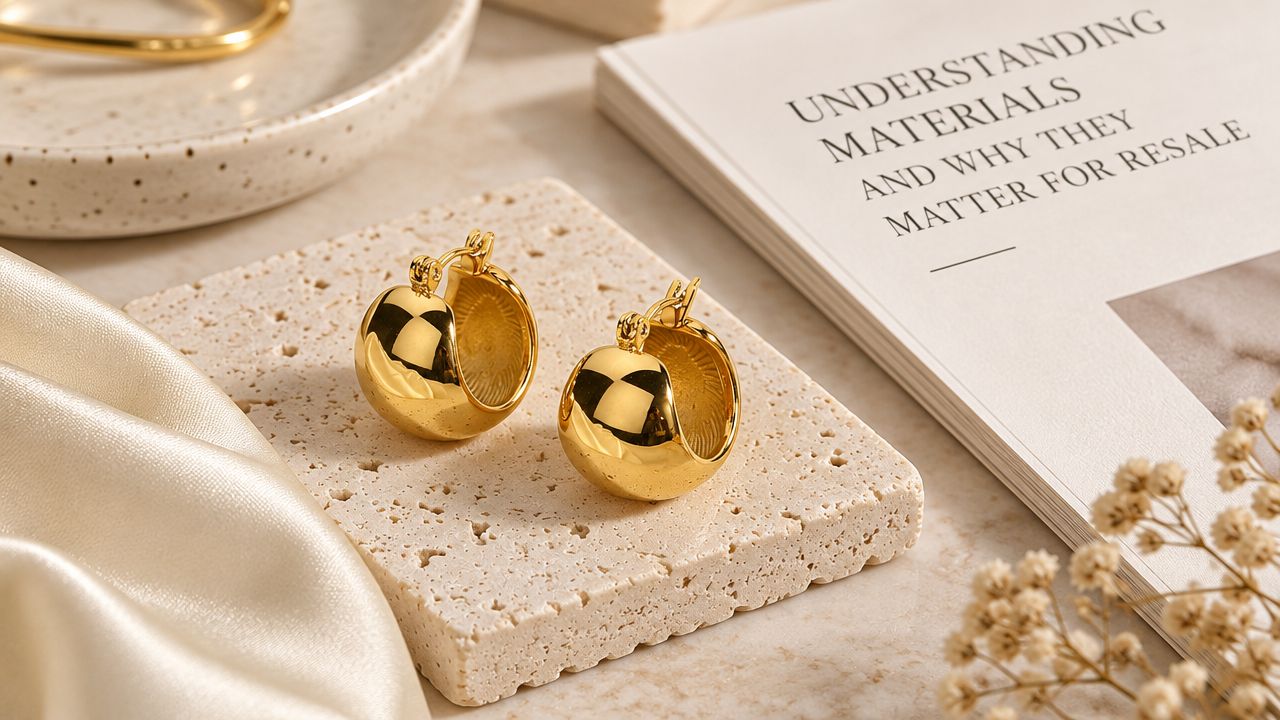
Stainless steel can be a useful base for compact everyday silhouettes, but the exact grade and every attached component still need confirmation. Do not convert the word “stainless” into “316L,” “waterproof,” “nickel-free,” or a fixed wearing-life promise unless the SKU-level documentation supports that statement.
Finish language also matters. PVD describes a deposition route, not a complete performance guarantee; substrate preparation, layer system, color specification, geometry and use conditions all affect the result. Ask what was specified for the item and what test, if any, applies to the approved sample or production batch.
The existing Gold Plated 316L Stainless Steel Chunky Dome Huggie Earrings is a relevant catalog reference because the live product title identifies both 316L stainless steel and a gold-plated finish. Confirm the current product record, dimensions, closure and quotation when ordering; it does not establish the specification of other stainless-steel pieces.
Use brass when you want fashion weight and sharper price control
Brass can support formed, cast and fashion-led designs, but a boutique should approve it as a finished construction rather than rely on the base metal alone. Record the plating or coating system, exposed edges, solder points, stone setting, closure and care language. If a claim concerns nickel release, lead content or another regulated requirement, define the destination market and request evidence appropriate to the item and claim instead of accepting a broad “compliant” label.
Use the sample to check finish consistency, edge comfort, moving parts, stone security and contact between the jewelry and its package. A short visual or controlled test can compare samples, but it cannot be translated into a promised number of months of wear.
Reserve sterling silver for customers who check stamps
Sterling silver suits a precious-metal position when the boutique can support the composition claim and explain normal care. In the United States, a “Sterling” or “Sterling Silver” representation means at least 925 parts per thousand pure silver under the FTC jewelry guides. Marks can help with identification, but a “925” stamp is not a substitute for reliable supplier documentation or any market-specific hallmarking requirement.
Keep the existing Source and 925 hallmark explanation as secondary reading prompts, not as proof of one product's composition or lifespan. Check current official rules before publishing a claim; for U.S. silver-content wording, see 16 CFR § 23.5.
| Material route | Assortment question | Sample and listing check |
|---|---|---|
| Confirmed stainless-steel grade | Does the silhouette suit the intended everyday or statement role? | Grade by component, finish, closure, edges, dimensions and accurate care language |
| Brass | Does the design value justify the finishing and care requirements? | Base-metal disclosure, coating specification, exposed areas, stones and destination-market evidence |
| 925 sterling silver | Will the customer value the precious-metal position and accept normal care? | Composition documentation, required marks, finish if plated and wording for the sales market |
Use HonHo's jewelry materials guide as a comparison tool, then attach the exact SKU specification to the buying record. Factory capability and a material guide are context; the approved item and current quotation govern the order.
Wholesale Pricing, Markup, and Landed Cost Basics
Price the assortment from landed and sale-related cost, not the supplier's unit price alone. The useful model includes goods, allocated freight, duty or tax where applicable, payment costs, unit packaging, labeling, fulfillment, channel fees, an evidence-based allowance for returns or defects, and any planned promotion. Keep the currency and order quantity consistent across supplier comparisons.
| Cost view | Include | Decision it supports |
|---|---|---|
| Landed unit cost | Goods, freight allocation, duty/tax and payment cost | Whether the item fits the intended retail band |
| Sale-related cost | Packaging, channel fee, fulfillment and realistic return allowance | Whether the planned margin survives the sale |
| Inventory exposure | Order quantity, units per SKU, sample cost and review date | Whether the assortment is too deep or too broad |
| Reorder case | Current reorder quantity, quote, lead time and stockout tolerance | Whether a winner can be replenished without breaking the retail plan |
The existing Source, Pricing formula guide and Boutique pricing benchmark can prompt worksheet fields, but their markup examples are not universal rules. Rent, labor, channel fees, return patterns, tax treatment and customer price tolerance differ by store. Set the retail price and margin threshold from the boutique's own costs and positioning.
Run at least two cases before approving the buy: the quoted case and a stress case with a smaller order, higher freight allocation or slower sell-through. If a SKU works only when freight, packaging or markdown risk is omitted, it has not passed the commercial check.
The video embed is retained as an additional reference; verify any claim from its accessible content against the written SKU and quotation. Use HonHo's MOQ and wholesale pricing page for current planning information, while recognizing that ready-stock terms and custom-development minimums are different and special components or packaging may change the quote.
Building an Assortment That Mixes Trends and Evergreen Sellers
A useful assortment balances breadth and depth deliberately. Breadth tests customer preference across categories, shapes, materials and price points. Depth keeps likely repeat sellers available. Too much breadth creates weak signals and operational clutter; too much depth in an unproven style concentrates cash in one assumption.
Give each SKU one primary role and check for overlap. Two gold-plated hoops may look different to a buyer but serve the same customer need, retail band and display position. When that happens, keep the stronger evidence or reorder path and use the freed budget to fill a real gap.
How do you put together a first small mixed wholesale order?
Start with the first-order wholesale selection and choose a customer need for each style. HonHo's ready-stock minimum is 1 piece per style, with a US$100 merchandise minimum after discounts and before shipping. You can mix eligible styles in one order. This is separate from the custom-development minimum discussed below.
Choose products whose differences you can explain and track. A compact everyday earring tests a different offer from a drop earring; a fitted band raises different stock questions from an occasion ring. As a starting comparison, review huggies and small hoops, lariat and Y necklaces, and cocktail rings. You do not need every category. Include the ones that fit your existing customers, display space and price range.
Write the exact variant and quantity beside each choice. Count finish and size combinations as separate stock decisions, and confirm the selling unit for earrings. Keep the discounted merchandise subtotal separate from shipping and other applicable costs. If the basket falls below the minimum after a discount, reconsider the planned quantities or order timing rather than adding unrelated pieces merely to qualify.
Before submitting the order, check each selected variant's price and availability, resolve missing measurements, and set aside a budget for receiving checks, photography and a later reorder. The first delivery should give you products to inspect and a clear question to test. Increase depth only when your own sales and return records support it.
Trend pieces need tighter buys
A trend-led item should answer one testable question: will this customer accept this scale, motif, color, material or price? Set the review window and exit rule before launch. Record units received, units sold, return reasons, customer questions, remaining stock and whether the product page gave enough evidence for a confident purchase.
Do not turn a search-result statistic or supplier forecast into a sales promise. The existing Trend coverage can supply ideas to investigate, but it does not establish HonHo demand or a boutique's future sell-through. Convert any relevant observation into a sample or merchandising check: statement earrings require weight, balance and closure review; stone-led designs require setting and pressure-point checks; plated sculptural pieces require edge and high-friction inspection.
Evergreen styles hold the line
A product earns “core” status through the boutique's own evidence, not because its silhouette is commonly described as timeless. Reorder only after checking sales in the chosen window, stock remaining, return reasons, current terms and whether replenishment can arrive before the store reaches its minimum on-hand level.
| Assortment role | Initial buying logic | Next decision |
|---|---|---|
| Controlled test | Enough exposure to answer one clear customer question without dominating the budget | Reorder, revise the offer or exit at the planned review |
| Core candidate | Clear specification, broad use case and credible replenishment route | Promote to core only after store evidence supports it |
| Display-led statement piece | Chosen for visual impact with weight, balance, closure and packaging approved | Judge both direct sales and its merchandising role |
| Seasonal item | Quantity tied to a selling window and arrival date | Stop reordering at the pre-set cutoff |
The wholesale earrings in bulk guide is the better next step when the assortment includes paired components, posts, backs or closure-specific checks.
Branding and Packaging Options for Independent Boutiques
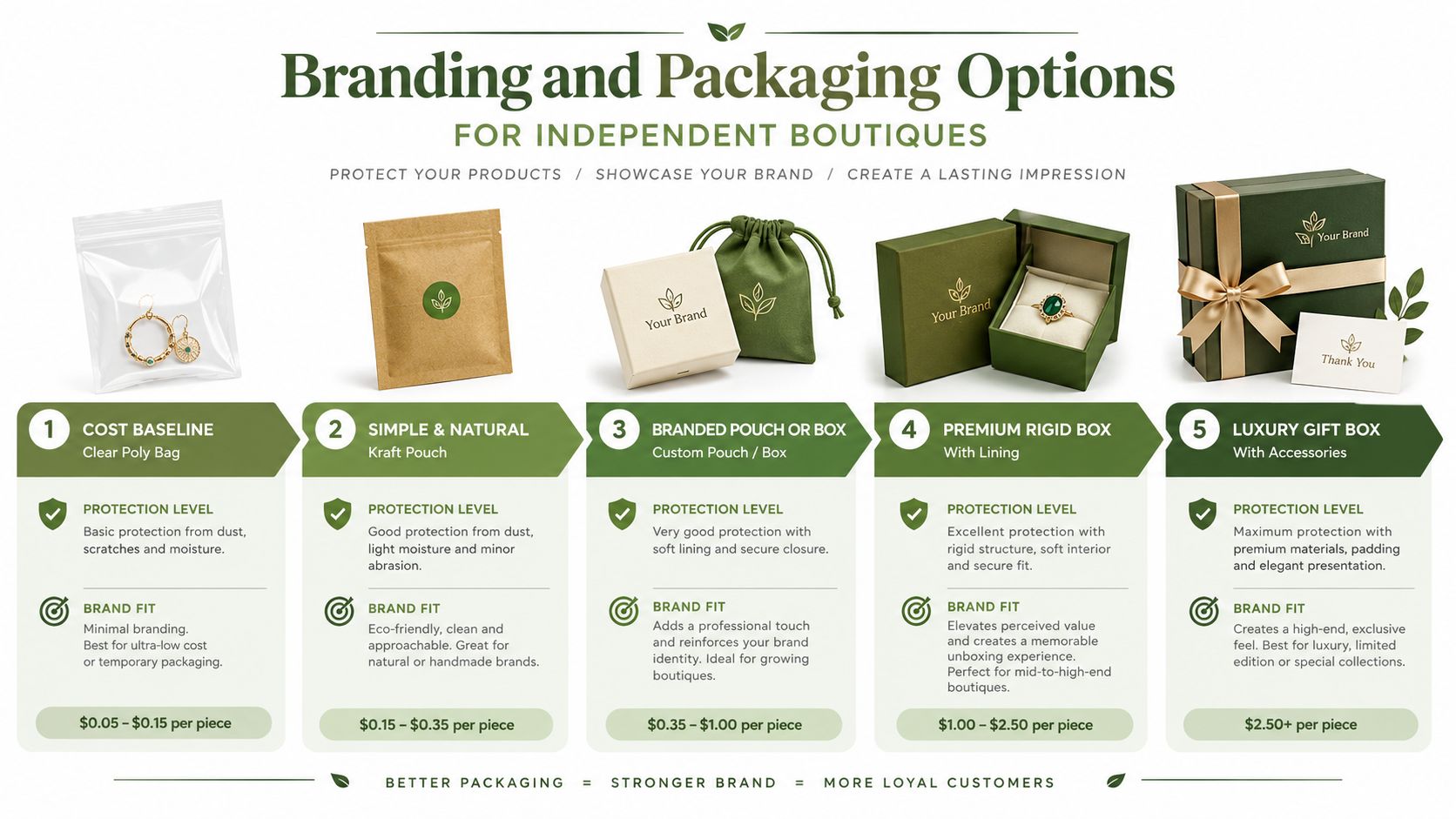
Packaging is part of both presentation and product protection. Choose it after the jewelry dimensions and sales channel are known. A chain needs restraint against tangling; earring posts need clearance; a statement piece needs protection from pressure and abrasion; a barcode or care card needs readable space. An attractive empty box is not an approved packed sample.
| Packaging decision | Check on the packed sample | Commercial effect |
|---|---|---|
| Format and insert | Fit, movement, pressure points, post or clasp clearance and surface contact | Damage risk, packing time and perceived finish |
| Artwork and labels | Logo, SKU/barcode, material and care wording, market-required information | Listing consistency and stockroom accuracy |
| Packed dimensions | Unit size, carton count, weight and protection during fulfillment | Freight allocation, storage and shipping cost |
| Customization | Sample approval, quantity, print method and schedule | Cash exposure and whether packaging delays the jewelry launch |
Simple packaging can be appropriate for a test buy; coordinated cards, pouches or boxes can support a proven line. Do not assume the custom jewelry minimum applies to packaging. Format, material, printing method and supplier can create separate minimums, so confirm them on the packaging quotation.
A Pre-Order Checklist for Buying Wholesale Jewelry
A first order should be a controlled risk with written acceptance points. Use the checklist to find missing information before money moves, then attach the approved version to the purchase record.
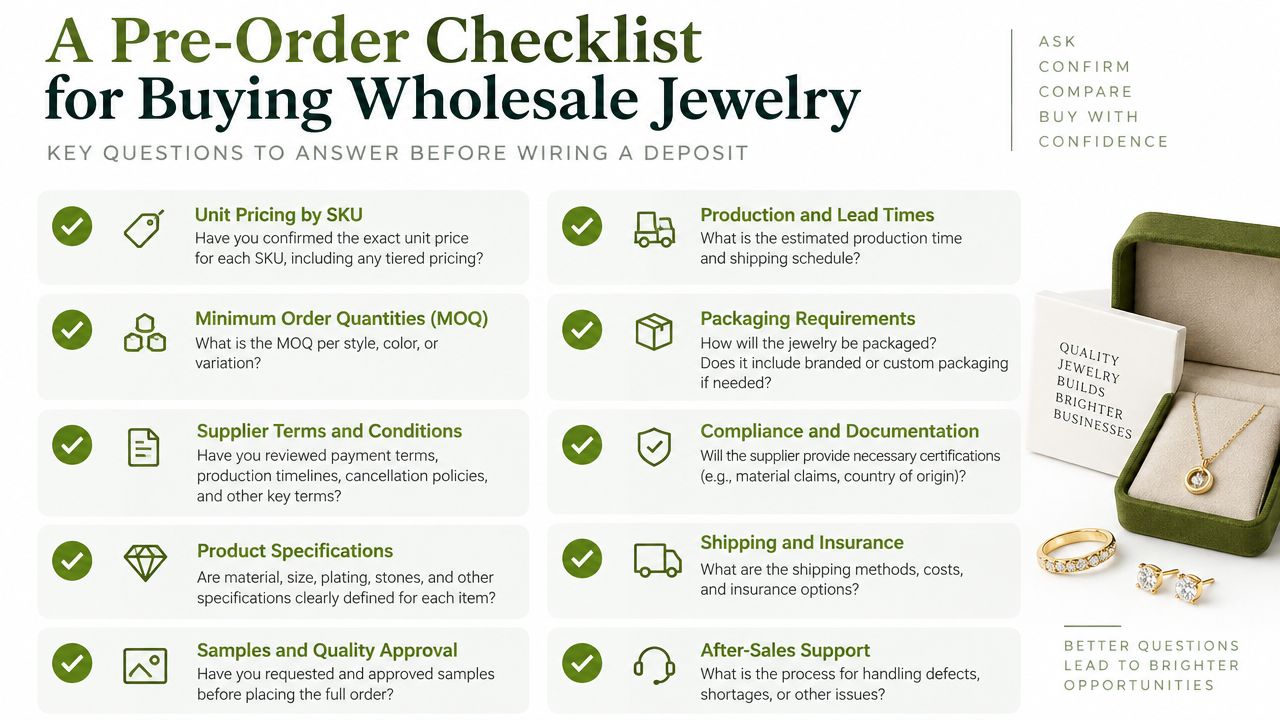
- Assortment role: core candidate, controlled test, display-led or seasonal—and which customer need it fills.
- Identity: supplier SKU or drawing revision, reference images and approved sample.
- Construction: base metal, finish, stones, dimensions, weight or tolerance, closure and skin-contact components.
- Commercial terms: quantity by SKU/color, unit price, sample cost, payment terms and current ready-stock or custom timing.
- Landed cost: freight, duty/tax where applicable, fees, unit packaging and realistic return or defect allowance.
- Evidence: documents appropriate to the destination market and the exact material, safety or performance claim.
- Packaging: packed-sample fit, artwork, label data, unit protection and carton configuration.
- Acceptance: workmanship limits, damage/shortage process and the decision maker for changes.
- Reorder or exit: review date, minimum on hand, current reorder terms and the point at which the SKU leaves the assortment.
Use HonHo's jewelry sample approval checklist for the physical review. A sample can confirm the item in front of you and compare controlled versions; it cannot prove that every production unit is identical or predict a fixed real-world wearing life.
Sourcing Smarter and Planning Your Next Buy
Set the review calendar before the stock arrives. On each review date, capture units received, units sold, returns with reasons, remaining stock, current reorder quote, replenishment time and whether the original assortment role still makes sense. This creates a decision trail without pretending that one week's sales predict a season.
For custom development, HonHo's current planning baseline is 50 pieces per style and color; brass or 925 silver samples are typically planned at 25–30 days, stainless-steel samples at 25–35 days, and bulk production at 35–45 days after sample and specification approval. These figures are custom-program planning baselines, not promises for every SKU or order. Special stones, components, finishes or packaging can change feasibility, quantities or timing. Confirm ready-stock availability and dispatch separately on the current quotation.
Before requesting a quote, send the target market and customer, assortment role, product category or reference, quantity by style/color, preferred material and finish, dimensions, closure, stones, packaging, required claim support, delivery destination and launch window. Ask the supplier to separate what is available now from what must be developed.
Practical rule: reorder when the SKU's evidence, current terms and arrival timing still fit the assortment—not simply because the first units sold.
HonHo Wholesale Jewelry supports ready-stock sourcing and custom development across stainless steel, brass and 925 silver. Use the catalog for current products and send a specification-led inquiry for a quotation; keep the approved record beside the next buy.
Ready to build the opening buy? Use the first-order selection above to choose the exact styles, variants and quantities, then review the discounted merchandise subtotal and delivery options at checkout before placing the order.


