

A stainless steel ring assortment should be approved by grade, fit, finish, and finished-item evidence. A supplier's use of “316L” is useful only when the designation applies to the actual ring and its skin-contact components. It does not establish size accuracy, coating performance, nickel release, or comfort.
For retailers, the first buying decision is whether each SKU can be described accurately and reordered consistently. Record the ring-size system, inner dimensions, band profile, base material, surface finish, sample reference, and any destination-market test requirements before committing to a larger order.
This guide focuses on product selection, customer-facing information, care, and assortment planning. For a factory qualification and bulk-order workflow, use the stainless steel rings wholesale sourcing guide.
Table of Contents
- What This Guide Covers for Wholesale Buyers
- What Makes Stainless Steel a Jewelry Material
- 316L Composition and Mechanical Behavior
- Benefits and Trade-Offs Compared to Brass and Silver
- Nickel Release, Plating, and Sensitive Skin
- Ring Sizing, Fit, and Product-Page Information
- Ring Styles That Sell in Wholesale Assortments
- Care, Quality Control, and Inventory Planning
- Sourcing Stainless Steel Rings and Next Steps
What This Guide Covers for Wholesale Buyers
A useful assortment gives customers enough information to choose a ring and gives the buyer a repeatable approval record. Product pages should state the material and finish separately, use a named size system, explain relevant care, and avoid “hypoallergenic,” “waterproof,” or “never tarnishes” unless the evidence supports the exact claim.
Start with the base grade. A supplier that confirms 316L gives you a more useful specification than one that says only “stainless steel.” The composition affects corrosion resistance, fabrication, polishing, and how confidently you can describe the ring to customers. The finished surface matters just as much. A plain polished ring, a brushed band, a gold-plated design, and a black coated signet ring can have very different care requirements even when they share the same base metal.
You also need to separate evergreen products from fashion-led products. Plain bands, simple stackable rings, and restrained signets can support a core assortment. Sculptural shapes, novelty motifs, and strong color finishes need tighter buying discipline because their appeal can be more dependent on a particular trend or customer segment.
My buying rule: never approve a ring from a catalog image alone. Approve the material, dimensions, finish, comfort, and documentation from a physical sample.
This guide gives you a practical framework for comparing suppliers, checking samples, evaluating 316L against brass and 925 sterling silver, and handling nickel-release questions. Use the wholesale jewelry buying guide alongside these checks when you build your next assortment.
The final decision should come down to whether a ring can survive your customer's expected use while leaving room for your retail margin. A low purchase price doesn't help if finish-related complaints create returns. A premium material doesn't help if the design is too narrow for your audience. Apply the framework to each SKU before you commit to a larger order.
What Makes Stainless Steel a Jewelry Material
Stainless steel is an iron-based alloy, not a single universal material. Its corrosion resistance comes primarily from chromium. When the alloy contains enough chromium, the surface forms a very thin passive oxide layer that limits further oxidation and can reform after minor surface damage.
The historical record of Harry Brearley describes early stainless-steel development and the role of chromium. That history explains why the material is an alloy family, but it does not establish the grade or quality of a modern ring. For the technical mechanism, the worldstainless corrosion overview explains the passive, chromium-rich oxide film that forms naturally on the surface.
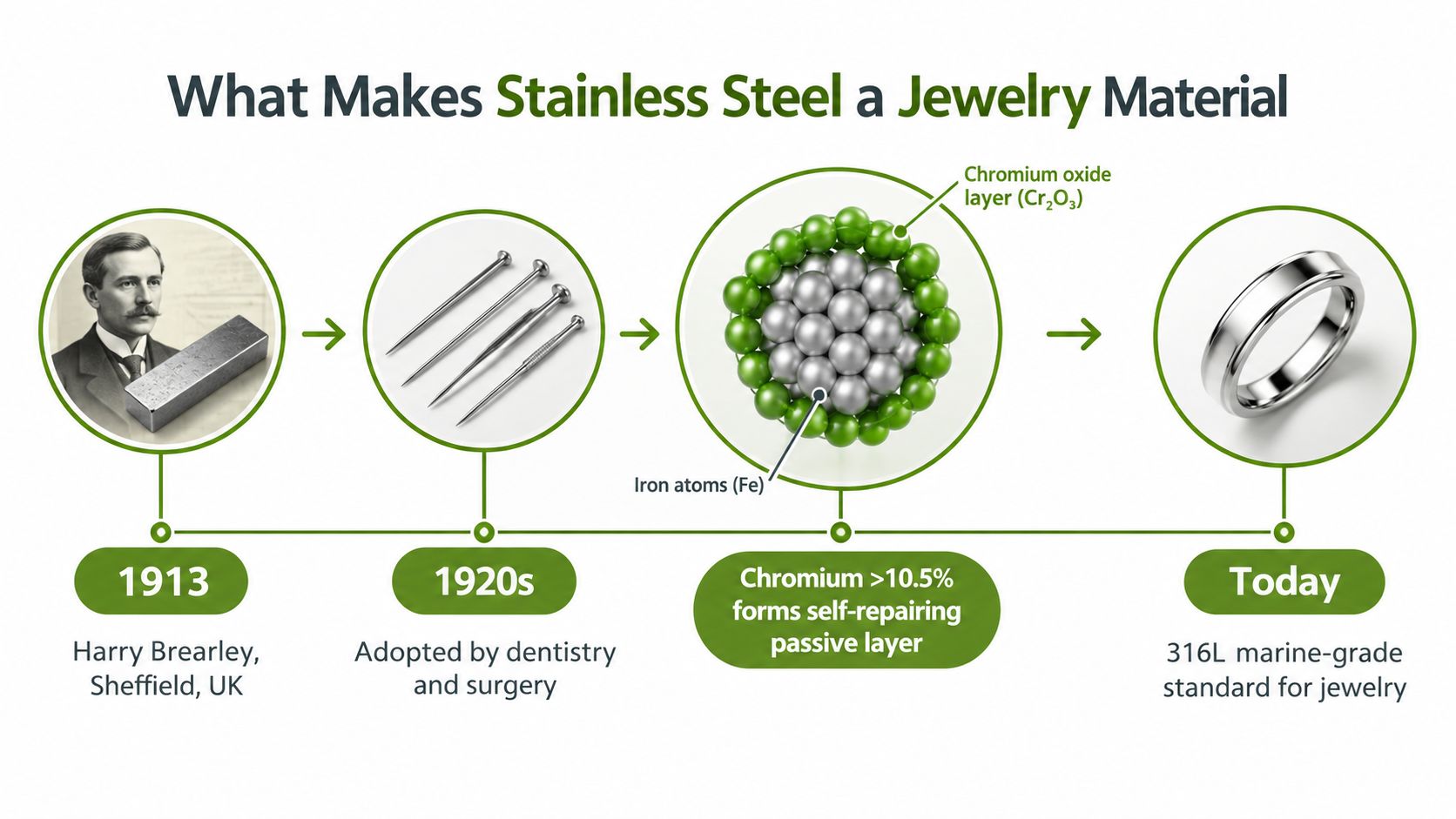
That history matters because a stainless steel ring isn't protected only by a decorative coating. The underlying alloy can provide corrosion resistance through its own chemistry. Gold plating, enamel, polishing, brushing, and other finishes mainly change the appearance and tactile experience.
Why the grade matters
The jewelry trade uses selected stainless steel grades because they balance corrosion resistance, ductility, workability, and surface finish quality. A generic “steel” label tells you very little about which balance the supplier has chosen.
316L is particularly useful for rings intended for frequent wear because chromium supports passivity, molybdenum improves resistance to localized corrosion, and the low carbon level supports fabrication around heat-affected areas. That doesn't make the ring immune to chlorine, abrasion, salt deposits, or poor finishing. It gives the manufacturer a sound material platform to work with.
The World Stainless Association publishes industry production totals. Those figures describe upstream scale; they do not prove jewelry demand, a ring's alloy, or a supplier's quality. Keep the purchase decision tied to the SKU, sample, and production record.
316L Composition and Mechanical Behavior
When a supplier confirms 316L, ask for the actual designation and supporting documentation. UNS S31603 is a useful reference for buyers because it identifies a defined 316L alloy rather than an undefined stainless category.
| Element | Typical Range | Function in Jewelry |
|---|---|---|
| Chromium | Approximately 16–18% | Forms the passive oxide layer that limits corrosion |
| Nickel | Approximately 10–14% in commonly cited specifications | Stabilizes the austenitic structure and supports formability |
| Molybdenum | Approximately 2–3% | Improves resistance to pitting and crevice corrosion in chloride exposure |
| Carbon | No more than approximately 0.03% | Helps reduce carbide precipitation during heating and fabrication |
| Iron | Balance of the alloy | Provides the primary structural metal |
The 316L technical specification from Stainless Europe explains why chromium and molybdenum are important in environments involving perspiration, humidity, and salt. Perspiration isn't the same as seawater, but both can expose a ring to chloride-containing moisture. A smooth surface gives those contaminants fewer places to collect.
The L in 316L means low carbon. It doesn't mean low nickel or nickel-free. The lower carbon limit is useful when a ring includes welded or heat-affected components because it helps preserve corrosion resistance around those areas.
What the mechanics mean at retail level
This 316L technical data sheet reports mechanical values for binder-jet manufactured 316L. It is an example of process-specific data, not a specification for every cast, machined, stamped, or fabricated ring.
Mechanical properties vary with material standard, manufacturing route, heat treatment, cold work, and geometry. A thin shank, deep engraving, sharp transition, porous casting, or weakly bonded coating can fail even when the alloy name is correct. Buyers should approve finished dimensions, construction, and surface condition rather than applying one material datasheet to every ring.
I'd ask for the mill certificate or equivalent material certificate, then compare it with the sample and purchase specification. If the supplier can't identify the grade, composition, and lot documentation, treat “316L” as an unverified marketing description.
For more terminology and material comparisons, use this jewelry materials guide when writing your internal buying specifications.
Benefits and Trade-Offs Compared to Brass and Silver
316L shouldn't replace every other ring material in your store. It occupies a different commercial position from brass and 925 sterling silver.
Stainless steel's advantage is dependable everyday wear. It generally resists tarnish better than sterling silver and usually needs less maintenance than a brass ring with a decorative finish. Its hardness can also help it hold its shape during normal use, although scratches and dents are still possible.
Brass's advantage is cost flexibility and design versatility. It works well for fashion-led pieces where the customer is buying the look rather than a long-term material story. The trade-off is that brass can develop surface changes, and a plated brass ring depends heavily on the quality and durability of its coating. Some customers may also react to the metals present in the alloy or exposed beneath the finish, so don't describe brass as suitable for every skin type.
925 sterling silver's advantage is perceived precious-metal value. It can support gift-led positioning and a stronger material story, but it requires more attention to tarnish and care. Many customers accept that maintenance because “sterling silver” carries a different emotional and commercial meaning from fashion steel.
| Attribute | 316L Stainless Steel | Brass | 925 Sterling Silver |
|---|---|---|---|
| Everyday corrosion resistance | Strong when the alloy and finish are properly controlled | More dependent on surface condition and coating | Good material value, but tarnish requires care |
| Tarnish behavior | Generally low maintenance | Can change appearance over time | Can tarnish and need polishing |
| Weight and feel | Solid, practical, industrial | Useful for lighter fashion designs | Precious-metal feel and familiar jewelry positioning |
| Scratch profile | Resists deformation well, but polished surfaces still scratch | Softer surface can show wear sooner | Softer than steel and can mark with use |
| Skin-sensitivity claims | Requires finished-item nickel-release evidence | Must account for alloy and exposed surfaces | Must account for alloy purity, solder, plating, and components |
| Retail positioning | Durable everyday basics and modern fashion | Accessible trend and statement jewelry | Giftable, premium, and precious-metal assortment |
| Main sourcing risk | Unknown grade, poor finish, unsupported skin claims | Plating wear and surface change | Tarnish, softness, and higher material expectations |
Use each material where it makes commercial sense. A stainless steel ring can anchor an everyday collection. Brass can add visual experimentation without pushing every design into a higher material tier. 925 sterling silver can serve customers who want a precious-metal purchase.
A content example such as a non-tarnish cross necklace can help you see how material positioning becomes part of the product story. Don't let “non-tarnish” become a blanket promise for every finish, though. State the base material and care requirements accurately.
Nickel Release, Plating, and Sensitive Skin
A 316L ring is not nickel-free. Nickel is part of the alloy, so your product copy should never equate “316L,” “surgical steel,” or “hypoallergenic” with zero nickel content.
The relevant question for skin contact is nickel release from the finished surface. For products sold into the European Economic Area, REACH Annex XVII lists finger rings among articles intended for direct and prolonged skin contact and sets a limit of 0.5 micrograms per square centimeter per week. The consolidated REACH text also addresses coated articles. This is a release limit, not a rule that the alloy must contain no nickel.
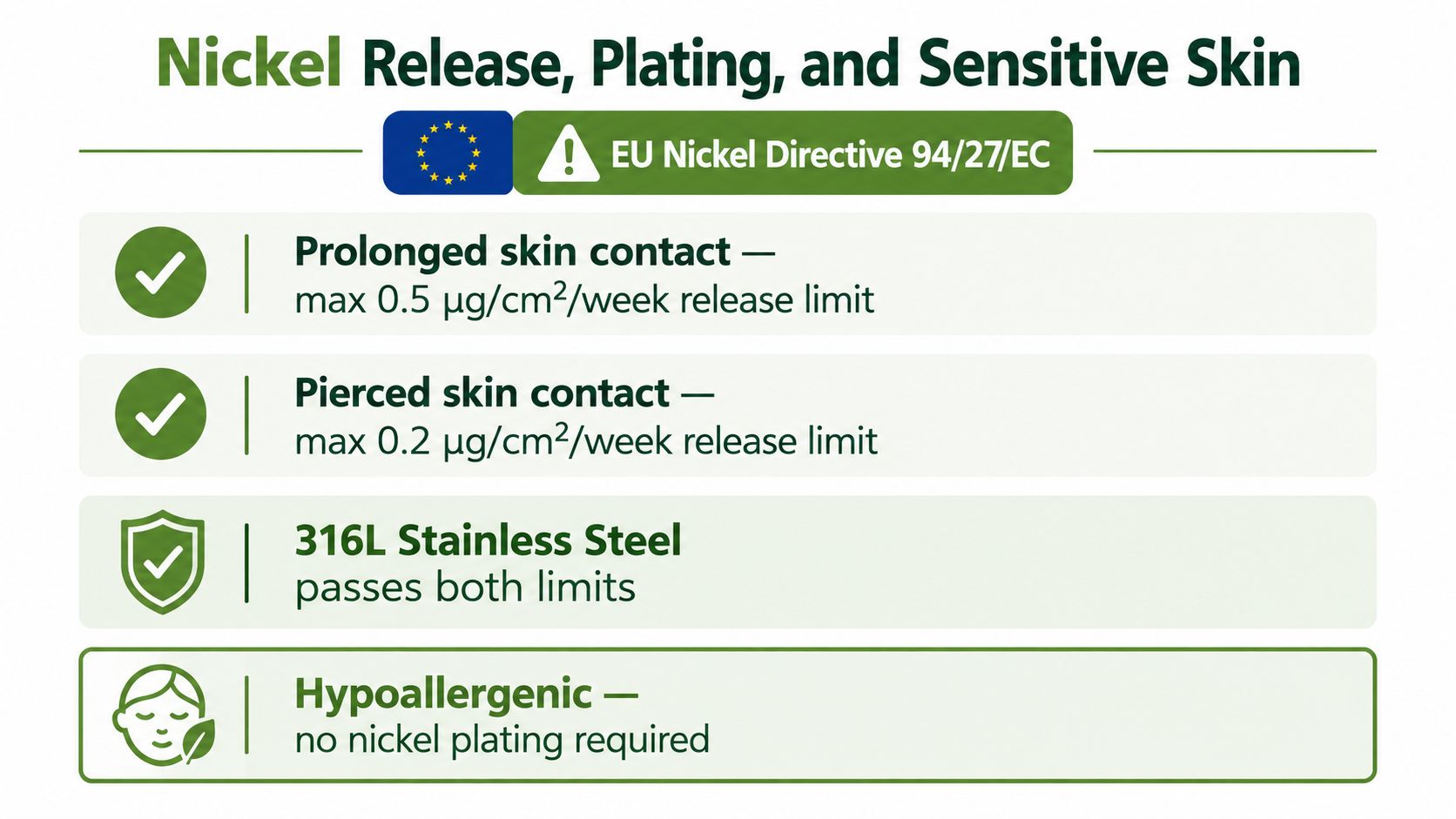
Compliance evidence should identify the finished ring, the tested contact surfaces, the coating condition, the method, and the market. An alloy certificate and a nickel-release report answer different questions, so retain both when each is relevant.
What plating changes
A plated ring adds another variable. Gold plating, rose-gold plating, black coatings, and other decorative finishes can wear at edges, on the underside of the shank, or wherever the ring rubs against skin and other objects. Once the surface system is damaged, the wearer's contact is no longer limited to the original decorative layer.
PVD may be appropriate for a specified project, but the process name does not define layer materials, thickness, adhesion, or wear life. Record the coating specification and inspect the actual finished ring, especially the inner shank, edges, and raised surfaces. If salt-spray testing is requested, ISO 9227:2022 defines test procedures but does not set one universal exposure period or convert a result into years of wear.
Request before ordering: the alloy certificate, a finished-item nickel-release report aligned with the destination market, and a clear description of every coating and skin-contact component.
The jewelry materials and plating guide can support your supplier questionnaire. Ask whether the report covers the actual ring, including plating, welds, engraved sections, and components. A raw-material datasheet proves what the steel is supposed to be. It doesn't prove what the finished ring releases.
Ring Sizing, Fit, and Product-Page Information
Ring sizing needs a controlled reference because nominal US, UK, EU, and local sizes are not interchangeable labels. ISO 8653:2016 specifies ring-size measurement and designation using a defined ring stick. For each SKU, record the named size system and the measured inner dimension from the approved sample.
| Record | What to approve | Retail use |
|---|---|---|
| Size designation | Named system and stated size for each variation | Prevents a bare number from being mistaken for another market's system |
| Inner dimension | Measured inner circumference or diameter, plus the agreed tolerance and tool | Supports size charts, incoming inspection, and reorders |
| Band profile | Width, thickness, inner edge, comfort fit, and any taper | Explains why two rings with the same nominal size can feel different |
| Adjustability | Approved opening range and deformation check, only for designs intended to flex | Avoids telling customers to bend a fixed band |
| Product-page wording | Material, finish, size system, care, and relevant claim evidence | Gives customer-service teams one consistent answer |
Do not promise easy resizing. Stainless steel can be harder for a local jeweler to resize than gold or silver, and plated or stone-set construction adds more constraints. Treat size availability and exchange policy as part of the assortment plan.
Ring Styles That Sell in Wholesale Assortments
Your assortment needs a core, a rotation layer, and a small amount of controlled experimentation. I'd classify styles before ordering rather than letting the supplier's catalog determine the mix.
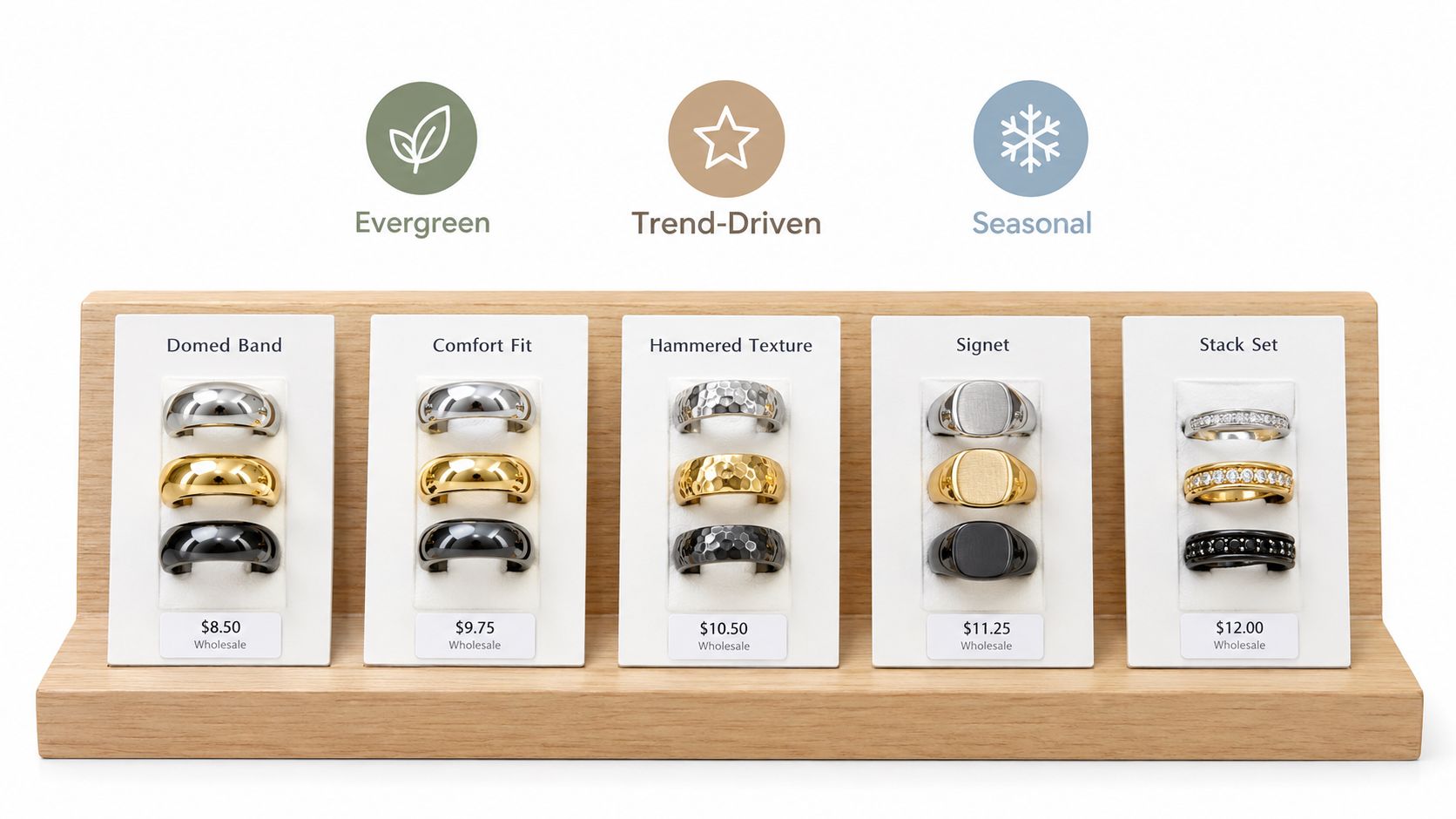
Evergreen styles
Plain domed bands are dependable candidates for everyday wear, wedding-adjacent styling, minimal wardrobes, and customers who want an uncomplicated ring. Their commercial strength is clarity. The customer understands the product immediately.
Flat-edge comfort-fit bands suit customers who care about clean geometry and wearability. Check the inner profile carefully. A ring can look simple in a product photograph and still feel uncomfortable if the inner edge is sharp or the sizing runs inconsistently.
Minimalist stackables work well as add-on products. Offer varied widths, textures, or finishes only when the differences are visible enough to justify separate SKUs. A stackable range should feel coordinated, not randomly assorted.
Rotating styles
Hammered and brushed textures add visual interest without relying on a complex silhouette. They can sit between basic and trend-led, but sample them under direct light because uneven texture can make a ring look poorly finished.
Signet rings can serve both men's and women's assortments. Classic faces have longer selling potential than highly specific motifs. Inspect the face-to-shank transition for sharp edges and inconsistent polishing.
Men's machined bands appeal to customers seeking a technical, understated look. Their success depends heavily on proportion, comfort, and weight perception, so a physical sample matters more than a product title.
Fashion and seasonal pieces
Cubic zirconia solitaires, oversized forms, and novelty silhouettes can bring attention to a display, but they should be bought as controlled tests rather than treated as permanent core stock. Seasonal colors and motif-led designs deserve the same discipline.
I won't prescribe a universal ratio because your customer base, channel, and sell-through history determine the right mix. The practical approach is to keep the majority of purchasing power in proven evergreen forms, reserve a smaller share for rotating designs, and use seasonal pieces to test demand without making them the foundation of the assortment.
Set retail prices from landed cost, packaging, platform fees, returns, and desired margin. Don't copy a competitor's price without understanding whether its ring has a different alloy, finish, stone setting, or customer promise.
Care, Quality Control, and Inventory Planning
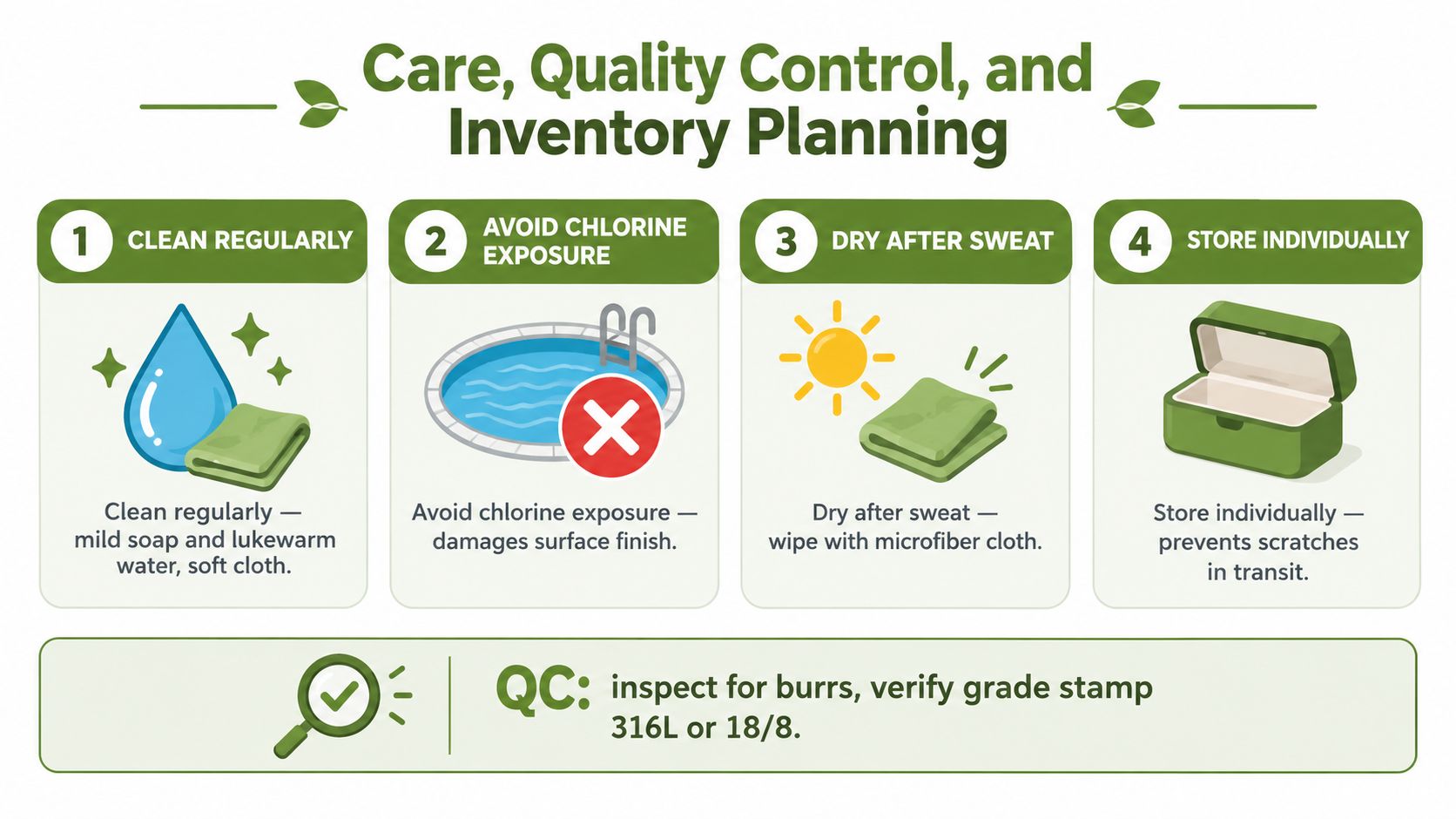
Your care card should match the ring's actual construction. For a plain stainless steel ring, recommend mild soap, lukewarm water, rinsing, and drying with a soft cloth. That removes sweat, soap residue, and cosmetic buildup without asking the customer to use aggressive cleaners.
Tell customers to avoid chlorine-rich chemicals and to wipe the ring after heavy perspiration. Chloride exposure, stagnant deposits, and abrasion can disrupt the passive surface locally, while harsh products can damage gold-tone, rose-gold, black, or other decorative finishes. Plated pieces need gentler handling than uncoated steel.
Incoming sample checks
Use the same checklist for samples and bulk shipments:
- Confirm the grade: Check the supplier paperwork and any 316L marking. A stamp helps, but it isn't a substitute for documentation.
- Inspect the inner and outer edges: Run a clean fingertip around the ring. Burrs, sharp transitions, and rough engraving will create comfort complaints.
- Compare dimensions: Measure the approved inner dimension with the named tool and size system, then record band width, thickness, and weight. Do not approve a size from a tag alone.
- Assess the finish: Look for uneven polish, pinholes, scratches, color variation, and exposed base metal around edges.
- Test moving parts: If the design has an adjustable opening, hinge, or connected element, operate it repeatedly and check for looseness.
- Check the coating carefully: For gold-tone or rose-gold rings, request the coating specification and inspect high-friction areas. Don't perform an abrasive test on a saleable sample unless the supplier has agreed to the method.
- Review the packaging: Make sure individual pieces won't rub against one another during storage and transport.
A sample can pass visual inspection and still lack finished-product compliance evidence. Keep the supplier's certificates and reports with the purchase order so your product listings, customer-service team, and marketplace records use the same information.
Planning the assortment
Track each SKU by sell-through, returns, customer questions, and finish complaints. Reorder evergreen designs before they become unavailable, but don't let a fashion style keep receiving budget just because it received attention at launch.
Use small initial commitments for unfamiliar shapes and finishes. Reorder designs that prove their place in your channel, then phase out weak styles rather than discounting them indefinitely. If you sell through Shopify, marketplaces, and a physical store, review each channel separately. The same ring can perform differently because customers see different photography, pricing, and styling context.
Sourcing Stainless Steel Rings and Next Steps
Before you compare supplier prices, write a one-page specification for each ring family. Include the base grade, size range, band profile, stone setting if applicable, finish, color, packaging, documentation, and intended customer use.
Then compare suppliers against the same criteria:
- Documentation: Can the supplier identify 316L, provide lot-linked material information, and supply finished-item nickel-release evidence where required?
- Construction: Are the edges smooth, the dimensions consistent, and the ring comfortable on the finger?
- Finish: Does the polish, brushing, plating, or PVD-style coating match the approved sample?
- Weight and feel: Does the physical ring match the product specification and your intended retail position?
- Packaging: Will the finish remain protected from abrasion during storage and delivery?
- Reordering: Can the supplier support your normal reorder cycle without forcing you into an assortment that no longer fits demand?
Don't compare a plain 316L band with a plated brass fashion ring as if they're identical products. Compare the complete offer, including material evidence, finish behavior, packaging, customer promise, and expected return risk.
Custom development is relevant when your assortment needs a specific profile, engraving, stone setting, or brand presentation. Review custom stainless steel jewelry manufacturing options only after you've defined the product and validated the commercial reason for customization.
Approve a sample set that covers the planned size range and at least one high-risk finish or construction. Record the size system, measured inner dimensions, band profile, material evidence, color reference, packaging, and acceptance criteria. Use the same record for incoming inspection and the next reorder.
Visit HonHo Wholesale Jewelry to compare current ring options. For a useful sample or custom discussion, send the design or SKU, target size system and range, band profile, material, finish, quantity, destination market, packaging, and test requirements.


