

For a bulk headband order, approve the construction, fit, fiber content, color performance, labeling, packaging, and reorder reference—not just the style. Start by separating elastic fabric bands, rigid or wrapped horseshoe bands, padded fashion bands, and athletic sweatbands because each construction needs different measurements and failure checks.
This guide is for fashion brands and jewelry boutiques evaluating headbands as an adjacent accessory category. HonHo specializes in wholesale jewelry; it does not present the headbands discussed here as HonHo-made products or HonHo stock. Use the jewelry links as examples of collection planning, sample approval, private-label presentation, and ordering discipline, then confirm headband-specific capabilities with the supplier named in your quotation.
Headband Buying Decisions at a Glance
| Decision | Record before approval | Common failure to check |
|---|---|---|
| Construction | Elastic loop, rigid core, wrapped/padded band, or sweatband | Wrong test applied to a different construction |
| Fit | Relaxed dimensions, usable stretch, recovery, width, and pressure points | Slipping, pinching, hair pulling, or permanent elongation |
| Material and color | Fiber percentages, color reference, surface finish, and test method | Shrinkage, dye transfer, pilling, fraying, or finish damage |
| Decoration | Attachment method, placement, sharp-edge check, and approved sample | Loose stones, exposed wire, glue marks, or asymmetry |
| Packaging | Packed shape, dimensions, labels, barcode, and carton plan | Crushing, deformation, dust, or relabeling labor |
| Reorder control | Supplier, color lot, sample reference, SKU, lead-time basis, and tolerance | A repeat order that no longer matches the approved item |
Table of Contents
- Why Headbands in Bulk Make Sense for Fashion Retailers
- Material Choices That Matter for Wholesale Buyers
- Sizing, Fit, and Quality Standards for Bulk Orders
- Customization and Branding Opportunities
- Packaging, Display, and Retail Presentation
- Ordering Logistics and Inventory Management
Why Headbands in Bulk Make Sense for Fashion Retailers
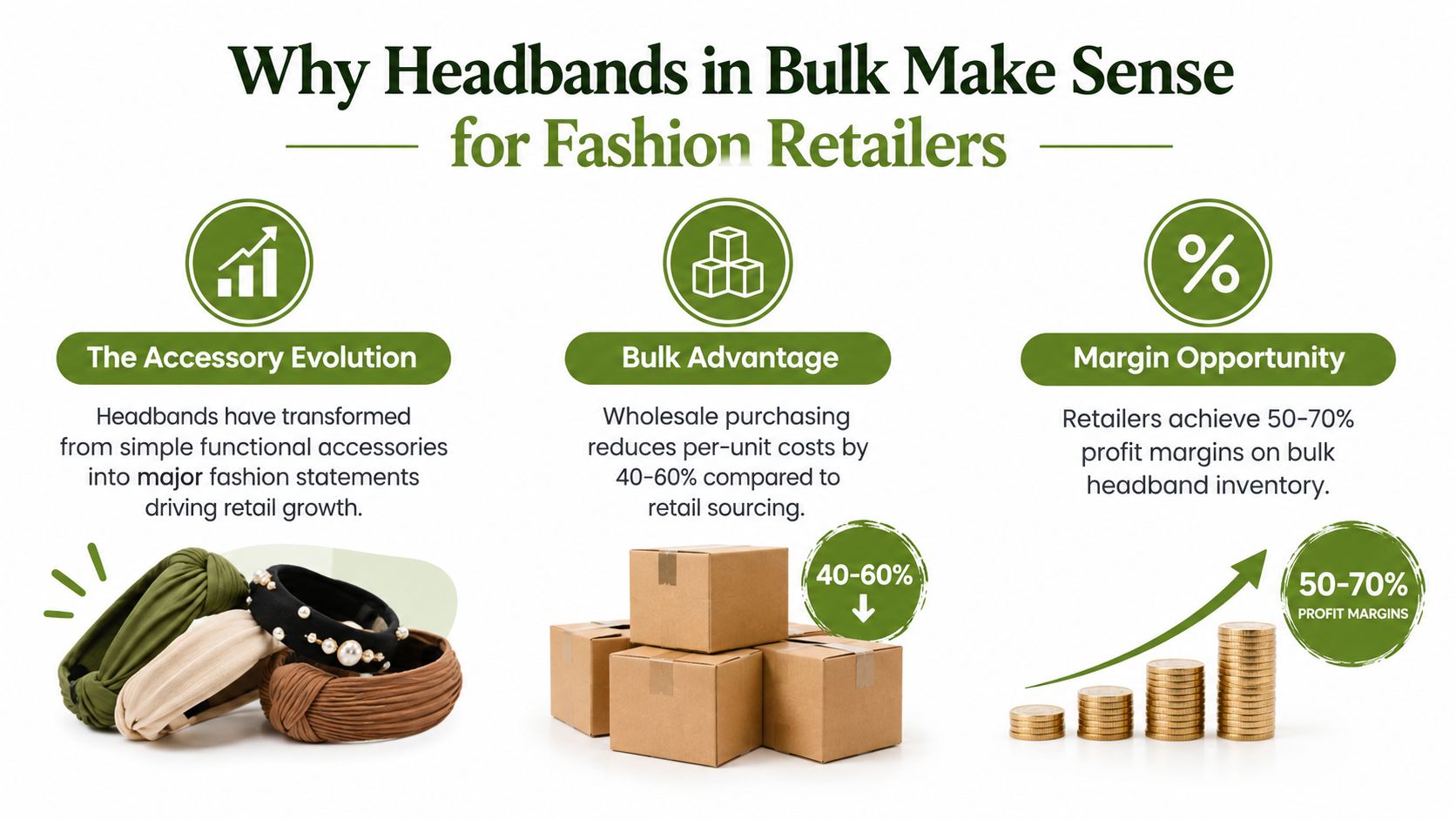
A retailer may already have a jewelry assortment built around stainless steel, brass, or 925 sterling silver. Adding headbands gives the store another way to sell color, texture, and occasion-based styling without asking customers to commit to a more expensive fashion purchase. A padded satin band can sit beside formal jewelry, while a practical fabric or athletic style can support everyday and wellness collections.
A commercial forecast from Dataintelo's headband market analysis estimates a growing global category and assigns a substantial share to fabric and fashion-oriented headbands. These are publisher estimates, not audited sales for a particular market and not proof that a style will sell through in one boutique. Use them only as a prompt to test a narrowly defined assortment against the store's own sales, returns, and customer feedback.
The accessory evolution
The more useful merchandising conclusion does not depend on a forecast: headbands serve different jobs. A fashion band, spa wrap, padded occasion piece, and athletic sweatband should not share one generic specification, care claim, or fit promise.
For a jewelry boutique, the most useful assortment usually combines evergreen shapes with selective trend pieces:
- Everyday fabric styles can support neutral, casual, and repeat-purchase merchandising.
- Embellished or sculptural styles can complement occasion jewelry and gift displays.
- Athletic constructions can reach customers interested in wellness and active use.
- Seasonal colors and motifs can refresh a display without changing the entire store identity.
The wholesale advantage isn't just a lower purchase price. It comes from being able to test several constructions, color families, and use cases while keeping the assortment operationally manageable. Headbands also occupy less display space than many apparel categories, and fit problems are easier to identify before ordering when the supplier provides proper measurements.
Practical rule: Treat a headband assortment as a small collection with a defined customer and retail context, not as a miscellaneous box of accessories.
A second publisher estimate, Dataintelo's hair-accessories market report, describes growth across the wider hair-accessories category. It can help frame a category review, but it cannot establish demand, margin, or reorder timing for a specific store. Base the first buy on a controlled SKU test and define the evidence that will trigger a reorder.
Material Choices That Matter for Wholesale Buyers
Separate Construction Before Comparing Materials
An elastic fabric loop is measured through stretch, recovery, seam, and laundering behavior. A rigid horseshoe band needs checks on core symmetry, tip finish, flex, covering adhesion, and concentrated pressure. Padded or knotted fashion bands add shape retention and decoration attachment, while athletic sweatbands require an agreed moisture-management and wash protocol. A supplier quote that says only “polyester headband” leaves the construction—and therefore the approval method—undefined.
Fiber names are only the starting point. A buyer choosing cotton, polyester, nylon, or an elastane blend still needs to know how the finished knit behaves against sweat, cosmetics, repeated washing, stretching, and friction. Two products with similar labels can feel and perform differently because of knit structure, yarn size, finishing chemistry, and the amount of elastic content.
Match the material to the use case
Cotton and cotton blends are often suitable for casual, spa, beauty, and sensitive-skin positioning because they can feel familiar and soft. They may require more attention to shrinkage, drying time, and color transfer, particularly in darker shades. A cotton-rich band can work well for a wellness display, but a buyer shouldn't assume that softness guarantees dimensional stability after washing.
Polyester-rich constructions generally support faster moisture transport and drying than untreated cotton, but the result depends on the knit structure, yarn size, finish, and elastane content. That makes polyester and stretch blends candidates for athletic or active-use assortments, not automatic proof of sweat-wicking performance. Ask for controlled moisture-management or drying data, then confirm the result with a sample wash-and-wear test.
Nylon and elastane blends can offer useful stretch and a close fit, especially in performance-oriented designs. Their success depends on recovery rather than stretch alone. A band that extends easily but fails to return to its intended size may slide during use or become uncomfortable after repeated wear.
Decorative and structured materials require a different inspection approach. Satin needs attention to fraying and seam quality. Knits call for checks on pilling and loose yarns. Faux-leather textures need bending and surface inspection. Embellished styles require secure attachment of pearls, stones, beads, or metal details.
Specify testing, not vague quality
For bulk procurement, ask the supplier to state the fiber composition, fabric or component weight, stretch direction, recovery requirement, and exact test method. The ASTM textile standards collection is a starting point, not a pass certificate. For example, ASTM D4964 covers tension and elongation of elastic fabrics, while the AATCC standards index identifies methods for perspiration, laundering, crocking, and appearance after home laundering. Specify the current method designation, specimen construction, colorway, conditioning, acceptance grade, and report identity. A method cited on a quotation does not show that the finished headband or production lot was tested.
A practical supplier request should include:
- Colorfastness: Ask for the relevant test method and acceptable shade-change or staining grade.
- Moisture behavior: Request absorbency or drying data for active-use products.
- Care performance: Confirm dimensional change after laundering and drying.
- Colorway control: Retain reports by color, since pigment load and finishing chemistry can vary between shades.
- Claim support: Request documentation before using terms such as organic, recycled, PFAS-free, or sustainable in product copy.
If the target market is the United States, confirm the product's regulatory classification and labeling before approving packaging. The FTC's apparel and labeling guidance explains that most covered textile products need fiber content, country of origin, and responsible-company identification; care instructions may also apply. Other markets have different requirements, and decorations, children's positioning, or protective claims can change the review.
Organic-cotton and sustainability-focused variants may support premium positioning, but material messaging needs evidence. A recycled-polyester athletic band may be a better performance choice than organic cotton for sweat management, while verified cotton or correctly labeled bamboo-derived rayon may be more appropriate for spa, sleep, or comfort-focused merchandising. Buyers should describe the product by its verified use-case performance, not by an environmental label alone.
For related material considerations across your accessory assortment, review HonHo's jewelry materials guide.
Sizing, Fit, and Quality Standards for Bulk Orders
A “one size fits most” label doesn't remove the need for measurement. Headband fit is a tension-and-pressure problem. More elastic tension can improve retention, but it can also increase discomfort, trigger readjustment, and create returns when the band is too narrow or recovery is poor.
Build a fit specification
Request these measurements for every size or construction:
- Relaxed circumference, measured without pulling the band.
- Maximum usable stretch, not just the point at which the material can be stretched further.
- Elastic recovery after repeated extension, recorded against the approved sample.
- Band width, including whether the width changes along the product.
- Seam and edge construction, including labels, exposed stitching, adhesive, and decorative hardware.
- Dimensional change after laundering, especially for cotton and cotton blends.
Wider bands distribute force over a larger contact area. Tapered or cushioned edges can reduce localized pressure, but a wide band can still feel tight if the circumference is too small or the elastic has excessive recovery force. A supplier's measurement sheet should therefore describe both dimensions and construction, not merely state “comfortable” or “non-slip.”
Use HonHo's jewelry size guide as a reminder of the same principle that applies across wearable accessories: clear measurements support better customer expectations than broad labels alone.
Test movement before approving the order
Sample testing should involve representative head circumferences and normal movement. Have testers walk, bend, turn their heads, and perform light exercise where the product is intended for active use. Record whether the band migrates, pinches, pulls hair, leaves pressure points, or requires repeated adjustment.
A headband that feels fine while standing still may fail during movement. Test the use case your customer will actually perform.
Check the product again after a defined number of extensions, then let it relax for the supplier-agreed interval before measuring recovery with the same fixture and reference points. A 24-hour interval is useful only when it is written into the buyer's comparison protocol and applied to the approved sample and production checks alike. This in-house screen is not a substitute for a suitable laboratory method. Record the sequence, force or extension, recovery interval, tolerance, and sample identity before the bulk order.
| Observed symptom | Inspect next | Record for approval |
|---|---|---|
| Band slips backward | Inner surface, width, circumference, hair type, and movement | Which tester and movement caused migration |
| Pressure at temples or behind ears | Rigid-core spread, end tips, padding, seam, and local width | Wear interval and exact pressure location |
| Hair catches or pulls | Seam ends, teeth, decoration backs, glue, burrs, and exposed wire | Defect photo and approved edge/finish reference |
| Band stays stretched | Extension cycle, recovery interval, elastic construction, and laundering | Before/after dimension and agreed tolerance |
Fit-related problems often come from the interaction of several details. A slippery lining can cause migration even when circumference is correct. A stiff label can create irritation. A narrow edge can concentrate pressure. A cotton blend can shrink enough after laundering to turn an acceptable fit into a marginal one. Good procurement catches those issues before they reach customer service.
Customization and Branding Opportunities
Customization works best after the product has passed fit, wash, and performance checks. For a first assortment, standard stock lets a retailer test colors, fabrics, and silhouettes with less inventory risk. Private-label development becomes more practical once sales data identifies the customer and use case worth supporting.
Compare the branding routes
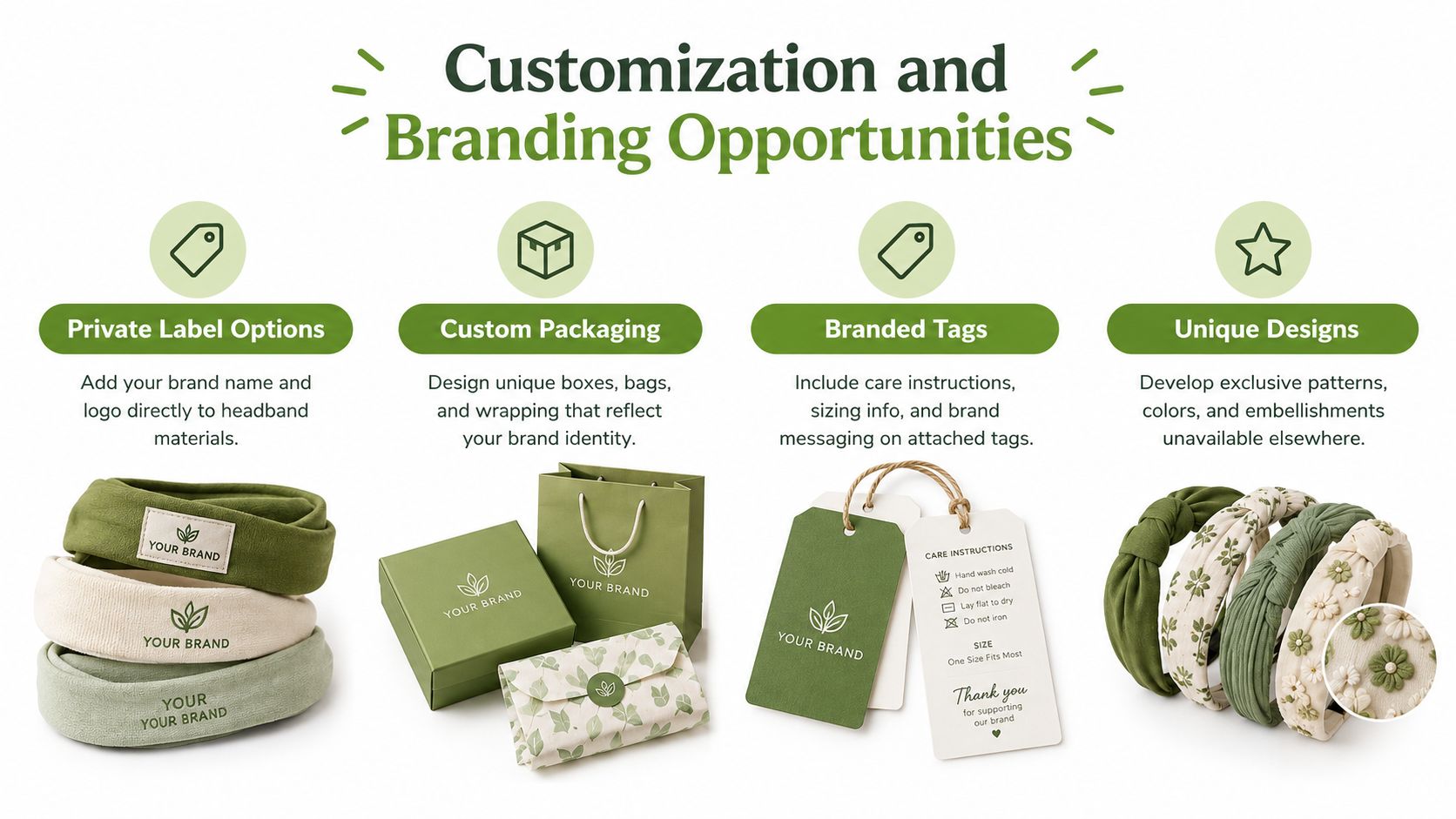
Standard wholesale stock offers the quickest route for seasonal buying, new-store assortments, or retailers adding headbands beside an existing jewelry collection. It avoids exclusive-development commitments while giving buyers a reference for demand and quality.
Private-label packaging changes the customer-facing presentation without redesigning the headband. Branded cards, hang tags, care information, and protective bags can give a common shape a clearer identity. The printed information must match the actual material, care method, and product claims.
Product-level branding includes woven labels, printed elastic, attached hardware, and custom color specifications. These features can support repeat recognition, but each one adds an approval point. Confirm logo position, color matching, attachment strength, and resistance to handling before production.
Exclusive design development provides the most differentiation. A retailer may specify a knot, band width, pattern, embellishment, or coordinated color palette. The trade-off is a longer approval cycle and a higher risk of holding stock if the design misses the customer base.
Use minimums as a planning variable
Unit cost alone gives an incomplete view of a custom order. Ask how minimum quantities apply to each color, size, print, packaging format, and decoration. A supplier may accept a larger total order while setting separate commitments for individual variants. Confirm whether packaging minimums are independent of product minimums, and ask how unused printed materials are handled.
Telectronic Hub's wholesale headband discussion repeats category-growth and sustainability-premium figures. Treat them as an unverified commercial lead, not as a pricing benchmark or sell-through forecast. A premium test is justified only when the material claim is documented, the quotation scope is equivalent, and the store has a plan to compare conversion, returns, and reorder demand against a conventional option.
Request a physical product sample with the final packaging before approving branded production. Check whether the tag obscures the headband, whether the item keeps its shape during transit, and whether care information remains legible after handling. For a wider private-label accessory program, HonHo's private-label jewelry service illustrates how a jewelry branding workflow can separate product approval from packaging approval. It is not evidence that HonHo manufactures headbands; confirm headband branding with the supplier responsible for that product.
Packaging, Display, and Retail Presentation
Packaging affects more than appearance. It protects the product during transport, determines how much stock fits in the back room, and influences whether a customer can understand the material, size, and use case at a glance. A headband that arrives flattened, creased, dusty, or tangled may need labor before it can reach the sales floor.
Choose packaging around the channel
Fold-flat packaging uses less storage space and can work well for soft fabric bands, especially when the product doesn't depend on a sculpted shape. Pre-formed packaging protects padded, embellished, or structured products better, but it uses more volume in cartons and storage. Ask the supplier to provide packed dimensions and gross carton details before finalizing the order.
Display format should match the product:
- Hang tags or cards work for lightweight fabric styles and make price, material, and care information easy to read.
- Small display racks help shoppers compare colors and silhouettes without opening individual packages.
- Bundles can connect a headband with coordinating jewelry, a gift item, or a seasonal theme.
- Protective sleeves or boxes suit formal and embellished products where surface damage would reduce perceived value.
A boutique owner should calculate packaging materials and handling labor as part of landed cost. A lower product price may not remain attractive if every unit needs manual folding, repacking, relabeling, or replacement after transit. The right comparison is the cost of a retail-ready unit, not the cost of an unpacked unit at the factory.
Keep the display easy to shop
Group by use case or style family rather than mixing every construction together. A customer shopping for spa accessories should be able to distinguish a soft terry or fleece product from a fashion band with decorative hardware. Neutral basics can anchor the display, while brighter or embellished pieces create visual interest near related jewelry.
Packaging should also protect product claims. If a band is washable, include accurate care instructions. If the material composition varies by color or style, label it accurately rather than applying one generic description across the collection. HonHo's custom packaging options show jewelry packaging considerations that may help structure a brief. They do not establish headband packaging availability from HonHo; the headband supplier must confirm the actual card, sleeve, box, barcode, and carton specification. Packaging should follow the approved product details, not replace them.
Ordering Logistics and Inventory Management
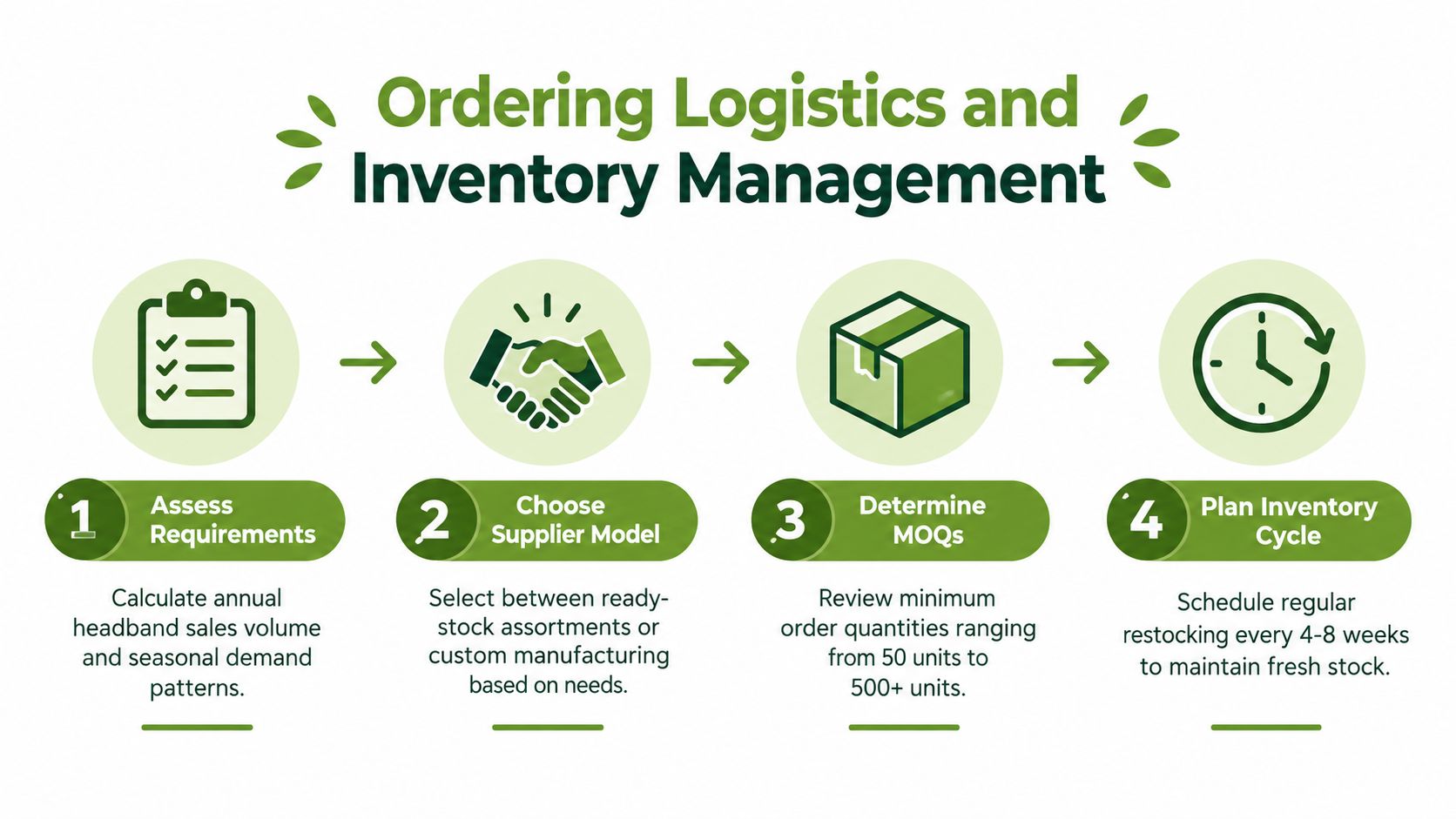
The best sourcing decision can still fail if the order structure doesn't match the store's cash flow and replenishment cycle. Before requesting a quotation, separate the assortment into ready-stock products, trial styles, seasonal items, and custom developments. Each group deserves a different buying decision.
Choose the right supplier model
Ready-stock assortments are useful when the retailer wants to test demand, refresh a display quickly, or mix several colors and constructions. Confirm the actual available quantity, packed condition, material information, and dispatch process before treating stock as ready for sale.
Custom production makes more sense when the brand already understands its customer, needs an exclusive color or pattern, or wants branded packaging that cannot be sourced from standard inventory. The purchase agreement should define the approved sample, dimensions, composition, color references, logo placement, packaging, inspection process, and documentation.
Don't assume that a supplier's standard minimum applies to every customization. Ask separately about product quantities, color minimums, printed packaging, labels, and special components. The quoted MOQ may be manageable for the total order but difficult for every individual variant.
Build the order around evidence
A practical sequence is:
- Define the assortment: Separate evergreen, seasonal, active, beauty, and occasion uses.
- Approve samples: Test fit, recovery, colorfastness, seams, embellishments, packaging, and care instructions.
- Confirm the commercial terms: Record MOQ, unit price, packaging cost, payment terms, inspection responsibilities, and delivery arrangement.
- Set replenishment rules: Track sales by SKU and color rather than treating all headbands as one inventory pool.
- Review after launch: Remove weak variants, reorder proven ones, and adjust the next order based on customer feedback and return reasons.
For a Shopify seller, the standard reorder-point formula is reorder point = average daily sales × supplier lead time + safety stock, as explained in Shopify's reorder-point guide. If a store sells 8 headbands per day, the supplier lead time is 14 days, and planned safety stock is 20 units, the reorder point is 132 units, calculated as (8 × 14) + 20 = 132. The buyer places the next order when available inventory reaches that threshold.
Safety stock can be calculated separately using safety stock = maximum daily usage × maximum lead time − average daily usage × average lead time. For a SKU with maximum usage of 15 units per day, average usage of 9 units per day, a worst-case lead time of 18 days, and an average lead time of 12 days, the calculated buffer is 162 units, or (15 × 18) − (9 × 12) = 162, according to Shopify's safety-stock guidance. Apply the method by SKU where demand and lead times differ, rather than using one blanket buffer for black, neutral, seasonal, and embellished products.
Inventory discipline: Low unit cost can encourage overbuying. A reorder point protects availability, but it doesn't justify ordering every color in the same volume.
Use your wholesale ordering guide to organize supplier questions before sending a purchase order. The final checklist should cover the approved sample, material and test documentation, fit measurements, packaging dimensions, labels, shipment terms, inspection timing, and the process for handling discrepancies.
Headband RFQ and Sample Approval Checklist
Send the headband supplier a single brief covering: construction type; intended customer and use; relaxed dimensions; usable stretch or rigid-core spread; width and padding; fiber percentages and component materials; color reference; decoration and attachment; labeling market; care claim; test method and acceptance criteria; sample quantity; order quantity by color; packaging; barcode; carton limits; destination; inspection point; and repeat-order reference. Require the quotation to separate product, customization, packaging, testing, tooling, and freight so competing offers remain comparable.
Do not release bulk production until the approved sample and approval record identify what may change and what must remain fixed. For repeat orders, compare the new sample or pre-shipment result with that named reference rather than relying on “same quality.”
HonHo Wholesale Jewelry supplies jewelry assortments across earrings, rings, necklaces, bracelets, anklets, and coordinated sets in verified product-specific materials. Browse the HonHo Wholesale Jewelry catalog when the goal is to coordinate jewelry with a separately sourced headband range. For headbands themselves, use the RFQ and approval record above with a specialist supplier; do not treat this guide as a HonHo headband product offer.


