

You're comparing supplier quotes for stainless steel rings, and the lowest unit price looks attractive. Then the first customer messages arrive: the finish has changed, a band feels rough, or a wearer reports irritation. A supposedly profitable order becomes refunds, replacement shipping, poor reviews, and stock you can't confidently reorder.
That outcome usually starts before production. Stainless steel rings wholesale sourcing is a specification-and-approval decision, not just a price negotiation. Before a bulk order, confirm the alloy evidence, finished surface, nickel-release requirement for the destination market, ring-size method and tolerance, approved sample, and reorder record. A product photo cannot prove any of those points.
| Decision | Require before bulk approval | Why it matters |
|---|---|---|
| Base material | Grade statement tied to the SKU or production lot, plus the relevant material record | “Stainless steel” alone does not identify 304, 316L, or another grade |
| Finished-item compliance | Test report for the finished ring and destination market, with sample identity and method | A raw-material certificate does not establish nickel release from the finished product |
| Ring size | Named size system, measurement tool, recorded inner dimension, and agreed tolerance | Nominal US, UK, EU, or local sizes are not enough for repeat orders |
| Finish | Process description, color reference, approved sample, and defined test scope | “Gold PVD” or “plated” is a process label, not a wear-life guarantee |
| Reorder control | Approved sample ID, lot or order reference, packaging label, and defect terms | The next batch must be compared with a known reference rather than memory |
Table of Contents
- The Reality of Sourcing Stainless Steel Rings
- Why Rings Dominate the Wholesale Jewelry Market
- Decoding 316L Grading and Compliance Standards
- Selecting Styles and Finishes for Retail Durability
- Building a Private Label Ring Collection
- Navigating Wholesale Pricing and Inventory Risk
- Finalizing Your Wholesale Sourcing Strategy
The Reality of Sourcing Stainless Steel Rings
A boutique owner may order a mixed carton of minimalist bands, signet rings, and gold-tone styles because the assortment photographs well and the quote fits the budget. Weeks later, the returns reveal a pattern. Some rings show uneven color, others have sharp inner edges, and several listings never clearly stated whether the product was solid stainless steel or merely given a stainless finish.
That's the practical risk with this category. “Stainless steel” describes a broad material family, not a complete quality specification. A responsible buyer needs to know the confirmed grade, the finish method, how the surface was prepared, and what compliance records support skin-contact claims. “Hypoallergenic” alone doesn't answer those questions.
Stainless steel remains useful for resale because it combines a modern appearance with durability and accessible positioning. It works for everyday bands, stackable rings, statement silhouettes, and private-label collections aimed at shoppers who want lower-maintenance jewelry without the price positioning of precious metals. It also supports mixed assortments, allowing a retailer to carry silver-tone basics alongside gold plated, two-tone, enamel, zirconia, or pearl-accented designs.
What the first order should prove
Your first purchase shouldn't attempt to maximize the number of styles. It should test whether a supplier can deliver consistent product information and repeatable construction.
- Material clarity: The listing or quotation should identify the alloy rather than relying on “premium steel” or “surgical” language.
- Finish transparency: Ask whether the base is solid stainless steel and whether the visible color comes from plating, PVD, enamel, or another treatment.
- Wear suitability: Examine polished edges, inner comfort, band thickness, stone settings, and surface consistency.
- Documentation: Request material and nickel-release records where your destination market requires them.
- Reorder confidence: A supplier should be able to explain how the same style, size range, and finish will be reproduced.
For smaller businesses, a sourcing partner that supports a controlled initial order can be more useful than a factory that only discusses large production runs. HonHo's guidance on low-MOQ jewelry manufacturing is relevant here because a lower-commitment test gives a retailer room to validate quality before expanding the line.
Practical rule: Treat every supplier claim as a question to verify, especially when the claim affects skin contact, finish life, or your return policy.
Why Rings Dominate the Wholesale Jewelry Market
Rings can anchor a resale assortment because one product form supports core bands, signets, stacks, gifting, symbolic designs, and statement pieces. The original article used Grand View Research's jewelry market analysis for broad category context. Treat that report as market background, not a sales forecast for a particular store: it cannot tell you which sizes, prices, finishes, or silhouettes your customers will accept.
For a wholesale buyer, the useful advantage is operational. A focused ring range can express several customer-facing stories while sharing photography standards, packaging, care guidance, and a common size-control process. The constraint is fit: every extra size multiplies inventory, so width, inner profile, size curve, and reorder consistency deserve more attention than headline market growth.
Why stainless steel strengthens the category
The broader ring market doesn't automatically guarantee success for every steel ring. It does, however, give ring-focused assortments a large demand base. Stainless steel allows buyers to position rings for customers who prioritize durability, accessible pricing, and simple care over the material prestige associated with fine jewelry.
Published estimates for stainless steel jewelry vary because the reports define the segment and forecast period differently. The original article also cited Deep Market Insights. The disagreement is the useful lesson: third-party market projections are not a purchasing model for a ring line.
Build the order from evidence you can control. Use actual inquiries, size exchanges, returns, sell-through by finish, and repeat purchases to decide depth. Until that record exists, split the first order between a narrow evergreen core and a smaller experimental group rather than buying broadly because a report predicts category growth.
A sensible assortment architecture
Use the category's breadth deliberately:
- Evergreen anchors: Smooth bands, slim stackables, restrained signets, and simple geometric rings can support repeat merchandising.
- Identity pieces: Chunky signets, irregular shapes, symbolic motifs, and gemstone-look details help a store express its style.
- Finish variation: Silver-tone, gold-tone, black, and mixed finishes can test different customer preferences without changing the basic category.
- Size discipline: Rings are less forgiving than earrings or necklaces because fit affects conversion and returns. Size availability and measurement guidance deserve early attention.
Decoding 316L Grading and Compliance Standards
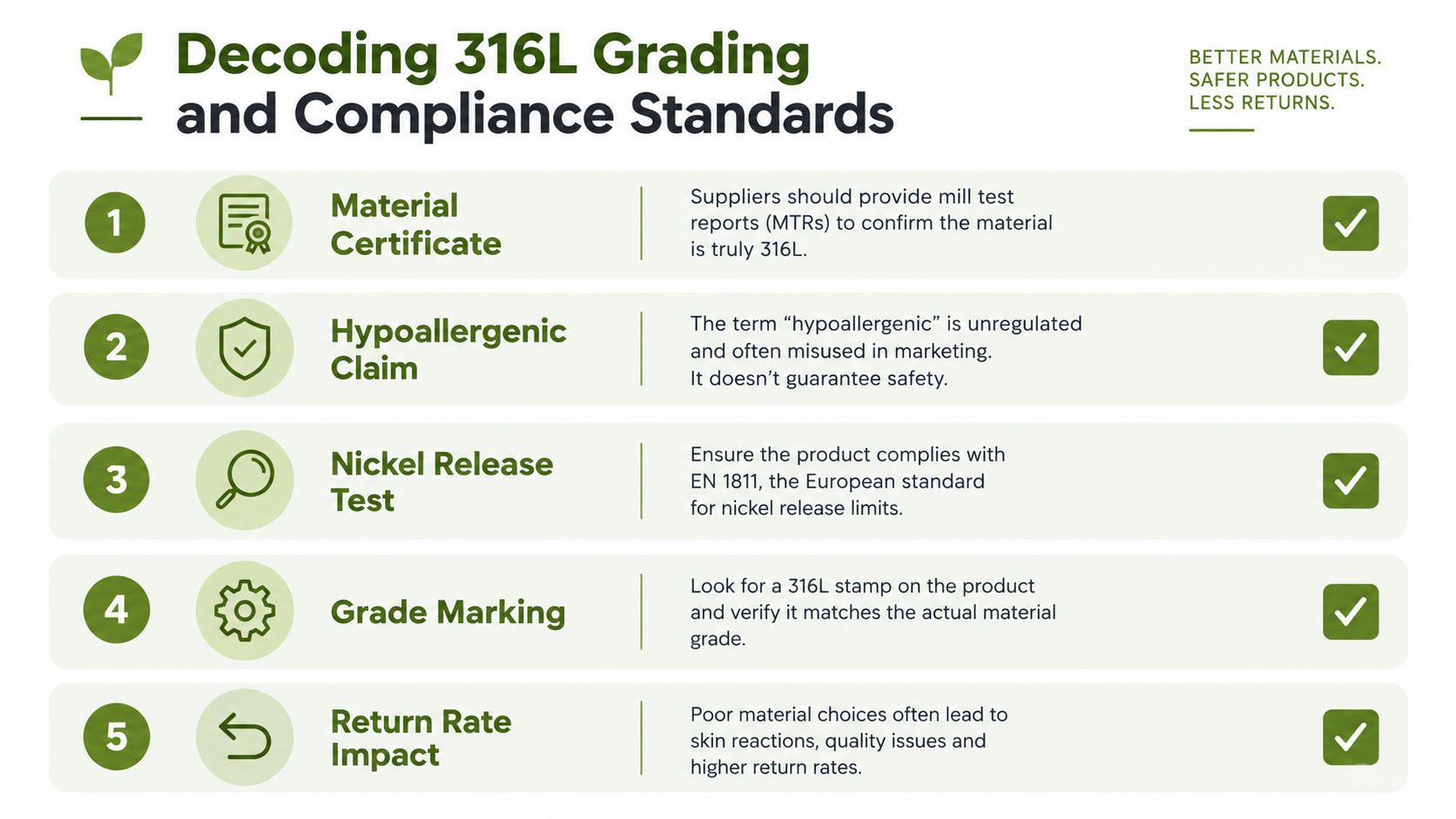
A supplier's use of the word “hypoallergenic” shouldn't replace a material specification. The term is often used loosely in jewelry listings, while a ring can contain nickel as part of its alloy and still be suitable for skin contact if its actual release stays within the applicable threshold.
316L is the low-carbon version of 316 stainless steel, and its molybdenum-bearing chemistry generally gives it better resistance to pitting and crevice corrosion than 304. It is still not immune to chloride exposure, rough finishing, trapped moisture, or surface damage. The World Stainless grade data explains those material distinctions; this technical comparison of stainless steel used in jewelry remains a secondary jewelry-oriented explanation.
Do not turn a grade name into a blanket performance claim. Ask which specification applies to the supplied product form and whether the certificate actually covers the material used for the ring. For example, ASTM A240/A240M covers stainless steel plate, sheet, and strip; it should not be cited automatically for a ring made from another product form. The finished ring, coating, joins, and polish still require their own approval checks.
Read the supplier sheet in layers
Start with the alloy, then move to the finished product.
- Grade statement: Ask whether the ring is confirmed as 316L stainless steel, not “steel,” “surgical steel,” or “stainless finish.”
- Mill or material evidence: Request a material certificate or mill test report that identifies the supplied alloy. A product photo with a 316L stamp isn't enough on its own.
- Surface treatment: Establish whether the ring is untreated, polished, plated, PVD-coated, enamelled, or made with another finish. The base alloy and visible finish are separate specifications.
- Nickel-release testing: For EU sales, check the current consolidated REACH text. Rings intended for direct and prolonged skin contact use the 0.5 µg/cm²/week release limit in Annex XVII, Entry 27; the 0.2 µg/cm²/week limit applies to post assemblies inserted into pierced parts, not ordinary finger rings. Request a report for the finished ring with the sample identity, method, result, laboratory, and date. This corrosion and compliance assessment for stainless steel jewelry is retained as a supplier-side explanation, but it does not replace the regulation or a product-specific report.
- Wear condition: Ask whether testing reflects the finished, polished or coated item, since surface treatment, passivation, and wear can affect release.
Bulk nickel content and nickel release are different measurements. A material certificate can support the alloy identification, but it cannot substitute for a finished-item release test. This wholesale guide to 316L and sensitive-skin jewelry provides category context; treat its numerical examples as supplier-published information, not as a result for HonHo stock or your production batch.
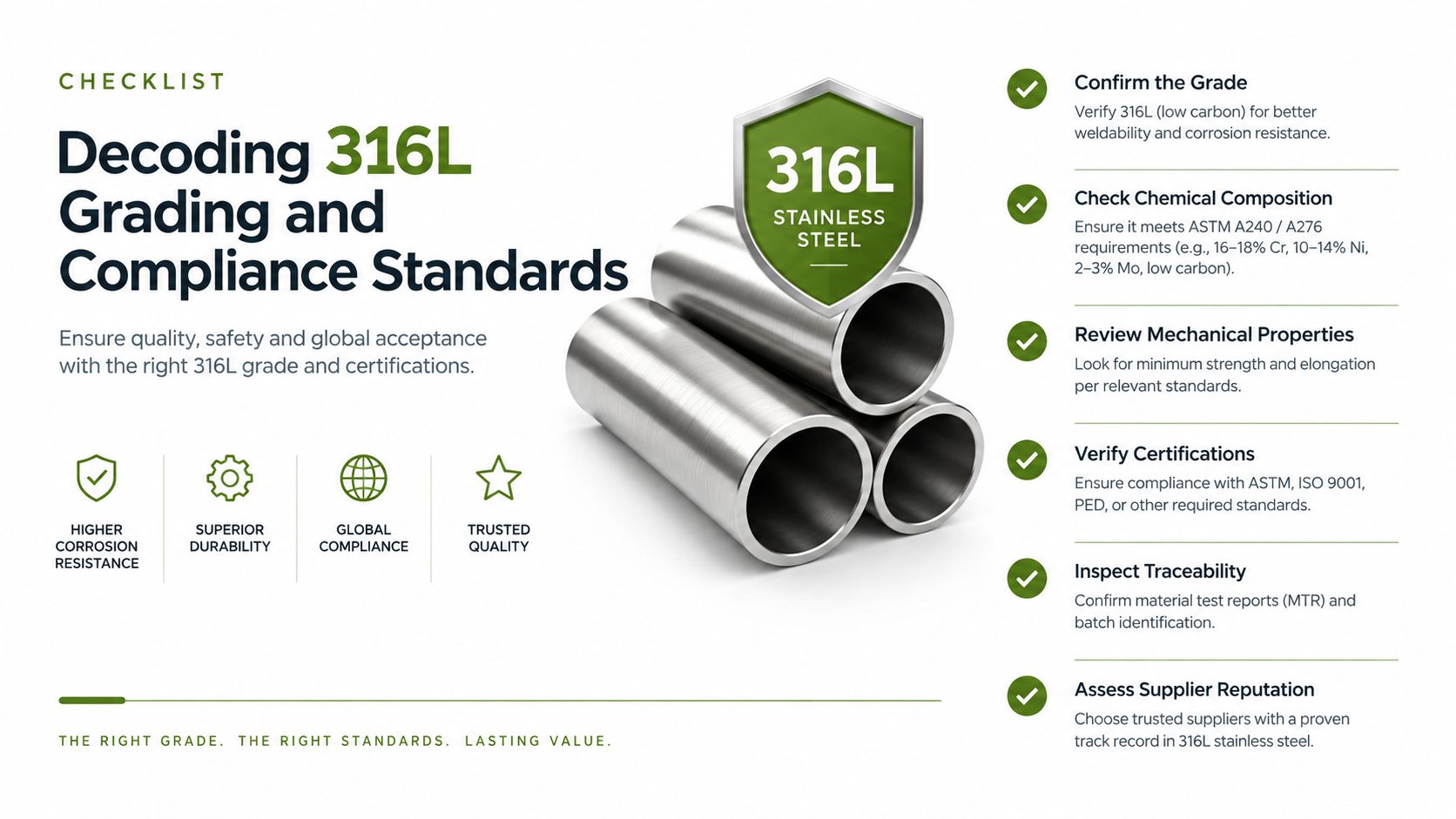
The graphic is a planning aid, not a material certificate or proof that a product passed a test. Match any specification named in a supplier file to the actual product form, SKU, production lot, and destination-market requirement.
Claims that create avoidable risk
Don't publish “nickel-free” unless the supplier has verified that claim for the actual product. Don't describe every stainless steel ring as hypoallergenic, waterproof, or suitable for every sensitive wearer. A safer product page identifies the confirmed material, states that individual sensitivities vary, and avoids promising more than the documentation supports.
HonHo's jewelry materials guide can help buyers compare material categories, but you should still request item-specific documentation for the styles and finishes you intend to sell. The best file is the one tied to the actual production batch or finished construction, not a generic alloy description copied across a catalog.
Selecting Styles and Finishes for Retail Durability
Ring design affects returns as much as material does. A slim polished band has different failure points from a deep-relief signet, and a gold-tone ring introduces finish wear that a silver-tone ring may avoid. Match the product to the customer's expected use rather than treating every style as an interchangeable unit.
Compare the main retail roles
Stackable bands are easy to merchandise in groups and suit customers building combinations over time. Their narrow profiles can make fabrication quality important, especially around welded or joined areas. Chunky signets create stronger visual impact and can support a higher perceived value, but their weight, interior shape, and sizing accuracy matter more because customers feel the ring immediately.
Open and adjustable rings reduce some size barriers, making them useful for gifting and flexible fashion assortments. They can also create a quality problem if the opening bends unevenly or the adjustment area feels sharp. Cocktail and statement rings attract trend-led shoppers, but their larger surfaces make inconsistent polish, enamel edges, loose stones, or visible coating variation easier to notice.
Gold-tone stainless steel rings require a separate evaluation. PVD describes a deposition route, not one fixed layer stack or wear life. Approve the color reference, surface preparation, treated areas, layer description, sample identity, test method, conditions, and pass/fail criteria. If salt spray is used, ISO 9227:2022 defines test procedures but does not set the product exposure period or result interpretation, and it is not a prediction of long-term service life. A claim such as “24 hours” or “48 hours” is incomplete without the specimen, method, evaluation, and acceptance rule.
| Finish type | Main approval control | Useful evidence | Main limitation |
|---|---|---|---|
| Polished silver-tone steel | Edge comfort, polish uniformity, and scratch reference | Approved sample photographed under neutral light | Handling marks and scratches change the reflection even when the base metal remains sound |
| Brushed or matte steel | Direction, texture, and consistency around edges | Surface reference plus agreed inspection lighting | Local rubbing can create visibly smoother patches |
| Traditional gold plating | Layer system, color, coverage, and adhesion | Supplier specification and finish-specific sample test | Wear depends on preparation, layer stack, exposure, and abrasion |
| PVD gold-tone finish | Color standard, treated areas, layer description, and acceptance test | Approved sample and report tied to the tested construction | “PVD” alone does not establish thickness, chemistry, or wear life |
| Enamel or resin detail | Edge fill, bubbles, cure, color, and impact-prone areas | Close-up sample photos and defect limits | Raised edges can chip or separate under impact |
A practical assortment usually combines mostly quiet, repeatable shapes with a smaller selection of bold designs. Keep the visual identity consistent across finishes and motifs, then test which silhouettes deserve deeper size coverage.
For terminology and finish questions, use HonHo's plating and finish guide as a reference point while asking your supplier for the specification of each individual ring.
Building a Private Label Ring Collection
Generic rings compete on search placement and price. A private-label capsule gives you more control over the story, packaging, photography, and repeat purchase experience, but customization only works when the underlying product is already suitable for retail wear.
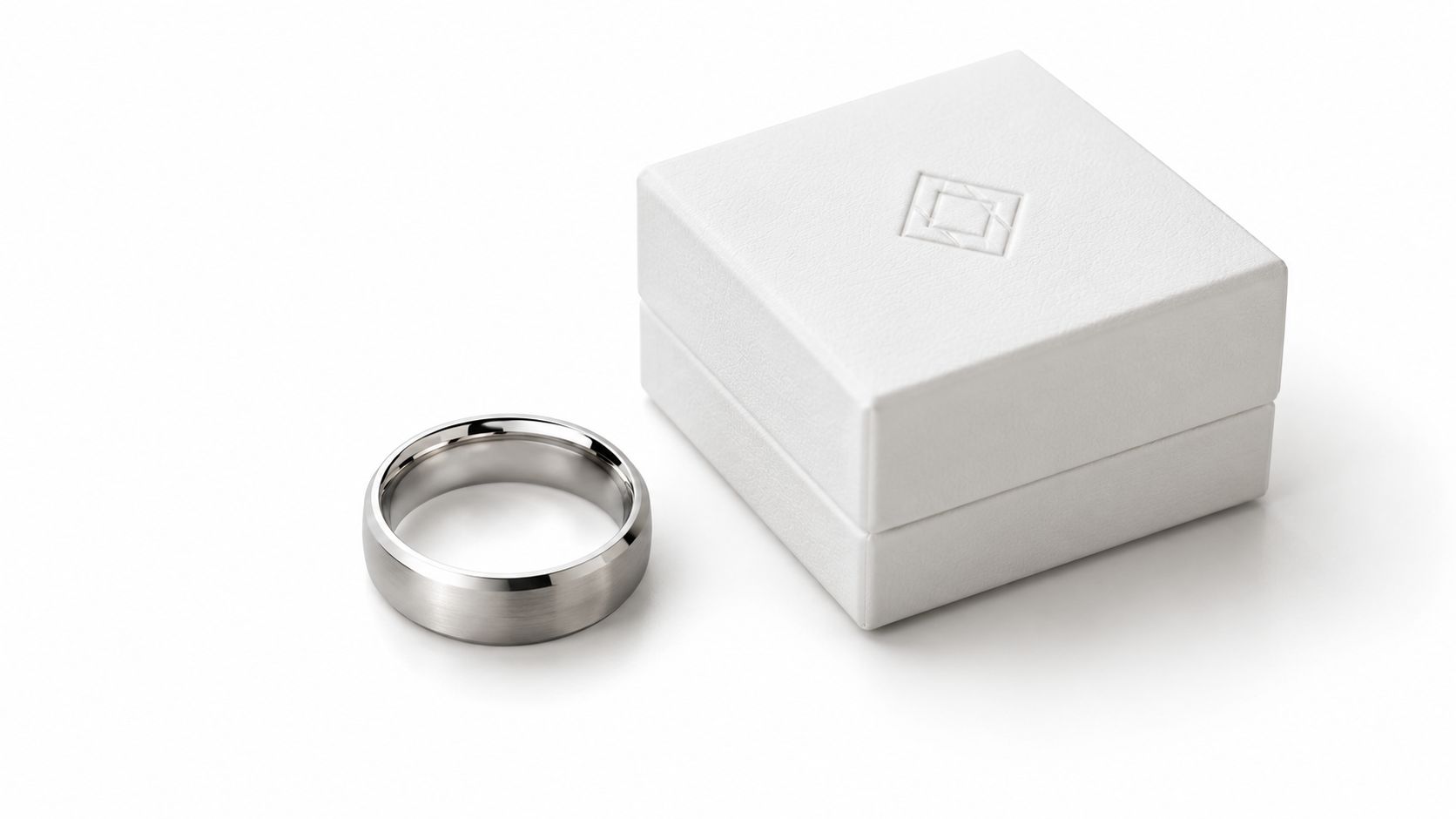
Start with a small, coherent group rather than trying to brand an entire catalog. Choose a few related silhouettes, one or two finish directions, and a clear customer profile. A minimalist capsule for a Shopify store needs a different design language from a symbolic signet collection for a boutique with a vintage identity.
Customize what customers can notice
Useful private-label options include:
- Logo engraving: Add a discreet mark inside the band or in a visible position where it supports recognition without harming comfort.
- Packaging: Use branded boxes, pouches, cards, or care instructions to create consistency across ready-stock and custom orders.
- Design adjustments: Modify proportions, motifs, inner engraving, or stone-look details while preserving a proven base construction.
- Finish direction: Select a specific combination of silver-tone, gold plated, two-tone, black, enamel, or resin details where the supplier confirms availability.
- Collection logic: Give related rings shared names, photography, and merchandising so customers see a collection instead of isolated products.
Custom work brings trade-offs. Design changes can require sampling, and custom colors or packaging may involve production conditions that don't apply to ready-stock purchases. Sampling windows also need to fit your launch calendar. HonHo lists stainless steel sample timing at 25 to 35 days, while brass and 925 sterling silver samples are listed at 25 to 30 days, according to the company's stated service information.
Show the supplier a written brief with material, finish, ring sizes, engraving placement, packaging, target quantity, and acceptance criteria. Ask for a physical sample before approving a larger run, then inspect the inner edges, symmetry, polish, logo clarity, color consistency, and fit across the size range.
The original article's embedded video is retained below as an additional visual reference. Its presence does not establish the specification, test result, or availability of any HonHo ring; use the written brief and approved sample as the production record.
HonHo's private-label jewelry service covers OEM and ODM development, logo engraving, custom plating, and branded packaging. Treat those services as tools for differentiation, not substitutes for material verification or sample approval.
Navigating Wholesale Pricing and Inventory Risk
A low factory quote can turn into expensive inventory when ring sizes are difficult to manage, finishes trigger complaints, or compliance files cannot support your product claims. Calculate the total cost from the unit price, packaging, freight, applicable duties or taxes, payment costs, replacements, customer support, and unsold stock. A supplier's material certificate matters here because an attractive price does not protect you from returns if the documented alloy or finish differs from the product listing.
Do not set retail price from a universal markup multiple. Start with landed cost, then model payment and marketplace fees, expected promotions, replacement allowance, returns, packaging, and the margin needed to operate the channel. A ring can meet a target unit price and still be a poor buy if one slow size or inconsistent finish creates excess stock.
Use small tests to buy better information
A first order should answer practical commercial questions:
- Which ring profiles receive clicks, saves, try-ons, or direct customer questions?
- Which sizes sell first, and which remain untouched?
- Do shoppers prefer silver-tone basics or gold-tone statement pieces?
- Does the photography communicate scale and comfort accurately?
- Are customers responding to durability, design, giftability, or price?
A modest test reveals these answers before you commit more cash. Minimum values, custom MOQs, and discount tiers are different commercial controls. Review HonHo's MOQ and wholesale pricing page for current thresholds, then compare equivalent quotation scopes. This B2B wholesale ordering guide remains a third-party example of another seller's ordering model; its discount figures are not HonHo terms and should not be copied into a purchase plan without current confirmation.
A larger order improves economics only when the styles are proven, the size curve fits demand, and the supplier has passed material, finish, and documentation checks. Dead stock can erase a discount quickly.
Separate evergreen and experimental stock
Use core bands and restrained signets as dependable inventory. Reserve a smaller budget for unusual shapes, bold relief, and color-led finishes. Track each style's sell-through, return reason, size demand, and finish feedback. That record is more useful than a broad supplier claim that a design is popular.
Before ordering, calculate three prices:
- Factory cost, the quoted unit amount.
- Landed cost, including every charge required to place the ring in sellable inventory.
- Target retail price, tested against channel fees and expected promotions.
If the target retail price feels too high for your customer, adjust the design, finish, packaging, or order mix before buying more units. A markup formula cannot rescue a product the market will not accept.
Finalizing Your Wholesale Sourcing Strategy
A supplier review should finish with written answers, not general reassurance. Keep one product file for every ring style, including the material statement, finish description, sample notes, approved measurements, compliance documents, packaging details, and commercial terms.
Pre-order checklist
- Confirm the alloy: Record whether the ring is 316L stainless steel or another material. Don't accept “stainless finish” as a substitute for the base-metal specification.
- Request evidence: Ask for a material certificate or mill test report, then match it to the product and supplier.
- Check nickel release: For prolonged skin-contact products, request finished-item testing relevant to your destination market. Compare the result with the applicable threshold.
- Inspect construction: Check inner edges, symmetry, band consistency, engraving, stone security, and the transition between different surfaces.
- Test the finish: Review the sample under normal handling. Ask how the finish was applied and what care guidance belongs on the product page.
- Verify sizing: Name the size system and record the measured inner dimension, ring width, measurement tool, and tolerance. ISO 8653:2016 specifies a ring-stick measurement method and size designation; a conversion chart alone is not a batch-control method. Stainless steel rings are difficult to resize after production, so fit errors are costly.
- Confirm order terms: Clarify minimum order value, custom quantity requirements, sample charges, payment stages, packaging, shipping method, and responsibility for defects.
- Plan replenishment: Ask how quickly ready-stock items can ship and how custom samples and production fit your release calendar.
- Write accurate claims: Use “316L stainless steel” only when confirmed. Use gold plated or PVD only when the finish applies. Avoid unsupported promises about waterproof performance or allergy safety.
A consolidated supplier can simplify buying when you need rings alongside earrings, necklaces, bracelets, or coordinated sets. It also helps when you want to compare 316L stainless steel with brass or 925 sterling silver while keeping your product files and ordering process organized.
HonHo Wholesale Jewelry states that it offers ready-stock jewelry, 316L stainless steel, brass, and 925 sterling silver options, alongside OEM and ODM services such as engraving, custom plating, and branded packaging. The current confirmed planning baseline is a US$100 wholesale minimum and 50 pieces per style and color for custom manufacturing. Stainless steel sample development is typically 25 to 35 days; the current production baseline is 35 to 45 days after sample approval. These are service-level planning terms, not a guarantee that every listed ring is 316L or available for every finish. Confirm the selected SKU, quote, and schedule before payment.
Questions buyers still ask
Is every stainless steel ring 316L? No. Stainless steel is a material family. Use 316L only when the SKU or production lot is supported by appropriate material evidence.
Does PVD make a ring waterproof? “PVD” does not answer that question. Water, chemicals, abrasion, surface preparation, and the complete layer stack affect performance. Approve a defined finish and care claim rather than a universal waterproof promise.
What should a comparable quote include? Send the same brief to each supplier: alloy and evidence required, ring profile, width and thickness, size system and curve, finish and color reference, quantity per style and color, logo and packaging, destination market, test scope, sample timing, production timing, and defect terms.
Browse the latest collections from HonHo Wholesale Jewelry and request a comparable ring quote with the alloy, size system, finish, quantity per style and color, logo, packaging, destination market, and required test evidence. For a private-label capsule, approve the physical sample and written acceptance record before scaling the order.


