

A good sterling-silver care handoff gives staff and customers four clear rules: put the piece on after cosmetics, remove it before water or chemical exposure, wipe it after wear, and store it fully dry in a closed, compatible package. Retailers also need a separate back-room routine, because display handling and bulk storage expose jewelry in different ways.
This guide is designed for the point of sale: what staff should say, what a care card should include, and where generic advice must stop. “Sterling silver” describes an alloy; it does not tell you whether a particular piece is plain, plated, oxidized, stone-set, glued, or protected by an additional coating. Cleaning instructions must follow the actual construction.
Table of Contents
- Why Sterling Silver Tarnish Is a Wholesale Problem
- What Causes Sterling Silver to Tarnish
- Storing Sterling Silver the Right Way
- Wearing Sterling Silver Without Speeding Up Tarnish
- A Simple Daily Care Routine for Staff and Customers
- Handling, Packaging, and Shipping Tips for Retailers
- Putting It All Together for Better Resale Value
Why Sterling Silver Tarnish Is a Wholesale Problem
A customer asking whether a ring has gone bad needs a useful answer before a cleaning recommendation. Staff should check the finish on the product record, ask when the change appeared, and distinguish an ordinary care question from a possible product fault.
Why 925 silver reacts so readily
Sterling silver is an alloy, and that matters in trade. This Canadian conservation guidance discusses protective methods used in conservation. For retail care, the transferable lesson is to reduce sulfur exposure and keep storage dry; it is not evidence that every jewelry coating, package, or customer routine performs for a fixed period.
Repeated cleaning is a reason to review the item and its care instructions, not to assume the customer stored it badly.
Keep the same care wording on the product page, printed card and staff reference. If those instructions disagree, resolve the discrepancy before advising the customer.
Train staff to identify three limits: what can be wiped at the counter, what needs an approved cleaner, and what must go to a jeweler or supplier for review.
For buyers comparing materials across a wider assortment, HonHo's Wholesale Rings Sterling Silver guide is a useful reference for where sterling fits in a mixed-material catalog.
What Causes Sterling Silver to Tarnish
Ask about the actual routine: storage location, swimming or household-cleaner exposure, cosmetics, and any cleaning products already used. These questions collect context; they do not establish fault.
The main triggers to keep out of the supply chain
The Canadian silver tarnish guidance explains that sulfur-containing gases form the tarnish layer and that higher relative humidity speeds the reaction. Tiffany sterling silver care offers a brand-specific consumer routine. Use those sources for principles, then confirm the supplier’s instructions for the actual SKU instead of turning general care advice into a warranty.
Use these points as questions for a care conversation:
- Airborne sulfur: keep silver away from rubber, some paints, wool felt, and other sulfur-emitting packing materials.
- Humidity swings: avoid damp stockrooms, bathroom-adjacent storage, and unsealed display cases.
- Chemicals on skin and surfaces: lotion, perfume, makeup, bleach, chlorine, and household cleaners all shorten the clean-looking window.
- Residual manufacturing materials: polishing compound or pickle residue trapped in crevices can create early dulling if pieces aren't fully cleaned.
- Body chemistry: some wearers react faster than others, so staff should never assume all customers will see the same wear pattern.
For buyers briefing staff quickly, this table keeps the message simple.
| Tarnish Trigger | How to Prevent It |
|---|---|
| Sulfur in air, wool, rubber, some paints | Store in sealed packaging with sulfur scavengers |
| Humidity and temperature swings | Use desiccant and keep stock in a stable, dry room |
| Lotion, perfume, cosmetics, chlorine | Tell customers to put silver on last and take it off first |
| Dust, leather, silk, long open display | Use closed storage and rotate stock regularly |
| Residual cleaning compounds | Inspect and clean fully before bagging |
Gold Plated & Silver-Finish Stainless Steel Ring-Cluster Earrings is a stainless-steel product example, so a silver-colored surface must not be mistaken for sterling silver. Read the SKU record alongside the Jewelry Materials & Plating Guide before choosing a cleaning method.
Storing Sterling Silver the Right Way
Show the customer how the supplied package closes and where the jewelry sits. Explain any care insert or anti-tarnish component supplied with that specific purchase, rather than assuming every pouch has the same protective treatment.
A simple storage routine for back rooms and ship-out desks
For a plain-silver item, use the approved storage package after it is clean and dry. Pearl, plated and mixed-material pieces need their own instructions; do not transfer a bare-metal storage recipe to every design.
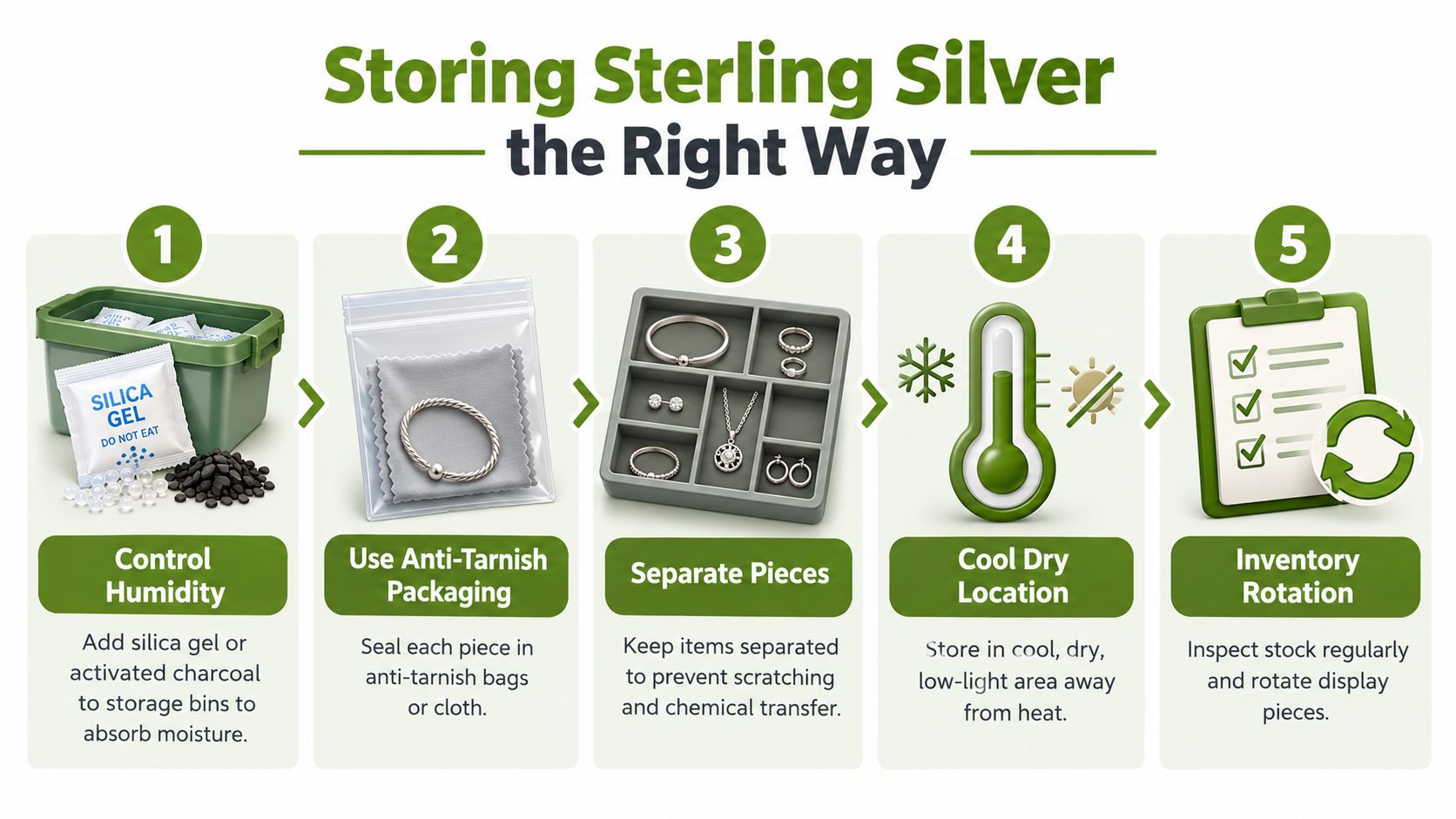
- Check before sealing. Confirm that jewelry and packaging are clean and free of residual moisture; hold any uncertain item for review.
- Check the enclosure. Use the approved bag or box and confirm its closure; a lining alone does not establish an air barrier.
- Follow the packing specification. Use the selected moisture and tarnish controls only where suitable for the complete assembly.
- Keep conditions stable. Avoid damp storage and record temperature changes that may warrant a moisture check.
- Separate every item. Chains should not tangle, and finished pieces should not rub against one another.
A display accessory is not evidence of jewelry-safe storage. The existing silver clothing rail guide reference concerns retail fixtures; it does not establish which lining, adhesive or insert is suitable for direct contact with silver.
Frequent polishing may keep a case bright, but it is not a substitute for compatible storage. Repeated or aggressive cleaning can also affect plating, deliberate oxidation, delicate details, adhesives, or porous stones. Record the approved method by SKU and escalate unfamiliar surfaces rather than letting staff improvise.
Wearing Sterling Silver Without Speeding Up Tarnish
Daily wear and continuous wear are different. A person may wear silver regularly while still removing it for activities excluded by the style-specific care instructions.
Do not promise that rhodium plating or a different finish makes a piece suitable for uninterrupted shower, pool or gym wear. The non-tarnish cross necklace guide explains why buyers should ask what a durability claim covers for the complete item.
The best guidance is practical, not fussy:
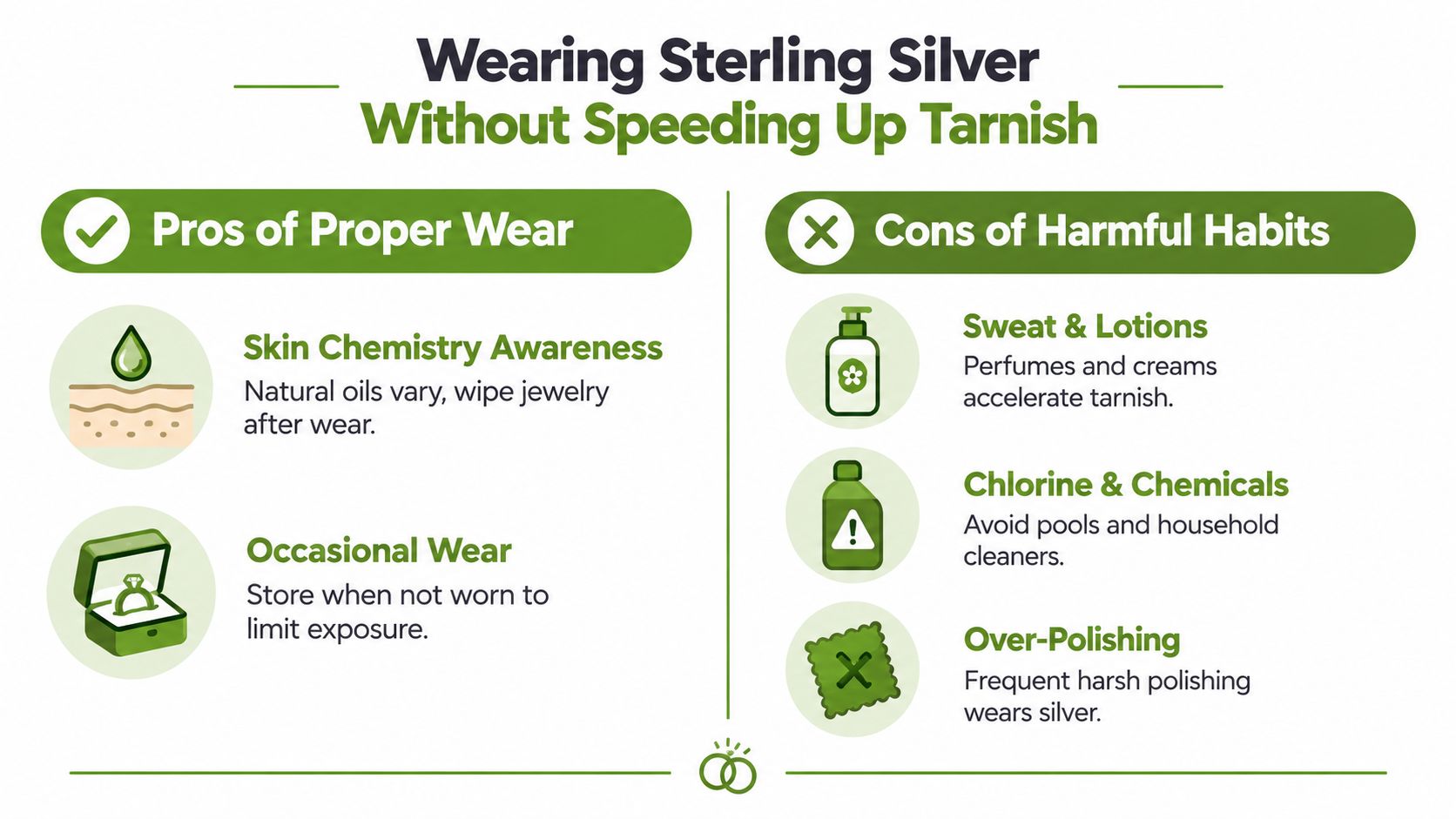
- Put jewelry on after lotion, perfume, sunscreen, and hair products.
- Take it off before swimming, showering, cleaning, or using bleach-based products.
- Wipe it with a soft cloth after wear so body oils do not sit on the surface.
- Put it back only when it is fully dry.
When customers describe different experiences with two pieces, ask about both constructions and routines. Avoid a blanket explanation based on body chemistry, price or the word “925.”
If the customer needs a different wear routine, discuss products whose stated care instructions fit it. Confirm the construction and limits before recommending an alternative.
A Simple Daily Care Routine for Staff and Customers
Make the care card short enough to use, with the finish named clearly. Give cleaning advice only when needed, rather than imposing a weekly wash on every item.
A printable routine retailers can teach at point of sale
A wholesale team should keep the message tight and repeatable. HonHo's Jewelry Care Guide is the kind of reference buyers can point customers toward when they want more detail without overwhelming the sale.
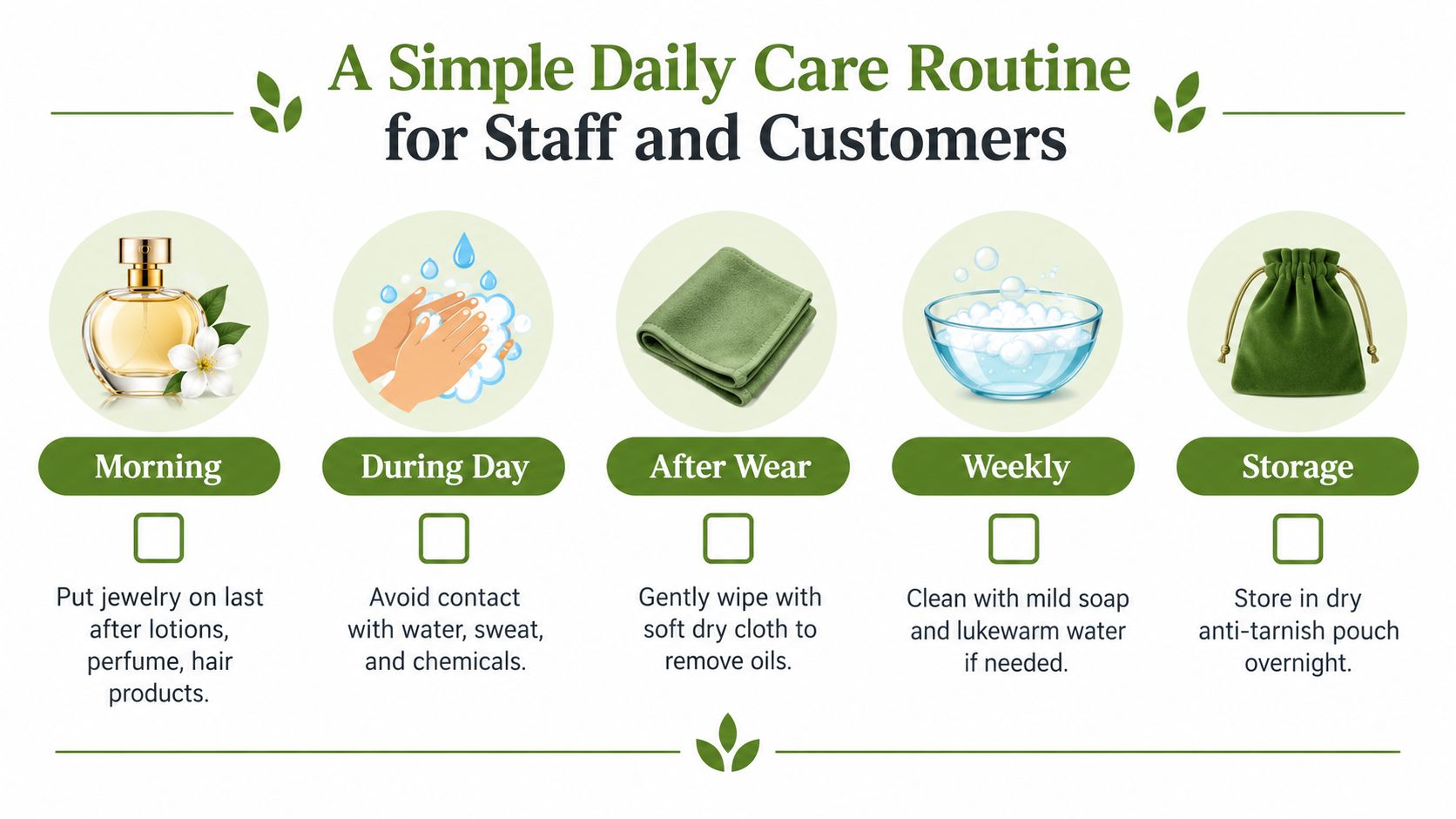
Use this as the handoff version:
- Morning: put jewelry on after lotion, perfume, and hair products.
- During the day: keep it away from sweat-heavy workouts, chlorinated water, and household cleaners.
- After wear: wipe with a soft, lint-free microfiber or untreated silver cloth.
- When cleaning is needed: follow the method approved for the whole piece; do not impose a fixed weekly wash on plated, pearl or mixed-material jewelry.
- Storage: place it in a dry anti-tarnish pouch or sealed bag overnight.
Use the card as a shared reference during after-sale support. It should help the customer describe what happened without making a diagnosis or promising a cleaning result.
What to say when a customer asks about cleaning
Keep the language practical: “Start dry and gentle; stop if the finish changes unevenly.” An untreated soft cloth may be suitable for light residue. Liquid dips, abrasive pastes, ultrasonic cleaning, and home remedies should not be recommended across an assortment because stones, plating, darkened details, solder, and adhesives can respond differently. When the construction is unclear, ask the supplier before cleaning.
Handling, Packaging, and Shipping Tips for Retailers
At handoff, check that the correct care card accompanies the correct finish. A gold-plated item should not receive a bare-silver polishing instruction merely because both share a sterling base.
A handled display item needs a condition check before packing. If staff notice a new mark, document it and follow the approved care route before presenting it as new stock.
Use the packaging approved for the style and include a treated polishing cloth only when its use is appropriate. A cloth placed in the box can otherwise imply that customers should use it on every component.
For retailers who want a wider packaging reference, fragile item shipment tips covers the same basic logic, separation, cushioning, and moisture control. Those principles apply to silver just as they do to other delicate goods.
Mixed assortments need the same discipline. A piece like Gold Plated 925 Sterling Silver Pavé Paperclip Link Hoop Earrings combines a 925 sterling silver base, gold plating, and clear zirconia, so it should be packaged with the same care as other plated or stone-set silver. HonHo's wholesale earrings and 925 sterling silver jewelry assortments make that easier to apply across SKUs.
Record recurring questions and improve the care card when its wording is unclear. Track actual support cases rather than assuming a particular insert will reduce returns.
Putting It All Together for Better Resale Value
Good retail care makes the product easier to understand. It also gives the team a consistent way to handle questions without making unsupported promises about permanent shine.
The inventory chain reaction retailers should watch
If a customer returns with a concern, preserve the initial photographs and note the advice already given. Avoid escalating from one cleaner to another while the cause remains uncertain.
HonHo's Gold PVD Coating article is useful for buyers who are weighing finish choices across an assortment, because finish selection and care expectations belong in the same buying conversation. The bigger lesson is that prevention has to be documented. A care card, a packaging standard, and a staff routine turn tarnish control into part of the business model, not a clean-up task after the fact.
A workable action plan looks like this:
- Audit current storage. Check humidity, packaging materials, and whether silver sits near rubber, dust, or open air.
- Train staff on the daily routine. Keep the message short, last on, first off, wipe after wear.
- Check the specified protection. Use the approved anti-tarnish component where required, following its supplier instructions.
- Revise display rotation. Don't leave the same pieces under light and handling day after day.
- Include written care guidance with each sale. Give customers the same clarity your team uses.
Review the care message when the supplier changes a finish, stone, adhesive or packaging component. The card should follow the current product specification.
Care questions to answer at the counter
Can the same cloth clean plain silver, gold plating and pearls?
Do not treat all cloths as interchangeable. A clean untreated soft cloth is different from a silver-polishing cloth impregnated with abrasive material. The CCI silver-care note explains this distinction and warns that polishing can damage gilded surfaces. Use a treated cloth only where the supplier approves it for that finish.
This is a real point of confusion: a reader in a Reddit care discussion asks what to use on silver, gold-plated pieces and pearls after contact with lotion. The useful retail answer starts with the complete construction, including stones, coatings and adhesives, rather than offering one cleaner for everything.
What changes when a silver design contains pearls?
Pearls need separate care. GIA’s pearl-care guidance recommends a very soft clean cloth for routine wiping and rules out ultrasonic and steam cleaning. Do not let a silver-cleaning treatment contact a pearl merely because its setting is sterling silver.
Does regular wear mean it will never tarnish?
No. Regular wear is not a guarantee against discoloration, and it does not override instructions to remove a piece before swimming or chemical exposure. Give the customer the style’s actual care limits. If a new mark appears, ask for a photo and the product reference before recommending further cleaning.
For a complaint that cannot be resolved with the approved care method, use the tarnish troubleshooting guide to gather a useful record.
Match the Care Message to the Construction
| What the staff sees | Safe first response | What to confirm before stronger cleaning |
|---|---|---|
| Plain polished sterling silver | Dry soft cloth; if supplier-approved, mild soap and water followed by complete drying | Stone settings, soldered areas, and whether a protective coating is present |
| Gold-plated sterling silver | Wipe gently and keep dry | Plating system and supplier-approved cleaner; do not treat it as bare sterling |
| Oxidized or antiqued details | Clean only raised bright areas with minimal pressure | Which dark areas are intentional design features |
| Stone-set or pearl jewelry | Remove surface dust with a soft dry cloth | Stone identity, porosity, adhesives, setting security, and liquid-cleaning limits |
| Unknown finish or mixed construction | Isolate, photograph, and ask before cleaning | Base material, finish stack, components, and an approved care method |
A Point-of-Sale Script That Does Not Overpromise
“This is sterling silver with the finish shown on the product record. Keep it dry, apply cosmetics first, wipe it after wear, and store it closed. Tarnish is a surface reaction and can still occur; use only the care method listed for this style.” That is more useful than calling a piece “tarnish-free” or promising a wear-life that has not been demonstrated for the specific construction and customer routine.
For a wholesale quote, care-card program, or sample review, send HonHo the SKU or reference image, base material, finish, stones or other components, order quantity, destination, packaging request, and the customer-care language you plan to use. HonHo can confirm what is specified or developable for that inquiry; factory capability is not the same as a specification or test result for every ready-stock item.
Browse HonHo Wholesale Jewelry's latest collections to compare sterling silver, stainless steel, brass, and plated styles by care requirements. For a B2B quote, sample, packaging, or care-card discussion, contact HonHo Wholesale Jewelry with the SKU, construction, quantity, destination, and the instructions your retail team needs to support.


