

Round stud earrings are easy to recognize but easy to specify poorly. A wholesale buyer needs more than a round outline and a color choice. Approve the visible diameter, front profile, pair weight, material, finish, setting, post dimensions, backing fit, and any compliance claim for the finished pair. Those details decide whether a style works as an everyday basic, a gift item, or a higher-risk fashion test.
For boutiques, Shopify stores, resellers, and professional jewelry buyers, the useful question is which round stud assortment fits the customer, price ladder, and returns policy. A low flat solitaire, a rounded dome, a pavé halo, and a bezel-set stone may share the same outline, but they need different sample checks and serve different merchandising roles.
Table of Contents
- What Wholesale Buyers Should Know Before Stocking Round Studs
- The History and Lasting Appeal of Round Stud Earrings
- Matching Round Stud Materials to Your Customer
- Sizes, Posts, and Settings Explained for Bulk Buyers
- Round Stud Styles That Are Winning Retail Space
- Skin Safety and Nickel Release for Sensitive-Ear Shoppers
- A Practical Wholesale Buying Checklist for Round Studs
What Wholesale Buyers Should Know Before Stocking Round Studs
Round studs can cover several jobs in one earring program: an entry-price basic, a giftable stone style, a metal-led alternative, and a more decorative upgrade. Treating all of them as one SKU family hides the differences that matter at approval and reorder.
| Assortment role | Typical construction | Approve before ordering | Watch after launch |
|---|---|---|---|
| Everyday basic | Flat disc, low solitaire, or small bezel | Front diameter, post finish, backing tension, pair match | Lost backs, irritation complaints, uneven finish |
| Metal-led style | Dome or half-ball | Projection, pair weight, hollow or solid construction, denting | Tilting on the ear, scratches, shape distortion |
| Decorative upgrade | Pavé, halo, textured edge, or cluster | Stone security, symmetry, prong finish, back access for cleaning | Missing stones, snagging, visible mismatch |
| Protected stone look | Full or partial bezel | Stone centering, rim consistency, setting height | Uneven rims, trapped residue, color mismatch |
One commercial DataIntelo earring market report gives a large 2025 estimate for the stud category. Treat that figure as the publisher's market model, not proof that a particular size, material, or HonHo SKU will sell in your store. Your own sell-through, return reasons, and reorder intervals are better assortment evidence.
Keep the original four profile groups because each serves a distinct buying purpose:
- Flat profiles, including solitaire-style stones and low discs, are useful for entry gifting and daily wear.
- Dome and half-ball profiles give the customer a metal-first choice.
- Pavé and halo designs create a visible step up, with more setting points to inspect.
- Bezel-set rounds give a clean outline and reduce exposed stone edges, although the finished rim still needs inspection.
Buying rule: “Round” describes the outline. Record the profile, dimensions, construction, customer use, and approval evidence separately.
A retailer-facing stud earrings for jewelry businesses collection can help identify common style labels, but its assortment is not a manufacturing specification or a demand forecast. Compare suppliers on the same written fields instead of copying another seller's mix.
Use this wholesale earrings in bulk buying guide to record profile, diameter, material, finish, post, closure, packaging, evidence, and reorder notes for every candidate SKU. A useful line usually combines dependable basics with a smaller number of styles that test a new profile or finish.
The History and Lasting Appeal of Round Stud Earrings
The round stud has remained useful because the compact form can support very different materials and price points. A plain metal ball, a bezel-set cubic zirconia, and a pavé cluster can sit in the same display while answering different customer needs. That versatility matters more to a buyer than an unsourced origin story.
The shape is also efficient in a product grid. It reads clearly in small images, pairs easily with other jewelry, and can be organized by diameter, profile, material, or price. Those traits make round studs a sensible anchor category, but they do not remove the need to test pair matching, comfort, and hardware.
Current fashion articles, including this 2026 jewelry trend coverage, mention dome, bombé, geometric, and mixed-shape silhouettes. Use trend coverage as a lead for a small trial, not as evidence of future sales. Translate the idea into sample questions: How far does the front project? Does the pair sit level? Is the edge comfortable? Can the finish be reproduced on reorder?
Matching Round Stud Materials to Your Customer
Material affects price, finish options, care wording, and the evidence a retailer needs. A factory's general material capability does not establish the grade, alloy, plating, or skin-contact performance of a specific finished pair.
Stainless steel can support accessible everyday styles and polished or brushed metal profiles. If a quote says 316L, record that grade for the complete item or the relevant component rather than assuming every post, backing, soldered joint, and decorative part is identical. This stainless steel jewelry guide explains common grade terminology, but it does not verify a supplier's finished SKU.
Brass supports detailed shapes and a range of plated finishes. Review the base metal, surface preparation, plating specification, skin-contact components, and care instructions together. Color alone does not establish that a finish is gold plated.
925 sterling silver suits gift-led and classic positioning. Confirm which parts are silver, which parts are a different alloy, and how the post and backing are specified. Tarnish management and packaging remain part of the retail plan.
| Material route | Useful retail role | Quote fields | Sample checks |
|---|---|---|---|
| Stainless steel | Everyday metal styles and accessible fashion | Exact grade by component, finish method, color reference | Pair match, edge finish, post straightness, backing fit |
| Brass | Detailed, plated, or seasonal designs | Base metal, plating stack, skin-contact parts, care | Coverage at recesses, solder areas, abrasion points |
| 925 sterling silver | Classic, gift, and higher-perceived-value styles | Silver scope, stone identity, finish, post and backing material | Stamp or documentation scope, tarnish condition, solder and setting quality |
HonHo's jewelry materials and plating guide gives the current custom-development baseline: MOQ 50 pieces per style and color, brass or 925 silver samples in 25–30 days, stainless steel samples in 25–35 days, and bulk production in 35–45 days after approval. These are planning figures for custom work, not ready-stock dispatch promises or specifications for every SKU.
For U.S. claims, the FTC Jewelry Guides cover how businesses describe precious-metal content, plating, size, weight, treatments, and other material product facts. Match product-page wording to evidence for the actual finished pair and target market.
Sizes, Posts, and Settings Explained for Bulk Buyers
For a round stud, “size” may refer to the visible front diameter, stone diameter, setting diameter, projection from the ear, post diameter, usable post length, or pair weight. Put units beside every field. A 6 mm dome and a 6 mm low disc can feel and sit very differently.
A consumer-facing article with post and closure guidance can introduce common hardware terms, but do not copy its measurements into a purchase order. Record the supplier's finished dimensions and approve the actual pair.
Read the post and backing together
A post is only one part of the retention system. Review its diameter, usable length, straightness, end finish, groove or thread, and material with the matching back. Friction backs need repeatable tension. Screw backs need clean threads and enough engagement without sharp edges. Flat backs or locking systems need their own assembly and comfort checks.
| Observed issue | Inspect on the sample | Record for approval |
|---|---|---|
| Front tilts downward | Pair weight, projection, backing support, post position | Pair weight, side view, post location, chosen back |
| Back slips off | Post groove or thread and repeated attachment | Backing type, fit result, replacement policy |
| Post feels rough | End polish, burrs, plating buildup, thread finish | Close-up photo and rejection criterion |
| Pair looks mismatched | Diameter, profile, setting height, stone or finish color | Permitted comparison standard and reference pair |
Settings change both appearance and returns
Prongs expose more of a stone but create points that can snag or sit unevenly. A bezel surrounds the edge and gives a clean outline, while a pavé halo adds more stones and more inspection points. The setting name alone does not establish security. Check stone movement, symmetry, prong or rim finish, access for cleaning, and the back of the setting.
Record the actual diameter, projection, post dimensions, backing, setting, finish, and pair weight. HonHo's jewelry size guide can organize the specification conversation, but a physical sample should remain the approval reference.
Round Stud Styles That Are Winning Retail Space
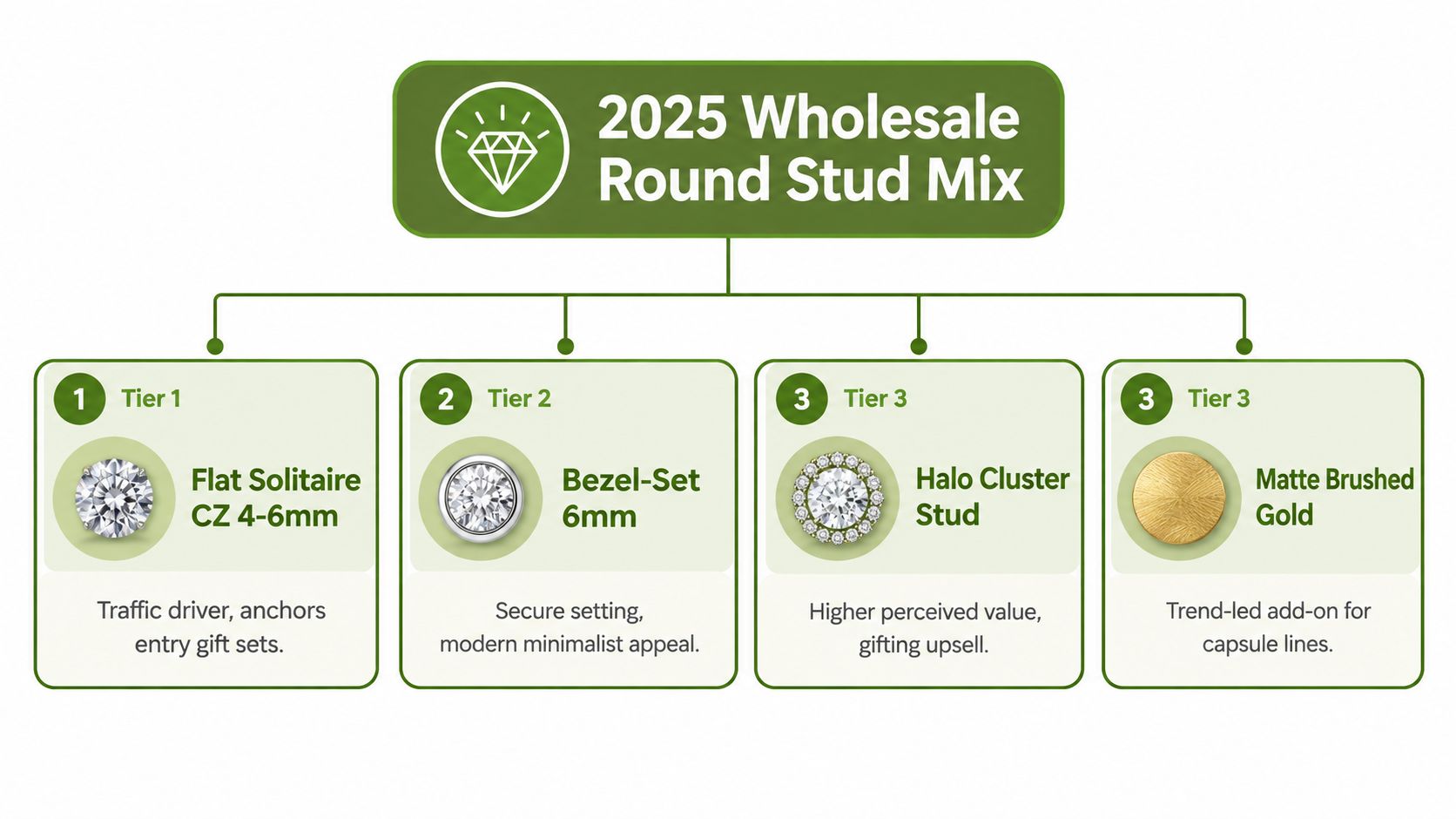
A clear display hierarchy helps shoppers compare quickly. Flat solitaires cover the familiar basic. Domes provide a metal-led alternative. Bezels, pavé, textured edges, and clusters create visible steps in detail and price. The mix should come from the store's customer and sell-through record, not a universal percentage.
Build the assortment by role
Flat solitaire basics are easy to understand and compare. Approve the stone description, pair match, setting height, and post position.
Dome and half-ball studs depend on profile as much as diameter. Confirm whether the construction is hollow or solid, then check denting, seam quality, pair weight, and how the earring sits.
Bezel-set rounds provide a defined outline. Inspect centering, rim consistency, stone movement, and any sharp or uneven edge.
Pavé halo and cluster studs add detail for gifting and visual merchandising. Approve stone count, symmetry, security, and the finish around every setting point.
Geometric round profiles can refresh a familiar shape through texture, beaded edges, or asymmetry. Treat them as a controlled trial until sales and returns justify a reorder.
If your team wants to test the original 50/30/20 idea, label it as a trial allocation rather than a market fact: 50% basics, 30% mid-tier domes or detailed styles, and 20% directional designs. Set a review date and compare unit sell-through, gross margin, returns, and reorder requests before repeating it. Review the wholesale stud earrings collection by profile, material, and hardware rather than color alone.
Skin Safety and Nickel Release for Sensitive-Ear Shoppers
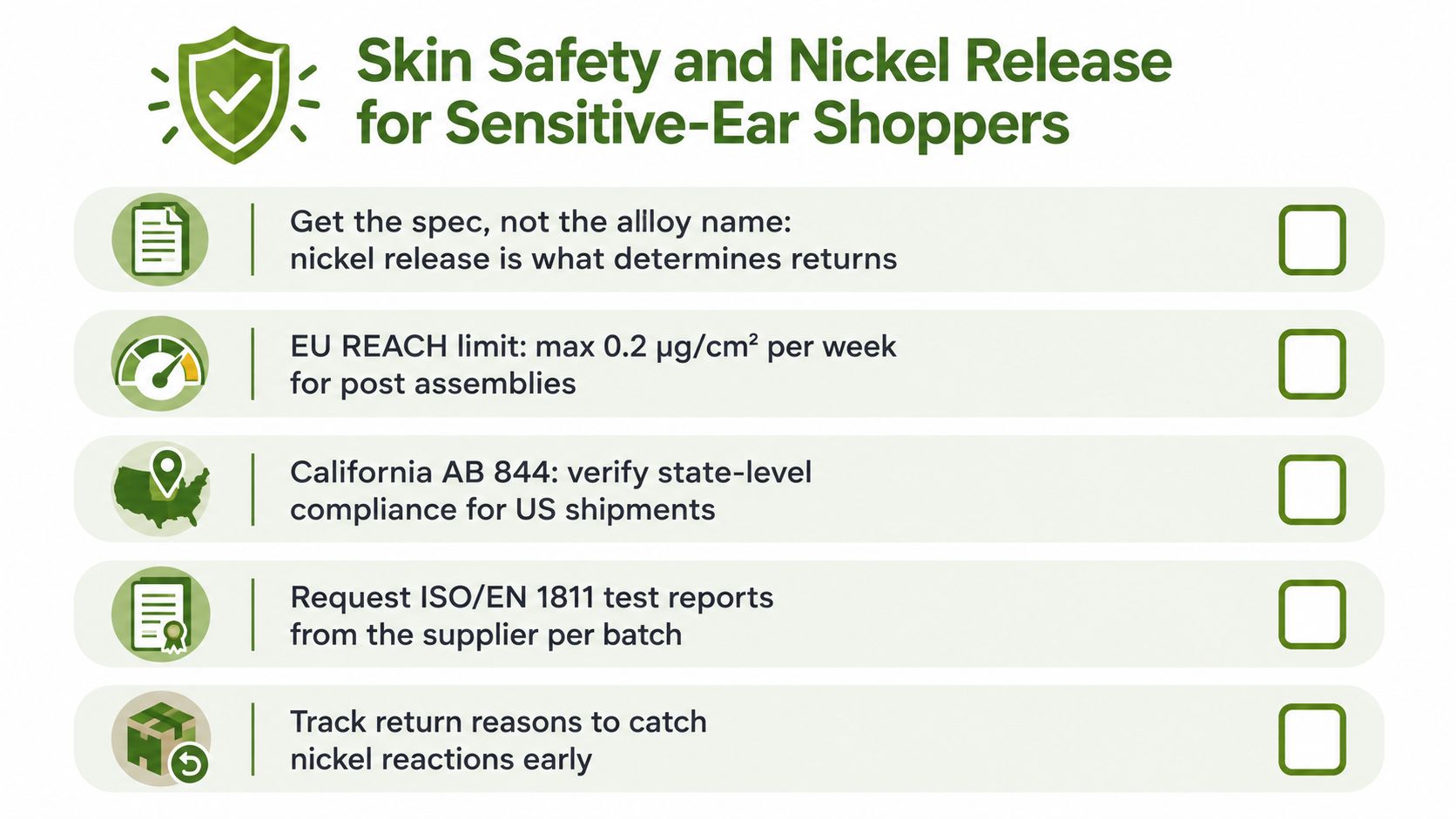
An alloy name does not prove that a finished earring is suitable for every sensitive wearer. The post, backing, solder, coating, decorative components, and wear conditions can all affect exposure. Keep material identity, regulatory conformity, and marketing language as separate fields.
A technical nickel release and jewelry safety review discusses nickel exposure from jewelry. For the current EU requirement, REACH Annex XVII Entry 27 sets a migration limit below 0.2 µg/cm²/week for post assemblies inserted into pierced ears and 0.5 µg/cm²/week for other parts intended for direct and prolonged skin contact. The official EU REACH text also requires coated items in the latter group to remain within the limit for at least two years of normal use.
Screen the finished product, not the label
A systematic review of nickel release in earrings reported that some earrings screened positive or exceeded relevant limits. That research supports asking for finished-product evidence, but its regional samples do not predict the result for a particular HonHo item or production batch.
Ask which method, product identity, components, sampling plan, and test date a report covers. Confirm that the post assembly and other direct-contact parts are included. A result for raw wire, a coating coupon, or a different style does not by itself establish conformity of the finished pair.
DermNet's DermNet nickel allergy guidance explains a consumer spot test that may produce a pink signal when nickel is detected. Treat that as a screening prompt, not a release-rate measurement or a substitute for the applicable conformity test.
Claim check: Use “nickel-free,” “hypoallergenic,” or similar wording only when the evidence supports the exact claim, finished product, and market. A material label alone is not enough.
A Practical Wholesale Buying Checklist for Round Studs
Use one approval record for the sample, purchase order, and reorder. That makes a simple-looking product comparable across suppliers and helps separate design changes from quality drift.
- Define the customer and role. Record whether the pair is an entry basic, gift style, metal-led alternative, or decorative upgrade.
- Write the complete specification. Include front diameter and projection, pair weight, base material by component, finish, stone description, setting, post dimensions, backing, packaging, and required evidence.
- Separate ready stock from custom development. Marketplace directories such as wholesale jewelry marketplace pages show that seller minimums and terms vary. They do not establish HonHo's terms. For HonHo custom work, the current planning baseline is 50 pieces per style and color; confirm the quote for the actual project.
- Approve a physical pair. Check pair matching, stone security, post straightness, edge finish, backing retention, surface consistency, comfort, packaging fit, and the scope of any report.
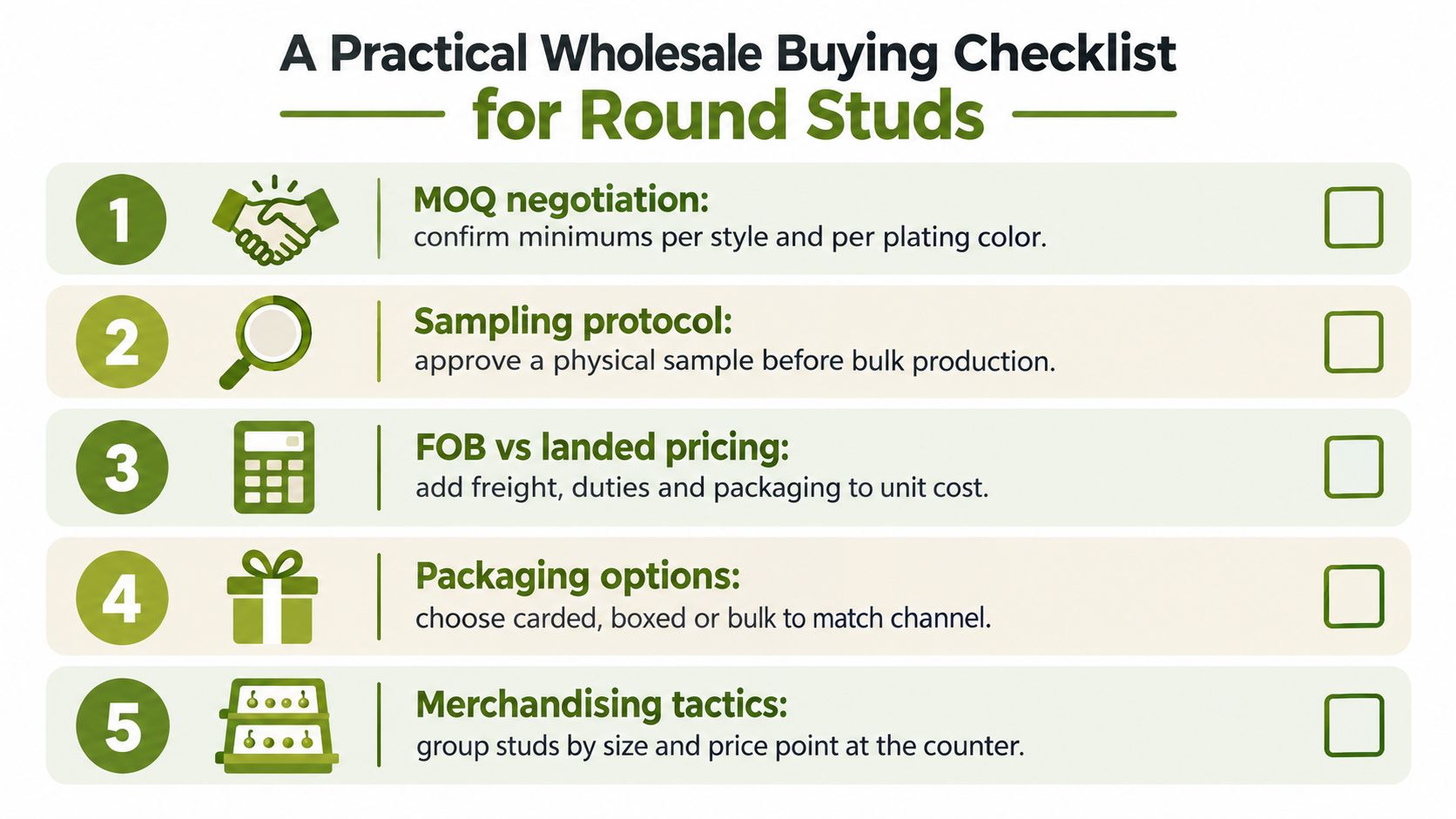
- Calculate landed cost. Add freight, duties, packaging, inspection, payment charges, and any finish or closure upgrade to the quoted unit cost.
- Set an acceptance record. Photograph the approved front, side, post, backing, and packaging. Record dimensions, weight, color reference, and defect limits.
- Plan the first review. Track sales by profile, material, finish, and size. Separate return reasons such as irritation, loose backs, tarnish, missing stones, tilting, and color mismatch.
- Reorder against the reference. Compare the next batch with the approved pair and written specification before releasing it for sale.
For the complete release decision, use this jewelry sample approval checklist before production or repeat ordering.
To request a comparable HonHo quote, send the target market, profile reference, visible diameter, projection, pair weight target, base material, finish, stone description, post and backing requirements, packaging, quantity by style and color, evidence needs, and delivery window. Browse HonHo Wholesale Jewelry for ready-stock options, or identify the fields that need custom development so the quote and sample can be reviewed against the same brief.


