

A wholesale sterling-silver SOP should control five handoffs: supplier packing, inbound receiving, back-stock storage, display replenishment, and outbound shipping. At each handoff, keep pieces clean and dry, use compatible individual packaging, record the package condition, and separate questionable units before they enter sellable stock.
This guide turns general tarnish advice into a repeatable warehouse and fulfillment routine. It does not set one universal humidity number, desiccant quantity, replacement interval, or shelf-life promise: those controls must match the enclosure, climate, opening frequency, packaging supplier, and actual SKU construction.
Table of Contents
- Why Sterling Silver Tarnish Is a Wholesale Problem
- What Causes Sterling Silver to Tarnish
- Storing Sterling Silver the Right Way
- Wearing Sterling Silver Without Speeding Up Tarnish
- A Simple Daily Care Routine for Staff and Customers
- Handling, Packaging, and Shipping Tips for Retailers
- Putting It All Together for Better Resale Value
Why Sterling Silver Tarnish Is a Wholesale Problem
A back-room problem often begins as a small process gap: stock is opened in a humid receiving area, handled with bare hands, repacked beside rubber bands or unknown foam, or returned to a drawer before it is fully dry. The SOP should make these handoffs visible so the team can correct the process before the same pattern reaches multiple cartons.
Why 925 silver reacts so readily
Sterling silver is an alloy, so packaging controls need to address both moisture and sulfur-bearing contaminants. This Canadian conservation guidance discusses one conservation treatment. It is background for control thinking, not a specification for a HonHo SKU or proof that a shipment received that treatment.
If a handoff cannot be traced, record the missing information and improve that step before the next shipment.
Assign a named role to receiving, storage checks, replenishment and final pack-out. A written procedure is useful only if staff know who can release stock and who handles exceptions.
Maintain the approved packing sample beside the written specification. Staff should compare materials and arrangement, not substitute whatever packaging looks similar.
For buyers comparing materials across a wider assortment, HonHo's Wholesale Rings Sterling Silver guide is a useful reference for where sterling fits in a mixed-material catalog.
What Causes Sterling Silver to Tarnish
Record the approved package as a set of components: the inner barrier, supports, inserts, any moisture or tarnish control, closure and outer cushioning. Changes to one component should trigger a review of the complete set.
The main triggers to keep out of the supply chain
The Canadian silver tarnish guidance explains the role of sulfur-containing gases and increasing relative humidity. Tiffany sterling silver care provides consumer storage context. For operations, translate those principles into monitored conditions and approved materials; do not treat either source as a batch-specific storage guarantee.
Translate these potential exposures into handling and packing controls:
- Airborne sulfur: keep silver away from rubber, some paints, wool felt, and other sulfur-emitting packing materials.
- Humidity swings: avoid damp stockrooms, bathroom-adjacent storage, and unsealed display cases.
- Chemicals on skin and surfaces: lotion, perfume, makeup, bleach, chlorine, and household cleaners all shorten the clean-looking window.
- Residual manufacturing materials: polishing compound or pickle residue trapped in crevices can create early dulling if pieces aren't fully cleaned.
- Body chemistry: some wearers react faster than others, so staff should never assume all customers will see the same wear pattern.
Use this table to brief new packing staff, then identify the corresponding check on the work instruction:
| Tarnish Trigger | How to Prevent It |
|---|---|
| Sulfur in air, wool, rubber, some paints | Store in sealed packaging with sulfur scavengers |
| Humidity and temperature swings | Use desiccant and keep stock in a stable, dry room |
| Lotion, perfume, cosmetics, chlorine | Tell customers to put silver on last and take it off first |
| Dust, leather, silk, long open display | Use closed storage and rotate stock regularly |
| Residual cleaning compounds | Inspect and clean fully before bagging |
Route Gold Plated & Silver-Finish Stainless Steel Ring-Cluster Earrings according to its own material and finish record. A mixed order can contain different care requirements; the Jewelry Materials & Plating Guide supports classification but does not replace the SKU-specific packing instruction.
Storing Sterling Silver the Right Way
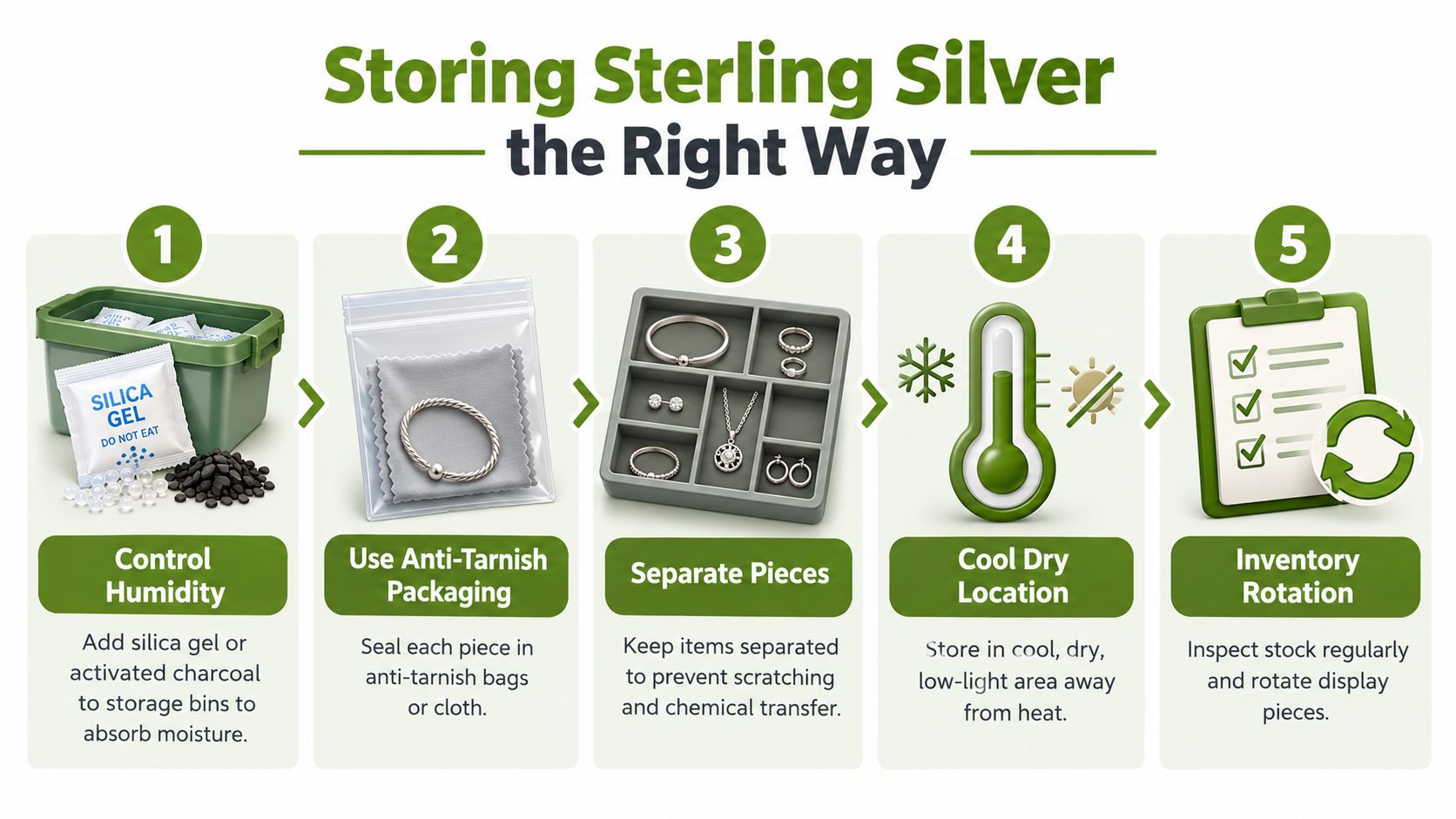
Storage is a system, not a pouch. Define the approved bag or box, insert material, anti-tarnish component, desiccant specification if used, closure method, label fields, stockroom location, inspection interval, and action for a failed check. A sealed package only helps when the piece and materials placed inside it are clean, dry, and compatible.
A simple storage routine for back rooms and ship-out desks
Use a low-air-exchange enclosure with supplier-approved anti-tarnish materials and, where the packaging plan calls for it, a suitable desiccant. Keep sorbents and desiccants from scratching the jewelry, follow their manufacturer’s capacity and replacement instructions, and validate the assembled package with retained samples under the intended storage conditions.
- Check before sealing. Confirm that jewelry and packaging are clean and free of residual moisture; hold any uncertain item for review.
- Check the enclosure. Use the approved bag or box and confirm its closure; a lining alone does not establish an air barrier.
- Follow the packing specification. Use the selected moisture and tarnish controls only where suitable for the complete assembly.
- Keep conditions stable. Avoid damp storage and record temperature changes that may warrant a moisture check.
- Separate every item. Chains should not tangle, and finished pieces should not rub against one another.
Do not approve a new insert solely because its color matches the old one. The silver clothing rail guide reference addresses display fixtures; it provides no qualification for a material enclosed with sterling silver.
Record any rework outside normal packing. Once an item has been cleaned or handled for photography, check and relabel its condition before returning it to reserve stock.
Wearing Sterling Silver Without Speeding Up Tarnish
Separate wearable display samples and customer returns from untouched stock. A quick visual glance is not sufficient to put a heavily handled sample straight back into a sealed replenishment lot.
Select the care card by SKU and finish, even when the order includes styles described in the non-tarnish cross necklace guide. Marketing wording should not override the pack-out instruction.
The best guidance is practical, not fussy:
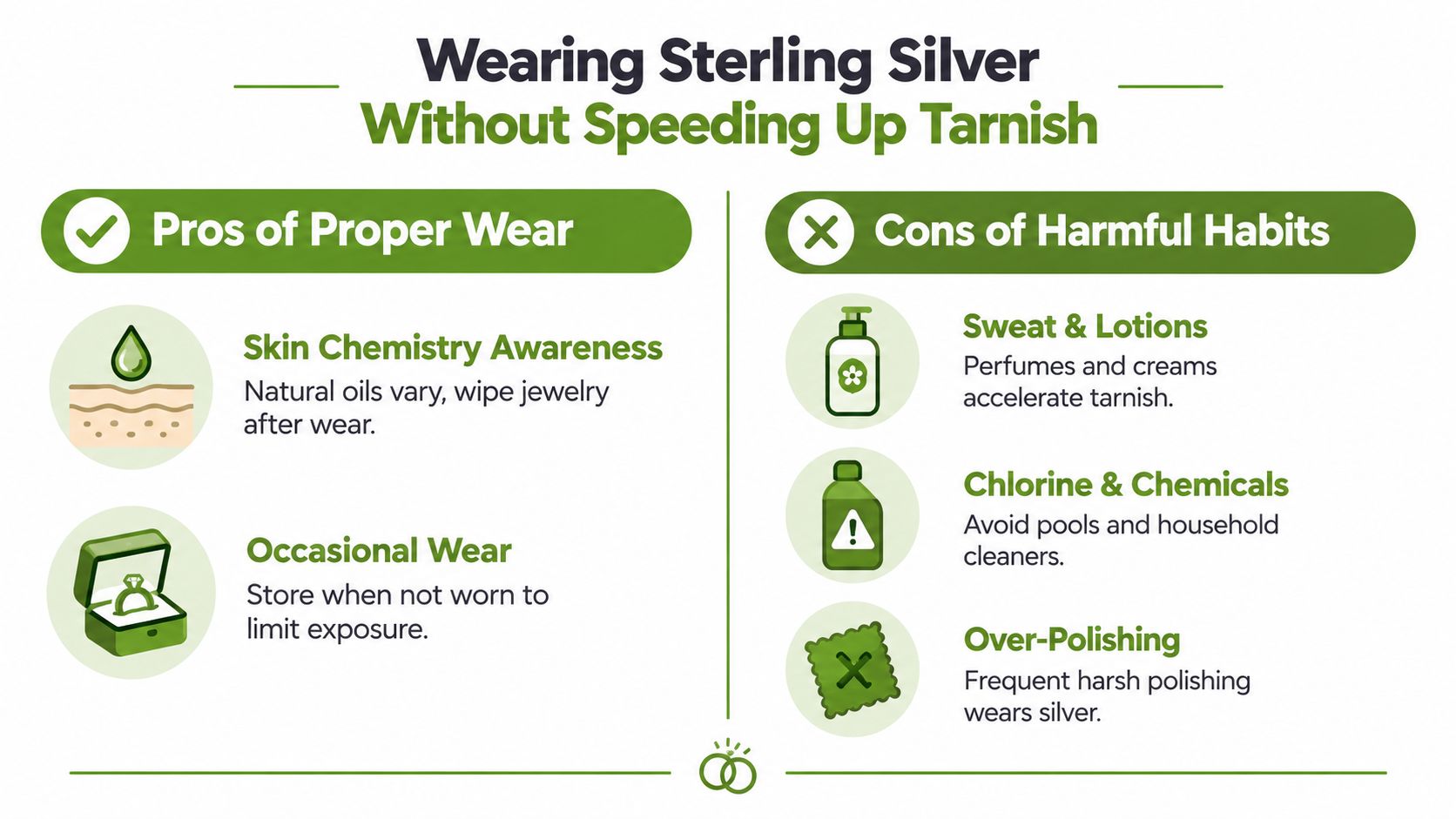
- Put jewelry on after lotion, perfume, sunscreen, and hair products.
- Take it off before swimming, showering, cleaning, or using bleach-based products.
- Wipe it with a soft cloth after wear so body oils do not sit on the surface.
- Put it back only when it is fully dry.
The person receiving a returned display sample should know where it has been and whether it was cleaned. Mark uncertain items for inspection rather than mixing them into a new lot.
For mixed-material designs, follow the most restrictive relevant component instruction. Obtain a revised packing specification when the assembly changes.
A Simple Daily Care Routine for Staff and Customers
Keep the packer’s work instruction separate from the customer’s care card. The first controls release and traceability; the second explains use after sale.
A printable routine retailers can teach at point of sale
The customer-facing Jewelry Care Guide is a useful companion to the shipment. Record the care-card version and language in the order’s packing specification.
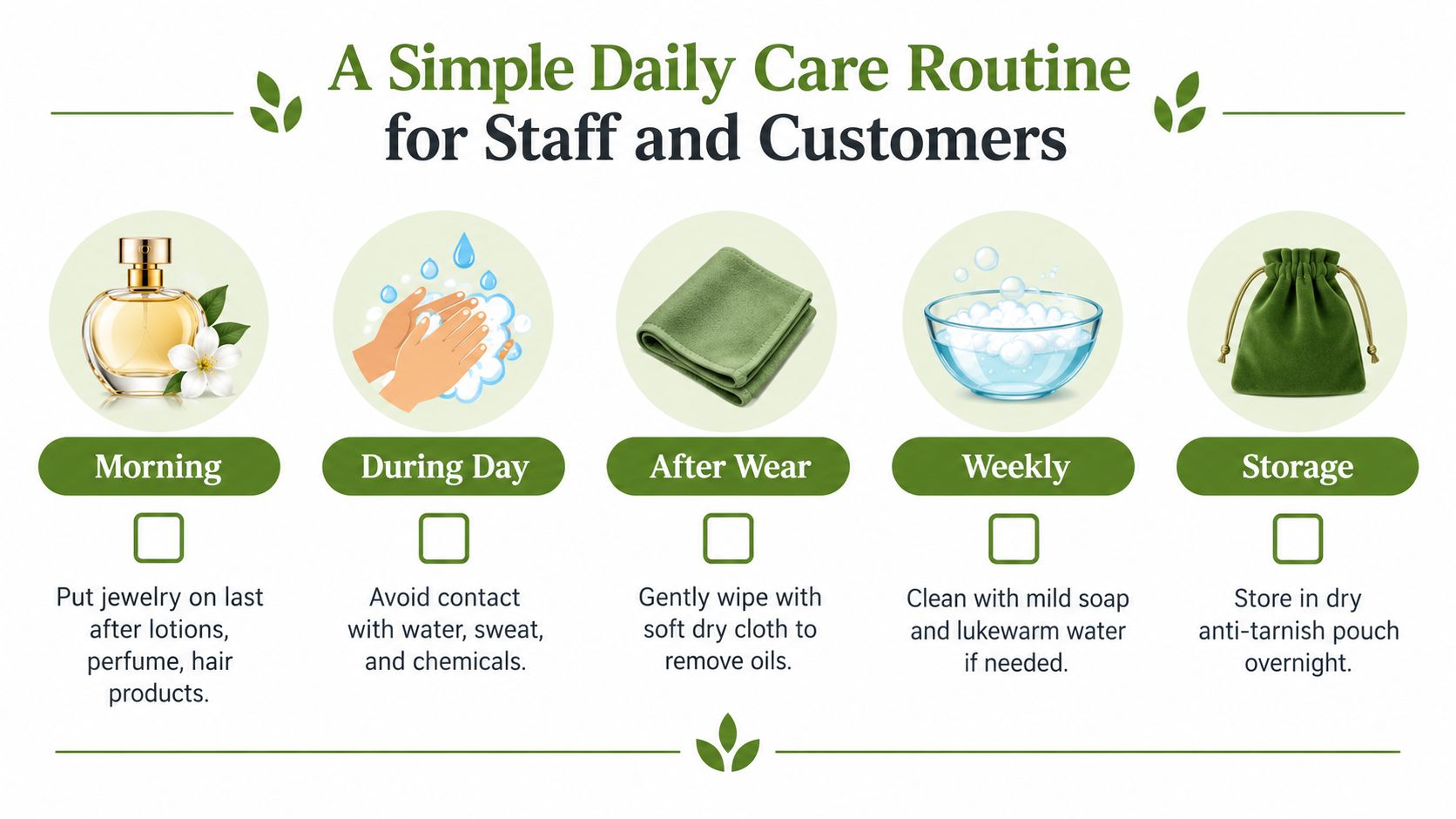
Check that the customer card covers these basic points, where suitable for the style:
- Morning: put jewelry on after lotion, perfume, and hair products.
- During the day: keep it away from sweat-heavy workouts, chlorinated water, and household cleaners.
- After wear: wipe with a soft, lint-free microfiber or untreated silver cloth.
- When cleaning is needed: follow the method approved for the whole piece; do not impose a fixed weekly wash on plated, pearl or mixed-material jewelry.
- Storage: place it in a dry anti-tarnish pouch or sealed bag overnight.
At final inspection, confirm the card matches the actual finish. Remove obsolete cards from the packing station to prevent accidental substitution.
What to say when a customer asks about cleaning
Packing staff should not improvise a cleaning method. Hold a marked item and request the approved procedure; return it to pack-out only after the documented check is complete.
Handling, Packaging, and Shipping Tips for Retailers
Outbound shipping needs the same controls as storage, plus evidence of the pack-out. Record who packed the order, the date, SKU and quantity, condition of the sampled pieces, materials used, and carton seal. If a customer later reports dulling, that record helps separate pre-shipment condition from transit, receiving, or post-delivery exposure.
Inspect cartons at receiving and keep exceptions separate. Record visible moisture, damaged seals, crushed packaging and affected quantities before changing the package.
Build the pack-out from the jewelry outward: separate each piece, prevent movement and scratching, use approved inserts and barriers, add the specified anti-tarnish or moisture-control component, close the primary package, cushion it in the carton, and include the correct care information. Do not mix unknown paper, foam, rubber, felt, or adhesives into the package simply because they look presentable.
For retailers who want a wider packaging reference, fragile item shipment tips covers the same basic logic, separation, cushioning, and moisture control. Those principles apply to silver just as they do to other delicate goods.
Mixed assortments need the same discipline. A piece like Gold Plated 925 Sterling Silver Pavé Paperclip Link Hoop Earrings combines a 925 sterling silver base, gold plating, and clear zirconia, so it should be packaged with the same care as other plated or stone-set silver. HonHo's wholesale earrings and 925 sterling silver jewelry assortments make that easier to apply across SKUs.
Record material substitutions and shortages before packing. If the approved inner barrier or insert is unavailable, get a replacement approved rather than quietly changing the specification.
Putting It All Together for Better Resale Value
A complete pack-out record should allow another person to reconstruct what was sent, in which packaging, and in what observed condition.
The inventory chain reaction retailers should watch
Review exceptions by SKU, lot and package version. Use the pattern to choose a corrective trial, then verify that trial before changing the standard process.
HonHo's Gold PVD Coating article is useful for buyers who are weighing finish choices across an assortment, because finish selection and care expectations belong in the same buying conversation. The bigger lesson is that prevention has to be documented. A care card, a packaging standard, and a staff routine turn tarnish control into part of the business model, not a clean-up task after the fact.
Use this review list when maintaining the SOP:
- Audit current storage. Check humidity, packaging materials, and whether silver sits near rubber, dust, or open air.
- Train staff on the daily routine. Keep the message short, last on, first off, wipe after wear.
- Check the specified protection. Use the approved anti-tarnish component where required, following its supplier instructions.
- Revise display rotation. Don't leave the same pieces under light and handling day after day.
- Include written care guidance with each sale. Give customers the same clarity your team uses.
Keep earlier package specifications with their order records. This allows later complaints to be assessed against the materials actually used rather than today’s revised packing method.
Approve the complete package before bulk pack-out
A bag described as “anti-tarnish” is not a complete packing specification. Record its supplier and product reference, dimensions, closure, insert materials, jewelry arrangement and any specified protective component. Keep the approved sample so a replacement packer can reproduce it.
The CCI silver-care note specifies sulfur-free archival tissue when describing protective wrapping. “Acid-free” alone should therefore not be your entire purchasing description. Ask the packaging supplier to identify what will touch the silver.
What should a packaging trial record?
| Record | Practical check |
|---|---|
| Starting condition | Identify the SKU, finish, lot and dated reference photographs. |
| Package version | List each component and document any substitution. |
| Exposure | Record actual storage duration, location, opening frequency and any known transport conditions. |
| Release decision | Compare surface condition, abrasion, tangling and closure integrity with agreed acceptance criteria. |
Questions about a travel case in this Reddit discussion illustrate why the enclosure itself belongs in a complaint record. For wholesale use, compare the proposed package with an approved reference before extending a change to the whole order. An informal trial helps screen options; it does not simulate every shipping route.
Do pearl-set designs need a separate packing rule?
Yes, review the complete assembly. GIA notes pearl sensitivity to dehydration, heat and chemicals. Do not prescribe stronger drying for every silver-and-pearl design just because it suits plain metal stock; have the supplier confirm a compatible package.
Keep customer returns in a separate inspection queue. For unresolved discoloration, follow the supplier-escalation checklist before cleaning or changing the original package.
Warehouse and Fulfillment SOP
| Stage | Required check | Record or hold point |
|---|---|---|
| Receiving | Confirm PO/SKU/quantity; inspect a defined sample under neutral light; check seals, inserts, residue, moisture, haze, and abrasion | Photograph exceptions before cleaning or repacking; quarantine affected units |
| Put-away | Keep items individually protected, fully dry, and away from unapproved sulfur-emitting or abrasive materials | Label location, pack date, lot/carton reference, and next inspection |
| Display replenishment | Move only the required quantity; use clean handling tools; do not return damp or heavily handled pieces directly to back-stock | Separate returns from untouched inventory until checked |
| Routine inspection | Compare a retained control sample and inspect the package, not just the jewelry surface | Record condition and replace control materials according to their supplier instructions |
| Outbound pack-out | Verify SKU, finish, quantity, piece separation, approved inserts, closure, cushioning, and care card | Save the pack date, packer, sampled condition, and carton seal reference |
| Complaint or exception | Stop rework, preserve one untreated piece, collect photos and handling history | Escalate with PO, SKU, quantity affected, packaging evidence, storage/transit facts, and cleaning attempts |
Before ordering, send HonHo the SKU or design reference, base material and finish, stones/components, quantity, destination and climate concerns, intended storage duration, opening frequency, packaging format, and acceptance checks. HonHo can confirm available options for the inquiry; MOQ, packaging, coating, test route, and production timing must be confirmed for the specific order rather than inferred from general factory capability.
Browse HonHo Wholesale Jewelry's latest collections to compare jewelry constructions against your fulfillment process. For a B2B packaging or sample discussion, contact HonHo Wholesale Jewelry with the SKU, finish, quantity, destination, storage and shipping conditions, packaging specification, and acceptance checklist.


