

For wholesale buyers, button covers are a fit-and-mechanism product before they are a fashion product. A design is ready for a bulk order only after a sample closes securely over the intended garment button, leaves enough room for the buttonhole and placket, and can be removed without marking the fabric.
The fastest way to qualify a SKU is to record the base button's face diameter and profile, identify the cover's fastening mechanism, and test that exact combination on the target garment. “Fits cardigan buttons” is not a specification. A reference garment, measured button, mechanism close-up, and approved sample are.
Table of Contents
- What Button Covers for Women Actually Are
- A Short History of Covered Buttons in Women's Fashion
- Sizing and Fit for Different Garments
- Materials, Finishes, and Skin Contact Safety
- Wholesale Pricing, MOQs, and Markup Math
- Merchandising Button Covers Alongside Other Jewelry
- Buying Checklist and Next Steps for Retailers
What Button Covers for Women Actually Are
In this guide, button covers means removable decorative fittings placed over an existing garment button. They are not the same as covered buttons: button components wrapped in fabric or another material and sewn to a garment, commonly through a shank. The names are easy to confuse, but the purchasing questions are different.
Removable covers may use a hinged clip, spring action, or another supplier-specific fastening construction. The mechanism is part of the SKU. A front view alone cannot show which button profile it accepts, how much clearance it needs, or whether it may rub the fabric.
Wholesale specifications should therefore separate four items:
- Decorative face: diameter, depth, design, color, base material, and surface finish
- Back mechanism: construction, material, opening direction, internal clearance, and closing tension
- Compatible base button: face diameter, thickness or dome, sew-through or shank construction, and thread clearance
- Garment context: fabric, placket thickness, button spacing, buttonhole clearance, and intended wearing position
Why they belong in a jewelry assortment
Button covers can work beside jewelry because shoppers read the visible face as an outfit accent. They can be grouped with earrings, necklaces, bracelets, or brooches by finish family without claiming that the underlying materials or wear conditions are identical.
The category is especially suitable for a small test assortment when the retailer can demonstrate fit. A sample garment, a mechanism close-up, and a simple measurement card usually provide more selling value than adding more decorative designs.
What usually goes wrong
Most failures begin with incomplete compatibility information. A cover may match the button's face diameter but still fail because the button is too domed, sits too close to the fabric, or leaves too little room to pass through the buttonhole after the cover is attached. A strong clip may also mark a delicate fabric even when the metal parts remain intact.
Wholesale rule: if the supplier and buyer cannot identify the fastening mechanism, accepted base-button range, and sample approval method, the design is not ready for a volume decision.
A Short History of Covered Buttons in Women's Fashion
Buttons have long served as both closures and decoration. Fashion histories, including this history of the button in fashion, show how visible buttons acquired an ornamental role across different periods of dress. That context explains why a decorative cover is intuitive to shoppers, but it does not define today's product construction or fit.
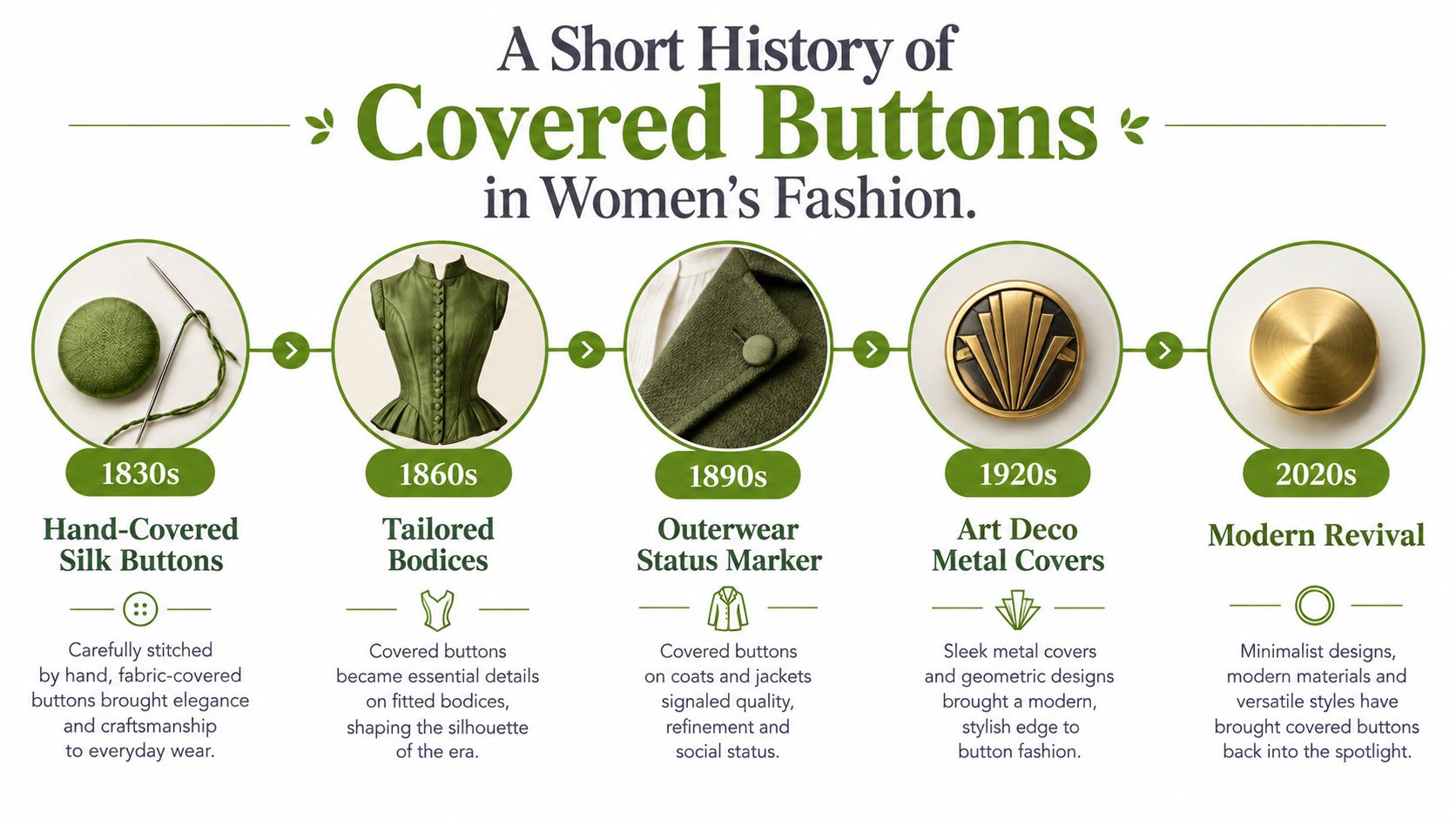
Historical references to fabric-covered, shank-backed buttons describe a different product category from many removable covers sold today. this covered button history reference is useful background for that tradition; it should not be used as evidence that a modern clip-on cover has a particular mechanism, material, or performance level.
Why that history still matters to buyers
The commercial lesson is modest: customers already understand a visible button as decoration. The buyer's job is to make the modern attachment method legible. Showing the cover installed, open, closed, and beside a measured base button turns a familiar idea into a product that can be evaluated.
This is also why button covers can sit beside garment-facing accessories such as extra large brooches. The merchandising relationship is visual; the fit, fastening, care, and safety specifications still need to be stated separately.
Sizing and Fit for Different Garments
Diameter is necessary, but it is not sufficient. Retail guidance such as this styling guide on button cover fit helps explain the concept to consumers, while a wholesale approval record must capture the complete button-and-garment combination.
How to measure correctly
Measure the existing button straight across its widest point with a caliper where possible. Then record its maximum thickness or dome, the clearance between the button and fabric, and whether it is a sew-through or shank button. Photograph the button from the front and side with the scale visible.
Next, check the garment rather than relying on a garment label. Two cardigans can use buttons with different profiles, spacing, and placket thickness. A general jewelry size guide can reinforce the habit of measuring, but a button-cover listing still needs its own compatibility data.
Button cover sizing by garment type
| Approval field | What to record | Why it changes the decision |
|---|---|---|
| Base-button face | Diameter and flat, domed, or irregular profile | Determines whether the cover can seat and close |
| Button depth | Maximum thickness plus thread or shank clearance | A matching diameter can still be too thick for the mechanism |
| Cover mechanism | Open and closed dimensions, hinge or clip path, closing tension | Shows how the cover captures and releases the button |
| Placket and fabric | Fabric type, layers, thickness, and button spacing | Reveals rubbing, puckering, and overlap problems |
| Closure clearance | Fit through the actual buttonhole before and after installation | An installed face may obstruct normal fastening |
| Use cycle | Attach, wear, unbutton, remove, and inspect | Finds slippage, marks, sharp edges, or loosening before bulk |
Do not turn one successful sample into a universal size claim. Approve a stated range only after testing representative buttons at both ends of that range.
Common fit problems buyers should expect
| Observed problem | Likely check | Purchasing response |
|---|---|---|
| Cover rotates or slips | Button profile, internal clearance, and closing tension | Reject the pairing or request a mechanism adjustment |
| Cover will not close | Button thickness, dome, thread build-up, or shank clearance | Do not force it; retest with the intended button range |
| Garment puckers | Clip pressure and placket or fabric thickness | Use a different mechanism or exclude delicate fabrics |
| Buttonhole becomes hard to use | Decorative face diameter, depth, and adjacent spacing | Reduce face size or revise the intended garment |
| Finish rubs or fabric is marked | Back edges, hinge movement, burrs, and contact points | Reject the sample until the edge and mechanism are corrected |
The same discipline applies in jewelry categories: small profile differences change use and fit. The Gold Plated Stainless Steel Chain Bracelet Collection offers a useful visual reminder that similar-looking designs can drape and feel differently, but it is not a specification reference for button covers.
Materials, Finishes, and Skin Contact Safety
Ask about the decorative face and the fastening mechanism separately. A listing described as “stainless steel” may not tell a buyer whether every component, including a spring, pin, soldered joint, decorative insert, or plating layer, uses the same material.
Material names also do not predict finished-product performance on their own. Edge finishing, plating preparation, assembly, hinge movement, storage, perfume exposure, and repeated handling can all affect appearance and use.
How the main materials compare
| Material or construction | Useful purchasing question | What not to assume |
|---|---|---|
| Stainless steel | Which grade and which parts are steel? | “Stainless” alone does not prove a specific grade, nickel-release result, or finish life |
| Brass | What plating stack and protective finish are used? | Base metal does not establish color retention or skin-contact suitability |
| 925 sterling silver | Is 925 used for the face, mechanism, or both, and how is it marked? | A silver face does not mean the spring or clip is silver |
| Other alloy | Can the supplier provide a material declaration for every metal component? | “Alloy” is not a usable compliance specification |
| Enamel or decorative insert | How is it bonded, and are edges and recesses fully finished? | Front decoration does not describe the underlying metal or mechanism |
What tends to work best
There is no universally safest material choice for every customer, finish, mechanism, and market. Choose the construction that meets the intended design, cost, compliance, and use requirements, then approve the finished sample rather than a material label.
For a core program, prioritize repeatable mechanisms, smooth back edges, finish consistency, and traceable specifications. For a seasonal color capsule, decorative range may matter more, but the same closure and surface checks still apply.
Approve the complete cover—face, back, hinge or clip, plating, and assembly—not a material name in isolation.
Skin contact and compliance
Requirements depend on the target market and intended contact. The EU nickel restriction addresses articles intended for direct and prolonged skin contact and sets different requirements for post assemblies used in pierced parts of the body. The existing Nickel Institute paper on EU nickel limits summarizes the rule and includes garment components such as metal buttons among possible examples. It does not prove that a particular button cover is compliant, and the piercing-post limit should not be applied to a garment accessory without a valid reason.
Before ordering, define the selling market, likely placement, duration of skin contact, and every metal component. Ask for a current material declaration and the specific test report or compliance evidence required for that market. A generic “nickel free” statement or a report for a different construction is not a substitute for evidence tied to the ordered item.
Use a jewelry materials and plating guide to structure supplier questions, while keeping the final SKU specification and applicable market requirements separate.
Wholesale Pricing, MOQs, and Markup Math
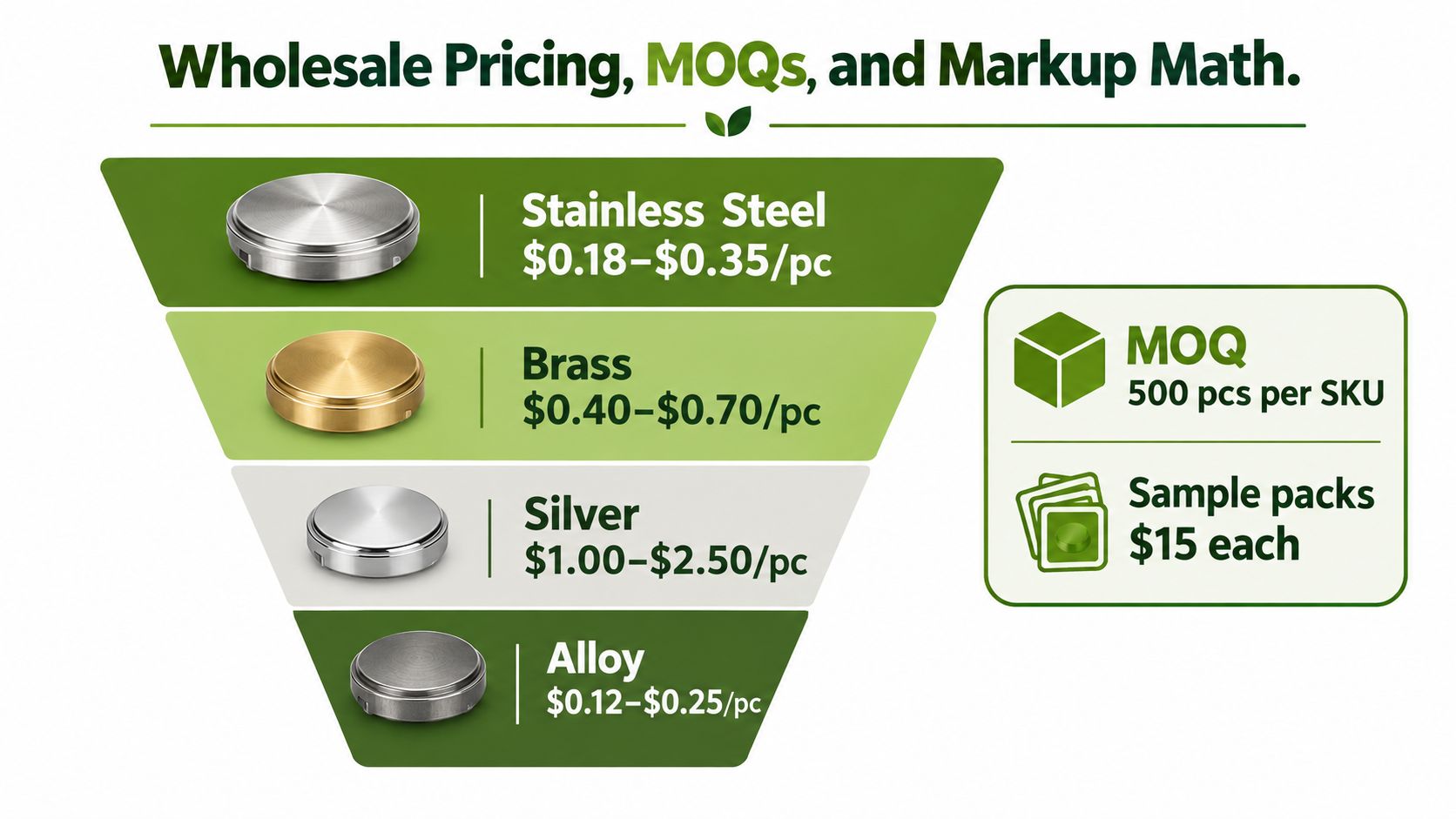
Price the sellable set, not only the metal piece. Mechanism complexity, decoration, plating, packaging, inspection, freight, duties, relabeling, replacements, and expected returns can matter more than a small difference in factory unit price.
this jewelry markup calculator guide describes keystone as a common starting framework. It is a calculation convention, not a recommended retail price or guaranteed margin for button covers.
What wholesale buyers can use as a market baseline
Broad supplier articles such as this overview of wholesale jewelry supplier economics can help a new buyer identify cost categories, but their generalized price, MOQ, markup, or starting-capital ranges are not HonHo quotations and should not be treated as current market facts for a specific button-cover order.
Build the working baseline from a written quotation for the exact design. The quote should state unit basis, set or piece count, approved materials and finish, packaging, quantity breaks, sample charges, tooling where relevant, production lead time, test or documentation scope, and shipping terms.
Where buyers misread the margin
A useful internal calculation is:
Landed cost per sellable set = product cost + packaging + allocated freight and duties + inspection and relabeling + expected replacement or return allowance.
Then test the proposed retail price against payment fees, selling costs, markdowns, and the time required to answer fit questions. MOQ and wholesale pricing information provides HonHo's general planning context; the quotation for the specific design remains controlling.
Order structure that usually makes sense
Start with an approval sample and a narrow set of clearly different mechanisms or sizes. A mixed test only produces useful evidence if each variant is labeled and tied to its sample record.
For HonHo custom development, the current general planning baseline is 50 pieces per style and color. Typical sample planning is 25–30 days for brass or 925 silver and 25–35 days for stainless steel, with typical bulk production at 35–45 days. These are planning baselines for custom work, not guaranteed terms for every button-cover design or ready-stock SKU; mechanism feasibility, tooling, materials, tests, packaging, quantity, and the final quotation must be confirmed.
Merchandising Button Covers Alongside Other Jewelry
Button covers work best when the merchandising answers the compatibility question before introducing a matching jewelry suggestion. The product page and display should make the attachment method visible.
Where they fit in a mixed order
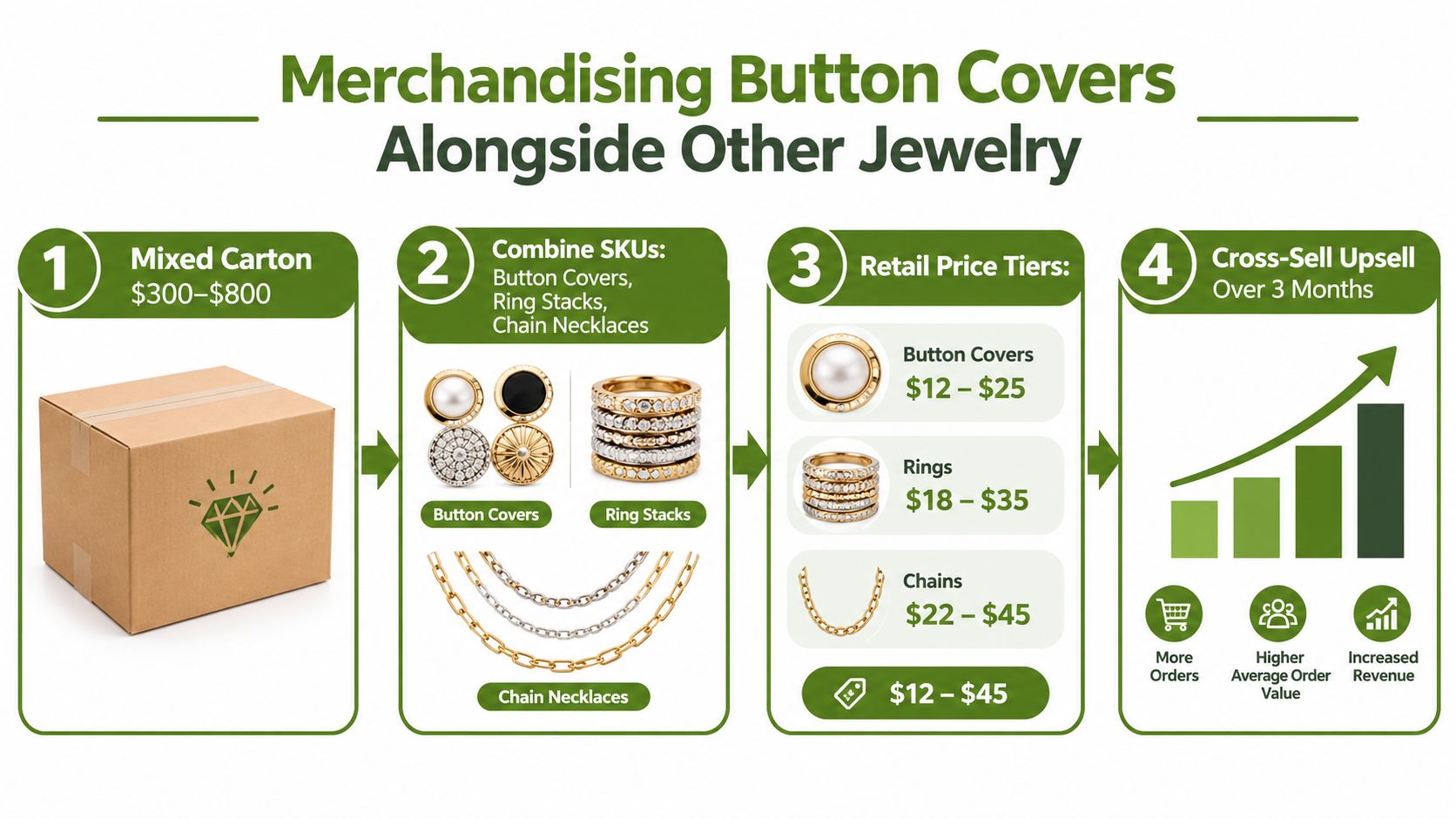
Use them as a small garment-accessory capsule beside proven categories, not as unqualified filler. Separate ready-stock availability from custom-development capability, and never imply that a material or finish offered elsewhere in the assortment is automatically available for this mechanism.
HonHo supplies ready-stock and custom jewelry across stainless steel, brass, and 925 sterling silver categories. A button-cover inquiry still needs its own feasibility check, sample, material specification, and quotation.
How to merchandise online
A useful product page should show:
- the cover by itself from the front and back;
- the mechanism open and closed;
- the cover installed on a measured reference button;
- a side view showing profile and garment clearance;
- the number of covers in the sellable set;
- compatible and incompatible examples;
- removal, care, and washing guidance tied to the approved construction.
Use precise titles such as “gold-tone hinged button covers for 11–12 mm flat sew-through buttons” only when that range and mechanism have been verified. Avoid garment-only labels that sound universal.
How to merchandise in a boutique or stall
Mount one sample on a real garment or fabric card and keep one loose sample available to show the back. Add a small measurement reference and a notice telling customers to check their own button profile, not just the apparent size.
Do not leave the mechanism to be repeatedly forced open without instructions. A demonstration sample and sealed sellable stock reduce handling damage and make it easier to identify genuine defects.
Pairing logic that actually sells
Pair by visual finish after confirming fit. Gold-tone covers can sit beside gold-tone earrings or chains, while silver-tone covers can sit beside cooler metal stories. Describe that as coordination, not as proof that the items share a base metal, plating process, test result, or expected wear life.
A concise staff sequence is:
- Ask which garment and button the customer intends to use.
- Check face diameter, profile, depth, and mechanism compatibility.
- Explain attachment, removal, and care.
- Only then suggest coordinated jewelry.
Buying Checklist and Next Steps for Retailers
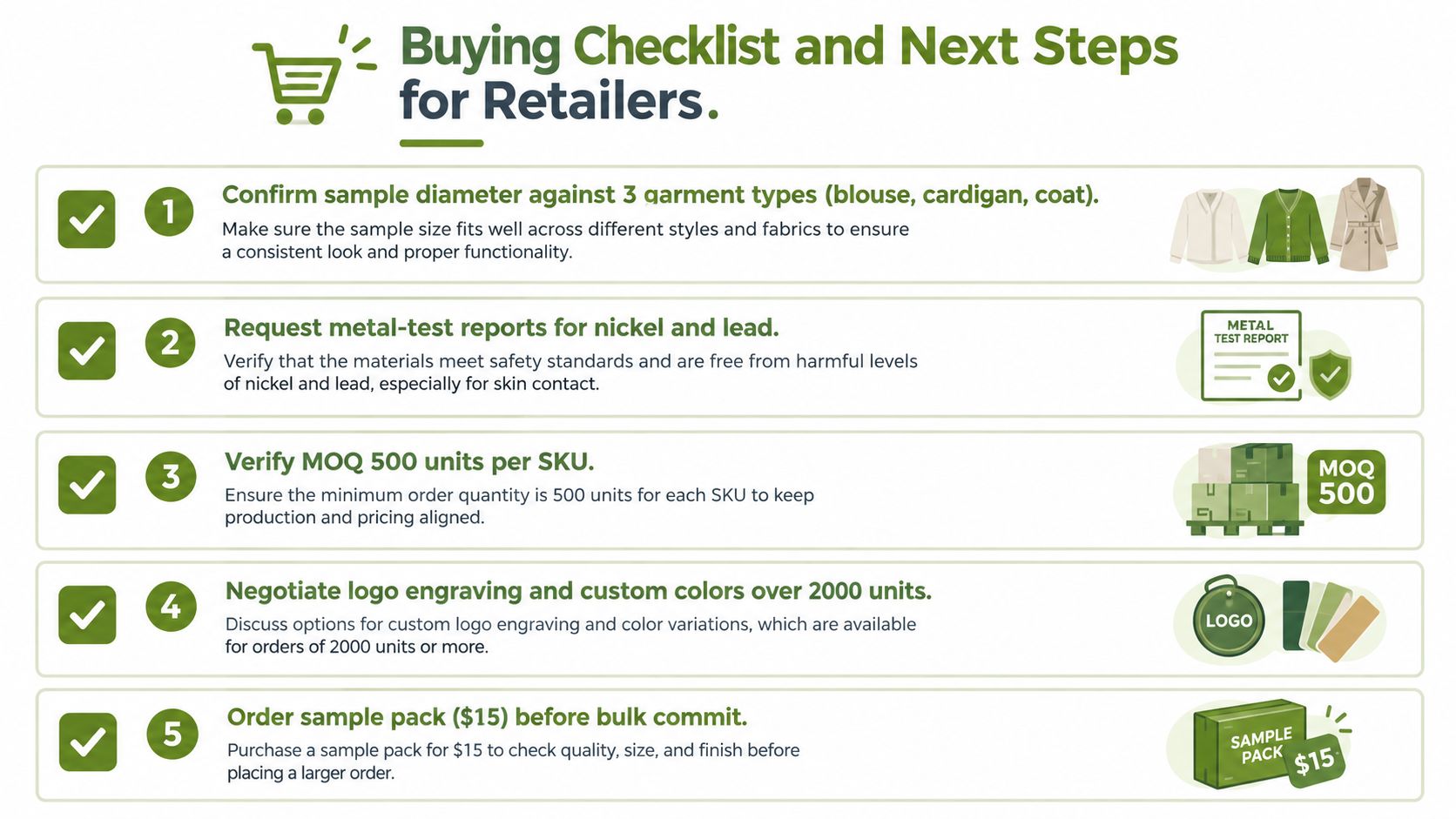
The buying record should make a repeat order auditable. Save the approved sample photos, dimensions, supplier quotation, material declaration, packaging layout, test documents where applicable, and any approved deviations under one style reference.
Pre-order checks worth doing every time
| Check | Approval evidence |
|---|---|
| Mechanism and fit | Open/closed photos, measured base buttons, and results at both ends of the claimed range |
| Garment interaction | Buttonhole clearance, fabric inspection, placket movement, and removal check |
| Construction | Face, back, hinge or clip, edges, joints, decoration, and set count confirmed |
| Material and finish | Written component-level specification and approved color/finish sample |
| Market requirements | Applicable documentation tied to the target market and ordered construction |
| Packaging and care | Approved carding, measurement note, attachment instructions, and washing/removal guidance |
| Commercial terms | MOQ, sample and bulk lead times, quantity basis, packaging, tests, tooling, and shipping terms |
Accessibility and usability deserve more attention
this adaptive clothing design study discusses broader closure and dressing considerations for women with lower-limb prostheses. It does not test removable button covers and should not be used to claim that they improve accessibility.
If accessibility is part of the design brief, evaluate the exact sample with representative users and the intended garment. Record grip area, force, number of motions, fine-motor demands, accidental opening risk, and whether the larger decorative face obstructs the buttonhole. Do not infer a universal benefit from appearance or size.
What to do after the first test order
Track questions and returns by failure mode: wrong diameter, incompatible profile, closure obstruction, fabric marking, mechanism failure, finish issue, or unclear instructions. That evidence tells the buyer whether to revise the listing, narrow the compatibility claim, adjust the mechanism, or stop the style.
A wholesale ordering guide helps standardize the commercial steps. For a useful button-cover quotation, send the front and back design reference, target mechanism, measured base-button diameter and profile, garment or placket photos, requested material and finish, quantity by style and color, packaging, target market, and required test or documentation scope.
HonHo Wholesale Jewelry can review ready-stock sourcing and custom-development requirements alongside a broader jewelry assortment. Availability and specifications depend on the exact design: request confirmation for the mechanism, materials, finish, sample plan, MOQ, lead time, packaging, and evidence needed for your market before placing a bulk order.


