

Black onyx and black agate are both chalcedony, and suppliers do not always use the names consistently. In traditional gem terminology, onyx has relatively straight, parallel bands; agate has curved or concentric bands. A solid-black stone may show neither feature, especially after dyeing.
For a wholesale order, the useful distinction is not the label alone. Confirm the visible banding, color treatment, lot-to-lot consistency, polish and documentation before you approve product copy. That evidence tells you more than whether an invoice says “onyx” or “agate.”
Table of Contents
- What Buyers Need to Know First
- Black Onyx and Black Agate in Mineralogy
- Key Differences Between Black Onyx and Black Agate
- How to Verify Treatment and Quality in Wholesale Lots
- Durability, Care, and Performance in Jewelry
- Which Stone Fits Your Jewelry Line
- Wholesale Buying Recommendations
What Buyers Need to Know First
Start by treating the invoice name as a claim to verify, not a complete specification. “Black onyx” and “black agate” both refer to chalcedony in commercial use, and a supplier may use either term for uniformly black material.
The practical dividing line is usually disclosed treatment versus an unsupported assumption of natural color. Much commercial black onyx is dyed chalcedony; the International Gem Society describes in its black onyx profile how the traditional sugar-and-acid process blackens chalcedony, while GIA notes that material sold as black onyx is often dyed black chalcedony. An even black face is therefore a reason to ask for treatment information, not proof that the color is natural.
If your listing promises “natural black onyx” but the supply record supports only dyed chalcedony, the problem reaches beyond wording: returns, marketplace disputes and future reorders all become harder to manage.
Buying rule: Treat the stone's name, visible appearance, and treatment status as three separate product details.
Before approving a lot, ask for photographs under neutral lighting and a written statement covering dyeing or other enhancement, and keep a retained sample for comparison with later deliveries. Write the description around what you can verify: "dyed black chalcedony" or "black agate, color treated" is defensible copy. "Natural black onyx" needs documentation behind it.
A working jewelry sample approval checklist turns this into routine: each lot is checked against the retained reference, and every treatment claim is logged before the listing goes live. When the next shipment arrives, your team compares stone against stone rather than relying on memory.
Black Onyx and Black Agate in Mineralogy
Black onyx isn't a separate mineral from agate. Both are chalcedony, the microcrystalline form of quartz. Traditional onyx is distinguished by straight, parallel bands, often alternating black and white. Agate is the broader name for banded chalcedony whose layers may curve or form concentric patterns. This is the core distinction in Mindat's explanation of the relationship between onyx and agate.
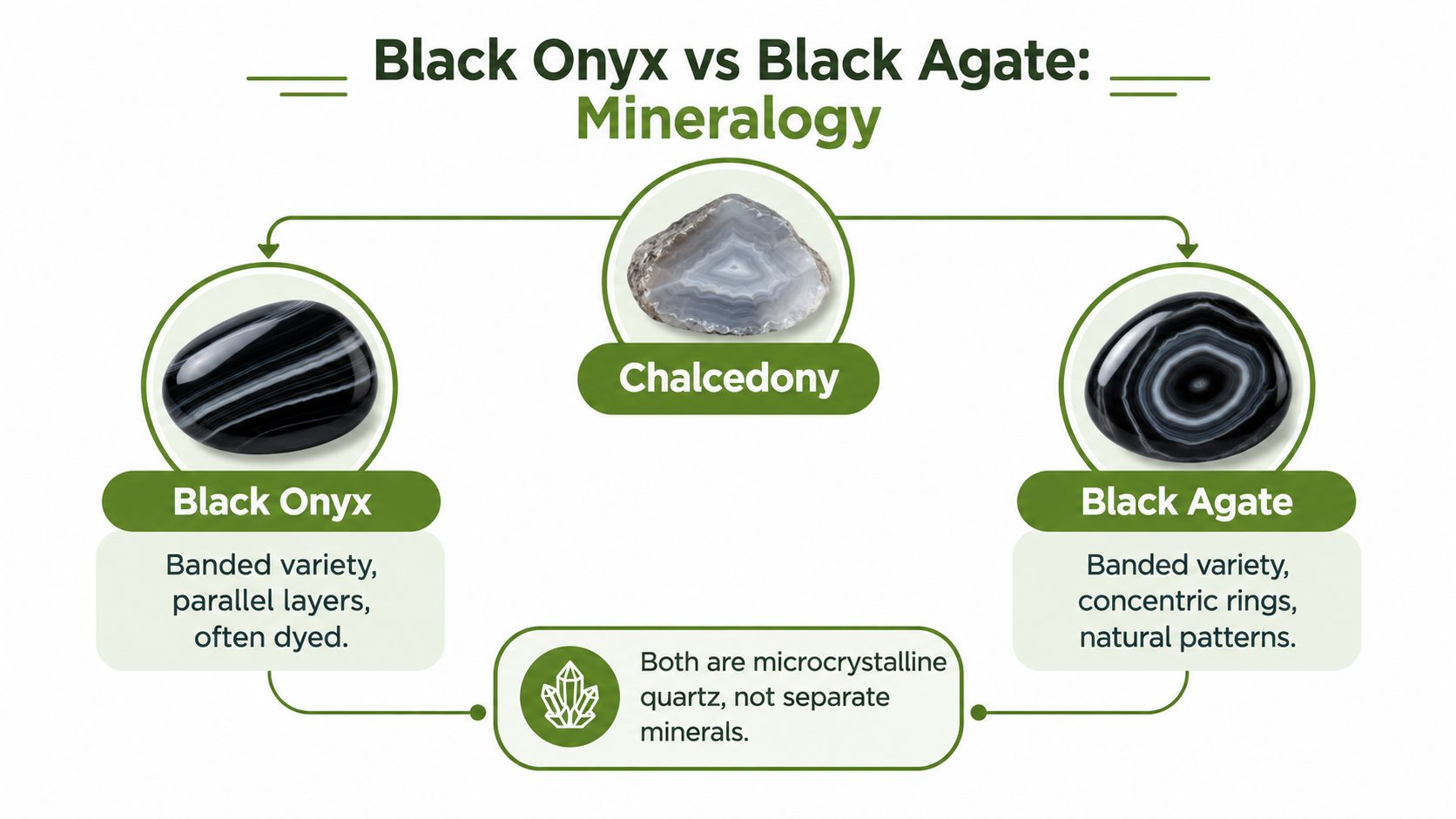
Band geometry is a useful clue, not a guarantee
Look at the pattern rather than relying on the name. Relatively straight, parallel bands support the traditional onyx description. Curved or concentric layers fit the usual description of agate. But the categories aren't always rigid in mineralogical commentary or commercial practice, and treatments can make the original pattern hard to see.
If a stone has no visible banding, “black chalcedony” may be a more precise description than insisting on a geological distinction that the appearance can't confirm. For a wholesale product page, separate the observable feature from the trade name: state whether the stone shows parallel bands, curved agate banding, or a solid-black appearance.
Why a precise description matters
Customers use product names to form expectations about pattern and color. A buyer who orders a “black agate” bead may expect visible natural-looking layers, while someone choosing “black onyx” may expect a polished, uniform black surface. If the material is dyed and the pattern is obscured, the listing should make that clear rather than implying a specific natural appearance.
This also makes product comparisons more useful across suppliers. A name can vary from seller to seller, but a description of visible banding and disclosed treatment gives your purchasing team a clearer basis for matching one lot to another.
Key Differences Between Black Onyx and Black Agate
The table below works as a practical guide rather than proof that every stone sold under either name follows a strict geological rule. Trade names overlap in commercial practice, and treatment can hide the banding features that would otherwise tell the stones apart. In most orders, the decision is treated versus natural, not onyx versus agate.
| Criterion | Black Onyx | Black Agate |
|---|---|---|
| Composition | Banded chalcedony, a microcrystalline form of quartz | Banded chalcedony, a microcrystalline form of quartz |
| Traditional banding | Straight, parallel bands | Curved, concentric, or irregular banding |
| Typical commercial appearance | Often sold with a uniform black appearance | May be sold with visible curved bands or a uniform black appearance |
| Treatment consideration | Much commercial material may be dyed | May also be dyed to produce a dark, even color |
| Hardness | Mohs ~6.5–7; hardness identical to agate | Mohs ~6.5–7; hardness identical to onyx |
| Commercial naming | Can be used for treated black chalcedony | Can be used for treated black chalcedony |
| Best use in a purchase specification | Record parallel banding if visible, plus treatment and color standard | Record curved or concentric banding if visible, plus treatment and color standard |
Treatment can outweigh the trade name
One documented blackening method impregnates chalcedony with sugar and then uses sulfuric acid to leave carbon in its pores. That is a recognized treatment route, not a diagnosis you can make from a product photograph. GIA's study of black opaque gem materials also shows why identification becomes difficult when a stone is opaque and uniformly dark.
A Mohs scratch result near 7 cannot separate natural black color from treated color, because both stones are quartz-rich chalcedony with the same hardness. Scratching may help reject softer simulants such as plastic, but it is not a treatment test and it can damage merchandise. Keep it out of your approval process.
For wholesale sourcing, record the appearance and the treatment disclosure independently of the label. Ask suppliers to state the treatment in writing on the invoice or spec sheet. A description that names the banding type and the disclosed process gives your product team a specification they can hold a shipment against, which a trade name alone never does.
How to Verify Treatment and Quality in Wholesale Lots
A non-destructive inspection can help you screen representative samples before approving a larger lot. Start with transmitted light: illuminate a thin edge and look for translucency or banding that is not apparent on the polished face. Relatively straight, parallel bands support the traditional onyx description, while curved or concentric patterns support an agate description. GIA documents this kind of edge examination in its work on black opaque gem materials. A solid-black appearance alone does not establish that the color is natural. Visual inspection guidance for black onyx
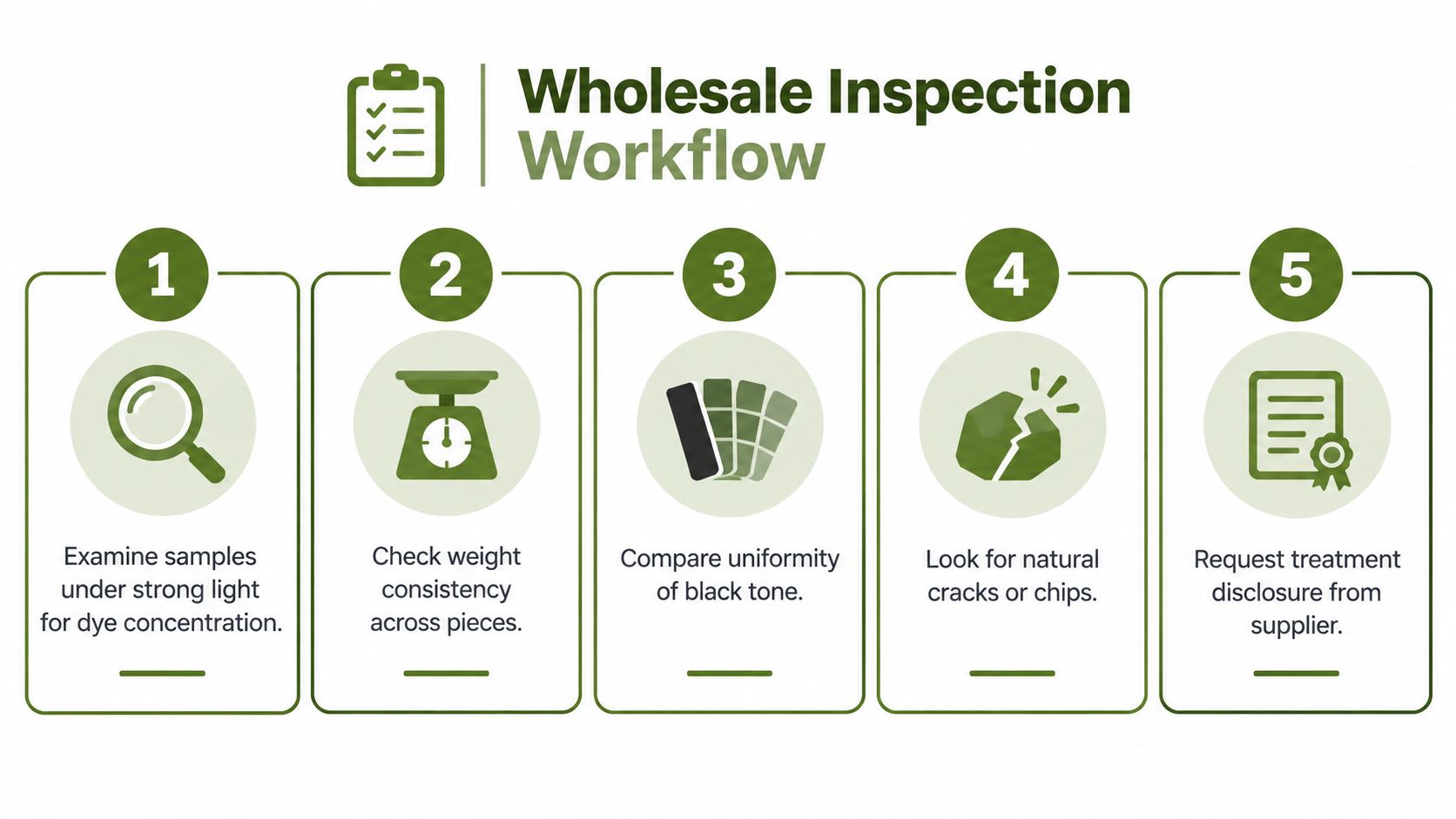
Check sample details that can expose uneven color
Inspect drill holes, chipped edges, fractures, and polished recesses. Dye may pool in openings or appear more concentrated in porous areas; a lighter interior can also signal that the surface color doesn't extend evenly through the stone. These clues warrant a supplier question, not an unsupported conclusion about every piece in the batch.
Compare pieces under the same neutral lighting and note any differences in black tone, finish, translucency, and visible banding. Ask for batch-level photographs, since a single attractive sample can't show how consistent the rest of an assortment is. If you approve the lot, retain a reference sample so your team can compare it with later deliveries.
Request the information that belongs on the order record
Ask the supplier to state in writing whether the stones are dyed or have another known color enhancement. Keep that answer with the product specification, along with your approved photographs and reference sample. On the product sheet, record material identity separately from treatment status and appearance.
| Approval record | What to capture | Hold the lot when |
|---|---|---|
| Material name | Supplier term plus observable banding or solid-black appearance | The name and sample appearance conflict without an explanation |
| Color treatment | Dyed, other enhancement, none stated, or unknown | Copy claims natural color but the supplier will not document it |
| Visual standard | Approved photos, black tone, polish, translucency and acceptable variation | The production sample falls outside the agreed range |
| Reference sample | Dated retained piece tied to the lot or purchase order | Future deliveries cannot be compared with the approved standard |
For U.S.-facing listings, treatment disclosure also has a regulatory basis. The FTC Jewelry Guides call for disclosure when a gemstone treatment is not permanent, creates special-care requirements, or significantly affects value. This article is a purchasing guide, not legal advice, but it is a strong reason to keep treatment status in the order record instead of leaving it in an email thread.
This approach helps reduce the risk of mislabeling and gives your team a repeatable basis for incoming inspection. It also supports more accurate consumer-facing copy. For related guidance on distinguishing material details from surface finishes, consult the jewelry materials and plating guide.
Durability, Care, and Performance in Jewelry
Black onyx and black agate are quartz-based chalcedony and suit many jewelry applications, but they are not immune to chips or impact damage. More importantly, hardness isn't a guarantee of color stability. It does not tell you whether the stone is dyed, whether a treatment needs special care, or how consistent the finish will be across a lot.
Surface condition matters during selection. Porous areas may absorb contaminants or show uneven color, while a well-polished surface offers better resistance to routine abrasion. Inspect stones intended for rings or bracelets closely, since those pieces can see more contact with surfaces than jewelry worn in less exposed positions. Choose pieces with consistent polish and no obvious color irregularities for a cleaner, more dependable presentation.
A durable base material and a stable-looking color are different buying questions. Check both before you write the product description.
Care instructions should be practical and cautious. Tell customers to avoid rough handling and to follow any care guidance appropriate to the finished jewelry, particularly when treatment information is available. Don't promise that black color is permanent unless the supplier has provided documentation that supports the claim.
For listings, describe what a customer can see and what you know. “Polished black chalcedony” describes material and finish broadly; “black agate with curved banding” gives a more specific visual description when the pattern is present. If the stone is treated, disclose that rather than presenting a uniform black appearance as proof of natural color. HonHo's jewelry care guide can help you align customer-facing care information with the finished piece.
Which Stone Fits Your Jewelry Line
Consider a boutique building a minimalist collection around clean shapes. A solid-black cabochon can suit a pendant or open bangle whether the supplier calls it black onyx or black agate. The decision should turn on the actual stone's color, polish, banding, and disclosed treatment, not on a name that may be used differently across the trade.
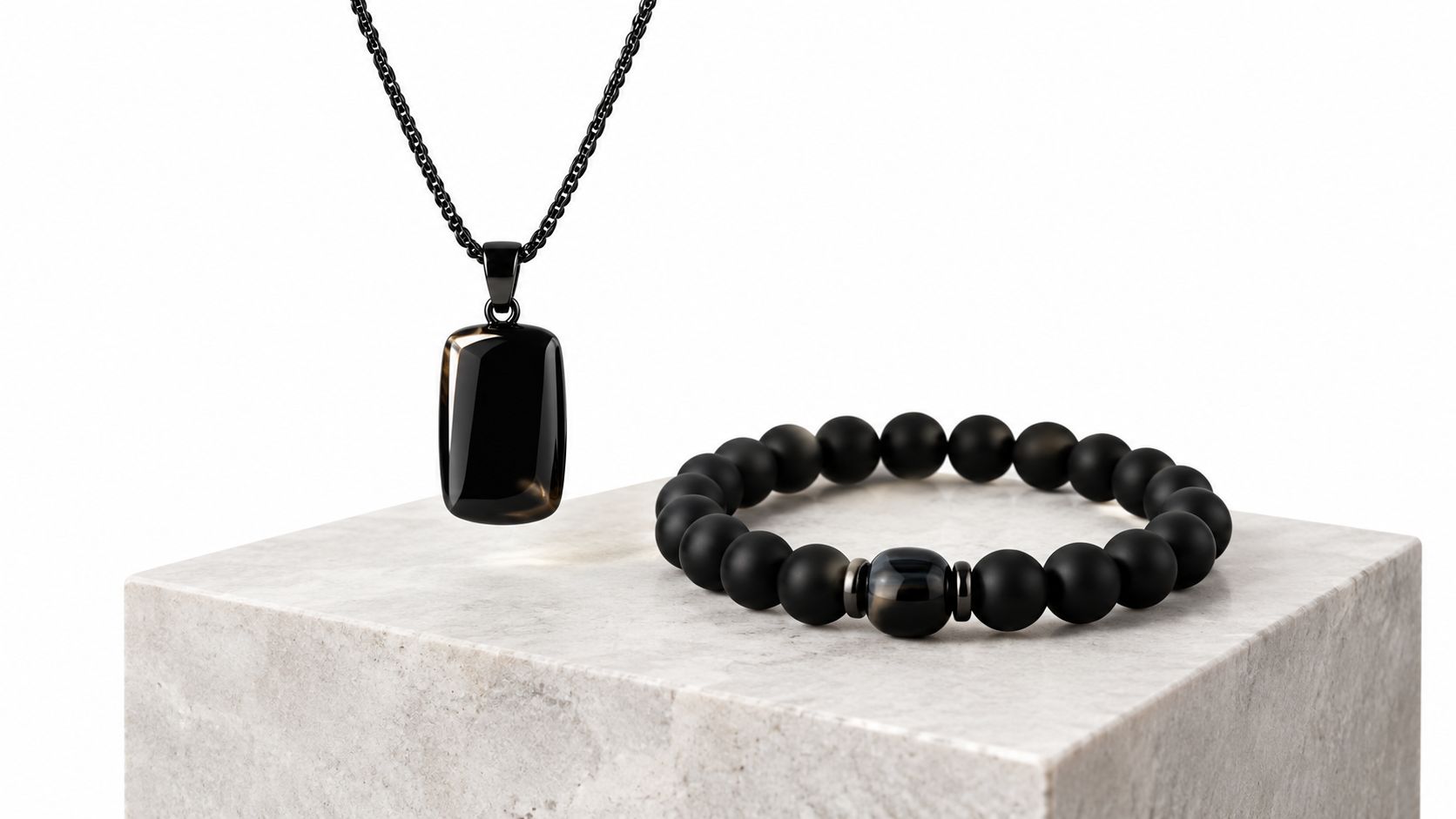
Match the pattern to the design
A stone with visible curved or concentric patterns can make each piece feel more individually marked, which may suit beaded jewelry or designs that foreground the stone's natural-looking variation. Straight, parallel bands work naturally with geometric settings or an Art Deco-inspired look. If the stone appears uniformly black, the visual effect may be better suited to a restrained design where shape and polish do the work.
Naming still matters for retail positioning. Customers may associate “black onyx” with a premium natural stone, so use the term carefully and explain known treatment. For both boutique and online sales, a clear photograph of the actual pattern can do more to set expectations than an unqualified gemstone label.
Let the product's finish carry the story
For a clean, gold-accented look, HonHo's gold-plated black agate open bangle pairs a round black agate cabochon with a slim polished band and bezel. That type of setting lets the dark stone read as a focal point without requiring a bold banded pattern.
The right fit depends on how your customers shop. If they choose primarily by color and silhouette, focus your inspection on uniformity and finish. If they value visible stone pattern, request photographs that show banding clearly and avoid promising that every piece will look identical.
Wholesale Buying Recommendations
For private-label brands and marketplace sellers, put treatment disclosure and product wording at the center of the purchase record. A supplier's use of “black onyx” or “black agate” shouldn't be the only evidence behind your listing. Record the material description, visible pattern, finish, and known color enhancement separately so your team can explain what it is selling.
Boutiques positioning a stone as premium and natural should verify the claim before publishing it. Ask for written treatment information, request photographs of the lot under neutral lighting, and retain a sample from the approved batch. If the supplier can't confirm that a color is natural, avoid wording that makes that promise.
Before ordering, ask how consistently the supplier can match color and finish across lots. A reference sample can flag visible differences later, but it cannot guarantee that future material will be identical. Keep product photography and copy tied to the specific item or assortment you are buying.
For a broader supplier evaluation, use the wholesale jewelry supplier guide to organize questions about materials, documentation, and fit for your business. HonHo Wholesale Jewelry offers ready-to-buy jewelry across earrings, rings, necklaces, and bracelets in stainless steel, brass, and 925 sterling silver, alongside product options such as the black agate bangle described above. Compare your material and finish requirements against the product details before placing an order.
Browse HonHo Wholesale Jewelry for ready-to-buy styles across jewelry categories, materials and finishes. If you need a black-stone style sourced or developed for a collection, send HonHo your reference image, target material, finish, quantity and market so the team can review a practical sample route. Product-level material and treatment details still need to be confirmed for the specific style you select.


